Test your voice agent
Voice agent pricing models explained
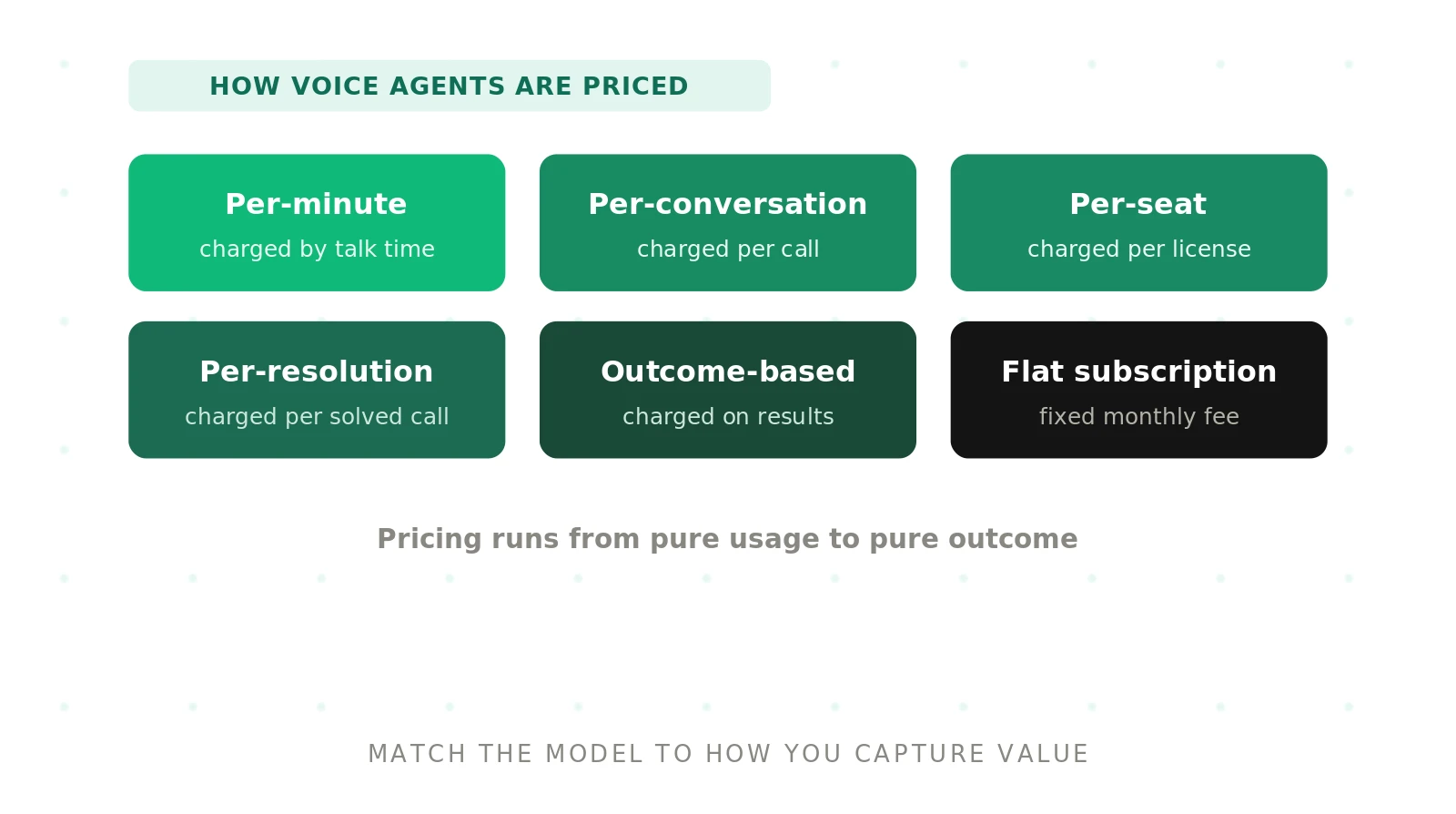
> Quick Answer: Voice agent pricing comes in seven main shapes: per-minute, per-seat, per-conversation, per-resolution, outcome-based, flat subscription, and usage tiers. Each bills a different unit of value, so the best fit depends on your call volume, how you define success, and how predictable you need the bill to be.
Every voice agent vendor charges for the same thing, roughly, but they wrap it in very different meters. One bills by the minute. Another bills by the resolved ticket. A third bills a flat monthly fee and hopes you use it. The label on the invoice shapes how you budget, how you negotiate, and how you compare one vendor to the next.
This guide is the reference map. It walks through each pricing model, explains how the meter actually works, and names the situations where it helps you or quietly costs you. If you want the raw dollar breakdown instead, start with our voice agent cost guide. Here we stay focused on the models themselves.
The seven voice agent pricing models at a glance
Pricing is really a question of what unit the vendor sells. Below is the full set side by side, then a section on each. Treat every dollar figure as an approximate ballpark; real prices move fast and vary by volume, so always confirm on the vendor's own page.
| Model | How it's charged | Best for | Watch-outs |
|---|---|---|---|
| Per-minute | A rate per minute of active call time | Variable or seasonal volume | Long calls and retries inflate the bill |
| Per-seat | A monthly fee per human or agent license | Small, steady internal teams | Poor fit when the agent handles most volume |
| Per-conversation | A flat fee per session or contact | Predictable, discrete interactions | A "conversation" can be defined loosely |
| Per-resolution | A fee only when the issue is solved | Support and deflection use cases | Who decides what counts as resolved? |
| Outcome-based | A fee tied to a business result | Sales, bookings, recovered revenue | Attribution and measurement disputes |
| Flat subscription | One fixed fee for a defined scope | Stable, forecastable workloads | You pay the same whether you use it or not |
| Usage tiers | Bundled volume bands at set prices | Teams scaling in steps | Overage rates and unused headroom |
The rest of this guide takes each row and turns it into a decision you can actually make.
Per-minute pricing
Per-minute is the most common voice agent pricing model, and the most intuitive. You pay a rate for every minute the agent is on a live call. Ballpark all-in rates in 2026 often land somewhere in the low tens of cents per minute, though bundled platforms and self-hosted stacks can sit well below that.
It works because voice is inherently time-based. The meter maps cleanly to the underlying costs, which are themselves largely per-minute: speech recognition, the language model, speech synthesis, and telephony. This is a form of pay-per-use pricing, where you are billed in proportion to consumption.
The strength is fairness at low or spiky volume. If you run a seasonal campaign or an unpredictable inbound line, you pay for what you use and nothing more. The weakness is that minutes are a cost unit, not a value unit. A caller who rambles for eight minutes and hangs up unresolved costs more than a crisp two-minute fix, even though the short call delivered more. Long hold music, retries, and dead air all show up on the bill.
Per-minute also makes forecasting harder at scale. As volume grows, small changes in average call length swing the total meaningfully. Teams often move to tiers or outcome models once they can predict their monthly minutes.
Per-seat pricing
Per-seat pricing borrows from traditional software. You pay a fixed monthly fee per license, whether that license represents a human agent, a supervisor dashboard, or a configured virtual agent. It is the familiar subscription business model applied to voice.
Seats make sense when the product is really a tool for people. If your voice agent assists human agents, or you are buying a contact-center suite where the AI is one feature, seats keep the bill flat and easy to plan. Finance teams like seats because they behave like headcount.
The trouble starts when the whole point is to remove seats. A voice agent that handles thousands of calls without a human is poorly served by a per-seat meter, because there is no natural seat to count. Vendors sometimes invent a "virtual agent" seat, but its price rarely tracks the work done. If you are automating volume rather than equipping staff, per-seat usually overcharges or undercharges in ways neither side likes.
Per-conversation pricing
Per-conversation pricing charges a flat fee each time the agent handles a session, regardless of how long it runs. A three-minute call and a ninety-second call cost the same.
This model shines when your interactions are discrete and reasonably uniform. Appointment reminders, order-status checks, and simple FAQs all fit a per-conversation meter well, because the value is in the completed contact, not the elapsed time. It also insulates you from the length problem that dogs per-minute pricing, since a long call no longer punishes your budget.
The watch-out is definitional. What counts as a single conversation? If a caller hangs up and phones back twice, is that one conversation or three? Does a transfer to a human start a new meter? Vague definitions let the count drift upward. Before signing, pin down exactly how a conversation is opened, closed, and counted, and how re-contacts within a window are treated.
Per-resolution pricing
Per-resolution pricing only charges when the agent actually solves the problem. If the call ends unresolved or escalates to a human, you pay little or nothing. This aligns the meter with the thing support teams care about most: closed issues.
It is compelling on paper and increasingly popular for customer support and deflection. You stop paying for failed attempts, and the vendor is motivated to make the agent genuinely capable. For a deeper look at that unit, see our guide to cost per resolution.
The hard part is definition and measurement. Resolution is a judgment call. Does a customer who got an answer but calls back the next day count as resolved? Who audits the resolution rate, the vendor or you? If the vendor both delivers the service and grades its own homework, the incentive to score generously is obvious. Independent measurement of what actually got resolved is what keeps this model honest, which is where evaluation tooling earns its place.
Outcome-based pricing
Outcome-based pricing ties the fee to a business result rather than an interaction. Think a fee per booked appointment, per qualified lead, per recovered payment, or per completed sale. It is the voice-agent expression of value-based pricing, and it echoes decades of performance-based contracting in other industries.
The appeal is total alignment. You pay for outcomes you can put on a spreadsheet, so the spend maps directly to value created. For revenue-generating use cases, this can turn a cost center into a clear return. Our outcome-based pricing deep dive covers the mechanics in detail.
The risks are attribution and disputes. If a customer books after talking to the agent and later visiting your site, who gets credit? Outcome models require agreed attribution rules, a trusted source of truth, and a way to handle partial or delayed outcomes. Prices per outcome also tend to be high, since the vendor absorbs the risk of failed attempts. When outcomes are clean and measurable, this model is powerful. When they are fuzzy, it breeds friction.
Flat subscription pricing
Flat subscription is the simplest meter: one fixed fee for a defined scope, month after month. No counting minutes, conversations, or outcomes. You know the number before the month starts.
Predictability is the whole point. Finance can forecast to the dollar, procurement has one line item, and nobody watches a usage dashboard nervously. Flat pricing suits stable, well-understood workloads where volume barely moves and the scope is clear.
The downside cuts both ways. If you under-use the service, you overpay for idle capacity. If you over-use it, either the vendor caps you or renegotiates at renewal. Flat deals also tend to bundle a usage ceiling in the fine print, so "unlimited" is rarely truly unlimited. Read the scope definition carefully, and treat a flat fee as a bet that your volume stays where it is today.
Usage tiers
Usage-tier pricing bundles volume into bands. You buy, say, up to 50,000 minutes or conversations a month at one price, the next band at another, and pay an overage rate above your tier. It blends the predictability of subscriptions with the fairness of usage pricing.
Tiers are a natural fit for teams scaling in steps. You pick a band that fits current volume, get a blended per-unit rate cheaper than pay-as-you-go, and move up as you grow. Committing to a tier usually earns a discount, which is why growing teams gravitate here.
The two things to watch are overage and headroom. Overage rates above your band are often much higher than the in-band rate, so a busy month can sting. And if you buy a tier for headroom you never use, you are paying for empty space, much like a flat fee. The right tier sits just above your realistic peak, not your dream volume.
How to choose the right voice agent pricing model
No model is best in the abstract. The right one depends on your volume shape, how you define success, and how much billing risk you can carry. Work through these steps in order.
1. Define your unit of value. Decide what a good outcome actually is, a resolved ticket, a booked demo, a delivered reminder. The model that bills closest to that unit will feel fairest over time.
2. Map your volume shape. Is your traffic steady, seasonal, or spiky? Steady volume favors flat or tiered pricing; unpredictable volume favors per-minute or per-conversation, where you only pay for what runs.
3. Estimate your true unit economics. Model the full total cost of ownership, not just the headline rate. Include escalations, retries, integration work, and testing. A cheap meter with heavy overage can beat a rich flat fee, or lose to it.
4. Stress-test the definitions. For per-conversation, per-resolution, and outcome models, get the vendor to write down exactly how the billable unit is counted. Ambiguity always drifts in the vendor's favor.
5. Decide who measures success. If the meter depends on resolution or outcomes, you need an independent way to verify the numbers. Do not let the party sending the invoice be the only party grading the result.
6. Model a bad month and a great month. Run your finances at low and high volume under each model. The model that stays acceptable at both extremes is usually the safe pick.
7. Negotiate the exit, not just the entry. Check renewal terms, tier resets, and overage rates before you sign. The best entry price can hide a punishing renewal.
For a fuller vetting process, pair this with our guide to evaluating voice agent vendors and the procurement checklist.
Frequently asked questions
What is the most common voice agent pricing model?
Per-minute pricing is the most common, because voice costs are themselves largely per-minute. It maps cleanly to speech recognition, the language model, synthesis, and telephony. Most platforms quote a per-minute rate first, then layer tiers, seats, or outcome options on top for larger buyers.
Is per-minute or per-conversation pricing better?
It depends on call length. Per-conversation protects you when calls run long, since you pay a flat fee per session. Per-minute is fairer when calls are short or volume is unpredictable. If your interactions are uniform and discrete, per-conversation is usually easier to budget and forecast.
How does outcome-based voice agent pricing work?
You pay a fee tied to a business result, such as a booked appointment or a recovered payment, rather than per interaction. It aligns spend with value but requires agreed attribution rules and a trusted source of truth. Prices per outcome run high because the vendor absorbs the risk of failed attempts.
What does per-resolution pricing actually count as resolved?
That is the critical question, and it varies by vendor. Some count any answered query, others require confirmed problem closure with no repeat contact. Because resolution is a judgment, insist on a written definition and independent verification. Otherwise the party sending the invoice decides what you owe.
Is flat subscription pricing cheaper for voice agents?
Only when your usage matches the scope. Flat pricing is predictable and simple, which finance teams love. But you pay the same whether you use it heavily or barely at all. If your volume swings, a usage or tiered model often costs less overall while still capping surprises.
How do usage tiers differ from pay-as-you-go?
Usage tiers bundle volume into bands at a blended, discounted rate, while pay-as-you-go charges per unit with no commitment. Tiers reward predictable scaling but punish you with high overage rates above your band, or wasted spend if you buy more headroom than you use.
Why do vendors use so many different pricing models?
Because they sell to different buyers with different value units. A team automating support values resolutions; a sales team values booked meetings; an internal tool values seats. Each model also shifts billing risk differently, so vendors pick the meter that fits their product and their appetite for risk.
Can I negotiate a custom voice agent pricing model?
Often, yes, especially at higher volumes. Many vendors will blend models, cap overage, or set a floor and a variable component. Come with your own unit economics and volume forecasts. The clearer your definition of value, the stronger your position to shape a model that fits how you actually operate.
Measuring real value with Evalgent
Whatever meter a vendor uses, the same question decides whether the price is fair: how well does the agent actually resolve calls at the quality your customers expect? Independent measurement is the only way to answer that, and Evalgent is built to provide it, vendor-neutral, before and after you sign.
- Scenarios recreate the real calls your agent must handle, from clean requests to messy edge cases.
- Profiles model different caller types, accents, and moods so results reflect your true audience.
- Metrics quantify resolution, accuracy, latency, and quality against thresholds you set.
- Evaluations run scenarios at scale and score outcomes consistently, so per-resolution and outcome claims can be checked.
- Reviews put humans in the loop to audit edge cases and confirm what the automated scores report.
Together, these tell you the real value behind any pricing model, so you pay for performance you can prove. To see it against your own use case, book a demo. You can also connect the numbers to returns with our voice agent ROI guide.
The bottom line
Every voice agent pricing model bills a different unit of value, so the right choice follows your volume shape and your definition of success. Pick the meter that matches your real outcomes, then measure independently to confirm the price is worth it.
Related Articles
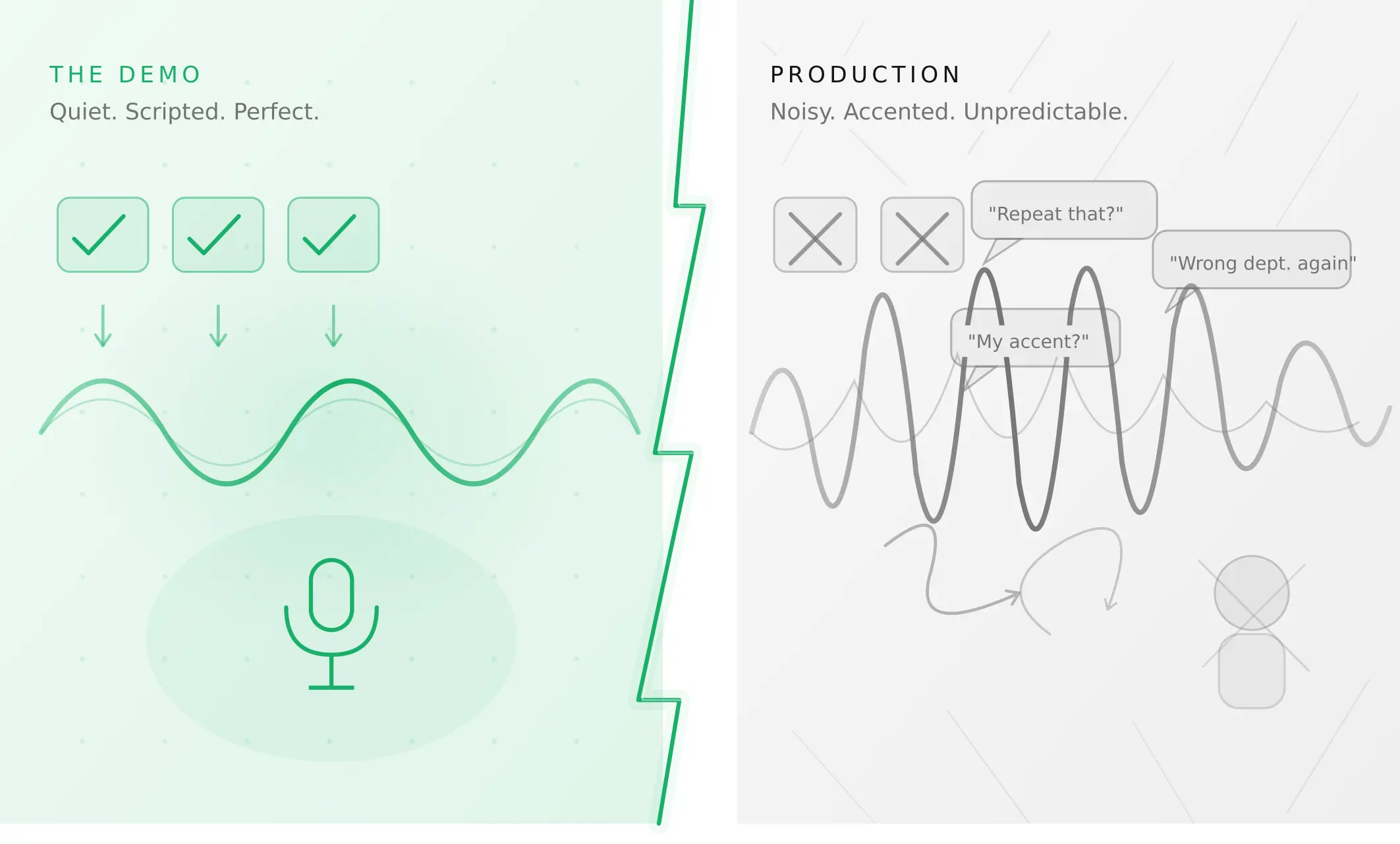
Why AI voice agents fail in production (and how to prevent it)
AI voice agents that ace demos still break in production. Learn the 5 root causes, how to test for each, and what production readiness actually means.
Read more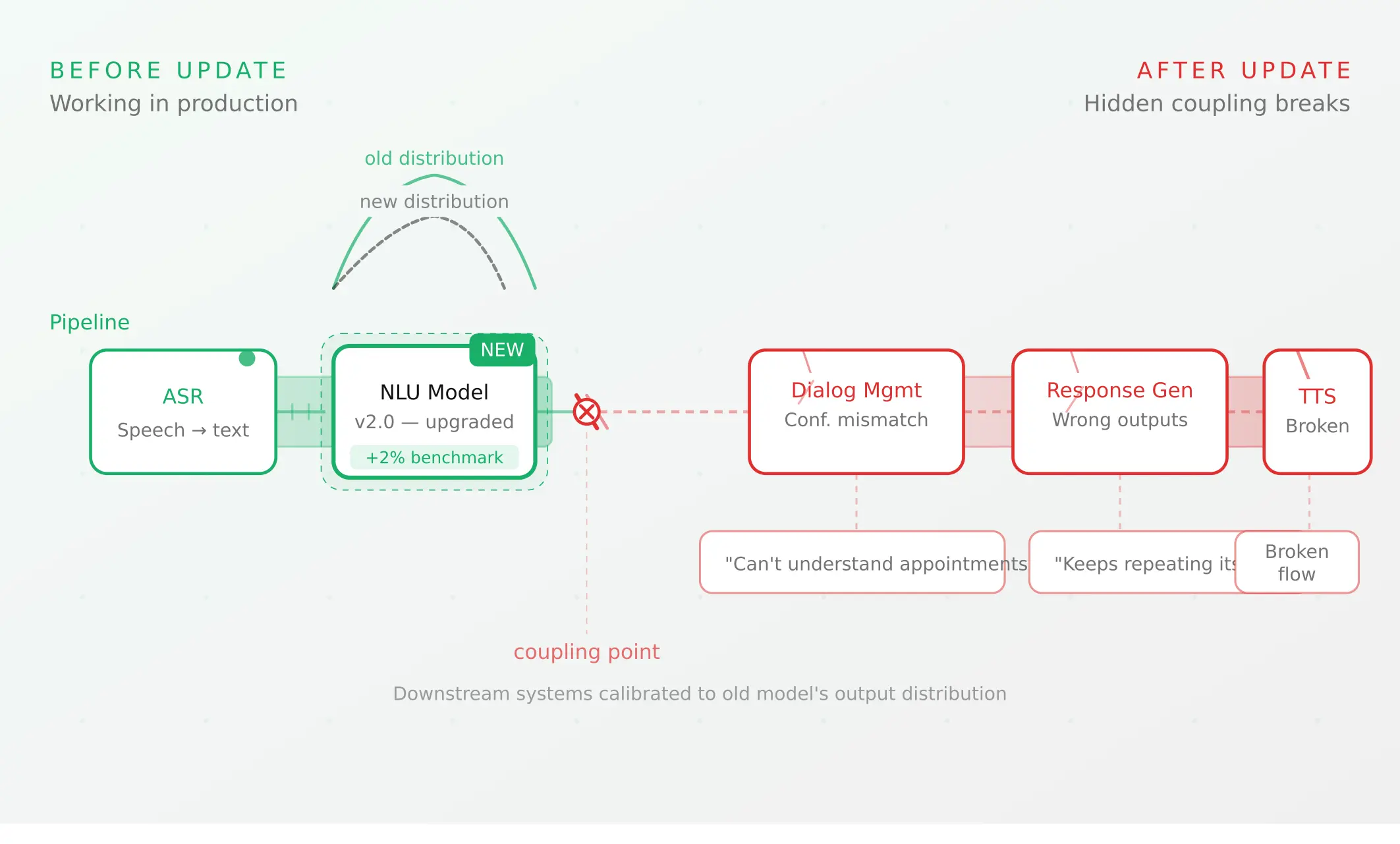
Voice agent regression testing: why LLM updates break production
LLM updates improve benchmarks but break voice agents in 5 predictable ways. How to detect and prevent regressions after every model or prompt change.
Read more