Test your voice agent
Outcome-based vs per-minute voice agent pricing
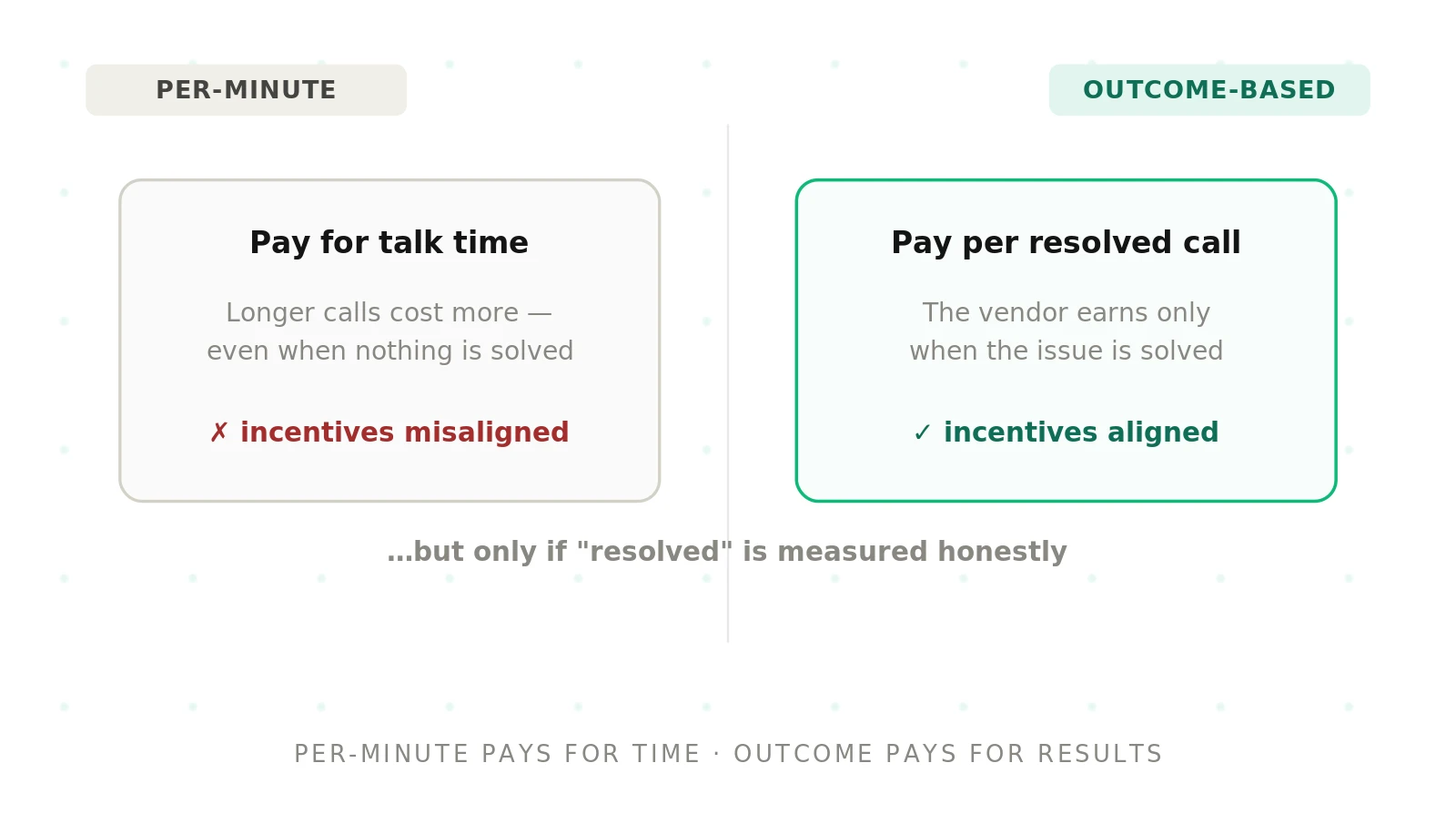
Two pricing models now dominate voice AI contracts. One is old and familiar: you pay for every minute the agent stays on the line. The other is newer and louder: you pay only when the agent actually solves the problem. On the surface, the second sounds obviously better. It usually is. But the reason it works, and the reason it sometimes fails, both come down to a single word that buyers rarely pin down before signing. That word is "resolved."
This is a focused comparison of the two models. It covers how each one shapes vendor behavior, where the gaming risk hides, when each model actually favors you, and why independent measurement is the thing that keeps outcome pricing honest.
The two models, in plain terms
Per-minute pricing is the incumbent. You are billed for connection time, often rounded up, sometimes with separate line items for speech, language, and telephony. It mirrors how pay-per-use metering works across most cloud services: consumption in, dollars out. It is easy to forecast against call volume and easy to audit against a phone bill. For a fuller breakdown of the components underneath a minute, our voice agent pricing models guide walks through the stack.
Outcome-based pricing flips the unit. Instead of time, you pay for a result: a resolved support ticket, a booked appointment, a qualified lead, a completed transaction. It belongs to the same family as value-based pricing and performance-based contracting, where the buyer pays for delivered value rather than delivered effort. The 2026 shift toward this model is real, and it is driven less by generosity than by competition. Vendors confident in their agents want to charge for what those agents achieve.
Why the unit of pricing changes behavior
The unit you pay for is not a billing detail. It is an incentive, and incentives shape what a vendor optimizes.
Under per-minute pricing, longer calls generate more revenue. No serious vendor sets out to pad calls, but the structure quietly rewards verbosity, slow escalation, and agents that keep talking when a human handoff would serve the caller better. The buyer wants short, effective calls. The vendor's revenue grows with long ones. The interests point in opposite directions, even when everyone is acting in good faith.
Under outcome-based pricing, the vendor earns only when the caller's problem is solved. Now a fast, clean resolution is good for both sides. A dragged-out call that ends in a human transfer costs the vendor money without earning a fee. The structure rewards the vendor for doing exactly what you want: resolving more calls, more efficiently, more often. That alignment is the core argument for the model, and it is a strong one.
But alignment is only as good as the definition of the outcome. This is where outcome pricing gets interesting, and where it can quietly break.
The gaming risk: how "resolved" gets defined and gamed
Here is the uncomfortable truth. The moment "resolved" becomes the thing you pay for, "resolved" becomes the thing the vendor optimizes, and not always in the way you meant. This is Goodhart's law in a contract: when a measure becomes a target, it stops being a good measure.
Consider a few ways a resolution rate can be inflated without a single caller actually being helped:
- The caller hangs up, so it counts. If any call that ends without a human transfer is scored as resolved, then abandoned calls, confused callers, and people who gave up all become billable wins.
- The agent declares victory. If the agent's own summary decides the outcome, an optimistic "Is there anything else?" followed by silence can be logged as success.
- The deflection sleight of hand. A call routed to a chatbot, an email form, or a callback queue can be counted as resolved when the problem simply moved elsewhere. The difference between real containment and mere deflection matters enormously here, and our containment vs deflection guide unpacks why.
- The narrow definition. If "resolved" only means the agent completed its script, a technically finished call that left the customer angry still pays out.
None of these require bad faith. They require an ambiguous definition and a measurement method the vendor controls. Combine those two, and outcome pricing can cost you more than per-minute ever would, while looking like a bargain on the invoice.
When each model actually favors the buyer
Neither model is universally better. The right choice depends on your call mix, your volume, and how measurable your outcomes are.
Per-minute tends to favor the buyer when calls are short and predictable, when outcomes are genuinely hard to define, or when volume is low enough that a per-minute rate stays cheap in absolute terms. It also favors buyers who want full transparency into the underlying cost stack, since minutes are simple to audit. If your use case is informational, where "success" is fuzzy, per-minute avoids arguments about what counts.
Outcome-based tends to favor the buyer when calls are transactional and the result is crisp: an appointment booked, an order placed, a bill paid. It favors high-volume operations where the efficiency gains compound. And it shifts execution risk onto the vendor, which is exactly what you want when you are less certain the agent will perform. If the agent fails, you have not paid for the failure.
There is also a blended reality. Many 2026 contracts pair a modest per-minute floor with an outcome bonus, or cap outcome fees to prevent runaway costs on unexpectedly high resolution volume. The pure models are the ends of a spectrum, and understanding the ends is what lets you negotiate the middle. For the mechanics of translating either model into a true unit cost, see our note on cost per resolution.
Per-minute vs outcome-based, side by side
| Dimension | Per-minute pricing | Outcome-based pricing |
|---|---|---|
| Unit of billing | Connection time | Resolved result |
| Vendor incentive | Longer calls earn more | Faster resolutions earn more |
| Incentive alignment | Weak; interests diverge | Strong, if outcome is defined well |
| Execution risk | Sits with the buyer | Shifts to the vendor |
| Forecasting | Simple against call volume | Harder; depends on resolution rate |
| Gaming surface | Low; minutes are hard to fake | High; "resolved" can be inflated |
| Audit difficulty | Easy; matches call logs | Hard without independent measurement |
| Best fit | Fuzzy outcomes, low volume | Crisp outcomes, high volume |
The table makes the trade explicit. Outcome pricing wins on alignment and risk transfer, but only if you can trust the resolution count. Per-minute loses on alignment but is nearly impossible to game. The whole decision, in the end, hinges on measurement.
How to choose between the two pricing models
Use this sequence to decide which model fits, and to protect yourself if you pick outcome-based.
1. Define "resolved" in writing before you talk price. Write the success definition first, in plain language, with edge cases named: abandoned calls, transfers, callbacks, and partial completions. If you cannot define it clearly, per-minute is the safer model.
2. Map your call mix. Sort your volume into transactional calls with crisp outcomes and informational calls with fuzzy ones. Outcome pricing fits the first bucket; per-minute often fits the second.
3. Model both at your real volume. Run per-minute against your minute forecast and outcome-based against a conservative resolution rate. Compare total cost, not headline rate. Our voice agent cost breakdown helps frame the full picture.
4. Insist on independent measurement. Require that resolution be verified by a method neither party can quietly tune, not by the vendor's own self-scored summaries. This single clause is what keeps outcome pricing honest.
5. Separate containment from deflection. Confirm that a call pushed to a form, bot, or callback queue does not silently count as resolved. Make that distinction contractual.
6. Set caps and floors. Cap total outcome fees to avoid surprise bills on high resolution volume, and consider a small per-minute floor so the vendor is not incentivized to abandon hard calls.
7. Re-audit on a schedule. Resolution definitions drift as agents change. Re-verify the number quarterly against real transcripts, and build the right to audit into the contract.
Why independent measurement decides everything
Strip away the pricing debate and one fact remains. Outcome-based pricing is only as trustworthy as the number that triggers the invoice. If the vendor both defines and measures "resolved," you are paying them to grade their own homework. That is not alignment. That is a conflict of interest wearing alignment's clothing.
Independent measurement breaks that conflict. When resolution is verified by a party with no stake in the invoice, using transcripts and consistent criteria, the incentive alignment that makes outcome pricing attractive finally becomes real rather than theoretical. The vendor still earns more by resolving more, but now they cannot earn more by redefining "resolved."
This is also why the vendors worth trusting welcome independent measurement rather than resisting it. A vendor confident in its agents has nothing to fear from an honest count. One that fights the audit is telling you something. Before you sign either kind of contract, it is worth reading how to evaluate voice agent vendors and which vendor metrics actually predict performance.
Measurement also feeds your broader total cost of ownership picture. A low outcome fee attached to an inflated resolution count is not cheap. It is expensive dressed as a discount. Only a verified number tells you what you are truly paying per real result.
The 2026 shift, and where it leads
The move toward outcome pricing is not a fad. It reflects a maturing market where agents are good enough that vendors will stake revenue on results. That is a healthy signal. Buyers should welcome it, because a vendor willing to be paid on outcomes is telling you they believe in their product.
But maturity cuts both ways. As outcome pricing spreads, so does the sophistication of how "resolved" gets counted. The buyers who win in 2026 are not the ones who simply prefer outcome pricing. They are the ones who pair it with a definition they wrote and a measurement they trust. The pricing model is the easy part. The measurement is the whole game.
Measure resolution honestly with Evalgent
Outcome pricing only works if "resolved" is measured honestly and independently, by someone who does not send the invoice. Evalgent is that independent layer. Here is how the five primitives make the resolution count trustworthy:
- Scenarios reproduce the real situations your agent faces, so resolution is tested against genuine caller intent, not a happy-path demo.
- Profiles model the range of callers, accents, and moods that stress an agent, exposing where a claimed resolution quietly fails.
- Metrics define what "resolved" means in measurable terms, separating true containment from deflection and abandonment.
- Evaluations score outcomes consistently against those metrics, producing a resolution number neither buyer nor vendor can quietly tune.
- Reviews put a human check on ambiguous cases, keeping the count defensible when a contract dollar rides on it.
Together they turn "resolved" from a vendor's claim into a verified fact. If you are negotiating an outcome-based contract, book a demo and see the number your pricing should actually be based on.
The bottom line
Outcome-based pricing aligns your vendor with your goals better than per-minute ever can. But that alignment is only real when "resolved" is defined clearly and measured by someone who does not profit from the answer.
Frequently asked questions
What is the difference between outcome-based and per-minute voice agent pricing?
Per-minute pricing bills for connection time, so revenue grows with call length. Outcome-based pricing bills per resolved result, such as a booked appointment or solved ticket. The key practical difference is incentive: per-minute rewards longer calls, while outcome pricing rewards fast, genuine resolutions that serve both sides.
Is outcome-based voice agent pricing cheaper than per-minute?
Not automatically. Outcome pricing can be cheaper per real result and shifts execution risk to the vendor. But a low outcome fee attached to an inflated resolution count can cost more than per-minute. Compare total cost at your real volume using a conservative resolution rate, not the headline rate.
How do vendors game outcome-based pricing?
By defining "resolved" loosely and measuring it themselves. Common tactics include counting abandoned calls as resolved, letting the agent self-declare success, treating deflection to a form or bot as containment, or scoring a completed script as a win even when the caller left unhappy.
Why does the pricing unit change vendor behavior?
Because the billing unit is an incentive. Vendors optimize whatever earns them money. Per-minute quietly rewards verbosity and slow escalation. Outcome-based rewards fast, clean resolutions. The unit you choose shapes what the agent is tuned to do, even when every party is acting in good faith.
When should I choose per-minute over outcome-based pricing?
Choose per-minute when call outcomes are genuinely hard to define, when calls are short and predictable, or when volume is low enough that the per-minute rate stays cheap. It is also better when you want the simplest possible audit trail, since minutes are easy to verify against call logs.
How can I keep outcome-based pricing honest?
Define "resolved" in writing before discussing price, name every edge case, and require independent measurement by a party with no stake in the invoice. Separate containment from deflection contractually, set fee caps and floors, and re-audit the resolution number quarterly against real transcripts as agents change.
Does deflection count as a resolved outcome?
It should not, but loose contracts let it. Routing a caller to a form, chatbot, or callback queue moves the problem rather than solving it. If deflection counts as resolved, your resolution rate inflates while customers stay unhappy. Make the containment-versus-deflection distinction explicit in the contract.
Why is the 2026 market shifting toward outcome-based pricing?
Because agents are now good enough that confident vendors will stake revenue on results, and competition rewards that confidence. Buyers benefit from the risk transfer and better alignment. The shift is healthy, but it also raises the stakes on how "resolved" is defined and independently measured.
Related Articles
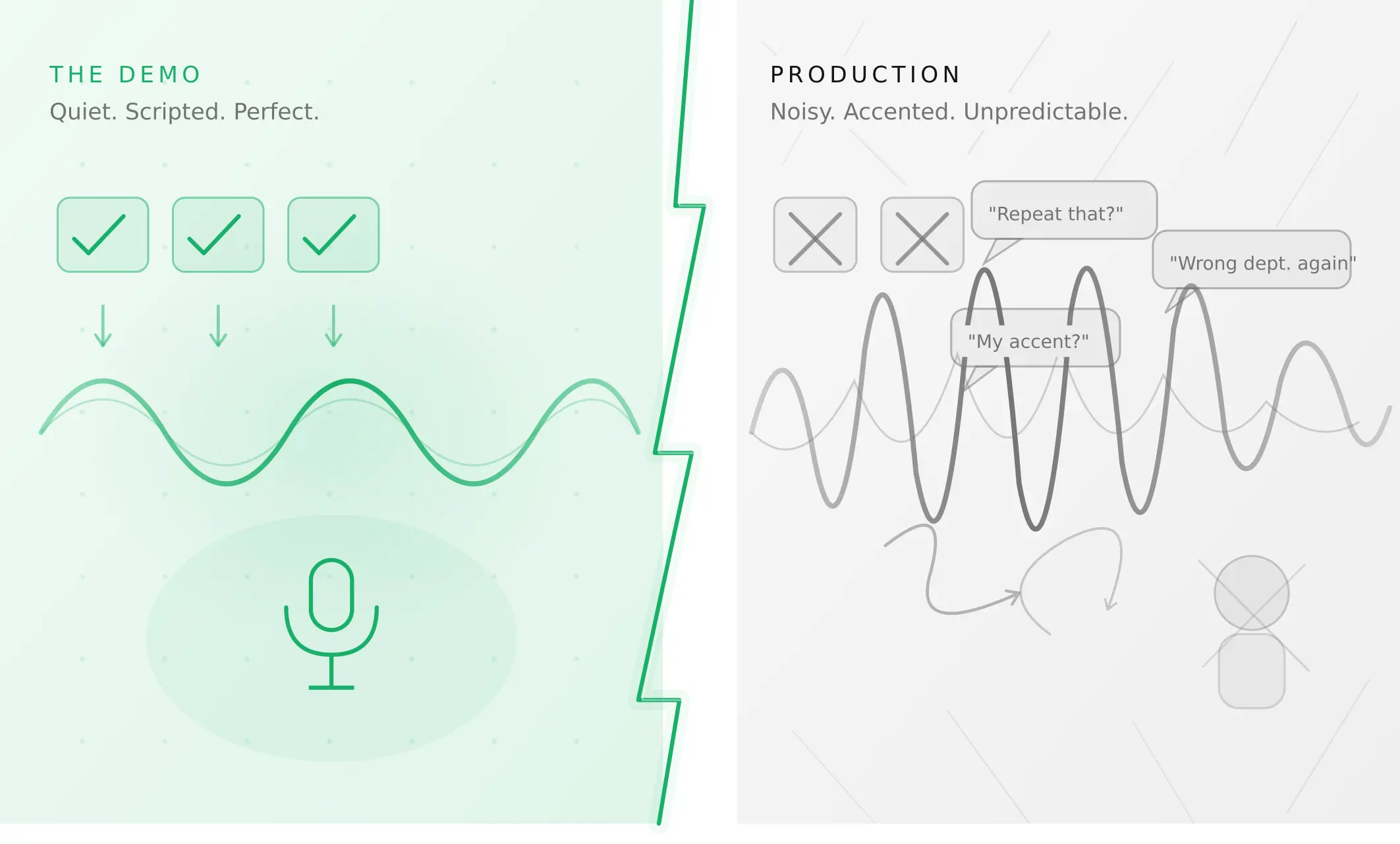
Why AI voice agents fail in production (and how to prevent it)
AI voice agents that ace demos still break in production. Learn the 5 root causes, how to test for each, and what production readiness actually means.
Read more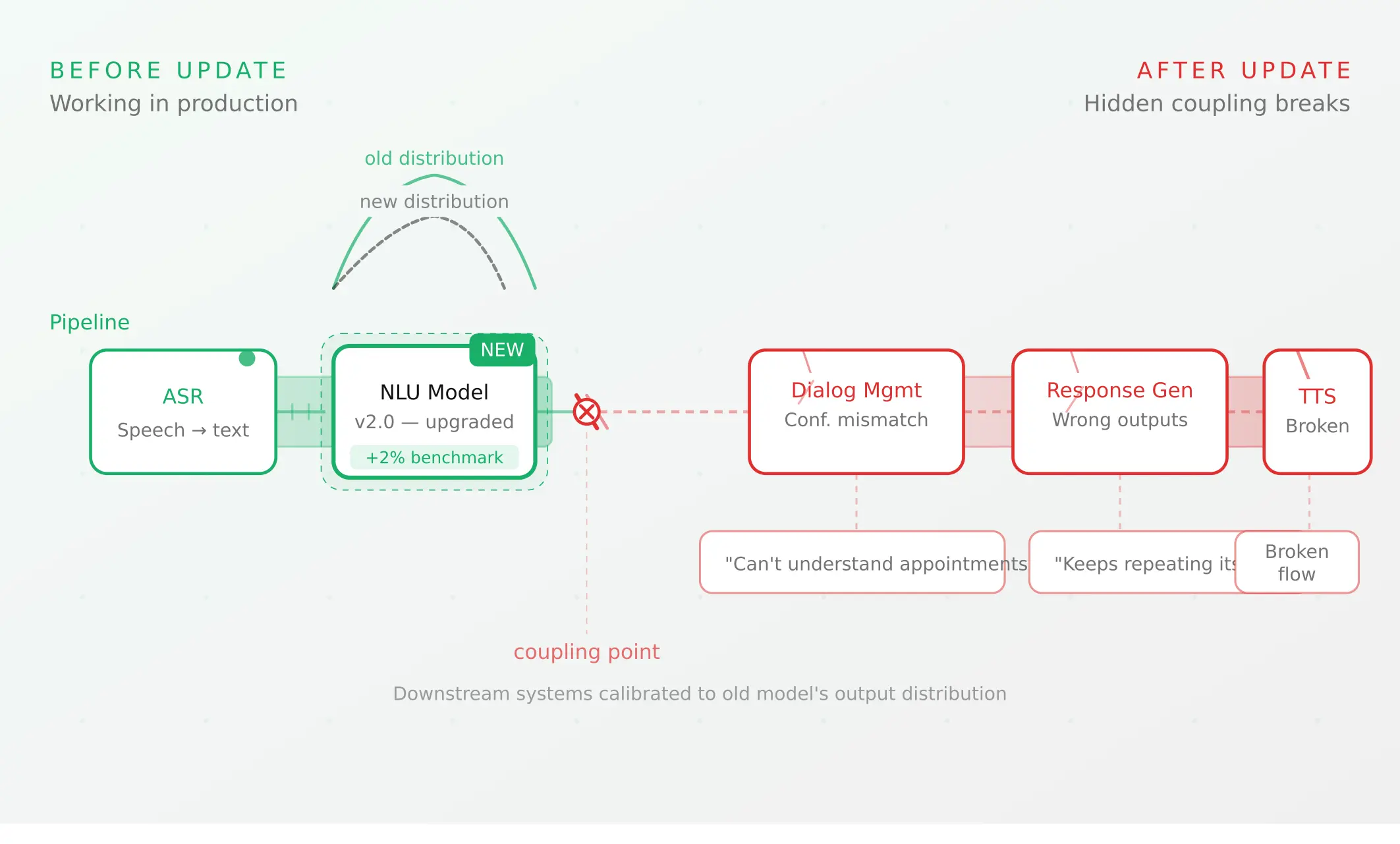
Voice agent regression testing: why LLM updates break production
LLM updates improve benchmarks but break voice agents in 5 predictable ways. How to detect and prevent regressions after every model or prompt change.
Read more