Test your voice agent
Voice Agent Test Automation in CI/CD
# Voice agent test automation in CI/CD
Quick answer
> Quick answer: Voice agent test automation runs your voice agent evaluations automatically inside a CI/CD pipeline. Fast deterministic checks gate every pull request, broader suites run nightly, and the full end-to-end suite runs before deploy. Thresholds and multiple runs turn non-deterministic output into stable pass/fail gates.
A voice agent is code. A prompt edit, a model swap, a new tool, or a changed knowledge base all ship through your build process. Yet most teams test the agent by hand, days after the change merged. By then the regression is already live.
Wiring evals into the pipeline fixes that. The same automation that gates web-app deploys can gate voice-agent deploys. The catch is non-determinism. A voice agent gives a slightly different answer each run, so a naive pass/fail check flaps and everyone learns to ignore it.
This piece is about the pipeline mechanics. Which evals run on every pull request, which run nightly, and which run before deploy. How to set gates on outputs that vary. How to keep flaky tests from eroding trust. If you are still deciding what to test at all, start with our voice agent testing overview and the pillar on voice agent evaluation, then come back for the wiring.
Why voice agent tests belong in the pipeline
Manual QA does not scale with change frequency. A busy team ships prompt tweaks daily. Each tweak can move behavior on hundreds of call paths. No human reviews all of them by ear.
Automation closes the gap between change and feedback. This is the whole point of continuous integration: small changes merge often, and each merge triggers automated checks. Applied to voice, the checks are evals, not unit tests alone.
> CI/CD pipeline: an automated sequence that builds, tests, and ships software on every change. See CI/CD for the general practice. For voice agents, the test stage runs conversation evals against the built agent.
The payoff is early defect discovery. A prompt change that breaks refund handling should fail a check in minutes, not surface in an angry call transcript next week. The Google SRE guidance on testing for reliability makes the same case: automated tests are how you keep confidence as a system changes under you.
Voice adds one wrinkle that standard test automation does not face. The output is a spoken conversation scored on many dimensions at once. So the pipeline runs graded evals, and the gates are thresholds on scores, not exact string matches.
Which evals run at each pipeline stage
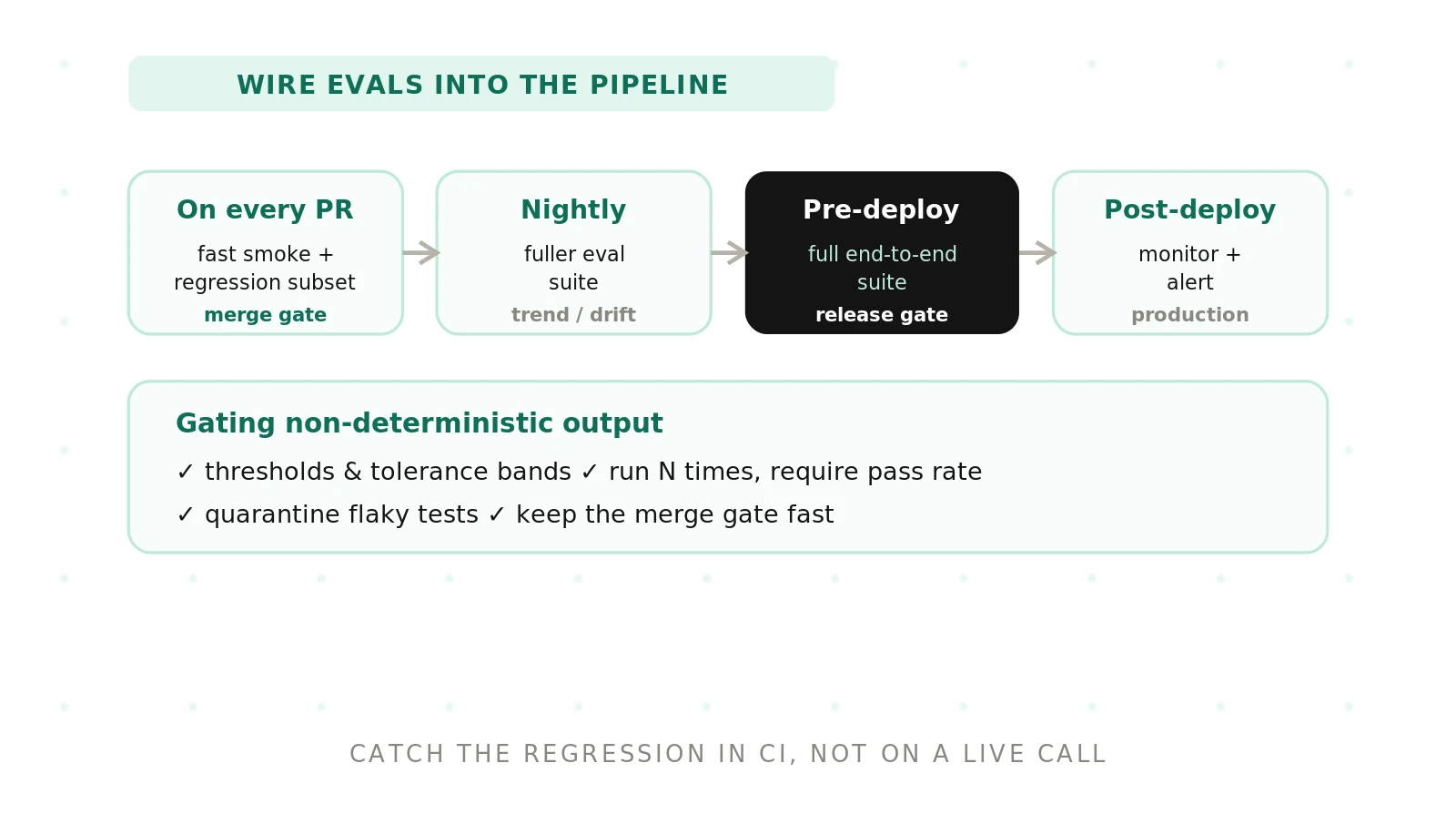
Not every eval belongs on every commit. A three-hundred-scenario audio suite that takes forty minutes cannot gate a pull request. A five-scenario smoke check cannot certify a release. Match the depth of the test to the stage.
The rule is simple. Fast and cheap runs often. Slow and thorough runs rarely. The table below maps each stage to the tests it runs and the gate it enforces.
| Pipeline stage | Which tests run | The gate |
|---|---|---|
| On every pull request | Small deterministic smoke set: intent routing, tool-call schema, guardrail refusals, 15-30 core transcripts | Hard fail. Any core scenario regresses, the merge is blocked |
| Nightly build | Broader graded suite: 100-300 scenarios, judged transcripts, latency and task-success scoring across accents and edge cases | Soft fail with alert. Score below threshold opens a ticket, does not block work in progress |
| Pre-release | Full end-to-end suite over telephony audio: barge-in, background noise, DTMF, multi-turn memory, escalation paths | Hard fail. Release is held until every critical scenario passes and scores clear the release bar |
| Post-deploy | Canary and smoke checks against production, plus live sampling scored on a schedule | Auto-rollback trigger. A metric breach reverts the deploy or pages on-call |
Read the stages as a funnel. Cheap checks catch the obvious breakage before merge. Nightly runs catch quality drift that a small set would miss. Pre-release is the last thorough gate before customers hear the agent. Post-deploy confirms the live system matches what the suite approved.
Each stage answers a different question. On a pull request, did this change break anything obvious and fast to check. Nightly, did overall quality slip. Pre-release, is this build safe to ship. Post-deploy, does production behave like the tested build.
How to add voice agent tests to CI/CD
Adding evals to a pipeline is a staged rollout, not a big-bang install. Start with a small trusted gate and widen it as confidence grows. Follow these steps in order.
1. Build a seed suite of deterministic checks. Pick 15 to 30 core scenarios that must never break: main intents, required tool calls, and hard guardrail refusals. Assert on structured facts, such as which tool fired and with what arguments, not on exact wording.
2. Make the agent callable from a script. Expose a test entry point that accepts a scripted caller turn or an audio fixture and returns the transcript, tool calls, and timing. The pipeline needs to drive the agent without a human on the phone.
3. Wire the seed suite to run on every pull request. Trigger the evals on each commit to a branch. Fail the check when any core scenario regresses. Keep this stage under ten minutes so it never blocks a merge for long.
4. Set score thresholds, not exact matches. For graded scenarios, define a minimum acceptable score and a tolerance band. Run each non-deterministic scenario several times and gate on the aggregate, not a single run.
5. Add a nightly graded suite. Schedule the broader set of 100 to 300 scenarios to run overnight. Route failures to a ticket and an alert rather than blocking active branches.
6. Add a pre-release end-to-end gate. Before any deploy, run the full audio suite over telephony conditions. Hold the release until critical scenarios pass and scores clear the release bar.
7. Close the loop with production. Feed real failed calls back into the suite as new fixtures. Our guide to the production feedback loop covers how each live failure becomes a permanent test.
By step seven the suite compounds. Every incident it catches becomes a scenario it will catch forever. The pipeline gets stronger with each release rather than decaying.
Setting pass/fail gates on non-deterministic output
Here is the core problem. Run the same scenario twice and the agent phrases its reply differently, or picks a slightly different path. An exact-match assertion fails at random. A gate that fails at random gets muted, and a muted gate protects nothing.
The fix is to gate on distributions, not single outcomes. Three techniques do most of the work.
> Non-deterministic output: a system that can produce different valid results for the same input. Voice agents vary in wording, ordering, and timing across runs, so gates must tolerate acceptable variation while still catching real regressions.
Score thresholds. Grade each scenario on a scale rather than a binary. A judged transcript scores, say, 0 to 1 on task completion, tone, and policy adherence. The gate passes when the score clears a set minimum. This tolerates rewording while still catching a genuinely wrong answer.
Multiple runs. Run each non-deterministic scenario several times and aggregate. Gate on the mean or on a pass rate, such as "passes 9 of 10 runs." One unlucky run no longer sinks the build, and a scenario that fails half the time still gets caught. Averaging across runs is how you separate signal from noise.
Tolerance bands. For numeric metrics like latency or task-success rate, gate on a band around a baseline, not a fixed point. A build passes if latency stays within, for example, 10 percent of the last release. This absorbs normal jitter and flags only real movement. Set the band from measured variance, not a guess. Our guide on benchmarking with your own data shows how to establish those baselines.
The threshold is a policy decision, so write it down. A refund scenario might demand a 0.95 task score, while a chitchat scenario tolerates 0.8. Encode the bar per scenario. That way the gate reflects business risk, not a single global number.
Handling flaky voice tests
A flaky test passes and fails on the same code. In voice pipelines, flakiness has two sources, and they need different fixes. Confusing them wastes days.
The first source is the agent itself. Real non-determinism in the model. The right response is the distribution techniques above: thresholds, multiple runs, tolerance bands. Do not "fix" this by loosening a gate until it always passes, or you have gated nothing.
The second source is the harness. A timing race, an audio fixture that clips, a flaky third-party dependency, or test-data drift. This is real flakiness and you fix the test, not the threshold. Isolate it with a rerun-on-failure policy for harness errors only, distinct from your scenario-level retries.
> Flaky test: a test that yields different results across runs without any code change. Separate agent-driven variation, which you gate with thresholds, from harness-driven flakiness, which you debug and repair.
Track a flake rate per scenario. If a scenario flaps more than a set percentage of runs, quarantine it: keep it running and reporting, but stop it from blocking merges until it is stabilized. A quarantined scenario is visible, not deleted. Silently deleting flaky tests is how coverage rots.
Never let a red gate become normal. The moment engineers expect the voice check to be red, the check is dead. Quarantine aggressively, fix quickly, and keep the blocking suite green enough that a failure means something.
Keeping the gating suite fast enough to merge
A merge gate has a hard budget. If the pull-request suite takes forty minutes, developers batch changes, context-switch, and start merging around the gate. Speed is a feature of the gate, not a nice-to-have.
Three levers keep the PR gate fast. Keep the set small: only the core scenarios that must never break. Run them in parallel: independent scenarios have no reason to run in sequence. Prefer text-driven scenarios at this stage, since full audio synthesis and transcription are slower than scripted-turn evals.
Push the slow work later in the pipeline. Full telephony audio, wide accent coverage, and long multi-turn memory tests belong nightly and pre-release, where a forty-minute run is fine. The deployment pipeline exists precisely so heavy validation can run without blocking every commit.
Cache what does not change. If a scenario's synthetic caller audio is fixed, generate it once and reuse the fixture. Regenerating identical audio on every run burns minutes for no signal. Synthetic callers are cheap to store and fast to replay once created.
Running the full end-to-end suite before deploy
The pre-release gate is where the pipeline earns its keep. This is the last automated check before a customer hears the change. It should be thorough, and it should be a hard gate.
Run the full suite over realistic conditions. Real telephony audio, not just clean text. Background noise, barge-in, DTMF menu navigation, accents, and long multi-turn calls that exercise memory and escalation. These are the paths that break in production and never show up in a smoke test.
Gate the release on both pass rate and scores. Every critical scenario must pass, and aggregate scores must clear the release bar you set. A build that regresses escalation accuracy does not ship, even if everything else improved. This is exactly the failure mode a model update can introduce without touching your prompt at all.
Independence matters most at this gate. The team that wrote the change is not the right judge of whether it is safe to ship. As the independent evaluator, Evalgent runs the pre-release suite outside the build team, so the release bar is enforced by a party with no stake in shipping tonight. For why the split between building and grading matters, see our guide on testing versus evaluation for voice agents and the case for independent voice AI evaluation.
After deploy, keep watching. A canary run and scheduled live sampling confirm the deployed agent matches the build the suite approved. If a production metric breaches its band, trigger a rollback or page on-call. The release engineering practice treats a bad deploy as reversible, and voice deploys should be no different.
Frequently asked questions
What is voice agent test automation in a CI/CD pipeline?
Voice agent test automation runs conversation evals automatically inside your build pipeline. Instead of QA staff calling the agent by hand, scripted callers and audio fixtures drive it on every change. Fast checks gate pull requests, broader suites run nightly, and a full end-to-end suite gates the deploy. Gates use score thresholds rather than exact matches.
Which voice agent tests should run on every pull request?
Run a small deterministic set that must never break: main intent routing, required tool calls, guardrail refusals, and 15 to 30 core transcripts. Assert on structured facts like which tool fired, not exact wording. Keep the whole set under ten minutes so it gates merges without slowing developers, and push slow audio suites to nightly.
How do you set a pass/fail gate on non-deterministic voice agent output?
Gate on distributions, not single runs. Grade each scenario on a score, then require a minimum, such as 0.95 for a refund path. Run non-deterministic scenarios several times and gate on the aggregate pass rate. For numeric metrics like latency, use a tolerance band around the last release rather than a fixed value.
How do you handle flaky voice agent tests?
Separate the two causes. Model variation is gated with thresholds and multiple runs, not by loosening the check. Harness flakiness, such as timing races or clipped audio, is a bug you fix. Track a flake rate per scenario and quarantine any that flaps too often, so it keeps reporting without blocking merges until it is stabilized.
How often should the full end-to-end voice agent suite run?
Run the full end-to-end suite before every deploy as a hard gate, and nightly to catch quality drift. It is too slow for pull requests, so keep only a fast smoke set there. Also sample live calls on a schedule after deploy, so you catch drift from provider-side model updates you did not trigger yourself.
Can voice agent tests run fast enough to gate merges?
Yes, if you keep the merge gate small and parallel. Limit it to core scenarios, run them concurrently, and prefer scripted-turn evals over full audio synthesis at this stage. Cache fixed synthetic-caller audio so you generate it once. Heavy telephony and accent coverage move to nightly and pre-release, where longer runtimes are acceptable.
Should an independent evaluator run the CI/CD gates?
The build team can run fast smoke checks. But the pre-release and release-bar gates carry more weight when an independent party enforces them. The team shipping a change has an incentive to see it pass. As the independent evaluator, Evalgent runs those gates outside the build team, so the release bar reflects real behavior, not deadline pressure.
How is test automation different from voice agent regression testing?
Regression testing is what you run: checks that previously working behavior still works. Test automation in CI/CD is how you run it: automatically, at defined pipeline stages, with pass/fail gates. This post covers the pipeline wiring. For why regressions appear in the first place, especially after model swaps, see our post on LLM-update regressions.
The bottom line
Voice agent test automation puts your evals on the same pipeline that ships your code. Score thresholds, multiple runs, and tolerance bands turn non-deterministic output into stable pass/fail gates.
Ready to gate your releases on evals you can trust? Book a demo and we will help you wire an independent voice agent test suite into your CI/CD pipeline.
Related Articles
Why AI voice agents fail in production (and how to prevent it)
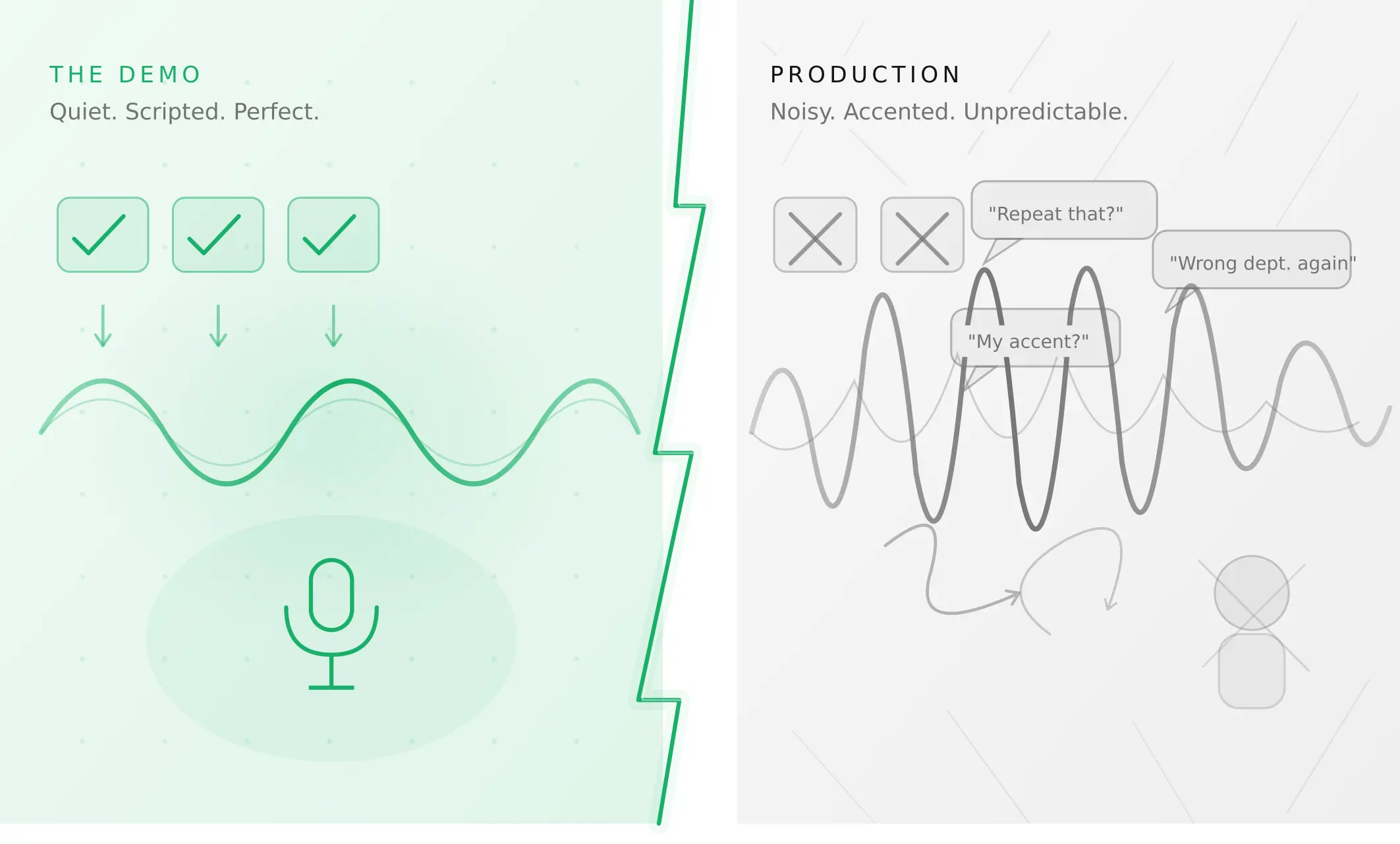
AI voice agents that ace demos still break in production. Learn the 5 root causes, how to test for each, and what production readiness actually means.
Read more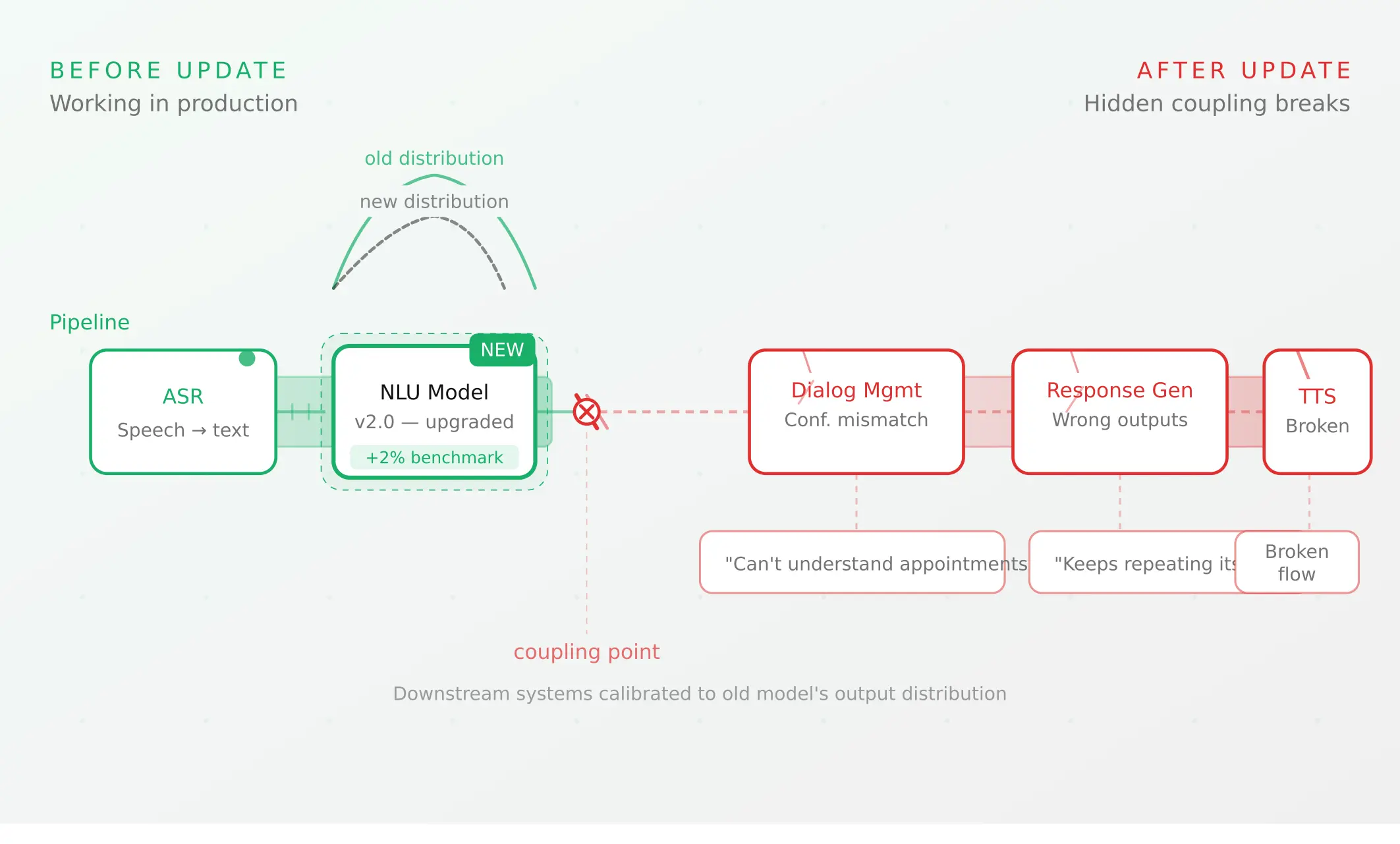
Voice agent regression testing: why LLM updates break production
LLM updates improve benchmarks but break voice agents in 5 predictable ways. How to detect and prevent regressions after every model or prompt change.
Read more