Test your voice agent
Per-Minute vs Per-Resolution vs Per-Seat Pricing
# Per-Minute vs Per-Resolution vs Per-Seat Pricing
Quick answer
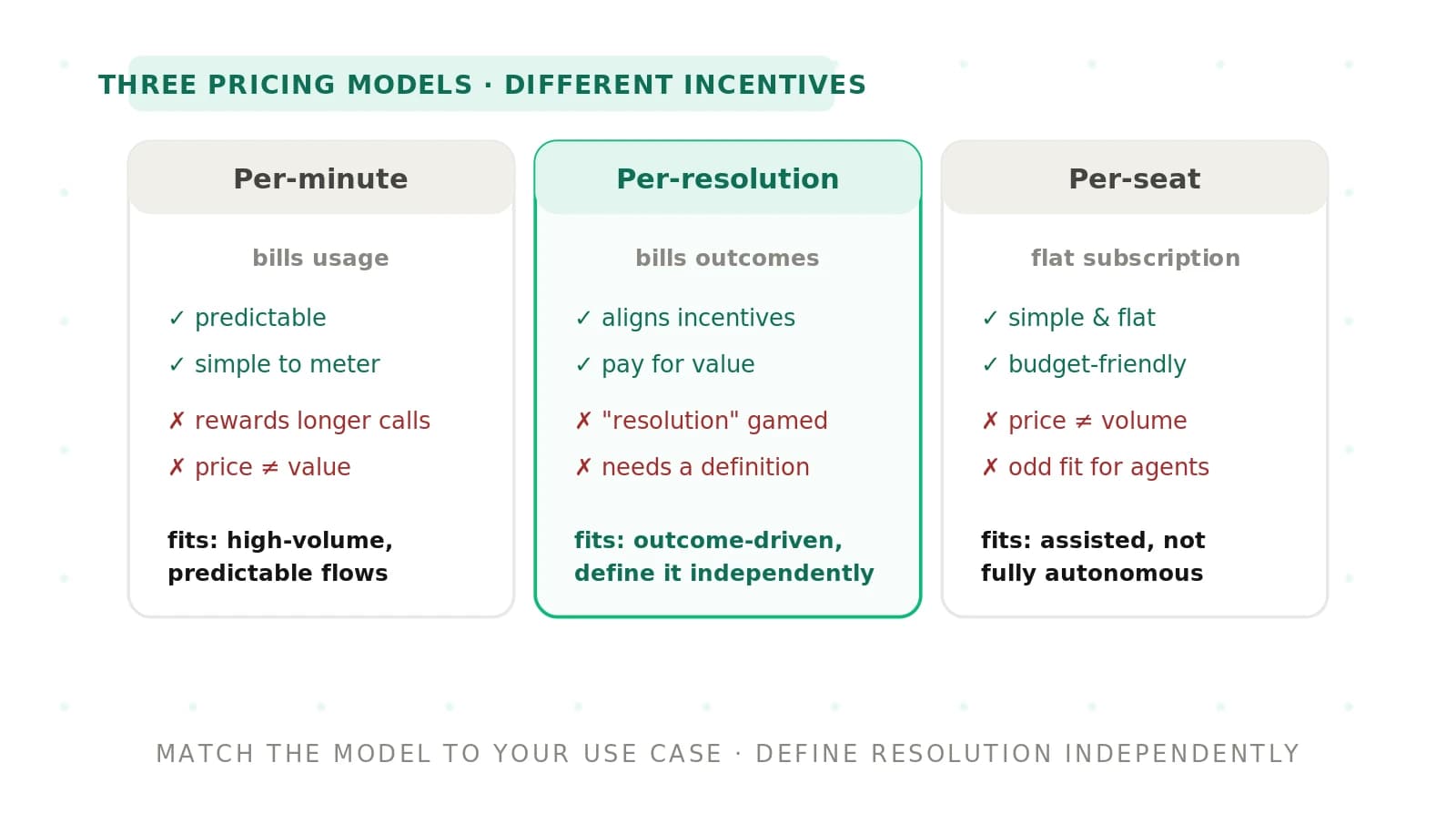
Per-minute pricing bills for connection time, per-resolution pricing bills for solved outcomes, and per-seat pricing bills for capacity. Per-minute is predictable but rewards long calls. Per-resolution aligns incentives best but needs an independent definition of resolved. Per-seat suits steady, low-volume teams. Match the meter to how you define value.
Every voice agent vendor sells roughly the same thing. They just wrap it in different meters. One charges by the minute. One charges by the resolved call. One charges a flat fee per agent seat. The meter is not a billing detail. It decides how you budget, how you negotiate, and what the agent is quietly tuned to do.
This is a voice agent pricing comparison of the three dominant models. We look at how each one works, who it favors, and how each one bends incentives. Because a price is never just a number. The unit you agree to pay is an incentive, and incentives shape behavior.
The three meters behind every invoice
Most voice agent contracts reduce to one of three units. Per-minute charges for time on the line. Per-resolution charges for a result, such as a booked appointment or a solved ticket. Per-seat charges a fixed fee for each concurrent line or named user.
The differences look small on a rate card. They are large in practice. Each unit answers a different question. Per-minute asks how long the agent talked. Per-resolution asks whether the agent actually helped. Per-seat asks how much capacity you reserved. Those are three different definitions of value.
For a wider tour of every meter on the market, including per-conversation and tiered plans, see our overview of voice agent pricing models. This post focuses on the three that buyers compare most often.
Per-minute pricing: paying for connection time
Per-minute pricing charges for the seconds the agent spends connected. It is the most common model, and the easiest to audit. Minutes are simple to verify against call logs. A finance team can reconcile the bill without trusting anyone's dashboard.
The model is also transparent in a useful way. You know the rate before the call starts. Volume forecasting is straightforward once you know your average handle time. This is why per-minute reads as the safe default for many buyers.
The catch is the incentive. Per-minute pricing rewards longer calls. A vendor is paid more when the agent talks more, escalates slowly, or handles the same caller twice. Nobody has to act in bad faith for this to happen. The meter simply pays for time, so time is what gets optimized.
There is a second trap. The headline per-minute rate rarely includes everything. Telephony, premium voices, and usage tiers ride on top. The all-in number can sit well above the advertised floor. Our breakdown of voice agent pricing hidden costs lists the add-ons that catch teams by surprise.
Per-minute works best when calls are short and predictable. It suits low volume, simple intents, and cases where a clean outcome is hard to define. When you cannot say what resolved means, paying for time is honest.
Per-resolution pricing: paying for outcomes
Per-resolution pricing charges for results, not runtime. You pay when the agent books the appointment, answers the question, or closes the ticket without a human handoff. This is the outcome-based family, and it is the fastest-growing model in the 2026 market.
The appeal is alignment. The vendor only earns when the caller is actually helped. That transfers execution risk to the vendor and points both parties at the same goal. Our deep dive on outcome-based voice agent pricing covers how these contracts are structured.
Alignment is real, but only when resolved is defined well. The whole model rests on one word. If resolved is loose, the incentive flips. A vendor paid per resolution has a reason to inflate the resolution count. That is a textbook perverse incentive, and it is easy to trigger by accident.
Common tactics are subtle. An abandoned call gets counted as resolved. A completed script counts as a win, even when the caller left unhappy. Deflection to a form or bot gets scored as containment. The number climbs while customers stay frustrated. Our note on the cost per resolution shows how the denominator can be quietly gamed.
Per-resolution fits high-volume, well-defined tasks. Appointment booking, order status, and password resets have clear success states. When the outcome is obvious and measurable, this model rewards the right behavior.
Per-seat pricing: paying for capacity
Per-seat pricing charges a fixed fee per concurrent line or named agent, usually monthly. It borrows from the classic subscription business model that software buyers already know. You reserve capacity, and you pay for it whether you use it fully or not.
The strength is predictability. The bill is flat and easy to plan around. There are no usage spikes to explain to finance. For a small team with steady volume, per-seat can be the simplest line item in the budget.
The weakness is utilization. You pay for the seat even when it sits idle. If volume is spiky, you either over-provision for the peak or drop calls at the peak. Neither is efficient. The economics only work when your load is stable and your seats stay busy. That is a question of economies of scale applied to call capacity.
Per-seat also decouples price from outcome entirely. The vendor is paid the same whether the agent resolves ten calls or a hundred. That is neutral, not aligned. It neither rewards nor punishes quality, so quality has to be enforced some other way.
Voice agent pricing comparison at a glance
This table maps each model to how it works, its main advantage, its main risk, and where it fits best. Numbers are illustrative, not quoted rates.
| Pricing model | How it works | Main pro | Main con | Best fit |
|---|---|---|---|---|
| Per-minute | Bills for connected call time | Easy to audit and forecast | Rewards longer calls and slow escalation | Short, low-volume, or hard-to-define calls |
| Per-resolution | Bills per solved outcome | Aligns vendor incentives with results | Gameable if resolved is loosely defined | High-volume tasks with clear success states |
| Per-seat | Flat fee per line or named agent | Predictable, flat monthly bill | You pay for idle capacity | Steady volume where utilization stays high |
How incentives bend under each model
Pick a meter and you pick a behavior. This is the core lesson of the principal–agent problem. The party doing the work optimizes for the thing that pays. Your job as a buyer is to make sure the paying thing is also the helping thing.
Per-minute pushes toward length. The agent has no reason to be brisk. Per-seat pushes toward nothing in particular. The vendor is paid on reservation, so effort per call is invisible to the invoice. Per-resolution pushes toward the count of resolutions, which is exactly right when resolved is honest and exactly wrong when it is not.
There is a well-known law here. When a measure becomes a target, it stops being a good measure. That is Goodhart's law, and outcome pricing invites it. The moment resolutions decide the bill, resolutions come under pressure to grow. The fix is not to abandon the model. The fix is to measure the number independently.
Remember that the meter is only part of the cost. Switching, integration, and oversight all add up over a contract. Frame the comparison inside your voice agent total cost of ownership so the cheapest meter does not hide the most expensive relationship.
Why per-resolution pricing needs an agreed, independent definition
Per-resolution is the most aligned model on paper. It is also the most fragile. The alignment depends entirely on who defines resolved and who counts it. If the vendor does both, you are trusting the scorekeeper to also referee.
A resolution is not the agent saying goodbye. It is the caller's intent satisfied, without a human handoff, and without a repeat call on the same issue. Containment, where the call simply never reaches a human, is not the same as resolution. A contained call can still fail the customer. Our guide on containment versus deflection untangles those definitions.
This is where an independent evaluator matters. Evalgent is a third-party platform that verifies the outcome your pricing bills on. We define resolved against real transcripts and audio, apply the definition consistently, and report the number without a stake in the invoice. That turns resolved from a vendor's claim into a verified fact.
Independent verification protects both sides. It stops the buyer from overpaying on inflated counts. It also protects an honest vendor from a buyer who disputes every result. Our explainer on independent voice AI evaluation covers why the referee cannot also be a player.
How to choose the right pricing model for your use case
Work through these steps in order. The goal is to match the meter to how your business actually defines value.
1. Define value before you look at rates. Decide what a good call is worth to you. If a resolved call has clear business value, outcome pricing is on the table. If value is fuzzy, per-minute keeps things honest.
2. Estimate your volume and its shape. Steady, predictable volume favors per-seat. Spiky volume punishes it. High volume with clear outcomes favors per-resolution.
3. Test whether resolved can be defined. Write the definition down. Name every edge case. If you cannot describe resolved in a paragraph, do not sign an outcome contract yet.
4. Model the all-in cost at real volume. Add telephony, voices, and tiers to the headline rate. Use a conservative resolution rate, not the marketing rate. Compare total cost, not sticker price.
5. Decide who measures the billing unit. For per-resolution, insist on independent measurement. For per-minute, confirm minutes reconcile against your own logs.
6. Build the meter into your scorecard. Put the unit cost beside quality and reliability. Our checklist for how to evaluate voice agent vendors shows where it fits.
7. Set floors and caps, then re-audit. Cap fees so a runaway count cannot surprise you. Re-audit the number quarterly as prompts and models change.
The bottom line
The right voice agent pricing model is the one whose meter matches how you define value, so per-minute suits fuzzy or low-volume work, per-seat suits steady load, and per-resolution suits clear outcomes. Per-resolution aligns incentives best, but only when resolved is defined in writing and measured by a party that does not profit from the count, so book a demo to see the verified number your pricing should be based on.
Frequently asked questions
What is the best pricing model for voice agents?
There is no single best model. The best one matches how you define value. Per-resolution aligns incentives best for high-volume tasks with clear outcomes. Per-minute is safest when outcomes are hard to define. Per-seat suits steady, predictable volume. Start from your use case, then pick the meter that fits it.
Is per-minute or per-resolution pricing cheaper?
Neither is automatically cheaper. Per-minute is cheap at low volume and short calls. Per-resolution can be cheaper per real result and shifts risk to the vendor. But a low outcome fee on an inflated resolution count can cost more. Compare total cost at your real volume, using a conservative resolution rate rather than the headline rate.
How does per-seat pricing work for voice agents?
Per-seat pricing charges a fixed fee for each concurrent line or named agent, usually monthly. You reserve capacity and pay for it whether or not it is fully used. The bill is flat and easy to forecast. It works well when volume is steady and seats stay busy, and poorly when volume is spiky and seats sit idle.
Can vendors game per-resolution pricing?
Yes, when resolved is loosely defined and the vendor counts it. Common tactics include counting abandoned calls as resolved, letting the agent self-declare success, treating deflection to a form as containment, or scoring a completed script as a win even when the caller left unhappy. An independent definition and measurement closes these gaps.
Why does per-resolution pricing need an independent definition of resolution?
Because the vendor is paid per resolution, so the vendor has a reason to count generously. If the same party defines and measures resolved, the scorekeeper is also the referee. An independent evaluator applies one definition against real transcripts and audio, with no stake in the invoice. That protects the buyer from inflated counts and the honest vendor from disputes.
Which voice agent pricing model is most predictable?
Per-seat is the most predictable, since the fee is flat regardless of usage. Per-minute is predictable once you know average handle time and volume. Per-resolution is the least predictable, because the bill moves with the resolution rate. If a stable monthly number matters most, per-seat wins on predictability, though it may cost more per resolved call.
Does per-minute pricing reward longer calls?
Yes. Per-minute pricing pays the vendor more when the agent stays connected longer. That quietly rewards verbosity, slow escalation, and repeat calls, even when no one acts in bad faith. The meter pays for time, so time gets optimized. If your calls should be brisk, per-minute pushes against that goal and needs quality checks to offset it.
How do I compare voice agent pricing models fairly?
Convert every model to the same unit before comparing. Cost per resolved call is the most useful, because it captures both price and quality. Add all-in costs like telephony and voices, use a conservative resolution rate, and measure the billing unit independently. Then place the number beside quality and reliability in one scorecard rather than judging the rate alone.
Related Articles
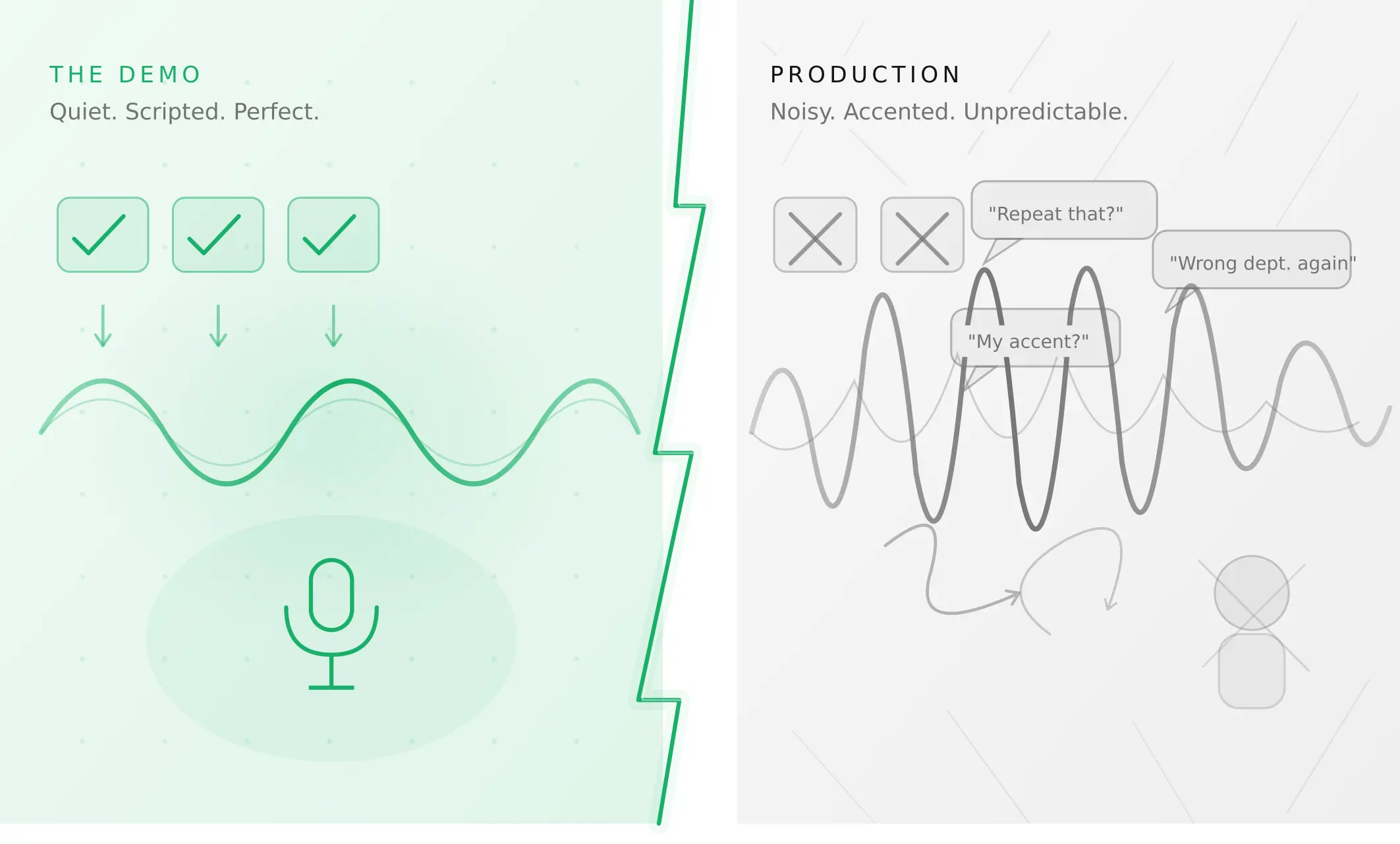
Why AI voice agents fail in production (and how to prevent it)
AI voice agents that ace demos still break in production. Learn the 5 root causes, how to test for each, and what production readiness actually means.
Read more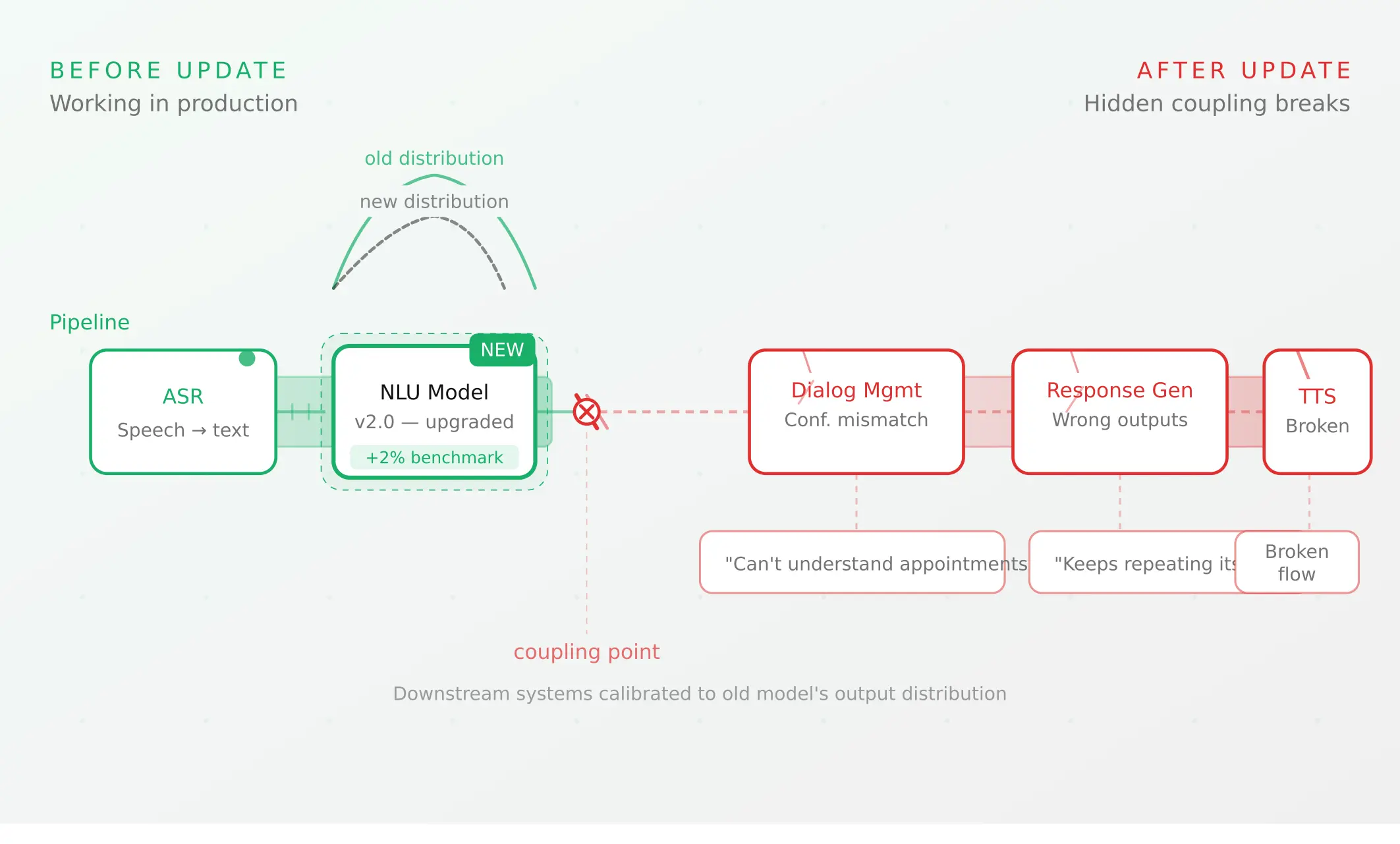
Voice agent regression testing: why LLM updates break production
LLM updates improve benchmarks but break voice agents in 5 predictable ways. How to detect and prevent regressions after every model or prompt change.
Read more