Open door for builders.
Telecom Voice Agent Vendor Scorecard
# Telecom voice agent vendor scorecard
Quick answer
A telecom voice agent vendor scorecard is a weighted rubric for picking one voice AI vendor across the whole telco industry. Score each vendor 1 to 5 on plan and bill grounding, CPNI privacy, outage-surge scale, troubleshooting containment, TCPA compliance, escalation, and cost per resolution. Weight the criteria, run them on your own calls, and total the result.
Telecom is a hard place to deploy a voice agent. Call volume is huge. Outages create surges. Bills are complex. And privacy rules are strict. A single rubric keeps every vendor honest.
This scorecard applies to the whole telco vertical. It spans customer support, billing, plan changes, technical support, outage status, activation and porting, and retention. It builds on our voice agent vendor scorecard and tunes it for telecom risk.
Why telecom needs its own scorecard
A generic voice AI evaluation misses the telecom risk profile. Telco calls are not like retail order lookups. The failure modes are specific, and they cost more.
Volume is the first difference. Carriers handle millions of calls. When a tower goes down, volume spikes in minutes. An agent that works at normal load can collapse during an outage. That surge behavior belongs in the score.
Grounding is the second difference. Telecom bills mix plan fees, taxes, device installments, and proration. Plans change with promotions. An agent that guesses a charge creates a dispute. So plan and bill grounding accuracy carries real weight.
Privacy is the third difference. Telecom account data is customer proprietary network information, or CPNI. Federal rules govern how carriers use and disclose it. An agent that reveals account details to an unverified caller is a compliance problem, not a bad call.
Outbound is the fourth difference. Carriers call about upgrades, past-due balances, and win-back offers. Those calls fall under the FCC's telemarketing and robocall rules and the Telephone Consumer Protection Act, or TCPA. Consent and timing matter. General guidance here is not legal advice.
Telecom use cases the agent must cover
A telco voice agent rfp should list the real call types up front. Vendors demo the easy ones. Your scorecard should test the full range. Test each use case on your own scenarios.
- Customer support: general questions, account status, and how-to help.
- Billing and payments: balance checks, charge explanations, and payment handoff. Defer the deep billing tests to our guide on how to evaluate a billing support voice agent vendor.
- Plan changes and upgrades: switching plans, adding lines, and device upgrades.
- Technical support: troubleshooting service, resetting equipment, and running line checks.
- Outage and status: confirming a known outage and giving an honest estimate.
- Activation and porting: turning on service and moving a number between carriers.
- Retention and win-back: save offers and lapsed-customer outreach.
Each use case has its own pass bar. A support answer can be approximate. A ported number cannot. Weight the categories so the risky flows count for more.
The telecom voice agent vendor scorecard
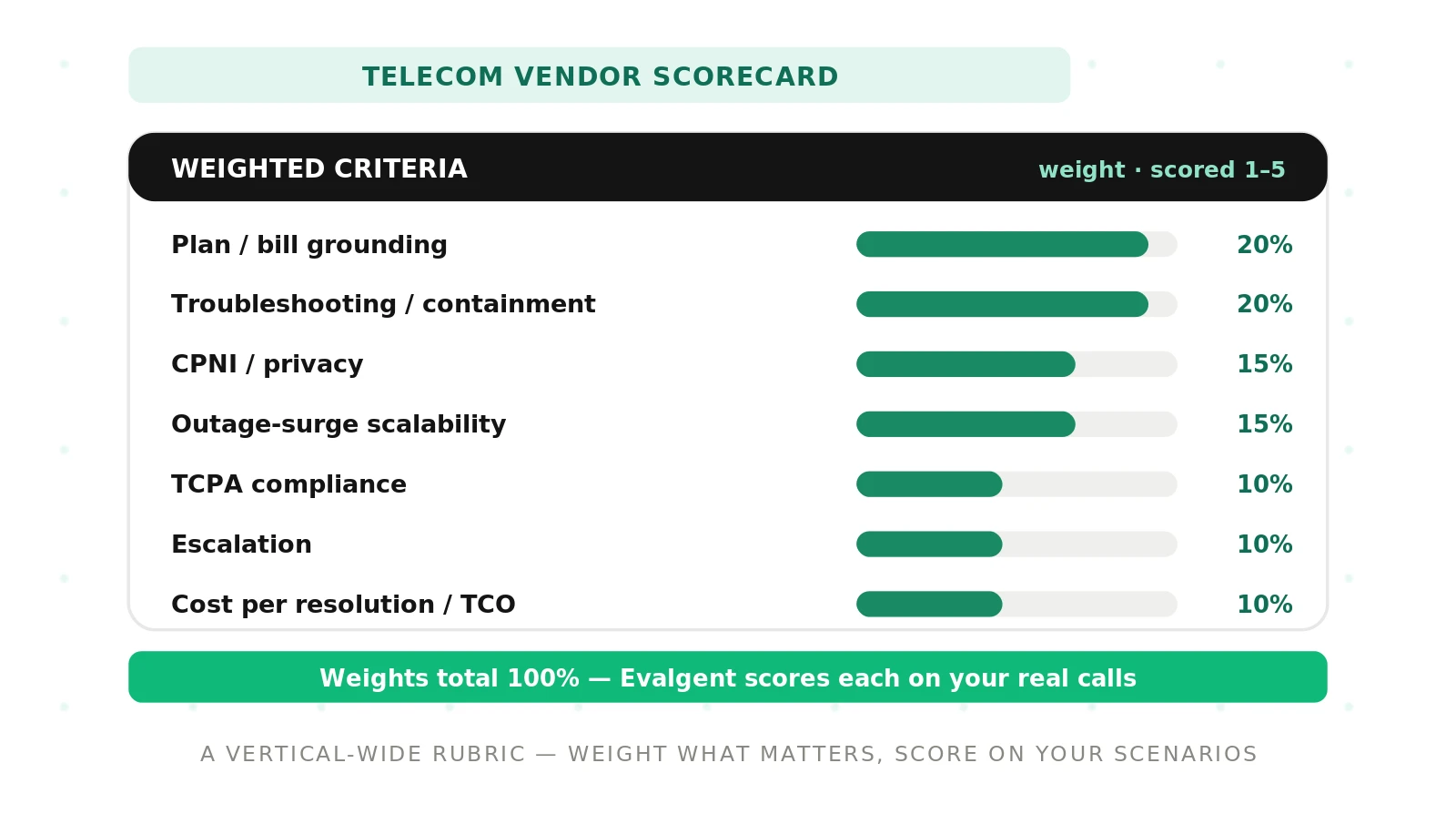
Here is the framework. Each criteria category has a weight. Score every vendor 1 to 5 on the same evidence. Multiply the score by the weight, then total across all rows. The weights below are a starting point. Adjust them to your traffic mix and risk.
> Weighted score: each category score (1 to 5) is multiplied by its weight, then summed. A perfect vendor scores 5.0. The pass bar column is the minimum score to advance, before weighting.
| Criteria category | Weight | What to score | Pass bar (1-5) |
|---|---|---|---|
| Plan and bill grounding accuracy | 20% | Every plan, fee, and balance the agent states matches the system of record; nothing is invented | 4: no hallucinated amounts across the test set |
| CPNI and customer privacy | 15% | Caller is verified before any account detail is disclosed; data handling follows carrier policy | 5: zero disclosures to unverified callers |
| Outage-surge scalability | 15% | Latency, accuracy, and completion hold under a modeled spike (for example 5x to 20x normal load) | 4: metrics stay within target at peak concurrency |
| Troubleshooting and containment | 20% | Correct resolution without a needless transfer; problem actually solved, not just deflected | 4: containment target met with correct outcomes |
| TCPA and outbound compliance | 10% | Consent checks, calling-window rules, and opt-out handling on outbound flows | 5: no calls outside consent or opt-out rules |
| Escalation and handoff | 10% | Timely, correct transfer with full context passed to the agent or system | 4: right escalations, no lost context |
| Cost per resolution and TCO | 10% | Fully loaded cost to resolve a call, including platform, usage, and integration | 3: cost per resolution beats current baseline |
The weights total 100%. Grounding and containment carry the most because they drive both cost and trust. Privacy and outage scale sit next because their failures are visible and expensive.
Plan and bill grounding accuracy
This is the highest-risk category for telecom. Bills are complex, and plans change often. The agent must read from the BSS or billing system, not from the model. Score it on real accounts with promotions, proration, and device installments. Any invented figure fails the row.
CPNI and customer privacy
CPNI is customer proprietary network information. It includes what services a customer buys and how they use them. Carriers must protect it and verify callers before disclosure. Score the agent on identity checks. It should refuse to read account details until the caller is verified.
Outage-surge scalability
Outages define telecom load. When service drops in a metro, calls spike fast. Score the vendor under a modeled surge, not steady state. Watch latency, accuracy, and completion at peak concurrency. A vendor that degrades quietly under load is a risk you can measure now.
Troubleshooting and containment
Technical support is where telecom agents earn their keep. The goal is a solved problem, not a fast deflection. High deflection with low resolution is a false win. Track true containment rate alongside correct outcomes. Read more on the difference in our customer support metrics guide.
TCPA and outbound compliance
Outbound telecom calls carry legal duties. Upgrade offers, past-due reminders, and win-back calls fall under TCPA and FCC rules. Score consent handling, calling windows, and opt-out response. Frameworks like the NIST AI Risk Management Framework help structure this. Confirm specifics with your own counsel.
Escalation and handoff
Some calls must reach a person. The agent should escalate at the right moment and pass full context. A cold transfer that drops the account and history wastes the customer's time. Our escalation guide covers the handoff patterns to test.
Cost per resolution and TCO
Price per minute is the wrong number. The number that matters is cost per resolution, fully loaded. Include platform fees, usage, and integration work. Compare that to your current baseline and to total cost of ownership over the contract, not just the pilot.
How to score telecom voice agent vendors with this scorecard
Follow these steps to run the scorecard as a fair, repeatable test.
1. Set your weights. Start from the table, then adjust to your traffic mix. A carrier with heavy outbound raises the TCPA weight. Keep the total at 100%.
2. Build your scenarios. Write test cases from your real call types across all seven use cases. Include hard accounts, promotions, and edge cases. Use your own data, not the vendor's demo script.
3. Fix the pass bars. Agree the minimum score per category before testing. Pass bars stop a strong demo from hiding a weak flow.
4. Model the outage surge. Define a peak load, such as 5x to 20x normal. Run every vendor at that concurrency and record latency and accuracy.
5. Run identical tests on every vendor. Same scenarios, same scoring, same evaluators. Consistency is what makes the scores comparable.
6. Score 1 to 5 and check pass bars. Any vendor below a pass bar in a critical category is out, whatever the total says.
7. Weight and total. Multiply each score by its weight and sum. Rank vendors by the weighted total and the pass-bar results together.
8. Document the evidence. Save transcripts, recordings, and metrics for each score. A defensible telco voice agent rfp needs an audit trail.
Integration realities: BSS, OSS, and billing
A telecom agent lives or dies on its integrations. It must read the billing system for charges. It must reach the order and provisioning systems for activation. It must touch the OSS for line checks and outage status.
Score the depth of these connections, not just their presence. A read-only lookup is easy. A safe write, such as a plan change or a payment, is harder. Test whether tool calls return the right data and take the right action. Our tool-calling guide shows how to test these flows.
Latency matters here too. A billing lookup that takes eight seconds feels broken on a call. Time the integrations under load, not just in a clean test. The outage surge row already stresses this.
Deflection versus containment economics
Telecom leaders often chase deflection. Deflection counts calls the agent kept away from a human. It looks good on a dashboard. But a deflected call that did not solve the problem still returns.
Containment is the honest metric. It counts calls the agent actually resolved. A customer who calls back twice was deflected, not contained. Score outcomes, not just avoided transfers. This is why the scorecard weights troubleshooting and containment at 20%.
Tie this to cost. A high deflection rate with low resolution raises repeat calls and hurts customer satisfaction. Real containment lowers cost per resolution and protects the experience. Both belong in the total.
SLAs and the contract
The scorecard feeds the contract. Turn your pass bars into service-level agreement targets. Name the peak concurrency the vendor must hold. Set the containment and grounding floors in writing.
Ask for the right to re-test. Vendors update models often. A version that passed last quarter may drift. A recurring audit clause keeps the scorecard live after the sale, not just before it.
Why Evalgent runs the scorecard for you
Evalgent is an independent, third-party evaluator. We do not sell a voice agent. We test the ones you are considering, on your scenarios, against your pass bars. That neutrality is the point. Read more about independent voice AI evaluation.
We run the full telecom scorecard, including the outage-surge load test. We build test cases from your real call types across all seven use cases. We check grounding on your accounts, verify CPNI handling, and score containment on outcomes. Then we hand you the weighted results and the evidence behind every number.
Vendors report their own metrics. An independent audit gives you numbers you can defend to procurement, legal, and the board. Book a demo to see the scorecard run on your telecom scenarios.
Frequently asked questions
What is a telecom voice agent vendor scorecard?
A telecom voice agent vendor scorecard is a weighted rubric for choosing one voice AI vendor across the telco industry. It scores each vendor 1 to 5 on plan and bill grounding, CPNI privacy, outage-surge scale, containment, TCPA compliance, escalation, and cost per resolution. You weight the categories, test on your own calls, and total the results.
How do you weight criteria in a telco voice agent rfp?
Start with grounding and containment at the top, since they drive trust and cost. Weight privacy and outage scale next, because their failures are expensive and visible. TCPA, escalation, and cost round out the set. Keep the total at 100% and raise weights that match your traffic and risk profile.
How do you test a telecom voice agent for outage surges?
Model a peak load well above normal, such as 5x to 20x. Run the vendor at that concurrency, not steady state. Measure latency, accuracy, and call completion at the peak. A vendor that stays within target under the surge passes. One that degrades quietly fails the outage-surge row.
What is CPNI and why does it matter for voice agents?
CPNI is customer proprietary network information: the services a customer buys and how they use them. Carriers must protect it and verify callers before disclosure. A voice agent must confirm identity before reading account details. Disclosing CPNI to an unverified caller is a compliance failure, so the scorecard weights privacy heavily.
Does TCPA apply to telecom outbound voice agents?
Yes, outbound telecom calls generally fall under TCPA and FCC telemarketing rules, covering consent, calling windows, and opt-outs. This applies to upgrade offers, payment reminders, and win-back campaigns. Score the agent on consent checks and opt-out handling. This is general guidance, not legal advice; confirm the specifics with your own counsel.
How do you score plan and bill grounding accuracy?
Test the agent on real accounts with promotions, proration, and device installments. Every plan, fee, and balance it states must match the system of record. Nothing should come from the model. Any invented amount fails the row. A strong pass bar is no hallucinated figures across the full test set.
What pass bar should a telecom voice agent meet for containment?
Set the containment pass bar on correct outcomes, not avoided transfers. A common bar is a score of 4, where the agent meets your containment target while actually solving the problem. Track repeat calls, since a deflected call that returns was not contained. Outcomes, not deflection, decide the score.
Who should run a telecom voice AI vendor evaluation?
An independent, third-party evaluator gives the most defensible result. Vendors report favorable numbers on their own demos. An outside auditor runs the same scorecard on your scenarios, including the outage-surge load, and hands you evidence. Evalgent does this without selling a voice agent, so the scores stay neutral.
The bottom line
A telecom voice agent vendor scorecard turns a risky purchase into a measured one. Weight the criteria, set pass bars, test on your own calls including an outage surge, and total the scores.
Evalgent runs that scorecard as an independent evaluator, on your scenarios, with evidence behind every number. Book a demo to score your telecom vendors before you sign.
Related Articles
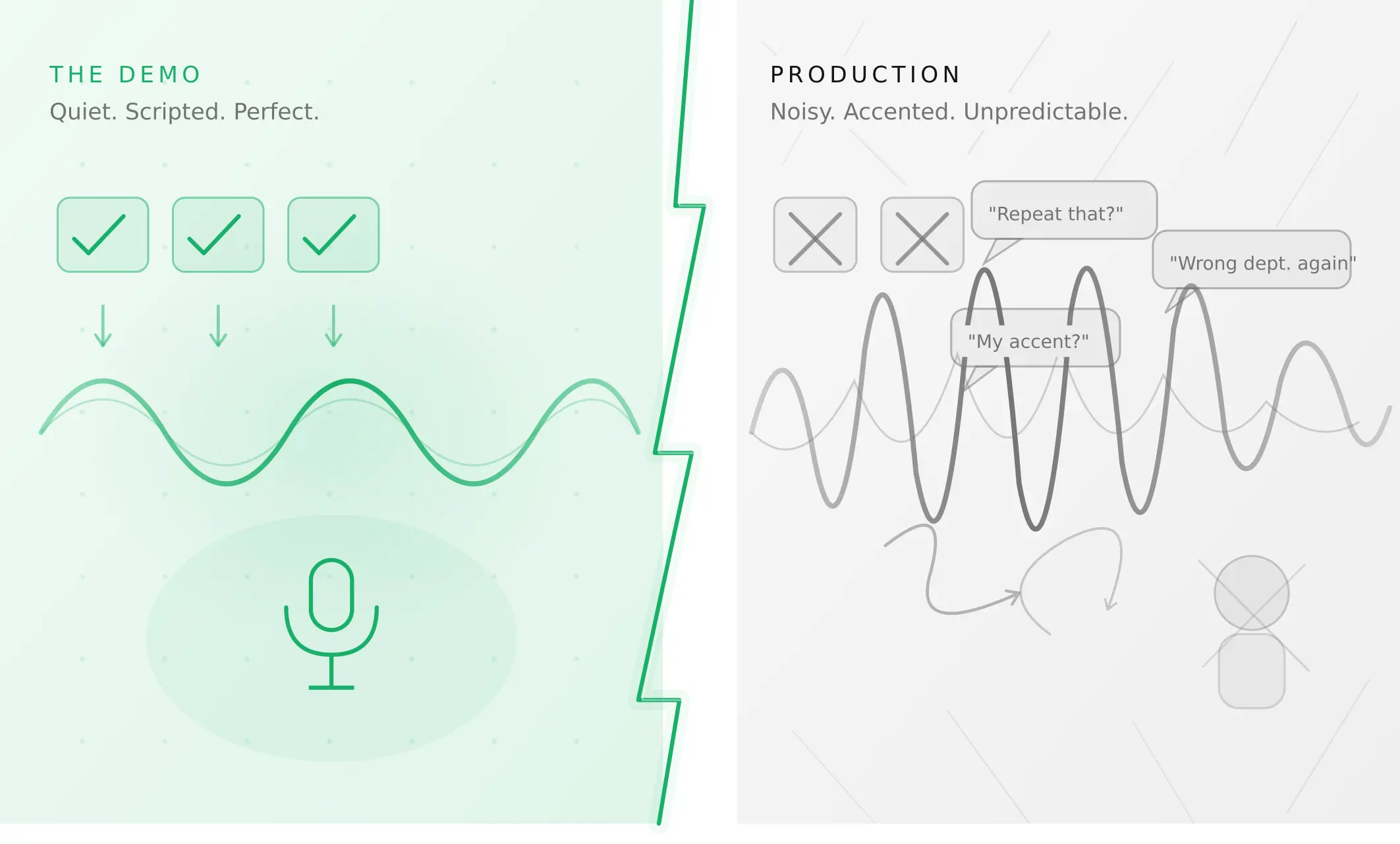
Why AI voice agents fail in production (and how to prevent it)
AI voice agents that ace demos still break in production. Learn the 5 root causes, how to test for each, and what production readiness actually means.
Read more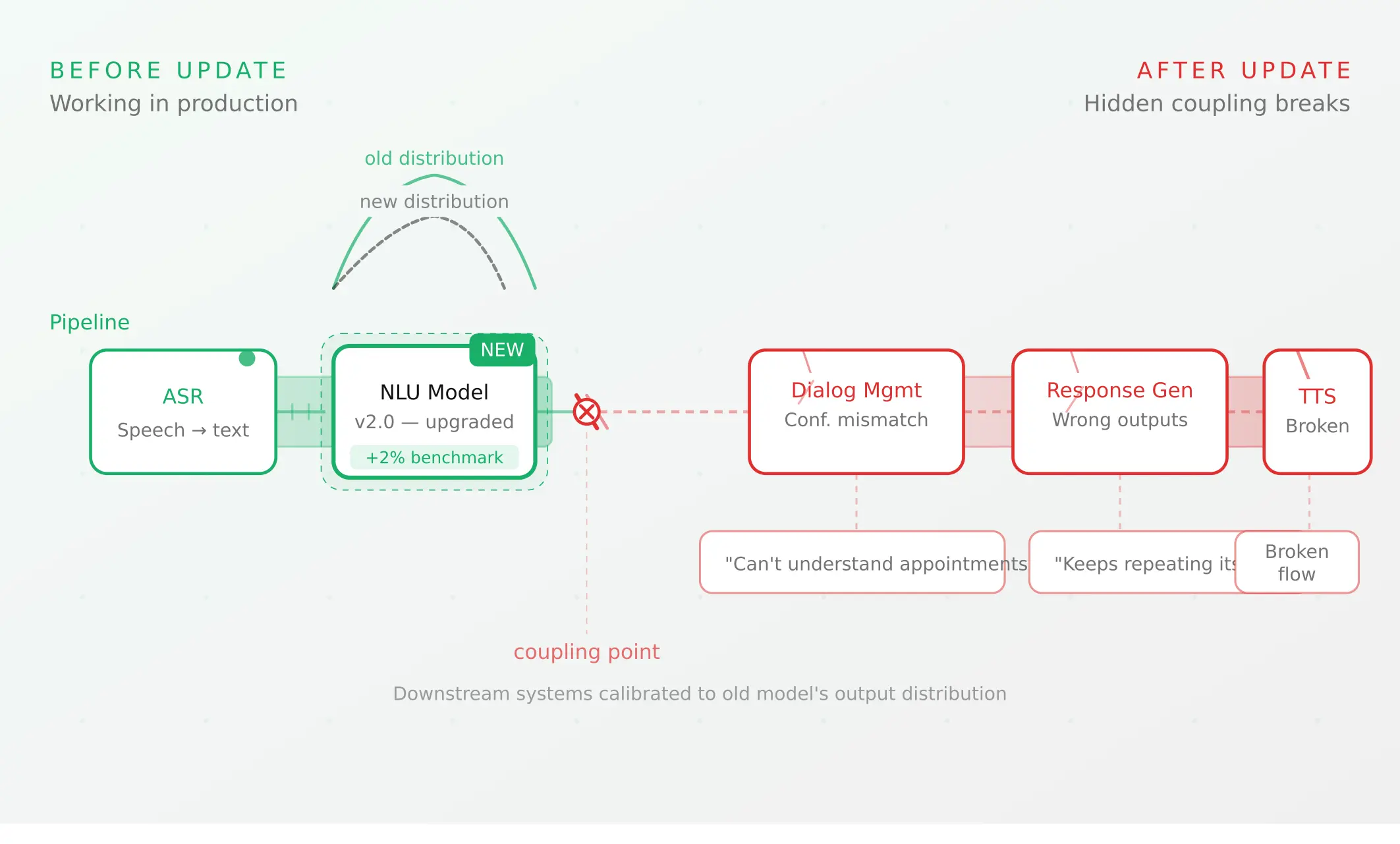
Voice agent regression testing: why LLM updates break production
LLM updates improve benchmarks but break voice agents in 5 predictable ways. How to detect and prevent regressions after every model or prompt change.
Read more