Open door for builders.
How to Evaluate Pause Handling in AI Voice Agents
# How to evaluate pause handling in AI voice agents
Quick answer
> Quick answer: Pause handling voice agent evaluation measures whether an agent waits correctly when a caller goes silent. You score two failures: cutting in too early on a thinking pause, and leaving dead air after a real end of turn. Test it on realistic pause scenarios and real calls, not clean scripts.
A caller pauses to read a card number aloud. A good agent waits. A bad one jumps in after half a second and talks over the digits. Now the call is a mess. The caller repeats themselves, the agent apologizes, and the whole exchange feels broken.
That failure never shows up in a transcript. The words look fine. Only the timing was wrong. This post is about measuring that timing. It covers pause handling voice agent evaluation end to end: the failure modes, the scenarios, the metrics, and a repeatable method.
This is a narrow topic on purpose. It is about waiting on silence, not about stopping on speech. Barge-in, where the caller interrupts and the agent should yield, is the sibling problem. Our turn-taking evaluation post covers that side. Here the question is simpler and just as important: does the agent wait long enough?
Evalgent is an independent evaluator. We run pause scenarios on your own call audio and measure premature-endpoint and dead-air rates, without favoring any provider.
What pause handling means for a voice agent
> Pause handling: how a voice agent decides whether a caller who has gone quiet is finished speaking or just pausing. It drives the choice to wait, prompt, or start replying.
The core mechanism is endpointing. Endpointing is the decision that a turn has ended. It sits on top of voice activity detection, which flags whether audio contains speech or silence.
Those two jobs are not the same. Our guide on VAD versus endpointing draws the line. VAD answers "is anyone speaking right now?" Endpointing answers "is the caller done?" A caller can be silent and not done. That gap is where pause handling lives.
Human conversation runs on tight timing. The study of turn-taking shows people swap turns with gaps often under a fifth of a second. Yet people also hold the floor through long pauses when they are thinking. A voice agent has to tell those two silences apart in real time.
Getting it wrong costs money. An agent that cuts callers off feels rude. An agent that leaves dead air feels broken or offline. Both push callers to hang up or ask for a human.
Why pauses break voice agents in two directions
Pause handling fails in two opposite ways. Naming both matters, because a fix for one often worsens the other.
The first failure is being too eager. The agent treats a short silence as the end of the turn. It starts speaking while the caller is mid-thought. This is premature endpointing. The caller was pausing, not finishing.
Premature endpointing is common when a caller gathers information. They say "let me find my account number," then go quiet to look. A greedy agent fills that silence. It asks again, or moves on, or repeats the last prompt. The caller loses their place.
The second failure is being too slow. The caller finishes. The agent keeps waiting. Now there is a long, awkward silence. This is dead air, and it makes the agent feel laggy or dead on the line.
Dead air has a second cause worth separating. The agent may detect the end of turn quickly but still take too long to produce audio. That is a latency problem, not an endpointing one. Our latency guide covers that gap in detail. A full evaluation has to tell the two apart.
The trade-off is real. Shorten the silence threshold and the agent feels snappy but interrupts more. Lengthen it and interruptions drop but dead air grows. There is no single setting that wins everywhere. The right target depends on the call type, which is why you test scenarios.
The pause scenarios that expose endpointing failures
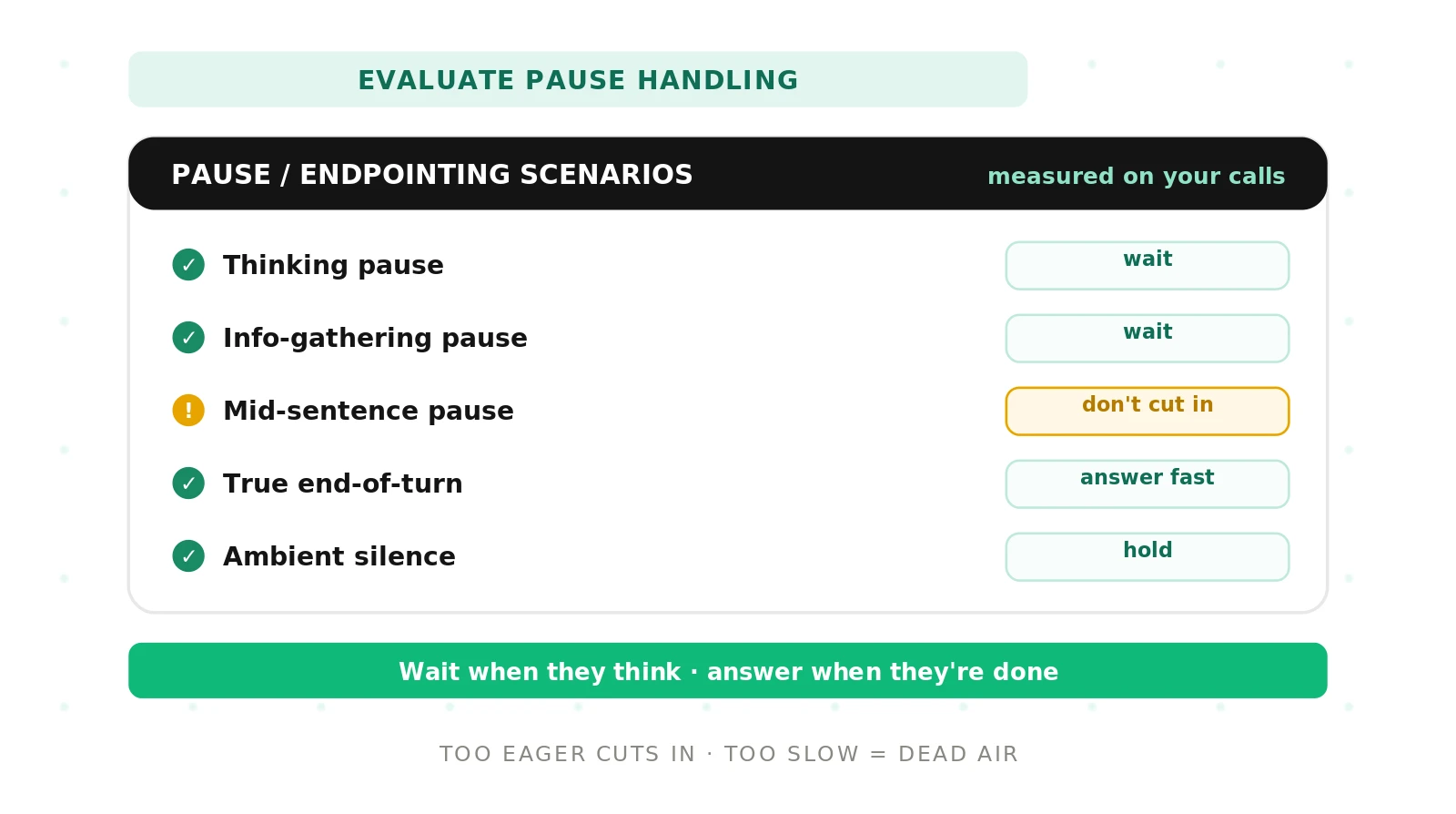
Real callers pause for different reasons. Each reason needs a different wait. A useful evaluation builds a scenario for each, then scores the agent on all of them. The table below maps every pause type to what you measure, the bar it should clear, and the sound of failure.
| Pause scenario | What to measure | Pass bar | Failure signal |
|---|---|---|---|
| Thinking pause (caller pauses mid-thought) | Premature-endpoint rate on short silences | Agent waits through a brief pause and does not cut in | Agent replies before the caller finishes the thought |
| Info-gathering pause ("let me find my card number") | Premature-endpoint rate during long, cued silences | Agent holds the floor while the caller looks something up | Agent re-prompts or moves on during the search |
| Mid-sentence pause (breath, filler, hesitation) | False-endpoint rate on within-turn silence | Agent treats the pause as continuation, not an ending | Agent starts talking over a half-finished sentence |
| True end-of-turn (caller is genuinely done) | End-of-turn accuracy and post-endpoint latency | Agent detects the end and replies within target time | Long dead air, or the agent keeps waiting for more |
| Ambient silence (no speech, background noise) | Over-wait rate and re-prompt behavior | Agent recognizes no turn is coming and prompts politely | Agent sits silent, or misfires on background noise |
Read each row on its own. An agent can ace the thinking pause and fail the info-gathering pause. Another can nail end-of-turn timing yet trip on ambient silence. You want the full profile before trusting it live.
The hardest rows are the info-gathering pause and the mid-sentence pause. Both require the agent to wait through silence that a naive threshold would read as an ending. This is where context-aware waiting earns its keep, and where cheap agents fail.
The metrics that turn pause handling into a score
"Feels patient" is not a metric. To hold a provider accountable you need numbers anyone can reproduce. Four metrics carry most of the weight. Track them together, since each hides a different failure.
Premature-endpoint rate. This is the share of caller pauses the agent wrongly treated as an ending. Count every turn where the agent cut in while the caller was still going. A high rate means the agent is too eager. This is the number that captures interrupting a thinking pause or an info-gathering pause.
Dead-air rate. This is the share of real end-of-turns followed by an over-long silence before the agent speaks. Report it as a rate and pair it with the length of the worst gaps. A rising dead air rate means the agent is too slow, too cautious, or laggy. Set the threshold at what your callers notice, often around one to two seconds.
End-of-turn accuracy. This scores end-of-turn detection, a form of speech segmentation: did the agent correctly tell "done" from "still going"? Treat it as a classification task. Count false endpoints, where it cut in early, and missed endpoints, where it kept waiting after the caller finished. The false endpoint count and the missed-endpoint count trade off, so report both.
Response latency after a legitimate end-of-turn. Once the caller is truly done, how fast does audio come back? Measure from the caller's end-of-speech to the agent's first sound. Report the median and a high percentile. A good median with a bad tail still frustrates callers on slow lines.
Fixed versus adaptive endpointing timeouts
The setting behind all of this is the endpointing timeout. It is how long the agent waits in silence before deciding the turn is over. How the agent sets that value shapes every metric above.
A fixed timeout uses one value for the whole call. It might wait 700 milliseconds after any silence. Fixed timeouts are simple and predictable. They also fail the moment a caller needs longer, like when reading a long number. One value cannot serve both a quick "yes" and a slow document lookup.
An adaptive timeout changes the wait based on context. It can read the words so far, the disfluency pattern, or the call state. After "my account number is," a good agent extends the wait. It expects more digits. After a complete "yes," it can reply fast.
Context-aware waiting is the mark of a strong agent. It waits longer when the caller signals more is coming. It waits less when the turn is clearly done. This is why your test set must include cued pauses. A fixed-timeout agent and an adaptive one can score the same on clean speech, then split apart on "hold on, let me check."
A backchannel adds another wrinkle. A short "mm-hmm" or "right" means "keep going," not "your turn." A good agent does not treat a backchannel as a turn boundary. Score that case too, since a misread backchannel produces the same early cut-in as a mishandled thinking pause.
None of this is free. Every extra millisecond of waiting adds to perceived response time. The goal is not the longest wait or the shortest. It is the right wait for each moment, measured against real calls. Framing endpointing as a safety-relevant behavior also fits the risk-based approach in the NIST AI Risk Management Framework, which asks teams to test for the failures that harm users.
How to evaluate pause handling in a voice agent
Here is a repeatable method. It works for any voice agent, on any stack, whichever provider built it.
1. Define the pause scenarios that matter. List the call types your callers make. Mark where thinking pauses, info-gathering pauses, and mid-sentence pauses are common. Those moments stress endpointing most.
2. Build a messy test set. Assemble real or synthetic calls with short pauses, long cued pauses ("let me find it"), filler words, hesitations, and stretches of ambient silence. A clean script will pass a broken agent.
3. Run the calls and capture aligned audio. Place the calls into the agent. Record caller audio and agent audio separately, with synchronized timestamps. You cannot measure a gap from a single mixed track.
4. Label every pause. For each silence, mark whether it was a true end of turn or a within-turn pause. This label set is the ground truth for scoring.
5. Score premature-endpoint and dead-air rates. Compare the agent's behavior against the labels. Count early cut-ins and over-long gaps. Report each as a rate per call type.
6. Score end-of-turn accuracy and post-endpoint latency. Count false and missed endpoints. Measure the delay from a real end of turn to the agent's first audio, at the median and a high percentile.
7. Set pass bars and re-test after every change. Fix a target for each metric per scenario. Re-run the suite after any model, prompt, or timeout change, since these settings drift.
The output is a scorecard, not a vibe. For how these numbers slot into a broader rubric, see our voice agent metrics scorecard. For the wider practice this sits inside, start with the voice agent evaluation pillar.
How Evalgent evaluates pause handling independently
Vendors tune their demos on clean speech. Clean speech hides pause failures completely. This is the case for independent voice AI evaluation: an outside party running the messy scenarios the vendor's demo skips.
Evalgent runs pause handling voice agent evaluation on your own call audio. We build the scenario set from your real traffic. We label the pauses. Then we measure premature-endpoint rate, dead air rate, end-of-turn accuracy, and post-endpoint latency, per call type.
We stay neutral. We do not sell a voice stack, so we have no reason to favor one agent's endpointing over another. You get a scorecard you can defend to a vendor, a buyer, or a compliance team. That is the point of an independent voice agent endpointing evaluation: numbers nobody in the deal can wave away.
Frequently asked questions
How to evaluate pause handling in a voice agent?
Build a test set of realistic pauses: thinking pauses, info-gathering pauses ("let me find it"), mid-sentence pauses, and ambient silence. Run the calls on real audio and label each silence as an ending or not. Then measure premature-endpoint rate, dead-air rate, end-of-turn accuracy, and response latency per scenario. Re-test after every change.
What is premature endpointing in voice agents?
Premature endpointing is when the agent decides a caller has finished while the caller is only pausing. The agent starts speaking mid-thought and talks over the caller. It is most common during info-gathering pauses, like reading a card number. It signals the silence threshold is too short or the endpointing is not context-aware.
How do you measure dead air in a voice agent?
Measure dead air as the silence between a caller's true end of turn and the agent's first audio. Record both audio channels with aligned timestamps. Count gaps that exceed a threshold callers notice, often one to two seconds. Report the dead air rate per call type, plus the length of the worst gaps.
How long should a voice agent wait before responding?
There is no single number. A short "yes" needs a fast reply, near 500 to 800 milliseconds. An info-gathering pause needs seconds. Strong agents use an adaptive timeout that reads context and extends the wait when more input is coming. Test each scenario and set a separate target rather than forcing one universal value.
Why does my voice agent interrupt when I pause?
The agent is treating your pause as the end of your turn. Its endpointing waits a fixed, short time after silence and then speaks. It cannot tell a thinking pause from a finished sentence. Fixing it usually means a longer or adaptive timeout, plus testing against cued pauses like "hold on, let me check."
How to test voice agent silence handling?
To evaluate voice agent silence handling, script calls that include long pauses, mid-sentence hesitations, and stretches of ambient silence with background noise. Run them on real audio, not text. Watch whether the agent waits, prompts politely, or misfires on noise. Score how often it cuts in early and how often it leaves dead air.
What is end-of-turn detection accuracy?
End-of-turn detection accuracy scores how well an agent tells "the caller is done" from "the caller is pausing." Treat it as a classification task against labeled pauses. Count false endpoints, where it cut in early, and missed endpoints, where it kept waiting. Report both, since tuning to reduce one raises the other.
How to set endpointing timeouts for voice agents?
Do not pick one value. Start from the call type: quick confirmations tolerate short waits, while number or document lookups need long ones. Prefer an adaptive timeout that lengthens on cues like "let me find it." Then test with real pause scenarios and adjust each target by measured premature-endpoint and dead-air rates.
The bottom line
Pause handling fails in two directions: cutting in too early on a caller's pause, or leaving dead air after they finish. Evaluate it by running realistic pause scenarios on real audio and measuring premature-endpoint rate, dead-air rate, end-of-turn accuracy, and post-endpoint latency.
Ready to see how your agent handles silence? Book a demo and Evalgent will measure your premature-endpoint and dead-air rates on your own call data.
Related Articles
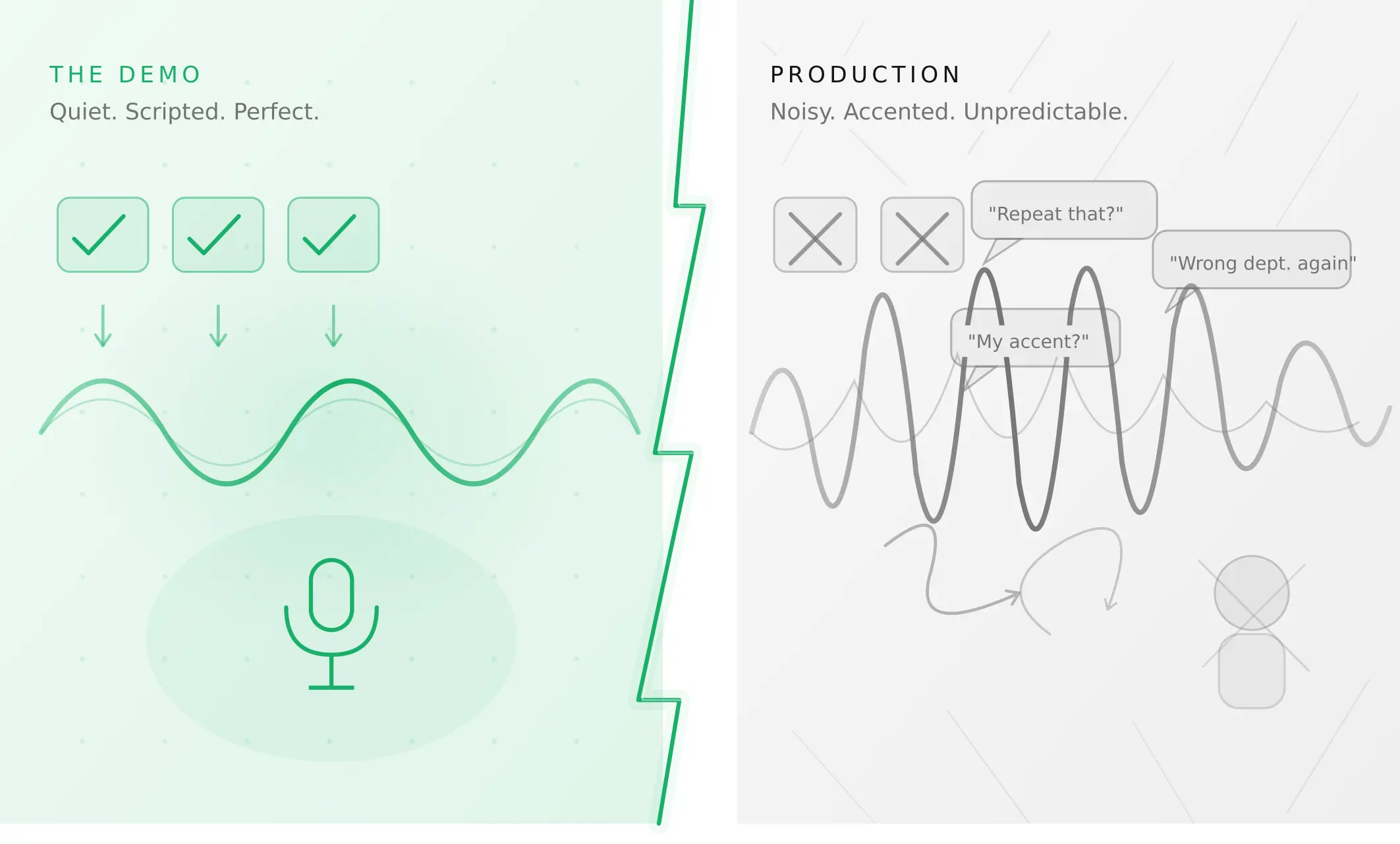
Why AI voice agents fail in production (and how to prevent it)
AI voice agents that ace demos still break in production. Learn the 5 root causes, how to test for each, and what production readiness actually means.
Read more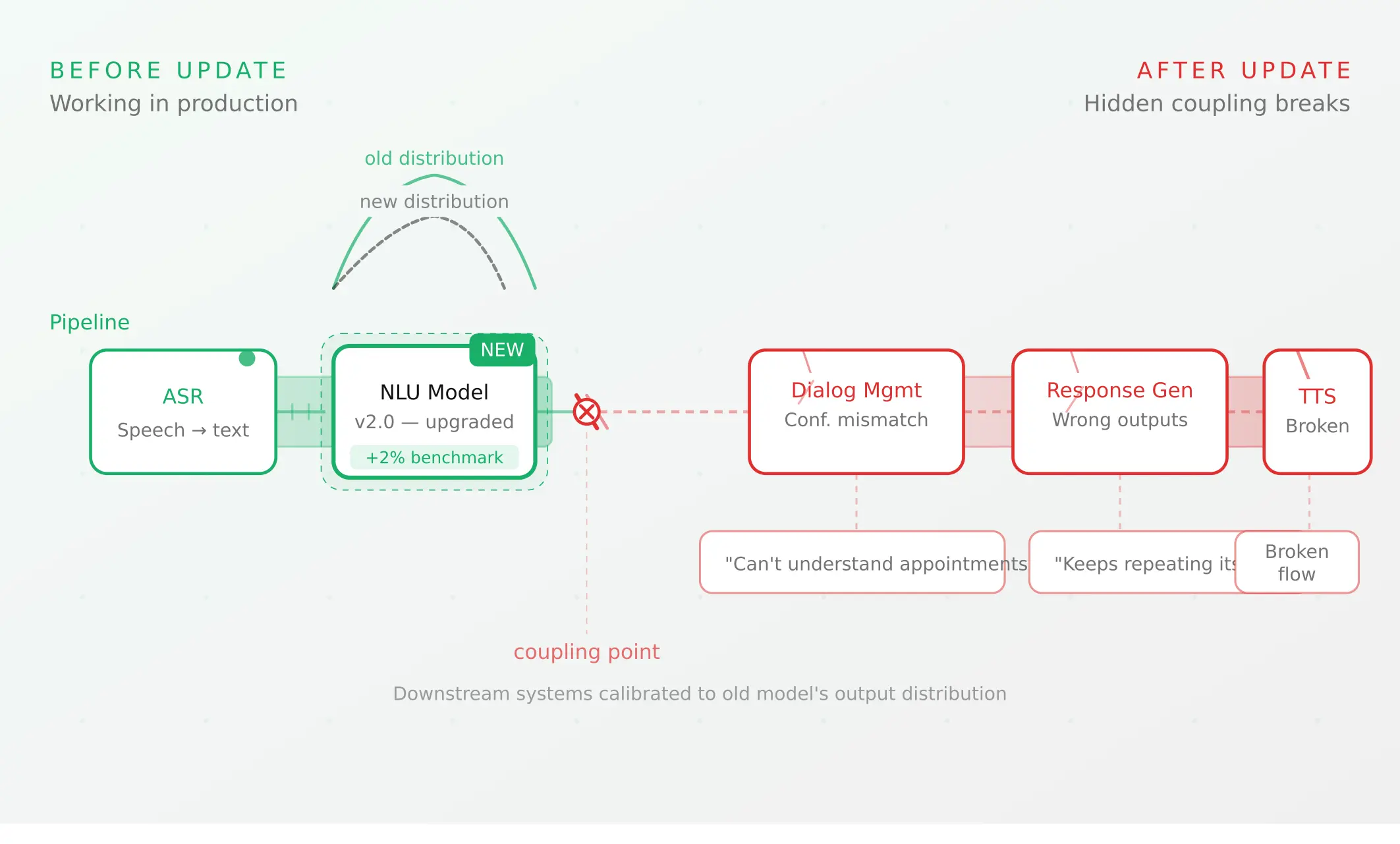
Voice agent regression testing: why LLM updates break production
LLM updates improve benchmarks but break voice agents in 5 predictable ways. How to detect and prevent regressions after every model or prompt change.
Read more