Test your voice agent
How to Negotiate a Voice AI Contract
# How to negotiate a voice AI contract
Quick answer
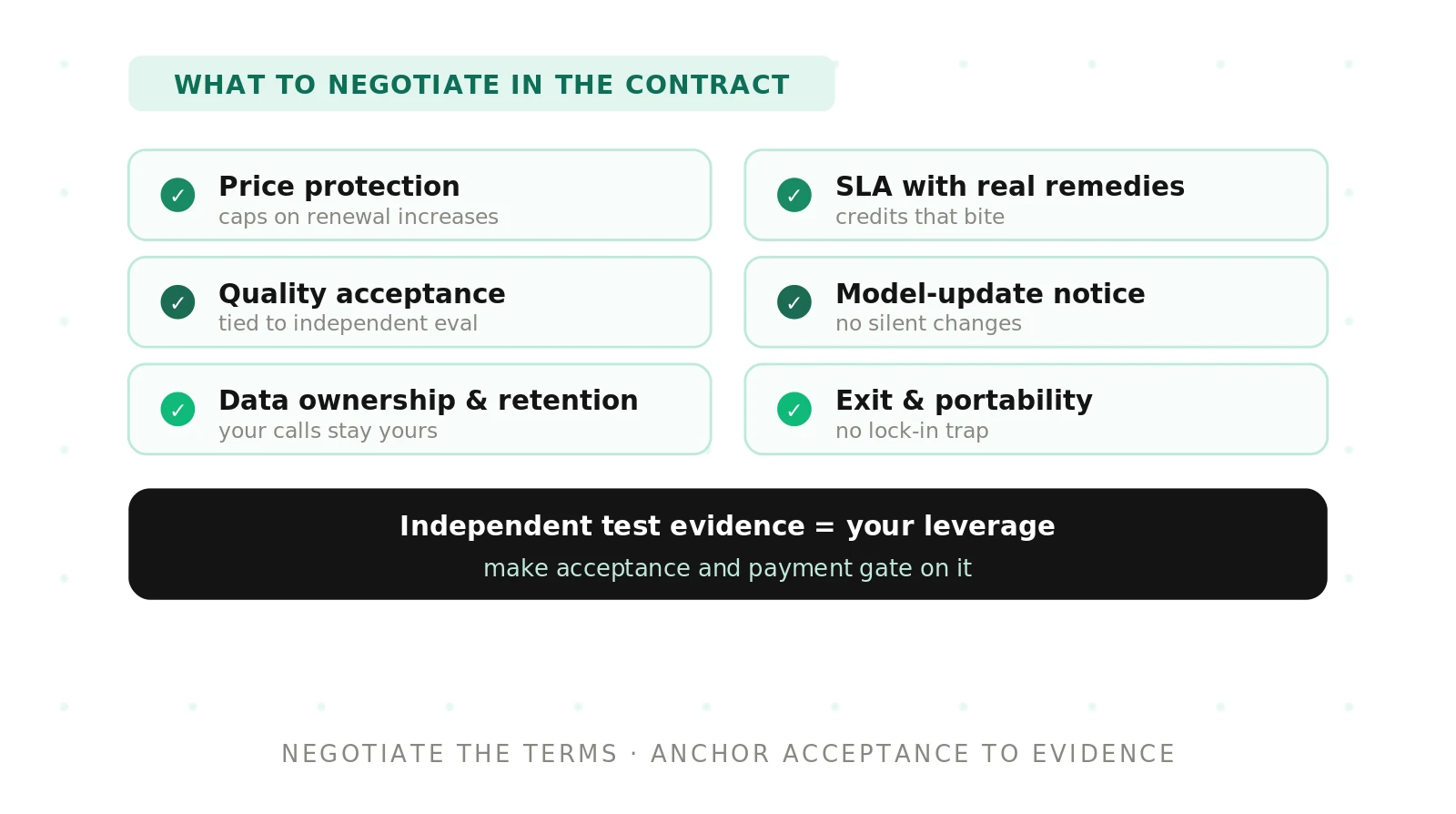
To negotiate a voice AI contract, secure a clear pricing model with price caps, an SLA with real service credits, and acceptance tied to measured performance. Add model-update notice, data ownership, and exit rights so you avoid lock-in. Use independent test evidence as your leverage and your acceptance gate.
A voice AI contract is not an ordinary software license. It puts an AI on the phone with your customers, in your name, handling real money and real emotions. When the deal is papered well, you can hold the vendor to the numbers they sold you. When it is papered badly, you carry the risk and the vendor carries the upside.
Most buyers negotiate price and stop. That is the smallest lever you have. The terms that decide whether this partnership survives contact with production are the ones nobody reads in the demo: acceptance criteria, remedies, model-change notice, and exit rights. This guide walks through each one, and shows where independent evidence turns a hopeful purchase into a defensible deal.
This is general information, not legal advice. Have your counsel review any agreement before you sign it.
Why a voice AI contract needs hard negotiation
Voice agents fail differently from other software. They do not throw a stack trace. They mishear a name, invent a policy, or go silent, and the caller hangs up angry. The failure is quiet, one call at a time, and it lands on your brand long before it shows up in a dashboard.
That changes what you negotiate. A traditional license cares about uptime and support. A voice AI deal has to care about quality. An agent can be up 100% of the time and still be wrong on a third of calls. Uptime alone is a comfortable metric that hides the risk you actually took on.
The vendor knows their product better than you do. They know its weak spots, its bad accents, its brittle intents. The negotiation is your one chance to close that information gap with contract language. Public buyers formalize this discipline in the Federal Acquisition Regulation at acquisition.gov, and the same principles scale to any enterprise deal. After signing, the leverage shifts to them. Our guide to defensible voice AI vendor selection covers how to keep that leverage through the whole cycle.
What to negotiate first: the pricing model and price protection
Start with the pricing model, not the price. The model decides how your bill scales, and a bad model gets worse as you grow. Ask for the full rate card, not a headline number.
Most voice AI is billed per minute of conversation. That sounds simple, but it hides variables. Ask how partial minutes round. Ask what counts as billable time. Ask whether silence, hold, and transfer time are metered. Ask about separate charges for speech, language models, and telephony.
Then negotiate protection against increases. A price good today means little if it can double at renewal. Push for a price protection clause with a capped annual increase, tied to a public index rather than the vendor's discretion. Lock the rate for the initial term, and cap any renewal bump in writing. These commitments usually live in the master service agreement.
Also weigh whether usage pricing even fits your goal. If you buy voice AI to resolve calls, consider outcome-based pricing that charges per resolved contact instead of per minute. That aligns the vendor's incentive with yours, though it needs a clean, agreed definition of a resolution.
Volume commitments and ramp
Vendors want a large committed spend up front. It de-risks their revenue and it locks you in. You want the opposite: a small commitment that grows only as the agent earns it.
Negotiate a ramp. Start with a low minimum for the first quarter, while you validate the agent on live traffic. Step the commitment up on a schedule tied to performance, not to the calendar. If the agent misses its numbers, the ramp pauses.
Watch the overage terms too. Ask what happens when you exceed the committed volume. Overage rates are often higher than the base rate, so a successful rollout can quietly raise your effective price. Cap overage rates in the contract.
SLA with real remedies
An SLA is only as strong as its remedy. Many voice AI SLAs promise 99.9% uptime and offer a token credit if the vendor misses. A credit worth a few percent of one month's fee does not cover a day of failed customer calls. Negotiate remedies that actually hurt the vendor.
> Service-level agreement (SLA): a contractual commitment to specific, measured levels of service, backed by defined remedies when the vendor falls short. See the SLA overview for the general concept.
Push past uptime. A voice agent needs quality SLAs, not just availability ones. Negotiate targets for latency, task success, and containment, each measured on your traffic. Tie escalating service credits to sustained misses, and win the right to terminate for repeated breach without penalty. Our detailed breakdown of voice agent SLA requirements lists the specific clauses to request.
Define who measures. If the vendor reports their own SLA compliance, the SLA is theater. Insist that the metrics that trigger remedies be measured independently or from data you can audit.
Accuracy and quality acceptance tied to independent evaluation
This is the clause most buyers miss, and the one that protects you most. Do not accept the agent because it demoed well. Make acceptance conditional on measured performance against agreed criteria, verified by a neutral party.
Write acceptance criteria into the statement of work. Name the metrics, the thresholds, and the test set. State that payment or go-live is contingent on the agent clearing those thresholds on a shared, independent test. If it misses, the vendor fixes it before you pay in full.
The evidence has to be neutral. Vendor-reported accuracy is measured on data the vendor chose, under conditions they controlled, so it does not compare across bids. An independent evaluation runs one test set the same way for every vendor. The difference between checking claims and trusting them is explained in our guide on testing vs evaluation for voice agents, and the broader case appears in our post on independent voice AI evaluation.
Make this recurring, not one-time. Tie renewal and continued acceptance to periodic re-tests, so quality cannot quietly drift after the ink dries.
Model-update notice and the right to re-test
Voice AI sits on models the vendor controls and updates. A silent model swap can change how the agent behaves overnight. An update that helps average performance can still break your specific scripts, your compliance language, or your edge cases.
Negotiate advance notice before any material model change. Require a written description of what is changing. Then negotiate the right to re-test on your scenarios before the change reaches your production traffic, with the option to defer the update if it regresses your numbers.
Without this clause, you are trusting that every future update helps you. Some will. The point of the contract is that you do not have to hope.
Data ownership, retention, and exit portability
Your call recordings and transcripts are valuable data. They train future models, feed your analytics, and prove what happened on a disputed call. Negotiate clear ownership before you generate a single minute of it.
> Vendor lock-in: a situation where switching vendors is so costly or difficult that you stay by default rather than by choice. See the vendor lock-in overview for the mechanics.
State that you own your data and any derived transcripts. Set a data retention schedule and deletion rights. Require a data processing agreement and a subprocessor list so you know where the audio goes.
Then negotiate exit. This is how you avoid vendor lock-in. Win the right to export your data in a standard format, a defined transition period, and vendor cooperation on migration. Add termination for convenience with reasonable notice. Negotiate exit terms now, while you have leverage, because you will have none later. If you run more than one provider to keep that leverage alive, see our post on running multiple voice agent vendors.
Security, compliance, and liability terms
Voice AI handles sensitive conversations, so security is not a checkbox. Confirm real certifications, not marketing claims. Ask for a current audit report, encryption details, and how the vendor isolates your data from other tenants.
Match the terms to your regulatory exposure. If you take payments or handle health or financial data, the contract must reflect the relevant standards, with the vendor's obligations spelled out. Vague "industry-standard security" language is not enough.
Then read the liability section closely. Vendors cap their liability low and push risk onto you through broad indemnification clauses. Negotiate the cap up for data breaches and confidentiality failures. Make sure the vendor indemnifies you for its own negligence, not the reverse.
How to prepare for and run a voice AI contract negotiation
A negotiation is won in preparation. Walk in with evidence and a script, not opinions and hope. Here is a sequence that works.
1. Set your must-haves before you talk price. List the terms you will not sign without: acceptance criteria, quality SLAs, model-update notice, data ownership, and exit rights. Rank them so you know what to trade.
2. Gather independent evidence first. Run a neutral evaluation across your shortlisted vendors on one shared test set. The numbers become your leverage at the table.
3. Benchmark the pricing model. Ask every vendor for a full rate card. Model total cost over the full term, including overage and escalation, not just the per-minute rate.
4. Draft acceptance criteria into the statement of work. Name the metrics, thresholds, and test set. Tie payment and go-live to clearing them.
5. Redline the SLA for real remedies. Replace token credits with escalating credits and a termination right for repeated breach.
6. Lock model-change and exit clauses. Require notice, a re-test right, data export, and a transition period.
7. Trade from strength. Concede on low-priority items to win your must-haves. Keep the evaluation evidence visible so claims stay honest.
8. Get counsel to review before signing. Have your legal team confirm the language matches what you negotiated.
For a wider view of the whole selection process this negotiation sits inside, see our guides on how to evaluate voice agent vendors and the procurement lead's approach to choosing a voice vendor.
Contract terms, what to ask for, and why each matters
Use this table as a checklist at the table. Each row is a term, the concrete ask, and the reason it protects you.
| Contract term | What to ask for | Why it matters |
|---|---|---|
| Pricing model | Full rate card, capped annual increase, rate locked for the initial term | A bad model scales against you; caps stop renewal surprises |
| Volume commitment | Low starting minimum, performance-linked ramp, capped overage rates | You commit as the agent earns it, not on faith |
| SLA and remedies | Quality and uptime targets, escalating service credits, termination for repeated breach | Token credits do not cover failed customer calls |
| Acceptance criteria | Named metrics and thresholds, verified on an independent test set | Payment is contingent on measured quality, not a demo |
| Model-update notice | Advance written notice plus a right to re-test before rollout | Silent model swaps can break your scripts overnight |
| Data ownership | You own recordings and transcripts, defined retention and deletion | Your data stays yours and stays auditable |
| Exit and portability | Standard-format export, transition period, termination for convenience | Prevents vendor lock-in and keeps future leverage |
| Liability | Higher cap for breaches, vendor indemnifies its own negligence | Keeps the vendor's risk from landing on you |
Where independent evaluation fits as leverage and gate
Independent evidence does two jobs in a negotiation. First, it is leverage. When you can show measured results across vendors on the same test set, marketing claims lose their power and the conversation moves to facts. A vendor who knows you will verify negotiates differently.
Second, it is a gate. By writing independent evaluation into your acceptance criteria and your renewal terms, you convert a one-time check into a standing condition. The agent has to keep earning its place. This is the mechanism our pillar on voice agent evaluation treats in depth.
Evalgent exists to be that neutral party. It scores every vendor on the same test cases, so the evidence in your contract is comparable and defensible. That is what turns a hopeful signature into a deal you can stand behind at renewal.
A confident vendor accepts measurement. One that resists an acceptance gate has told you something useful before you signed. Either way, the evidence works for you.
Frequently asked questions
How do you negotiate a voice AI contract?
Start with the pricing model and price caps, then negotiate the terms that manage quality risk: an SLA with real service credits, acceptance criteria tied to measured performance, model-update notice, data ownership, and exit rights. Bring independent test evidence across vendors so your asks rest on facts, not marketing claims. Have counsel review before signing.
What should you negotiate in a voice AI contract?
Negotiate the pricing model and price protection, volume commitments with a performance-linked ramp, quality and uptime SLAs with escalating remedies, acceptance criteria verified independently, advance notice of model changes, data ownership and retention, exit and portability rights, and liability caps. Rank these before the meeting so you know which to defend and which to trade.
How do you negotiate a voice AI SLA with real remedies?
Push past uptime alone. Add quality targets for latency, task success, and containment, measured on your own traffic. Replace token credits with service credits that escalate as misses continue, and win a right to terminate for repeated breach without penalty. Insist the metrics that trigger remedies are measured independently or from data you can audit.
What pricing terms should you negotiate in a voice AI contract?
Get the full rate card, not a headline per-minute number. Clarify how partial minutes round and whether silence, hold, and transfer time are billed. Cap annual increases against a public index, lock the rate for the initial term, and cap overage rates. Consider outcome-based pricing if you can define a resolution cleanly.
How do you avoid vendor lock-in in a voice AI contract?
Negotiate exit before you sign, while you still hold leverage. Win the right to export your data and transcripts in a standard format, a defined transition period, and vendor cooperation on migration. Add termination for convenience with reasonable notice. Avoid proprietary formats that trap your data, and consider running more than one vendor.
What data ownership terms should a voice AI contract include?
State clearly that you own your call recordings and any derived transcripts. Set a retention schedule and deletion rights, and require a data processing agreement with a current subprocessor list so you know where audio and transcripts are stored and processed. These terms keep your data auditable, portable, and usable if you later switch providers.
How do you use independent test evidence as negotiation leverage?
Run a neutral evaluation across your shortlisted vendors on one shared test set before you negotiate. The comparable numbers shift the conversation from marketing claims to facts. A vendor who knows you will verify performance negotiates more honestly on price, SLAs, and acceptance, because inflated claims no longer survive contact with your evidence.
Should a voice AI contract tie acceptance to independent evaluation?
Yes. Write acceptance criteria into the statement of work with named metrics and thresholds, verified on an independent test set. Make payment and go-live contingent on clearing them, and tie renewal to periodic re-tests. This turns quality from a demo-day promise into a standing contractual condition the vendor must keep meeting over time.
The bottom line
A voice AI contract is won on terms, not on price. Negotiate acceptance criteria, real SLA remedies, model-update notice, and exit rights, and back them with independent evidence you can audit.
Ready to make independent evidence your contract gate? Book a demo to see how Evalgent scores every vendor on the same test cases, so your next negotiation runs on facts you can defend.
Related Articles
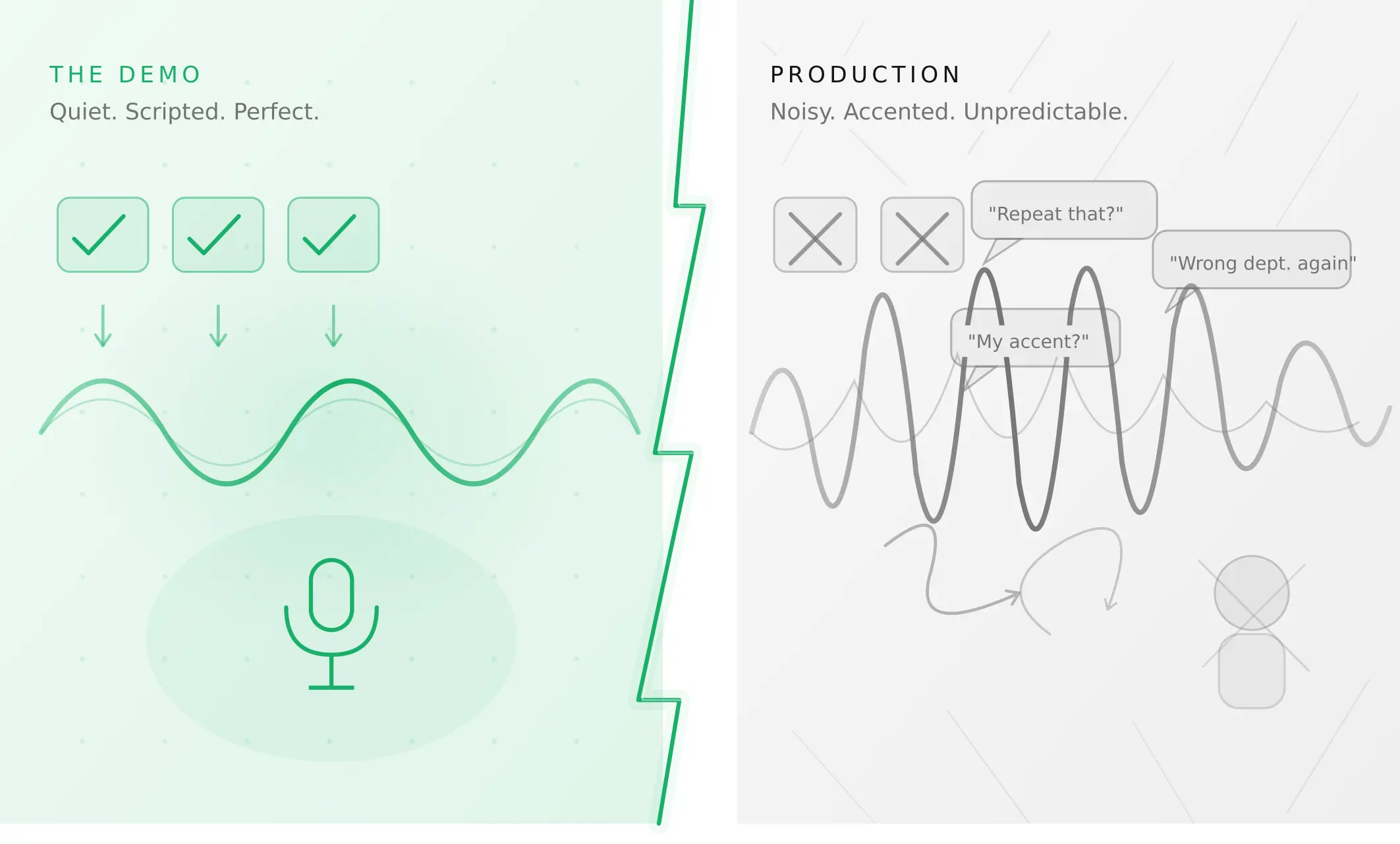
Why AI voice agents fail in production (and how to prevent it)
AI voice agents that ace demos still break in production. Learn the 5 root causes, how to test for each, and what production readiness actually means.
Read more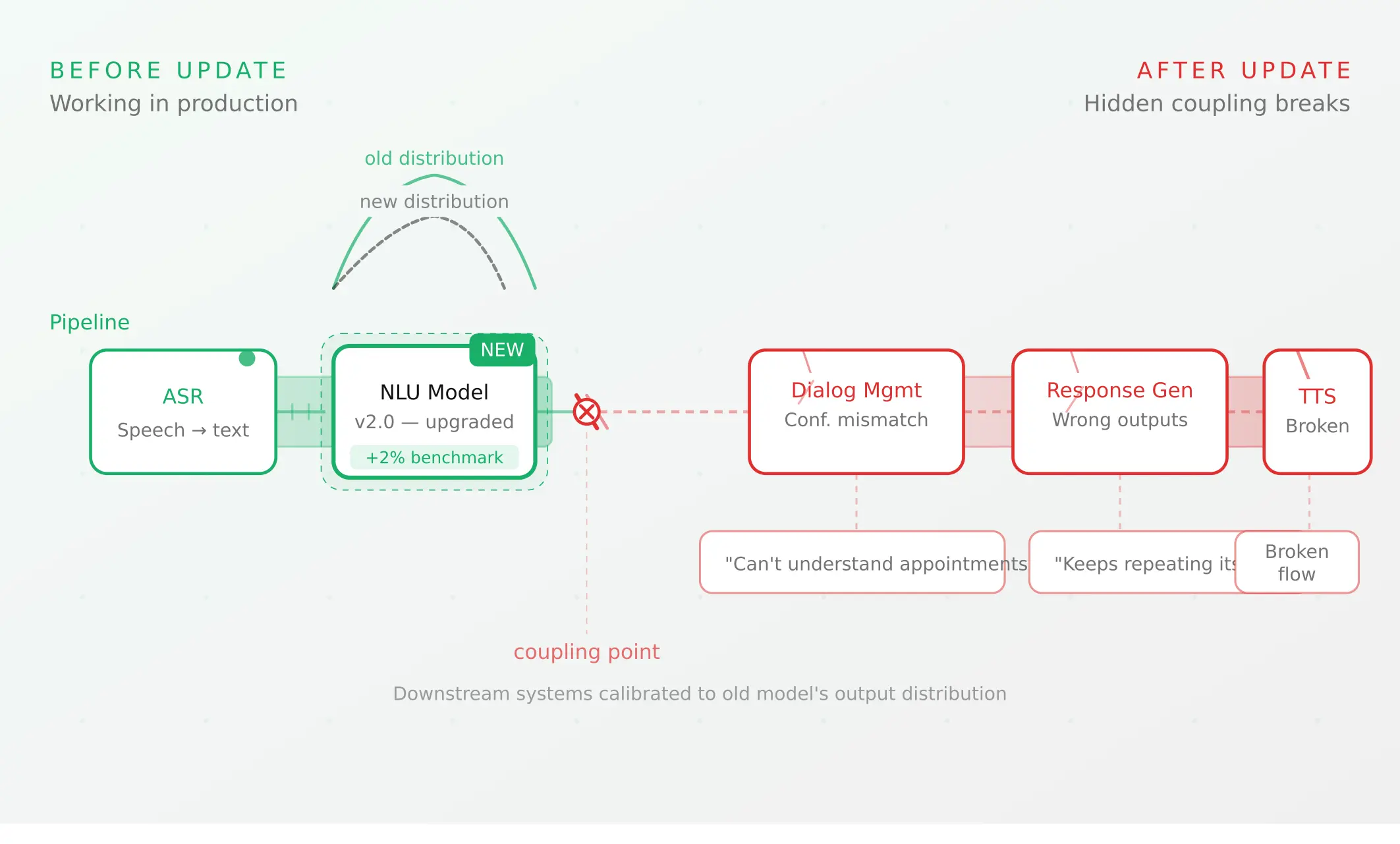
Voice agent regression testing: why LLM updates break production
LLM updates improve benchmarks but break voice agents in 5 predictable ways. How to detect and prevent regressions after every model or prompt change.
Read more