Moving Company Scheduling Software With AI: What Breaks
On this page
Last verified October 18, 2026, against the SmartMoving help center, 49 CFR Part 375, 47 CFR 64.1200 and the PostgreSQL documentation.
This post is for the product team that owns the AI booking agent inside moving company scheduling software. Your agent takes the call, builds the job and writes it to the dispatch board. Then a foreman shows up on Saturday with a truck that was promised twice.
Other posts cover the rest of the call. The moving receptionist QA playbook is the pillar. Price errors live in AI moving estimate accuracy. Bad CRM records live in moving AI lead quality. This post covers one step only: the write into the schedule.
What an AI booking writes into moving company scheduling software
Booking record: the set of fields an AI agent writes to the schedule. It holds a date, an arrival window, a truck, a crew, stops, storage dates and a deposit state.
A moving job is not a 30-minute appointment. It consumes a truck and three or four people for most of a day. That makes moving crew scheduling and truck dispatch one problem, not two. Every field the agent writes has a consumer downstream.
| Field | Captured from | Consumer | What a wrong value breaks |
|---|---|---|---|
| Move date | "the Saturday after next" | Dispatch board | Wrong day, or a full day overbooked |
| Arrival window | "first thing, like eight" | Customer, crew | Crew late on paper, angry customer |
| Inventory | Room-by-room list | Crew size, truck size | Short crew, overtime, second trip |
| Access | Stairs, elevator, long carry | Job hours | Under-booked hours, next job late |
| Stops | Pickup, drop, extra pickup | Route and hours | A stop nobody plans for |
| Storage-in-transit | "store it for three weeks" | Warehouse, notices | Wrong conversion date |
| Deposit | Card on call or link | Booking status | Unpaid hold blocks a truck |
Look at how one vendor models this. SmartMoving's dispatch setup guide organises scheduling into slots, with a truck assigned to each slot. Its four preset arrival windows are TBD, 8–9 a.m., 10 a.m.–12 p.m. and 1–3 p.m. Crews also get a separate "time to arrive" that customers never see. When multiple truck and crew assignments are disabled, "each truck and crew member can only be assigned to a single slot each day." Its Smart Scout article says the assistant can "create new leads and opportunities in SmartMoving in real time."
Most guides to moving company scheduling software AI features list what the agent can do. Few cover what it writes wrong. That last part is the point. Once an AI writes in real time, the voice call becomes part of your scheduling engine's write path.
Six ways the schedule breaks
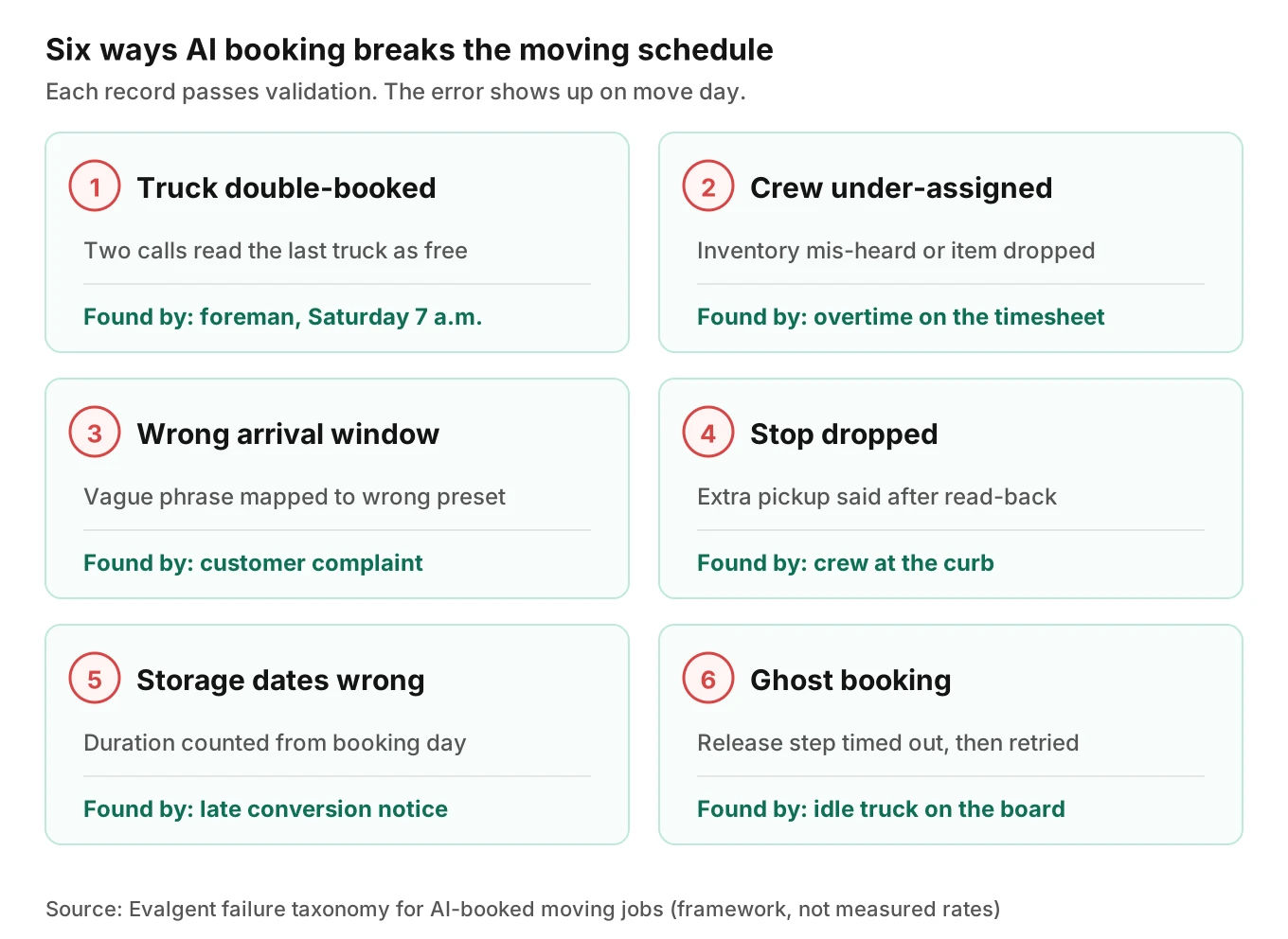
Each failure below starts in speech or in timing. None of them throws an error. The record looks valid until move day.
1. A truck double-booked on a peak day
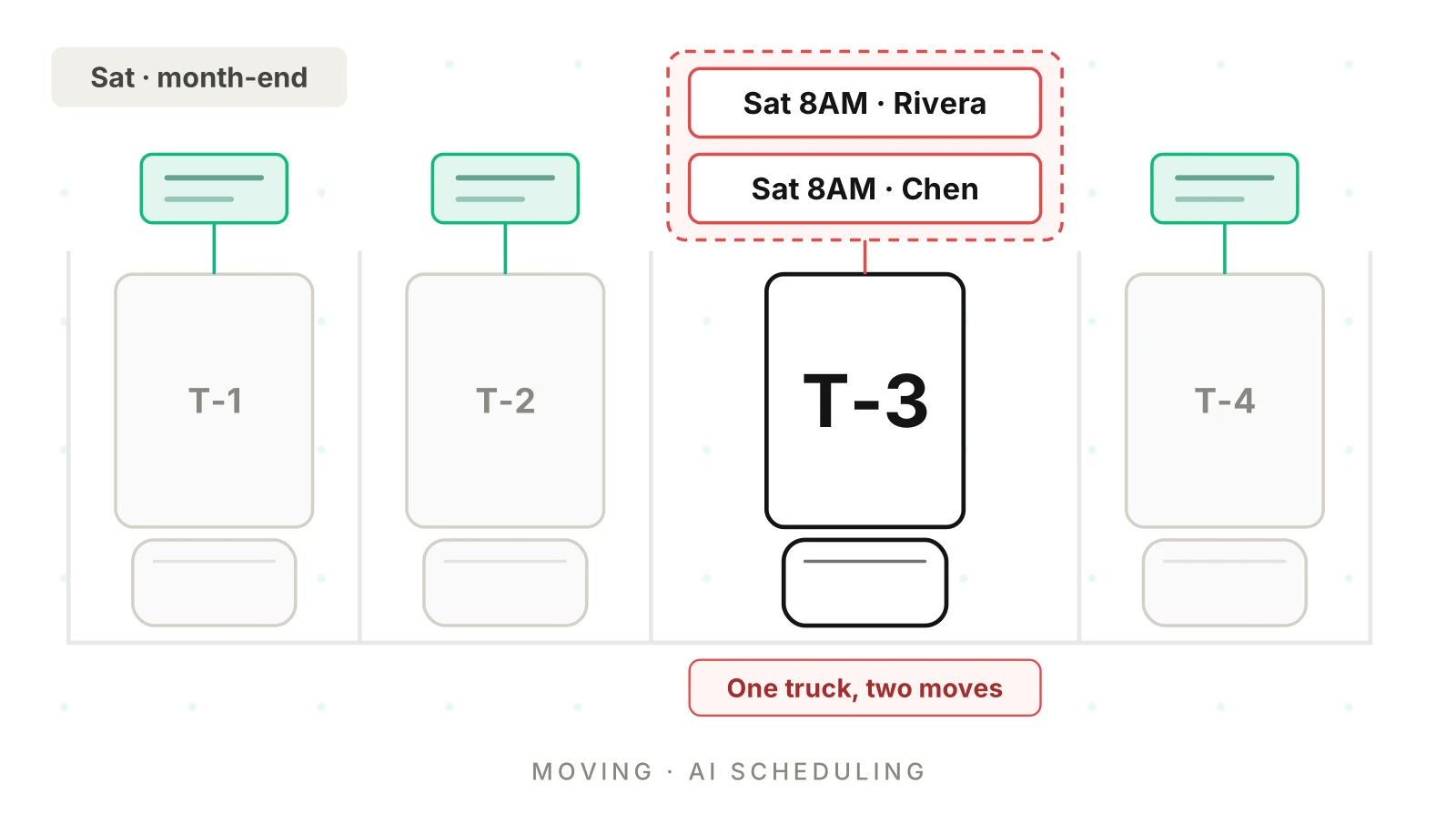
Two callers ask for Saturday at 8 a.m. on the last weekend of the month. Both agents check availability and see truck T-3 free. Both confirm. Both write. The board now shows one truck on two jobs, or the second write silently lands in an overflow slot nobody staffed.
This is a classic race condition: check, then act. A web form has the same race, but its window is seconds. A voice call stretches it to minutes, as the next section shows.
2. A crew under-assigned from mis-captured inventory
The caller says "three-bedroom, plus the piano in the basement." The agent writes "two-bedroom" and drops the piano. Your crew rule picks two movers and a 16-foot truck. On move day the foreman needs four people.
Spoken capture is hard. The SpokenWOZ benchmark built 5.7k human-to-human spoken dialogues from 249 hours of audio. Its best dialogue state tracker reached 25.65% joint goal accuracy. The authors name "cross-turn slot" detection as a new challenge. Inventory is exactly that: items mentioned across many turns.
3. The arrival window is wrong
"Early, like eight-ish, but not before" can map to 8–9 a.m. or to TBD. "Afternoon is fine" might mean 1–3 p.m. or "any time after noon." The agent has to pick from a fixed list. If it picks the crew's internal start time instead of the customer window, the customer hears a promise nobody made.
4. A multi-stop move loses a stop
"We're picking up from my mom's place on the way" arrives in minute six, after the agent has already read back the job. Many flows only collect one origin and one destination. The second pickup ends up in a notes field, or nowhere. Hours and route ignore it.
5. Storage-in-transit dates are wrong
Storage-in-transit has legal timing attached. Under 49 CFR 375.609, an interstate mover must notify the shipper in writing of "the date of conversion to permanent storage." The notice goes out at least 10 days before the storage period ends. If the agent writes "three weeks" as 21 days from booking instead of from pickup, every downstream notice is off.
6. A reschedule leaves a ghost booking
The customer moves from the 28th to the 30th. The agent creates the new job, then tries to release the old one. The release call times out. The agent retries the whole tool, so now there are two new jobs and one old one. Two trucks sit blocked for a move that needs one.
Why voice turns a rare race into a weekly incident
The danger in voice is the gap between read and write. An agent reads availability at minute two. It reads back the details, takes a deposit and writes at minute six. Your critical section is four minutes long, not 40 milliseconds.
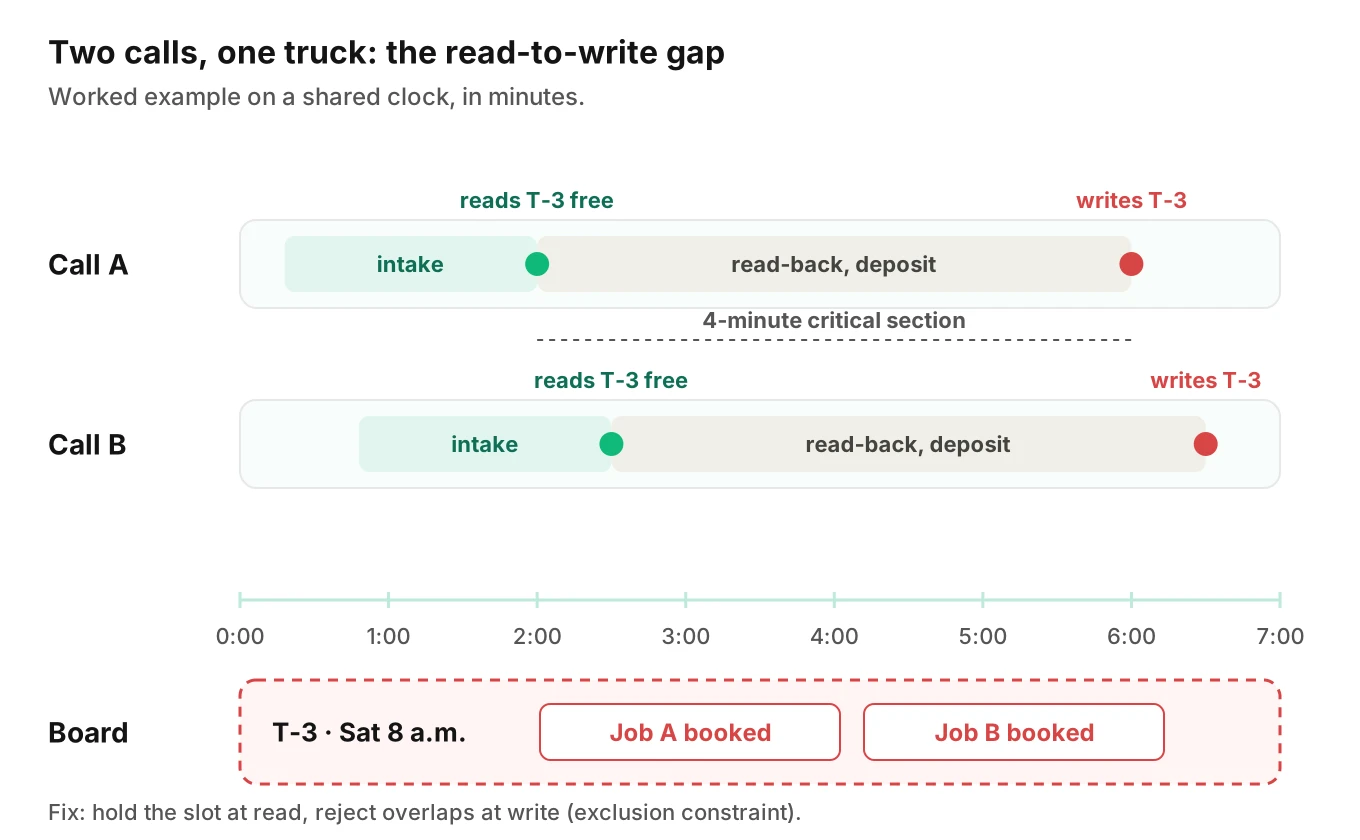
Here is a worked example with illustrative assumptions. Say the last free truck on a Saturday gets requests at a rate λ. A collision needs a second request inside the four-minute window. With random arrivals, P(collision) = 1 − e^(−λ·d).
- Normal Saturday: λ = 3 requests per hour for that slot, d = 4 min = 0.067 h. P = 1 − e^(−0.2) ≈ 18%.
- Month-end Saturday in August: Lugg's data via Stacker puts August about 23% above an average month. The last three days of a month run about 16% busier. Multiply: 3 × 1.23 × 1.16 ≈ 4.3 per hour. P = 1 − e^(−0.29) ≈ 25%.
The λ values are assumptions, not measured rates. The shape is what matters. Peak days raise the odds on exactly the days with the least slack. A human dispatcher catches some of these by eye. Weekends often have no dispatcher on shift.
The fix: hold at read, enforce at write
Use two layers. First, place a short hold when the agent offers a slot. Second, let the database reject overlaps no matter what the agent believes. PostgreSQL's range types documentation shows an exclusion constraint for exactly this. With `btree_gist` installed, it rejects overlapping ranges for the same key.
-- Simplified. One row per truck assignment, holds included.
CREATE EXTENSION IF NOT EXISTS btree_gist;

CREATE TABLE truck_assignment (
  id          bigserial PRIMARY KEY,
  tenant_id   bigint    NOT NULL,
  truck_id    bigint    NOT NULL,
  job_id      bigint,
  status      text      NOT NULL CHECK (status IN ('hold','booked')),
  during      tstzrange NOT NULL,
  expires_at  timestamptz,           -- set for holds only
  EXCLUDE USING GIST (truck_id WITH =, during WITH &&)
);
The second insert for the same truck and overlapping time fails with `conflicting key value violates exclusion constraint`. Your tool returns that as "slot just taken," and the agent offers the next one. Expired holds need a sweeper job, or the constraint will block a truck nobody is using. Apply the same pattern to crew members.
Inventory to crew size: build an oracle
You cannot test crew size by reading a transcript. You need an oracle: code that computes the correct crew, truck assignment and hours from a known inventory in cubic feet. Then you compare it to what the agent wrote.
Every mover sets these rules differently. Treat the numbers below as one tenant's illustrative config, not an industry standard.
# Simplified oracle. Rules are per-tenant config; values are illustrative.
RULES = {
    "cuft_per_mover_hour": 100,
    "trucks": [(800, "16ft"), (1300, "20ft"), (1700, "26ft")],
    "hours_per_flight": 0.25,
    "hours_per_50ft_carry": 0.25,
    "max_day_hours": 8,
}

def expected_job(cuft, flights, long_carry_ft, has_piano):
    access = flights * RULES["hours_per_flight"] + (long_carry_ft // 50) * RULES["hours_per_50ft_carry"]
    movers = 2
    while True:
        hours = cuft / (RULES["cuft_per_mover_hour"] * movers) + access
        if hours <= RULES["max_day_hours"] or movers == 6:
            break
        movers += 1
    if has_piano:
        movers = max(movers + 1, 3)   # tenant rule: piano adds one mover
    truck = next((t for cap, t in RULES["trucks"] if cuft <= cap), "two trucks")
    return {"movers": movers, "truck": truck, "hours": round(hours, 1)}

def diff_booking(booked, reference):
    exp = expected_job(**reference)
    return {k: (booked[k], exp[k]) for k in ("movers", "truck") if booked[k] != exp[k]}

# diff_booking({"movers": 2, "truck": "16ft"},
#              {"cuft": 1100, "flights": 2, "long_carry_ft": 75, "has_piano": True})
# -> {'movers': (2, 3), 'truck': ('16ft', '20ft')}
The scripted caller in your test knows the true inventory. It describes it the way people do: "the usual stuff," a correction two turns later, a piano mentioned last. The oracle computes the right job from the true inventory. Any mismatch with the booked job is a failure with a cause you can trace.
This also separates two bugs that look alike. If the captured inventory is wrong, it is a speech capture bug. If the inventory is right but the crew is wrong, it is a config or rule bug. Our HVAC wrong-tech post uses the same split for skill matching.
Arrival windows, stops and storage dates
These three fail quietly because each one passes schema validation.
Arrival windows. Map spoken phrases to the tenant's window list in code, not in the prompt. Keep a phrase table per tenant: "first thing," "early," "after lunch," "whenever." Test each phrase with fast talkers and with interruptions. Assert the stored window ID, not the agent's spoken summary.
Multi-stop moves. Model stops as an ordered list with a count. Ask "any other pickups or drop-offs?" before the read-back, not after. In tests, add the extra stop late in the call and after a correction. Assert the stop count and the hours delta.
Storage dates. Store the storage start as the pickup date and the duration in days. Compute the conversion date in code. Then check it against the 375.609 notice rule. A test case: pickup on the 30th, "about three weeks," booked on the 12th. The conversion date must key off the 30th.
Reasoning over dates is weak even in text. On the NATURAL PLAN benchmark, the best model scored 48.9% on calendar scheduling with five examples, and GPT-4 scored 41.2%. Those tasks were text, with all constraints given up front. A phone call adds speech errors on top. Do date math in code and let the model only fill slots.
Reschedules and cancellations without ghost bookings
A reschedule is one change, so make it one transaction. Do not run "create new" then "delete old" as two tool calls.
1. Update the existing assignment's `during` range in place, inside one transaction.
2. Pass an idempotency key per call and intent, so a retried tool call returns the first result.
3. On cancellation, release truck and crew holds in the same transaction as the status change.
4. Return the final state to the agent and have it read back the new date only after commit.
For interstate moves, the mover has duties when its own dates slip. Under 49 CFR 375.605, the mover must notify the shipper "as soon as the delay becomes apparent" and keep a written record of the amended date. If your agent handles mover-initiated changes, log the date, time and manner of each notice. This is not legal advice; check the rules with counsel.
Weather reschedules stress this path hardest, because many jobs move at once. Our rain-day rescheduling post covers that bulk case.
Confirmation calls and TCPA
Many movers want the agent to place a confirmation call two days out. That is an outbound call with an artificial voice. Under 47 CFR 64.1200(a)(1)(iii), such calls to a cell phone need the called party's prior express consent unless an exception applies. The FCC's February 2024 ruling (FCC 24-17) confirmed that AI-generated voices count as "artificial" voices under the TCPA.
Revocation rules are moving. FCC 26-67 was adopted September 30 and released October 1, 2026. It narrows "revoke-all" for informational calls and lets callers name exclusive opt-out methods, per Kelley Drye and Nixon Peabody. It takes effect 30 days after Federal Register publication, which had not happened as of October 7. The 11th Circuit vacated the one-to-one consent rule on January 24, 2025. This is not legal advice.
For testing, the practical checks are simple. Store consent with the booking. Block the call when it is missing. Honor "stop calling me" mid-call and write it back. Our outbound voice agent testing guide and TCPA pre-dial checks go deeper.
The peak-day booking matrix
Here is a copyable test matrix. Rows are scenarios. Columns are conditions. Run every cell against a fixture schedule for a month-end Saturday in August, with one truck left.
| Scenario | Clean audio | Truck noise, fast talker | Mid-sentence correction | Concurrent caller | Tool timeout |
|---|---|---|---|---|---|
| Last truck, 8 a.m. window | Book | Book | Book | One books, one offered next | No duplicate |
| Three-bed plus piano | Oracle crew | Oracle crew | Correction kept | n/a | n/a |
| Extra pickup in minute six | 2 stops | 2 stops | 2 stops | n/a | n/a |
| Storage three weeks | Date from pickup | Same | Same | n/a | n/a |
| Reschedule 28th to 30th | One job | One job | One job | Old slot freed once | No ghost |
| Cancel with deposit paid | Released | Released | Released | n/a | No ghost |
Each cell has an assertion on the stored record, not on the transcript. Run each cell several times. The tau-bench paper found that function-calling agents succeeded on fewer than 50% of tasks and that pass^8 in retail fell below 25%. Pass^8 means all eight repeated trials succeed. A booking flow that works once in a demo can still fail one Saturday in five.
How to test AI booking in moving company scheduling software
1. Build schedule fixtures. Create a month-end Saturday in August with one truck free, one crew member on time off and two holds about to expire. Reset it before every run.
2. Write the oracle. Encode each tenant's crew, truck and hours rules in code. Feed it the true inventory from each test script.
3. Script real callers. Use late corrections, extra stops, vague windows and "same as last time." Vary accent, pace, background noise and interruptions.
4. Race the last truck. Start two simulated calls for the same slot 30 seconds apart. Assert exactly one booking and one alternative offer.
5. Break the tools. Inject a timeout on the release step of a reschedule. Assert one job, one truck, no ghost.
6. Assert the stored record. Diff the scheduling database against expected values per field. Ignore what the agent said it did.
7. Repeat and gate. Run each case at least eight times. Block the release if any cell fails, and rerun the matrix for every tenant config change.
Evalgent can generate scenarios like these from your agent's prompt and flows, including branches and coverage gaps. It runs caller profiles with accent, pace, interruptions and background noise over phone, SIP or WebRTC. It judges from the audio, not only the transcript. Teams can add custom metrics such as "stored stop count matches script." For rollout across many movers, see testing one agent across hundreds of tenant setups and the go-live checklist.
Monitoring booked vs actual crew hours
Tests catch known failures. Production shows you the rest. The single best signal for a moving AI booking agent is the ratio of actual crew hours to booked crew hours.
Take a worked example. The agent booked 3 movers for 5 hours, so 15 crew hours. The timesheet shows 3 movers for 7.5 hours, so 22.5 crew hours. The ratio is 1.5. One job proves nothing. A tenant whose AI-booked jobs run at 1.3 while its human-booked jobs run at 1.05 has a capture problem.
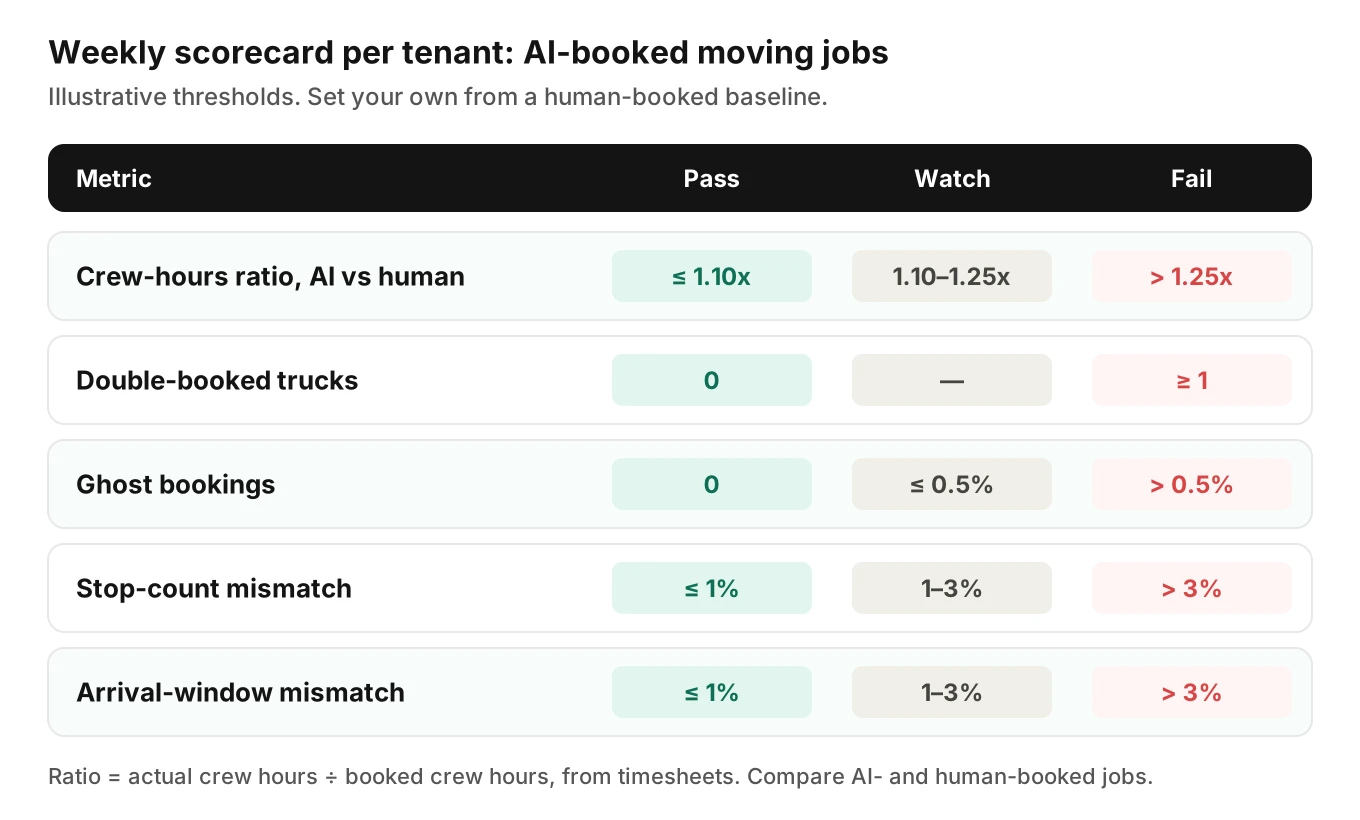
Track five numbers per tenant per week:
- Crew-hours ratio: actual divided by booked, AI-booked versus human-booked jobs.
- Double-booked trucks: overlaps found at dispatch publish time. The target is zero.
- Ghost bookings: jobs with no customer contact and a sibling job for the same customer.
- Stop-count mismatch: stops on the bill of lading versus stops booked.
- Window mismatch: stored window versus the window the customer heard on the call.
The last one needs the recording. A transcript may say "eight to nine" while the caller heard "eight to ten" through a crosstalk overlap. Evalgent's production monitoring takes pushed call recordings, transcribes them, maps each call to a scenario and judges it. It flags tool-call failures, latency spikes and policy failures, with fix recommendations. Pair those flags with timesheet data and you can tell a speech miss from a rule miss.
For more on scheduling metrics in general, see voice agent testing for appointment scheduling.
Frequently asked questions
What is moving company scheduling software?
Moving company scheduling software assigns trucks, crews and arrival windows to moving jobs on a calendar. It tracks crew availability, time off and truck slots. Many platforms now let an AI phone agent create jobs directly. That makes the voice call part of the scheduling write path, so speech errors become schedule errors.
How do you prevent double booking trucks for movers?
Preventing double booking trucks for movers takes two layers. Place a short hold on the truck when the agent offers a slot. Then enforce non-overlap in the database, for example with a PostgreSQL exclusion constraint on truck ID and time range. Test it by racing two simulated calls for the last truck on a peak day.
How should an AI agent decide crew size for a move?
An AI agent should never decide crew size by itself. It should capture inventory, stairs, long carry and special items, then pass them to a rule engine set by each mover. Test the result against an oracle that computes the correct crew from the true inventory in each test script.
Can an AI phone agent book moving jobs directly into the schedule?
An AI phone agent can book moving jobs directly into the schedule when the platform exposes a booking tool. SmartMoving, for example, documents an assistant that creates leads and opportunities in real time. Direct writes need holds, overlap constraints, idempotency keys and stored-record assertions in testing.
How do you handle multi-stop moves in scheduling software?
Multi-stop moves need stops stored as an ordered list with a count, not as free-text notes. The agent should ask about extra pickups and drop-offs before the read-back. Tests should add a stop late in the call and assert the stored stop count and the added job hours.
What happens to the schedule when a customer reschedules a move with AI?
A reschedule by AI should update the existing booking in one transaction. If the agent creates a new job and then fails to release the old one, a ghost booking blocks a truck and crew. Idempotency keys stop retries from creating duplicate jobs.
Do AI moving confirmation calls need TCPA consent?
AI moving confirmation calls use an artificial voice under FCC 24-17. Under 47 CFR 64.1200(a)(1)(iii), such calls to cell phones need prior express consent unless an exception applies. FCC 26-67 changes revocation rules once effective. Store consent with the booking. This is not legal advice.
How do you test moving scheduling software before peak season?
Testing moving scheduling software before peak season starts with a month-end August Saturday fixture with one truck left. Race concurrent callers, inject tool timeouts on reschedules and check crew size against an oracle. Run each case at least eight times and assert the stored record, not the transcript.
The bottom line
AI booking agents fail in moving company scheduling software at the write, not in the conversation. Hold the slot at read, enforce overlaps in the database, check crew size with an oracle and watch booked versus actual crew hours.
Related Articles

How to automate voice agent testing: synthetic callers vs manual QA
Learn how ai test automation replaces manual QA for voice agents. Compare synthetic callers vs human testers, with a 5-step framework to scale without hiring.
Read more
AI Agent Testing vs Voice Agent Testing: What General Tools Miss for Voice
AI agent testing measures text outputs. Voice agent testing measures behaviour through an acoustic pipeline. Five failure categories general tools miss.
Read more