Rain-Day Reschedules by AI: Test Before Your Route Breaks
On this page
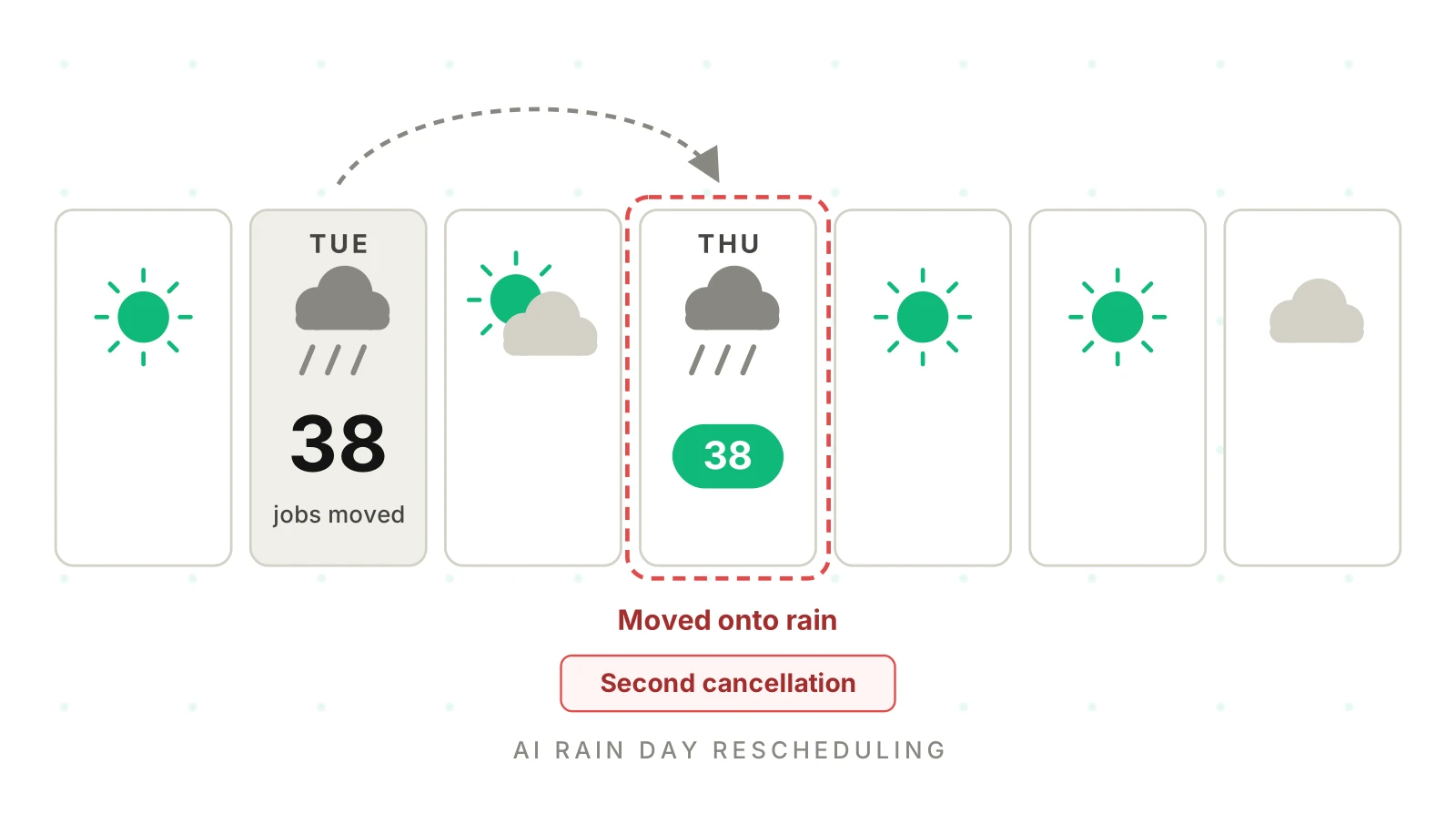
Rain cancels a Tuesday: 38 lawns, two crews, one neighborhood. Your AI agent must reach every customer and find each a new slot. Most teams test this with three calls on a sunny afternoon. The real test is 200 customers moving at once, with Thursday also looking wet.
This post is for product teams building AI rescheduling for field service and quoting software. Your voice agent reschedules visits for many lawn care, cleaning and exterior service businesses. Pricing on the same calls is covered in our post on AI quote accuracy for lawn and cleaning.
What a rain day reschedule actually changes
A booking call creates one record. A rain day reschedule edits many records that already exist. Each one belongs to a recurring series, a crew, a route and a customer with preferences. The call is the front door to a four-step workflow:
1. Capture. The customer accepts a new day, declines, or asks to skip this week.
2. System action. The agent moves one occurrence, skips it, or (rarely) shifts the series.
3. Confirmation. The agent reads back the new date and window.
4. Write-back. The schedule, route and reminder jobs all reflect the change.
A speech error at step 1 corrupts step 4 silently. "Not Thursday, I'm out Thursday" can be stored as Thursday. "Just skip it this week" can become "cancel." The call sounds fine. The transcript looks fine. The schedule is wrong.
The category exists today. QuoteIQ's overview article describes a "Virtual Call Team" that "answers calls 24/7, qualifies leads, takes messages, and can make outbound calls." The same article lists "Route Optimization + Route Density Zones" and serves "lawn care and landscaping" and "house cleaning and maid services." It does not describe weather-based rescheduling.
Route density: the number of stops a crew can serve per hour of drive time in one area. Lawn and cleaning margins depend on it. A reschedule that ignores it can be correct for the customer and wrong for the business.
A mass reschedule is routine in this trade. One Jobber user described moving 75 to 100 jobs to the next day when it rains. Jobber's Move Visits article lists "inclement weather" as a reason to bulk-move visits. It also says: "Visits will not move if there is a duplicate of another visit on the day that you're shifting to." Your agent needs the same guard, and you need a test that proves it.
Seven ways AI rain day rescheduling breaks a route
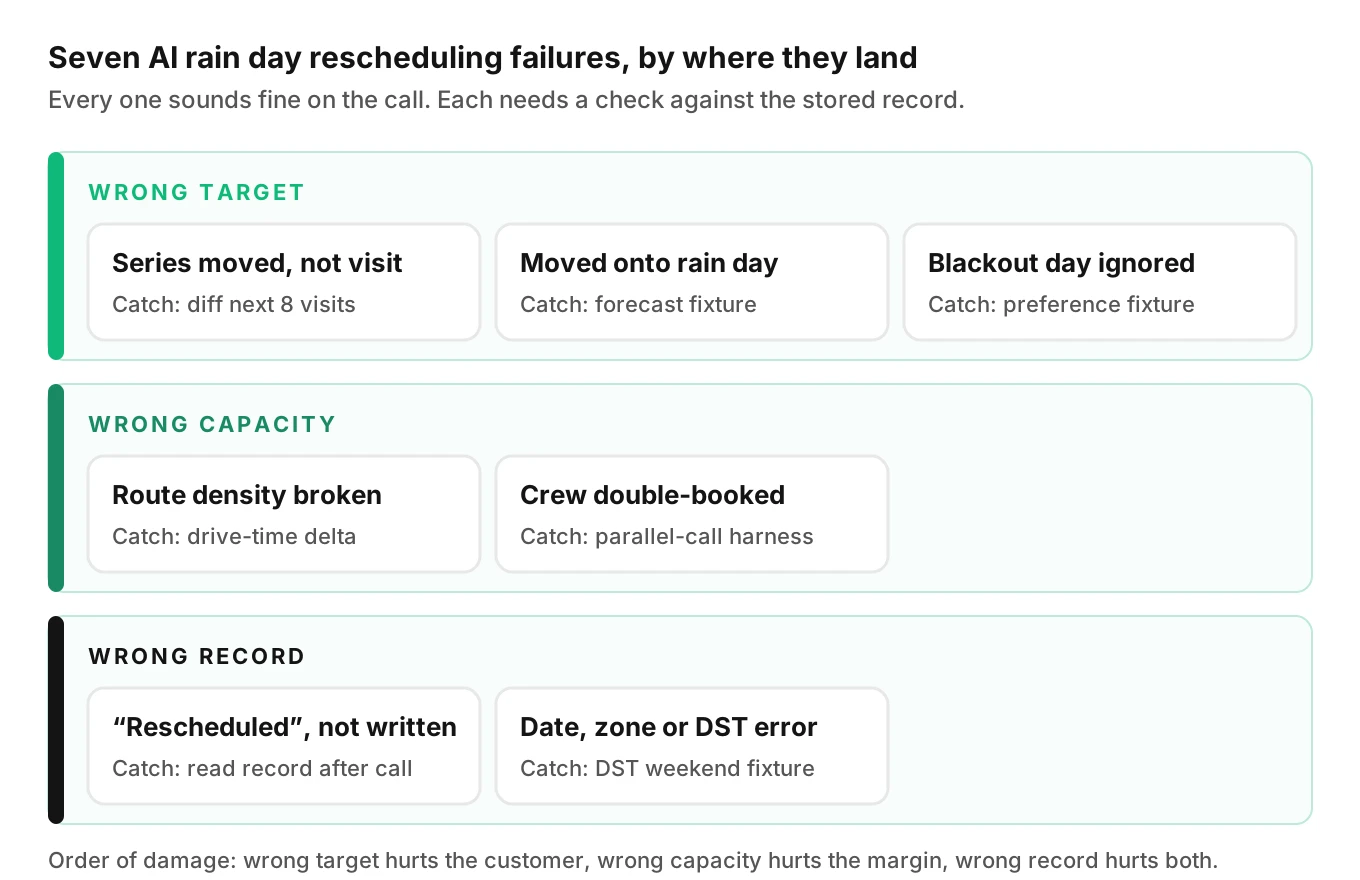
Each failure below passes a casual listen. Each needs a check against the stored record, not the transcript.
| Failure | What the customer hears | What the system stores | How to catch it |
|---|---|---|---|
| Series moved, not visit | "Moved you to Thursday" | Every future visit now on Thursday | Diff the next 8 occurrences |
| Moved onto another rain day | "See you Thursday" | Thursday at 70% rain chance | Forecast fixture check |
| Route density broken | "Thursday at 9" | Stop added to a crew across town | Drive-time delta per crew |
| Crew double-booked | "You're confirmed" | Two jobs, one crew, same window | Capacity check after commit |
| Told "rescheduled," no write-back | "All set" | Original Tuesday visit unchanged | Read the record after the call |
| Date or time zone error | "Monday the 2nd" | Sunday the 1st, or 8:00 not 7:00 | DST and zone fixtures |
| Blackout day ignored | "Friday works" | Friday, which the customer blocked | Preference fixtures |
The research explains why these appear under load. In NATURAL PLAN, Google DeepMind researchers gave models a calendar scheduling task with busy attendees and time constraints. The best 5-shot result was 48.9% (Gemini 1.5 Pro). GPT-4 scored 41.2%. The task was text-only, with no tools. Your agent has a scheduling API, which helps. It still has to choose among slots, and that choice is where errors live. The tau-bench paper adds the reliability angle. Agents were "quite inconsistent (pass^8 <25% in retail)." The same request run eight times did not reliably succeed every time. A rain day runs your agent hundreds of times in an hour.
Series versus occurrence: the most expensive mistake
Agents that reschedule recurring visits need to know which thing they are moving. Calendar standards already separate these two edits. RFC 5545's RECURRENCE-ID allows "the reference to an individual instance within the recurrence set." Adding `RANGE=THISANDFUTURE` applies the change to "the given recurrence instance and all subsequent instances." One parameter separates "move this mow" from "move every mow until November."
Your API likely has `scope=occurrence` versus `scope=series`. The agent picks the scope from language. "Can you do Thursday instead?" means this visit. "Can you just switch me to Thursdays?" means the series. "Thursday is better for me" is ambiguous. The agent should ask, not guess.
Default to the occurrence, require explicit confirmation for any series change, and test with borderline phrases.
Skip or shift: a business rule, not a model choice
Some businesses skip a rained-out visit. Others shift it. Service Autopilot's rain delay article splits it by billing. Under a contract, "you'll get paid regardless," so skipping can work. For pay-as-you-go customers, it advises against skipping. Your agent should read this rule from tenant config, per service plan. It should never infer it from the conversation.
Order matters too. On lawn care rain days, a Turf Magazine piece on weather disruptions warns that "First missed, first mowed sounds good in theory, but generates the greatest number of complaints in practice." If your agent offers slots first-come, first-served, it is running that exact policy by default. Make the ordering rule explicit and testable.
Forecast fixtures: never move a job onto another rain day
Weather rescheduling starts with data, not dialogue. The agent's slot finder needs a forecast. In the US, many teams pull it from the National Weather Service API. The NWS API documentation offers a "forecast for 12h periods over the next seven days" and an hourly version. It requires a User-Agent and applies rate limits that are not published.
Probability of precipitation is not "will it rain." NWS defines PoP as forecaster certainty times expected areal coverage. Its PoP explainer says 40% means "a 40% chance of rain at any point in the county." Each business needs its own threshold. A mowing company may block days above 50%. An exterior window cleaner may block any day above 30%. Store the threshold per tenant and per service type.
Forecasts change between call and visit. A slot that was dry at 8:00 can be wet by 14:00. Live forecasts make tests flaky, so freeze them. A forecast fixture is a stored seven-day forecast the slot finder reads in tests.
# Simplified forecast fixture for tests. Values are illustrative.
FORECAST_WEEK_OCT26 = {
    "zone": "north",
    "periods": [
        {"date": "2026-10-26", "pop": 10},
        {"date": "2026-10-27", "pop": 90},  # the rain day
        {"date": "2026-10-28", "pop": 20},
        {"date": "2026-10-29", "pop": 70},  # trap: second rain day
        {"date": "2026-10-30", "pop": 10},
        {"date": "2026-10-31", "pop": 0},
        {"date": "2026-11-01", "pop": 0},   # DST ends at 2 a.m.
    ],
}
Build at least four fixtures: one rain day, two rain days in a row, the nearest dry day on a blackout day, and a forecast that flips after the call. The last one tests your re-check job, not the agent.
Route density: worked math for one moved day
Here is an illustrative example. All numbers are assumptions, not measurements.
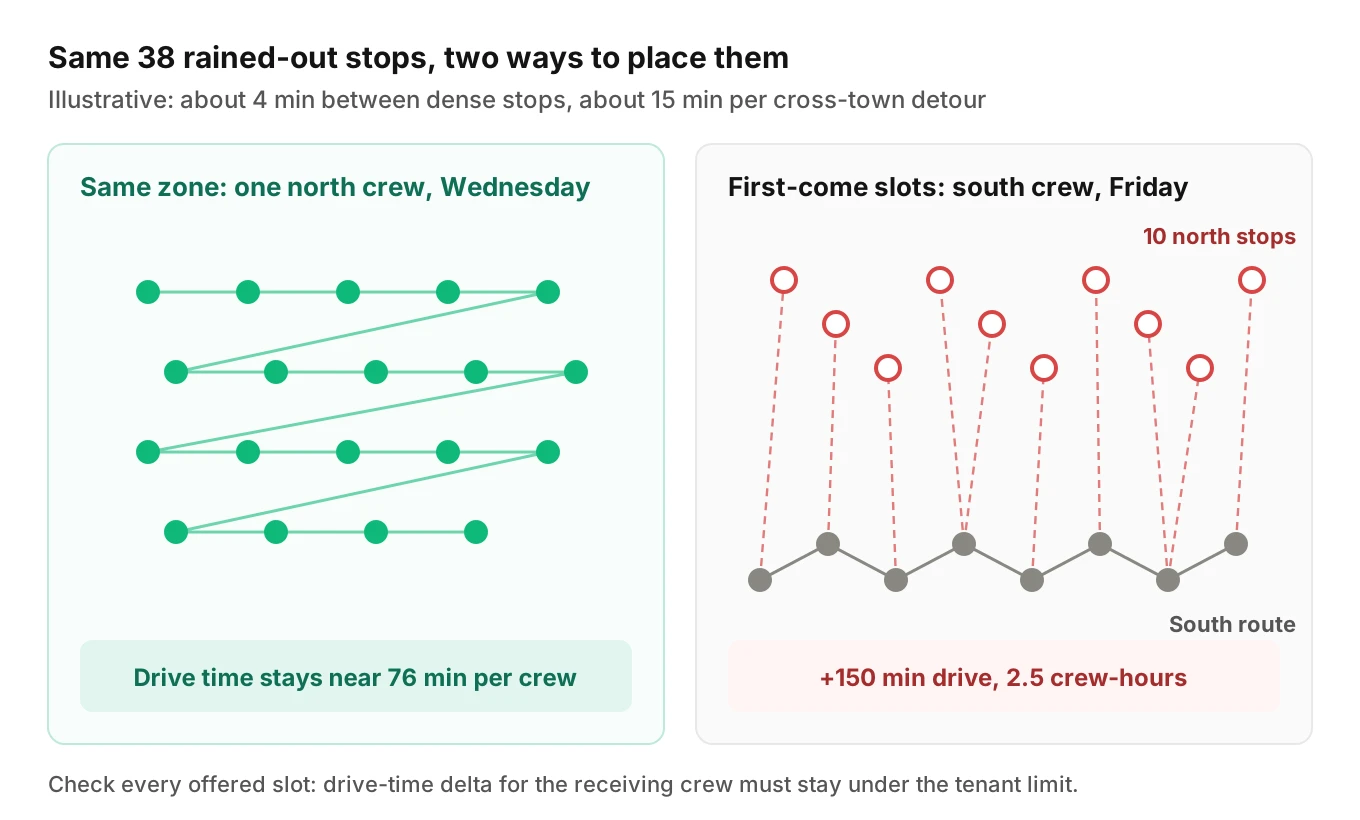
A lawn company runs two crews in the north zone on Tuesdays. Each crew serves 19 stops. Stops sit about 4 minutes apart, so drive time is about 76 minutes per crew. The agent moves all 38 stops after Tuesday rain.
Good outcome. All 38 go to Wednesday in the north zone. Drive time stays near 76 minutes per crew.
Bad outcome. The agent fills slots first-come, first-served across the city. Ten stops land on a south-zone crew's Friday. Each adds a cross-town detour of about 15 minutes. That is 150 extra minutes, or 2.5 crew-hours, for ten mows.
At an assumed $60 per crew-hour, that is $150 lost on one day for one tenant. No customer complains, because every customer was told the truth. The damage shows up as margin, not as a ticket.
The check is simple. For every proposed slot, compute the drive-time delta for the receiving crew. Reject slots above a tenant threshold, such as 10 minutes. Prefer same-zone, same-crew days. Then test that the agent's offers come from that filtered list.
Concurrency: 200 customers want Thursday at once
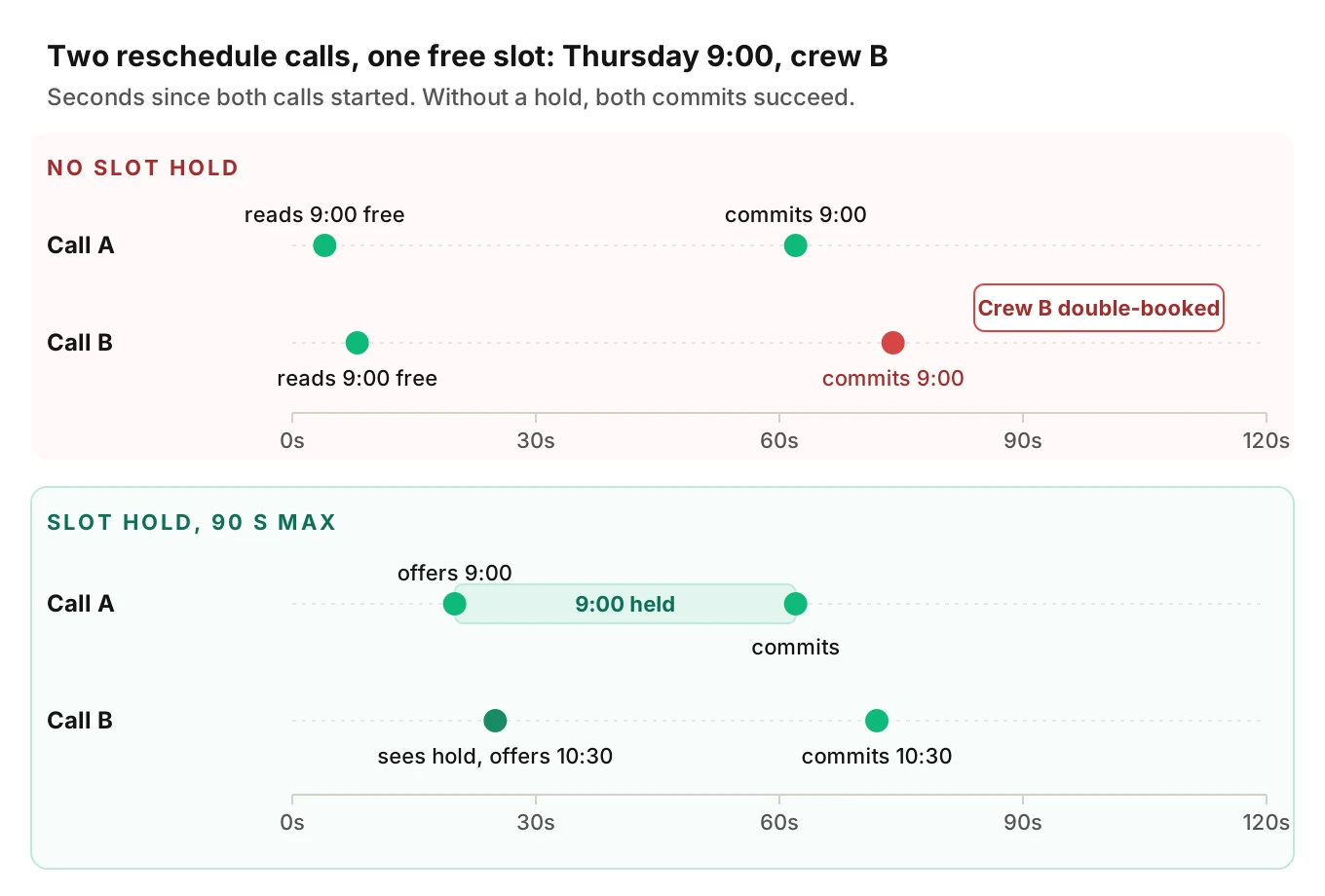
A rain day is a burst of inbound and outbound calls that all read the same free slots. Without a lock, two calls can book the last Thursday 9:00 slot on the same crew. Our post on auto repair booking errors covers the race pattern in depth. Here is what is different on a rain day.
Outbound pacing is limited. Twilio says "each Twilio account can make 1 outgoing call per-second (CPS)" by default. Calls above the rate "will be queued." On an Elastic SIP Trunk, they fail with a 503 instead. A queued call reaches the customer later than your slot snapshot assumed.
Concurrent calls follow Little's law. Say one tenant needs to reach 228 customers in 30 minutes. That arrival rate is 228 ÷ 1,800 s ≈ 0.127 calls per second. Assume each answered call lasts 90 seconds. Concurrent calls L = λ × W = 0.127 × 90 ≈ 11.4. So you need about 12 live agent sessions for one tenant. Ten tenants in one storm need about 114. Our guide to concurrency failure in voice agents explains what breaks at that level.
Holds must expire, and commits must be idempotent. Hold a slot briefly when the agent offers it, and release it on decline or hang-up. Commit with an idempotency key built from visit ID and target date, so a retried tool call cannot create a second visit.
A validator the agent's tool call must pass
Do not trust the agent to remember every rule. Put the rules in code that runs before any write. This is simplified. Your field names will differ.
# Simplified pre-commit validator for a reschedule tool call.
from datetime import datetime, timedelta
from zoneinfo import ZoneInfo

def validate_reschedule(req, visit, tenant, forecast, crew_load):
    errors = []
    tz = ZoneInfo(tenant["timezone"])            # e.g. "America/Chicago"
    new_start = datetime.fromisoformat(req["new_start"]).replace(tzinfo=tz)

    if req["scope"] != "occurrence" and not req.get("series_confirmed"):
        errors.append("series change without explicit confirmation")
    pop = forecast.get(new_start.date().isoformat(), 100)
    if pop > tenant["rain_pop_threshold"][visit["service_type"]]:
        errors.append(f"target day PoP {pop}% over threshold")
    if new_start.strftime("%a") in visit["customer_blackout_days"]:
        errors.append("customer blackout day")
    crew = crew_load[(req["crew_id"], new_start.date())]
    if crew["booked_minutes"] + visit["duration_min"] > crew["capacity_minutes"]:
        errors.append("crew over capacity")
    if crew["drive_delta_min"](visit["location"]) > tenant["max_drive_delta_min"]:
        errors.append("route density: drive delta over limit")
    if new_start.date() <= visit["original_start"].date():
        errors.append("target not after rained-out date")
    return errors  # empty list means safe to commit
Return the errors to the agent as plain facts: "Thursday is blocked for rain. Wednesday 10:30 is open." Our guide to tool call accuracy for voice agents covers scoring the arguments the agent sends.
Dates, time zones and the DST weekend
Fall rain and the end of daylight saving time overlap. NIST says the US returns to standard time "on the first Sunday in November at 2 a.m. (local time)." In 2026 that is November 1. NIST also lists "most of Arizona" and Hawaii as places that do not observe DST.
Three bugs show up that week.
- Fixed-offset storage. A make-up visit for Monday, November 2 at 8:00 is stored with Friday's UTC offset. It renders as 7:00 after the change. The crew arrives an hour early.
- Relative dates. "Next Monday" said on Friday, October 30 should mean November 2. Models often resolve relative dates loosely. Google's Test of Time benchmark was built because LLMs "remain susceptible to errors, particularly in temporal reasoning tasks."
- Tenant versus server time zone. A Phoenix tenant and a Chicago tenant share one platform. The clock change applies to only one.
Python's zoneinfo docs show the safe pattern. Adding `timedelta(days=1)` to noon on October 31 in Los Angeles returns noon on November 1, with the PST offset. Store local date, local time and IANA zone. Convert to UTC only at the edge. Then put a DST-weekend fixture in every regression run.
Outbound notifications: calls, texts and TCPA
Rain day reschedules are often outbound. Calls using an artificial or prerecorded voice to a cell phone need prior express consent under 47 CFR 64.1200(a)(1). The FCC ruled in 2024 that AI-generated voices are "artificial" under the TCPA. A reschedule notice is informational. Add an upsell ("want aeration while we're there?") and it may become telemarketing, which needs prior express written consent.
Opt-out rules are changing. The FCC adopted a new revocation order, FCC 26-67, on September 30, 2026. Per RecordingLaw's summary, callers may treat an informational opt-out as covering only that category. They may also name exclusive opt-out methods if they disclose them clearly. Revocations must still be honored within ten business days. The order takes effect 30 days after Federal Register publication. As of Day Pitney's October 2 alert and RecordingLaw's October 8 check, it had not been published.
For testing: "stop calling me" must suppress reschedule calls in any phrasing. A suppressed customer's visit must still be moved by another permitted channel or flagged for the office. And no marketing may slip into an informational call. This is not legal advice. Check your consent flows with counsel. Our outbound voice agent testing guide covers consent checks and voicemail handling.
A rain day test matrix
Run every scenario against every condition. Score outcomes from the stored record.
| Scenario | Conditions to vary | Pass when |
|---|---|---|
| Accept first offered day | Accent, noisy yard, speakerphone | One occurrence moved, read back, written |
| "Switch me to Thursdays" | Fast speech, interrupts mid-offer | Series change only after explicit yes |
| Customer names a rain day | Fixture with two rain days | Agent declines it and offers a dry day |
| Customer names a blackout day | Preference fixture | Agent declines it and offers another |
| "Just skip it this week" | Contract vs pay-as-you-go plan | Tenant skip rule applied |
| Hangs up mid-confirm | Drop after slot offer | Hold released, original visit flagged |
| 200 parallel calls, one free slot | Concurrency harness | Exactly one commit, others re-offered |
| DST weekend make-up | Chicago and Phoenix tenants | Local time unchanged in stored record |
| "Stop calling me" | Mid-call, then via text | Suppression written, visit still handled |
Rain day calls are messy: people answer from a driveway, a car or a job site. Evalgent builds caller profiles with accent, speech pace, interruption level, response delay and background noise. It calls your agent over phone, SIP or WebRTC, so the audio path matches production. The multi-tenant testing guide explains how to sample tenants when each one has different rules.
How to test AI rain day rescheduling before every release
1. Freeze four forecast fixtures. Single rain day, back-to-back rain, dry day on a blackout day, and a flip after the call.
2. Seed real recurring series. Weekly, biweekly and every-four-weeks plans. Include customers with blackout days and preferred windows.
3. Load two tenants with different rules. One skips contract visits. One shifts every visit. Use different time zones.
4. Generate scenarios from the agent's prompt and flows. Cover occurrence, series, skip, decline, blackout, rain-on-rain and opt-out branches. Evalgent generates these from the agent's prompt, states and constraints, and flags coverage gaps.
5. Run each scenario under at least three caller profiles. Clean, noisy outdoor and fast interrupter.
6. Score the record, not the transcript. After each call, read the schedule. Check scope, date, crew, drive delta, forecast and reminders.
7. Run the concurrency harness. Fire 200 parallel reschedules at a day with limited slots. Expect zero double-bookings and zero duplicate visits.
8. Run the DST fixture. Book make-ups for November 2 from October 30. Confirm the stored local times.
9. Gate the release. Zero series moves without confirmation. Zero rain-on-rain. Zero write-back gaps. Any failure blocks the change.
Repeat failing scenarios several times; tau-bench's pass^k result shows why one pass proves little.
Monitoring the day after the storm
Production shows you the rest of what AI rain day rescheduling gets wrong. After every rain day, compare what the agent said, what the schedule stores and what the crew did. Track per tenant:
- Write-back gap rate. Confirmed on the call, unchanged in the record.
- Rain-on-rain rate. Moved visits that landed on a day later cancelled for weather.
- Series change rate. Near zero on rain days; a spike means scope errors.
- Drive-time delta. Route minutes per crew before and after the wave.
- Second-cancellation calls. Customers called twice in one week.
Evalgent's production monitoring can help here. Teams push call recordings. Calls are transcribed, mapped to scenarios and judged from the audio. Evalgent flags tool-call failures, latency spikes and policy failures with fix recommendations. The schedule comparison stays in your own data. For the general setup, see how to monitor voice agents in production.
For the wider picture, see our home services AI receptionist QA guide, roof inspection AI scheduling for storm-driven spikes, and the pool service AI receptionist post for another route-based trade.
Frequently asked questions
How do lawn care companies handle rain days?
Lawn care companies usually move rained-out visits to the next dry day, add Saturday or longer days, or skip contract visits. Service Autopilot suggests skipping contract jobs but not pay-as-you-go ones. Turf Magazine warns that strict first-missed, first-mowed ordering causes the most complaints. An AI agent must follow each business's rule, not invent one.
Should AI skip or shift a recurring visit after rain?
An AI agent should skip or shift a recurring visit based on the tenant's rule for that service plan, never on its own judgment. Contract plans may allow skipping. Pay-as-you-go plans usually shift. Either way, the agent should change one occurrence, not the whole series, unless the customer explicitly asks to change their regular day.
How do you test AI rescheduling before launch?
Test AI rescheduling with frozen forecast fixtures, seeded recurring series and tenants with different rules. Run scenarios under several caller profiles. Score the stored schedule, not the transcript. Add a concurrency test with parallel reschedules and a DST weekend fixture. Block release on any series move without confirmation, rain-on-rain booking or write-back gap.
Can an AI agent reschedule a whole route after rain?
An AI agent can reschedule a whole route after rain if every move passes a validator. The validator checks forecast, crew capacity, blackout days and drive-time delta. The agent handles the conversations. Code enforces the rules. Without that split, the agent fills open slots anywhere, and route density quietly collapses.
How many outbound calls can an AI make at once?
By default, each Twilio account can place one outgoing call per second, and extra API calls are queued. Concurrent calls depend on call length. By Little's law, reaching 228 customers in 30 minutes with 90-second calls needs about 12 simultaneous sessions. Load test at that level before a storm, not during one.
Do rain day reschedule calls need TCPA consent?
Rain day reschedule calls using an AI or prerecorded voice to cell phones need prior express consent under 47 CFR 64.1200(a)(1). The FCC treats AI voices as artificial. Adding marketing to the call raises the bar to written consent. FCC 26-67 changes opt-out scope once published. This is not legal advice; check with counsel.
How do you stop an AI from rescheduling onto another rain day?
Stop rain-on-rain reschedules by filtering slots in code before the agent sees them. Read a forecast, apply a per-tenant precipitation threshold by service type, and remove wet days. In tests, use a frozen fixture with two rain days. In production, re-check moved visits when the forecast updates.
What should an AI reschedule confirmation include?
An AI reschedule confirmation should include the service, the new day and date, the arrival window, and whether only this visit moved. It should mention the regular schedule if unchanged. Send it only after the schedule write succeeds. A text copy helps, if the customer consented to texts.
The bottom line
AI rain day rescheduling fails in the record, not in the conversation. Test it with frozen forecasts, real recurring series, route-density checks and parallel calls, then score what the schedule stores.
Related Articles

How to automate voice agent testing: synthetic callers vs manual QA
Learn how ai test automation replaces manual QA for voice agents. Compare synthetic callers vs human testers, with a 5-step framework to scale without hiring.
Read more
AI Agent Testing vs Voice Agent Testing: What General Tools Miss for Voice
AI agent testing measures text outputs. Voice agent testing measures behaviour through an acoustic pipeline. Five failure categories general tools miss.
Read more