Credit Union Loan Status AI: What It Can and Can't Say
On this page
Verified October 22, 2026 against the eCFR, CFPB and Cornell LII pages linked below. This is engineering guidance, not legal advice. Ask your compliance counsel how your institution handles notices.
A member calls and asks, "Where is my loan?" Credit union loan status ai calls sound like a lookup. They are not. Loan application status sits at the edge of lending law. It also depends on a loan origination system (LOS) that lags the underwriter, and a member may hold three open applications.
If your team built credit union voice ai inside your lending or member-service platform, you own that edge. This post covers what a loan status voice agent can say, what it must hand off, and how to test both before a prompt change reaches every credit union you serve. It does not repeat identity checks or balance answers. Those posts cover who is allowed to hear a number. This one covers which status words are safe to say.
What a loan status call really asks the agent to do
A status call is a chain of five steps. Each one can fail without any error in the transcript.
1. Verify the caller. Confirm the person may hear anything about this file.
2. Find the application. Pick one record from every application tied to that member.
3. Read the status. Pull a label from the LOS, along with when it last changed.
4. Translate it to speech. Turn an internal label into a sentence a member understands.
5. Make a promise or hand off. Offer a callback, a document upload or a transfer.
The CFPB warned about this class of risk in its report on chatbots in consumer finance. It says "Providing inaccurate information regarding a consumer financial product or service, for example, could be catastrophic" (CFPB, June 2023). A wrong status is inaccurate information about a financial product. It is also a record: someone waits for money, or stops waiting for it, because of what the agent said.
For payment calls, see payment arrangement calls and FDCPA. For general lender testing, start with the financial services QA guide.
Why a spoken denial is risky: what Regulation B requires
The Equal Credit Opportunity Act (ECOA) is implemented by Regulation B, 12 CFR part 1002. Three rules shape credit union loan status ai calls. I checked each on the eCFR and CFPB pages linked below.
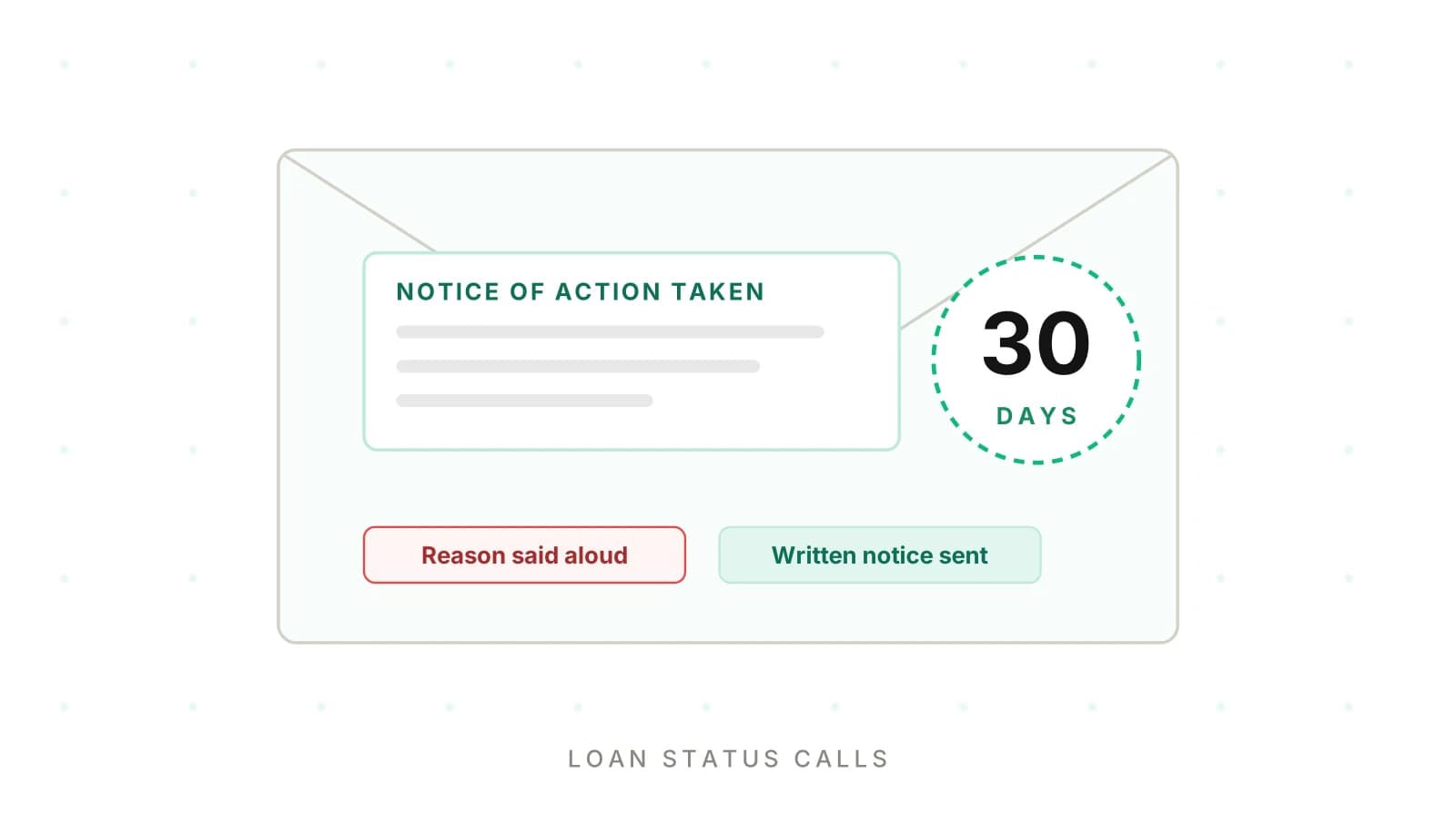
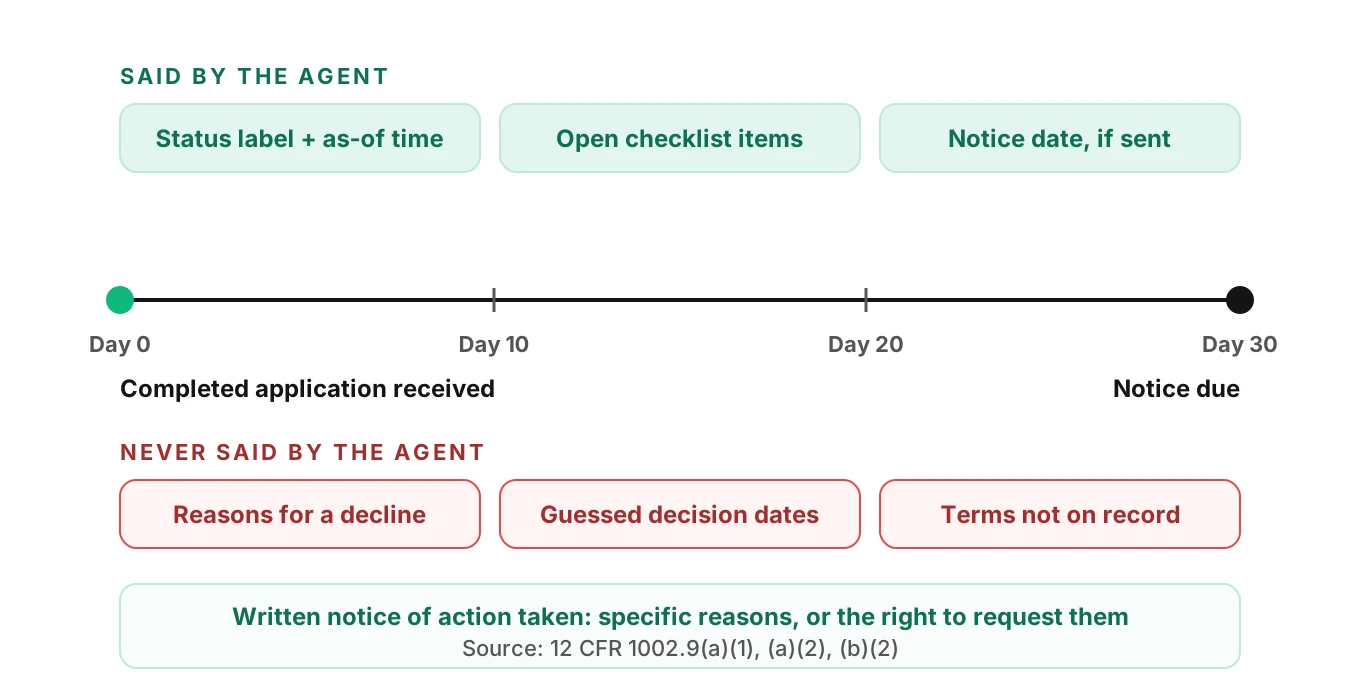
The clock. A creditor must notify an applicant of approval, counteroffer or adverse action within 30 days after receiving a completed application (12 CFR 1002.9(a)(1)(i)). The clock starts once the creditor has the information it normally considers (CFPB comment 9(a)(1)-1).
The form. The rule says a notification of adverse action "shall be in writing." That notice of action taken must name the action and carry either a statement of specific reasons or a disclosure of the right to one. Oral reasons also require a disclosure of the right to written confirmation. Creditors that received no more than 150 applications in the prior calendar year may satisfy the section orally (1002.9(d)).
The reasons. They "must be specific and indicate the principal reason(s)." Saying the decision rested on "internal standards or policies" is not enough (1002.9(b)(2)). CFPB Circular 2022-03 adds that creditors "must be able to provide applicants against whom adverse action is taken with an accurate statement of reasons," even when a complex model made the call (CFPB, May 26, 2022).
Now picture an agent that fills a gap. The LOS holds a free-text underwriter note: "DTI too high, thin file." The agent paraphrases it aloud as the reason. Three things can go wrong. The note may not be the principal reason on the adverse action notice. The paraphrase may drift from the note. And nobody logged what was said.
Reg B's own comments say the reasons must accurately describe the factors actually considered (CFPB comments 9(b)(2)-2 and -3). A generated reason has no such guarantee.
Two more definitions matter. A counteroffer the applicant does not accept is itself adverse action (12 CFR 1002.2(c)(1)). So "we approved you for less" is not a good-news status. And a request becomes an application depending on how the creditor responds, "not on what the consumer says or asks" (CFPB comment 2(f)-3). An agent that tells a caller whether they qualify can turn an inquiry into an application.
If the decision relied on a consumer report, the Fair Credit Reporting Act adds its own notice. The creditor must name the reporting agency and disclose the member's right to a free copy within 60 days (15 U.S.C. 1681m(a)). An agent cannot recite that from memory. The notice of record carries it.
Which status words are safe to say
Real LOS vocabularies are long. One credit union's public page defines ten application statuses: Approved, Approved Pending, Canceled, Counter Offer, Declined, Member Waiting, Need More Info, Pending, Pre-Approved and Review/Referred (State Farm Federal Credit Union status definitions). Your list will differ. The pattern is the same: a handful of labels are neutral, a few carry money or rights, and some mean different things to a member than to staff.
The table below is a starting design, built on that ten-label pattern. Treat it as a draft to review with compliance. "As-of" means the agent states how old the status is.
| Internal label (example) | Agent may say | Agent must not say | Action |
|---|---|---|---|
| Pending / awaiting review | "Your application is waiting for initial review, as of this morning." | Any decision date or odds | Say, with as-of |
| Need more info | The open items, read from the checklist | "That's all you need" | Say, offer upload link |
| Conditional approval (approved pending) | "A decision is recorded with conditions open." Then list them. | "You're approved, funds tomorrow" | Say conditions, hand off for terms |
| Approved / ready to close | That the file is approved and closing is next | Rate, amount or payment unless read from the record | Say, then offer transfer |
| Pre-approved | That a pre-approval exists and its expiry date | That it guarantees a final loan | Say with expiry |
| Counter offer | That a response from the lender is waiting | Terms, or why they differ | Route to a person |
| Declined | That a written notice was sent on a date | Reasons, or "you were denied because" | Route to a person |
| Review / referred / member waiting | That the file is with underwriting | Underwriter opinion or timing | Say, with as-of |
| Canceled / withdrawn | That the file is closed, and when | Who closed it, unless recorded | Route if disputed |
The rule behind the table is simple. The agent reports what the record says and when. It does not interpret. It does not predict. Decisions with consequences go to a person who can read the notice of record.
For a declined file, I would have the agent say what a notice fact says, nothing more. For example: "I see a decision on this application. A written notice was mailed on October 14. I'm connecting you to a lender who can go through it." That sentence is true, short and checkable against the notice log.
Reading the right application when several exist
Members rarely have one file. A member may hold an auto refinance, a card limit request and a half-finished personal loan from last spring. Joint applicants add more rows. "My loan" is ambiguous before it reaches speech recognition.
Here is an illustrative case, not a customer story. A member asks about "the car loan," and the agent opens the wrong application. The LOS has two vehicle applications: a 2019 purchase loan, withdrawn in March, and a refinance opened last week. The agent picks the first row returned by the API. It reads "Canceled" aloud. The member hears that the refinance died. They apply elsewhere.
Selection errors come from four places:
- Sorting. The API returns records by creation date, ascending. The agent takes row zero.
- Matching. "Car loan" matches both vehicle products.
- Closed files. Withdrawn and canceled applications stay in the list.
- Co-applicants. The caller is verified for one borrower. The file belongs to the other.
A safer rule has three parts. Rank open applications first. If more than one is open, ask a disambiguating question that uses a fact the member knows, such as product and month opened. Never read the application number as the only match key; digit strings are fragile on the phone, as our STT entity accuracy post shows. And pass the chosen application ID to the status tool as a typed argument. Wrong arguments are a common silent failure; see tool argument accuracy.
Stale status from the loan origination system
Status labels are snapshots. Some LOS integrations push events in seconds. Others poll or batch. The agent's answer is only as fresh as the last sync.
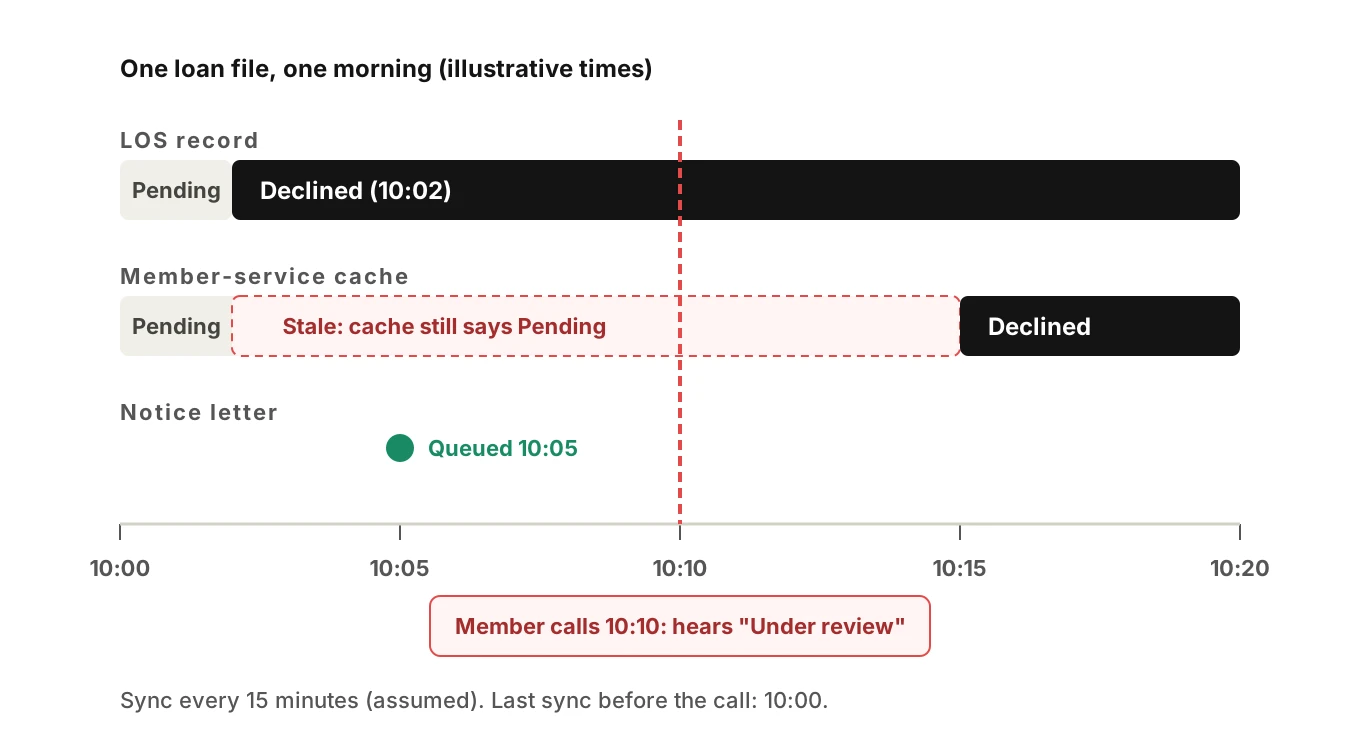
Worked example, with assumed numbers. Suppose the LOS syncs to the member-service database every 15 minutes. An underwriter marks a file "Declined" at 10:02. The notice letter queues at 10:05. A member calls at 10:10 and hears "Under review." The agent was accurate to the data it had. That data was ten minutes old, from the 10:00 sync. Now flip it. The cache shows "Approved," but an underwriter reopened the file at 10:08 for a missing pay stub. The agent says "approved," and the member signs a lease.
Three habits reduce the harm:
1. Store the status change timestamp with the label. Speak it: "as of 9:50 this morning."
2. Set a max age per status. A `pending` label can be an hour old. An `approved` label that triggers a promise should be read live or routed.
3. When the status tool returns a `last_synced_at` older than the limit, say so and hand off.
The silent tool failure post covers the neighbouring case: the tool returns an empty or default value and the agent fills the gap with a confident sentence.
Document checklists and incomplete applications
Most status calls really ask, "what do you still need from me?" Members act on the document checklist, so errors cost days.
Common checklist faults:
- Received versus accepted. An analyst rejected the pay stub as too old. The agent says "we have it."
- Wrong borrower. The agent reads the co-borrower's open items to the primary.
- Outdated list. A condition was waived but still shows open.
Regulation B sets a floor for incomplete files. If an application is incomplete, the creditor must within 30 days either act on it or send a written notice. That notice specifies the missing information, sets a reasonable deadline and says that no response means no further consideration (12 CFR 1002.9(c)). A creditor may also tell the applicant orally, but if the file stays incomplete the written notice is still due (1002.9(c)(3)). So an agent that says "just send the bank statement whenever" may contradict the notice the member already received. The agent should read the checklist as written and state the deadline from the notice, not invent one.
Callback promises and the callback queue
Every callback promise is a commitment. "A lender will call you today" with no task behind it is a promise only the member remembers.
Check three things for every promise the agent makes:
1. A task or ticket exists with the member, application ID and promised window.
2. The promised window matches staffing. If lenders leave at 5 pm, "today" after 4:45 is false.
3. The task survives a transfer failure.
Log the promise as a structured field, not only as audio. Then a daily query finds promises without tasks. Regulation B also gives you a reason to keep this log: records of applications, notices and any notation of oral reasons must be kept for 25 months on consumer credit (12 CFR 1002.12(b)(1)).
Identity first, and a fair lending note
Identity checks are covered in the member verification post and the loan servicing verification post. Do not rebuild them here. Just confirm that the status tool refuses to run without a verified flag, and that a failed verification returns a neutral line that leaks nothing about whether an application exists.
One fairness check belongs in your tests. The same file, spoken by callers with different accents and speech patterns, should produce the same status sentence and the same handoff. If one profile gets a transfer and another gets a guess, you have an unequal-treatment problem that a transcript review will not show. Your fair lending counsel will want that evidence, so keep it.
A say, confirm, route framework
Here is a copyable decision frame. Call it Say, Confirm, Route.
| Class | Test | Example | Agent behaviour |
|---|---|---|---|
| Say | Fact read from record, fresh, no rights attached | Pending, open items, file closed | Read it, with as-of |
| Confirm | Fact could attach to the wrong file or person | Two open applications, co-borrower | Ask one disambiguating question |
| Route | A decision, a reason, a term, a rights notice | Declined, counteroffer, "why" | Hand to a person with context |
The tool layer enforces it, not the prompt. Here is simplified Python. It encodes a policy table and returns what the agent may speak.
from dataclasses import dataclass
from datetime import datetime, timedelta, timezone

POLICY = {  # label -> (class, max_age_minutes)
    "pending": ("say", 60),
    "need_more_info": ("say", 60),
    "approved_pending": ("say", 20),
    "approved": ("say", 20),
    "pre_approved": ("say", 240),
    "counter_offer": ("route", 0),
    "declined": ("route", 0),
}

@dataclass
class App:
    app_id: str
    label: str
    status_changed_at: datetime
    last_synced_at: datetime
    notice_sent_on: str | None = None

def status_reply(apps: list[App], verified: bool, now: datetime):
    if not verified:
        return {"action": "route", "say": "neutral_no_leak"}
    open_apps = [a for a in apps if a.label not in ("canceled", "withdrawn")]
    if len(open_apps) != 1:
        return {"action": "confirm", "say": "ask_which_application"}
    app = open_apps[0]
    cls, max_age = POLICY.get(app.label, ("route", 0))
    stale = now - app.last_synced_at > timedelta(minutes=max_age)
    if cls == "route" or stale:
        return {"action": "route", "app_id": app.app_id,
                "say": "notice_sent" if app.notice_sent_on else "handoff"}
    return {"action": "say", "app_id": app.app_id,
            "label": app.label, "as_of": app.status_changed_at.isoformat()}
Unknown labels route by default. That one line stops new LOS statuses from becoming improvised speech. The agent's prompt then speaks only the fields the function returns. It never invents a reason.
How to test a loan status agent before launch
A test set is a grid, not a list of calls. Build it from the policy table and the failure modes above.
1. List the labels. Export every status your LOS can emit, including rare ones. Each becomes a row.
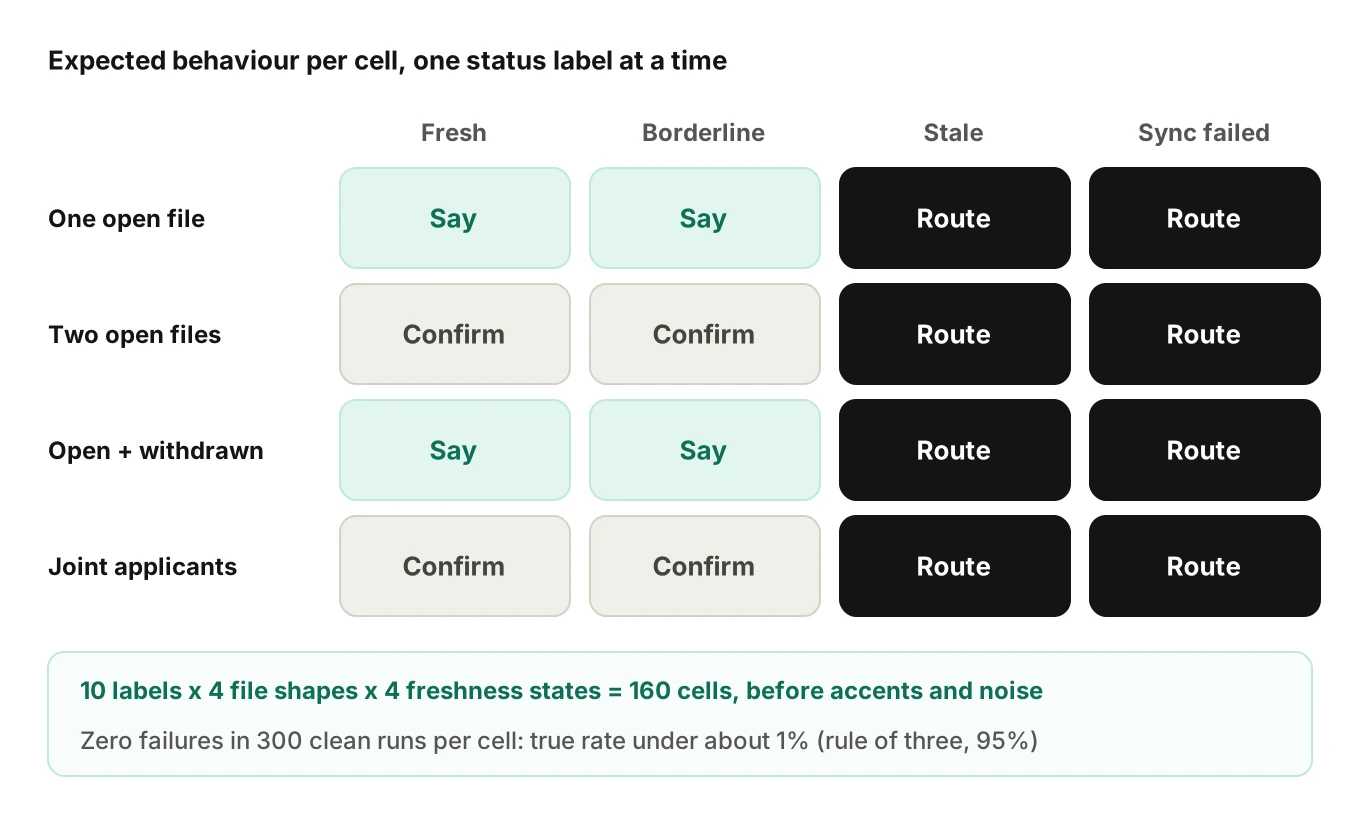
2. Add the file shapes. One open application, two open, one open plus one withdrawn, joint applicants.
3. Add the freshness states. Fresh, borderline, stale, and a failed sync.
4. Add the caller conditions. Accent, pace, interruption, background noise, and a digit-heavy application number read slowly or fast.
5. Write the pass rule per cell. Correct label spoken, correct as-of, correct handoff, no reason given, promise logged.
6. Run enough calls to bound the risk. Zero failures in n clean runs bounds the true failure rate at about 3 divided by n at 95% confidence, the standard "rule of three." So 300 clean runs of one cell bound it near 1%. This is a statistical rule, not a regulatory one.
7. Score from the audio. Check that what was spoken matches the status, not just the transcript.
8. Gate every prompt change. Rerun the grid before it ships.
Ten labels, four file shapes and four freshness states give 160 cells before caller conditions. That is why hand-testing fails, and why a unit test on the tool function above is only the first layer.
For credit union loan status ai calls, Evalgent builds scenarios from the agent's prompt and flows, including hard constraints and coverage gaps. A rule such as "never state a reason for a decline" becomes a scenario family, and caller profiles then vary accent, pace and noise. Evalgent scores the audio rather than only the transcript, which matters for spoken application numbers and for what the member actually heard. See why transcript-only judging misses this.
What to watch in production
Pre-launch tests catch what you thought of. Live calls surface the rest. Sampling misses rare combinations, so score every call.
Evalgent's production monitoring takes call recordings, transcribes them, maps each call to a scenario and judges it. It flags tool-call failures and policy failures, such as a reason spoken on a declined file, and attaches a fix recommendation. Your team reviews the verdicts. The same pipeline also helps with the regulator question, "show me what the agent told members," since each call has an evidence trail.
Track these four numbers weekly:
- Wrong-file rate. Calls where the spoken application differs from the verified member's intended one.
- Stale-read rate. Calls where the status spoken differs from the LOS status at call end.
- Reason leak rate. Calls where the agent stated or implied a reason for a decline or counteroffer.
- Orphan promise rate. Promises with no task.
If your agent serves many credit unions, split each by tenant, since policy tables differ. Our multi-tenant testing post explains why, and the go-live checklist and policy test case library cover the surrounding controls. Lost card and dispute calls have their own rights clock.
Frequently asked questions
Can AI tell a member their loan was denied?
Technically yes, but it is a poor design choice. Regulation B requires a written notification of adverse action with specific reasons or a right-to-reasons disclosure. A voice agent can state that a written notice was sent. The decision itself, and any reasons, are safer with a trained person who can read the notice of record.
What can a loan status voice agent say?
It can read a verified, fresh status label, say when it last changed, list open document items from the checklist, and state notice dates already on file. It should not predict decisions, state reasons, quote unrecorded terms or promise timing. Anything with consumer rights attached goes to a person.
Why does my loan application still show pending?
Pending usually means the file is waiting for review or for items from the applicant. It can also mean the status is stale. A good agent reads the label with an as-of time and lists open items. It should not guess why the file is slow.
Does Regulation B allow oral adverse action notices?
Mostly no. Section 1002.9(a)(2) says the notification "shall be in writing." Reasons may be given orally if the creditor also discloses the right to written confirmation. Creditors that received no more than 150 applications in the prior calendar year can satisfy the section orally under 1002.9(d). Check which applies to you.
How long does a lender have to notify an applicant?
Regulation B sets 30 days after receiving a completed application for approval, counteroffer or adverse action. For an incomplete application, the creditor must act or send a written incompleteness notice within 30 days. The clock starts when the creditor has the information it normally considers.
What happens when the AI reads the wrong loan application?
The member may act on a status that belongs to another file, such as a canceled loan or a co-borrower's items. The harm is silent because both calls look fine in a transcript. Prevent it by ranking open files first, asking a disambiguating question, and passing a typed application ID to the tool.
Should an AI agent give the reason a loan was declined?
No, not unless your compliance team approves a scripted reason that comes straight from the notice of record. Regulation B requires reasons to be specific and to match the factors actually considered. A paraphrase of an underwriter's note can drift, and the agent's wording may then conflict with the written notice.
How do you test a loan status AI agent?
Build a grid of status labels, file shapes, freshness states and caller conditions. Define a pass rule for each cell. Run the calls over the phone, judge the audio, and gate every prompt change on a rerun. In production, score every call for wrong-file, stale-read, reason-leak and orphan-promise rates.
The bottom line
A loan status agent is safe for credit union loan status ai calls when it reports fresh facts from the record and hands decisions, reasons and counteroffers to a person. Regulation B puts the notice in writing, so the voice channel should point to that notice rather than replace it.
Related Articles
How to automate voice agent testing: synthetic callers vs manual QA
Learn how ai test automation replaces manual QA for voice agents. Compare synthetic callers vs human testers, with a 5-step framework to scale without hiring.
Read more
AI Agent Testing vs Voice Agent Testing: What General Tools Miss for Voice
AI agent testing measures text outputs. Voice agent testing measures behaviour through an acoustic pipeline. Five failure categories general tools miss.
Read more