Test your voice agent
How to Choose Telephony for Voice Agents (2026)
# How to choose telephony for voice agents (2026)
Quick answer
The best telephony for voice agents in 2026 is the carrier layer that delivers clean, low-latency calls to your regions at your concurrency, ports your numbers cleanly, and keeps outbound calls from being spam-labeled. Do not trust coverage maps. Test candidate providers on your own real calls before you commit.
Every voice agent that answers or places a phone call sits on top of a telephony layer. This is the layer that owns your phone numbers, connects to the public phone network, and carries the actual audio. It decides whether a call connects, how clean it sounds, and how fast the audio arrives. Teams obsess over models and voices, then bolt on telephony as an afterthought. That is backwards. A brilliant agent on a bad carrier still drops calls and clips words.
This guide covers how to pick that layer. It is about numbers, trunking, call delivery, coverage, and routing. It is not about the transport protocol your media rides on. That is a separate decision. If you are weighing SIP against WebRTC, read our guide on SIP vs WebRTC for voice agents and come back here for the provider question.
What the telephony layer actually does
The telephony layer is the bridge between your software and the phone system. It gives your agent a real number, connects that number to the outside world, and moves audio in both directions.
> Telephony layer: the carrier and number infrastructure that connects a voice agent to the public switched telephone network and the wider VoIP ecosystem. It provisions numbers, routes calls, and carries the media.
Most voice agents reach humans over the old phone network, not a browser. That network is the PSTN. Your provider connects your agent's software to it, usually through IP-based trunks rather than physical lines. Callers dial a normal number and never know software answered.
Three things live in this layer. First, the numbers themselves, including how you get them and how you keep them. Second, the connection to carriers that actually deliver the call. Third, the quality and reliability of the audio path. Get all three right and the phone part disappears. Get one wrong and every call suffers.
The criteria that decide telephony for voice agents in 2026
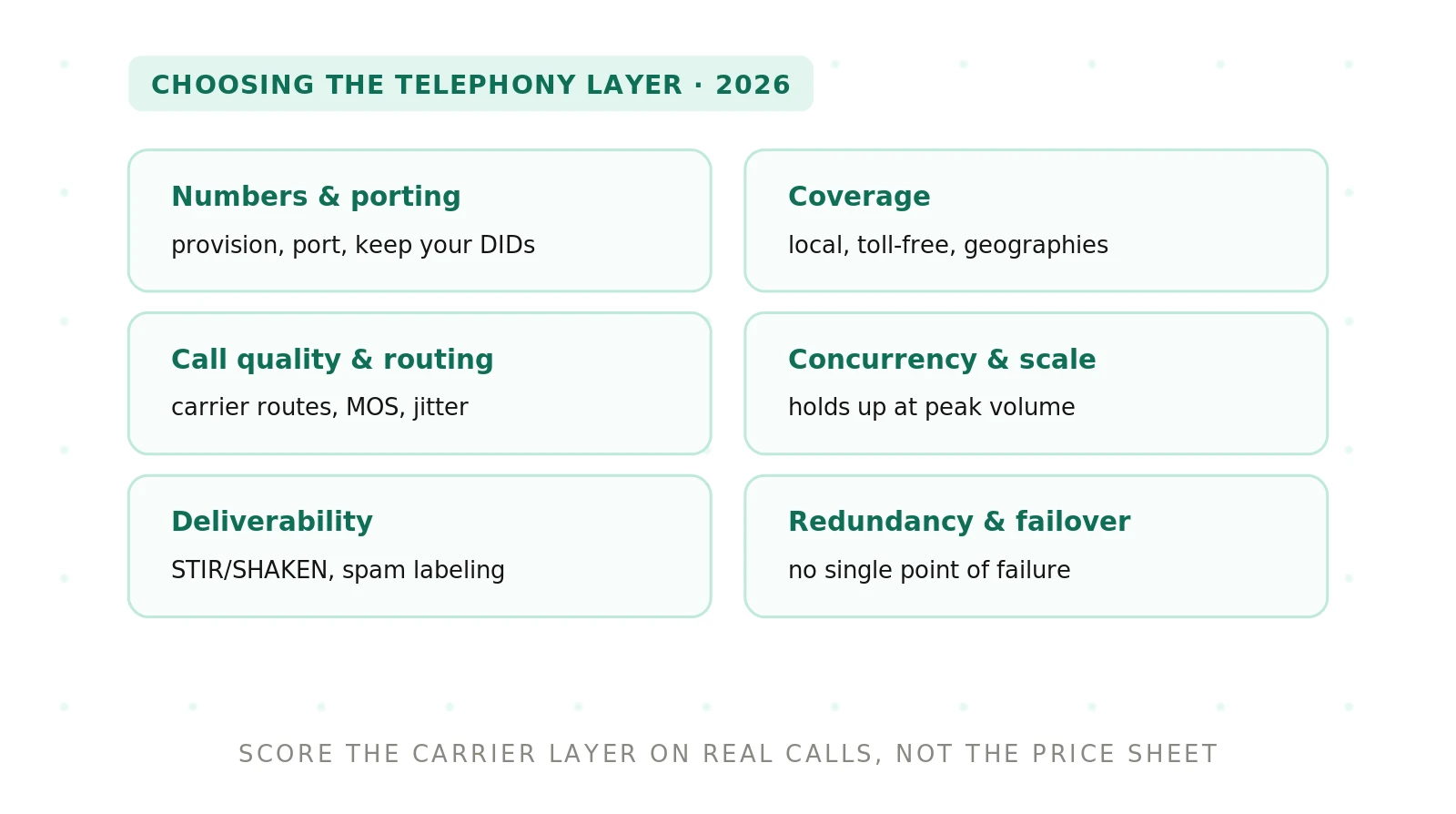
Not every feature matters equally. Below are the criteria that separate a production-ready carrier from one that only looks good on a pricing page. Each is something you can measure on your own traffic.
Number provisioning and porting
You need numbers, and you need them in the right places. A good provider lets you buy local and toll-free numbers fast, in every area you serve. It should support standard E.164 formatting and clean direct inward dialing so each agent or campaign can have its own number.
Porting matters just as much. When you move a number between carriers, that is local number portability. Ask how long a port takes, what can go wrong, and whether you can port back out later. A provider that makes it hard to leave is a provider you should not join.
Geographic and toll-free coverage
Coverage is where marketing and reality diverge most. A provider may claim national reach but route certain rural or wireless numbers through weak downstream partners. For US teams, confirm strong delivery to all major mobile carriers and to the regions your customers actually call from.
Toll-free coverage is its own concern. Toll-free traffic uses different routing and billing than local numbers. If you rely on 800-series numbers, test them separately from local ones.
Call delivery quality and carrier routing
A call can connect and still sound terrible. Audio quality on the phone network is often measured with a mean opinion score, a rating of perceived call clarity. Poor routing adds noise, echo, and dropped words. For a voice agent, bad audio means the speech-to-text stage mishears the caller and the whole turn derails.
Routing is the hidden variable. Providers buy delivery from many upstream carriers and pick a path per call. Cheaper paths often mean worse audio. Ask whether you can pin higher-quality routes, and always verify quality yourself.
Concurrency and scale
Concurrency is how many calls you can run at once. A demo needs one line. A contact center may need thousands in parallel at peak. Ask about hard limits, how fast you can raise them, and what happens when you hit the ceiling. Some providers queue or reject calls silently under load.
Test at your real peak, not your average. A provider that is clean at 10 calls can fall apart at 500. This is where managed versus self-hosted orchestration trade-offs also surface, because scale changes both cost and control.
Latency and jitter
Latency is the delay in the audio path. Jitter is the variation in that delay. Both hurt a voice agent badly, because the agent already adds its own thinking time on top. The ITU-T has long published guidance on acceptable one-way delay for interactive voice, and phone conversations get uncomfortable well before a full second.
The carrier owns part of this budget. Jitter and packet loss on their network add delay and distortion your agent cannot fix. Measure the telephony hop on its own. Our latency guide shows how to break the budget down stage by stage, and our note on latency versus response time explains why the two are not the same.
SIP trunking vs CPaaS APIs
There are two main ways to buy this layer. One is a raw SIP trunk, a direct connection you wire into your own stack. The other is a communications API that wraps trunking, numbers, and call control behind simpler calls. Trunks give you more control and often lower per-minute cost. APIs give you speed and less to operate.
Neither is universally better. Trunks suit teams with telecom skills and heavy volume. APIs suit teams that want to ship fast and treat telephony as a utility. Decide based on your team, not on which sales deck was slicker.
Deliverability and spam labeling
Outbound voice agents face a modern problem. Carriers and phones now flag suspicious numbers as "Spam Likely," and a flagged number gets ignored or blocked. In the US, call authentication runs through a framework called STIR/SHAKEN, which cryptographically signs caller ID so carriers can trust it. The FCC's call authentication rules require it across the network.
Ask how a provider handles attestation, branded caller ID, and number reputation. If your numbers get labeled as spam, your answer rate collapses no matter how good the agent sounds.
Redundancy and failover
Phone networks fail. Trunks go down, upstream carriers have outages, and data centers have bad days. A serious provider runs redundant routes and can fail over without dropping live calls. Ask what happens when a carrier partner has an outage, and whether calls reroute automatically.
For critical lines, single points of failure are unacceptable. Some teams run two providers in parallel for exactly this reason, a pattern we cover in running multiple voice agent vendors.
Pricing shape
Price is not one number. It is a shape. Watch for per-minute inbound and outbound rates, number rental fees, porting charges, toll-free surcharges, and minimum commitments. Cheaper per-minute rates sometimes hide worse routing, so the lowest price can cost you in answer rate and audio quality.
Model your real traffic mix, not a round number. A provider that is cheap for short inbound calls may be expensive for long outbound campaigns.
Telephony selection criteria at a glance
Use this table as a scan sheet while you compare providers. The point is to know what good looks like and to spot the warning signs early.
| Selection criterion | What to look for | Red flag |
|---|---|---|
| Number provisioning | Fast local and toll-free numbers, clean E.164 and DID support | Slow provisioning, limited area coverage |
| Number porting | Clear timelines, port-in and port-out both easy | Vague porting process, hard to port away |
| Geographic coverage | Verified delivery to all major US mobile and rural carriers | Coverage claimed but not testable per region |
| Call delivery quality | High, consistent audio quality across routes | Variable audio, cheapest-route routing only |
| Concurrency and scale | Clear limits, fast increases, graceful behavior at peak | Silent call rejection or queuing under load |
| Latency and jitter | Low, stable telephony-hop latency you can measure | No visibility into the carrier's contribution |
| SIP trunking vs API | Model that fits your team's telecom skill and volume | Lock-in to one buying model with no exit |
| Spam labeling | STIR/SHAKEN attestation and branded caller ID support | No answer to number reputation questions |
| Redundancy | Automatic failover across multiple upstream carriers | Single carrier path, no failover story |
| Pricing shape | Transparent per-minute, rental, port, and toll-free fees | Low headline rate hiding routing quality |
How to run your own telephony evaluation on real calls
The only reliable way to choose a provider is to test it on calls that look like yours. Here is a repeatable process any team can run.
1. Define your call profile. Write down your real mix: inbound versus outbound, regions, average and peak concurrency, and typical call length. This is the workload every provider will be measured against.
2. Provision numbers on each candidate. Buy local and toll-free numbers on every provider you are testing. Note how long provisioning takes and how easy it is.
3. Build a fixed test suite of scenarios. Script a set of representative calls, including hard cases: noisy lines, mobile callers, accents, and long conversations. Keep this suite fixed so every provider faces the same calls.
4. Run the same calls through each provider. Place identical calls through each candidate at your target concurrency. Record every call so you can review the audio, not just the logs.
5. Measure the telephony hop specifically. Isolate carrier latency, jitter, packet loss, and audio quality from your agent's own processing time. You are grading the pipe, not the brain.
6. Score delivery and answer rates. For outbound, track how many calls connect and whether numbers get flagged as spam. For inbound, track connection success and audio clarity.
7. Stress-test at peak concurrency. Push each provider to your real peak and beyond. Watch for dropped calls, rejected calls, and quality that degrades under load.
8. Compare on one scorecard. Put every provider on the same criteria and the same evidence. Pick the winner you can defend with recordings and numbers, not the one with the best sales deck.
Why marketing claims cannot decide this
Provider marketing is designed to survive the demo, not your traffic. Coverage maps show reach, not delivery quality. Latency figures come from lab conditions, not your regions at peak. Spam-labeling is barely mentioned, yet it can halve your answer rate. None of these claims predict how a carrier behaves on your calls, with your numbers, at your scale.
This is why independent measurement matters. When you grade every provider on the same fixed calls, the differences that marketing hides become obvious. That is the core of independent voice AI evaluation, and it is how serious teams pick a carrier they can trust.
Choosing telephony with Evalgent
The telephony decision is only safe if you can measure every candidate on equal terms. Evalgent is the independent, third-party evaluator built to do exactly that. It holds a yardstick you own, apart from any provider. Scenarios capture your real calls as a fixed, versioned suite. Profiles vary caller accent, pace, and line quality, so every provider faces the same range of conditions. Metrics score each run against pre-defined expected outcomes on one fixed definition, so results compare directly across carriers. Evaluations replay the identical suite against any provider at your target concurrency. Reviews let your team hear the actual call behind any score. Because the suite is yours and runs against anyone, you can compare providers, keep a backup carrier honest, or migrate without guessing, and prove at every step that call quality held. For the full method, start with our overview of voice agent evaluation and our guide to how to evaluate voice agent vendors. To put a neutral evaluation between you and every telephony choice, book a demo.
Frequently asked questions
What is the best telephony for voice agents in 2026?
The best telephony for voice agents in 2026 is the carrier layer that delivers clean, low-latency audio to your regions at your concurrency, provisions and ports numbers easily, and keeps outbound calls from being spam-labeled. There is no single winner. The right provider depends on your regions, call volume, and inbound-versus-outbound mix, proven on your own test calls.
What is the difference between SIP trunking and CPaaS APIs for voice agents?
A SIP trunk is a direct connection into the phone network that you wire into your own stack. A communications API wraps trunking, numbers, and call control behind simpler programming calls. Trunks give more control and often lower per-minute cost but need telecom skills. APIs ship faster and treat telephony as a utility. Choose based on your team and volume.
How do I port an existing phone number to a new telephony provider?
Number porting moves a phone number between carriers under local number portability rules. You submit the number, account details, and authorization to the new provider, which coordinates the transfer. Ports typically take days, and details like billing name must match exactly. Always confirm both port-in timelines and port-out ease, so you are never locked into one provider.
What causes bad call quality with a voice agent?
Bad call quality usually comes from the carrier routing path, not the agent. Cheap or overloaded routes add noise, echo, jitter, and packet loss, which lowers the mean opinion score. For a voice agent, poor audio makes speech-to-text mishear the caller and derails the turn. Test audio on real calls and pin higher-quality routes where a provider allows it.
How does STIR/SHAKEN affect voice agent outbound calls?
STIR/SHAKEN is the US framework that cryptographically signs caller ID so carriers can trust it. Under FCC rules, calls without strong attestation are more likely to be flagged as "Spam Likely" and ignored. For outbound voice agents, weak attestation or a poor number reputation collapses answer rates. Ask providers how they handle attestation and branded caller ID before you commit.
How much latency does the telephony layer add to a voice agent?
The telephony layer adds delay from carrier routing, media transport, and jitter, on top of your agent's own processing time. Interactive phone calls feel laggy well before a full second of one-way delay, and the ITU-T publishes guidance on acceptable limits. Because the agent already spends time thinking, measure the carrier hop separately and keep it as low and stable as possible.
How many channels of concurrency do I need for a voice agent?
Concurrency is the number of simultaneous calls you can run. Size it to your real peak, not your average, and add headroom for spikes. A small pilot may need a handful of channels, while a contact center can need thousands at once. Ask each provider about hard limits, how quickly you can raise them, and what happens when you hit the ceiling.
How do I test telephony providers before I commit to one?
Provision numbers on each candidate, build a fixed suite of representative calls, and place identical calls through every provider at your target concurrency. Record each call, then measure carrier latency, jitter, audio quality, connection rates, and spam-labeling separately from your agent. Score everyone on one scorecard. Pick the provider you can defend with recordings and numbers, not marketing claims.
The bottom line
The telephony layer decides whether calls connect and how clean they sound, so it deserves the same scrutiny as your model and voice. Choose the provider that wins on your own recorded calls, at your real concurrency, not the one with the best coverage map.
Ready to compare telephony providers on your real calls? Book a demo and see it on your own traffic.
Related Articles
Why AI voice agents fail in production (and how to prevent it)
AI voice agents that ace demos still break in production. Learn the 5 root causes, how to test for each, and what production readiness actually means.
Read more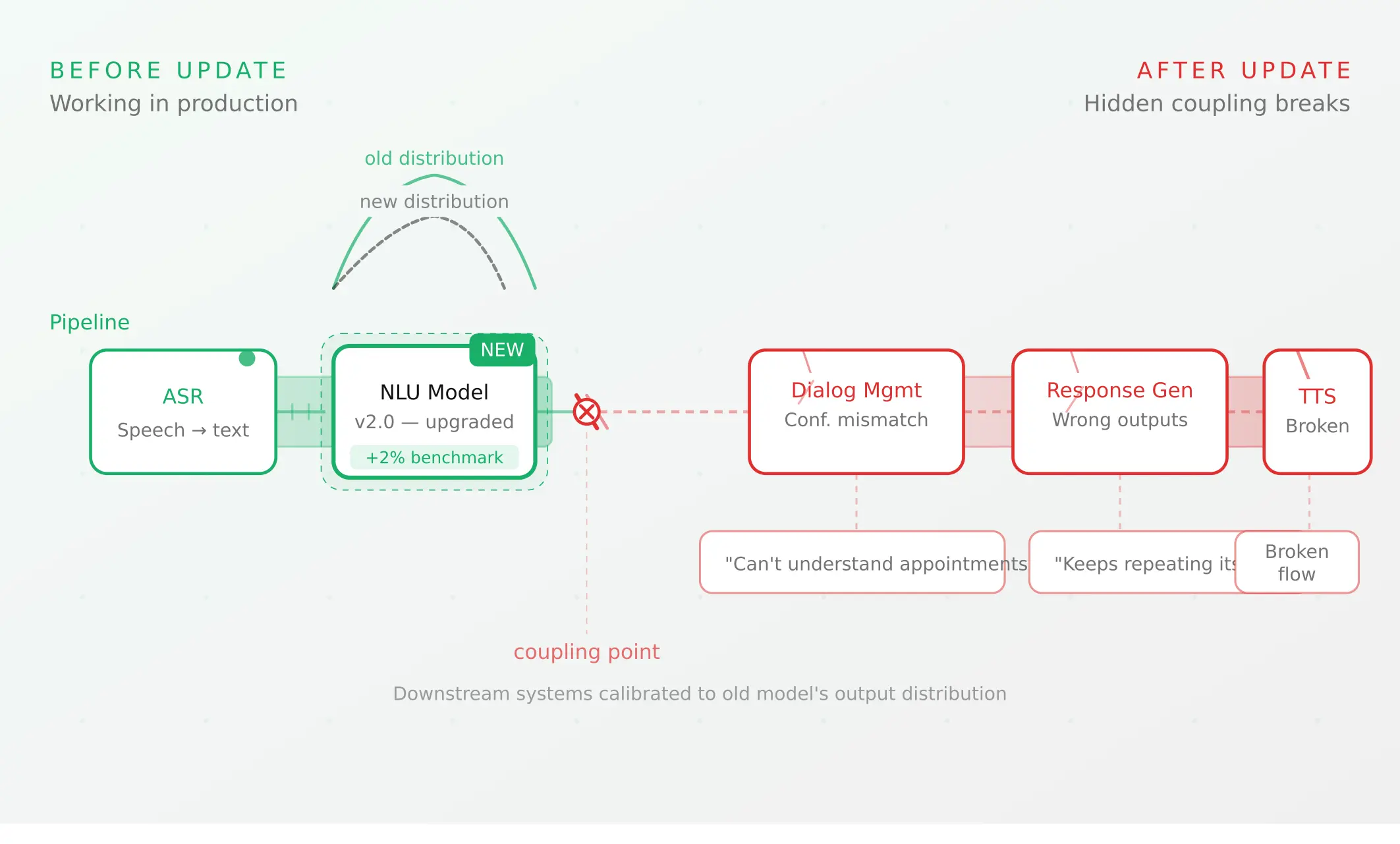
Voice agent regression testing: why LLM updates break production
LLM updates improve benchmarks but break voice agents in 5 predictable ways. How to detect and prevent regressions after every model or prompt change.
Read more