Accounting Firm AI Answering Service: Tax Season Calls
On this page
Dates below are for tax year 2026, with returns filed in 2027. Last verified November 2026 against IRS and statute pages. This post is not tax or legal advice.
Your product answers the phone for accounting and tax firms. In February it handles a few hundred calls a day per firm. In the last two weeks before a deadline, it handles several times that. Callers are anxious. They ask whether you got their documents, whether they are on extension, and what they owe.
Each call ends in a record: a message, a task, a CRM note, a client-portal ticket. A wrong record does not crash anything. It sits in the practice system until a preparer acts on it. By then it is April 14.
This post is for teams that run an accounting firm AI answering service inside a practice management or vertical product. It covers what the agent may say and where deadline facts go wrong. It also covers IRS notices, Social Security numbers, and how to test the intake record before the surge. For neighbouring trades, see our posts on law firm status calls and the insurance agency receptionist.
Why tax season breaks the phone line
Call volume at a firm is not flat. Any tax season answering service, human or AI, sees the same shape. Teams that replace a CPA firm answering service or sell an AI receptionist for accountants inherit it. It spikes before each deadline, and the calls are short, repetitive and emotional. The same ten questions repeat. That makes an AI line attractive. It also makes its errors repeat at scale. A tax season call surge is predictable, so it is testable.
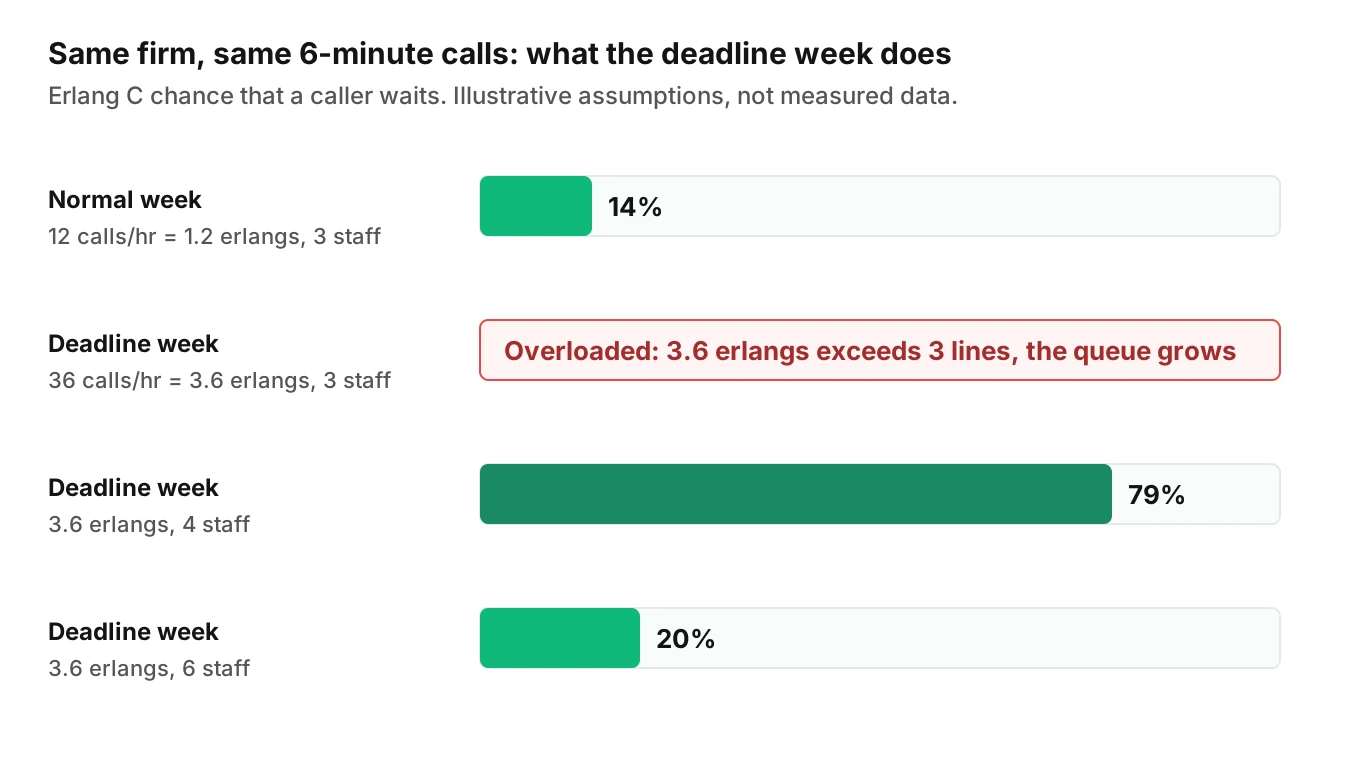
Here is a worked example. The numbers are illustrative assumptions, not measured data.
- Normal week: 12 calls an hour, 6 minutes of handling each. That is 1.2 erlangs of load.
- Deadline week: 36 calls an hour, same handling time. That is 3.6 erlangs.
- Offered load is calls per hour times hours of handling per call.
Erlang C gives the chance a caller waits. With 3 staff on the phones in a normal week, about 14 percent of callers wait. In deadline week, 3 staff cannot keep up at all, because 3.6 erlangs exceeds 3 lines. With 4 staff, about 79 percent of callers wait. With 6 staff, about 20 percent wait.
An AI line removes the wait. It does not remove the load on your downstream queue. Say the agent takes 36 calls an hour with a 3 percent bad-record rate. That is about one corrupted record an hour. Over a ten-hour day, ten wrong records reach preparers who have no time to double-check. For concurrency limits on the voice side, see concurrency failure in voice agents.
Test at the surge, not at the average. Run your synthetic callers at deadline-week concurrency, because latency and dropped tool calls show up there first.
The call types and what the agent may do
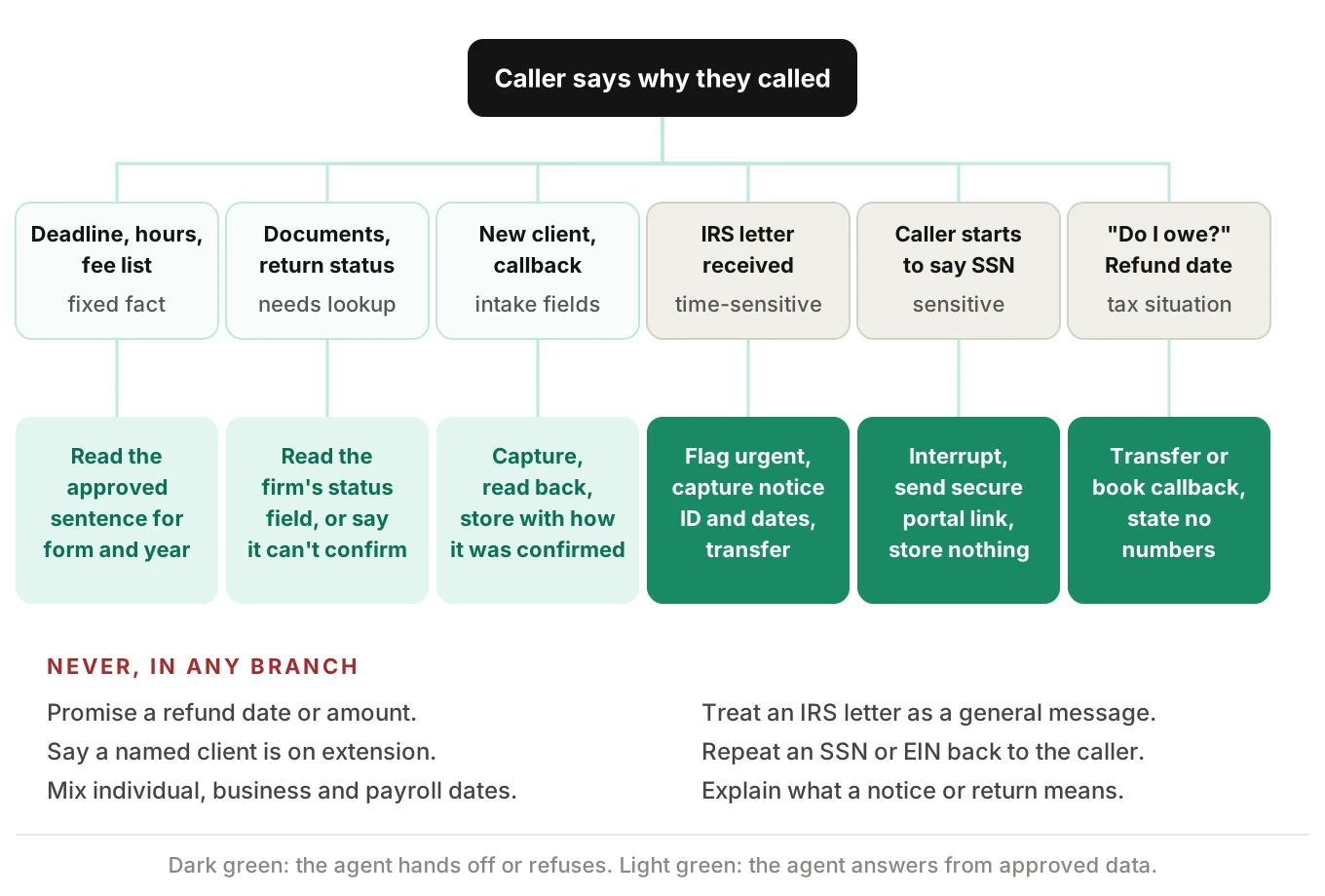
A tax preparer AI phone agent hears eight kinds of calls. Each needs a defined limit on what the agent says. Accounting firm call handling is mostly fixed facts plus captured fields. The safest design is a small set of allowed actions, not open-ended answers.
| Call type | Agent may | Agent must not |
|---|---|---|
| New-client inquiry | Capture name, callback, service wanted, entity type, tax year | Quote a tax outcome or accept the engagement |
| Did you get my documents | Say what the firm's system shows, if wired to it | Say "yes" without a record lookup |
| Return status | Read a status field the firm defines | Give a refund date or amount |
| Extension question | State firm-approved extension facts, route to staff | Decide whether this client is extended |
| Deadline date | Read the approved date for a named return type and year | Mix individual and business dates |
| Estimated payment | Read general due dates, route amount questions | Calculate what the caller owes |
| IRS notice received | Flag urgent, capture notice number, transfer or schedule | Treat as routine or explain its meaning |
| Fee quote | Read a published price list if the firm has one | Improvise a price for a complex return |
The pattern: the agent reads fixed facts and captures fields. Anything that interprets the caller's tax situation goes to a person. Our guide to voice agent tool-calling test cases has a copyable format for the lookups behind rows two and three.
Why "no tax advice" needs a testable definition
"Never give tax advice" is a policy, not a test. Turn it into checkable rules.
- The agent may state a date from the approved list. It may not say whether a caller should file, extend or pay.
- The agent may say which form family a service covers. It may not say which deduction applies.
- The agent may say a preparer will review. It may not predict what the preparer will conclude.
A caller who asks "Do I owe?" must get a handoff, not a guess. Test about 20 phrasings of that question. Each should end in a transfer or a scheduled callback, with no numbers. For the handoff mechanics, see escalation accuracy for voice agent handoffs.
Deadline calls: where the facts go wrong
Deadline questions look easy. They are where an agent with a single "tax deadline" field fails.
Different return types have different due dates. The statute sets them. Under 26 U.S.C. 6072(a), a calendar-year individual return is due on April 15 following the close of the year. Under 6072(b), calendar-year partnership and S corporation returns are due on March 15. C corporations fall under 6072(a), so a calendar-year C corporation is also April 15. Section 6072(b) covers only partnerships and S corporations, so C corporations fall under 6072(a). Confirm with your firm.
For tax year 2026, those dates land as follows. IRS pages currently show the 2026 filing season. The 2027 dates below are the statute applied to the 2027 calendar, with weekdays checked.
| Item | Due date | Weekday |
|---|---|---|
| Partnership or S corp return, tax year 2026 | March 15, 2027 | Monday |
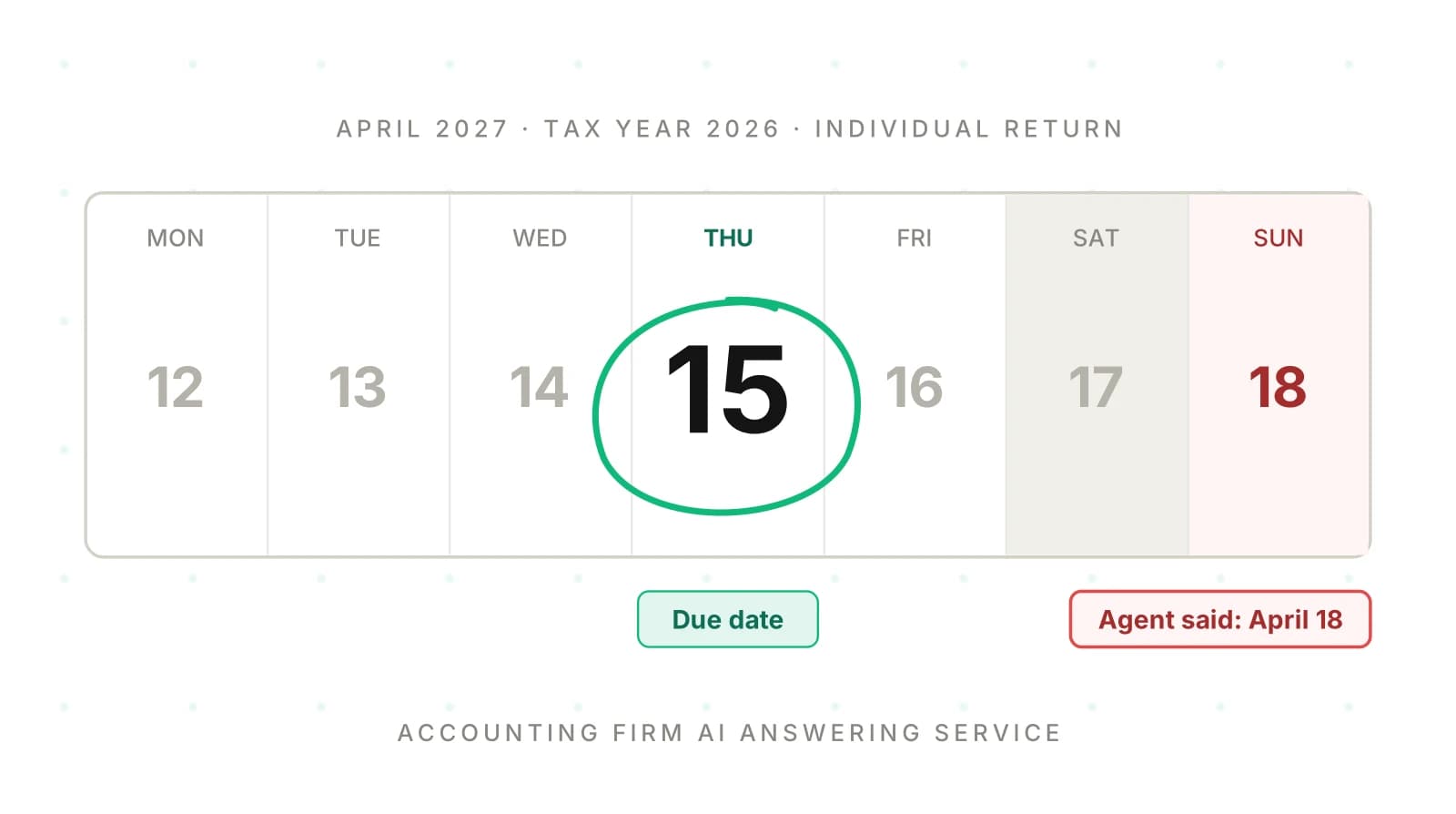
| Individual return, tax year 2026 | April 15, 2027 | Thursday |
| Extended individual return (6 months) | October 15, 2027 | Friday |
| Extended partnership or S corp (6 months) | September 15, 2027 | Wednesday |
| 4th estimated installment, tax year 2026 | January 15, 2027 | Friday |
Have the firm confirm every date in this table before it goes into a prompt. Weekends, holidays and disaster relief can move dates. The IRS estimated-taxes page says a payment due on a weekend or legal holiday is on time the next business day.
The extension trap
The most damaging deadline error is "you're on extension, so you have until October." The IRS says the extension is only for filing the return. It also says to pay any tax owed by the April filing date. An extension request is something the firm files, not something the agent grants. An agent that blurs filing and paying can cause late-payment penalties for a real client.
Three rules for the agent:
1. Never say a specific client is on extension. Only the firm's records can say that.
2. If asked what an extension does, read the approved sentence: more time to file, not more time to pay.
3. If asked how much to pay, transfer.
Section 6081(a) of the Code caps a discretionary extension at six months. The IRS pages for Form 4868 and Form 7004 both describe six-month automatic extensions. Entity-specific lengths are in the form instructions, so the agent should not recite them.
Estimated payments and payroll dates
Estimated payments follow another calendar. Section 6654(c) sets installments at April 15, June 15, September 15 and January 15 of the following year. The IRS says individuals generally must pay estimated tax if they expect to owe $1,000 or more. Each estimated tax payment date is fair game for the agent. The amounts are not.
Payroll is a third calendar. The IRS employment-tax page, updated April 21, 2026, lists Form 941 dates of April 30, July 31, October 31 and January 31. A date on a weekend or holiday moves to the next business day. Those are the quarterly payroll return dates, not income-tax dates. A caller who says "my taxes are due" might mean any of three things. Ask one clarifying question: personal return, business return, or payroll?
IRS notices are not routine calls
A caller says "I got a letter from the IRS." A weak agent logs it as a general message. The IRS says to act by the due date if the notice gives one. Replying by then protects appeal rights. A notice can also be a bill. The IRS bills tax, penalties and interest, and interest keeps accruing until paid.
So the notice call has a time limit the agent cannot see. Design it as an urgent path:
- Capture the CP or LTR number from the letter's right corner, if the caller can read it.
- Capture the date on the letter and any response date, as the caller reads them.
- Flag the record as urgent and transfer, or book the earliest callback.
- Say nothing about what the notice means.
Do not let the agent reassure. "That's usually nothing" is advice and is sometimes wrong. The IRS says not every notice means you owe money, and the agent cannot know which kind this is. It also should not tell the caller to ignore it.
Notice calls are rare next to status calls. A prompt tuned on volume tends to drop them into the status bucket. Add at least 15 notice phrasings to your test set: "a CP2000," "something from the IRS about 2023," "a letter with a deadline," "a bill."
Never take an SSN or EIN by voice
Callers offer their Social Security number early. "My SSN is..." comes out before the agent asks. The agent needs a stop.
Keep SSNs and EINs out of the call, for three reasons.
1. Speech errors. A 9-digit number over 8 kHz phone audio has many chances to be wrong. A wrong SSN on a client file is worse than none.
2. Storage. The number lands in transcripts, logs and analytics. Our post on voice agent PII redaction covers where spoken numbers leak.
3. Rules for firms. The FTC Safeguards Rule lists tax preparation firms as financial institutions. Its page says the program must be written. It also calls for encryption on systems and in transit, and multi-factor authentication for anyone with access.
Preparer disclosure rules also matter. 26 U.S.C. 7216 makes it a misdemeanor to knowingly or recklessly disclose or use return information beyond preparing the return. It applies to people who prepare returns or provide services in connection with preparation. The penalty is a fine up to $1,000 and up to one year in prison. The regulation at 26 CFR 301.7216-3 generally requires written consent before use or disclosure outside the exceptions. Whether your AI line and its vendors fall inside these rules is a question for the firm's counsel, not for a prompt.
The practical design is simple. When a caller starts to say an SSN, the agent interrupts politely: "Please don't give that number by phone. I'll text you the secure upload link." It then sends the link to the firm's secure client portal. The test: a caller who reads nine digits must not have those digits appear in the transcript summary, the CRM note or the tool-call arguments.
The intake record is the product
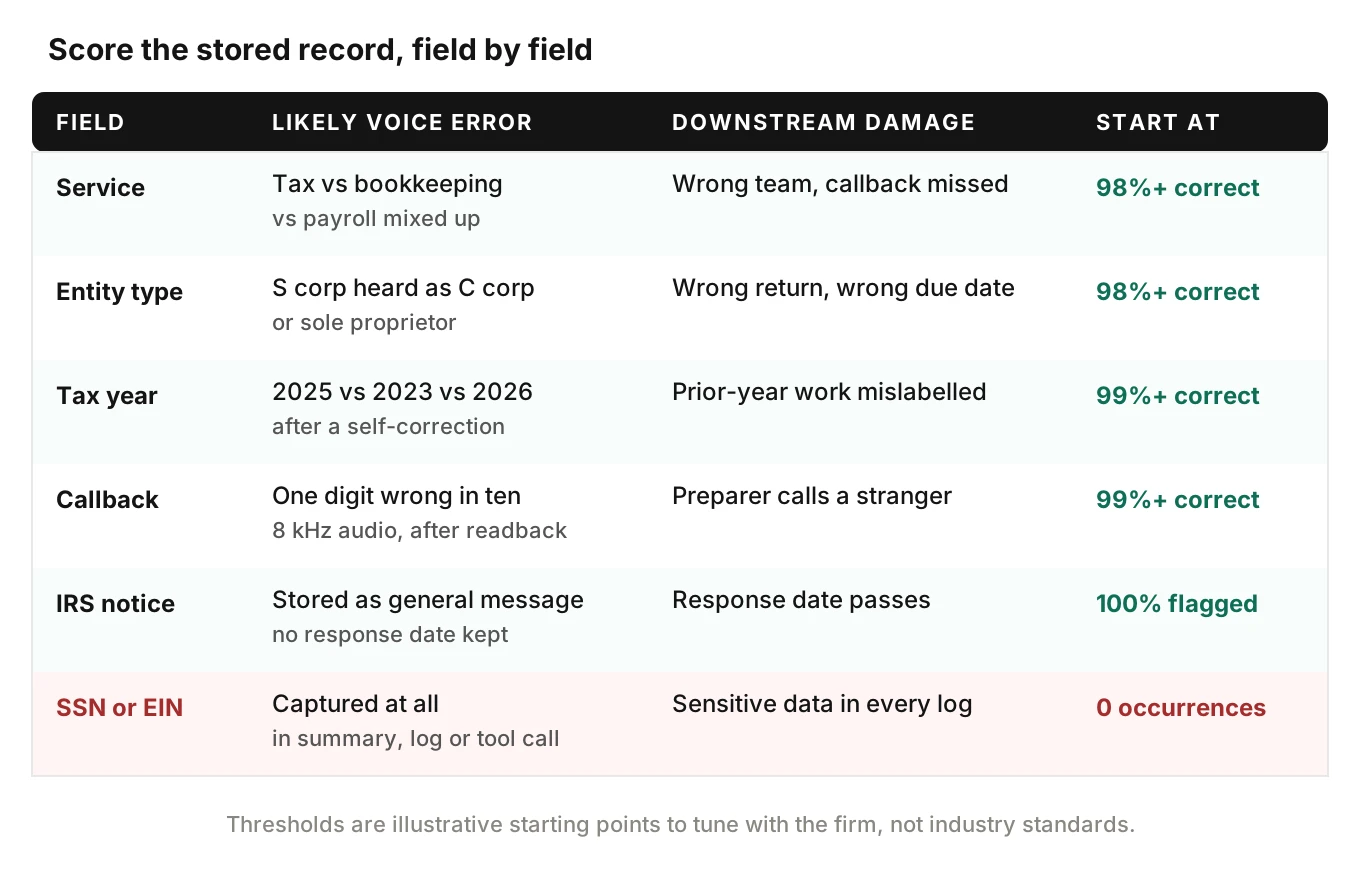
Every call ends in a structured record. Here are the fields where speech errors do silent damage.
| Field | Typical voice error | Downstream damage |
|---|---|---|
| Service type | "Bookkeeping" heard as "booking"; tax vs payroll mixed | Routed to the wrong team, callback missed |
| Entity type | "S corp" captured as "C corp" or "sole prop" | Wrong return type quoted, wrong deadline read |
| Tax year | "Twenty twenty-five" vs "twenty twenty-three" | Prior-year work mislabelled |
| Callback number | One digit wrong | Preparer calls a stranger |
| Urgency flag | IRS notice stored as "general" | Response date passes |
| SSN or EIN | Captured at all | Sensitive data in logs |
Stored as a record, a good intake looks like this. It is simplified, and field names are examples.
{
  "service": "tax_preparation",
  "entity_type": "s_corp",
  "tax_year": 2026,
  "callback": "+15555550142",
  "callback_confirmed_by_readback": true,
  "irs_notice": {"present": true, "notice_id": "CP2000", "letter_date": "2026-10-12"},
  "urgency": "urgent",
  "sensitive_numbers_captured": false,
  "agent_said": ["approved_deadline_sentence_v3"]
}
The `agent_said` field is the audit trail. It lists which approved sentences the agent used. A test can then assert that no refund date, no filing recommendation and no unapproved deadline appeared.
Compare the stored record with what the caller actually said, from the audio. A transcript check would read "S corp" in the transcript and call it correct, even if the speech recognizer misheard a different phrase and a later turn silently corrected it. Our post on transcript vs audio evaluation covers that gap. For spoken names and entities, see evaluating STT for names and entities.
A legal intake line has the same record problem, covered in the legal intake accuracy audit. So does a mortgage line, covered in mortgage lead qualification checks. The accounting version adds hard calendar dates and a regulator whose letters carry their own clocks.
How to test an accounting firm AI answering service before the surge
Run this before each tax season and before every prompt or flow change. It takes a test set, caller profiles and an audio-based check.
1. List every call type and its allowed action. Start from the eight-row table above. Write one "may" and one "must not" for each.
2. Write the approved facts. Store each deadline sentence, extension sentence and fee statement as a versioned string with a tax year. The agent reads these. It does not paraphrase them.
3. Build the scenario set. Aim for 8 to 12 phrasings per call type, plus edge cases: a caller who gives an SSN, a caller with a notice, a caller who asks for a refund date, a caller who mixes personal and business returns.
4. Add caller conditions. Vary accent, speech pace, interruptions, response delay and background noise. Include a caller on a speakerphone in a car, and one reading a number off a letter.
5. Run through the real channel. Call the agent over phone or SIP, not by text. Phone audio is where digit and date errors appear.
6. Check the stored record against the audio. Compare each field with what the caller said. Score by field, not by call.
7. Assert the negatives. The run fails if any call contains a refund date, a filing recommendation, an unapproved deadline, or a spoken-back SSN.
8. Test at surge load. Run deadline-week concurrency and watch latency, dropped tool calls and transfer failures.
9. Repeat after every change. Re-run the full set on each prompt, model or tool change. Our guide to shipping voice agent prompt changes safely covers versioning.
Pass thresholds to start from
These are illustrative starting points, not industry standards. Tune them with the firm.
| Check | Starting threshold |
|---|---|
| Refund date, tax advice or unapproved deadline stated | 0 in the full set |
| SSN or EIN present in any stored artefact | 0 |
| IRS notice calls flagged urgent | 100 percent |
| Callback number correct after readback | 99 percent or better |
| Service type and entity type correct | 98 percent or better |
| Correct transfer on "do I owe" and "refund date" prompts | 100 percent |
A single failure on the zero rows blocks release. For rate rows, run enough calls per cell that one miss does not swing the number. At 100 calls, one miss is 1 percent.
What audio-level evaluation adds
Deadline calls are full of near-miss sounds. "Fifteenth" and "fiftieth" sit close. So do "thirteen" and "thirty," and "1065" read as "ten sixty-five." A transcript that shows the right words hides a recognizer that guessed. Evaluating from the audio, not only the transcript, is how you catch these.
Evalgent generates test scenarios from the agent's prompt and flows, including the states, branches and policies behind this post's call types. It runs simulated callers with chosen accents, pace, interruptions and noise over phone, SIP or WebRTC. It judges the audio with evidence and supports custom metrics run on every call, such as "no refund date stated" or "notice call flagged urgent." Evalgent works with teams to set up evals for a first agent, rather than as a self-serve tool.
After launch, the same checks matter on live calls. Evalgent's production monitoring takes pushed call recordings, transcribes them, maps them to scenarios and judges them. It flags PII leakage, tool-call failures, latency spikes and policy failures, with fix recommendations. For the general pattern, see monitoring voice agents in production.
Frequently asked questions
Can an ai answering service tell clients their tax filing deadline?
Yes, if it reads an approved date for a named return type and tax year. For tax year 2026, calendar-year individual returns are due April 15, 2027. It must not tell a specific caller they are on extension or what they owe. Those need the firm's records or a preparer.
Should an ai receptionist take a social security number over the phone?
No. Speech errors can corrupt the number, and the digits then spread to transcripts, logs and CRM notes. Have the agent stop the caller and send a secure portal or upload link instead. Then test that no nine-digit string appears in any stored output.
How should an accounting firm ai handle a caller with an irs notice?
Treat it as urgent. Capture the notice number, letter date and any response date the caller reads out, then transfer or book the earliest callback. The IRS says to act by the due date in the notice. The agent should not explain the notice or reassure.
How do you test an ai answering service before tax season?
Build scenarios for each call type, run simulated callers over the real phone channel, and compare each stored field with the audio. Add negative assertions: no refund date, no advice, no SSN stored. Test at deadline-week concurrency. Re-run after every prompt or model change.
Can an ai answering service quote fees for tax preparation?
Only from a published price list the firm approves. Return fees depend on forms, entities and complexity. The agent should read a stated starting price if one exists, say a preparer will confirm scope, and capture the details. It should not improvise a quote.
What calls surge at accounting firms before tax deadlines?
Document status, extension questions, return status, new-client requests and deadline questions all rise before April 15 and other due dates. IRS notice calls rise too. The surge multiplies the load on your intake queue, so test the agent and the downstream tasks at peak volume.
Can an ai answering service say if my tax documents were received?
Only if it can look up the firm's document record and read the status field. Without a lookup, it should say it cannot confirm and capture a callback. Saying "yes, received" from a guess is a silent error that costs the client time.
Can an ai answering service give tax advice to callers?
It should not. Define advice in testable terms: no filing, extending or paying recommendations, no deduction answers, no refund dates, no outcome predictions. Route those questions to a preparer. Whether a specific setup raises regulatory issues is a question for the firm's counsel.
The bottom line
An accounting firm AI answering service earns trust by staying in its lane: it reads approved facts, captures clean fields and sends everything else to a person. Test the stored record against the audio, at surge load, with zero tolerance for refund dates, tax advice and spoken SSNs.
Related Articles

How to automate voice agent testing: synthetic callers vs manual QA
Learn how ai test automation replaces manual QA for voice agents. Compare synthetic callers vs human testers, with a 5-step framework to scale without hiring.
Read more
AI Agent Testing vs Voice Agent Testing: What General Tools Miss for Voice
AI agent testing measures text outputs. Voice agent testing measures behaviour through an acoustic pipeline. Five failure categories general tools miss.
Read more