Is Your Mortgage AI Qualifying Leads Correctly?
On this page
Last verified October 19, 2026, against eCFR text of 12 CFR parts 1002, 1008 and 1026 and FHFA's 2026 conforming loan limit release. This is not legal advice. Have counsel review your call flow.
Mortgage lead qualification AI answers a form lead or an inbound call. It runs a short pre-qualification interview and writes a record. Teams call it an AI loan officer assistant, a mortgage AI voice agent or AI mortgage lead qualification. A loan officer, a queue or a text follow-up then acts on that record. Nobody on the lender's side hears the call again. The record is the call, so a wrong field is a wrong decision.
This post is about that record. It covers which fields the agent captures, how speech errors corrupt them, how the stored values pick a queue, and where a "qualifying" call turns into something regulated. It does not repeat the TCPA, licensing and handoff checks in our mortgage AI calls TCPA and handoff guide, or the post-close answers in mortgage servicing AI. It is for the owner of the agent.
Why mortgage lead qualification fails without an error
Mortgage lead qualification calls look easy. Ask five or six questions, write down the answers, pass the lead on. The failure is not in the logic. It sits between the caller's voice and the stored field.
Three mechanisms cause most of it.
1. Numbers are the hardest words on a phone line. Telephone audio is narrow-band. "Fifteen" and "fifty" differ mostly in stress. "Hundred" and "thousand" are easy to swap when a caller speaks fast. A dollar amount has no spelling to fall back on.
2. Callers answer in the wrong unit. People give monthly pay, weekly pay or a salary. They give a down payment as a percent or as dollars. The agent must ask which, and most prompts do not.
3. The agent infers what it should confirm. "We're buying our first place" suggests primary residence. It does not prove it. An agent that fills the occupancy field from tone has made a decision, not captured one.
Accent makes all three worse. The Koenecke study measured five commercial speech systems on matched audio. It found an average word error rate of 0.35 for Black speakers and 0.19 for white speakers. The authors trace it to the acoustic models. A qualification agent built on a similar recognizer inherits the gap. Our voice agent accent robustness post shows how to measure it for your own stack.
The silent part matters most. The agent reads back one number and stores another, and the caller says "yes." The transcript looks fine. Only the audio and the stored record, side by side, show the mismatch.
The qualification record: ten fields and how each breaks
Start by writing down the record your agent produces. The list below is a typical lead-intake set. Yours will differ. Every field needs a defined format, a read-back rule and an owner.
| Field | What the caller says | Typical break | Downstream effect |
|---|---|---|---|
| Loan purpose | "Looking to buy" or "lower my rate" | Refinance stored as purchase | Wrong officer team and scripts |
| Occupancy | "We'll live there" | Inferred, or stored as investment | Wrong queue, wrong product |
| Property type | "Condo", "duplex" | Duplex stored as single family | Wrong guideline screen |
| Property state and ZIP | "Outside Tampa" | Near-miss ZIP, wrong state | Lead sent to unlicensed officer |
| Price or value | "Around four-twenty" | Magnitude error | Wrong loan amount, jumbo flag |
| Down payment or equity | "Twenty percent" | Percent stored as dollars | Wrong loan-to-value |
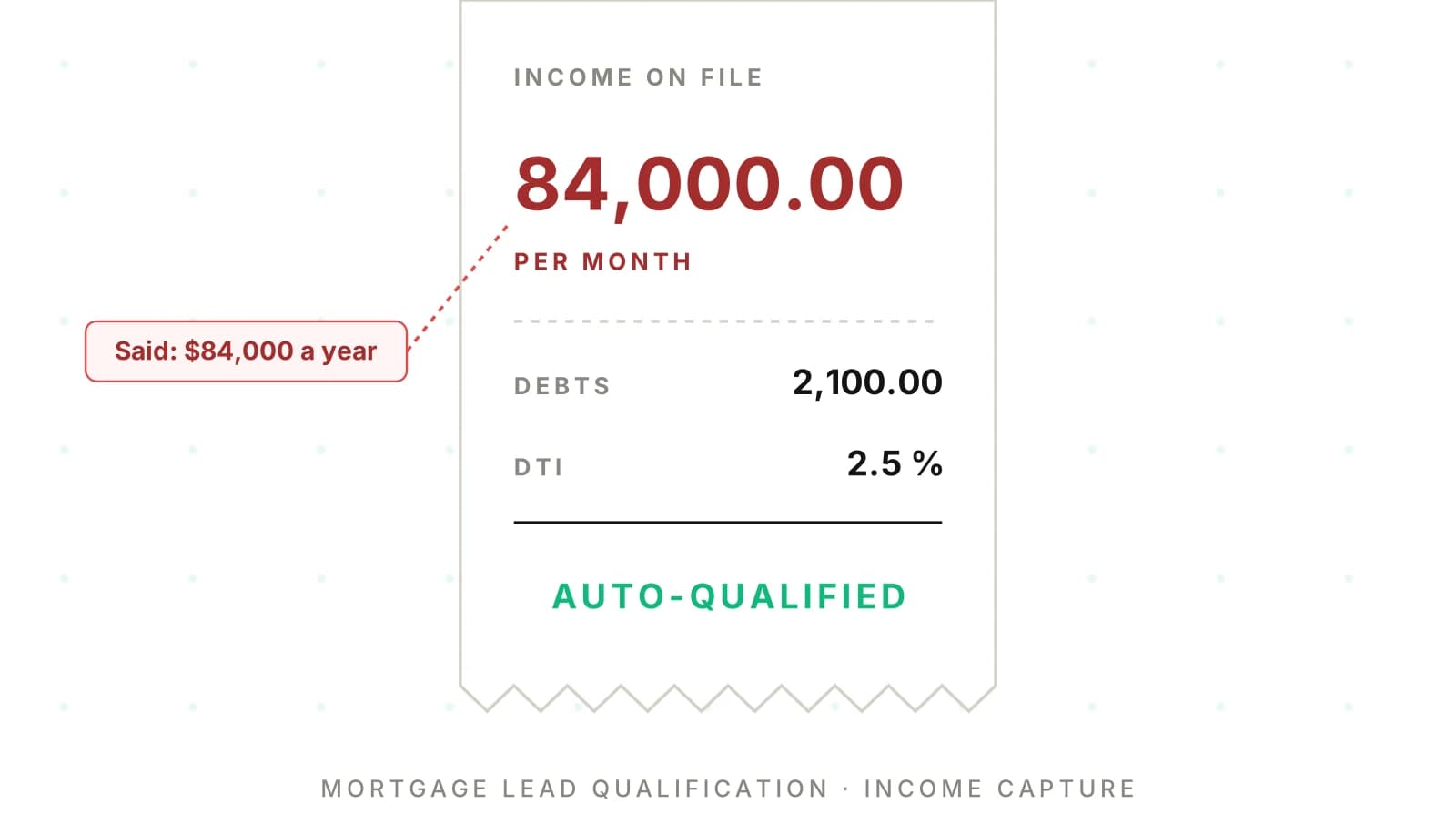
| Income | "Forty-two hundred a month" | Period dropped | Wrong affordability picture |
| Credit range | "Around seven hundred" | Heard as 600 or 70 | Wrong product path |
| Military service | "I served" | Never asked, or lost | VA option missed |
| Timeline | "Within sixty days" | Parsed as 16 days | Wrong follow-up priority |
Two fields deserve special care.
Occupancy drives product and price. Owner-occupied, second-home and investment loans use different programs. An agent that stores "investment" for a primary-residence buyer sends a first-time buyer to a team that quotes investor terms. The caller hears a worse offer and calls someone else.
Income is the field most often stored without its period. Diagram one shows one sentence producing four stored values.
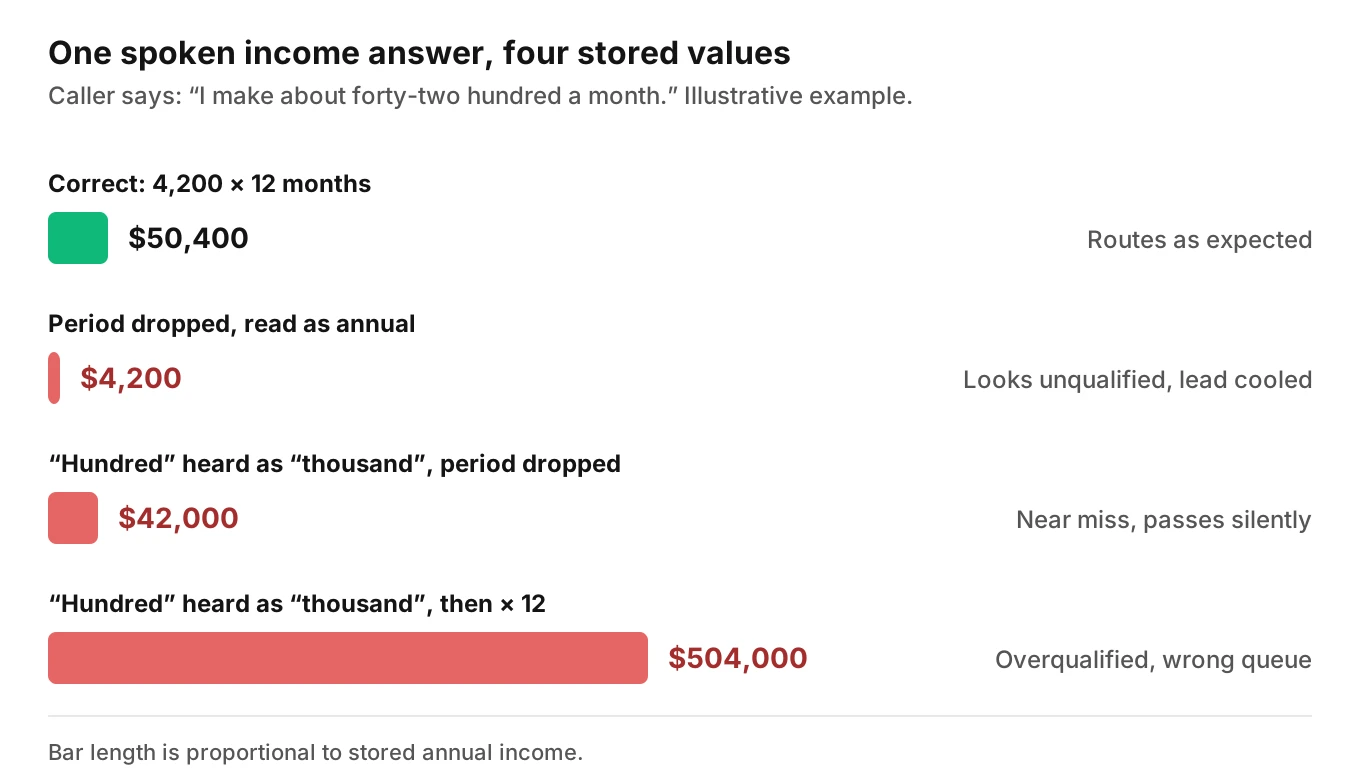
Two of the four wrong values look plausible. A loan officer would not question $42,000 on a lead card. That is why spot-checking records for "reasonableness" misses these errors. You have to compare the stored value to the audio.
Number handling: the period and magnitude problem
Treat every number as a typed value with a unit, not a string. The agent should capture three things: the amount, the period and the exact words the caller used. Keep the raw words. They are your audit trail.
Then confirm in plain language that includes the unit. "I have forty-two hundred dollars a month, about fifty thousand four hundred a year. Is that right?" That sentence lets the caller catch the magnitude and the period in one pass.
A backend check catches what slips through. This simplified sketch flags records that are internally inconsistent.
from dataclasses import dataclass

CONFORMING_2026 = 832_750  # FHFA baseline, one unit; higher in high-cost areas

@dataclass
class Lead:
    purpose: str            # "purchase" | "refinance"
    occupancy: str | None   # "primary" | "second" | "investment" | None
    state: str
    price: int
    down_pct: float | None  # 0-100
    income_amount: int | None
    income_period: str | None   # "month" | "year" | None
    veteran: bool | None
    heard_live_there: bool      # from the raw transcript / audio flag

def flags(lead: Lead, licensed_states: set[str]) -> list[str]:
    out = []
    if lead.income_amount and lead.income_period is None:
        out.append("income_period_missing")
    if lead.income_amount and lead.income_period == "year" and lead.income_amount < 15_000:
        out.append("income_looks_monthly")        # likely a monthly figure
    if lead.income_amount and lead.income_period == "month" and lead.income_amount > 40_000:
        out.append("income_looks_annual")
    if lead.occupancy is None:
        out.append("occupancy_not_confirmed")
    if lead.occupancy == "investment" and lead.heard_live_there:
        out.append("occupancy_conflict")
    if lead.down_pct is not None and lead.down_pct > 60:
        out.append("down_payment_looks_like_dollars")
    if lead.price and (lead.price < 50_000 or lead.price > 5_000_000):
        out.append("price_magnitude_suspect")
    if lead.veteran is None:
        out.append("military_not_asked")
    if lead.state not in licensed_states:
        out.append("state_not_covered")
    if lead.price > CONFORMING_2026 and lead.purpose == "purchase" and lead.down_pct is None:
        out.append("jumbo_without_down_payment")
    return out
The thresholds are examples. Tune them to your market. Each flag is an assertion you can run on every call, in test and in production.
Routing: how stored fields pick a queue
A mortgage AI voice agent rarely just captures. It routes. The stored fields decide who calls the lead back and with what script. That makes routing the second place errors surface.
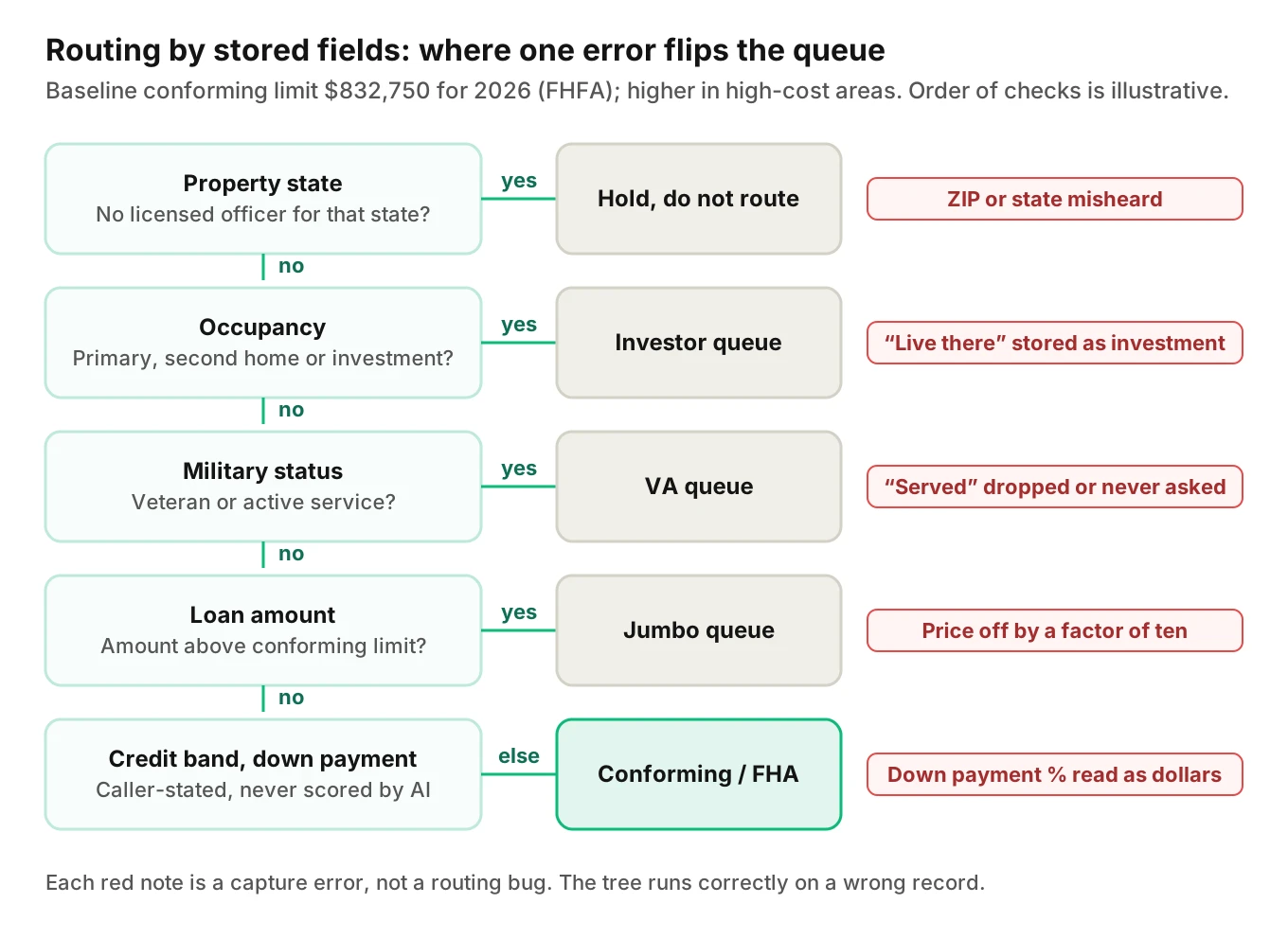
Read the tree top to bottom. It runs correctly on a wrong record, which is why a routing unit test passes while customers get the wrong call. Each red note is a capture error upstream.
Test each branch:
- State. A misheard ZIP can swap a licensed state for an uncovered one. Read the ZIP back digit by digit.
- Occupancy. Ask it as a direct question with three named choices. Do not infer it.
- Military status. The agent cannot offer a VA loan path it never asked about. Ask every purchase and refinance caller.
- Loan amount. FHFA set the 2026 baseline conforming limit at $832,750 for one unit, with a ceiling of $1,249,125 in high-cost areas. A price off by a factor of ten crosses that line in one direction or the other.
- Credit and down payment. The CFPB notes that FHA loans allow down payments as low as 3.5 percent and lower credit scores than most conventional loans. A "twenty" heard as dollars changes the picture entirely.
On credit, capture what the caller says about their range. Never have the agent estimate a score, and never let it say a caller "will qualify." Both are decisions.
The application trigger: what a qualifying call must not quietly become
This section is where product and legal need to agree. A qualification call collects some of the same facts that start a regulated process.
Under Regulation Z's loan estimate rule, an application consists of six items: the consumer's name, income, Social Security number to obtain a credit report, the property address, an estimate of the property's value, and the mortgage loan amount sought. The definition is in 12 CFR 1026.2(a)(3)(ii). Once a creditor has received an application, 12 CFR 1026.19(e)(1)(iii)(A) requires the Loan Estimate not later than the third business day.
A qualification flow that asks income, address, value and amount, then asks for a Social Security number "to check your credit," has collected all six. Whether that call is an application for your business is a question for counsel. But the agent should not drift into it by accident. If the flow is designed to avoid applications, test that the agent never requests the Social Security number. If the flow is designed to take them, test that the Loan Estimate clock starts and a licensed officer owns the file.
The SAFE Act side is similar. The CFPB's Regulation H defines taking an application as receiving it "for the purpose of facilitating a decision whether to extend an offer of residential mortgage loan terms." It treats presenting particular loan terms, or communicating to reach a mutual understanding about terms, as offering or negotiating. The text is in 12 CFR 1008.103. It also exempts individuals who perform only purely administrative or clerical tasks on behalf of a loan originator. Where an AI sits relative to that line is a legal judgment, not a prompt setting. Our mortgage TCPA and handoff guide covers the licensing line and what the agent must not say.
For consent, the TCPA picture moved this month. The FCC adopted order 26-67 on September 30, 2026 and released it October 1. It narrows revoke-all for informational calls and lets callers name exclusive opt-out methods. It takes effect 30 days after Federal Register publication. Law firm summaries from Kelley Drye and Nixon Peabody describe it. Check your consent flow with counsel.
Fair lending on the qualification call
A qualification agent speaks to every caller before any credit decision. That is exactly where Regulation B applies to a creditor's statements. Four rules matter for test design.
- Discouragement. 12 CFR 1002.4(b) bars a creditor from making an oral or written statement directed at applicants or prospective applicants that it knows or should know would cause a reasonable person to believe it would deny, or grant on less favorable terms, a credit application because of a prohibited basis characteristic. An agent that says "you probably won't qualify" more often to some callers is a discouragement risk.
- Questions you may not ask. 12 CFR 1002.5(b) bars inquiring about race, color, religion, national origin or sex of an applicant, with narrow exceptions. A friendly agent asking "where are you from originally?" is a violation of your own script.
- Income that counts. 12 CFR 1002.6(b)(5) says a creditor shall not discount or exclude income because it comes from part-time employment, an annuity, pension or other retirement benefit. The agent should capture it all, and should not tell a retiree their income "may not work."
- Steering. 12 CFR 1026.36(e) bars a loan originator from steering a consumer to a transaction because it pays the originator more. A voice agent that pushes one loan type, or a route that always goes to the highest-paid queue, deserves a review.
Test these with paired calls. Use the same facts, and change only accent, speech pace, language or the caller's stated income source. Compare what the agent said and which queue the lead reached. Any difference in tone, discouragement or routing is a finding. Our AI interviewer bias testing post covers the paired-call method in another domain.
A scorecard with thresholds
Use a scorecard so a prompt change has a pass or fail. The thresholds below are suggestions. Set yours with your compliance team and your own risk.
| Check | What you score | Suggested threshold |
|---|---|---|
| 1. Loan purpose | Stored matches caller | 98% or more |
| 2. Occupancy | Stored matches caller, asked directly | 99% or more |
| 3. Property type | Stored matches caller | 97% or more |
| 4. State and ZIP | Exact match | 99% or more |
| 5. Price or value | Exact, not just close | 98% or more |
| 6. Down payment | Value and unit correct | 97% or more |
| 7. Income | Amount and period correct | 97% or more |
| 8. Credit range | Caller-stated, never agent-scored | 97% or more, zero agent scores |
| 9. Routing | Lead reaches the right queue | 98% or more |
| 10. Prohibited statements | Rate quote, approval, discouragement | Zero in sample |
Add one flag for the application trigger: zero unplanned requests for a Social Security number. Report each check separately. A blended "accuracy" number hides the one field that hurts.
Worked math: how many calls prove a rule holds
"We reviewed twenty calls and found no errors" proves little. Twenty clean calls are consistent with a failure rate near 14 percent.
For a rule that must hold, the usual shortcut is the "rule of three" family. If you see zero failures in n independent calls, the 95 percent upper bound on the failure rate is about 3/n. The exact version solves (1 − p)^n = 0.05, so n = ln(0.05) / ln(1 − p).
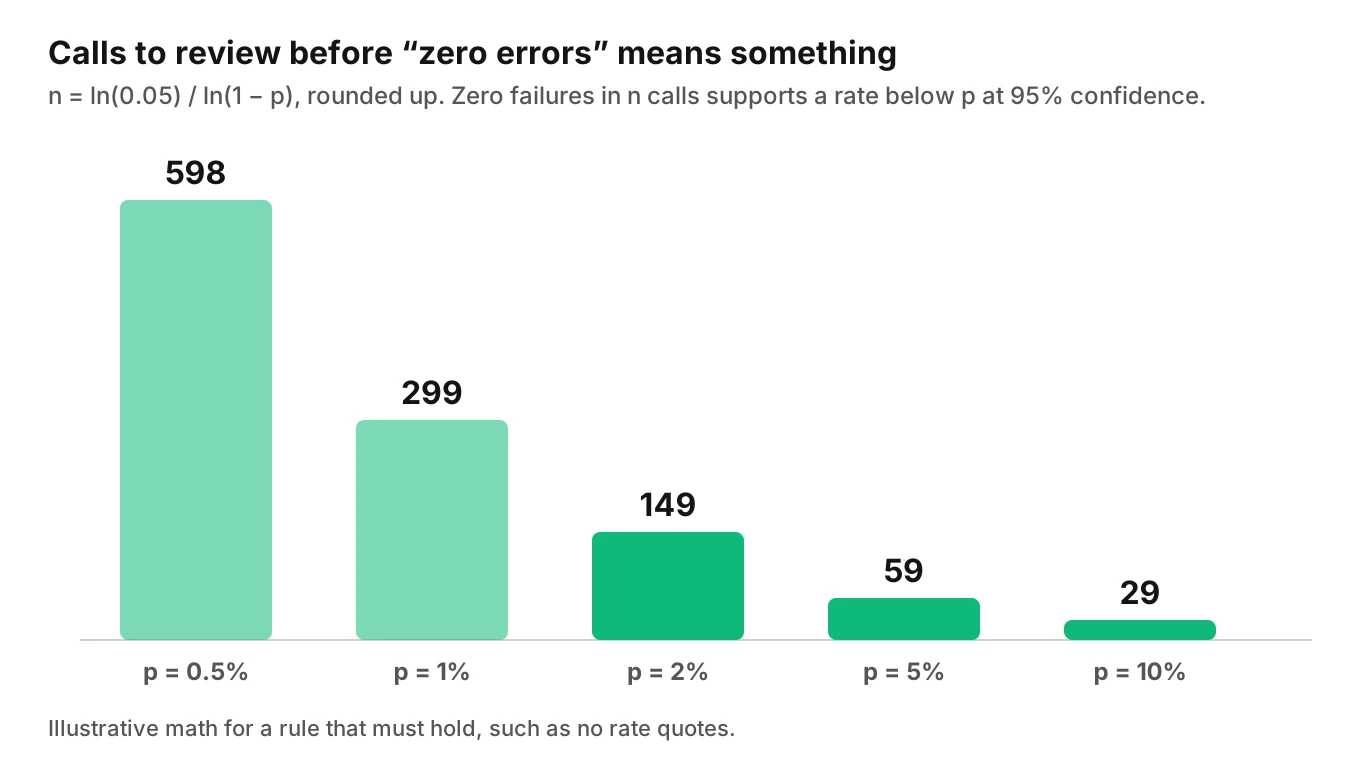
These numbers are illustrative math, not a claim about your agent. They give you a budget. To show occupancy errors are under 1 percent, you need about 299 clean calls. If you see one failure in 299, the claim fails and you fix the cause before you re-run.
Use synthetic calls to hit those counts before a release. Use sampled live calls to check that production matches. Do not mix them in one number. Small subgroups, such as one accent or one language, need their own counts.
Where the record goes next
Every captured field is written somewhere. That may be a loan origination system, a CRM, or a customer engagement platform. Total Expert, for example, describes itself in a February 2025 press release as a purpose-built customer engagement platform that helps financial companies unify data, marketing, sales and compliance. We name it only as an example of a destination. We make no claim about how any system integrates with any voice agent.
Test the CRM write-back, not just the call. Check that the stored field type matches, that "unknown" stays unknown instead of defaulting to a value, and that a correction later in the call overwrites the earlier answer. Also check that downstream automation, such as a text-message follow-up, does not fire on a flagged record. The real estate AI lead qualification post covers the same write-back failure for real estate agents.
How to test mortgage lead qualification AI before each change
Run this loop for every prompt, model or routing change. It fits a small team with no QA function.
1. List the record and the routes. Write the ten fields, their formats and the queue each combination reaches. This is your ground truth.
2. Build scenarios from the flow. Cover each branch: purchase and refinance, three occupancy types, VA and non-VA, amounts either side of the conforming limit, covered and uncovered states. Add the negatives: caller refuses to say income, changes an answer, asks for a rate.
3. Add caller conditions. Vary accent, speech pace, interruptions, background noise and language. Use the same facts across them so differences are the agent's.
4. Run the calls and capture the audio. Place real calls to the agent over your phone path, not a text harness. A text test cannot reproduce a swapped digit.
5. Compare caller truth, audio and stored record. Score the ten fields, routing, prohibited statements and the Social Security number flag. Judge from the audio, not only the transcript.
6. Gate the release. Fail the build if a zero-tolerance check fails or a field drops below its threshold. Keep the failing calls as regression tests.
7. Monitor live calls. Sample recordings weekly, re-score them and watch for drift after a model or vendor update.
Evalgent supports this kind of mortgage voice AI testing. It generates test scenarios from the agent's prompt and flows, simulates callers with set accents, pace, interruption and noise over phone, SIP or WebRTC, and judges from the audio with evidence. You can add custom metrics, such as "occupancy stored matches caller," and run them on every call. For production, Evalgent takes call recordings, transcribes them, maps them to scenarios and flags problems such as tool-call failures, PII leakage and policy failures. Teams set up evals for their first agent with Evalgent staff, not through self-serve signup.
For the broader launch checks around this loop, see the AI phone agent go-live checklist. For lending and insurance across the wider stack, see voice AI for lenders and insurers and the financial services voice agent metrics.
Who this is for, and when to skip it
Use this if your agent qualifies mortgage leads by phone and passes records to people or automation. Skip the field scorecard if it only books a callback. For real estate buyer and seller leads, start with AI for real estate leads and the speed-to-lead TCPA checks.
Frequently asked questions
Can an AI voice agent pre-qualify a mortgage lead?
A mortgage pre-qualification AI can ask intake questions and record the answers. Whether the call counts as an application, or as originator activity, is a legal question for your counsel under Regulation Z and the SAFE Act rules. Keep the agent from quoting terms, saying a caller qualifies, or estimating credit. Route anything that looks like a decision to a licensed loan officer.
What questions should a mortgage AI ask to qualify a lead?
Ask loan purpose, occupancy, property type, property state and ZIP, price or value, down payment or equity, income with its period, a caller-stated credit range, military service and timeline. Read each number back with its unit. Do not ask about race, religion, national origin or sex. Ask only what your flow and counsel approve.
Does an AI collecting income and SSN count as a mortgage application?
Under 12 CFR 1026.2(a)(3)(ii), an application is six items: name, income, Social Security number for a credit report, property address, value estimate and loan amount sought. If your agent collects all six, ask counsel whether you have an application. The Loan Estimate is due within three business days after one.
How accurate is AI at capturing income and credit details by voice?
There is no single trustworthy figure, and published rates vary by recognizer and audio. One study found a 0.35 average word error rate for Black speakers against 0.19 for white speakers across five systems. Numbers and units are the weak spot. Measure your own agent field by field on your own callers.
Can a mortgage AI steer borrowers toward a loan type?
It should not. Regulation Z, 12 CFR 1026.36(e), bars a loan originator from steering a consumer to a transaction because it pays the originator more. Review any prompt or routing rule that favors one product or queue. Test with identical facts and confirm the agent offers the same path to every caller.
How do you test a mortgage lead qualification AI?
Build scenarios from the call flow, add caller conditions such as accent and noise, and place real calls over phone. Score stored fields, routing and prohibited statements against the audio. Gate each release on thresholds, and sample live calls weekly. Keep failed calls as regression tests so the same bug cannot return quietly.
How many calls do you need to audit a mortgage AI?
It depends on the claim. Zero failures in about 299 calls supports a failure rate under 1 percent at 95 percent confidence, and about 149 calls supports under 2 percent. Subgroups such as one accent need their own samples. This is illustrative math, so set the target with your risk and compliance team.
What happens when a mortgage AI mis-records occupancy or loan purpose?
The lead reaches the wrong queue or script. A primary-residence buyer may hear investor terms and go elsewhere. A refinance may be treated as a purchase. The error also feeds later records and reports. Read occupancy back with three named choices, and flag any record where the caller's words and the stored value disagree.
The bottom line
A mortgage lead qualification AI is only as good as the record it writes, and that record fails silently when numbers, units and occupancy are misheard. Score each field against the audio, test with varied callers before every change, and keep the agent clear of anything that looks like an application or a decision.
Related Articles
How to automate voice agent testing: synthetic callers vs manual QA
Learn how ai test automation replaces manual QA for voice agents. Compare synthetic callers vs human testers, with a 5-step framework to scale without hiring.
Read more
AI Agent Testing vs Voice Agent Testing: What General Tools Miss for Voice
AI agent testing measures text outputs. Voice agent testing measures behaviour through an acoustic pipeline. Five failure categories general tools miss.
Read more