Test your voice agent
From Pilot to Production: Scoring Voice AI for Launch
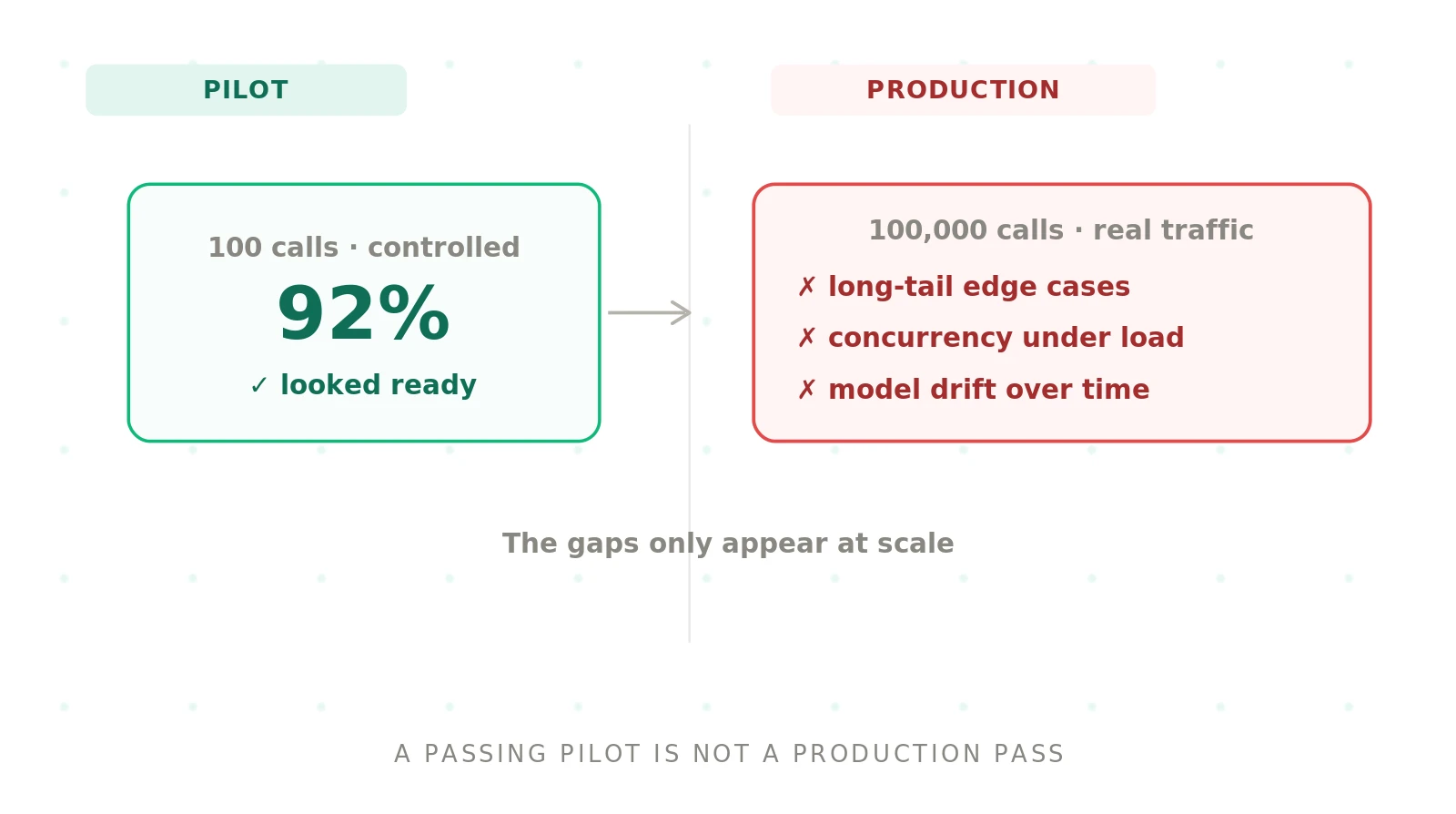
The pilot went well. Task success looked strong, latency felt snappy, and the room agreed the agent was ready. Then full traffic arrived, and the numbers moved. Calls that never appeared in the pilot started to fail. This is the gap between a pilot and production, and it catches good teams every launch. The agent did not get worse. The conditions got harder.
A pilot experiment is a small, controlled trial. It is designed to reduce risk before you commit. That is exactly why it can mislead you. A pilot samples a narrow, friendly slice of reality. Production is the whole distribution, at scale, over time. This post explains what changes in that transition, how to score a pilot honestly, and how to stage the rollout so a surprise stays small.
Why a pilot passes and production still fails
A pilot is a curated environment. You pick the callers, the hours, and often the scripts. Volume is low, so concurrency never stresses the system. The time window is short, so models do not drift. Edge cases are rare by definition, so a small sample rarely contains them. Every one of these comforts disappears at launch.
Think of the pilot as a sample and production as the population. A clean sample can hide the tail of the distribution entirely. The failures that matter most in production are often the ones a pilot is least likely to see. That is not bad luck. It is a structural property of small samples. If you understand that, you can plan around it. If you do not, you will call the surprise a regression.
The long tail appears
In a pilot of 200 calls, a failure mode that hits one caller in 500 probably never shows up. At 50,000 calls a month, it appears a hundred times. The agent behaves identically. Only the exposure changed. Accents, background noise, interruptions, unusual account states, and rare intents all live in this tail. A pilot samples the easy middle. Production forces you to meet the edges.
This is why coverage matters more than a headline average during scoring. A 94% task-success rate across a friendly sample tells you little about the 6%. If the failing 6% clusters around one intent or one caller profile, you have a real production risk hiding behind a good number. Our voice agent testing checklist walks through building coverage across intents, profiles, and conditions before you trust any aggregate.
Concurrency stresses latency and accuracy
Pilots run light. A handful of simultaneous calls rarely taxes your speech pipeline, your model endpoints, or your telephony path. Production runs heavy. Under load, queues form, retries fire, and tail latency climbs even when median latency looks fine. A percentile view is essential here. The p50 can stay flat while the p95 doubles.
Latency is not just a comfort metric. Slow turns break the rhythm of a conversation. Callers talk over the agent, the agent mishears, and accuracy falls as a second-order effect. The perceptual budget is tight. The ITU-T G.114 recommendation puts one-way mouth-to-ear delay under 150 milliseconds for good interactivity. A pilot rarely pushes you near that ceiling. Concurrency does. Deliberate load and stress testing is how you find the point where quality bends before your customers do.
Monitoring must exist before you scale
In a pilot you can listen to calls by hand. Someone reviews the transcripts and flags what went wrong. That does not survive contact with real volume. You cannot manually review 50,000 calls. If you scale without automated monitoring, failures happen silently and you learn about them from complaints. That is the worst possible feedback loop.
Production needs instrumentation from the first real call. You want structured traces for each turn, quality scores computed continuously, and alerts on the metrics that matter. Open, vendor-neutral tracing standards give you a way to follow a call end to end. Building this before launch is not gold-plating. It is the difference between catching a problem in an hour and finding it in a quarterly review. Our guide to voice agent observability covers what to trace and what to alert on.
Model drift emerges over time
A pilot is a snapshot. Production is a film. Over weeks, the world your agent lives in shifts. Callers ask new things. Your own prompts and knowledge base change. Underlying models get updated on a schedule you may not control. Each of these can move behavior in ways a one-week pilot could never reveal.
Drift is slow and easy to miss. A metric that sat at 92% can slide to 85% over a month without a single dramatic failure. This is why launch is not the finish line. You need a standing evaluation that reruns your scenario suite on a cadence and flags movement. Treat every model or prompt change as a trigger for regression testing against a fixed baseline. Without it, you discover drift from your customers, which is late and expensive.
Pilot conditions versus production conditions
The table below shows why one clean pilot cannot certify a launch. Each row is a dimension where the two environments differ. Score your pilot with the right-hand column in mind, not the left.
| Dimension | Pilot conditions | Production conditions |
|---|---|---|
| Call volume | Tens to low hundreds | Thousands to tens of thousands |
| Concurrency | Light, rarely simultaneous | Heavy, bursty, unpredictable |
| Caller mix | Curated, often internal | Full public distribution |
| Edge cases | Rare, mostly absent | Present at meaningful counts |
| Latency profile | Median looks fine | Tail latency under load matters |
| Time horizon | Days to a week | Months, with drift |
| Monitoring | Manual, by hand | Automated, continuous |
| Failure cost | Low, contained | High, customer-facing |
Read this table as a warning about generalization. A strong result in the left column does not transfer to the right column for free. Each dimension is a place where a comforting pilot number can quietly break. The scoring job is to estimate how each one will move, then decide whether the agent still clears your bar. For the numeric thresholds themselves, see our production-readiness bar.
How to score a pilot for production-worthiness
Scoring a pilot is not about celebrating a good average. It is about estimating how the agent will behave once conditions get harder. Follow these steps to turn pilot data into a defensible launch decision.
1. Separate the easy middle from the hard tail. Break results down by intent, caller profile, and call condition. A single blended number hides risk. Look for any segment where success drops sharply, because that segment will grow at scale.
2. Weight failures by cost, not by count. A rare failure that misroutes a payment matters more than a common one that repeats a menu. Score against the damage each failure type can do, so a low-frequency, high-cost mode does not disappear into the average.
3. Read latency at the tail, not the median. Report p95 and p99, not just p50. Then estimate how those tails will move under concurrency. If the pilot never generated load, treat its latency numbers as optimistic and plan a dedicated load test.
4. Estimate tail exposure at real volume. Multiply your rare failure rates by projected monthly call counts. A one-in-500 failure becomes a hundred incidents at 50,000 calls. Decide whether that count is acceptable before you commit, not after.
5. Confirm monitoring is live before you score readiness. An agent is not production-ready if you cannot see it fail. Verify that traces, quality scores, and alerts are running against pilot traffic first. If they are not, readiness scoring is premature.
6. Set a drift baseline and a rerun cadence. Freeze the pilot scenario suite as a baseline. Commit to rerunning it on a schedule and on every model or prompt change. Scoring is not a one-time event. It is the start of a standing check.
7. Write the decision down with its assumptions. Record the bar, the measured numbers, and the projections you used. If the launch surprises you later, the record tells you which assumption broke. This turns each launch into a lesson instead of a mystery.
How to stage the rollout after a passing pilot
A passing pilot earns a limited launch, not a full one. The goal is to expose the agent to real conditions while keeping any surprise small and reversible. Scalability is something you verify in stages, not assume. Stage the rollout so production teaches you cheaply.
Start with a canary. Route a small slice of real traffic, perhaps 1% to 5%, to the agent while the rest follows the existing path. This exposes the agent to the true caller distribution at a fraction of the risk. Watch your monitoring closely during this window. The canary is where the long tail first becomes visible, so give it enough volume and time to surface rare modes.
If the canary holds, widen in steps. Move to 10%, then 25%, then 50%, pausing at each level to confirm your metrics stay within the bar. Each step multiplies exposure, so each step can reveal a new failure that the previous slice was too small to show. Keep a fast rollback path ready at every level. A staged rollout is only safe if you can retreat quickly when a metric slips.
Full traffic is the last step, not the first. Even then, the standing evaluation and monitoring continue. Production is not a state you reach and forget. It is a condition you maintain. The NIST AI Risk Management Framework frames this well, treating measurement and monitoring as ongoing functions rather than a one-time gate. Our note on why voice agents fail in production covers the failure modes that a staged rollout is designed to catch.
What good looks like at each stage
A healthy pilot-to-production path has a rhythm. The pilot answers a narrow question: does the core flow work at all? A passing pilot moves you to scoring, where you stress the numbers and estimate the tail. Scoring moves you to a canary, where real traffic tests your estimates. The canary moves you to a staged ramp, where exposure grows under a watchful eye.
At each stage, the question sharpens. The pilot asks whether the agent can. The canary asks whether the agent does, under real conditions. The ramp asks whether it keeps doing so at volume and over time. If you skip a stage, you are not moving faster. You are just moving the discovery of failure to a more expensive place. Validate the agent methodically before deployment, as our pre-deployment validation guide lays out.
Scoring voice AI launches with Evalgent
Evalgent is an independent platform for testing and evaluating voice agents from pilot through production. Scenarios let you script the friendly middle and the hard tail as reusable test cases, so a pilot no longer samples only the easy path. Profiles model the accents, noise, and caller behaviors that a curated pilot tends to miss. Metrics report task success, accuracy, and latency percentiles so you read the tail, not just the median. Evaluations rerun your suite on a cadence and on every change, giving you a fixed baseline to catch drift. Reviews put human judgment on the calls that matter, so a low-frequency, high-cost failure never hides inside a good average. To see how this maps to your own rollout, book a demo.
The bottom line
A pilot is a sample, and production is the population. Passing one is evidence, not proof. Score your pilot for coverage and tail behavior rather than a headline average. Then stage the rollout so real conditions teach you cheaply, starting with a small canary before full traffic. The agent rarely gets worse at launch. The conditions get harder, and the teams that plan for that ship with fewer surprises.
Frequently asked questions
Why does a voice agent pass a pilot but fail in production?
A pilot samples a small, friendly slice of reality. Production is the full distribution at scale, over time. Rare edge cases, concurrency, and drift stay hidden in a short controlled trial. The agent does not get worse. The conditions get harder, so failures that were absent in the sample appear at volume.
What is the difference between a voice AI pilot and production?
A pilot is a controlled, low-volume trial used to reduce risk. Production is real traffic at full scale, with concurrency, the complete caller mix, and change over time. A pilot answers whether the core flow can work. Production tests whether it keeps working under load, across edge cases, and for months.
How do you score a voice agent pilot for production readiness?
Break results down by intent, profile, and condition rather than trusting a blended average. Weight failures by cost, read latency at the p95 and p99, and estimate rare-failure exposure at real volume. Confirm monitoring is live, set a drift baseline, and write the decision down with its assumptions.
Why does concurrency hurt voice agent latency?
Under many simultaneous calls, queues form and retries fire, so tail latency climbs even when median latency looks fine. Slow turns break conversational rhythm. Callers talk over the agent, it mishears, and accuracy falls as a knock-on effect. A light pilot rarely generates the load that reveals this, so it looks deceptively fast.
What is a canary rollout for a voice agent?
A canary routes a small slice of real traffic, often 1% to 5%, to the new agent while the rest follows the existing path. It exposes the agent to the true caller distribution at low risk. Watch monitoring closely, because the canary is where the long tail of rare failures first becomes visible.
How much traffic should a voice AI canary get?
Start around 1% to 5% of real calls, enough volume to surface rare failure modes but small enough to contain any damage. Hold it long enough for edge cases to appear. If metrics stay within the bar, widen in steps to 10%, 25%, and 50%, pausing to confirm quality at each level.
What is model drift in voice agents?
Drift is the slow change in agent behavior over time. Callers ask new things, prompts and knowledge bases change, and underlying models get updated. A metric can slide from 92% to 85% over a month with no single dramatic failure. A standing evaluation that reruns your suite on a cadence catches it before customers do.
Do you need monitoring before launching a voice agent?
Yes. You cannot manually review tens of thousands of calls, so without automated monitoring failures happen silently. Instrument from the first real call with per-turn traces, continuous quality scores, and alerts on the metrics that matter. An agent you cannot watch fail is not production-ready, whatever its pilot numbers looked like.
Related Articles
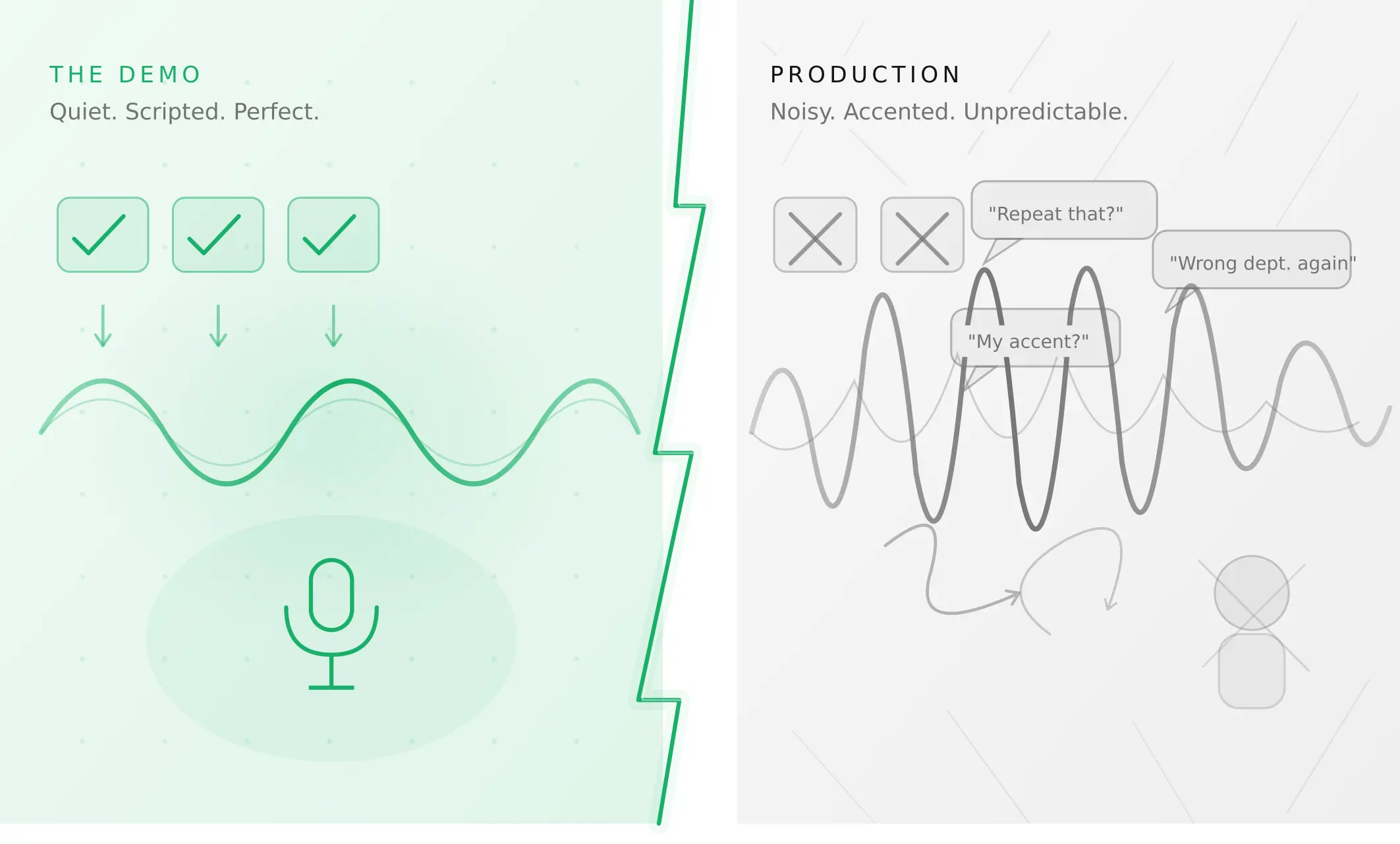
Why AI voice agents fail in production (and how to prevent it)
AI voice agents that ace demos still break in production. Learn the 5 root causes, how to test for each, and what production readiness actually means.
Read more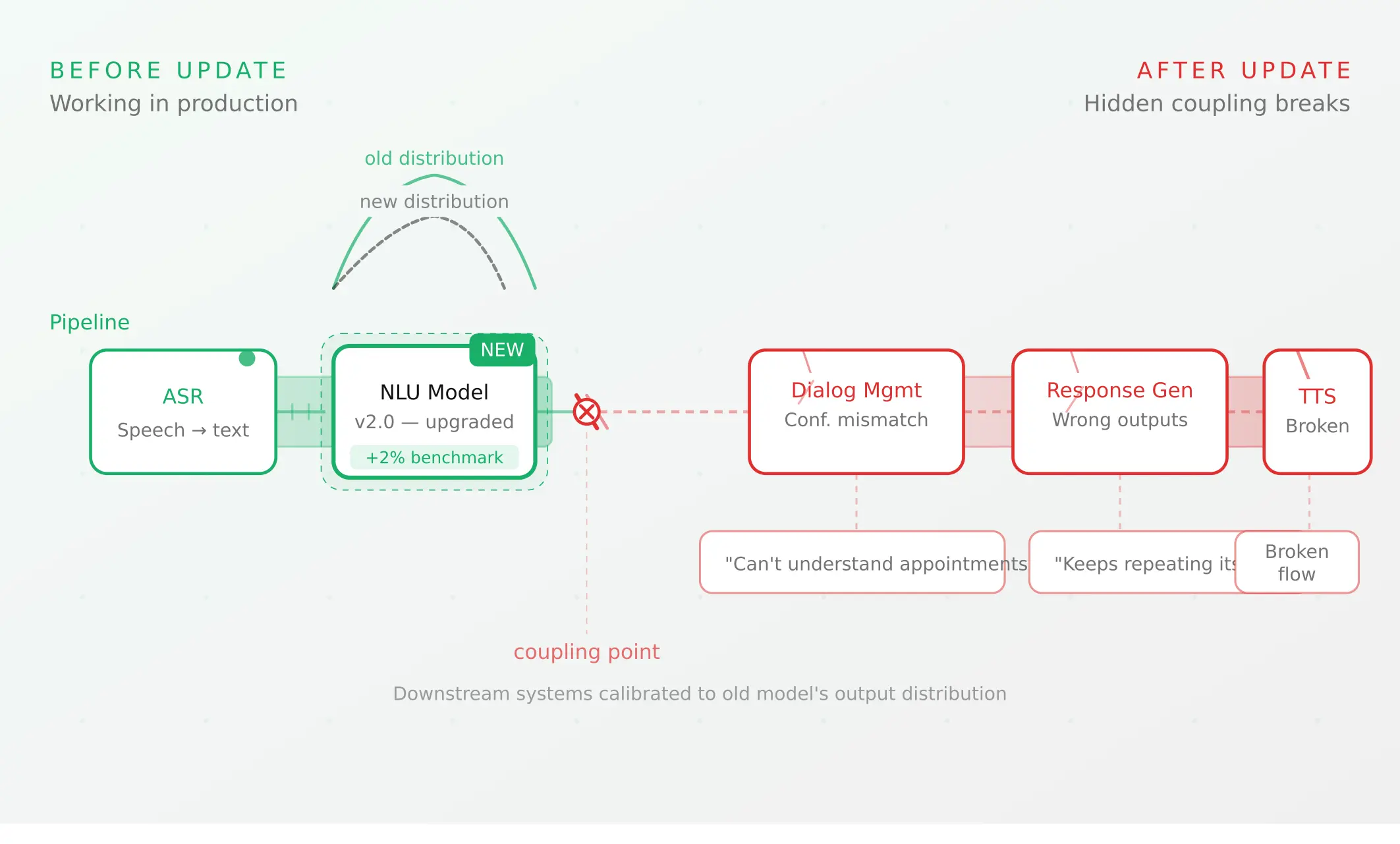
Voice agent regression testing: why LLM updates break production
LLM updates improve benchmarks but break voice agents in 5 predictable ways. How to detect and prevent regressions after every model or prompt change.
Read more