Test your voice agent
Voice Agent Shadow Testing in Production
# Voice agent shadow testing in production
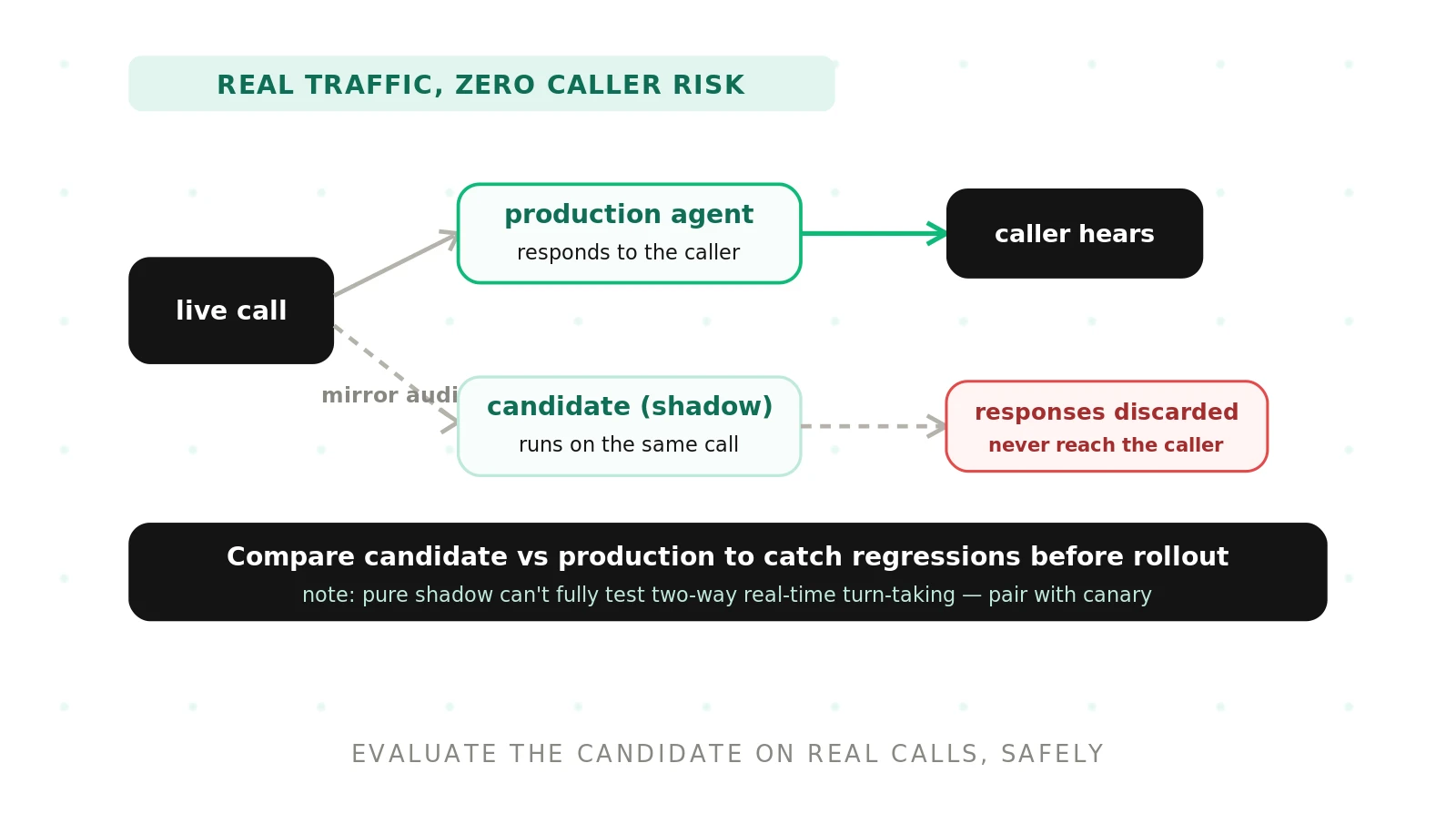
Voice agent shadow testing lets you evaluate a new agent on real calls before it ever speaks to a customer. You mirror live production traffic to a candidate agent, watch what it would have done, and keep its output away from the caller. The result is production-realistic evidence with none of the caller risk. This guide covers how shadow testing works, how to set it up, what it catches, its hard limits, and where it fits next to canary, offline, and full live testing.
Quick answer
> Quick answer: Voice agent shadow testing runs a candidate agent alongside your live agent on real production calls. The shadow agent receives mirrored audio and inputs, but its responses never reach callers. You get production-realistic evaluation with zero caller risk, comparing shadow decisions against live ones to catch regressions before rollout.
A voice agent that passes every scripted test can still fail on real calls. People interrupt. Lines are noisy. Callers ask for things your test set never imagined. Shadow testing closes that gap without betting a single live call on an unproven change.
What voice agent shadow testing is
Shadow testing borrows a pattern from software deployment. The idea is old and well understood in shadow deployment: you send real production input to a new version, but you throw its output away.
> Voice agent shadow testing: running a candidate voice agent on mirrored production traffic while suppressing its responses to the caller. The live agent handles the call; the shadow agent runs in parallel and is scored offline.
The live agent still owns the conversation. The caller hears only the live agent. The candidate runs on a copy of the same audio, transcripts, and context. Its replies, tool calls, and decisions get logged and scored, never played.
That single rule, do not play the shadow output to the caller, is what makes the technique safe. It is the voice equivalent of a dark launch, where new behavior runs in the production environment but stays invisible to users until you trust it.
Shadow testing sits on the online side of the split described in our guide to offline vs online voice agent evaluation. It uses real traffic, not a fixed test set. But unlike a canary, it exposes no caller to the new agent at all.
Why shadow testing beats a lab test alone
Scripted tests are fast, cheap, and repeatable. They are also blind to the messy edges of real calls. Shadow testing adds the one thing a lab cannot fake: genuine caller behavior.
Real callers cough, trail off, and change their minds. Background noise degrades transcription. Accents and speech rates vary far beyond your recorded fixtures. A candidate agent that scores well in offline evaluation can still misread these inputs.
Shadow testing surfaces those failures on live distributions before rollout. You see how the candidate handles the exact calls your business gets today, not the calls you imagined during design. And because nothing reaches the caller, a bad candidate costs you nothing but a log line.
There is a second benefit. You get a direct, call-by-call comparison. For each mirrored call, you have the live agent's decision and the shadow agent's decision on the same input. That paired data is far stronger than comparing two separate populations of calls.
How to set up voice agent shadow testing
Setting up shadow testing is mostly plumbing plus a scoring plan. Follow these steps in order.
1. Pick the traffic to mirror. Start with a representative sample, not every call. Sample across intents, call lengths, and times of day. A 10 to 20 percent slice is often enough to see patterns without overloading the pipeline.
2. Duplicate the input stream. Fork the incoming audio and any structured inputs, such as caller ID, IVR selections, and CRM context. Feed one copy to the live agent and one to the candidate. Timestamp both so you can align them later.
3. Run the candidate in shadow mode. Give the candidate the same tools and context the live agent has. Let it decide and act internally, but block every outbound effect. No audio to the caller. No real writes to downstream systems.
4. Stub or sandbox side effects. Point the candidate's tool calls at read-only or sandboxed endpoints. A shadow agent must never charge a card, send an SMS, or book an appointment for real.
5. Log both agents' full traces. Capture transcripts, intents, tool calls, arguments, latency, and final decisions for the live and shadow runs. Align them by call and by turn.
6. Score shadow against live. Compare decisions turn by turn. Flag divergences: different intent, different tool call, different resolution. Have an independent evaluator grade whether the shadow decision was better, worse, or equal.
7. Set a rollout gate. Define pass thresholds before you look at results. For example, no regression on safety-critical intents and equal-or-better task success on a large sample.
8. Promote or iterate. If the candidate clears the gate, move it to a small canary release. If it fails, fix and re-shadow. Never skip straight to full traffic.
The one step teams get wrong is number four. If the shadow agent's tool calls hit real systems, it stops being a shadow and starts causing side effects callers never see but your database does.
Shadow vs canary vs offline vs full live
Each testing mode trades caller risk for realism. Shadow testing is unique: high realism, zero caller exposure. The table below compares the four on the axes that matter for a rollout decision.
| Testing mode | Caller risk | Realism | What it catches | What it misses |
|---|---|---|---|---|
| Offline evaluation | None | Low to medium | Regressions on known cases, logic and prompt errors, scripted edge cases | Real caller behavior, live noise, true traffic distribution |
| Shadow testing | None | High (real inputs) | Divergences on live traffic, misreads of real audio, decision regressions | Two-way turn-taking, real interruptions, downstream side effects |
| Canary release | Low (small share) | Very high | Real turn-taking, interruption handling, end-to-end outcomes on a slice | Rare intents outside the canary window, long-tail failures |
| Full live rollout | High (all callers) | Complete | Everything, including the failures you did not predict | Nothing, but every miss is now a real caller's problem |
The pattern is clear. Offline and shadow both carry zero caller risk, but shadow adds real-world inputs. Canary adds true interaction at the cost of exposing some callers. Full live is the destination, not a test.
Shadow and canary are complementary, not competing. Shadow clears the candidate on real inputs first. Canary then validates the parts shadow cannot, using the smallest possible caller exposure. This mirrors how blue-green deployment and canary patterns stage risk in classic software releases.
What shadow testing catches and what it misses
Shadow testing is powerful, but it has a real ceiling. Knowing the limit keeps you from over-trusting a clean shadow run.
What it catches
Shadow testing is strong at anything decided from the input the candidate receives. It catches intent misclassification on real phrasing. It catches wrong or missing tool calls. It catches transcription-driven errors when real audio is noisier than your fixtures. It catches decision regressions where the new agent resolves a call worse than the old one.
Because the comparison is paired, you can quantify the change. You can report, for example, that the candidate matched the live agent on most calls and improved a measurable share, with a small number of new regressions to review. That is defensible evidence for a rollout decision, closer to real regression testing than a demo.
What it misses
Pure shadow testing cannot fully evaluate two-way, real-time turn-taking. This is its central limitation. The candidate hears the caller, but the caller never hears the candidate. So the conversation that unfolds is shaped by the live agent's timing, not the shadow's.
If the shadow agent would have interrupted sooner, paused longer, or asked a clarifying question, the caller never reacts to that. The downstream turns are counterfactual. You are scoring what the candidate would say into a conversation that went a different way.
Related limits follow from the same fact. Shadow testing cannot measure real interruption handling, real barge-in, or how the candidate's own latency would have changed caller behavior. It also cannot test real side effects, since those are stubbed by design.
This is exactly why shadow does not replace canary. To validate live turn-taking, you need the candidate actually talking to some callers. Our note on voice agent testing versus monitoring draws the same boundary between pre-rollout checks and live observation.
Where shadow testing fits with monitoring and offline evaluation
Shadow testing is one layer in a release pipeline, not the whole thing. Each layer answers a different question.
Offline evaluation answers: does the candidate still pass what we already know? Run it on every build. It is your fast, cheap gate, and it is covered in depth in AI voice agent testing and voice agent evaluation.
Shadow testing answers: does the candidate behave well on today's real traffic? Run it once a build clears offline. It catches what fixed test sets cannot.
Canary answers: does the candidate work in a real two-way conversation? Run it on a small caller slice after shadow passes.
Monitoring answers: is the promoted agent still healthy in production? Run it forever. Once a candidate becomes the live agent, you watch it with the metrics and alerts described in how to monitor AI voice agents in production.
A useful mental model: offline and shadow gate the release, canary de-risks the switch, and monitoring guards the run. Treating any one as the whole story is where teams get burned.
When to reach for shadow testing
Shadow testing earns its cost in specific situations. It is not free plumbing, so aim it where the payoff is high.
Reach for it when you are swapping a core component, such as a new model, a new prompt, or a new vendor. Component swaps are exactly where our note on independent voice AI evaluation argues for a neutral scorer, since the incumbent and the challenger both want to look good.
Reach for it before any high-stakes rollout, where a bad live turn carries compliance or revenue risk. Reach for it when your offline test set feels stale and you suspect real traffic has drifted. And reach for it when you want paired, call-by-call evidence rather than aggregate before-and-after numbers.
Skip it, or keep it light, for tiny prompt tweaks with narrow blast radius. There, a strong offline suite plus a short canary is often enough.
Where an independent evaluator fits
Shadow testing produces a lot of paired decisions to grade. Someone has to decide, per divergence, whether the candidate was better or worse. If the team shipping the candidate also grades it, the result is easy to nudge.
Evalgent runs that scoring as an independent, third-party evaluator. It ingests the paired shadow and live traces, applies one consistent rubric to both, and reports where the candidate improved, held even, or regressed. Because the standard does not change between the incumbent and the challenger, the rollout decision rests on comparable numbers.
This matters most on vendor swaps and model upgrades. You can benchmark a candidate on your own calls, not a generic demo set, using the approach in benchmark voice agents on your own data. The NIST AI Risk Management Framework makes the same general point: risk decisions should rest on measurement you can defend, not on the builder's word.
Frequently asked questions
What is voice agent shadow testing?
Voice agent shadow testing runs a candidate agent on mirrored production calls while blocking its responses from reaching callers. The live agent still handles every conversation. The candidate receives the same audio and context, decides what it would do, and gets scored offline. You get real-traffic evidence with zero caller risk before you roll the candidate out.
How do you set up shadow testing for a voice agent?
Set up shadow testing by mirroring a sample of live traffic to a candidate agent, running it in shadow mode, and blocking every outbound effect. Point its tool calls at sandboxed endpoints so nothing real happens. Log both agents' traces, align them by call, and score the candidate's decisions against the live agent's on the same inputs.
Does the shadow agent talk to callers?
No. The shadow agent never speaks to callers. That is the defining rule of shadow testing. The candidate receives mirrored audio and context and decides what it would do, but its audio output is suppressed. Only the live agent is heard. This is what lets you evaluate the candidate on real calls at zero caller risk.
Can shadow testing test real-time turn-taking?
Shadow testing cannot fully test two-way, real-time turn-taking. The candidate hears the caller, but the caller never hears the candidate, so downstream turns are counterfactual. Interruptions, barge-in, and pause timing are shaped by the live agent, not the shadow. To validate live turn-taking, promote the candidate to a small canary where it actually talks to callers.
What is the difference between shadow testing and canary release for voice agents?
Shadow testing exposes no callers to the candidate; it runs on mirrored traffic with output suppressed. A canary release routes a small share of real callers to the candidate, so they hear it and interact with it. Shadow catches decision regressions on real inputs at zero risk. Canary validates live turn-taking and end-to-end outcomes on a limited slice.
Is shadow testing the same as A/B testing a voice agent?
No. In A/B testing, both variants serve real users and you compare outcomes across the two groups. In shadow testing, only the live agent serves callers; the candidate runs silently on the same calls. Shadow gives paired, call-by-call comparisons at zero caller risk. A/B testing gives real outcomes but exposes users to the variant being tested.
How do you compare shadow versus live decisions?
Compare shadow versus live decisions by aligning both agents' traces per call and per turn, then flagging divergences. For each difference in intent, tool call, or resolution, have an independent evaluator grade the shadow decision as better, worse, or equal on one rubric. Aggregate the results into match rate, improvement rate, and a short regression list for review.
When should you use shadow testing instead of offline evaluation?
Use shadow testing when offline evaluation passes but you still need proof on real traffic, such as before a model swap, prompt overhaul, or vendor change. Offline evaluation gates every build cheaply against known cases. Shadow testing adds real caller behavior and live audio conditions. Run offline first, then shadow the builds that clear it, then canary.
The bottom line
Shadow testing runs a candidate voice agent on real calls without letting it speak to callers. It gives you production-realistic evidence at zero caller risk, catching regressions before rollout instead of after.
Ready to score shadow and live decisions on one independent standard? Book a demo and see how Evalgent grades a candidate against your production traffic.
Related Articles
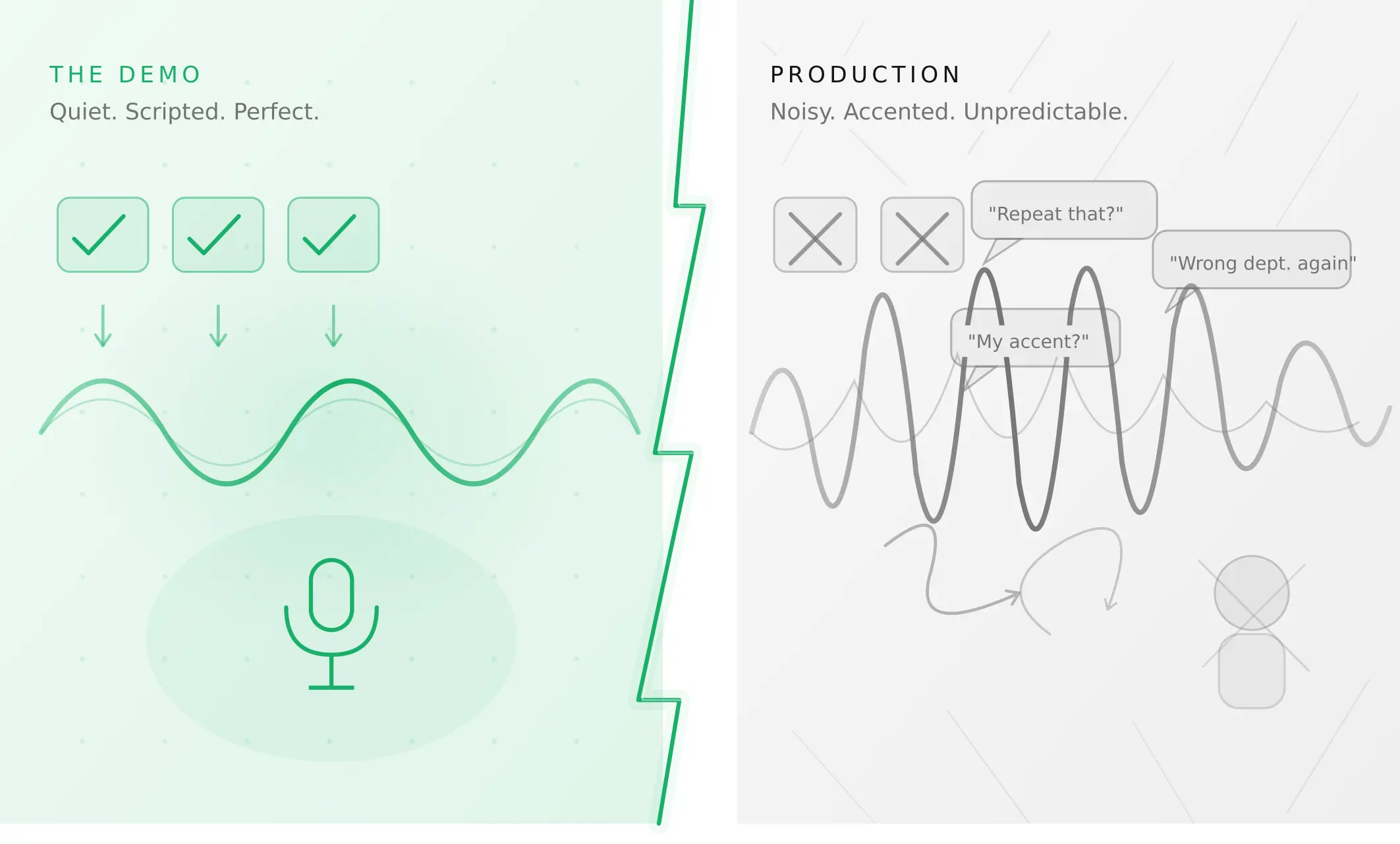
Why AI voice agents fail in production (and how to prevent it)
AI voice agents that ace demos still break in production. Learn the 5 root causes, how to test for each, and what production readiness actually means.
Read more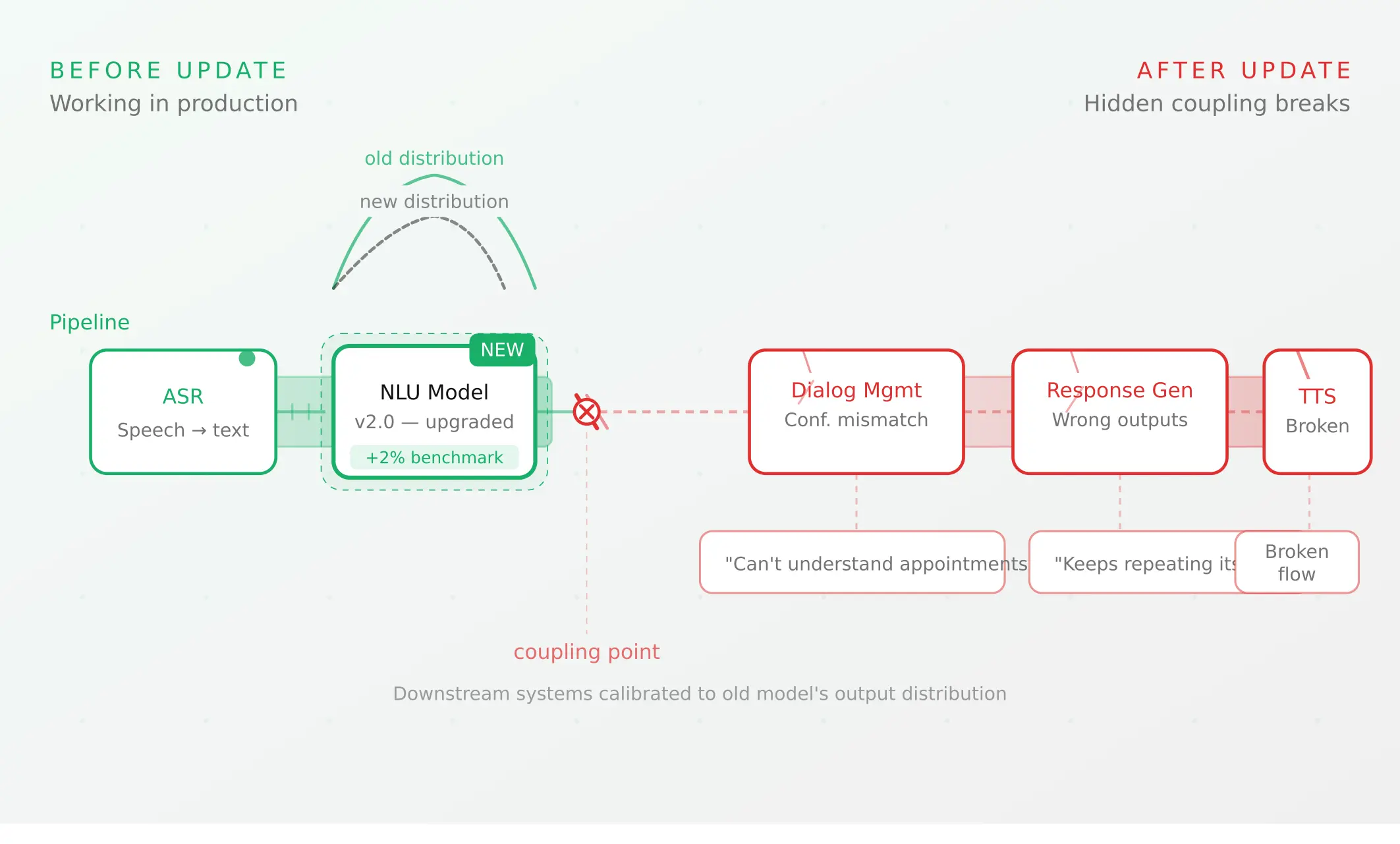
Voice agent regression testing: why LLM updates break production
LLM updates improve benchmarks but break voice agents in 5 predictable ways. How to detect and prevent regressions after every model or prompt change.
Read more