Test your voice agent
STT Cost vs Accuracy: How to Choose
# STT cost vs accuracy for voice agents
Quick answer
STT cost vs accuracy for voice agents is a trade-off, not a ranking. The cheapest engine can fail tasks and drive escalations, while the most accurate can be overkill for simple flows. Choose on accuracy per dollar for your calls, add latency as a third axis, and pick a point on the efficient frontier.
Speech-to-text is the first stage of a voice agent. It turns audio into text. Everything after it depends on that text.
So the engine you pick matters. But teams often pick it the wrong way. They sort by price, or they chase the top accuracy number. Both moves miss the real question.
The real question is fit. Which engine gives your calls enough accuracy, at a price you can live with, fast enough to feel natural? This post gives you a way to answer that.
Why the cheapest STT engine is rarely the cheapest
Price per minute is the number you see first. It is also the most misleading.
A cheap engine has a hidden bill. When it mishears a word, the agent acts on the wrong text. It confirms the wrong order. It routes the wrong call. It asks the caller to repeat.
Each mistake has a downstream cost. A failed task means a lost sale or a callback. An escalation means human time. Rework means the whole call runs again.
This is a classic cost-benefit analysis problem. The sticker price is one input. The failure cost is another. You have to add both.
The full picture is total cost of ownership. It includes the per-minute fee. It also includes failed tasks, escalations, rework, and lost trust. A cheaper engine with more errors can raise the total.
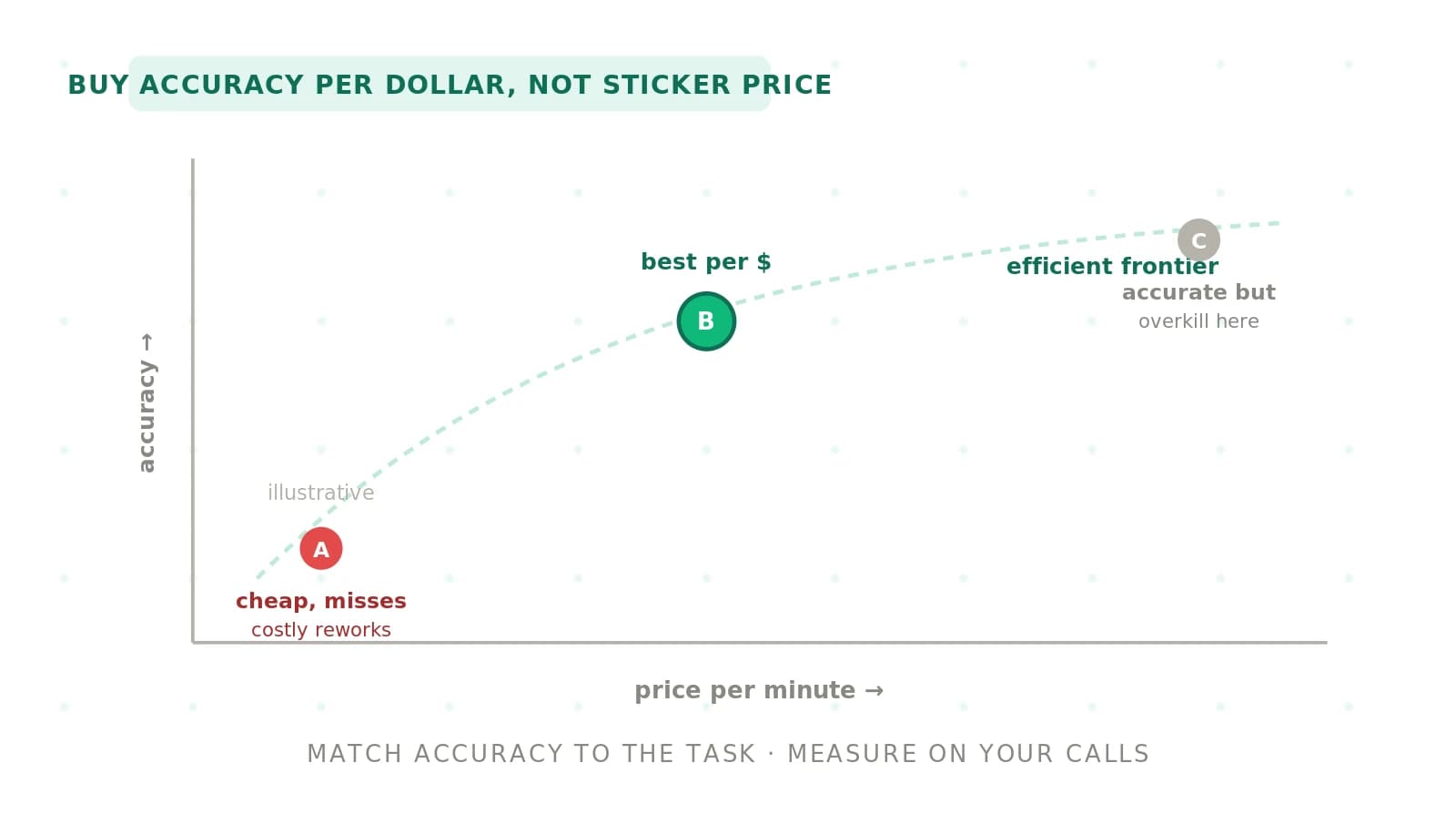
Here is the flip side. The most accurate engine is not always worth it either. A simple yes-or-no flow does not need premium transcription. Paying for accuracy you cannot use is waste. That is spending past the point of diminishing returns.
So both extremes can be wrong. The answer sits in the middle, and it depends on your calls.
The three axes of an STT choice
Most teams frame this as two numbers. Cost and accuracy. That framing is incomplete.
There are three axes, not two. Add latency to the picture.
> Accuracy per dollar: the transcription quality you get for each unit of spend. It is the real comparison, not price alone.
Accuracy itself needs a metric. The common one is word error rate, or WER. It counts inserted, deleted, and substituted words against a reference transcript. Lower is better.
WER is useful but blunt. It treats every word the same. A missed "not" and a missed "the" score alike, yet one flips meaning. For a deeper split, see our WER vs CER guide. The right metric depends on your flow.
The third axis is speed. A voice agent has a delay budget, and it is small. The engineering idea is plain latency): the gap between input and result.
Latency and accuracy often trade off. A larger model may score better but respond slower. Batch modes are accurate but late. Streaming modes feel fast but can wobble. Our reduce STT latency guide covers this stage in detail, and the wider budget is in our latency for voice agents guide.
So the choice is three-dimensional. Cost, accuracy, and latency. You optimize all three together, for one use case at a time.
Where a small WER gain matters, and where it does not
Not every accuracy gain is worth paying for. This is the crux.
Picture two engines. One has a WER of 8 percent. The other has 6 percent. The second costs more. Is the two-point gain worth it?
It depends entirely on the flow. In some calls, those two points change nothing. In others, they change the outcome.
The gain matters most when words carry high stakes. Account numbers. Dollar amounts. Medication names. Street addresses. One wrong token here breaks the task.
It also matters when errors compound. A misheard name early can derail a whole call. If a step gates later steps, accuracy at that step is worth more.
The gain matters less in forgiving flows. A caller says "yes" or "no." They pick from a short menu. The agent can confirm and recover. Here a slightly higher WER rarely hurts.
Context helps recovery too. An agent that confirms back and re-prompts can absorb small errors. A rigid flow cannot. So your design changes how much accuracy you need.
The lesson is simple. Do not buy accuracy in the abstract. Buy it where a mistake is expensive. This is marginal thinking applied to transcription.
Reading the efficient frontier for your use case
There is a clean way to picture the trade-off. Borrow it from economics.
> Efficient frontier: the set of options where you cannot improve one axis without giving up another. Off the frontier, a better option always exists.
This is the idea of Pareto efficiency. Plot every engine by cost and accuracy. Some engines are strictly worse than others. They cost more and score lower. Drop those first.
What remains is the Pareto front. On that curve, each engine is a real trade. More accuracy costs more money. Less money costs some accuracy. No option beats another on both.
Your job is not to find "the best" point. There is no single best. Your job is to find the point that fits your calls, your budget, and your latency budget.
A high-stakes flow pushes you up the curve. You pay more for accuracy because errors are costly. A simple flow lets you sit lower. You save money because errors are cheap to recover.
Add the third axis and the frontier becomes a surface. Cost, accuracy, and latency together. The math is the same. Keep only options that are not beaten on every axis, then choose by fit.
Illustrative comparison of three STT providers
The table below is illustrative only. The numbers are made up to show the shape of the trade-off, not to rank real engines. Always measure on your own calls before you decide.
| Axis | Provider A (budget) | Provider B (balanced) | Provider C (premium) |
|---|---|---|---|
| Relative price | Lowest | Medium | Highest |
| Word error rate (illustrative) | Higher | Moderate | Lowest |
| Latency profile | Fast, less stable | Fast and steady | Slower on large model |
| Domain vocabulary support | Basic | Good | Strong |
| Best fit | Simple menus, high volume | Most mixed call flows | High-stakes, complex speech |
Read the table as a map, not a verdict. Provider A is not "bad." It fits high-volume, low-stakes flows where recovery is easy. Provider C is not "best." It is overkill for a yes-or-no menu, and you pay for accuracy you will not use.
Provider B is the common landing spot. It is on the frontier for many mixed workloads. But "common" is not "correct for you." Your call mix decides. That is why illustrative numbers cannot replace a test on your data. See how we set that up in our benchmark on your own data post.
How to choose an STT engine on cost vs accuracy
Use this sequence. It turns the trade-off into a decision you can defend.
1. Define the task and its failure cost. Write down what the flow does. Then estimate what one transcription error costs you: a failed task, an escalation, a callback, or lost trust. This anchors the whole comparison.
2. List the words that must be right. Names, numbers, amounts, and domain terms. These are where accuracy earns its price. Errors elsewhere may be cheap to recover.
3. Set a latency budget. Decide how fast the transcript must arrive. A slow but accurate engine can still fail a real-time call. Treat speed as a hard constraint, not a bonus.
4. Build a representative test set. Use your own calls, or realistic recreations of them. Include accents, background noise, and hard vocabulary. Generic benchmarks like LibriSpeech are a starting point, not your answer.
5. Measure accuracy per dollar, not price alone. Run each candidate on the same set. Score WER, and score task success. Then divide quality by cost. See our STT evaluation guide for the scoring detail.
6. Plot the frontier and drop dominated options. Any engine that costs more and scores worse is out. Keep only the real trades.
7. Add the downstream cost to each candidate. Model failed tasks and escalations at each error rate. A cheaper engine with more failures can lose on total cost.
8. Pick the frontier point that fits your flow. High-stakes calls sit higher. Simple flows sit lower. Choose deliberately, and record why.
9. Re-test on a schedule. Engines change. Your traffic changes. A choice that fit last quarter can drift. Measure again before you renew.
Where an independent evaluator fits
Vendor accuracy numbers are marketing. They come from the vendor's own audio, tuned to look good. Your calls are different. So the published WER rarely matches what you will see.
This is the accuracy side of the trade-off, and it is the hardest to trust. Cost is on the invoice. Latency you can time. But accuracy on your calls has to be measured, on your calls, by someone with no stake in the result.
That is what Evalgent does. We are an independent, third-party evaluator. We run each candidate STT engine on your own calls. We score transcription quality and task success. We put the numbers on the same footing so you can compare accuracy per dollar honestly.
We measure the accuracy axis. You already hold the cost and latency data. Together that gives you the full frontier, built on your traffic, not a vendor deck. For why independence matters, see our independent voice AI evaluation post. The same logic extends to how you pay, covered in our outcome-based pricing post.
Frequently asked questions
What is the trade-off between STT cost and accuracy for voice agents?
The trade-off is that cheaper speech-to-text engines usually make more errors, and errors have a downstream cost. Failed tasks, escalations, and rework can outweigh the per-minute savings. More accurate engines cost more, but that accuracy is only worth paying for when transcription mistakes are expensive to your specific call flow.
Is the cheapest speech-to-text engine actually the cheapest?
Often not. The per-minute price is only part of total cost of ownership. A cheap engine that mishears names, numbers, or commands drives failed tasks and human escalations. Those cost more than the savings on transcription. The cheapest engine is only truly cheapest when your flow can recover from errors easily.
How much does a small WER improvement matter for a voice agent?
It depends on the flow. A two-point word error rate gain matters a lot when calls hinge on names, numbers, or amounts. It matters little in simple menu or yes-or-no flows, where the agent can confirm and recover. Buy accuracy where a single wrong word breaks the task, not everywhere.
Where does STT accuracy matter most in a voice agent?
Accuracy matters most where words carry high stakes and where errors compound. Account numbers, dollar amounts, medication names, and addresses are high-stakes. Steps that gate later steps compound errors. In forgiving flows with short menus and easy recovery, accuracy matters less, so paying for the top engine there is usually waste.
Is latency part of the STT cost vs accuracy trade-off?
Yes. Latency is the third axis, alongside cost and accuracy. Larger, more accurate models often respond slower, and a voice agent has a small delay budget. A slow but accurate engine can still fail a real-time call. Treat speed as a hard constraint and optimize all three axes together.
How do you measure accuracy per dollar for STT?
Run each candidate engine on the same representative test set of your calls. Score transcription quality with word error rate, and score task success. Then compare that quality against each engine's price. The result is accuracy per dollar. It replaces raw price with a fairer, use-case-specific comparison of value.
What is the efficient frontier for choosing STT?
The efficient frontier is the set of engines where you cannot gain accuracy without paying more, or vice versa. Plot every engine by cost and accuracy, then drop any option beaten on both. What remains is the frontier. Your job is to pick the point on it that fits your flow, not one universal best.
Can Evalgent test STT cost vs accuracy on my own calls?
Yes. Evalgent is an independent evaluator that measures the accuracy side on your own calls. We run candidate STT engines on your traffic, score transcription quality and task success, and present results on equal footing. You combine that with your cost and latency data to see the full trade-off and choose with evidence.
The bottom line
STT cost versus accuracy is a fit problem, not a ranking. Measure accuracy per dollar on your own calls, add latency, and pick the frontier point that matches your flow.
Ready to measure the accuracy side on your own traffic? Book a demo and see how Evalgent scores candidate STT engines on the calls that matter to you.
Related Articles
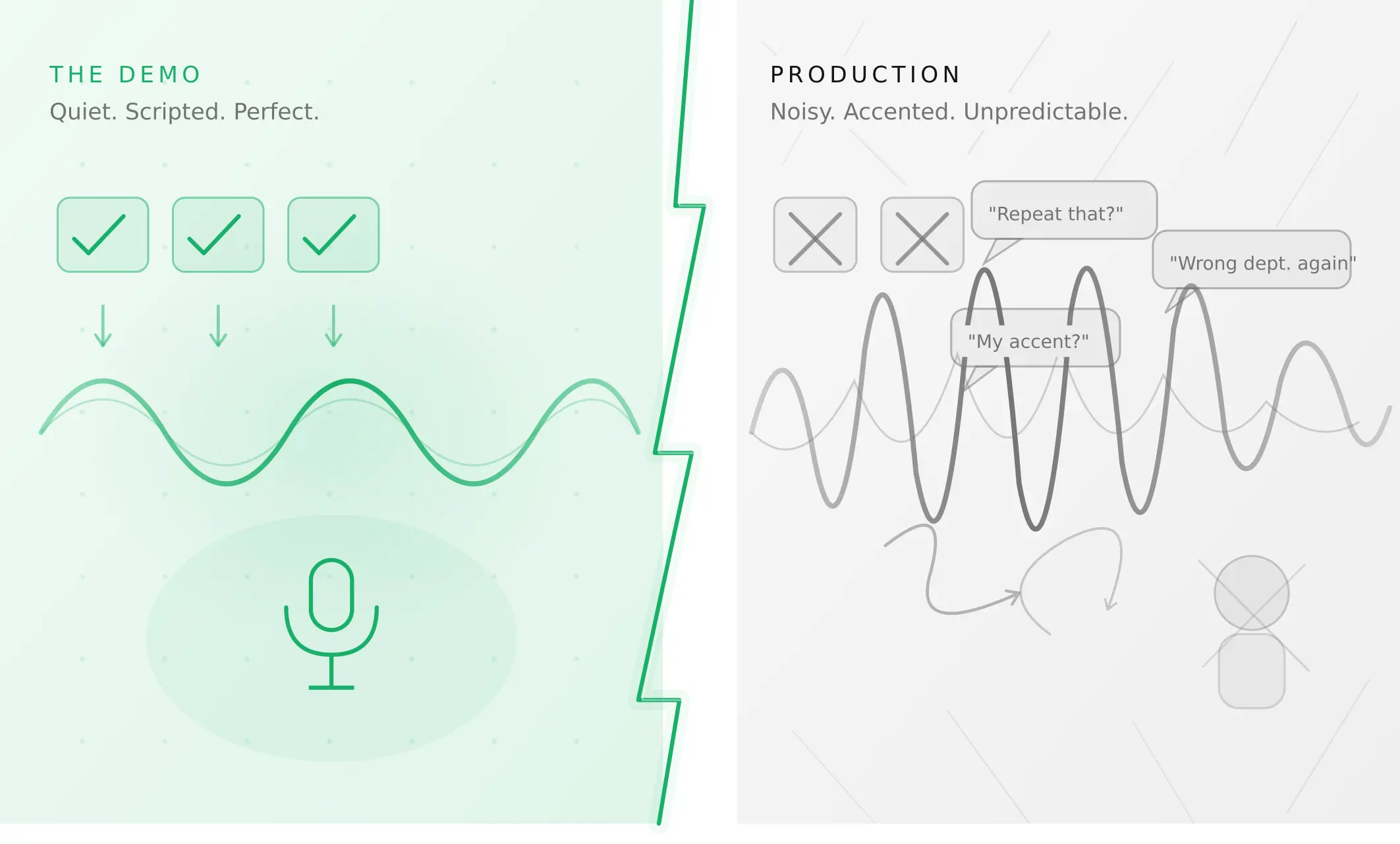
Why AI voice agents fail in production (and how to prevent it)
AI voice agents that ace demos still break in production. Learn the 5 root causes, how to test for each, and what production readiness actually means.
Read more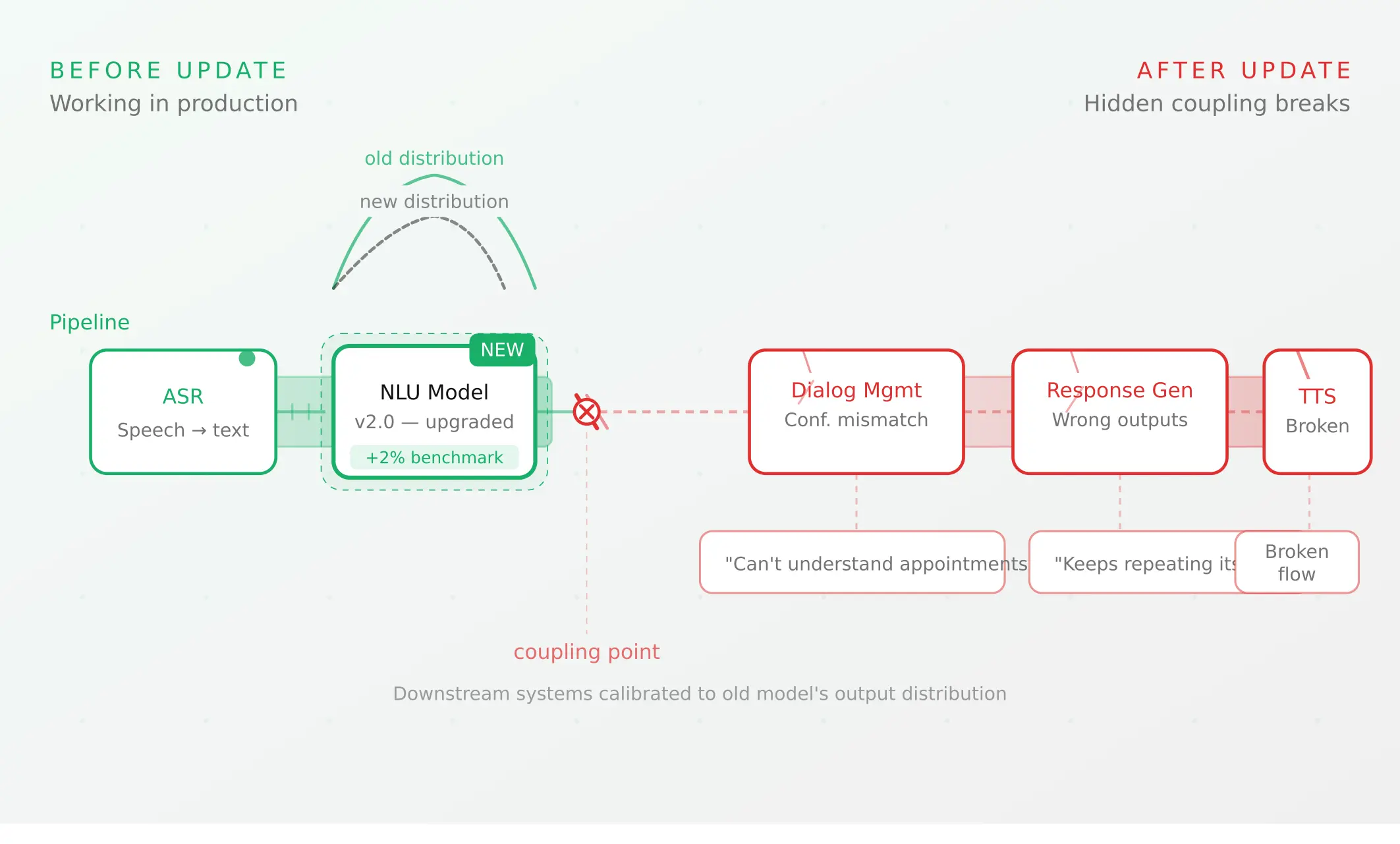
Voice agent regression testing: why LLM updates break production
LLM updates improve benchmarks but break voice agents in 5 predictable ways. How to detect and prevent regressions after every model or prompt change.
Read more