Test your voice agent
Streaming vs Batch STT for Voice Agents
# Streaming vs batch STT for voice agents
Quick answer
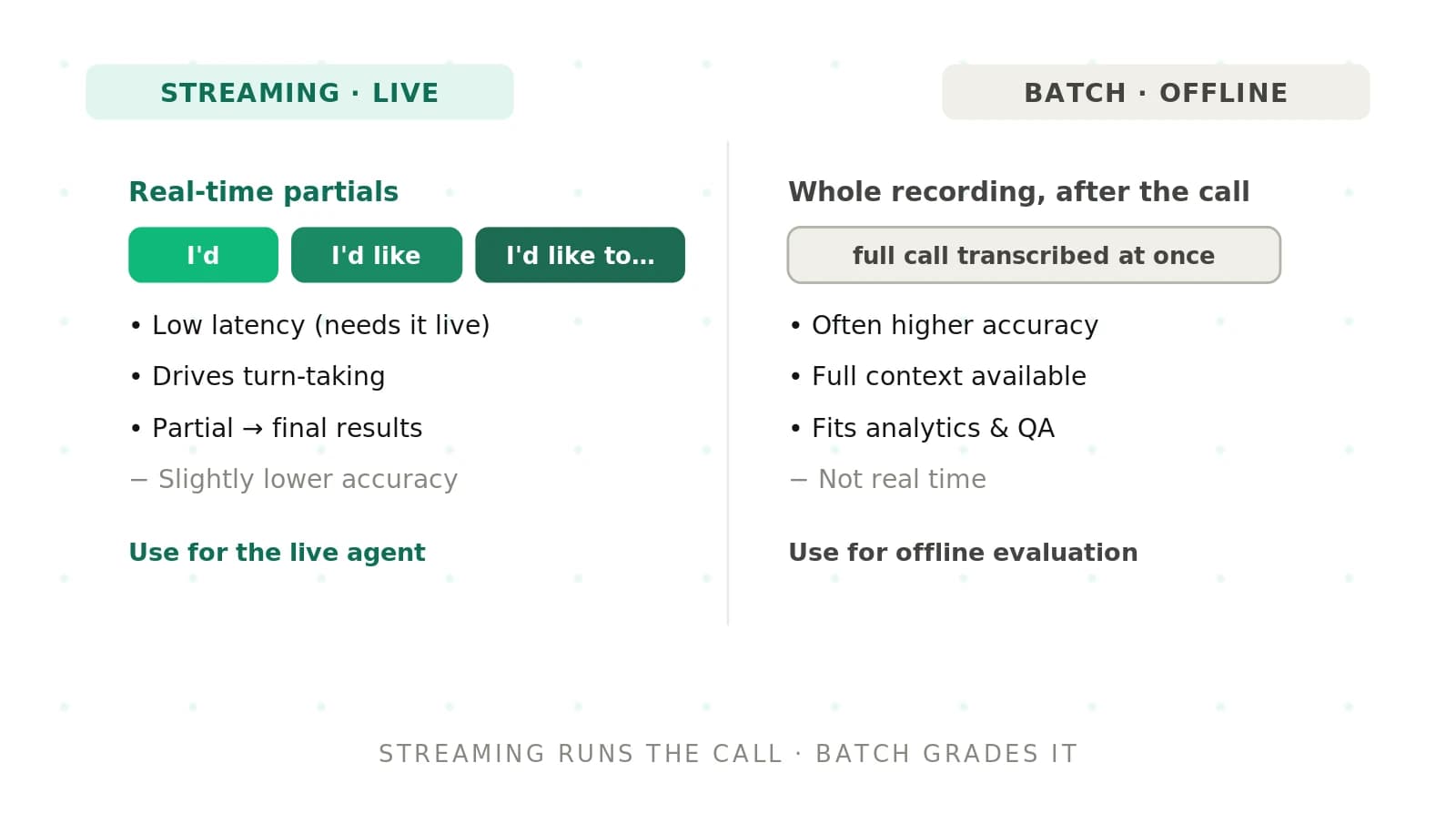
Streaming STT transcribes audio as it arrives, returning partial results in milliseconds. It powers live turn-taking. Batch STT processes a whole recording at once, often with higher accuracy, and fits post-call analytics. Use streaming for the live agent, batch for offline review, and evaluate both on your own calls.
Every voice agent has to turn speech into text before it can act. That is the job of speech recognition, often shortened to STT. How you feed audio into that step is a real design choice. It shapes latency, accuracy, and cost.
The streaming vs batch stt voice agents question comes down to timing. Do you transcribe live, word by word, while the caller is still talking? Or do you wait for a complete recording and transcribe it all at once? Both are valid. They just serve different jobs. If the STT-versus-ASR naming trips you up, our STT vs ASR guide clears it up first.
What streaming and batch STT actually mean
Both modes run the same underlying models. The difference is when and how audio arrives.
Streaming STT is a real-time process. Audio flows in as small chunks over a live connection. The engine returns text almost immediately. It updates its guess as more sound arrives. This is streaming media applied to transcription.
Batch STT is a whole-file process. You hand the engine a complete audio clip. It reads the entire recording, then returns one final transcript. This is classic batch processing, and it has no live pressure.
The mental model is simple. Streaming is a running commentary. Batch is a considered review after the fact. Neither is better in the abstract. Each wins at a different task.
Latency: the case for streaming
A live voice agent lives or dies on delay. Callers notice a gap above roughly a quarter second. The telecom comfort ceiling for one-way delay, ITU-T G.114, sits at 150 milliseconds.
Streaming STT exists to protect that budget. It returns text while the caller is still speaking. The agent can start planning its reply before the sentence even ends. That head start is why live agents stream.
Batch STT cannot meet a live budget. It must wait for the full clip before it starts. For a real conversation, that wait is fatal. The caller would sit in silence while the file uploads and processes.
So for the live path, streaming is not really optional. The question of overall delay is bigger than STT alone. Our latency in voice agents guide breaks down the full budget, from transport to synthesis. STT is one slice of it. For a formal view of the concept, see latency.
Accuracy: the case for batch
Here the trade-off flips. Batch STT usually transcribes more accurately than streaming.
The reason is context. A batch engine can see the whole recording at once. It uses words later in the call to fix guesses earlier in the call. It can run heavier models without a latency clock ticking. More context and more compute mean fewer errors.
Streaming STT works with a narrow window. It commits to early words before it hears what comes next. It cannot look ahead. That constraint costs a little accuracy, measured as a higher word error rate.
The gap is not always large. But it is real, and it matters when the transcript is the product. For quality assurance, compliance review, and analytics, batch often wins. When you want the most faithful record of what was said, reprocessing the recording in batch is the safer path.
Partial vs final transcripts
Streaming STT returns two kinds of results, and the difference confuses many teams.
Partial results are live guesses. They arrive fast and change often. The engine revises them as more audio comes in. A word can appear, then get corrected a moment later. Partials are useful for showing live captions and for early intent hints.
Final results are locked. The engine commits once it is confident a segment is done. Finals are stable and safe to act on. Your agent logic should key off finals, not off jittery partials.
Batch STT skips this dance entirely. It returns one final transcript. There are no partials, because there is nothing live to preview. That stability is part of why batch feels cleaner for offline work.
Designing around partials is subtle. Act too early on a partial, and you respond to a word the caller never finished. Wait too long, and you feel slow. Getting that balance right is core to good turn-taking.
How endpointing depends on streaming
Turn-taking is where streaming STT earns its keep. To reply at the right moment, the agent must know when the caller has stopped talking. That decision is endpointing.
Endpointing leans on the live audio stream. It watches for silence and for the shape of speech tailing off. It often works alongside voice activity detection, which flags when speech is present at all. Both need audio in real time. Batch cannot help here, because the turn is already over by the time a file exists.
The two ideas are related but distinct. Our VAD vs endpointing guide explains where one ends and the other begins. For the deeper mechanics of detecting a turn boundary, see our endpointing in voice agents guide.
The point for this comparison is direct. Live turn-taking requires streaming. Endpointing consumes the same stream that produces partial transcripts. You cannot bolt real turn detection onto a batch-only pipeline.
Cost and throughput
Cost pulls in two directions, and it depends on the workload.
Streaming holds an open connection for the length of each call. It bills for live processing time. It also carries operational weight, since you run and monitor a real-time service. For steady live traffic, that is simply the cost of doing business.
Batch is often cheaper per hour of audio. It can process files when capacity is free. It can queue work and smooth out spikes. For large volumes of recorded calls, batch throughput is efficient and predictable.
The practical answer is usually both. You stream live calls because you have no choice. You batch the recordings afterward for analytics and review, because it is cheaper and more accurate. The two modes are not rivals in one pipeline. They are two stages of it.
Streaming vs batch STT: a side-by-side
The choice is rarely either-or. It is about matching each mode to the job in front of it. Here is the contrast across the dimensions that decide it.
| Dimension | Streaming STT | Batch STT |
|---|---|---|
| Latency | Milliseconds; text as the caller speaks | High; waits for the full recording |
| Accuracy | Slightly lower; limited look-ahead | Often higher; full context and heavier models |
| Results type | Partial then final; live and revised | One final transcript; stable |
| Best-fit use case | Live agent, turn-taking, real-time captions | Post-call QA, compliance, analytics |
| Cost profile | Live connection per call; real-time ops | Cheaper per hour; queue and batch offline |
How to decide and test each STT mode
Work through this in order. Each step narrows the choice before the next one.
1. Separate the live path from the offline path. Live conversation needs streaming. Recorded analysis can use batch. Most products need both, at different stages.
2. Set your latency budget. Write down a mouth-to-ear target for the live agent. If it is tight, streaming is required, and STT is only one slice of the total delay.
3. Decide what the transcript is for. If the agent acts on it live, favor streaming and its final results. If a human or model reviews it later, batch accuracy pays off.
4. Plan for partial results. Confirm your agent logic acts on finals, not jittery partials. Decide how early you respond, and test that boundary against real speech.
5. Check endpointing behavior. Make sure turn detection reads the live stream cleanly. Late or noisy audio breaks endpointing and makes the agent talk over people.
6. Estimate cost at your volume. Price streaming for live minutes and batch for recorded hours. Model both, because the cheaper mode depends on the workload.
7. Build a test suite from your own calls. Use your accents, vocabulary, and noise, not a generic sample. Our benchmarking on your own data guide shows why public numbers rarely transfer.
8. Measure both modes on the same scenarios. Score streaming and batch on identical audio, with one fixed definition of accuracy and latency. Do not trust a vendor spec sheet alone.
Where each mode fits in practice
The clean way to think about this is by stage of the call lifecycle.
During the live call, streaming runs the show. It feeds partials for captions and intent. It produces finals for the agent to act on. It supplies the stream that endpointing needs. Everything time-sensitive depends on it.
After the call, batch takes over. You reprocess the recording for the cleanest transcript. That transcript drives quality assurance, compliance checks, and trend analysis. It is where the higher-accuracy record earns its value.
This split is why the debate is often a false choice. A mature voice agent streams live and batches offline. The two modes cover different needs in one system. For the broader method of scoring what those transcripts feed, see our STT evaluation for voice agents guide.
Why the STT mode hides quality problems
Here is the trap. STT errors do not always announce themselves. A dropped word or a wrong number can slip through and derail a whole turn. The caller repeats themselves, and the agent digs in deeper.
A demo on clean audio hides this. Real calls run over cell connections and noisy rooms. Streaming accuracy can wobble under that noise in ways a scripted demo never shows. Vendor-reported numbers rarely match your traffic, a theme we cover in independent voice AI evaluation.
The mode you pick also shifts the risk. Streaming trades a little accuracy for speed. Batch trades speed for accuracy. You cannot know how that trade lands on your calls until you measure it directly.
Where Evalgent fits
The STT decision is only safe if you can measure both modes on equal terms. Evalgent is an independent, third-party platform that measures accuracy and latency of either mode on your calls. It does not care whether the transcript came from a streaming or a batch engine.
Scenarios capture your real calls as a fixed, versioned suite you own. Profiles vary caller accent, pace, and line quality, so each mode faces the same range. Metrics score every run against pre-defined expected outcomes on one fixed definition. Evaluations replay the identical suite against a streaming path and a batch path. Reviews let your team hear the call behind any score.
Because the suite is yours and runs against either mode, you can compare streaming and batch honestly. You can prove a change helped, hurt, or changed nothing. For the wider approach, see our voice agent evaluation guide, and for vendor selection, our how to evaluate voice agent vendors scorecard.
To put a neutral yardstick between you and every STT choice, book a demo.
Common mistakes on both paths
Teams repeat the same errors. Watch for these.
Acting on partial results too early. A partial can change a moment later. Key your agent logic off final results instead.
Using streaming numbers to judge offline accuracy. Streaming trades accuracy for speed. Reprocess in batch when the transcript is the product.
Testing only on clean audio. The demo lied. Test on noisy, real-world calls before you trust a transcript.
Forgetting that endpointing needs the stream. Turn detection depends on live audio. A batch-only pipeline cannot take turns.
Ignoring cost at volume. Streaming bills live minutes; batch bills recorded hours. Model both against your real traffic.
Frequently asked questions
What is the difference between streaming and batch STT?
Streaming STT transcribes audio as it arrives, returning partial results in milliseconds for live use. Batch STT processes a whole recording at once and returns one final transcript, usually with higher accuracy. Streaming suits the live agent. Batch suits post-call review. Many pipelines use both, at different stages.
Which is more accurate, streaming or batch STT?
Batch STT is usually more accurate. It sees the entire recording, uses later words to fix earlier ones, and can run heavier models with no latency clock. Streaming commits to words early with limited look-ahead, so its word error rate tends to be higher. The gap varies by audio and vocabulary.
Do voice agents need streaming STT?
Live voice agents do. A real conversation needs text while the caller is still talking, so the agent can reply without a long pause. Batch STT waits for a complete recording, which is too slow for live turn-taking. Streaming is required for the live path, even if you batch recordings afterward.
What are partial and final results in streaming STT?
Partial results are fast, live guesses that the engine revises as more audio arrives. Final results are locked once the engine is confident a segment is done. Your agent should act on finals, not partials, because partials can change a moment later. Batch STT returns only one final transcript, with no partials.
How does endpointing relate to streaming STT?
Endpointing decides when the caller has stopped talking so the agent can reply. It reads the live audio stream, often alongside voice activity detection. Both need audio in real time, which only streaming provides. A batch-only pipeline cannot do live turn-taking, because the turn is already over by the time a file exists.
Is streaming or batch STT cheaper?
It depends on the workload. Streaming holds a live connection per call and bills real-time processing, plus the ops cost of a live service. Batch is often cheaper per hour and can queue work when capacity is free. For live traffic you stream; for large volumes of recordings, batch is the efficient choice.
Can I use both streaming and batch STT together?
Yes, and most mature pipelines do. You stream live calls because a conversation cannot wait. You reprocess the recordings in batch afterward for cleaner transcripts that feed analytics, compliance, and quality assurance. The two modes are not rivals in one system. They are two stages of the same call lifecycle.
How do I test streaming versus batch STT fairly?
Build a suite from your own calls, with your accents, vocabulary, and noise. Run both modes on the identical audio. Score them with one fixed definition of accuracy and latency. Do not compare a clean demo to a noisy production line, and do not rely on a vendor spec sheet alone.
The bottom line
Stream STT for the live agent and batch STT for offline review, because each mode wins a different job. Neither choice is proven until you measure accuracy and latency on your own calls with an independent evaluation.
Related Articles
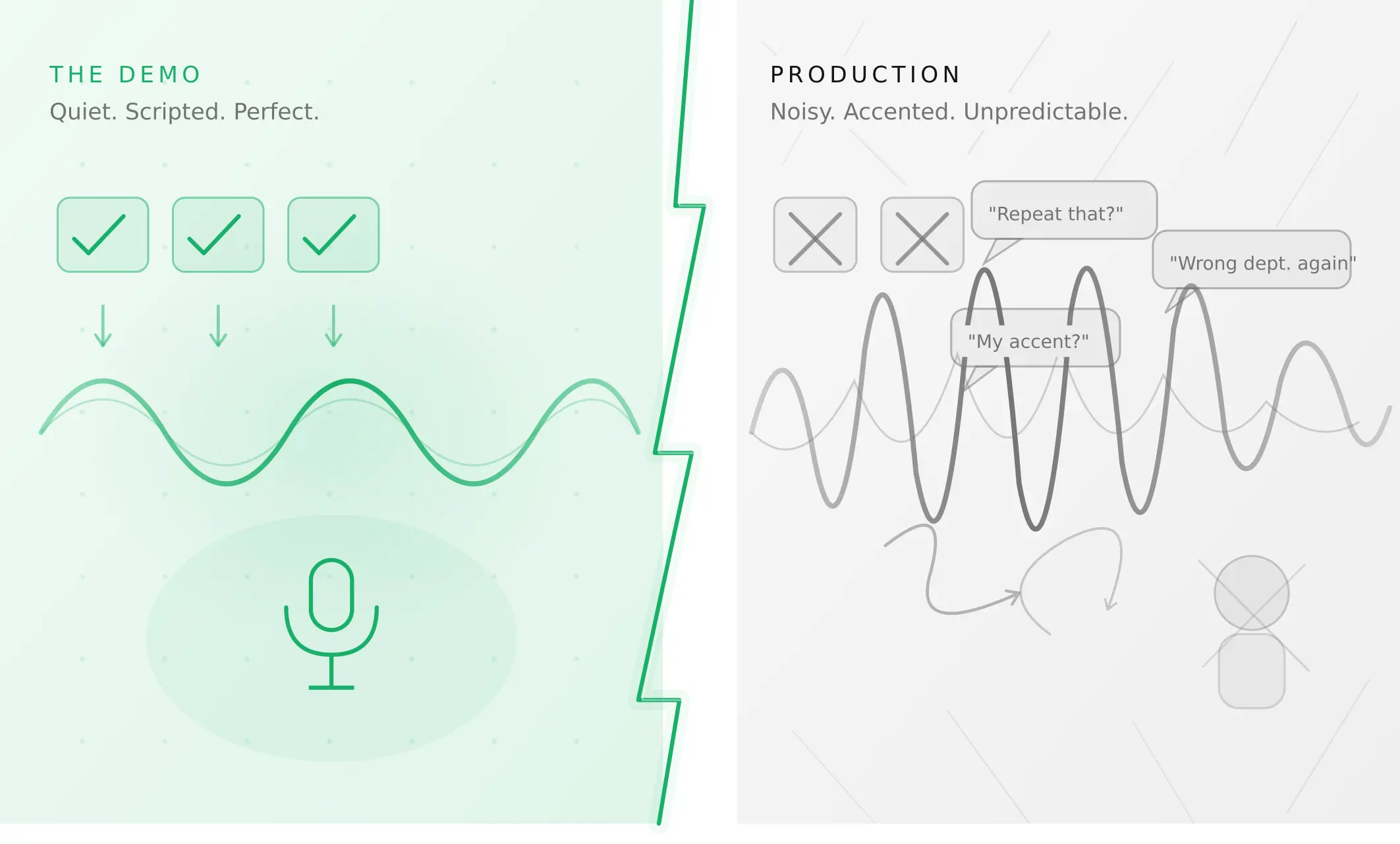
Why AI voice agents fail in production (and how to prevent it)
AI voice agents that ace demos still break in production. Learn the 5 root causes, how to test for each, and what production readiness actually means.
Read more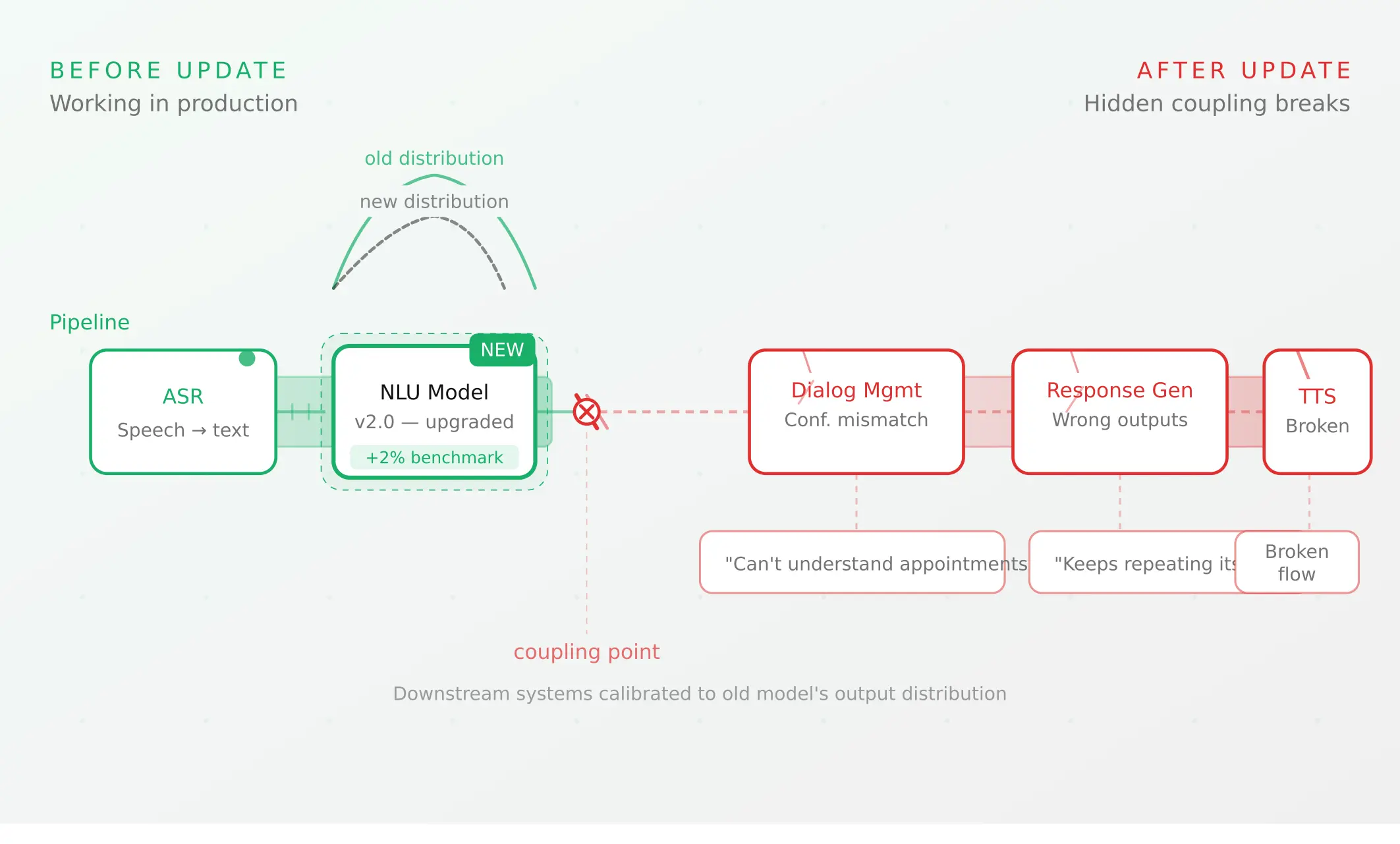
Voice agent regression testing: why LLM updates break production
LLM updates improve benchmarks but break voice agents in 5 predictable ways. How to detect and prevent regressions after every model or prompt change.
Read more