STT vs ASR: what's the difference?
On this page
STT and ASR trip people up because they sound like two different things when they are mostly one. If you are choosing a speech component for a voice agent and one vendor calls it ASR while another calls it STT, it is easy to assume you are comparing different technologies. You are not. This guide clears up the terminology, names the one subtle distinction worth knowing, and points at what actually matters. Evalgent measures that part, and this guide draws the line.
ASR (automatic speech recognition): the technology and field of converting spoken audio into text.
STT (speech-to-text): the same capability, usually as a product or API — often the ASR engine plus formatting such as punctuation and casing.
STT vs ASR: are they different?
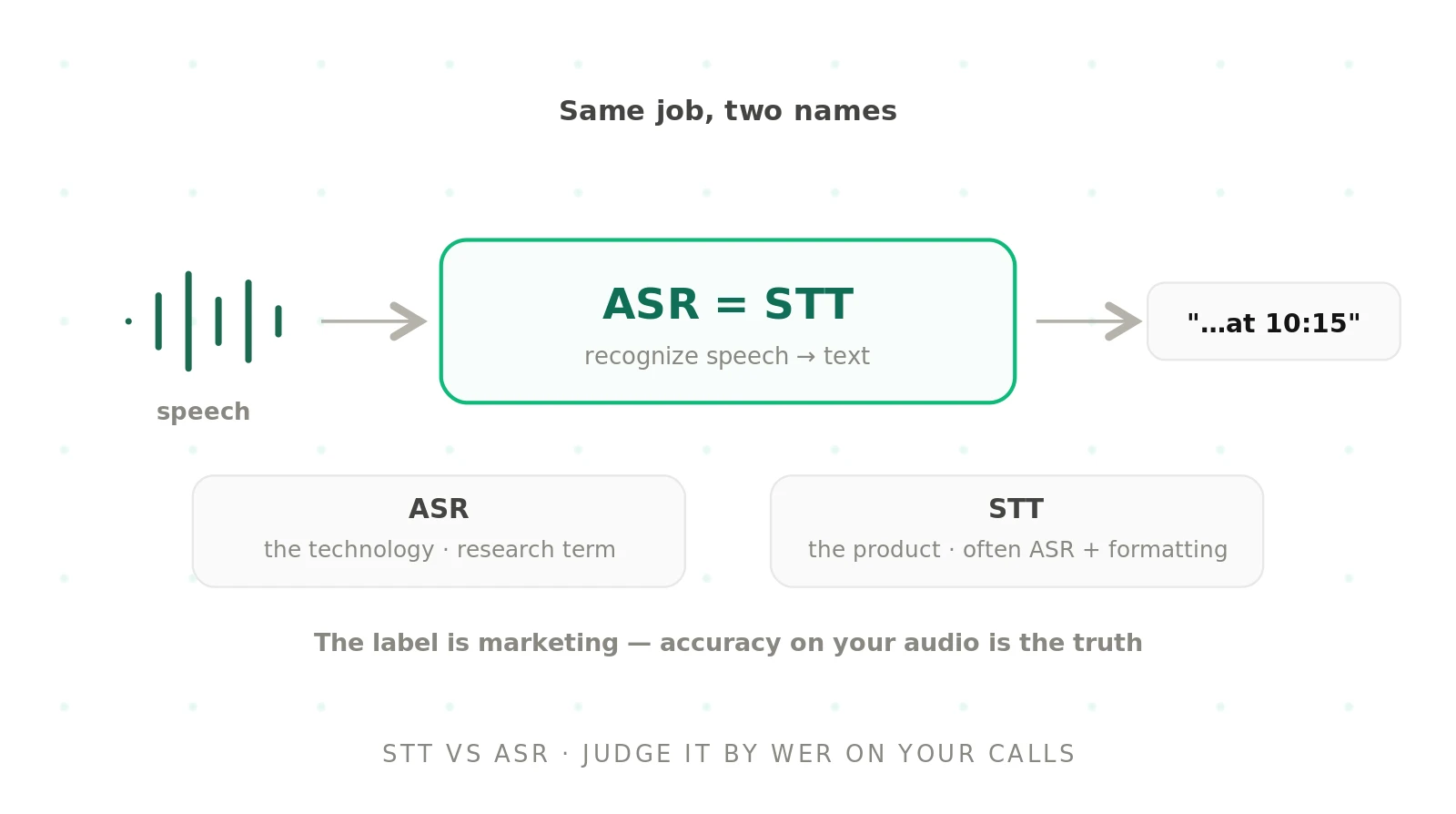
The honest answer is that they are the same core thing under two names. Both take audio in and produce text out. The difference is framing, not function: ASR is the term the research and engineering world uses for the technology, and STT is the term the product world uses for the service you call.
| Term | What it emphasizes | Used by |
|---|---|---|
| ASR | The core recognition technology | Research, engineering |
| STT | The product or API that delivers it | Vendors, developers |
| Output | Text from speech | Both |
| Accuracy metric | Word error rate | Both |
So when a benchmark talks about "ASR accuracy" and a vendor page advertises "STT," they are describing the same capability. Treating them as rival technologies is the confusion this guide exists to remove.
The one subtle distinction
There is a real, if soft, distinction some teams draw. ASR can refer specifically to the core recognition engine — the model that turns acoustic signal into raw words. STT can refer to the fuller service built on top of it, adding the formatting that makes the text usable: punctuation, capitalization, number formatting, and sometimes diarization or timestamps.
By that framing, STT is roughly ASR plus post-processing. It is a useful mental model, but it is not a universal standard — plenty of vendors and papers use the two words as exact synonyms. So treat the distinction as "sometimes STT means the packaged service and ASR means the engine," not as a firm rule. Do not make a decision based on which word a vendor chose.
Why the naming doesn't change what matters
The reason to move past the terminology quickly is that neither word tells you whether the thing is any good. What matters for a voice agent is the same regardless of the label: how accurately it transcribes your callers, on your audio, under your conditions. A component called ASR and one called STT are compared the exact same way — by their error rate on realistic speech.
That means the useful question is never "STT or ASR?" but "what is its word error rate on my calls?" Accuracy on noisy, accented, telephony audio is the deciding factor, measured with metrics like word error rate and, for exact fields, character error rate — the subject of our WER vs CER guide. The label is marketing; the error rate is the truth.
How to evaluate STT or ASR for a voice agent
Whatever it is called, evaluate it the same way.
1. Ignore the label — Do not weigh ASR versus STT as if they were different technologies; compare the components themselves.
2. Measure word error rate — Compute WER on audio that resembles your real traffic, not clean read speech.
3. Use CER for exact fields — Measure character error rate on numbers, IDs, and names where one character matters.
4. Test your conditions — Include noise, accents, and telephony, since that is where accuracy diverges between options.
5. Check the formatting — If you need punctuation, casing, or diarization, confirm the service provides them well.
6. Re-test on changes — Re-measure when you switch models or providers, since accuracy shifts with each.
A worked example
You are choosing between two speech components. One vendor's page says "industry-leading ASR"; the other's says "the most accurate STT." It is tempting to think you are comparing two categories, but you are comparing two products that do the same job. The right move is to run both on a sample of your own calls — noisy, accented, with the account numbers your callers actually read — and compare their word and character error rates. The one with the better accuracy on your audio wins, whatever it calls itself. The label did not decide it; the measurement did.
Evaluating STT and ASR with Evalgent
Evalgent measures the thing that matters, not the name on the box. Scenarios drive realistic calls — including the noisy, accented, and telephony audio where speech recognition diverges — through whichever component you use. Profiles vary caller voice and line quality so accuracy is reported per condition, not on clean samples. Metrics compute word error rate for the conversation and character error rate for exact fields, so you can compare an "ASR" and an "STT" on the same, honest footing. Evaluations run the comparison as automated batches, and Reviews let you replay a call to hear exactly where a component missed.
The result is a decision grounded in accuracy on your own audio, which is the only thing the STT-versus-ASR label was ever standing in for. For the wider method, see the STT evaluation guide and the AI voice agent testing pillar.
The bottom line
STT and ASR are two names for the same core technology — turning speech into text. ASR is the research term for the engine; STT is the product term, often the engine plus formatting. The subtle distinction is real but soft, and no universal standard enforces it.
Do not choose a speech component by which word its vendor uses. Whatever the label, the decision comes down to accuracy on your own audio — word error rate on realistic calls — which is the number both terms were always pointing at.
Frequently asked questions
What is the difference between STT and ASR?
STT (speech-to-text) and ASR (automatic speech recognition) refer to essentially the same thing: converting spoken audio into text. ASR is the technical, research term for the core technology, while STT is the product term for the service that delivers it, often the ASR engine plus formatting like punctuation. They are used interchangeably, and what matters is accuracy on your audio, not the term.
Are STT and ASR the same thing?
For practical purposes, yes. Both take audio and produce text, and they are often used as exact synonyms. The only nuance is that some teams use ASR for the core recognition engine and STT for the fuller service built on top, which adds formatting. But that is a soft convention, not a universal rule, so treat the two words as the same capability.
Is STT just ASR with formatting?
Sometimes that is the intended distinction. In that framing, ASR is the engine that turns audio into raw words, and STT is the packaged service that adds punctuation, capitalization, number formatting, and sometimes diarization. It is a useful mental model, but not a standard everyone follows — many vendors and papers use STT and ASR interchangeably with no such split.
Which is better, STT or ASR?
Neither is better, because they are the same technology under two names — the question does not compare two things. The real comparison is between specific components, judged by their accuracy on your audio, not by whether the vendor labeled it STT or ASR. Ask what the word error rate is on realistic calls; that decides which option is better for you.
Why do people use both terms?
Because they come from different worlds. ASR is the older, academic term from speech-recognition research and engineering. STT is the commercial, developer-facing term that vendors use to name their APIs and services. Both stuck, so you see ASR in papers and benchmarks and STT on product pages, even though they describe the same underlying capability.
Does it matter whether a vendor says STT or ASR?
No. The label tells you nothing about quality. A component called ASR and one called STT do the same job and are compared the same way — by their accuracy on your audio. Choosing based on the term would be choosing on marketing. Run both on your own calls, measure the error rate, and let that decide instead.
How do you measure STT or ASR accuracy?
Measure word error rate on audio that resembles your real traffic — noisy, accented, over telephony — rather than clean read speech. For exact fields like account numbers and names, also measure character error rate, since one wrong character can break the outcome. Report accuracy per condition, and re-measure whenever you change the model or provider, because accuracy shifts with each.
Does STT include punctuation and casing?
Often, yes — that is part of why STT is sometimes described as ASR plus formatting. A full speech-to-text service typically adds punctuation, capitalization, and number formatting to make the text usable, and may offer diarization or timestamps. If your voice agent needs those, confirm the service provides them well, since raw recognition without formatting can be harder for downstream steps to use.
Related guides
Testing vs evaluation for voice agents: what's the difference?
Testing and evaluation for voice agents are related but distinct: testing verifies behavior pass/fail, evaluation measures quality. Here's how they differ.
VAD vs endpointing: what's the difference in a voice agent?
VAD detects whether someone is speaking; endpointing decides when they've finished. Learn the difference and why confusing them cuts callers off.