Test your voice agent
Going Silent in Voice Agents: Causes and Fixes
# Going silent in voice agents: causes and fixes
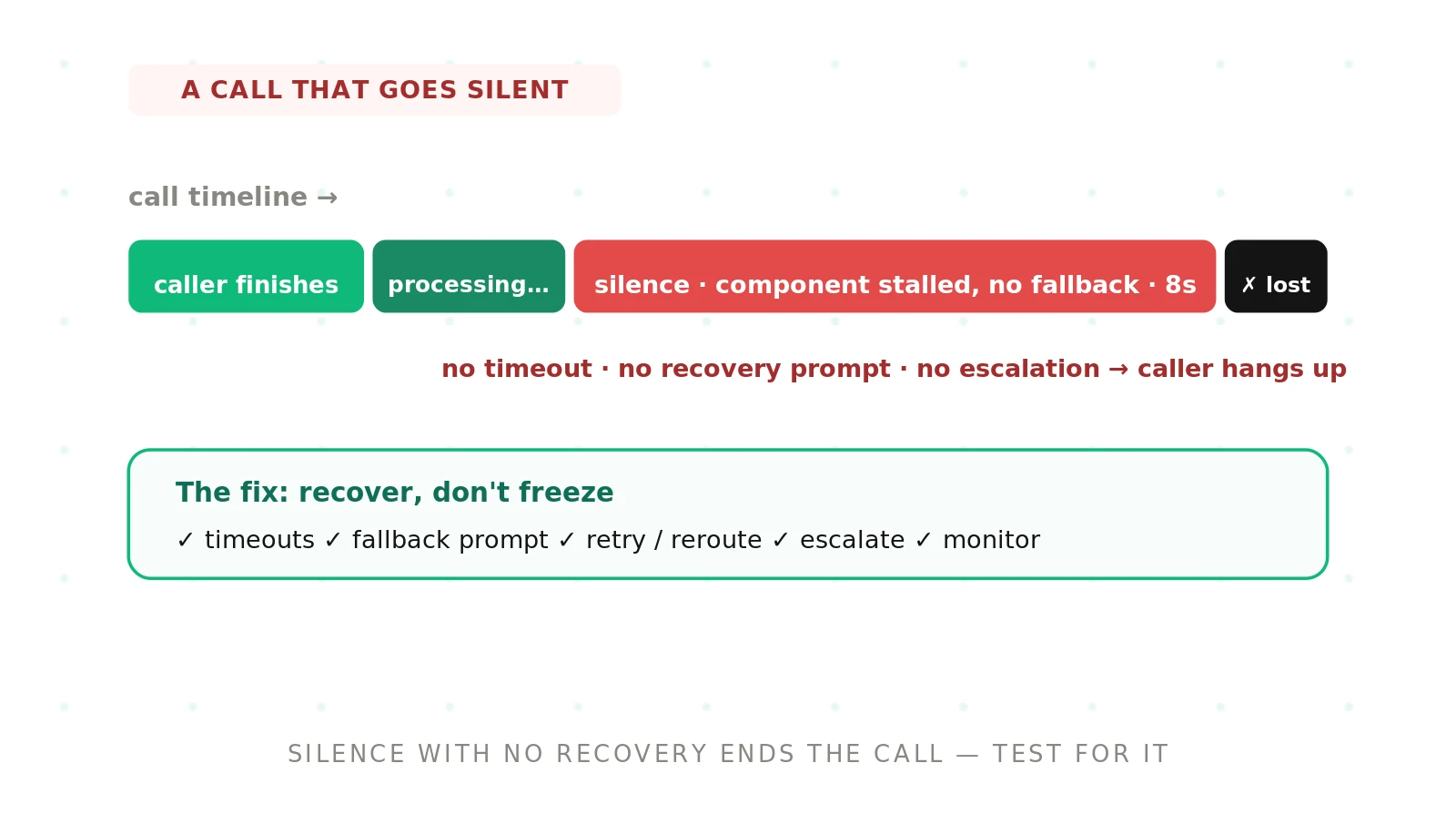
A voice agent that goes silent is worse than one that answers badly. A bad answer still keeps the conversation alive. Silence ends it. The caller hears nothing, waits a few seconds, and hangs up. They rarely call back. That lost call is often the most expensive failure in the whole system.
This guide covers the unrecoverable freeze. That is distinct from short pauses mid-answer. We cover those short gaps in our guide to dead air in voice agents. Dead air is recoverable. The agent pauses, then resumes. Going silent is different. The agent stops and never comes back. Below we walk through the causes, the detection signals, and the fixes.
What "going silent" actually means
Going silent has a precise shape. The agent stops producing audio. It also stops responding to input. No token streams out. No prompt fires. The session is technically still open, but functionally dead. The caller is left holding a live line with nothing on the other end.
This is not the same as a dropped call. A dropped call ends the session cleanly. The carrier tears down the connection. Going silent is worse because the line stays up. The caller does not get a busy tone. They get an eerie, open void. They assume the agent is thinking, wait too long, then leave frustrated.
The failure is unrecoverable by definition. If the agent could recover on its own, it would just be a long pause. Going silent means the recovery path itself failed, or never existed. Something broke, and nothing caught it. That distinction drives every fix in this guide.
Why voice agents go silent
A voice agent is a pipeline. Audio comes in, gets transcribed, gets reasoned over, gets spoken back. Each stage can stall. When one stalls with no timeout and no fallback, the whole call freezes. Here are the common causes.
STT or transport disconnect
Most voice agents stream audio over a persistent connection. That connection is usually a WebSocket. If the speech-to-text socket drops, audio keeps arriving but nothing transcribes. The agent waits for a transcript that never comes. It has no text to reason over, so it produces nothing. The line goes quiet.
The trap is that a dropped socket often fails silently. No error surfaces to the orchestrator. The connection object still looks alive. Meanwhile the caller keeps talking into a void. Without a heartbeat check, the agent never notices the socket died.
TTS timeout or stall
The text-to-speech stage turns the agent's reply into audio. If that service stalls, the agent has words but no voice. It generated a perfect response. The caller just cannot hear it. This is a common and cruel failure. The logs show a completed turn, yet the call was silent.
TTS stalls happen under load, on cold starts, or when a long reply overwhelms the synthesis buffer. If the agent does not time out the TTS call, it waits forever. So does the caller.
LLM stall or slow token stream
The language model can stall too. It may hang on a slow API call. It may loop on a tool call that never returns. It may stream the first token, then freeze. Any of these leaves the agent mid-thought with no output. The caller hears the start of nothing.
Long context windows and heavy tool chains raise this risk. Each added step is another place to hang. Without a deadline on the whole turn, one slow step freezes everything downstream.
Endpointing misfire
Endpointing decides when the caller has finished speaking. Get it wrong and the agent never takes its turn. If the endpointer thinks the caller is still talking, it waits. The caller has stopped. The agent keeps listening. Both sides wait for the other. The result is silence that neither party breaks.
This misfire is common with slow talkers, long pauses, and noisy lines. The agent's turn-taking logic gets stuck in "listening" and never flips to "speaking."
No fallback path
The deepest cause is architectural. Many agents are built as request/response systems. Send input, get output, done. But a phone call is event-driven. Audio, silence, interruptions, and errors all arrive as events at unpredictable times. An agent that assumes clean request/response has no plan for a missing response. When a step fails, there is simply no branch that says "if nothing happened, do this." The absence of that branch is the freeze.
Dead air versus going silent
These two failures get confused constantly. They are not the same. The table below separates them so you can triage fast.
| Symptom | Dead air | Going silent |
|---|---|---|
| Duration | Short pause, one to five seconds | Open-ended, until hangup |
| Recovery | Agent resumes on its own | Agent never resumes |
| Caller sees | A hesitation mid-answer | A dead, open line |
| Root layer | Latency in one step | Failed step with no fallback |
| Session state | Alive and progressing | Alive but frozen |
| Fix focus | Speed and streaming | Timeouts, fallback, recovery |
Dead air is a latency problem. Going silent is a fault-tolerance problem. If your agent pauses but recovers, read the dead-air guide. If it freezes and dies, keep reading here.
The real cost of a silent call
A silent call fails at the worst moment. The caller has already engaged. They asked a question or started a task. Then the agent vanished. That is a high-intent caller lost at the point of value. The cost is not just one call. It is the trust that keeps them from calling back.
Silent calls also hide in your metrics. A dropped call shows up as a short duration. A silent freeze can log as a long call, because the line stayed open. Average handle time looks fine. Task success looks like a timeout. The failure blends into the noise unless you measure it directly.
How to detect and prevent going silent
Detection and prevention are one workflow. You cannot fix what you cannot see. Follow these steps in order.
1. Instrument every pipeline stage. Emit a timestamped event for each step: audio in, transcript ready, LLM first token, TTS first byte, audio out. Follow an observability approach with traces and metrics. A gap between two events is a stall you can see.
2. Set a timeout on every step. Give each stage a deadline. STT, LLM, and TTS each get a hard limit. Use the standard timeout) pattern. When a step blows its deadline, the agent acts instead of waiting forever.
3. Add a global turn deadline. Steps can pass individually yet still add up to a frozen turn. Set one deadline for the whole turn. If the agent has not spoken within it, trigger a recovery response.
4. Wire a fallback prompt. When a step times out, the agent should say something. A simple "Sorry, I missed that — could you repeat it?" keeps the line alive. Silence is the enemy. Any words beat none.
5. Build recovery and escalation logic. If two fallbacks fail in a row, escalate. Hand the call to a human or a backup flow. Our escalation guide covers when and how to route out. Never let a broken turn become an open-ended void.
6. Add heartbeats on every connection. Ping the STT and TTS sockets on a fixed interval. If a ping fails, treat the connection as dead. Reconnect or escalate. Do not trust a socket object that merely looks open.
7. Test the failures on purpose. Inject dropped sockets, slow LLM calls, and TTS stalls in a test harness. Confirm the agent recovers every time. Our testing checklist shows how to script these failure cases.
Building for fault tolerance, not happy paths
The lasting fix is architectural. Stop treating voice as request/response. Treat it as an event-driven system. Every step can fail, and every failure needs a branch. This is fault tolerance, applied to a live phone call.
The goal is graceful degradation. When a component breaks, the agent should degrade in a way the caller can tolerate. A repeat prompt beats silence. A handoff to a human beats a dead line. The agent should always have a next move, even when the ideal move is unavailable.
Latency budgets matter here too. Callers tolerate only so much delay before a pause feels like a freeze. Telecom quality standards like ITU-T G.114 set expectations for acceptable one-way delay. Design your timeouts so recovery fires before the caller decides the agent is gone. A fallback that arrives too late is no fallback at all.
Why this fails so often in production
Most of these freezes never show up in a demo. Demos run on clean audio, fast networks, and short calls. The failure modes live in the messy edges: a dropped socket at second forty, a cold TTS start, a slow tool call under load. Our guide on why voice agents fail in production digs into that gap between demo and reality.
The other reason is measurement. Teams track word error rate and average latency. They rarely track "turns that produced no audio." So the freeze happens in production, gets logged as a generic timeout, and never gets a name. What you do not measure, you cannot fix. Strong voice agent observability makes the silent turn visible.
How to test for silent-call failures
You cannot wait for production to find these. You have to force them in testing. Build scenarios that drop the STT socket mid-call. Build scenarios that stall the TTS service. Build scenarios that make the LLM hang. Then confirm the agent recovers on every one. This is the core idea behind rigorous voice agent evaluation: test the failures you fear before a caller finds them.
Score each run on a simple question. Did the agent ever go silent for longer than your recovery deadline? If yes, the run fails. Treat that as a release gate. An agent that freezes under injected fault will freeze under real fault. Ship only the version that recovers every time.
Detecting going silent with Evalgent
Evalgent is an independent voice agent testing and evaluation platform. It runs realistic calls against your agent, over real audio, and catches the freezes that text-only tools miss. Because it hears the call, it can measure the one thing that defines going silent: a turn that produced no audio and never recovered. Five primitives carry the workflow.
- Scenarios define the calls that break agents, including dropped sockets, stalled TTS, and slow LLM turns.
- Profiles vary caller pace, accent, and line quality, so slow talkers and noisy lines expose endpointing misfires.
- Metrics measure silent-turn duration, recovery time, and escalation success against per-scenario thresholds, not one blended score.
- Evaluations run the whole fault-injection suite as automated batches, at concurrency, on every change.
- Reviews let your team replay any frozen call with audio, transcript, and timeline side by side, to hear exactly where it died.
Together they turn silent-call detection into a repeatable release gate. Define the failures you fear, inject them on every build, and ship only when the agent recovers every time. Ready to see it on your own agent? Book a demo.
The bottom line
Going silent is the unrecoverable freeze, and it costs you high-intent callers at the worst moment. Beat it with timeouts on every step, a fallback prompt, escalation, live monitoring, and tests that force the failure before a caller ever does.
Frequently asked questions
What does it mean when a voice agent goes silent?
It means the agent freezes mid-call and never recovers. A component stalls, no fallback fires, and the line stays open with no audio. The caller waits, hears nothing, and hangs up. The session is technically alive but functionally dead until someone drops the call.
How is going silent different from dead air?
Dead air is a short pause mid-answer that the agent recovers from on its own. Going silent is an open-ended freeze the agent never escapes. Dead air is a latency problem. Going silent is a fault-tolerance problem: a step failed and no fallback path existed to catch it.
What are the most common causes of a silent call?
A dropped speech-to-text or WebSocket connection, a text-to-speech timeout, a stalled language model, or an endpointing misfire that leaves the agent stuck listening. The deepest cause is architectural: an agent built as request/response with no fallback branch for a missing response.
Why does a dropped socket cause silence instead of an error?
Because the drop often fails silently. The connection object still looks alive, and no error surfaces to the orchestrator. Audio keeps arriving, but nothing transcribes. The agent waits for a transcript that never comes. Without a heartbeat check, it never notices the socket died.
How do I detect that my agent is going silent?
Instrument every pipeline stage with timestamped events, then measure the gaps between them. A long gap with no audio out is a stall. Track silent-turn duration directly as a metric. Do not rely on average handle time, because a frozen call can log as a long, healthy one.
What is the fastest fix for going silent?
Add a timeout to every step and a fallback prompt when a step blows its deadline. Even a simple "Sorry, could you repeat that?" keeps the line alive. Silence is the enemy, so any words beat none. Then add escalation for when two fallbacks fail in a row.
Should a silent call escalate to a human?
Yes, once recovery attempts fail. If two fallback prompts do not restart the conversation, hand off to a human or a backup flow. An open, dead line serves no one. Escalation turns an unrecoverable freeze into a recoverable handoff and saves a high-intent caller from hanging up.
Can I test for silent-call failures before production?
Yes, and you should. Inject dropped sockets, stalled TTS, and slow LLM calls in a test harness. Confirm the agent recovers on every run, and gate releases on that result. An agent that freezes under injected fault will freeze under real fault, so ship only the version that recovers.
Related Articles
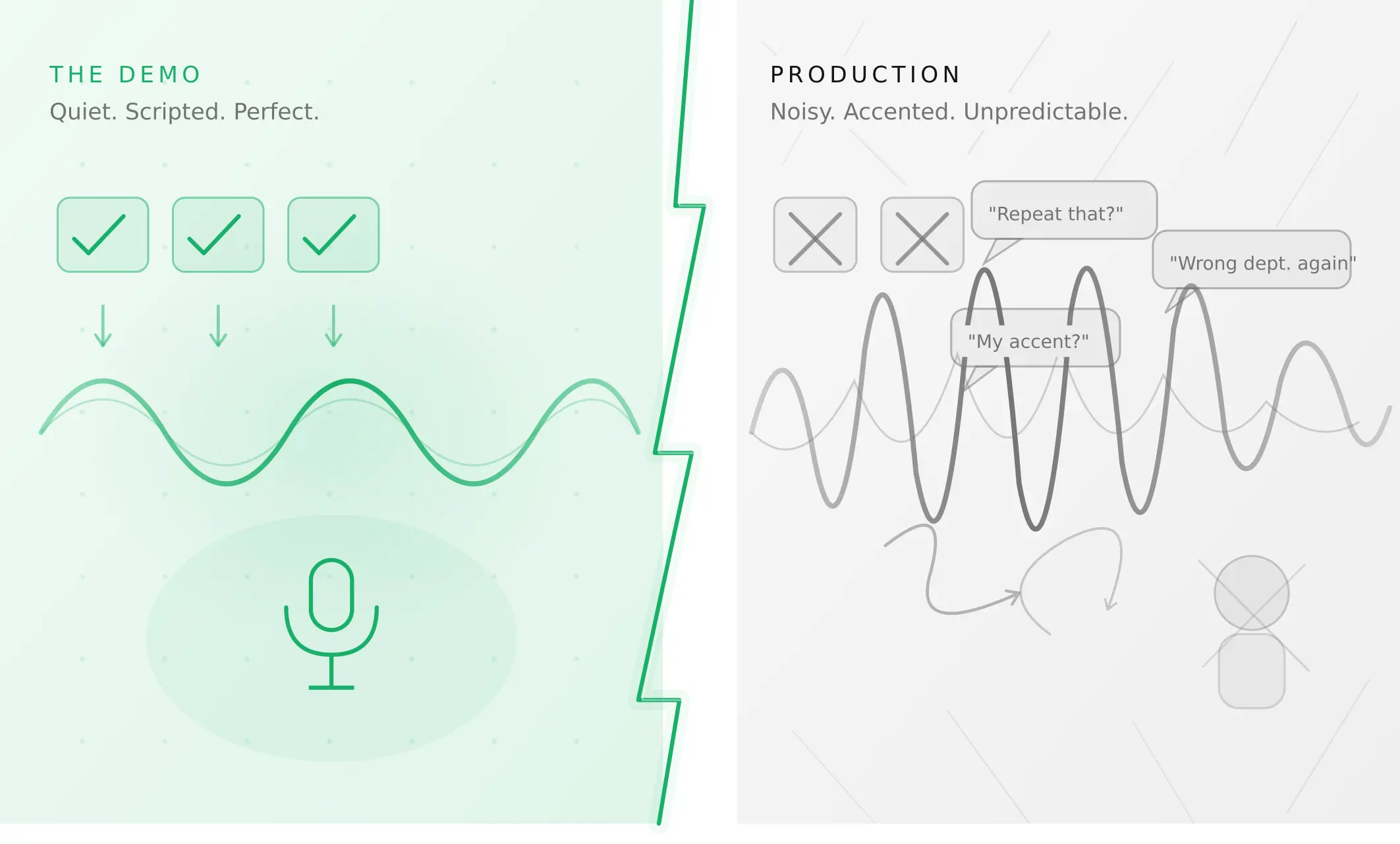
Why AI voice agents fail in production (and how to prevent it)
AI voice agents that ace demos still break in production. Learn the 5 root causes, how to test for each, and what production readiness actually means.
Read more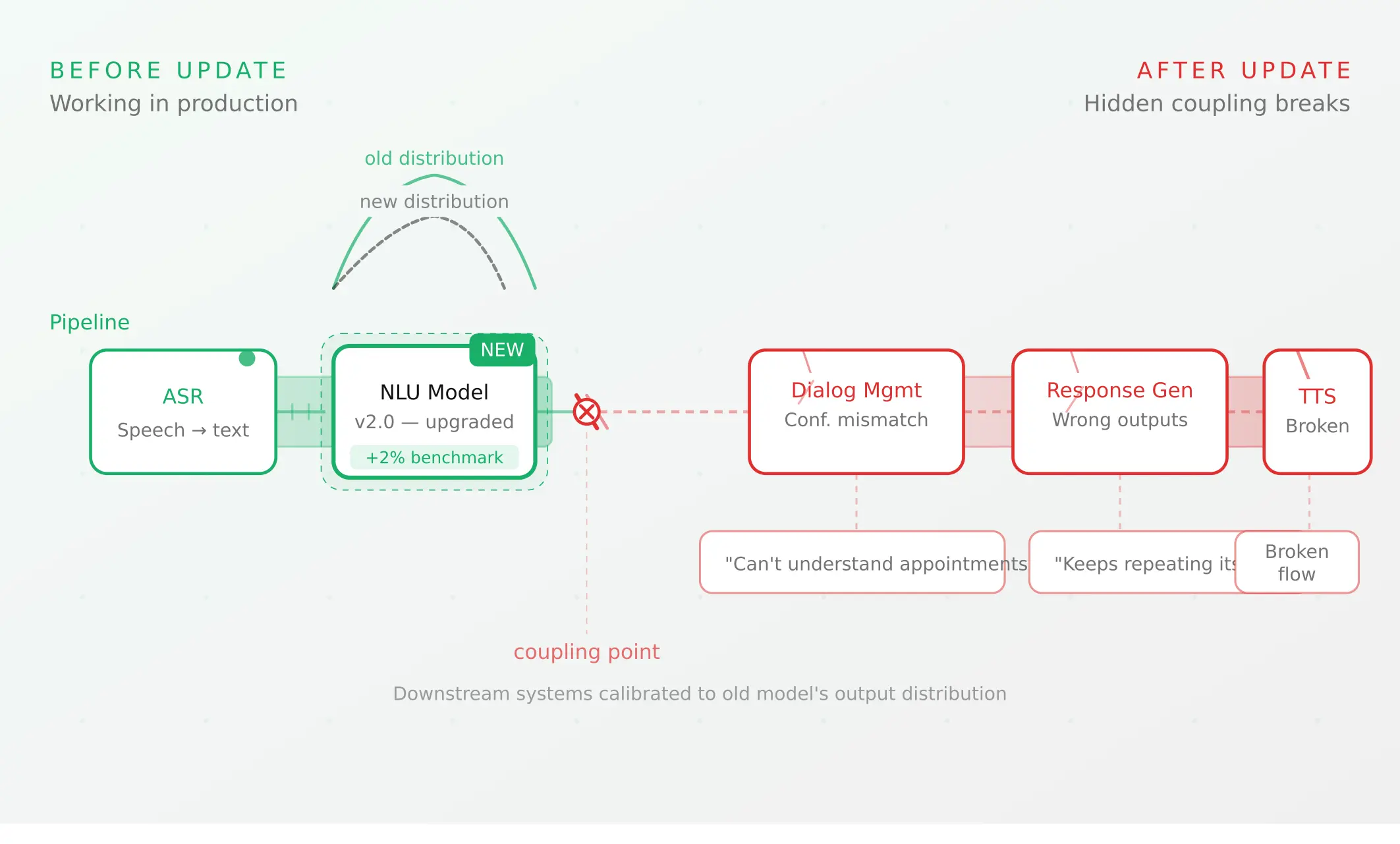
Voice agent regression testing: why LLM updates break production
LLM updates improve benchmarks but break voice agents in 5 predictable ways. How to detect and prevent regressions after every model or prompt change.
Read more