Event Venue AI Answering: Group Inquiries, Dates, Headcounts
On this page
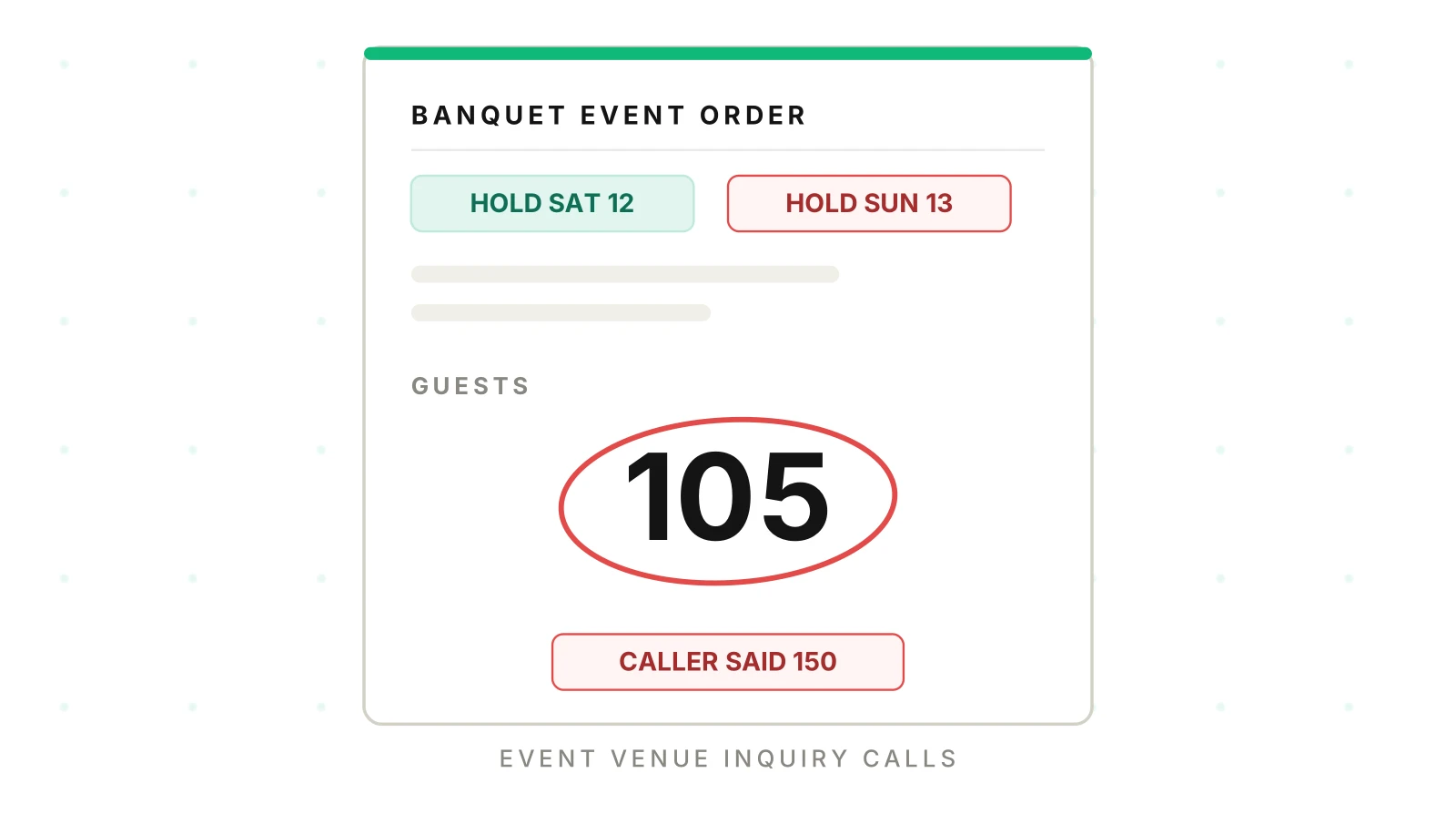
A wedding planner calls at 6 p.m. on a Friday. She wants a Saturday in June, 150 guests, a dinner, and a tour next week. The agent says "great, I've got you down." That sentence tells you nothing about what reached the calendar, the CRM or the follow-up queue. That gap is this post's subject.
Event venue AI phone answering sounds simple, but the stakes are real: the average wedding has 117 guests, and 89% of couples book a venue (The Knot, 2026 study release). This post is for the team that built the phone agent inside a venue-management product, or runs one for a group of venues. Your agent is live across many venues. Each prompt change reaches every caller. The call is the front door to a workflow: capture, hold, quote, tour, follow-up. A speech error at the door corrupts every step behind it.
What a venue inquiry call actually writes
An old event venue answering service took messages. A wedding venue AI receptionist writes records. A kids' party call is mostly add-ons and a time slot. We cover it in party booking AI for venues. Corporate event inquiries and planner calls are different. These venue inquiry calls touch a calendar, a capacity limit, a catering policy and a sales pipeline at once. An AI receptionist for event venues has to get all of them right.
One inquiry call produces up to six writes:
1. A calendar entry: open, held or booked.
2. A lead or contact record in the venue CRM.
3. A room and layout choice (ceremony, banquet, reception, boardroom).
4. A headcount, with a note on how firm it is.
5. Notes on catering, dietary and access needs.
6. A follow-up task: who calls back, and by when.
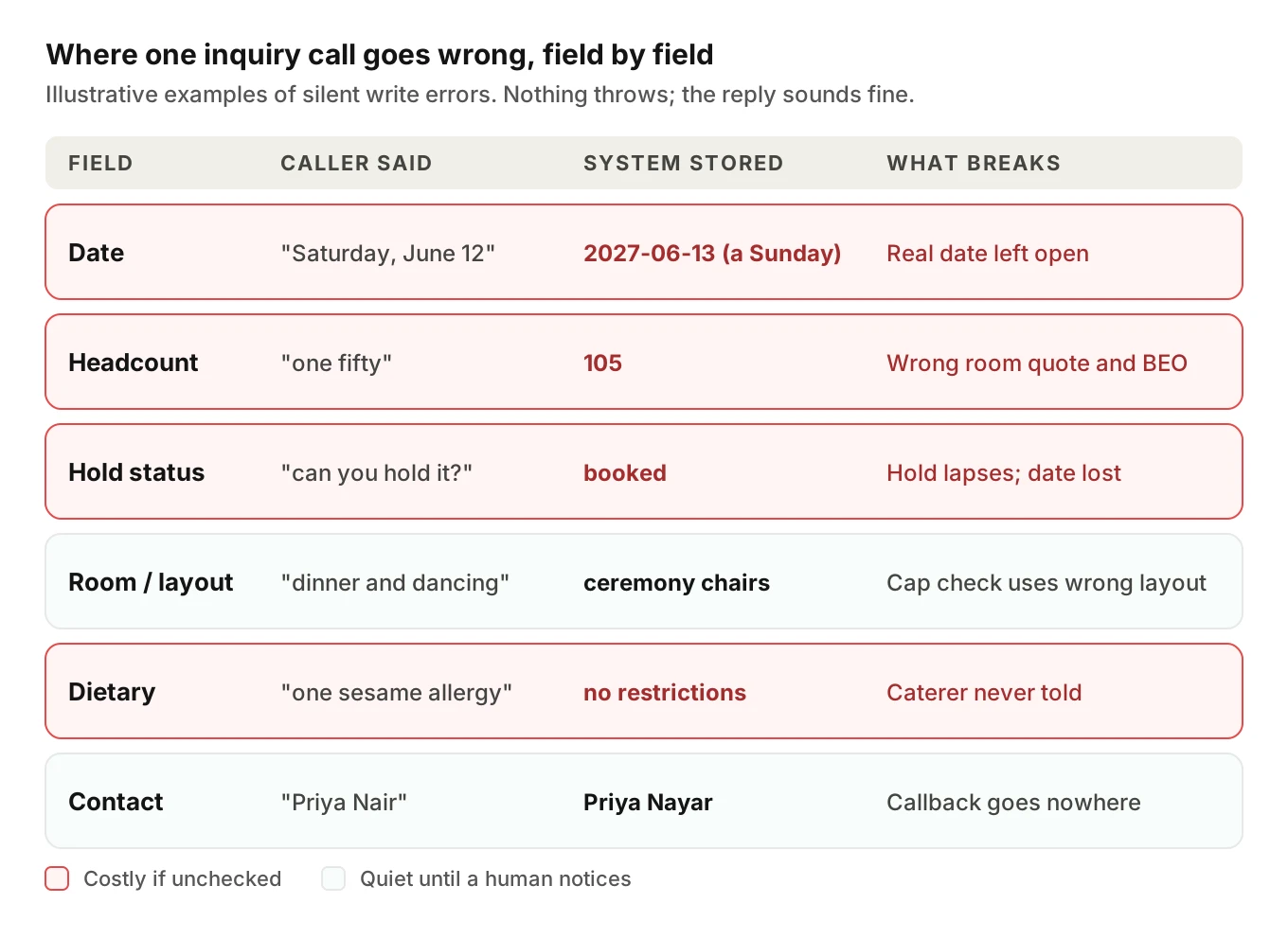
Each write can be wrong without any alarm. The caller hears a warm confirmation. The coordinator opens the CRM on Monday and finds a hold on the wrong Saturday. The right Saturday is still open for anyone else.
Neighbouring posts cover adjacent problems. Restaurant catering inquiries cover menu quoting. Tour booking tests cover no-shows. Hotel reservation errors cover rate codes. This post covers holds, headcounts and room fit.
Where event venue AI phone answering breaks
Dates: the right weekday, the wrong week
Callers give dates in many shapes. "The fifteenth." "Saturday after Memorial Day." "June, second weekend." "Sunday the 13th, no wait, the 12th." "Fifteenth" and "fiftieth" are easy to confuse on a noisy line.
The most useful check is cheap. A caller who says "Saturday, June 12" is describing 2027 only if June 12, 2027 is a Saturday. It is. A caller who says "Saturday, June 13" is not. Cross-check the weekday against the date, in code, before writing anything.
Self-corrections need a separate test. Alderete and colleagues ran WhisperX on 5,300 annotated speech errors from podcast audio (arXiv 2508.13060). For word-level slips, the output corrected the slip 43% of the time. It kept the slip as spoken 31% of the time. It got the word wrong 26% of the time. That is podcast speech, not phone calls. Still, "June, I mean July" is close to a coin flip for a transcript. Your agent needs a rule for it.
Headcount: 150 or 105
"One fifty" and "one oh five" sound close on an 8 kHz phone line. So do "fifteen" and "fifty." A planner who says "about 150, maybe 180 if the cousins come" has given three numbers and one decision.
A transcript shows whichever number the speech model chose. It does not show the clipped syllable. This is the case for judging from audio: a text-only judge cannot tell that the word was uncertain. Evalgent scores calls from the audio as well as the transcript, and that is the reason. We go deeper on this in transcript versus audio evaluation.
Store headcount as a record with three parts: the number, its firmness (firm, estimate, range) and the source phrase. "About 150, up to 180" becomes `{low: 150, high: 180, firmness: "estimate"}`. A bare integer hides the range.
Names, addresses and company details
The caller spells a surname. She gives a company name for the invoice. She names a street for a baraat route or a shuttle pickup. Names are where speech models fail hardest. Zhou et al. tested 15 models on spoken San Francisco and U.S. street names. Average street-name error across models was 44%. Whisper-Large had a low overall word error rate of 14% but a 27% street-name error rate (arXiv 2602.12249). Non-English primary speakers did worse (46% accuracy versus 64%).
That paper tests street names, not surnames. It is still the best primary evidence that a clean overall word error rate hides entity errors. Our post on STT entity accuracy goes further. For venues, the safe design is read-back and spell-back for the contact name, email and phone.
Hold versus booking: the state the agent must not promote
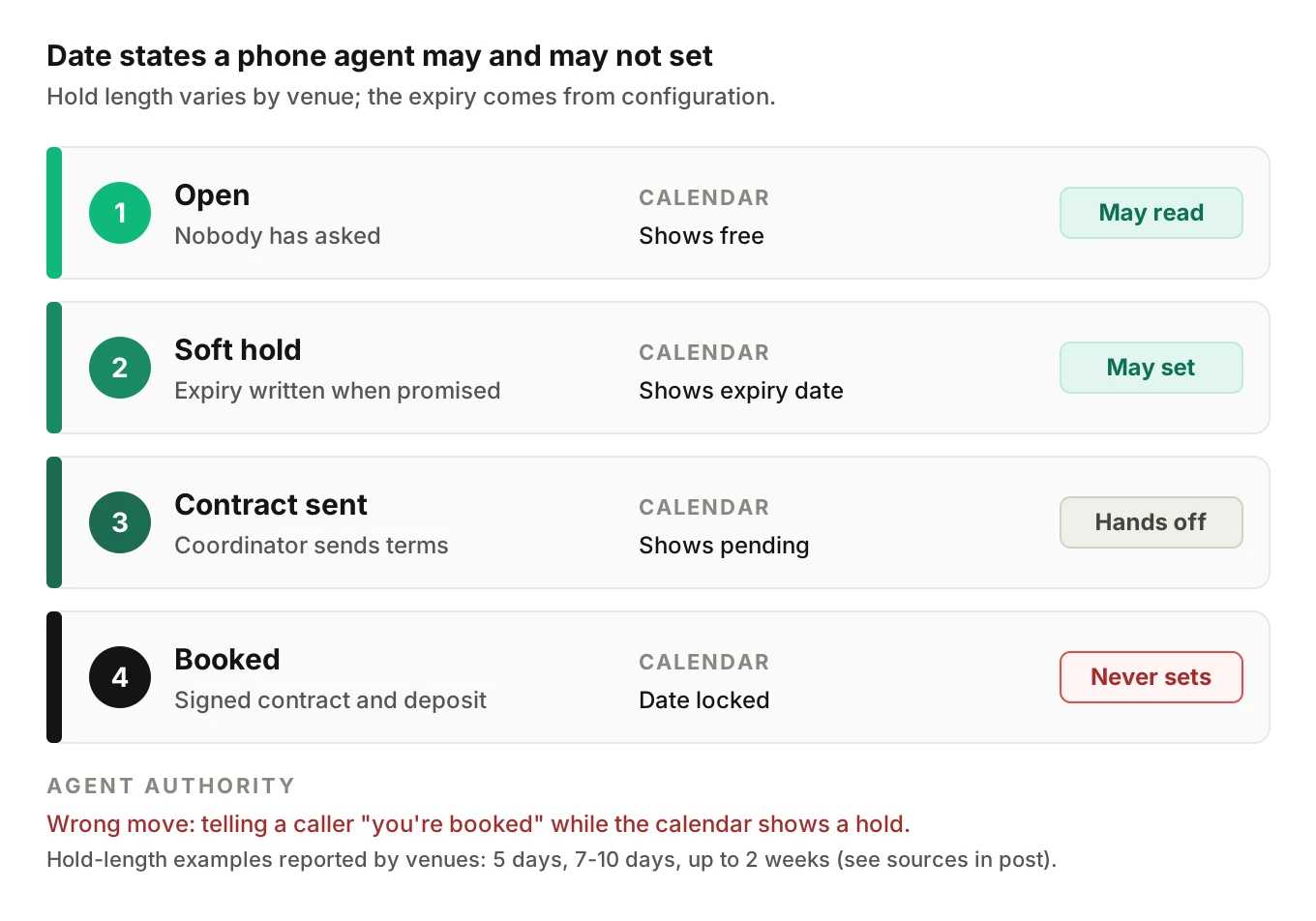
A hold is not a booking. VenueBill's guide to date holds says it plainly: a hold "is not a booking." A date is booked only after a signed contract and a deposit. It suggests holds of 7 to 10 days, which is vendor guidance, not a standard.
Venues differ. A Maroo roundup of wedding venue pros found a five-day complimentary hold at one, up to two weeks with a 1-to-2-day first right of refusal window at another, and no written agreement at a third. So your agent cannot hardcode "seven days." Read the venue's own policy from configuration.
The agent's allowed writes should be narrow:
- It may place a soft hold (some venues say tentative hold), with an expiry written at the moment it is promised.
- It may not mark a date booked. Only a signed contract and deposit do that.
- It may tell a caller "held until Friday at 5 p.m." only if the expiry exists in the calendar.
- If a second inquiry hits a held date, it follows the venue's first right of refusal rule, or hands off.
The failure is subtle. The agent says "you're all set for June 12." The calendar says "held." Two weeks later the hold expires, a second couple signs, and the first is told the date is gone. One sentence started that.
Capacity: the headcount has to fit the room, and the room has to fit the layout
Headcount only means something against a limit. Occupant load comes from the building code. The International Building Code's Table 1004.5 gives floor area per occupant. In Washington's adoption of it, assembly areas get 7 net square feet per person for chairs only, 5 for standing space, and 15 for tables and chairs (WAC 51-50-1004). Other states adopt and amend the model code differently, and the posted limit for a room is what governs.
The posted number matters because assembly rooms with an occupant load of 50 or more must display it on a permanent sign near the main exit (the model-code rule as Virginia adopted it, 13VAC5-52-220). Your venue already has that number. The agent should read it from configuration, not guess it.
Here is a worked example with an assumed room of 2,400 net square feet. This is illustrative, not a real venue.
| Layout | Formula | Max people |
|---|---|---|
| Ceremony, chairs only | 2,400 / 7 | 342 |
| Standing reception | 2,400 / 5 | 480 |
| Seated dinner, tables and chairs | 2,400 / 15 | 160 |
The caller says "150 for dinner and dancing." Against the 160 limit for seated dinner, 150 passes, with 10 to spare. Add 6 vendors and 4 staff in the room, and you are at the limit. Whether staff count toward the posted number depends on the venue and its fire marshal. So set a rule: if headcount is within 10% of the configured cap, the agent does not confirm room fit. It hands off to a coordinator. The 10% is a starting threshold for you to tune, not a standard.
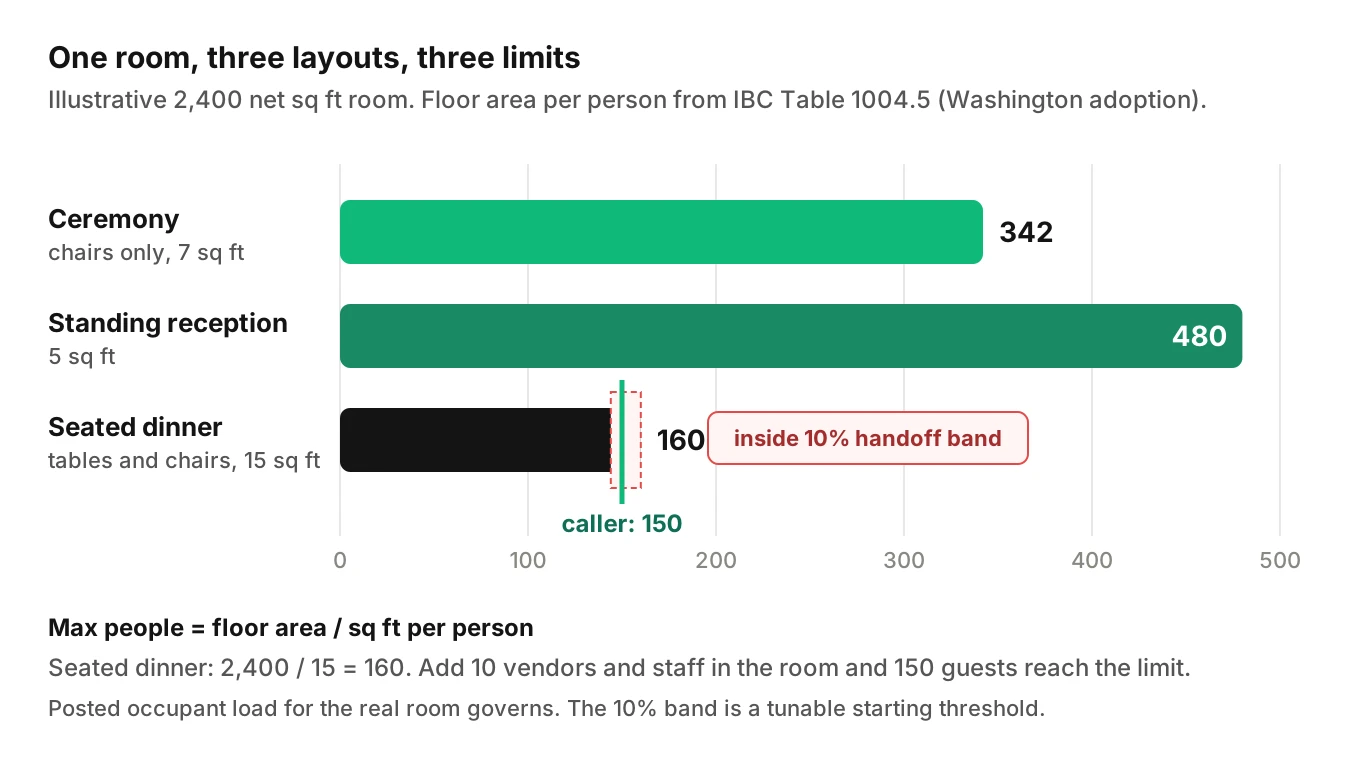
The layout is part of the fact. "150 guests" fits a seated dinner here. "200 guests" fits a standing cocktail hour here. The same room answers differently. If the agent says "yes, we fit 200" without asking the layout, it is wrong for dinner.
Room and package fit, catering restrictions, deposits and tours
Room and package fit. Match event type, headcount, layout and date to a room and event package. Package rules are venue data: minimums, bar packages, ceremony add-ons. The agent should quote only what is in the venue's configured package list. An invented "most weddings book the garden room for 150" is made-up policy.
Catering restrictions. Many venues require their own caterer or an approved list. Others allow outside food with fees. The agent must say which, from configuration, and must not guess. Dietary needs are a safety path. The FDA lists nine major food allergens: milk, eggs, fish, crustacean shellfish, tree nuts, peanuts, wheat, soybeans and sesame, which became the ninth on January 1, 2023 (FDA). A caller who says "one guest has a sesame allergy" has given the agent a safety fact. It should record the exact wording and route it to the catering lead. It should never say "that's fine." Our post on allergy errors in phone ordering covers the same trap.
Deposits. Most inquiry calls should end with a link, not a card number read aloud. The PCI Security Standards Council's guidance on telephone payments warns that call recordings and phone environments can capture card data unnecessarily, and says "no payment card data should ever be stored unless necessary" (PCI SSC). If your agent takes payment by voice at all, test that the recording and transcript do not retain it. This is not legal or compliance advice.
Tours. A venue tour, also called a site visit, is the real conversion step. Test the same things as any booking: the right date and time, the right contact, a calendar entry the coordinator can see, and a reminder. The agent should not offer a slot already taken by another tour. Our tour booking post covers the mechanics.
Follow-up and consent. If the agent promises a text with the quote or contract link, check consent first. On September 30, 2026, the FCC adopted a Report and Order that changes how consent revocation works under the TCPA, including allowing callers to designate an exclusive opt-out method (Kelley Drye). It takes effect 30 days after Federal Register publication. Check your own flow with counsel. This is not legal advice.
Writing back to the venue CRM without silent damage
The write-back is where a speech error becomes a business record. That record often feeds the banquet event order (BEO), the sheet the kitchen and floor staff run the event from. A wrong headcount at the door becomes a wrong BEO. Treat the model's output as a proposal. Validate it in code, then write. Here is a simplified Python guard. It is a sketch for your own stack, not a vendor API.
from datetime import date

HOLD_STATES = {"open", "soft_hold", "contract_sent", "booked"}

def validate_inquiry(rec: dict, rooms: dict, today: date) -> list[str]:
    errs = []
    d = date.fromisoformat(rec["event_date"])
    if d <= today:
        errs.append("date_in_past")
    said = rec.get("weekday_said")          # e.g. "saturday"
    if said and d.strftime("%A").lower() != said:
        errs.append("weekday_date_mismatch")
    room = rooms.get(rec["room_id"])
    layout_cap = room["caps"].get(rec["layout"]) if room else None
    if layout_cap is None:
        errs.append("unknown_room_or_layout")
    else:
        hi = rec["headcount_high"]
        if hi > layout_cap:
            errs.append("headcount_over_cap")
        elif hi >= 0.9 * layout_cap:
            errs.append("headcount_near_cap_handoff")
    if rec["status"] not in HOLD_STATES or rec["status"] == "booked":
        errs.append("agent_cannot_set_booked")
    if rec["status"] == "soft_hold" and not rec.get("hold_expires"):
        errs.append("hold_without_expiry")
    if not rec.get("contact_readback_confirmed"):
        errs.append("contact_not_confirmed")
    return errs
Any error blocks the write or forces a handoff to a human with the raw audio clip attached. The names are ours, so adapt them. The 0.9 factor is the same 10% handoff band from the capacity section.
This catches problems that no transcript review will see. If the tool call succeeds but stores the wrong date, nothing throws. Our posts on silent tool failures and tool argument accuracy cover how to catch that class of failure.
How to test an event venue AI phone agent
Run this before launch and before any prompt change. Treat prompt changes as releases.
1. List the writes. For each inquiry type (wedding, corporate, rehearsal dinner, nonprofit gala, trade show), list every calendar, CRM and task write. That list is your assertion set.
2. Build a venue fixture. Give the test environment a calendar with open, held and booked dates, rooms with layout caps, a package list and a catering policy. Seed one date that is already held.
3. Write scenarios from the prompt and the policies. Cover each branch: date given as a weekday phrase, headcount as a range, a held date requested, a room that is too small, an outside-caterer question, an allergy, a deposit request, a tour request, a same-day callback.
4. Vary the caller. Change accent, pace, interruptions, response delay, background noise and language. A venue manager gets calls from cars, kitchens and loud reception rooms. A single clean voice proves little.
5. Assert on the record, not the reply. After each simulated call, read the calendar and CRM and compare to the expected values. A friendly confirmation with a wrong record is a fail.
6. Judge from the audio. Flag calls where the date, headcount or name was said ambiguously or corrected mid-call, and have a human review those verdicts.
7. Set the pass bar by sample size. With zero failures in n independent calls, the 95% upper bound on the failure rate is about 3/n (the "rule of three"). Zero date errors in 150 calls means the true rate is probably under 2%. To claim under 0.5%, you need about 600 clean calls.
8. Re-run on every change. Prompt edits, model swaps and new venue configurations all go through the same set.
Evalgent builds scenarios from an agent's prompt and flows: states, branches, policies and hard constraints. It runs simulated callers with different accents, pace, interruption levels and background noise over phone, SIP or WebRTC. Teams get help setting up evals for a first agent. For a start, the synthetic callers guide explains the method.
A scorecard for live calls
Pre-launch tests tell you what could go wrong. Production tells you what does. Score every call, not a sample (why). These are custom metrics worth defining, with starting thresholds you should tune.
| Metric | Definition | Starting bar |
|---|---|---|
| Date fidelity | Stored date equals the date a human hears on the audio | 100% on reviewed calls |
| Hold integrity | Every hold has an expiry; none stored as booked | 0 exceptions |
| Headcount fidelity | Stored range matches the spoken range | 99%+ |
| Cap check | No confirmation above configured layout cap | 0 exceptions |
| Allergy routing | Every stated allergy is recorded verbatim and routed | 100% |
| Follow-up owner | Every call ends with a named owner and time | 100% |
Production monitoring on Evalgent works from call recordings you push. Calls are transcribed, mapped to scenarios and judged, with flags for PII leakage, tool-call failures, latency spikes and policy failures. Add these venue metrics as custom checks and they run on every call. Verdicts get human review.
These six are our proposal, not an industry standard. Tighten them as data comes in.
Who follows up, and when
The quietest failure is the call that ends and then nothing happens. The coordinator is on-site at a wedding all weekend. The inquiry sits. The caller rings the next venue.
Make follow-up part of the record: an owner, a callback window and a channel. Test it by ending a simulated call, advancing the clock and checking that the task fired. Test handoffs too. When the agent transfers to a human, date, headcount, room, hold status and notes must arrive. Our post on memory and context shows how.
Frequently asked questions
How does an AI answer calls for an event venue?
The agent greets the caller, asks the event type, date, headcount and layout, checks the venue calendar and room limits, places a time-limited hold or books a tour, then writes the record to the CRM and creates a follow-up task. It should hand off anything outside its configured policies, such as allergies, custom pricing or large groups.
Can AI hold a date for a wedding venue?
Yes, but only a soft hold with a written expiry that the venue's policy allows. A date is booked after a signed contract and deposit. The agent should never mark it booked. Hold length varies by venue, from about five days to two weeks in the examples we found, so read it from configuration.
How do you test an AI receptionist for a wedding venue?
Build a fixture calendar with open, held and booked dates, then run simulated callers with different accents, pace, noise and interruptions. After each call, check the calendar and CRM against expected values, not the agent's reply. Cover date phrasing, headcount ranges, held dates, room limits, allergies and tour slots. Re-run the set on every prompt change.
What is the difference between a date hold and a booking?
A hold is a temporary reservation with an expiry that does not commit either side. A booking exists once the contract is signed and the deposit is paid. The calendar should show open, held and booked as separate states. An agent that says "you're booked" on a hold creates a false promise.
How does AI handle guest count and room capacity?
It should store headcount as a range with firmness, then compare the high end to the cap for the chosen layout. Capacity differs by layout: in one model code table, 15 net square feet per person applies to tables and chairs, 7 to chairs only. If headcount is near the cap, the agent should hand off to a coordinator.
Can AI take a deposit over the phone for a venue?
It can, but a payment link is usually safer. PCI SSC guidance warns that call recordings and phone systems can capture card data unnecessarily. If the agent takes card details by voice, test that recordings, transcripts and logs do not retain them. Get your compliance advisor's view. This is not legal advice.
How should an AI handle dietary restrictions on event inquiries?
It should record the exact words, never reassure, and route to the catering lead. Nine major allergens, including sesame, are recognised under U.S. food law. The agent cannot promise a safe menu from a phone call. Test allergy calls with accents and noise, and require 100% routing in your scorecard.
Who follows up after an AI answers a venue inquiry?
A named coordinator, with a callback window stored as a task. The agent should state a window only if the task exists. Test it by ending a simulated call and checking that the task fires, escalates when missed and carries the date, headcount, room, hold status and notes.
The bottom line
Event venue AI phone answering fails quietly in the record, not loudly in the conversation: the wrong Saturday, 105 instead of 150, a hold treated as a booking. Check every call's date, headcount, room fit, hold state and owner against the venue's calendar and CRM, and judge from the audio, not only the transcript.
Related Articles
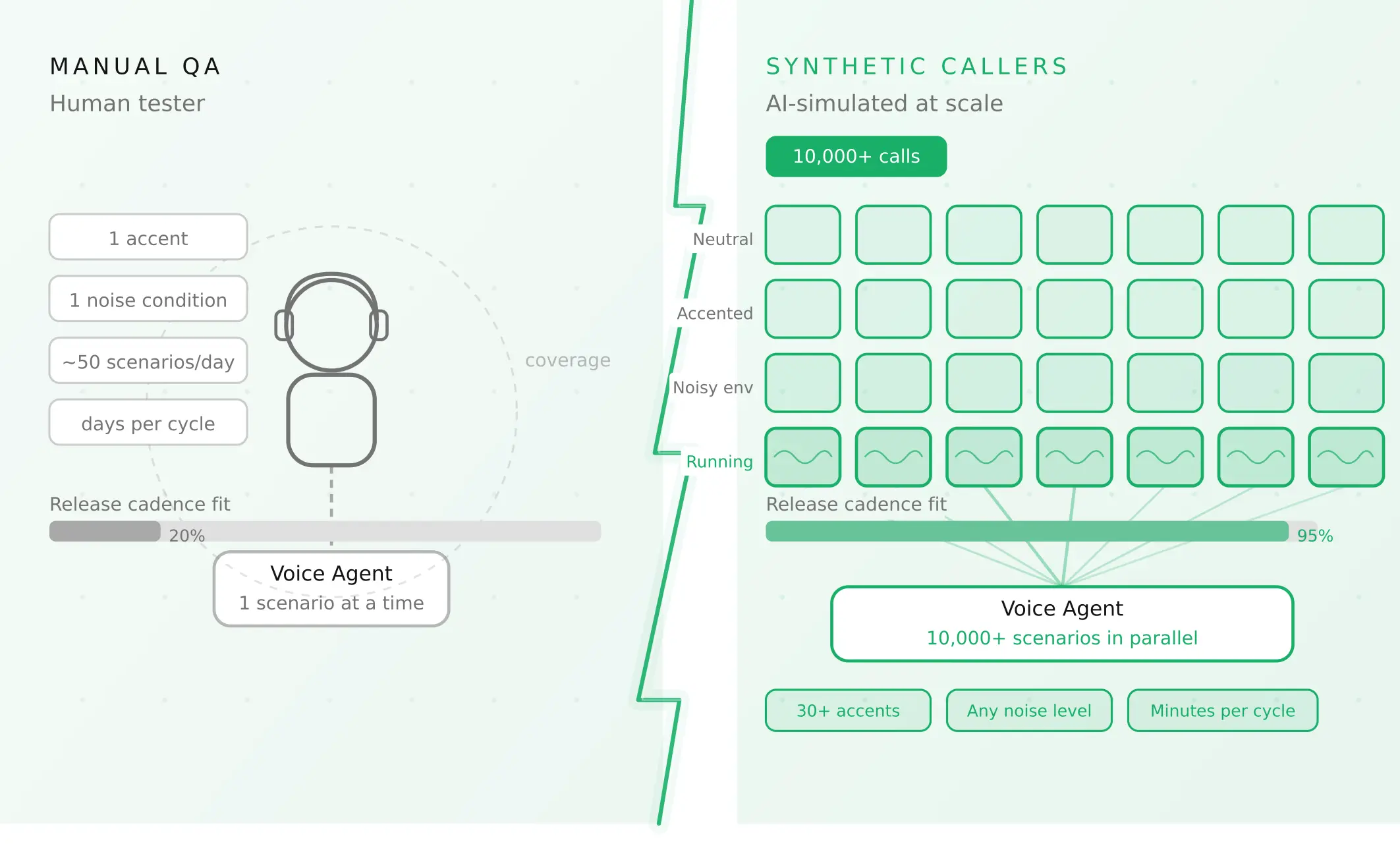
How to automate voice agent testing: synthetic callers vs manual QA
Learn how ai test automation replaces manual QA for voice agents. Compare synthetic callers vs human testers, with a 5-step framework to scale without hiring.
Read more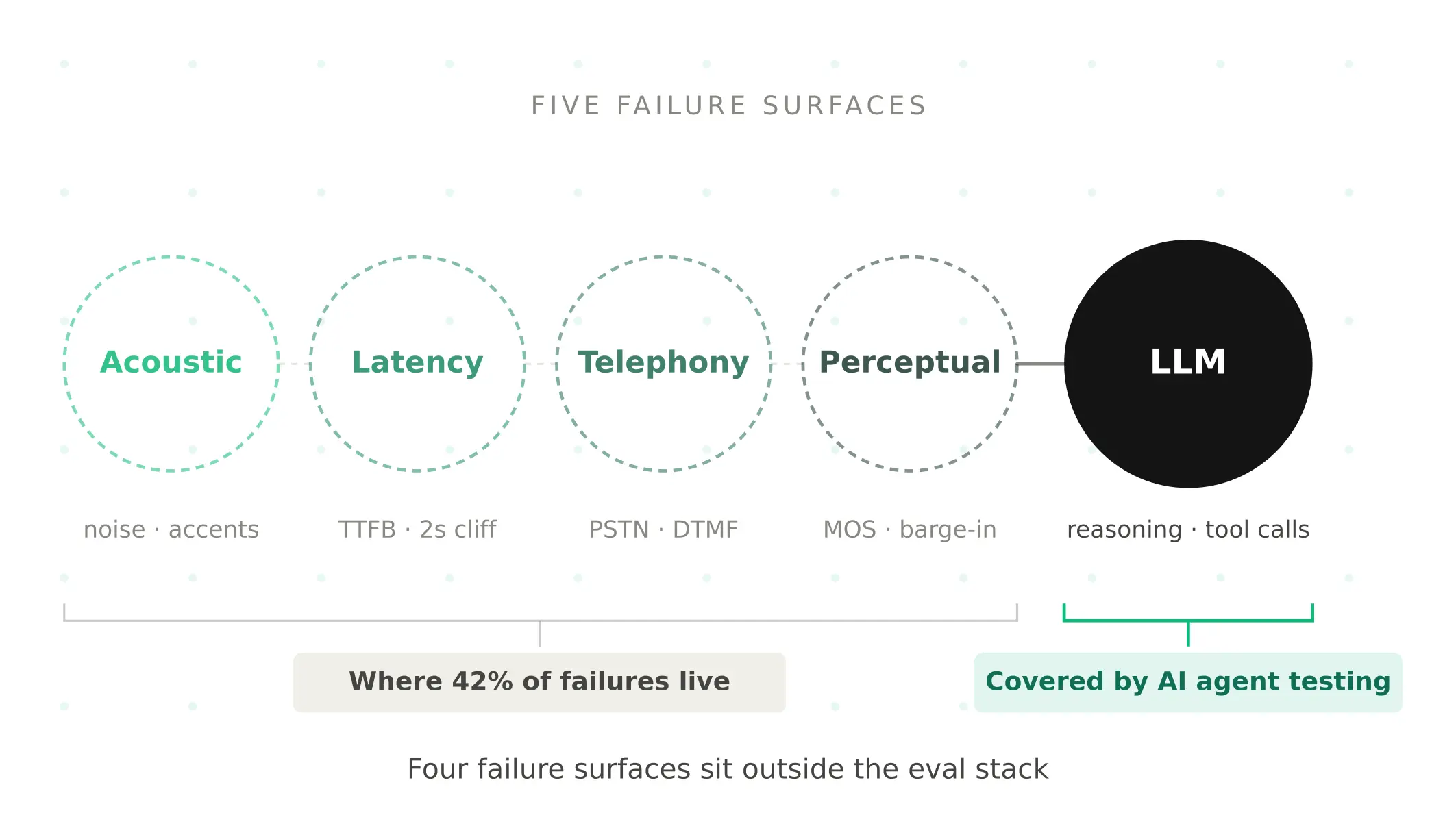
AI Agent Testing vs Voice Agent Testing: What General Tools Miss for Voice
AI agent testing measures text outputs. Voice agent testing measures behaviour through an acoustic pipeline. Five failure categories general tools miss.
Read more