Test your voice agent
How to Evaluate a Voice Agent Framework
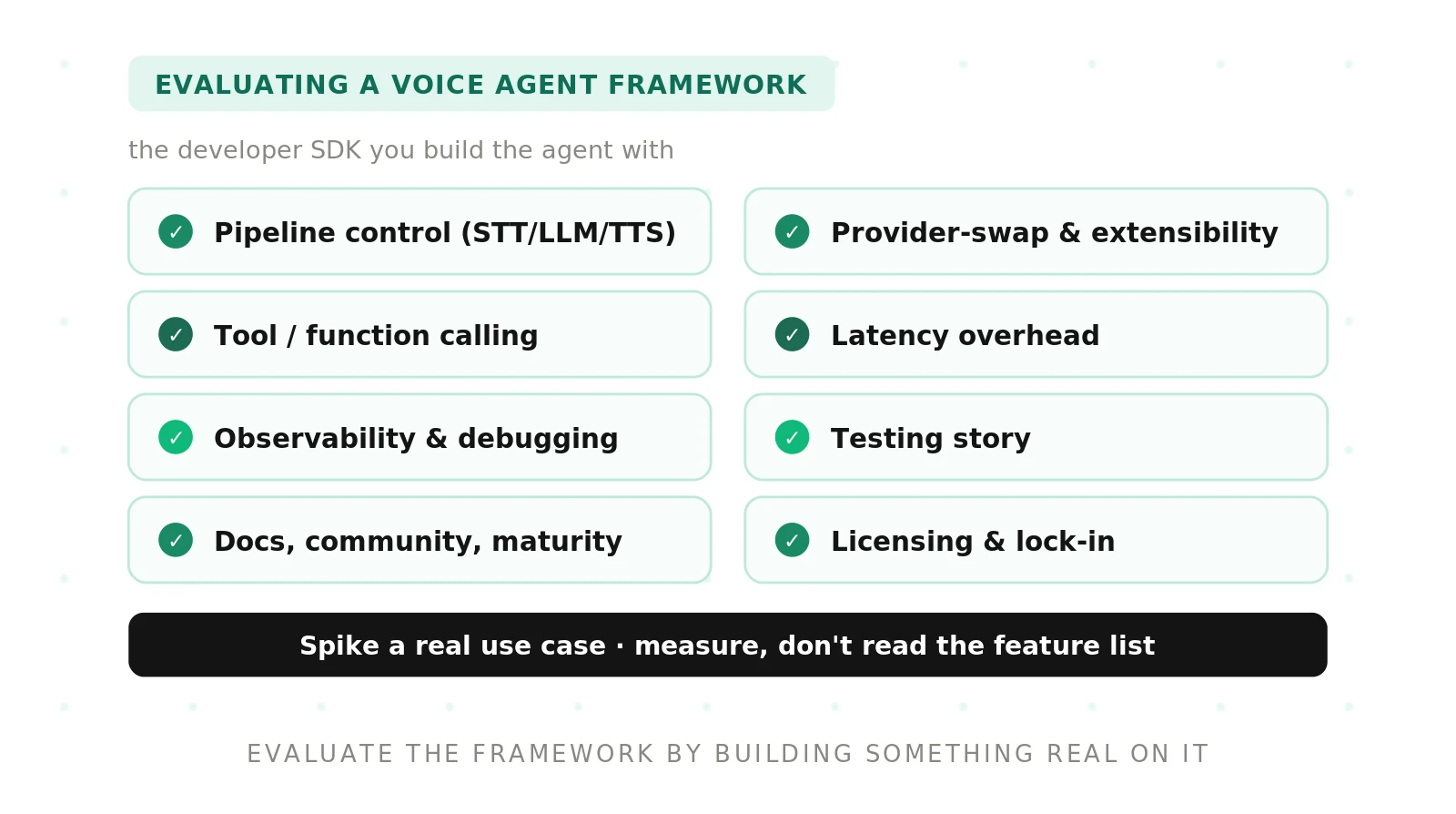
# How to evaluate a voice agent framework
Quick answer
To evaluate a voice agent framework, judge the code, not the demo. Score it on pipeline control, provider-swapping, tool calling, latency overhead, observability, testing hooks, docs, and licensing. Then spike your hardest use case on it and measure. The framework builds the agent; an independent evaluator measures what you ship.
A voice agent framework is a big commitment. You write your agent against its abstractions. You wire your tools through its interfaces. You inherit its update cadence and its bugs. Switching later means a rewrite, so the choice sticks for a long time.
Most teams pick a framework the way they pick a demo. They watch a slick example, skim a feature grid, and star the repo with the most stars. None of that predicts how the framework behaves once your real use case hits it. This guide gives you a developer's checklist instead. It covers the criteria that matter at the code level and how to test each before you commit.
What a voice agent framework is, and how it differs from an orchestration platform
A software framework is a reusable code scaffold you build your application inside. A voice agent framework is that scaffold for a real-time voice agent. It gives you the abstractions, APIs, and libraries to connect speech-to-text, a language model, and text-to-speech into one conversation.
> Voice agent framework: the developer library or SDK you build a voice agent with. It exposes code-level abstractions over the STT, LLM, and TTS pipeline, plus the extension points, tool interfaces, and debugging hooks a developer works against.
This is not the same thing as an orchestration platform. The framework is the toolkit you write code against. The orchestration platform is the runtime layer that actually sequences the pipeline at call time. The two overlap, but the evaluation lens differs. For the runtime layer, read our guide to choosing a voice agent orchestration platform. This post stays at the developer level: the code you touch every day.
Why does the distinction matter for evaluation? Because a framework is judged on the things a developer lives with. Clean abstractions. Escape hatches. Extensibility. Docs you can trust. A stable interface that will not force a rewrite next quarter. A great runtime with a hostile developer surface is still a bad framework for your team.
The criteria that decide a good voice agent framework
Not every feature carries equal weight. Below are the criteria that separate a framework you can live with from one you will fight. Each is something a developer can test directly in code.
Abstractions and control over the pipeline
A voice agent runs a pipeline: speech recognition, a language model, then speech synthesis. The framework wraps that pipeline in abstractions. Good abstractions hide the boilerplate while leaving you control. Bad ones hide the parts you need to reach.
Test whether you can drop below the abstraction when you must. Can you inspect the raw transcript before the model sees it? Can you rewrite a prompt mid-turn? Can you intercept audio frames? A framework with no escape hatch is a trap. You will hit its ceiling on your first hard requirement.
Extensibility and provider-swapping
Voice AI moves fast. The best STT or voice today may not lead next quarter. A strong framework treats each provider as a component behind an interface. You should be able to swap the model, the voice, or the transcriber without touching the rest of your agent.
Check how providers are registered. A clean framework uses a plugin or adapter pattern with documented extension points. A weak one hardcodes one vendor deep in its core. If swapping STT means editing framework internals, you own a fork, not an integration.
Tool and function calling
Real agents do things. They look up an order, book a slot, or check a balance. That means calling functions and external services mid-conversation. Evaluate how the framework models tools: how you define them, how arguments are validated, and what happens when a call is slow or fails.
Watch the failure paths. A weak framework goes silent or invents a result when a tool errors. A strong one gives you hooks to fill the gap and recover. Our guide to tool calling for voice agents covers the patterns to look for.
Latency overhead
Latency) is the delay callers feel most. The framework adds its own overhead on top of STT, the model, and TTS. A good framework streams tokens and audio as they arrive. It does not buffer a full response before speaking, and it does not add hidden hops.
Measure the framework's own contribution, not the whole stack. Instrument a bare pipeline, then the same pipeline through the framework. The difference is the tax you pay. Our latency guide shows how to measure each stage cleanly.
Observability and debugging hooks
You cannot fix what you cannot see. Observability is the framework's ability to expose what happened inside a turn. You want structured logs, per-stage timing, tool inputs and outputs, and access to the full transcript with audio.
Ask a sharper question: when a call goes wrong, can you replay it? A framework built for production gives you traces and hooks to instrument every stage. One built for demos gives you a print statement and a shrug. Debugging blind in production is expensive.
Testing story
A framework that ships with no testing story pushes that cost onto you. Ask how you test an agent built on it. Can you mock the model and the transcriber? Can you replay recorded audio through the pipeline in CI? Can you assert on tool calls without hitting real services?
This is where a framework built by people who ship shows itself. If the only way to test is to place a live call, iteration will be slow and flaky. Look for deterministic test modes and fixtures you control.
Docs, community, and maturity
Documentation is part of the product. Read the docs before you write a line. Are the examples current? Do they cover the hard paths, or just the happy one? A dialogue system has many edge cases, and thin docs mean you discover them in production.
Community and maturity matter too. Check release cadence, open issue quality, and how maintainers respond. A framework built on open-source software lets you read the code and file fixes. A stalled project, however clever, is future technical debt you will pay down alone.
Licensing and lock-in
Read the license before you commit. Some frameworks are permissively licensed and self-hostable. Others are open in name but gated behind a required hosted service. The difference decides whether you can run your agent on your own terms.
Lock-in is the risk that leaving becomes too costly. It comes from proprietary abstractions, a required runtime, or data trapped in one console. We cover the open versus managed tradeoff in open source versus managed voice agents and the hosting decision in managed versus self-hosted orchestration.
Framework evaluation: what to look for and what to avoid
Use this table as a quick screen. It maps each criterion to a positive signal and a warning sign. Score every framework on your shortlist against all nine rows.
| Evaluation criterion | What to look for | Red flag |
|---|---|---|
| Pipeline abstractions | Clean defaults with escape hatches to raw transcript, prompt, and audio | Sealed abstractions with no way to reach the layer you need |
| Extensibility and provider-swapping | Adapter or plugin pattern; swap STT, LLM, or voice behind an interface | One vendor hardcoded deep in the core; swapping means a fork |
| Tool and function calling | Typed tool definitions, argument validation, hooks for slow or failed calls | Silent gaps or hallucinated results when a tool errors |
| Latency overhead | Streams tokens and audio; measurable, low framework-added delay | Buffers full responses; hidden hops you cannot instrument |
| Observability and debugging | Structured logs, per-stage timing, tool I/O, replayable traces | Print-statement debugging; no way to trace one bad call |
| Testing story | Mockable providers, recorded-audio replay in CI, assertions on tool calls | No test mode; the only way to test is a live call |
| Docs and maturity | Current examples for hard paths; steady releases; responsive maintainers | Stale docs, happy-path-only examples, a stalled repo |
| Licensing | Clear permissive license; genuinely self-hostable | "Open" but gated behind a required hosted service |
| Lock-in | Portable abstractions; your logic and data stay yours | Proprietary runtime traps your agent and call logs |
How to run a voice agent framework evaluation
Feature grids lie. The only reliable test is to build your hardest real use case on each finalist and measure. A framework spike is a small, throwaway build that exercises the framework where it hurts. Here is the sequence we use.
1. Write down your weighted criteria first. List the nine criteria above. Assign a weight to each based on your use case. A telephony support agent weights latency and tool calling. A regulated line weights observability and self-hosting. Decide this before you look at any framework, so no demo skews your priorities.
2. Pick one hard use case, not a hello-world. Choose the scenario that stresses the framework most: a multi-step task with a tool call, an interruption, and a recovery path. A happy-path demo tells you nothing. The point is to find the ceiling early.
3. Spike the same use case on each finalist. Build the identical flow on two or three frameworks. Timebox each spike to a few days. Hold the STT, model, and voice constant across spikes so you are testing the framework, not the components.
4. Instrument latency at the framework boundary. Measure a bare pipeline, then the same pipeline through the framework. The delta is the framework's overhead. Record it per stage, under load, not just on a single quiet call.
5. Force the failure paths. Make a tool time out. Return a malformed response. Interrupt mid-turn and change the request. Note how much code each framework needs to recover cleanly. Fragile failure handling is where production breaks.
6. Read the code you cannot avoid touching. Trace one full turn through the framework's source. Count how many escape hatches you needed and how many you had to fake. This exposes abstraction quality faster than any README.
7. Score, then validate on your own calls. Apply your weights and rank the finalists. Then take the top choice and run your real scenarios through it with an independent evaluator, so the decision rests on measured outcomes, not on which spike felt nicer. See our guide to benchmarking voice agents on your own data.
Why the framework does not decide production quality
A framework choice is necessary but not sufficient. The same framework can produce a great agent or a terrible one, depending on your prompts, tools, and data. So the framework evaluation answers one question: can my team build well on this? It does not answer whether the agent you shipped actually works for callers.
That second question needs a different kind of test. Framework benchmarks run on the framework author's terms, with clean audio and favorable examples. Your production has your accents, your noise, your tools, and your edge cases. A number from a repo's example folder ignores all of it.
This is why an independent, owned evaluation matters. When the test suite belongs to you, no framework and no vendor can tune to it in advance. You measure the agent you actually ship, on the calls you actually get. This is the core of independent voice AI evaluation, and it is how serious teams make a framework decision defensible after the fact. For the full method, start with our overview of voice agent evaluation and our guide to evaluating voice agent vendors.
Evaluating your shipped agent with Evalgent
The framework decision is only safe if you can measure the agent it produces, whatever built it. Evalgent is the independent evaluator we use to do exactly that. It gives you a yardstick you own, held apart from any framework or vendor. Scenarios capture your real calls as a fixed, versioned suite. Profiles vary caller accent, pace, and line quality, so every build faces the same range. Metrics score each run against pre-defined expected outcomes on one fixed definition, so results compare directly.
Because the suite is yours and runs against anything, the framework underneath becomes an implementation detail. You can evaluate an agent built on any framework or SDK, compare two builds head to head, or prove that quality held after a migration. Reviews let your team hear the call behind any score. To put a neutral evaluation between you and every framework choice, book a demo and see it on your own traffic.
Frequently asked questions
What is a voice agent framework?
A voice agent framework is the developer library or SDK you build a voice agent with. It exposes code-level abstractions over the speech-to-text, language model, and text-to-speech pipeline, plus tool interfaces and debugging hooks. It is the scaffold your agent code lives inside, not the runtime that executes calls in production.
How do you evaluate a voice agent framework before committing?
Score the framework on pipeline control, provider-swapping, tool calling, latency overhead, observability, testing hooks, docs, and licensing. Weight those criteria for your use case. Then spike your hardest real scenario on each finalist, hold the providers constant, force the failure paths, and measure. Pick the framework that fits your priorities on evidence, not on the demo.
What is the difference between a voice agent framework and an orchestration platform?
A framework is the developer toolkit you write code against. An orchestration platform is the runtime layer that sequences the pipeline at call time. The framework is judged on abstractions, extensibility, and docs. The platform is judged on runtime behavior like turn-taking and reliability. They overlap, but the evaluation lens is different.
How much latency does a voice agent framework add?
A well-built framework should add little on top of STT, the model, and TTS. It streams tokens and audio rather than buffering full responses. Measure its overhead directly: instrument a bare pipeline, then the same pipeline through the framework, under load. The delta is the framework's tax. Hidden hops you cannot instrument are a red flag.
Can I swap STT, TTS, or LLM providers in a voice agent framework?
With a well-designed framework, yes. Good frameworks treat each provider as a component behind a stable interface, using an adapter or plugin pattern. You should change the transcriber, model, or voice without rebuilding the agent. If swapping one provider forces you to edit framework internals or fork the project, that is a serious lock-in risk.
Should I choose an open-source or managed voice agent framework?
Choose open-source when self-hosting, data residency, or deep control matter most. Choose managed when speed to launch and low operations burden win. Read the license carefully, because some frameworks are open in name but require a hosted service. Keep portable abstractions either way so you can change your hosting decision later without a rewrite.
How do I test an agent built on a voice agent framework?
Look for a framework with a real testing story: mockable STT and model providers, recorded-audio replay in CI, and assertions on tool calls without hitting live services. If the only way to test is a live phone call, iteration will be slow and flaky. After building, validate the shipped agent on your own scenarios with an independent evaluator.
Does the choice of framework decide voice agent quality?
No. The framework decides whether your team can build well, not whether the agent works for callers. The same framework can produce a great agent or a poor one, depending on your prompts, tools, and data. Evaluate the framework at the code level, then measure the agent you ship on your real calls with an independent suite.
The bottom line
Evaluate a voice agent framework on the code you touch, then spike your hardest use case and measure. The framework builds the agent, but an independent evaluation on your own calls is what proves it works.
Ready to measure the agent you ship, whatever framework built it? Book a demo and see it on your own traffic.
Related Articles
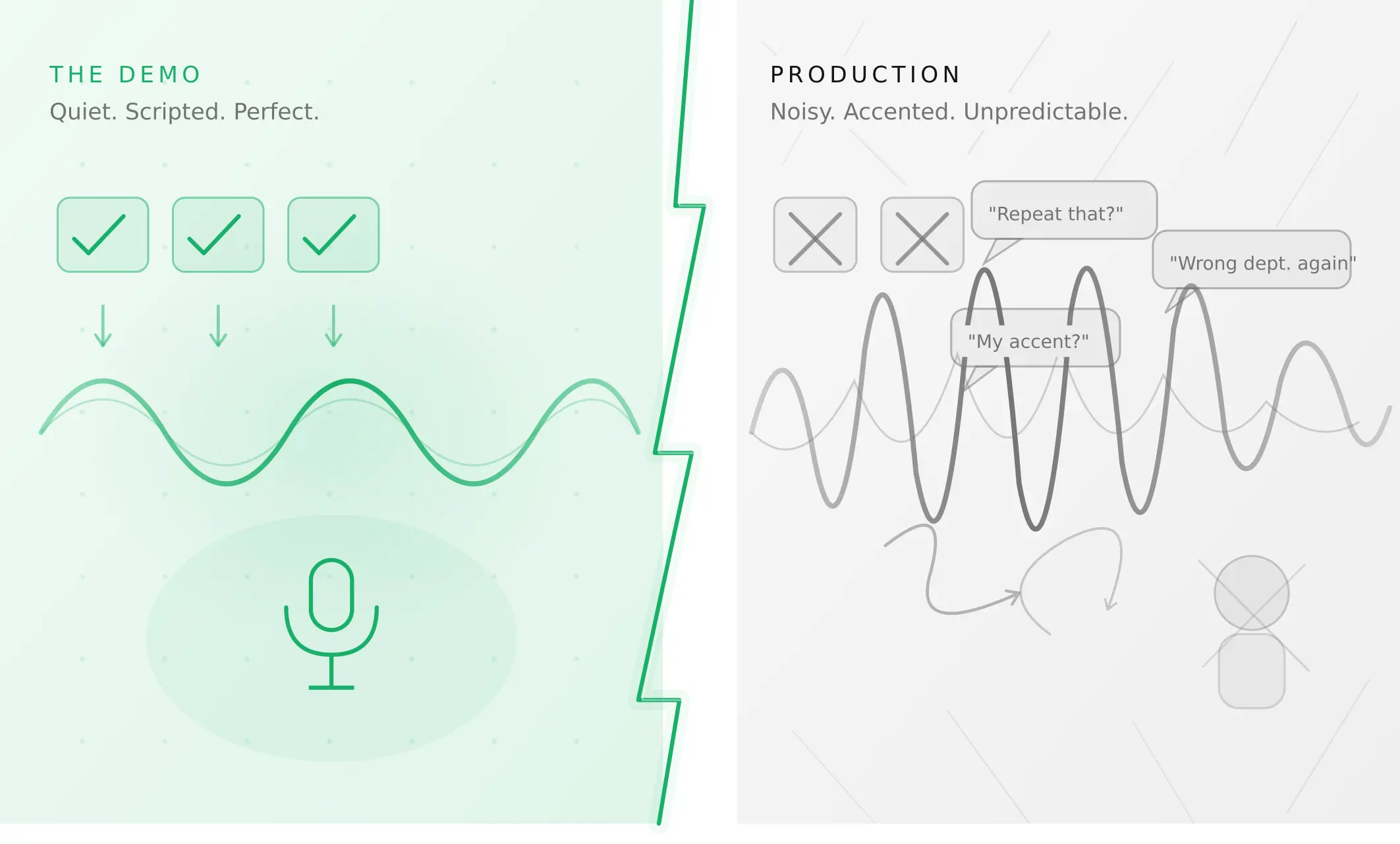
Why AI voice agents fail in production (and how to prevent it)
AI voice agents that ace demos still break in production. Learn the 5 root causes, how to test for each, and what production readiness actually means.
Read more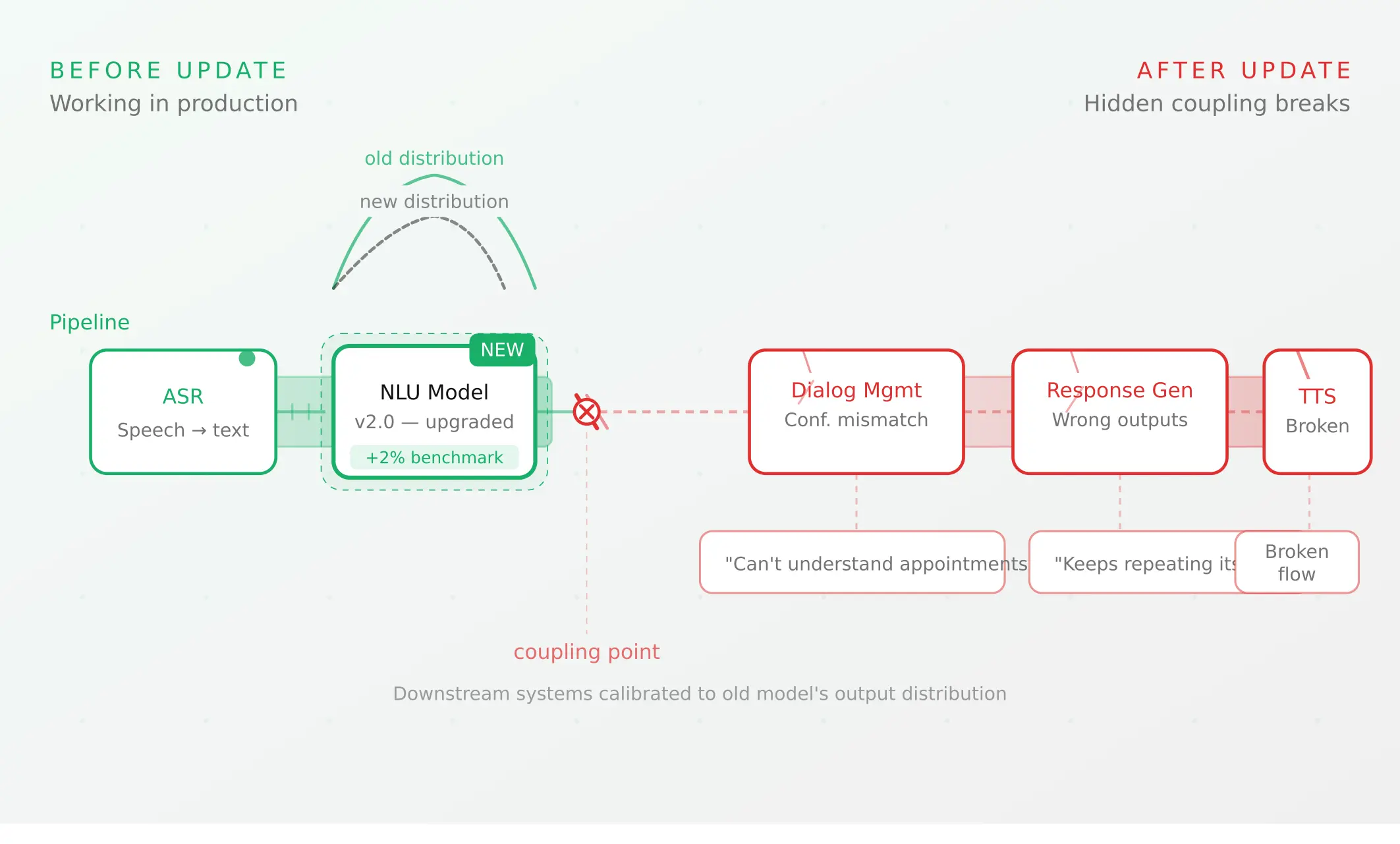
Voice agent regression testing: why LLM updates break production
LLM updates improve benchmarks but break voice agents in 5 predictable ways. How to detect and prevent regressions after every model or prompt change.
Read more