Test your voice agent
Open-Source vs Managed Voice Agent Stack
# Open-source vs managed voice agent stack
Quick answer
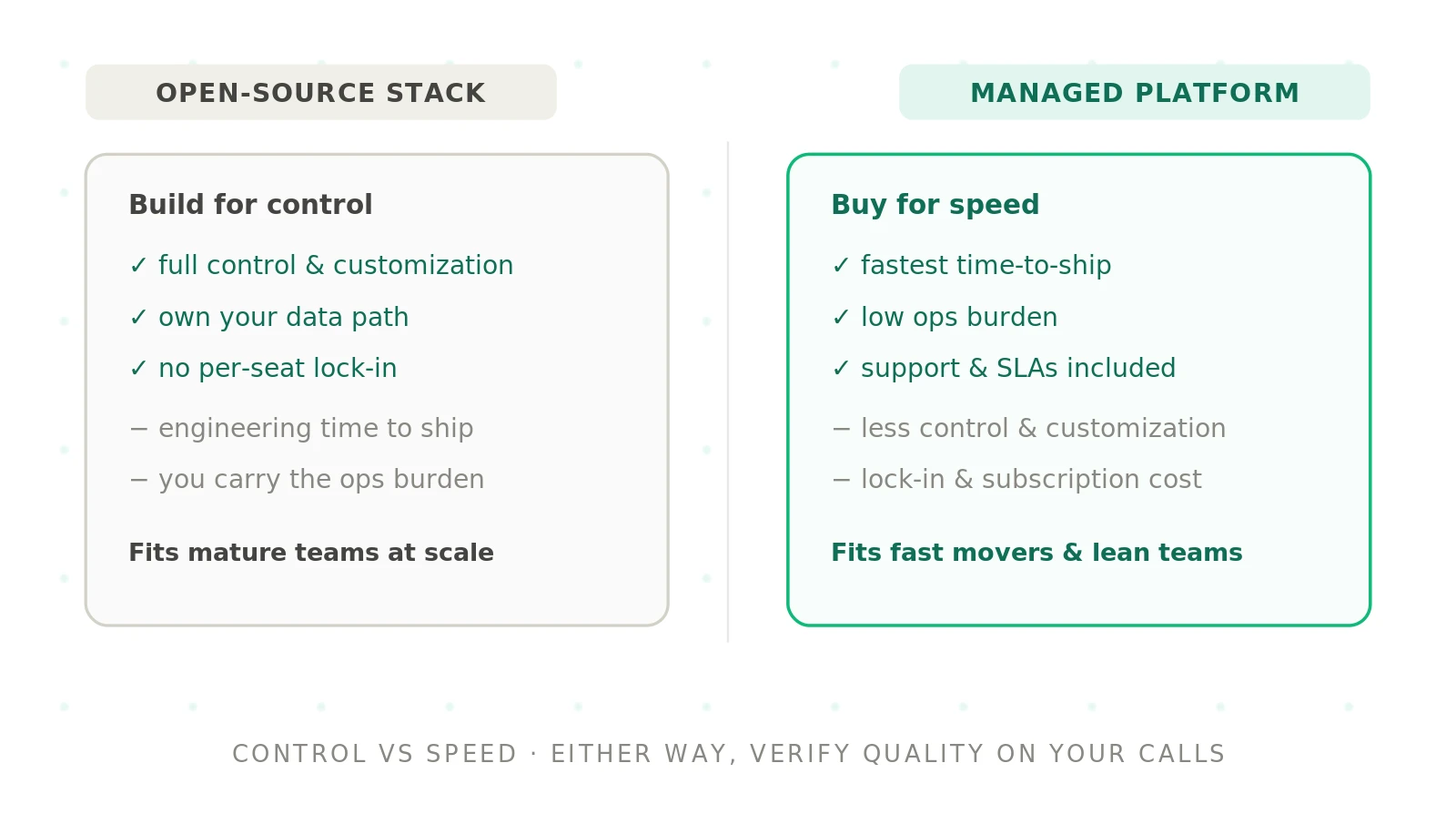
Open source gives you control and lower cost at scale. A managed platform gives you speed and low ops burden. Pick open source for deep customization, data control, and high volume. Pick managed to ship fast with a small team. Either way, verify quality on your own calls.
Two ways to build a voice agent
Every voice agent rests on the same layers. Speech-to-text turns audio into words. A language model decides what to say. Text-to-speech turns the reply into a voice. Telephony carries the call. Orchestration ties it all together in real time.
You can assemble these layers two ways. You can build on an open-source stack. Or you can buy a managed platform. The choice shapes your cost, your speed, and your risk for years.
This post compares the two paths. It covers control, time-to-ship, total cost of ownership, ops burden, security, and lock-in. It ends with a simple way to decide. And it explains why you should verify quality yourself, whichever path you take.
What each path actually means
The two terms hide a lot of detail. Define them before you choose.
> Open-source voice stack: a set of freely licensed components you host and wire together yourself. You control the code, the models, and the data path.
An open-source stack means you own the assembly. You pick each piece. You run the servers. You write the glue that binds transcription, the model, speech, and telephony. Nothing is hidden. Nothing is locked.
> Managed voice agent platform: a hosted service that runs the whole stack for you. You configure an agent, connect your data, and ship.
A managed platform hands you a working system. One vendor runs speech, the model, voice, telephony, and orchestration. You get a console and an API. The plumbing is their problem, not yours.
If you want the orchestration layer alone unpacked, our guide on managed vs self-hosted voice orchestration goes deeper. This post is about the whole stack.
Control and customization
Open source wins on control. You can swap any model. You can tune the endpointing. You can rewrite the turn logic. You can run a fine-tuned model no vendor offers. Nothing is off-limits because you own the code.
Managed platforms trade control for convenience. You get the knobs the vendor exposes. That covers most needs at first. It rarely covers the edge cases. If your call flow is unusual, you may hit a wall you cannot move.
Most teams do not need deep control on day one. They need it later. A niche compliance script or a custom barge-in rule can force the issue. Open source keeps that door open. Managed platforms may close it.
Time-to-ship
Managed platforms win on speed. A small team can launch a working agent in days. The vendor already solved latency, retries, and failover. You configure a prompt, connect a phone number, and test. That head start is real.
Open source is slower to first call. You must choose components, tune latency, and handle failure modes. A capable team still needs weeks, not days. The payoff comes later, once the system is stable and yours.
Latency is the hidden tax on both paths. Managed vendors hide it behind their console. Open-source teams must budget it by hand. Our latency guide for voice agents shows where the milliseconds go and how to claw them back.
Total cost of ownership
Sticker price misleads on both sides. Look at total cost of ownership instead. That means the full cost over the system's life, not the monthly bill.
Managed platforms charge a per-minute or subscription rate. It looks expensive next to raw component pricing. But it bundles the engineers, the uptime, and the upgrades. For low volume, that bundle is cheap. You avoid a big build.
Open source flips the math. Component costs are lower per minute. But you pay engineers to build and run the system. Those salaries dwarf the infrastructure bill at first. At high volume, the per-minute savings finally overtake the payroll.
The crossover point decides the winner. Low volume favors managed. High, steady volume favors open source. Model your real call minutes before you commit. A guess here can cost six figures a year.
Reliability and ops burden
Ops burden is where managed platforms shine. The vendor owns uptime, scaling, and on-call. A published service-level agreement sets the target and the remedy. You wake up to their alerts, not yours.
Open source puts that weight on your team. You run the servers. You handle traffic spikes. You get paged at 3 a.m. when a model provider degrades. Reliability becomes your job, not a contract line.
This burden scales with your ambition. A single region and modest volume are manageable. Multi-region, high-concurrency traffic is a full-time platform effort. Be honest about who will carry the pager before you self-host.
Security and data control
Data control favors open source. You choose where audio and transcripts live. You keep sensitive calls inside your own network. For regulated work, that boundary matters. Nothing leaves without your say-so.
Managed platforms route calls through their systems. Good vendors offer strong controls and clear data terms. But the data still crosses their boundary. You must trust their handling and read the fine print on retention.
Compliance shapes the call for many teams. The NIST AI Risk Management Framework offers a neutral way to reason about risk. Map your obligations first. Then see which path can meet them without heroics.
Provider flexibility and lock-in
Lock-in is the long-term risk. Vendor lock-in means the cost to switch grows until you feel trapped. Managed platforms carry more of it. Your prompts, logic, and integrations live in their format.
Open source keeps you portable. You can swap a transcription engine or a voice provider without a rebuild. The orchestration is yours. That freedom is worth real money when a provider raises prices or fades.
Managed lock-in is not always bad. Speed has value, and switching is not free anywhere. Just measure the exit cost before you sign. Our deep dive on voice AI vendor lock-in covers how to keep an escape hatch open.
Open source vs managed: the comparison
The table below sums up the trade-offs across the dimensions that matter most.
| Dimension | Open-source stack | Managed platform |
|---|---|---|
| Control and customization | Full; swap any model or rule | Limited to exposed settings |
| Time-to-ship | Weeks; you build the wiring | Days; vendor solved the plumbing |
| Total cost of ownership | Low per minute, high engineering cost | High per minute, near-zero build cost |
| Ops burden | Yours: uptime, scaling, on-call | Vendor's, backed by an SLA |
| Data control | Strong; you choose where data lives | Vendor boundary; read retention terms |
| Vendor lock-in | Low; portable components | Higher; logic in vendor format |
| Best fit | High volume, deep control, strict compliance | Fast launch, small team, modest volume |
Who each path fits
Match the path to your team, not to the hype. Three signals settle most cases: team maturity, scale, and compliance.
Managed platforms fit small teams that need to launch this quarter. They fit modest call volume where per-minute cost stays small. They fit pilots that must prove value before a big build. Start here when speed beats control.
Open source fits mature platform teams with on-call muscle. It fits high, steady volume where per-minute savings pay salaries. It fits strict data residency and custom logic that no console exposes. Choose it when control and cost at scale outweigh the build.
Many teams do both over time. They start managed to learn the domain. They move core traffic to open source once volume and requirements harden. That staged path lowers risk. It also spreads the engineering cost across quarters.
Why you must verify quality either way
Here is the part both camps skip. The stack does not guarantee the outcome. A managed platform can still mishandle interruptions. An open-source build can still hallucinate a policy answer. The build path tells you nothing about call quality.
Vendor dashboards and your own logs both flatter the system. They report the metrics that look good. They rarely surface the failure you fear most. You need evidence from real calls, scored against your own standard.
That is where independent evaluation earns its place. Evalgent is a third-party evaluator for voice agents. It measures quality regardless of how you built the stack. It runs your scenarios, scores the transcripts, and flags the failures your own tools miss.
The point is neutrality. An independent evaluator has no stake in the build path. It grades open source and managed platforms on the same rubric. See our overview of independent voice AI evaluation for how that works in practice.
How to decide between open source and managed for your team
Use this sequence to reach a defensible answer. Work through it in order.
1. Model your call volume. Estimate monthly minutes for year one and year three. Volume drives the total cost of ownership math more than any other input.
2. Rate your team's ops maturity. Ask honestly whether you can carry the pager. No on-call muscle points you toward managed.
3. List your compliance and data rules. Note any data residency or retention limits. Strict rules push you toward open source or a compliant managed tier.
4. Score customization needs. Flag any call logic no console exposes. Deep custom needs favor open source.
5. Estimate the exit cost. For each managed candidate, ask how hard it is to leave. High lock-in raises the long-term risk.
6. Run a scoped pilot. Build a thin version on both paths if you can. Test on real scenarios, not the demo script.
7. Verify quality independently. Score both pilots on the same call set with a neutral evaluator. Let evidence, not vendor claims, break the tie.
8. Decide and document. Write down the assumptions behind the choice. Revisit them when volume or rules change.
For a full scoring approach, our guide on how to evaluate voice agent vendors turns these steps into a rubric. To test on inputs that reflect your real traffic, see benchmarking voice agents on your own data.
Common mistakes to avoid
Teams trip on the same few things. Watch for these.
Do not compare sticker prices alone. A cheap per-minute rate can hide a costly build. Count the engineers too.
Do not self-host without an on-call plan. A stack you cannot keep up is worse than a managed one. Reliability is a promise to your callers.
Do not trust the demo. Vendors tune demos to shine. Your edge cases decide the real outcome, so test them.
Do not skip the exit plan. Ask how you leave before you arrive. An escape hatch is cheap insurance against lock-in.
Frequently asked questions
What is the difference between an open source and managed voice agent?
An open-source voice agent is a stack you host and wire together from freely licensed components. You control the code, models, and data. A managed voice agent is a hosted platform that runs the whole stack for you. Open source favors control and cost at scale. Managed favors speed and low ops burden.
Should I build or buy a voice agent?
Buy a managed platform when speed matters and volume is modest. Build on open source when you need deep control, strict data residency, or lower cost at high volume. Most small teams should start managed. Revisit the choice as call minutes grow and per-minute costs begin to outweigh engineering salaries.
How do I calculate the total cost of ownership of a voice agent?
Total cost of ownership counts every cost over the system's life. Add per-minute or subscription fees, engineering salaries, infrastructure, and on-call time. Managed platforms front-load convenience and back-load per-minute cost. Open source front-loads build cost and lowers per-minute spend. Model your real call volume for years one and three before you commit.
Is a managed voice agent platform worth it?
A managed platform is worth it when time-to-ship and low ops burden matter more than deep control. It suits small teams, pilots, and modest volume. The cost per minute is higher, but you skip a large build and inherit an SLA. Reassess once volume climbs and per-minute charges start to dwarf engineering payroll.
How do I avoid voice AI vendor lock-in?
Keep your orchestration and call logic portable. Prefer components you can swap without a rebuild. Store prompts and configuration in a format you own. Measure the exit cost before you sign any contract. Independent evaluation on a neutral rubric also helps, since it lets you compare a replacement vendor on equal terms.
When should I self-host a voice agent?
Self-host when volume is high and steady, when data must stay inside your network, or when you need call logic no console exposes. You also need a platform team that can own uptime, scaling, and on-call. Without that operational muscle, a self-hosted stack becomes a liability rather than an advantage.
Can an open source voice agent meet compliance requirements?
Yes, open source can meet strict compliance needs because you control where audio and transcripts live. That data boundary helps with residency and retention rules. Managed platforms can also comply through dedicated tiers and clear data terms. Map your obligations first, using a neutral reference like the NIST AI Risk Management Framework, then match the path.
How do I evaluate a voice agent stack before committing?
Run a scoped pilot on real scenarios, not the demo script. Score transcripts and audio against your own standard, not vendor dashboards. Use an independent evaluator so the build path does not bias the result. Test both an open-source and a managed version on the same call set, then let the evidence decide.
See how your stack really performs
The build path is your call. The proof is not optional. Ready to see how your stack performs on real calls? Book a demo and let Evalgent score your voice agent against your own standard, no matter how you built it.
The bottom line
Open source wins on control, data ownership, and cost at high volume, while managed platforms win on speed and low ops burden. Whichever path you pick, prove the quality on your own calls with an independent evaluator before you scale.
Related Articles
Why AI voice agents fail in production (and how to prevent it)
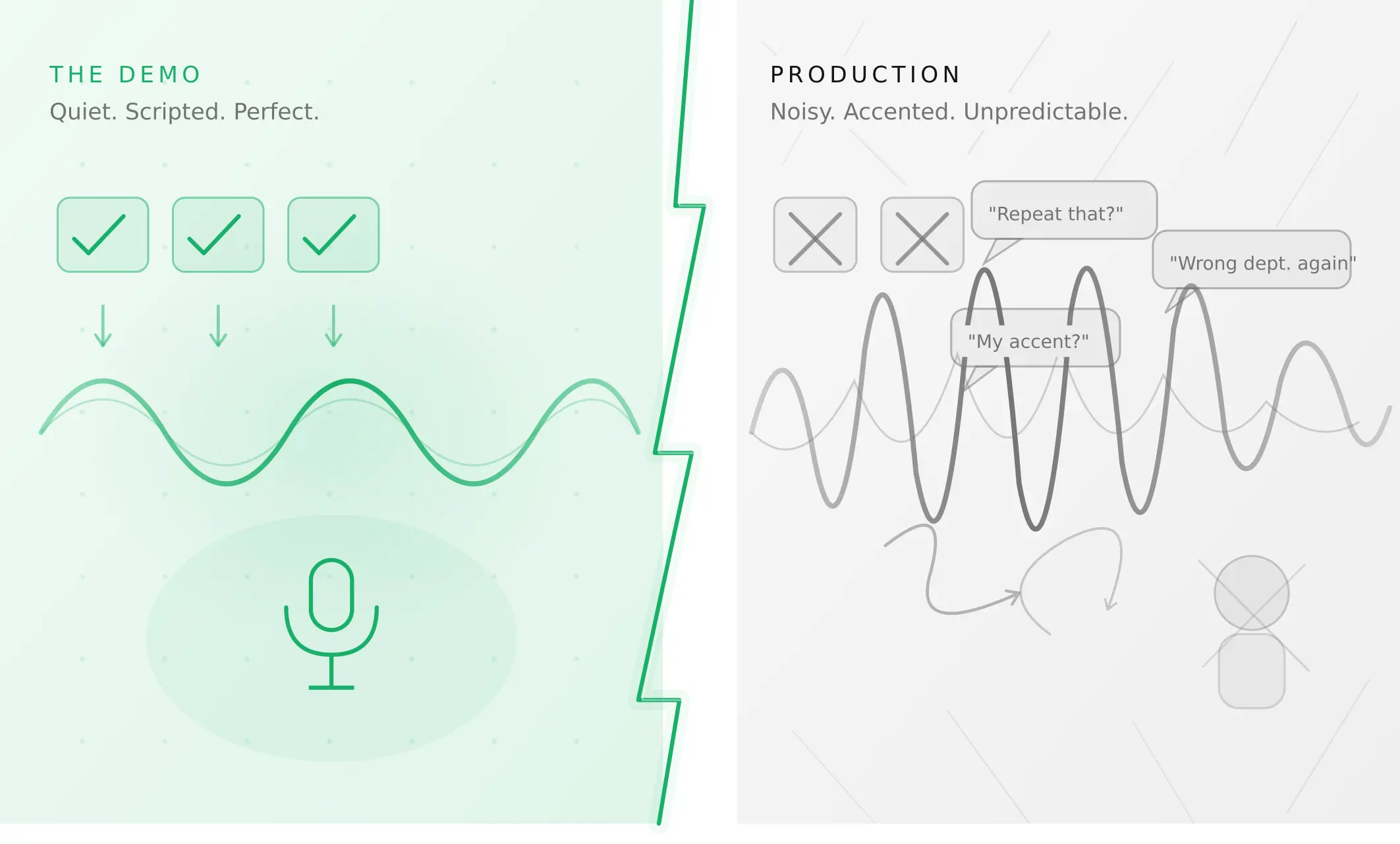
AI voice agents that ace demos still break in production. Learn the 5 root causes, how to test for each, and what production readiness actually means.
Read more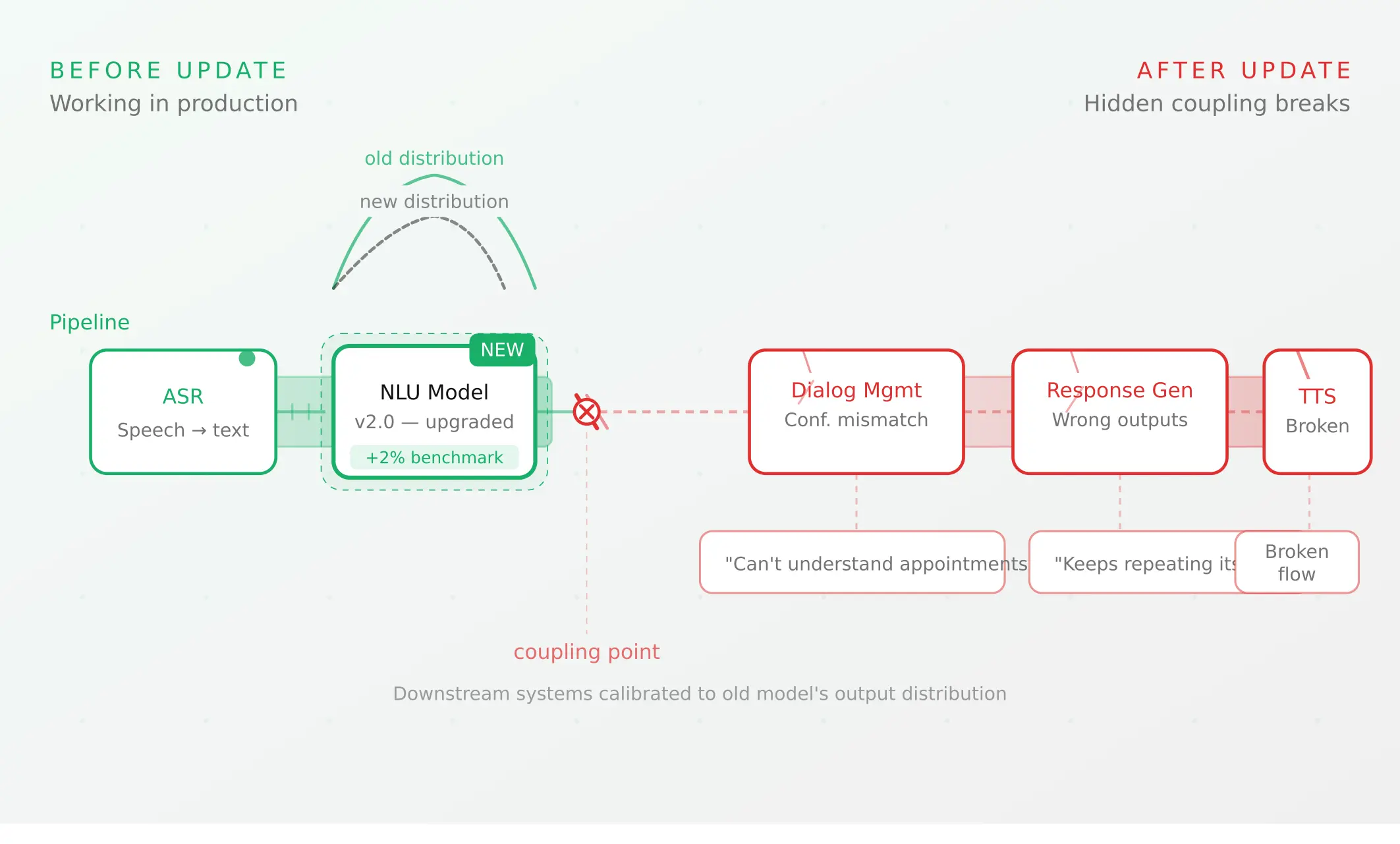
Voice agent regression testing: why LLM updates break production
LLM updates improve benchmarks but break voice agents in 5 predictable ways. How to detect and prevent regressions after every model or prompt change.
Read more