Open door for builders.
How to Evaluate a Survey Voice Agent Vendor
# How to evaluate a survey voice agent vendor
Quick answer
To evaluate survey voice agent vendor options, run your own instrument through each vendor and score data quality. Test scaled-answer capture, open-ended verbatim transcription, skip-logic fidelity, and non-leading neutrality. Check consent, opt-out, and TCPA compliance. Compare vendors on the same recorded calls, not on a demo.
A survey voice agent is not a support bot. Its job is to collect clean, unbiased data at scale. That reframes the whole evaluation. You are not buying a smooth conversation. You are buying a measurement instrument that happens to talk on the phone.
Most teams pick a survey vendor from a demo that runs one tidy interview. The respondent answers every question clearly and stays to the end. Your real sample will not behave that way. This guide shows how to evaluate a survey voice agent vendor on the data it actually captures. Treat the work as a phone survey voice agent evaluation, not a chatbot review. It builds on our voice agent vendor evaluation pillar, applied to automated phone surveys.
Why a survey voice agent is a data-quality problem
The output of a survey voice agent is a dataset. If the dataset is wrong, every downstream decision is wrong. So data quality is the core axis, not tone or charm.
Think about what can go wrong silently. A respondent says "four" and the agent logs a three. A respondent gives a long verbatim comment and the transcript garbles the key word. The agent nudges the answer with a leading phrase. Each of these produces numbers that look fine but mislead. Bad measurement is worse than no measurement, because it feels trustworthy.
> Survey voice agent: an AI phone agent that administers a structured questionnaire by voice and records each answer. It reads scripted items, captures scaled and open-ended responses, and follows the survey's branching rules.
Sound survey design is a mature discipline. The field of survey methodology has decades of rules about wording, order, and bias. A voice agent must honor those rules, not break them. When you evaluate survey voice agent vendor candidates, you are really asking one question. Does this vendor preserve the integrity of my instrument?
Whether you run a voice of customer voice agent or a broad market study, the automated phone survey ai must capture answers faithfully. There is also a mode effect to weigh. Answers collected by an AI voice differ subtly from answers collected by a human, a web form, or SMS. You cannot remove a mode effect, but you can measure it. Compare the agent's results against a known human-administered baseline on the same questions.
What to test in a survey voice agent vendor
A demo hides these behaviors. You have to force them with hard cases, then score what the agent records. Build a small instrument that includes every question type you use. Add noisy respondents, refusals, and edge answers on purpose.
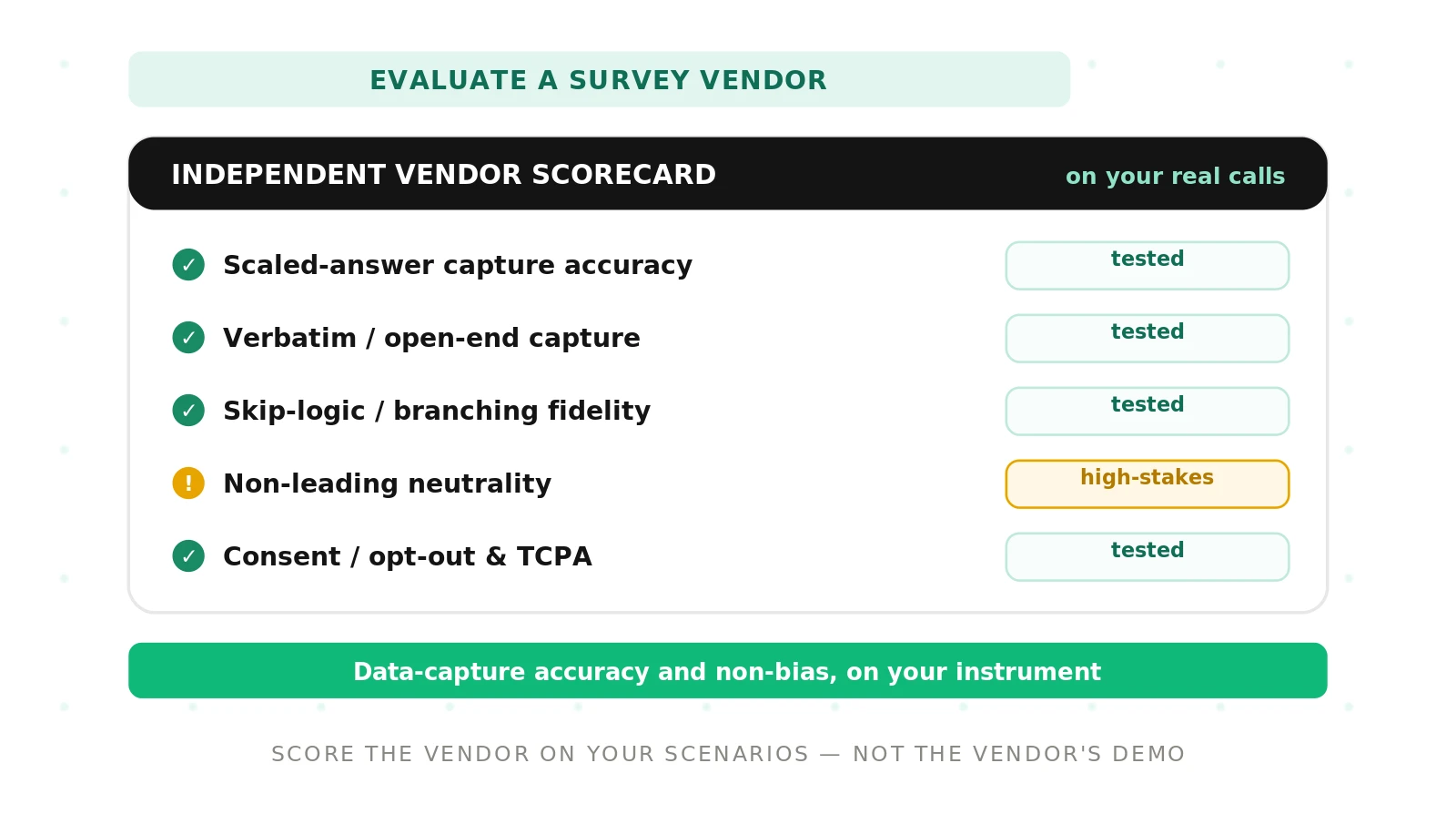
The table below is a starting rubric. It lists each data-quality dimension, what to test, a pass bar, and the red flag to watch. Set your own pass bars from your accuracy needs and your legal review.
| Dimension | What to test | Pass bar | Red flag |
|---|---|---|---|
| Scaled-answer capture accuracy | 1–5 Likert, 0–10 NPS, spoken and DTMF entry | 99%+ exact match to what the respondent said | Logs "4" as "3"; drops NPS "10"; rounds silently |
| Verbatim / open-end capture | Long comments, names, jargon, numbers, accents | 95%+ word accuracy; full comment retained | Truncates the comment; garbles the key term |
| Skip-logic / branching fidelity | Every branch path, including rare ones | Correct next question on 100% of tested paths | Asks a skipped question; strands a branch |
| Non-leading neutrality | Prompts, reprompts, and clarifications | No wording that nudges a specific answer | Adds "great, right?"; suggests a value |
| Consent / opt-out & TCPA | Recording notice, "no thanks," DNC state | Notice given; opt-out honored on first request | Records with no notice; ignores opt-out |
| Completion / response rate | Full sample, including partials and hang-ups | Response rate meets your target; partials logged | Pushes past refusals; miscounts completes |
Each row is a test you can script and repeat. What matters most is consistency. Every vendor faces the identical calls, scored by the same rubric. That is the difference between testing and evaluation: testing checks that features work, evaluation compares vendors on evidence.
Scaled-answer capture is the number that must be exact
Most survey value sits in the scaled items. A 1–5 Likert scale item or a 0–10 NPS rating rolls up into a headline metric. So capture must be near perfect. A one-point error on a five-point scale is a large error.
Test the boundaries. Say "five" clearly, then mumble it. Say "a four, maybe a five." Enter the number by keypad. Say "ten out of ten." Then read the stored value back against a transcript of the audio. Any mismatch is a defect, not a rounding choice.
Verbatim capture and transcription accuracy
Open-ended answers are where the "why" lives. They also expose the weakest link. Long comments, product names, and numbers stress the transcription engine. A garbled verbatim loses the one insight the question was meant to catch.
Test accented speech and domain jargon. Test a 30-second answer that runs past the agent's patience. Check that the full comment survives, not just the first clause. If you plan to run sentiment analysis on verbatims, weak transcription accuracy will corrupt those scores too.
Skip logic and branching must be exact
Surveys branch. A "no" on a screening question should skip a whole block. A high NPS score routes to a different follow-up than a low one. If the agent asks a question it should have skipped, your data has holes and contradictions.
Map every branch in your instrument. Then walk each path with a scripted respondent. Include the rare paths, since those break most often. A single stranded branch can invalidate a segment of your sample.
Neutrality: the agent must not lead the respondent
A leading question biases the whole dataset, so neutrality is not optional. Leading can be subtle. A reprompt like "so you were happy, right?" pushes the answer up. An enthusiastic "great!" after a positive reply trains the respondent to please the agent.
Listen to reprompts and clarifications, not just the scripted items. The agent should restate the scale neutrally. It should never suggest a value or react with approval to one answer over another. Neutral wording is a measurable property, so score it directly.
Consent, opt-out, and TCPA for outbound survey calls
Outbound survey calls are regulated. The FCC's rules under the TCPA govern autodialed and prerecorded calls, consent, calling windows, and opt-outs. A survey program that dials at the wrong hour or ignores a do-not-call request creates real legal exposure.
Test the compliance path directly. Confirm the recording notice plays before any answer is captured. Say "I don't want to take a survey" and check that the agent exits politely. Say "put me on your do-not-call list" and verify suppression. Consent and opt-out handling belong in your evaluation, not an afterthought. Frame this work against the NIST AI Risk Management Framework, which many buyers now cite in procurement.
Completion and response rate without being pushy
You want a high response rate), but not at any cost. A pushy agent that argues with refusers inflates completions while poisoning goodwill and data. The right target is a strong completion rate that still respects a "no."
Measure completes, partials, and break-offs separately. Test what the agent does when a respondent stalls or asks to stop. It should make one polite offer to continue, then honor the exit. Representative sampling also depends on who finishes, so uneven drop-off skews your results. Count a partial as a partial. Never let the agent recode a hang-up as a complete.
How to run a survey voice agent vendor evaluation
Use one repeatable process to evaluate survey voice agent vendor shortlists. The goal is an apples-to-apples comparison on your instrument, scored the same way each time.
1. Freeze your instrument. Lock the exact questionnaire, scales, and branching you will field. This is the shared test that every vendor must run.
2. Build a respondent scenario set. Script clear answers, noisy answers, refusals, opt-outs, wrong numbers, and at least one non-English respondent if you field multilingual surveys.
3. Define the pass bars. Set numeric thresholds for scaled-answer accuracy, verbatim word accuracy, branching correctness, and response rate before you test.
4. Run identical calls per vendor. Send every vendor the same scenarios and record all audio and transcripts. Keep call volume equal across vendors.
5. Score data quality against ground truth. Compare stored answers to the audio, not to the vendor's own logs. Have a second reviewer double-check a sample of scaled and open-end items.
6. Audit compliance and neutrality. Confirm the recording notice, opt-out handling, and calling windows. Flag any leading wording in reprompts.
7. Publish a scorecard. Put every vendor on one metrics scorecard with the same dimensions, so the decision is evidence, not vibes.
8. Recheck before launch and on changes. Re-run the evaluation when a vendor updates a model, since capture accuracy can drift.
This process fits any survey type: satisfaction tracking, voice-of-customer, market research, or post-call follow-up. Write the requirements into your RFP and your service-level agreement so the pass bars are contractual, not aspirational.
When a survey voice agent is the right fit, and when it is not
A survey voice agent fits high-volume, structured questionnaires with clear scales. Think post-transaction satisfaction, NPS tracking, or short screening calls. It works when the questions are stable and the branching is well defined.
It fits less well for long, exploratory interviews that need deep probing. It struggles with sensitive topics where a respondent wants a human. And it is risky for outbound work without solid consent records. Match the tool to the study, not the other way around.
For multilingual samples, test each language as its own instrument. Capture accuracy and neutrality can differ sharply by language. A vendor that scores well in English may lead or mistranscribe in Spanish. If a respondent needs a human, the agent should hand off cleanly, which our escalation guide covers.
Where independent evaluation fits
Vendors grade their own homework. Their dashboards report the numbers they choose to report. When the product is a measurement instrument, self-reported accuracy is a conflict of interest. Good survey voice agent vendor selection rests on evidence, not on a demo.
Evalgent is an independent, third-party evaluator for voice agents. We do not sell a survey agent, so we have no stake in which vendor you pick. We run your frozen instrument through each vendor and verify data-capture accuracy against the source audio. We check scaled-answer capture, verbatim transcription, skip-logic fidelity, and non-leading neutrality on the calls you will actually place. A trustworthy voice survey ai vendor should welcome that kind of independent scoring.
Independent scoring matters most on the parts vendors gloss over: silent capture errors, subtle leading, and opt-out handling. Our approach to independent voice AI evaluation is to score every dimension on shared, recorded scenarios. For teams tracking satisfaction, we align the survey scores with your customer support metrics so the numbers reconcile. Book a demo to see a survey vendor evaluation on your instrument.
Frequently asked questions
How do you evaluate a survey voice agent vendor?
Run your own frozen questionnaire through each vendor on identical, recorded calls. Score data quality: scaled-answer capture accuracy, open-ended verbatim transcription, skip-logic fidelity, and non-leading neutrality. Check consent, opt-out, and TCPA compliance. Compare vendors on a single scorecard against the source audio, never on a polished demo.
How do you test scaled answer capture in a voice agent?
Say each scale point clearly, then mumble it, then enter it by keypad. Include edge cases like "ten out of ten" and "a four, maybe five." Compare the stored value against a transcript of the audio. Any mismatch on a 1–5 or 0–10 scale is a defect, since one point is a large error.
What compliance rules apply to outbound survey calls?
Outbound survey calls fall under the FCC's TCPA rules, which govern autodialed and prerecorded calls, consent, calling windows, and opt-outs. Confirm a recording notice plays before capture. Honor do-not-call and opt-out requests immediately. Have legal review your consent records and calling hours before any vendor dials a live sample.
How do you measure survey completion rate for a voice agent?
Count completes, partials, and break-offs as separate categories. Divide completes by eligible contacts reached, using a consistent response-rate definition across vendors. Watch for a pushy agent that inflates completes by arguing with refusers. A strong response rate that still honors a "no" beats a higher rate built on pressure.
How do you test skip logic in a survey voice agent?
Map every branch in your instrument, including rare paths. Script a respondent for each path and walk it end to end. Confirm the agent asks only the questions that path allows and skips the rest. A stranded branch or a question that should have been skipped invalidates part of your sample, so treat any error as blocking.
How do you check a survey voice agent for leading questions?
Review the reprompts and clarifications, not just the scripted items. The agent should restate the scale in neutral words. It must not suggest a value, react with approval to one answer, or add phrases like "so you were happy, right?" Score neutrality as a measurable property on every prompt, since subtle leading biases the whole dataset.
How should a survey voice agent handle opt-out requests?
The agent should exit politely on the first clear refusal or opt-out. Test "I don't want to take a survey" and "put me on your do-not-call list." It should confirm suppression and end without pressure. One polite offer to continue is acceptable; arguing, looping, or re-dialing a do-not-call number is a compliance failure.
How do you handle multilingual respondents in a survey voice agent?
Treat each language as its own instrument and evaluate it separately. Capture accuracy, transcription quality, and neutrality can differ sharply by language. A vendor strong in English may mistranscribe or lead in Spanish. Test scaled and open-ended items in every supported language, and verify the recording notice and opt-out wording are correct in each.
The bottom line
When you evaluate survey voice agent vendor options, judge data quality first, because a survey voice agent is a measurement instrument and not a chatbot. Score scaled-answer capture, verbatim transcription, skip-logic fidelity, neutrality, and consent handling on your own instrument across identical recorded calls, then compare vendors against the source audio.
Related Articles
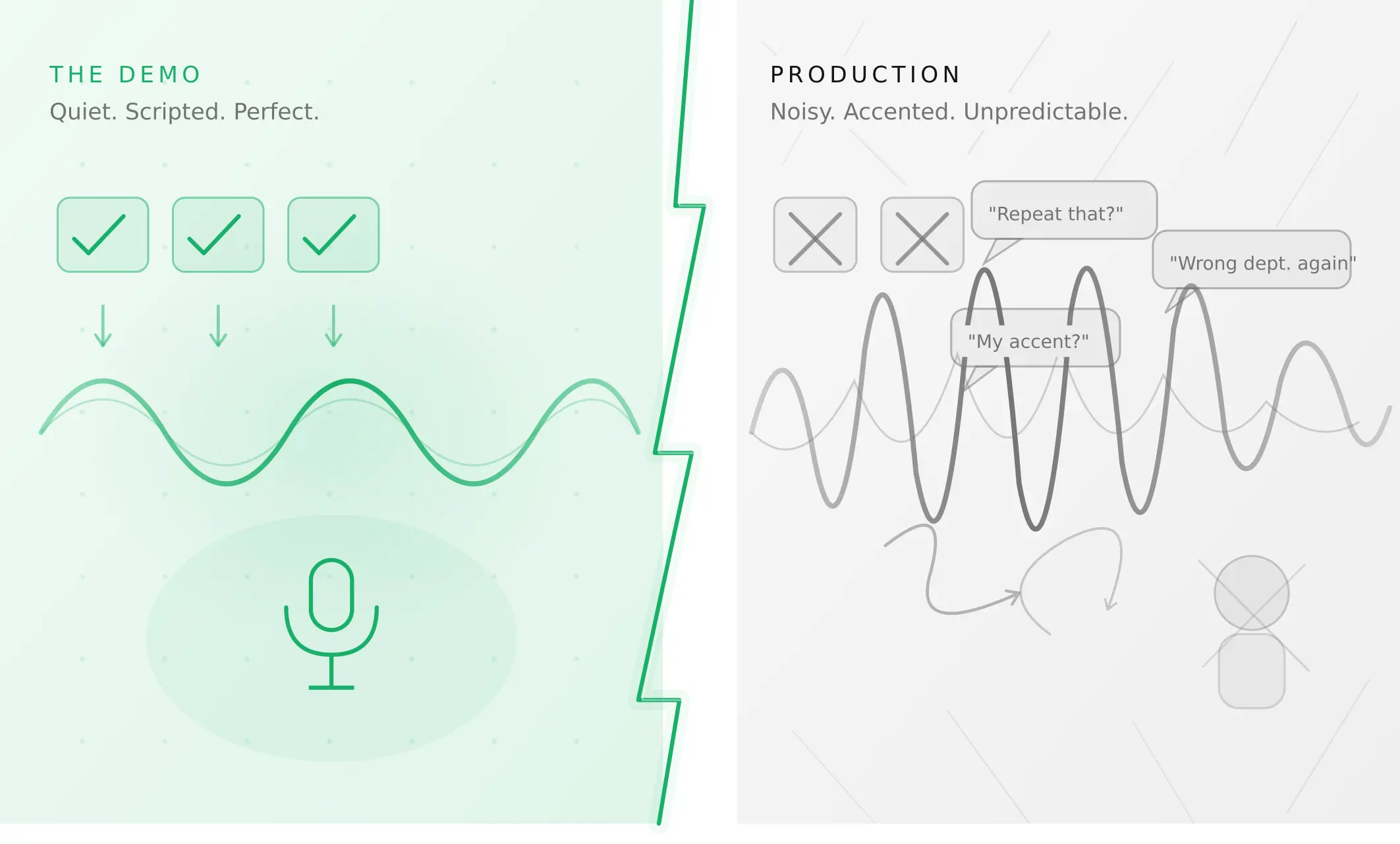
Why AI voice agents fail in production (and how to prevent it)
AI voice agents that ace demos still break in production. Learn the 5 root causes, how to test for each, and what production readiness actually means.
Read more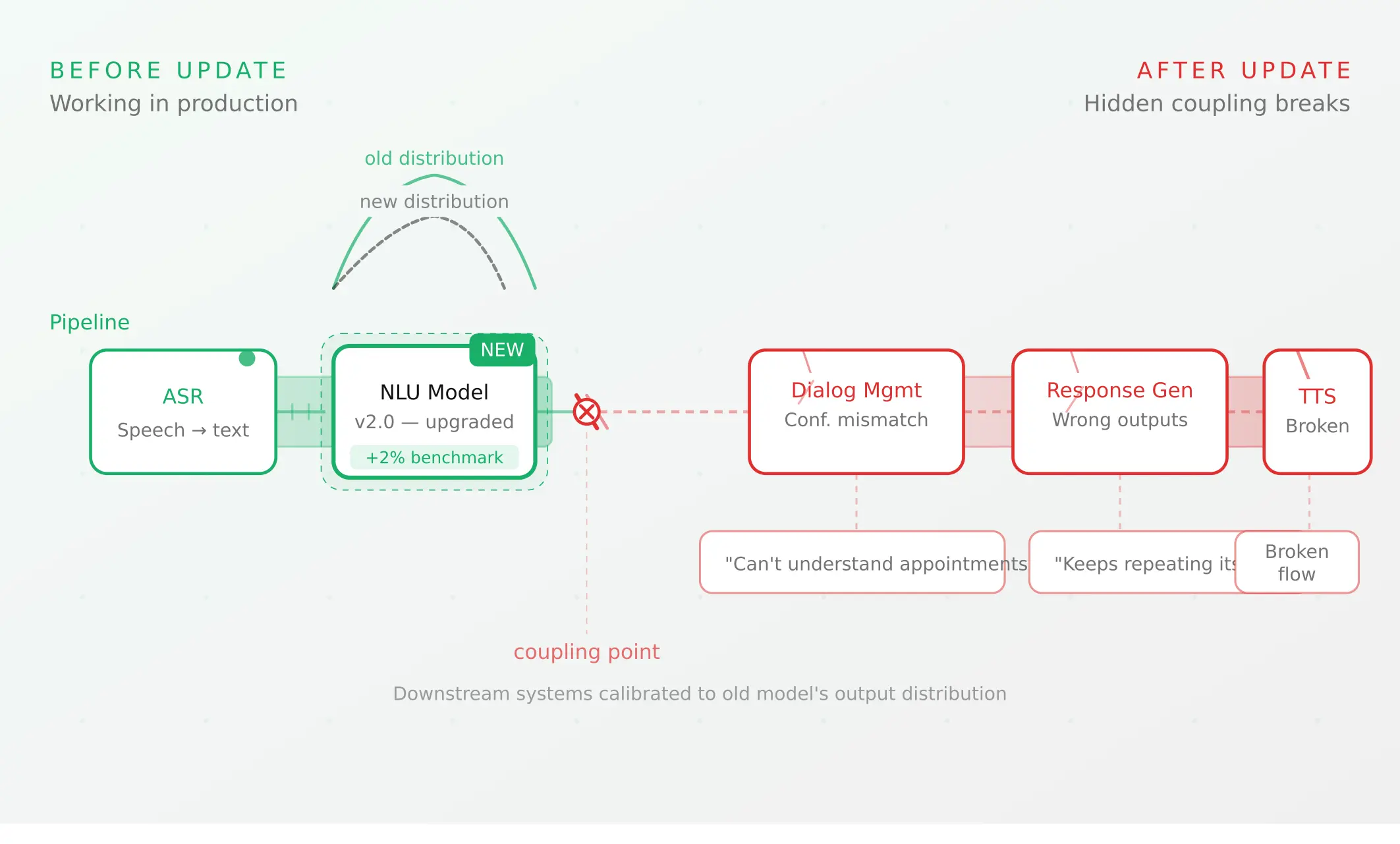
Voice agent regression testing: why LLM updates break production
LLM updates improve benchmarks but break voice agents in 5 predictable ways. How to detect and prevent regressions after every model or prompt change.
Read more