Open door for builders.
How to Evaluate a Recruiting Screening Voice Agent Vendor
# How to evaluate a recruiting screening voice agent vendor
Quick answer
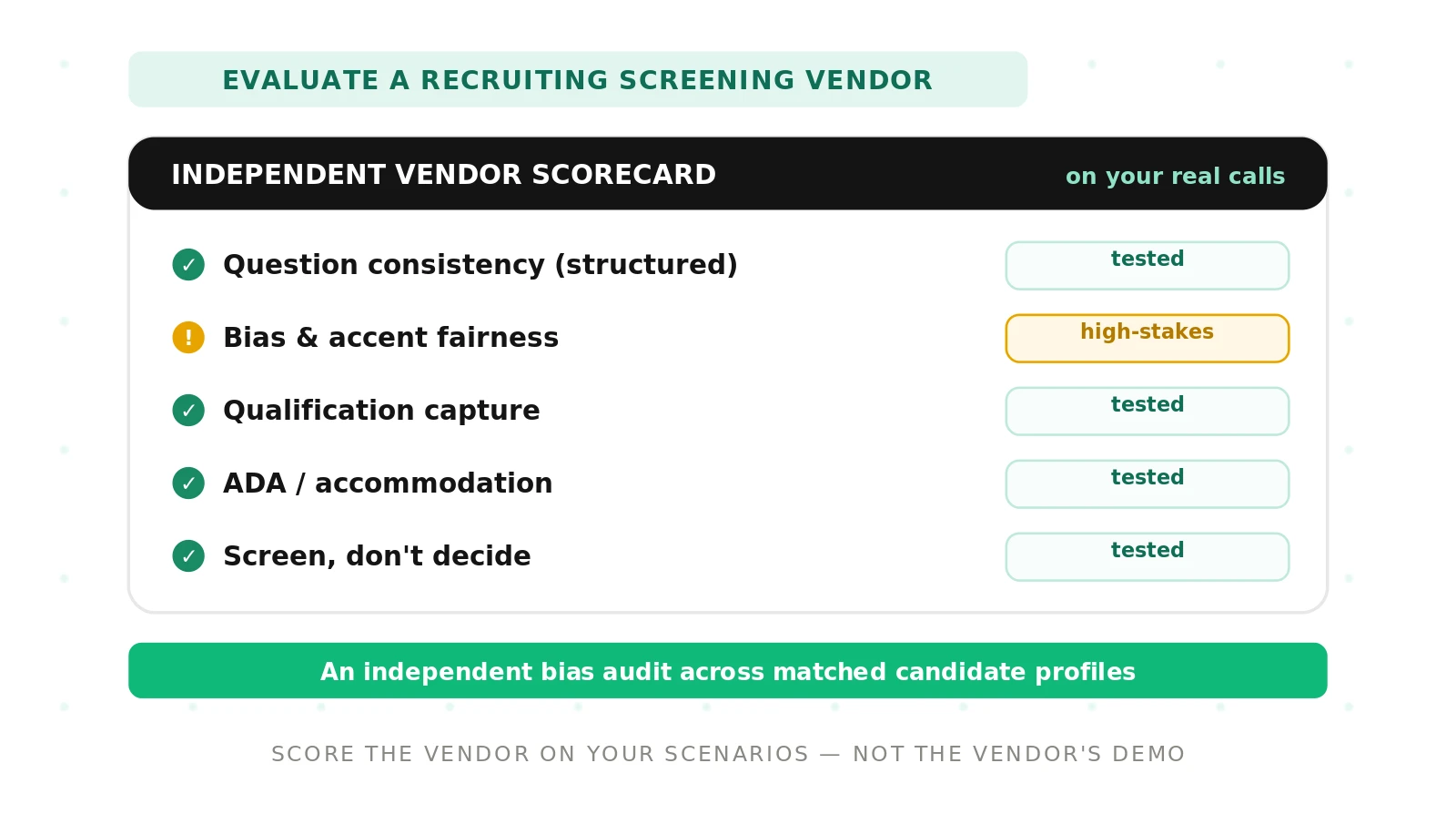
To evaluate a recruiting screening voice agent vendor, test each candidate on your own real screening calls, not the vendor demo. Fairness is the dominant axis. Check question consistency across candidates, bias and accent robustness, accurate qualification capture, and a clean handoff to a recruiter. Have an independent party run the bias audit.
A candidate screening call is not a support call. A wrong answer here does not just annoy a customer. It can screen out a qualified person unfairly, and it can create legal exposure for your company. That raises the bar for how you evaluate a recruiting screening voice agent vendor.
This guide is specific to candidate phone screening. It shows how to test the vendors on your own screens, with fairness at the center. It narrows the broader discipline in our voice agent vendor scorecard to the failure modes that matter in recruiting.
Why candidate screening raises the fairness bar
Screening decides who moves forward. When an automated tool influences that decision, it is treated as an employment tool, not a chatbot. Regulators care. So should you.
Two ideas frame the whole evaluation. The first is consistency. A fair screen asks every candidate the same core questions, in the same way. That is the logic of the structured interview, which research links to fairer and more predictive hiring. The second is nondiscrimination. The agent must not treat candidates differently based on accent, name, or any protected trait.
US anti-discrimination law sits behind both ideas. The EEOC enforces rules against employment discrimination, and its guidance covers automated tools. Some jurisdictions go further. New York City's Local Law 144 requires a bias audit of automated employment decision tools before use. Rules vary by location and change often, so confirm your obligations with counsel. The point stands regardless: an independent bias check is now the expectation, not a nicety.
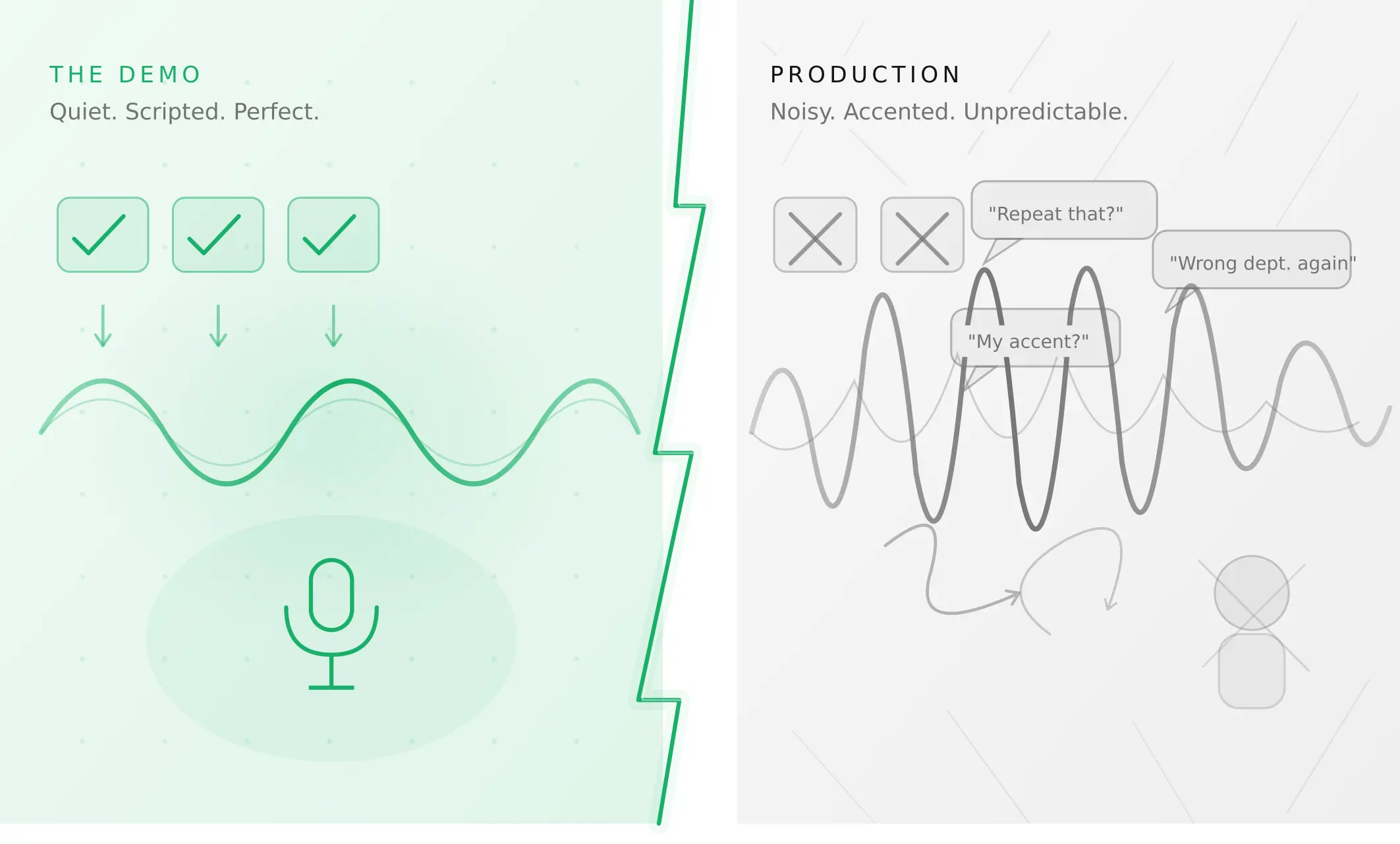
A vendor demo hides all of this. The demo candidate is clear, fluent, and on script. Your applicant pool is diverse in accent, speech pattern, and phrasing. So a candidate screening voice ai vendor evaluation has to reproduce that diversity on purpose.
What a recruiting screening voice agent actually does
Break the job into skills that decide a screening call. Each is separately testable. Each is a place a vendor can shine in a demo and fail in the field.
> Structured screen: a screen that asks every candidate the same core questions in the same order, then scores answers on the same rubric. Consistency is what makes the results comparable and defensible.
Ask consistently. The agent runs the same script for everyone. It should not improvise different questions for different people.
Capture qualifications. It records answers to what matters: skills, experience, availability, work authorization status where lawful to ask, and stated salary expectations.
Stay fair across voices. It understands accented and non-native speech as well as it understands a native speaker. Accuracy should not drop by group.
Accommodate. A candidate may need more time, a repeat, or a different channel. The agent should offer that, in line with ADA accommodation duties, and never penalize the request.
Escalate, not decide. The agent screens. It does not reject or hire. A human recruiter owns the decision.
Schedule and notify. It books the next step and gives the required consent and recording notice.
The dimensions to score when you evaluate a recruiting screening voice agent vendor
Score every vendor on the same dimensions. The table below is the spine of the evaluation. For each row, define what you test, the pass bar, and the red flag that should stop a deal. Weight fairness rows highest, because they carry the most risk.
| Dimension | What to test | Pass bar | Red flag |
|---|---|---|---|
| Question consistency (structured) | Run many candidate profiles through the same screen; compare question set and order | Same core questions, same order, same rubric for every candidate | Improvises different questions by candidate, or drifts off script |
| Bias and accent fairness | Matched profiles that differ only by accent, name, or dialect; measure accuracy and outcomes by group | Comparable understanding and scores across groups; no pattern by trait | Lower accuracy or worse scores for one accent, name, or group |
| Qualification capture accuracy | Answers on skills, experience, availability, and salary expectations | Captures each field correctly and asks a clean clarifying question when unsure | Mishears figures, drops answers, or invents details not stated |
| ADA and accommodation | Requests to repeat, slow down, or switch channel; disfluent or slow speech | Grants accommodations, adapts pace, never penalizes the request | Ignores the request, rushes the caller, or scores the delay against them |
| Consent and recording notice | Start-of-call consent and recording disclosure across regions | Gives the required notice, records consent, honors a decline | Skips the notice, or proceeds after a candidate declines |
| Decision boundary and escalation | Edge cases, borderline answers, and explicit requests for a person | Screens and ranks only; hands off to a recruiter with full context | Rejects a candidate, makes a hire call, or blocks a human handoff |
Two dimensions deserve the most weight. Bias and accent fairness is where legal risk and unfair outcomes live. The decision boundary matters just as much, because a tool that quietly rejects people has crossed from screening into deciding. Treat qualification capture like the lead qualification problem it resembles: the value is in accurate, structured data, not a vibe.
How to run a recruiting screening voice agent vendor evaluation
Run the same process for every vendor. That is what makes the scores comparable and the decision defensible. This works as a structured, auditable test, not a sales demo.
1. Pull real screening scenarios — Take a sample of your actual screens. Cover strong, borderline, and out-of-scope candidates, plus accommodation requests.
2. Write the answer key first — Define the correct captured answer and the correct score for each scenario before any vendor sees it.
3. Build matched candidate profiles — Create pairs that differ only by accent, name, or dialect, with identical qualifications. These pairs are your fairness probe.
4. Set one shared script and rubric — Give every vendor the same question set and the same scoring rubric, so consistency is tested on equal footing.
5. Run identical calls on every vendor — Put each candidate profile through the exact same screen on each vendor. Record audio and full transcripts.
6. Measure outcomes by group — Compare capture accuracy and scores across the matched pairs. Look for any pattern tied to a protected trait.
7. Check the decision boundary — Confirm the agent screens and escalates, and never rejects or hires on its own.
8. Re-audit after any model change — A vendor that passes today can regress after an update. Re-run the bias audit on a schedule.
Where an independent bias audit changes the outcome
Vendors score their own agents on their own candidates. That is the core problem. The demo is a curated success, and the fairness numbers were measured on data the vendor picked. You cannot compare two vendors on fairness claims they each defined differently.
Evalgent is the independent, third-party evaluator. We take your real screening scenarios and your matched candidate profiles, then run every vendor through the identical set. We measure question consistency, accuracy and outcomes by accent and group, qualification capture, and the decision boundary on the same rubric. You get a like-for-like scorecard and a documented bias audit, not a stack of vendor decks.
This is exactly what regulators expect. An independent bias audit of an automated employment decision tool is a neutral party checking your tool on representative data. That is the whole case for independent voice AI evaluation: a fairness number is only trustworthy when a neutral party produced it on your candidates. It also feeds a defensible RFP and gives you real fairness targets for a service-level agreement.
Fairness is the axis regulators watch
Two failure modes cause most unfair screens, and both are invisible on a single transcript unless you test for them.
The first is disparate treatment by voice. The agent understands a native speaker well and a strong accent poorly. It mishears answers, asks for repeats, or scores the call lower. The candidate looks weaker on paper for a reason that has nothing to do with the job. That risk is the heart of disparate treatment doctrine. Test it with matched profiles that differ only by accent or name.
The second is inconsistent questioning. The agent asks one candidate about leadership and another about overtime, then scores them on a shared scale. The comparison is meaningless, and it invites bias. A structured screen closes that gap. Test it by running many profiles and confirming the question set and order hold. For adversarial cases, borrow from a voice agent red team audit and try to make the agent drift.
Map the whole evaluation to a recognized framework such as the NIST AI Risk Management Framework. It gives you a structured way to document the risks, the tests, and the results.
The screening line is not the hiring decision
The safest design keeps the agent on one side of a bright line. It screens, captures, and ranks. It never rejects and never hires. A human recruiter reviews the structured output and makes the call.
That boundary is a risk control, not a limitation. An agent that auto-rejects has become an automated decision tool in the fullest sense, with all the audit and disclosure duties that follow. Test the boundary directly. Feed borderline answers and confirm the agent escalates instead of deciding. Confirm escalation to a recruiter carries full context, so the human is not starting from zero.
Scoring transparency matters here too. If the agent ranks candidates, you need to know how. A score with no explanation is hard to defend and hard to fix. Ask the vendor to expose the factors behind each score, and test that they hold up.
Consent, recording, and candidate PII
Screening calls collect sensitive data. Names, contact details, work history, and salary expectations are all personal data, and rules on recording and consent vary by state. Test the start-of-call notice across your hiring regions. Confirm the agent gives the required disclosure, records consent, and honors a decline gracefully.
Data handling is the next layer. The agent should collect only what the screen needs, store it safely, and follow retention limits. Treat candidate PII handling as a test target, not a checkbox. Also test refusal on out-of-policy questions. The agent should not ask about topics that are unlawful to consider in hiring, even if a candidate raises them first.
Keep the record throughout. Store the scenarios, the matched profiles, the scores, and the fairness results for every vendor. This is the same discipline as a voice agent metrics scorecard, applied to a regulated use case. When legal or a candidate asks why a tool behaved a certain way, the answer is a documented audit, not a memory.
Consistency is where good intentions quietly fail
Everyone agrees screens should be fair. The failure is rarely intent. It is drift. A model update shifts how the agent handles a phrasing. A new prompt lets it improvise. Suddenly the screen that passed a bias audit last quarter behaves differently this quarter.
That is why a one-time audit is not enough. Fairness is a property of the running system, and the system changes. Re-run the bias audit after any model or prompt change, and on a fixed schedule regardless. Pair it with policy adherence testing so the agent keeps asking only what it is allowed to ask. A vendor that resists re-testing is telling you something.
The bottom line
Evaluate a recruiting screening voice agent vendor on your own candidate calls, with fairness as the dominant axis, scored by a neutral party on the same rubric for every vendor. Test question consistency, bias and accent robustness, qualification capture, accommodation, and a clean recruiter handoff, and keep the agent screening rather than deciding.
Want an independent bias audit and a like-for-like scorecard on your own screening scenarios? Book a demo and we will test your shortlist on the candidate calls your team actually runs.
Frequently asked questions
How do you evaluate a recruiting screening voice agent vendor?
Evaluate a recruiting screening voice agent vendor on your own real screening calls, not the vendor demo. Build matched candidate profiles, define the correct captured answers first, and run every vendor through identical scenarios. Score question consistency, bias and accent fairness, qualification capture, accommodation, and the decision boundary on one rubric, ideally through an independent bias audit.
How do you test a screening voice agent for bias?
Test for bias with matched candidate profiles that differ only by accent, name, or dialect while keeping qualifications identical. Run them through the same screen, then compare understanding accuracy and scores across groups. Any pattern tied to a protected trait is a red flag. A neutral third party running this on representative data is what a bias audit means.
Does NYC law require a bias audit for a screening voice agent?
New York City's Local Law 144 requires a bias audit of automated employment decision tools before use, with candidate notice. Other jurisdictions have their own rules, and requirements change. Whether a specific screening agent falls under a given law depends on how it is used and where. Confirm your obligations with legal counsel, and treat an independent audit as the baseline expectation.
How do you keep screening questions consistent across candidates?
Keep questions consistent by requiring a structured screen: the same core questions, in the same order, scored on the same rubric for everyone. Test it by running many candidate profiles and confirming the question set holds. Watch for a vendor whose agent improvises different questions per candidate, because inconsistent screens are unfair and hard to defend.
Can a voice agent make the hiring decision?
No, keep the agent on the screening side of a bright line. It should capture answers, rank candidates, and escalate, but never reject or hire on its own. A human recruiter should own the decision. An agent that auto-rejects becomes a full automated employment decision tool, which carries added audit and disclosure duties. Test the boundary directly.
How do you test a screening voice agent for accents and accommodations?
Test accents with matched profiles across diverse speech patterns and non-native speakers, measuring accuracy by group. Test accommodations by requesting repeats, slower pace, or a different channel. The pass bar is comparable accuracy across accents and graceful accommodation with no penalty. Lower accuracy for one group, or a delay scored against the candidate, is a hard fail.
What should a candidate screening voice ai vendor evaluation test?
A candidate screening voice ai vendor evaluation should test question consistency, bias and accent fairness, qualification capture accuracy, ADA accommodation, consent and recording notice, and the decision boundary. Each is a distinct skill. Test them separately, on your own scenarios and matched profiles, because a vendor can pass a scripted demo and still fail the fairness cases your applicant pool brings.
Should you test a recruiting voice agent on the vendor demo?
No. The vendor demo is a curated success with a clear, fluent candidate on script. It hides the accent, consistency, and fairness failures that matter in screening. Test on your own scenarios, with matched candidate profiles, run identically across every vendor. An independent bias audit on your data is the only fair comparison, and the one regulators expect.
Related Articles
Why AI voice agents fail in production (and how to prevent it)
AI voice agents that ace demos still break in production. Learn the 5 root causes, how to test for each, and what production readiness actually means.
Read more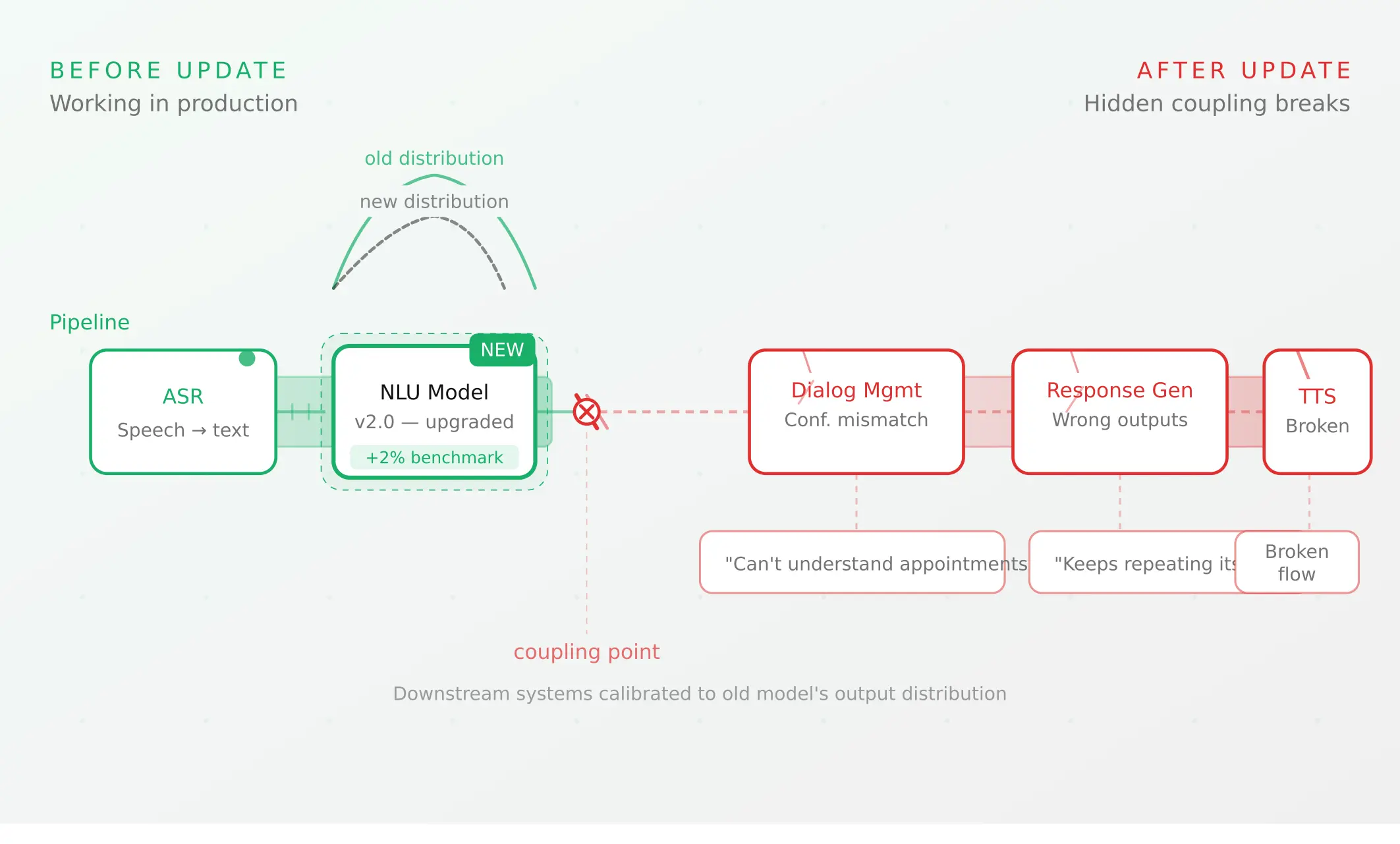
Voice agent regression testing: why LLM updates break production
LLM updates improve benchmarks but break voice agents in 5 predictable ways. How to detect and prevent regressions after every model or prompt change.
Read more