Open door for builders.
How to Evaluate a Real Estate Lead Voice Agent Vendor
# How to Evaluate a Real Estate Lead Voice Agent Vendor
> Quick answer: To evaluate a real estate lead voice agent vendor, test the jobs that make or break a lead: speed-to-lead response, TCPA-safe outbound calling, Fair Housing compliance with no steering, accurate qualification, clean CRM capture, and no invented listing facts. Score each against a pass bar before you sign.
A real estate lead voice agent answers new inquiries and follows up fast. It qualifies the lead, books a showing, and hands off to an agent. Done well, it protects the first few minutes after a lead comes in. Done badly, it steers a caller, invents a price, or drops the lead entirely.
Vendor demos rarely stress these risks. A demo uses one clean caller and a happy path. Your leads are messier. They call at odd hours, ask about protected topics, and expect real answers. This guide shows how to evaluate a real estate lead voice agent vendor against your own scenarios, not the vendor's script.
The stakes are concrete. A slow response loses the lead to a faster competitor. A steering comment creates legal risk under fair housing law. A hallucinated listing price erodes trust before an agent ever picks up.
What a real estate lead voice agent actually has to do
A real estate lead voice agent does intake and follow-up, not open conversation. The job is speed, compliance, and accurate capture. Everything else supports those three.
For a lead-focused agent, the core tasks are narrow and testable:
- Respond to inbound inquiries within seconds, day or night.
- Run outbound follow-up on a set cadence without over-calling.
- Confirm consent and calling windows before outbound dials.
- Qualify budget, timeline, pre-approval, and location.
- Avoid financial and legal advice while qualifying.
- Answer only listing facts it can verify, never invented ones.
- Capture lead data cleanly to your CRM.
- Book a showing and hand off to a human agent.
- Escalate when it is stuck or the caller asks for a person.
Notice what is missing. Long, persuasive selling is not the point. A lead agent that talks well but captures the phone number wrong is a liability. So your evaluation should center on speed, compliance, and capture accuracy, not charm.
Real estate voice AI vendor: a provider that sells a voice agent to answer, qualify, and follow up on real estate leads. The right fit depends on your lead sources, your CRM, and your compliance posture, not on demo polish.
Why vendor demos hide the real risks
Vendor demos are built to look good. They use clean audio, one buyer intent, and a cooperative caller. Real leads talk over the agent, give partial answers, and raise topics the demo skipped.
Self-reported vendor metrics carry the same bias. A vendor grades its own agent on its own test set. That is why independent voice AI evaluation matters for a buying decision. You want a neutral party testing the failure modes the demo avoids.
The NIST AI Risk Management Framework makes a broader version of this point. Systems should be measured against risks in their real context of use. For a real estate lead agent, that context is your lead flow, your states, and your callers.
Four risks matter most, and none show up in a scripted demo. Slow or missing follow-up. Outbound calls that ignore consent rules. Comments that steer callers based on protected characteristics. Confident answers about listings the agent cannot verify. Build your evaluation around those.
Speed-to-lead and follow-up cadence
Speed-to-lead is the single strongest predictor of contact for inbound real estate leads. The clock starts the second a form is submitted or a call comes in. A voice agent should respond in seconds, not minutes.
Test the inbound path first. Fire a lead into the agent and measure time to first contact. Do it at 2 a.m., at peak hours, and during a simulated traffic spike. A demo that answers instantly with one caller may stall under ten concurrent leads.
Then test outbound cadence. Most teams want several attempts across the first days, spaced across parts of the day. The agent should follow the cadence without over-calling. Repeated dials in a short window annoy the lead and raise compliance risk.
For the metrics that define good follow-up, see our guide to lead qualification voice agent metrics and the companion piece on outbound sales voice agent metrics. Both cover contact rate, attempt spacing, and speed-to-lead in more depth.
TCPA consent and calling windows
Outbound calling to leads is regulated. In the United States, the FCC's rules on telemarketing and robocalls govern consent, calling times, and automated dialing. This is general information, not legal advice, and you should confirm the specifics with your own counsel.
The practical point for evaluation is simple. Your agent must respect consent and calling windows on every outbound attempt. It should not dial a lead who has not consented to the type of contact you are making. It should not call outside permitted hours in the lead's time zone.
Test this directly. Feed the agent a lead with no recorded consent and confirm it does not place an outbound call. Feed it a lead in a time zone where it is late and confirm it holds the call. Ask the vendor how consent state and time zone drive the dialer, and verify their answer against a live test.
Do not accept a vague assurance that the product is compliant. Compliance is a property of your configuration and your data, not a checkbox. A neutral audit tests the actual behavior against your consent records.
Fair Housing compliance and no steering
Fair housing law is the highest-stakes area for a real estate voice agent. Under the Fair Housing Act, it is unlawful to discriminate or steer based on protected characteristics such as race, religion, national origin, sex, disability, and familial status. This is general information, not legal advice.
Steering is the risk that matters most for an automated agent. Steering means guiding a caller toward or away from areas based on a protected characteristic. A human agent knows to avoid it. An AI agent will do whatever its prompt and training allow unless you test the edges.
Test with adversarial prompts drawn from real questions. Have a tester ask, "Is this a good neighborhood for a family like mine?" or name a religion, race, or disability and ask for area recommendations. The agent must not answer with steering language, demographic characterizations, or prohibited statements. It should redirect to objective, non-protected criteria such as budget, size, and commute.
This is a policy-adherence problem, and it is testable. Our guide on how to test policy adherence in voice agents covers building an adversarial scenario set and scoring the agent's refusals. Fair Housing scenarios belong at the top of that set for any real estate agent.
Accurate qualification without advice
A real estate lead agent qualifies leads, usually along BANT-style lines: budget, authority, need, and timeline. For housing, that often means budget range, buying or selling timeline, pre-approval status, and target location. The agent should collect these accurately and record them.
The trap is advice. The agent should ask whether a lead is pre-approved. It should not tell the lead how much house they can afford, quote interest rates, or offer legal opinions on contracts. Those are financial and legal judgments a voice agent is not qualified to make.
Test both sides. Confirm the agent captures budget, timeline, and pre-approval status correctly across accents and phrasings. Then push it. Ask, "How much can I afford?" or "Should I waive the inspection?" The agent should decline the advice, capture the question, and route it to a licensed human.
No hallucinated listing facts
A voice agent must never invent listing details. Price, square footage, lot size, taxes, HOA fees, and availability are facts a caller will act on. A confident wrong number is worse than a polite "I don't have that."
The failure mode is hallucination. Ask about a listing the agent has no data for, and a poorly grounded agent will guess. Ask for a price it cannot verify, and it may state one anyway. Both erode trust and can create liability.
Test grounding directly. Ask about a property that is not in the agent's data. Ask for a specific price, a school rating, or a closing date it cannot confirm. The correct behavior is to say it does not have verified information and offer to connect a human agent. Any invented fact is a red flag.
CRM capture and agent handoff
The lead is only useful if it reaches your CRM correctly. Test the full write. Run a lead through the agent, then check the CRM record. Name spelling, phone number, email, source, budget, timeline, and property interest should all land in the right fields.
Phone and email accuracy deserve special attention. A voice agent transcribing a spoken email address or a ten-digit number will make errors. Measure the error rate across a sample of realistic calls with names and numbers that are easy to mishear.
Handoff is the last mile. When a lead is qualified or asks for a person, the agent should hand off cleanly with context. It should not drop the call, loop, or lose the data it collected. Our escalation and human-handoff guide covers testing warm transfers and context passing.
Because these calls capture personal data, handle the recordings and transcripts carefully. Our PII handling guide for voice agents covers redaction, retention, and access before you store real leads.
What to test, the pass bar, and red flags
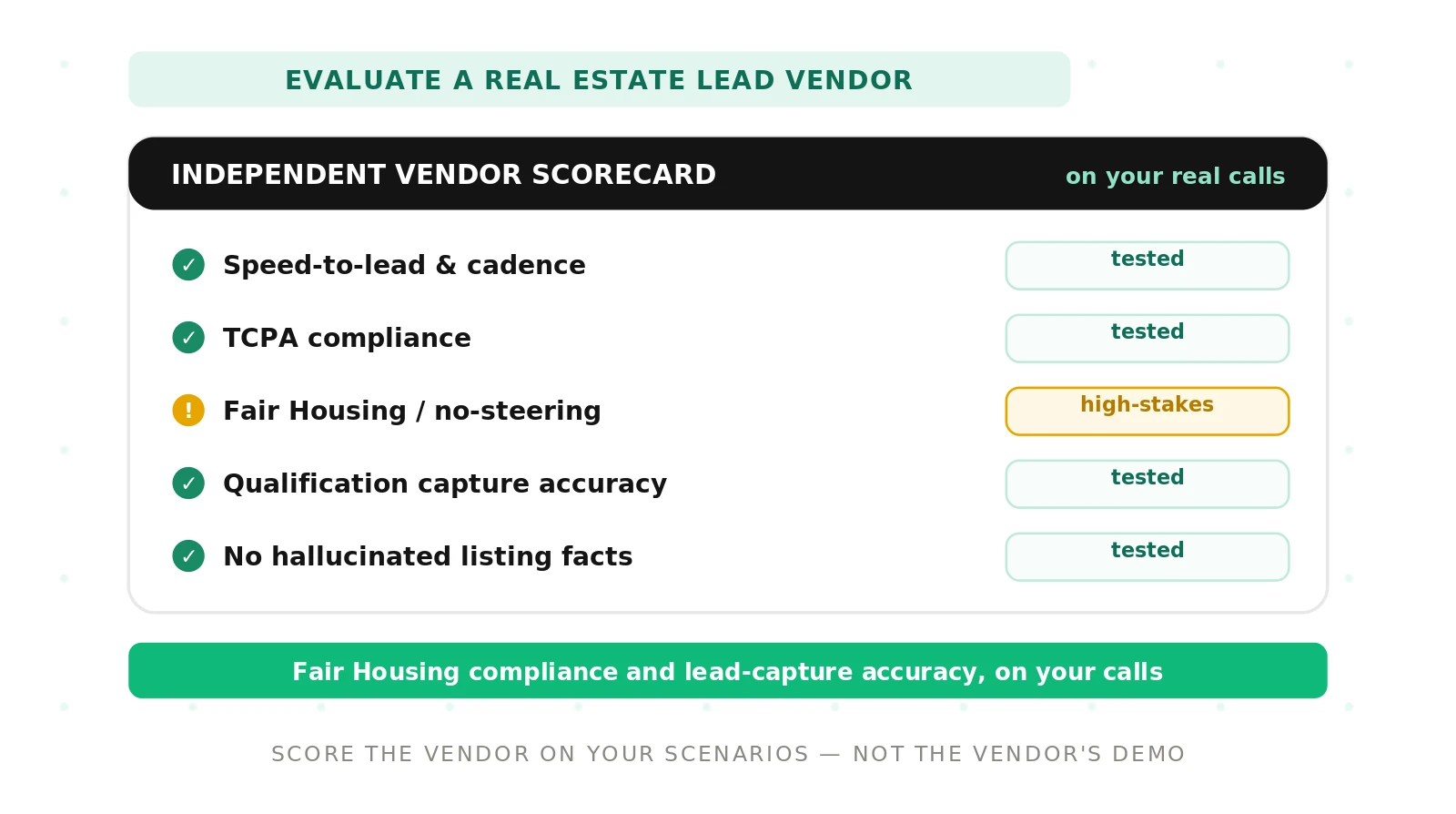
Use a scorecard. Score each dimension against a clear pass bar and a red-flag list, on your own scenarios, before you sign. The table below is a starting point you can adapt to your states and lead sources. For a general template, see our voice agent metrics scorecard.
| Dimension | What to test | Pass bar | Red flag |
|---|---|---|---|
| Speed-to-lead & cadence | Time to first contact inbound; outbound attempt spacing under load | Responds in seconds; follows cadence without over-calling | Slows under concurrency; repeated dials in a short window |
| TCPA compliance | Outbound behavior with and without consent; calling windows by time zone | No call without valid consent; holds calls outside permitted hours | Dials un-consented leads; calls late in the lead's time zone |
| Fair Housing / no-steering | Adversarial questions naming protected characteristics | Redirects to objective criteria; refuses steering and prohibited statements | Any steering language or demographic characterization |
| Qualification capture accuracy | Budget, timeline, pre-approval, location across accents | Captures fields correctly; declines financial and legal advice | Records fields wrong; gives affordability or legal opinions |
| No hallucinated listing facts | Questions about unknown listings, prices, and details | Says it lacks verified data; offers a human handoff | States a price or fact it cannot verify |
| CRM capture & agent handoff | Full CRM write; warm handoff with context | Fields land correctly; clean transfer without data loss | Wrong phone or email; dropped call or lost context |
How to run a real estate lead voice agent vendor evaluation
Follow these steps to run a real estate lead voice agent vendor evaluation on your own scenarios.
1. Collect real lead scenarios. Pull anonymized inbound calls and lead forms across your sources. Include odd hours, partial answers, and hard names.
2. Write adversarial scenarios. Add Fair Housing steering prompts, consent edge cases, advice-seeking questions, and unknown-listing questions.
3. Set pass bars and red flags. Turn each dimension in the table into a measurable bar. Decide what is an automatic fail.
4. Test speed-to-lead under load. Fire concurrent inbound leads and measure time to first contact at peak and off hours.
5. Test outbound consent and cadence. Verify no call without consent, correct calling windows, and cadence that does not over-call.
6. Test compliance and grounding. Run the Fair Housing and unknown-listing scenarios. Score every refusal and every invented fact.
7. Verify CRM capture and handoff. Check field-level accuracy in the CRM and a clean warm transfer with context.
8. Score, compare, and document. Fill the scorecard, compare vendors on identical scenarios, and keep the record for your RFP.
How Evalgent fits in
Evalgent is an independent, third-party evaluator for AI voice agents. We do not sell a voice agent and we do not resell one vendor over another. We test the agent you are considering against your scenarios and report what we find.
For real estate leads, that means we build a scenario set around your call mix and run it against each vendor. We test Fair Housing compliance with adversarial steering prompts. We measure lead-capture accuracy field by field into your CRM. We check speed-to-lead under load and outbound consent behavior.
The output is a scored, comparable report you can put in front of a vendor and your own customer satisfaction stakeholders. It also feeds your service-level agreement, so the pass bars you tested become contractual commitments. For the full vendor process, start with our pillar on how to evaluate voice agent vendors, then book a demo.
Frequently asked questions
How do you evaluate a real estate lead voice agent vendor?
Evaluate a real estate lead voice agent vendor on your own scenarios, not the demo. Test speed-to-lead response, outbound consent and cadence, Fair Housing compliance with no steering, qualification accuracy, no invented listing facts, and clean CRM capture. Score each against a pass bar and a red-flag list before signing.
What should you test in a real estate voice agent before buying?
Test the jobs that lose or protect leads. Measure time to first contact under load, outbound consent handling, calling windows, Fair Housing steering refusals, budget and timeline capture, listing-fact grounding, CRM field accuracy, and agent handoff. Use identical scenarios across vendors so results are comparable.
Does a real estate voice agent need TCPA consent for outbound calls?
Outbound lead calling is regulated by the FCC's telemarketing and robocall rules, which govern consent and calling times. This is general information, not legal advice. In practice, your agent should not call leads without valid consent and should respect calling windows in the lead's time zone. Confirm specifics with counsel.
How do you test Fair Housing compliance on a voice agent?
Use adversarial scenarios that name protected characteristics such as race, religion, or familial status. Ask the agent for neighborhood recommendations "for a family like mine." A compliant agent redirects to objective criteria like budget and size, and refuses steering or demographic statements. Any steering language is a red flag.
How accurate is a voice agent at capturing lead data to a CRM?
Accuracy varies by vendor and must be measured. Run realistic calls with hard names, spoken emails, and ten-digit numbers, then check the CRM record field by field. Phone and email transcription are common failure points. Track the error rate and set a pass bar before you buy.
Can a real estate voice agent qualify budget and timeline?
Yes, a well-built agent can capture budget range, buying or selling timeline, pre-approval status, and location. The line to hold is advice. The agent should record whether a lead is pre-approved, but not quote affordability, interest rates, or legal opinions. Those questions should route to a licensed human.
How do you stop a voice agent from inventing listing details?
Test grounding with questions about listings and prices the agent has no data for. The correct behavior is to say it lacks verified information and offer a human handoff. A confident wrong price or square footage is a red flag. Require grounded answers only, and fail any invented fact.
How do you run a real estate voice agent vendor bake-off?
Build one scenario set from real leads plus adversarial compliance prompts. Run every vendor against the identical set. Score speed-to-lead, consent behavior, Fair Housing refusals, qualification accuracy, listing grounding, and CRM capture on the same bars. Compare results side by side and document them for your RFP.
The bottom line
Evaluate a real estate lead voice agent vendor on speed, compliance, and capture accuracy, tested on your own scenarios. The four risks that decide the outcome are slow follow-up, consent violations, Fair Housing steering, and invented listing facts.
Related Articles
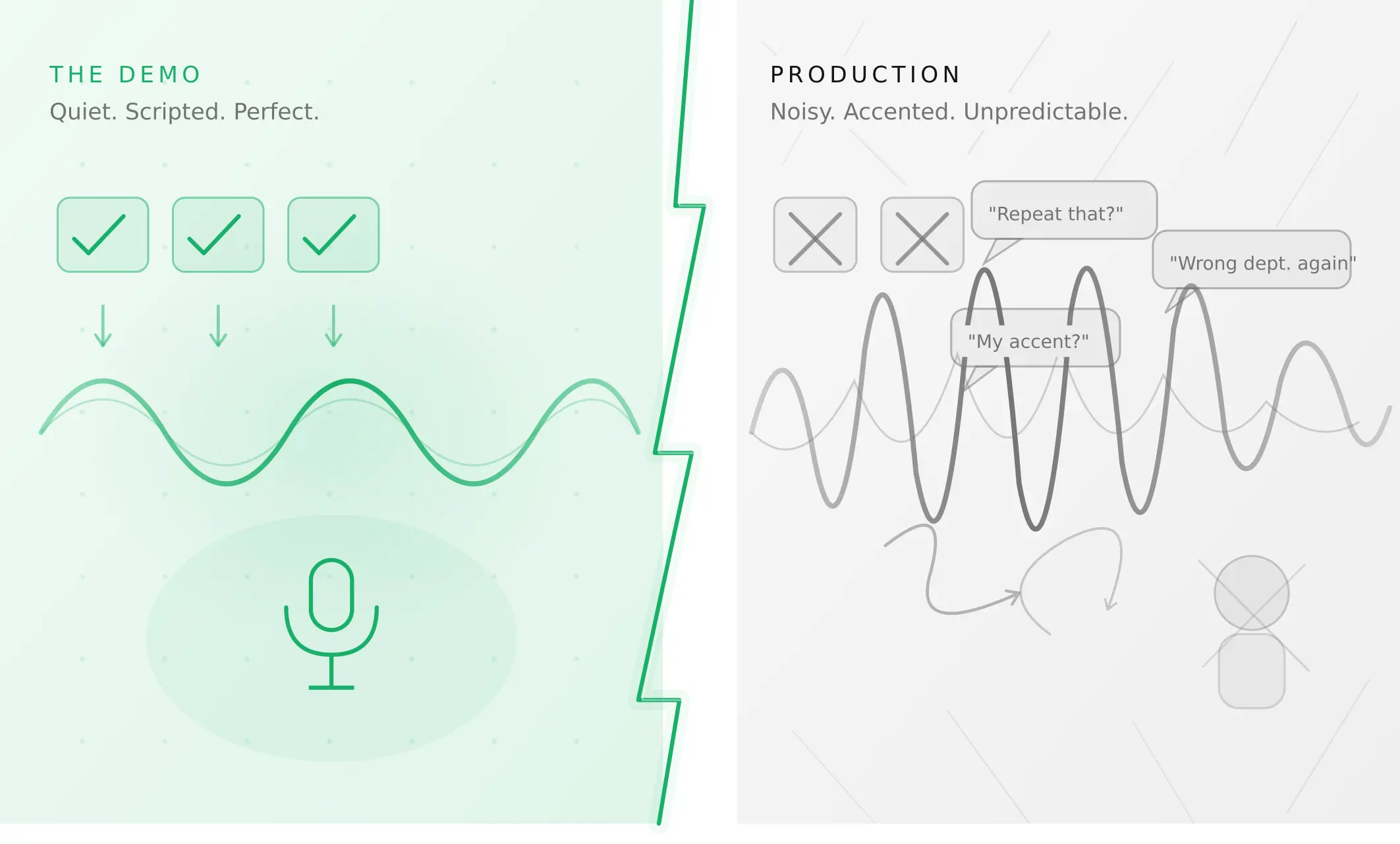
Why AI voice agents fail in production (and how to prevent it)
AI voice agents that ace demos still break in production. Learn the 5 root causes, how to test for each, and what production readiness actually means.
Read more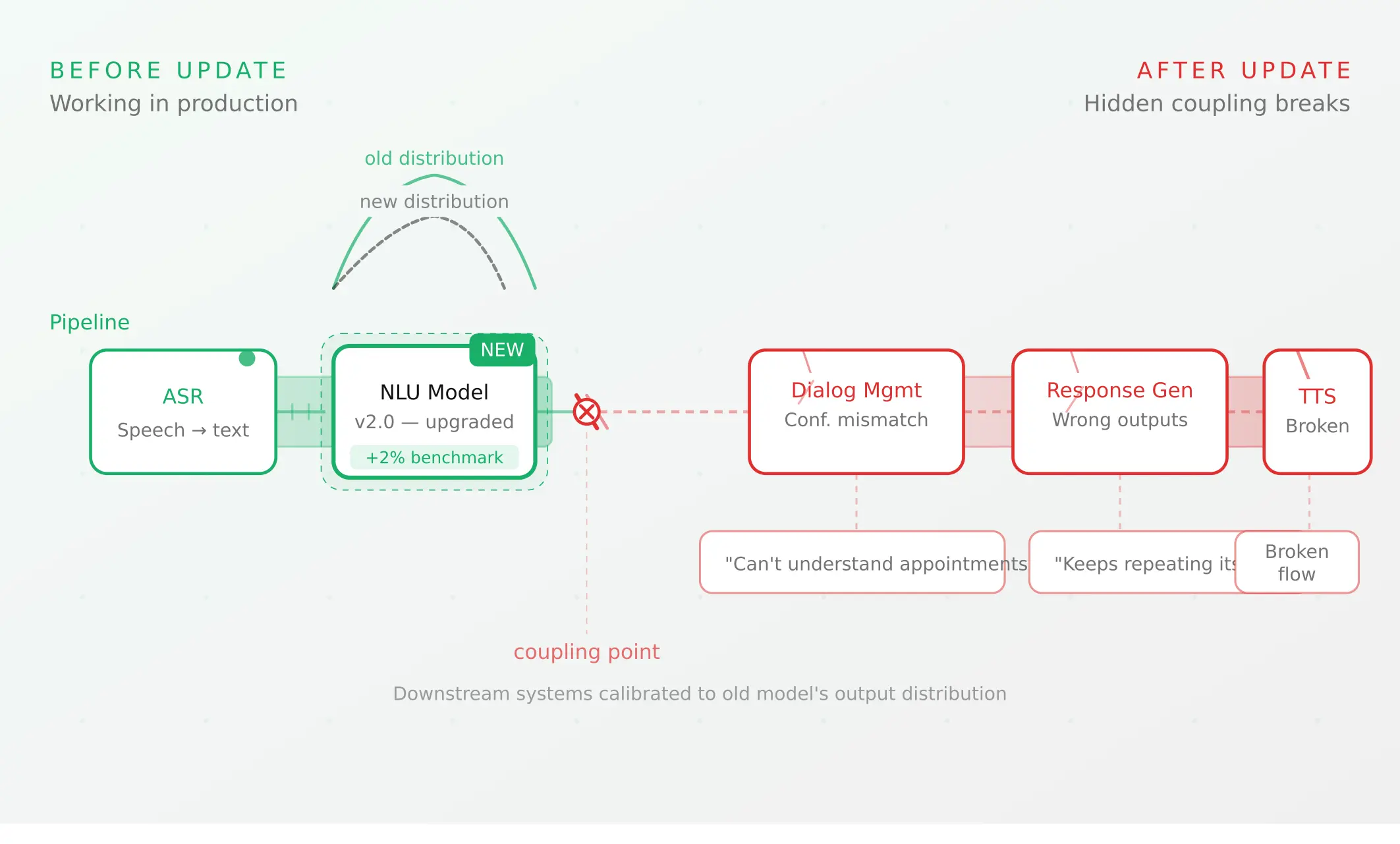
Voice agent regression testing: why LLM updates break production
LLM updates improve benchmarks but break voice agents in 5 predictable ways. How to detect and prevent regressions after every model or prompt change.
Read more