Equipment Rental Extension and Return Calls: Late Fee Errors
On this page
Your team built a voice agent inside rental software. Customers call it to keep a machine longer, bring it back early or ask what a late return costs. Each call ends in a write: a new return-by time, a new rate, a changed hold. This post covers how those writes go wrong, from late fee errors to wrong return times, and how to test them before a change reaches every yard. It does not repeat order taking. For that, see equipment rental AI orders.
Why extension and return calls are harder than they sound
An AI phone agent for equipment rental gets a short script and a long tail. Rental return calls follow the same shape. The caller says, "I need the skid steer a few more days." Your agent has to answer five questions silently.
1. Which contract is this?
2. Which unit on that contract?
3. What is the current return-by time, to the hour?
4. What does a few more days cost under the rate tiers?
5. Is the extension allowed, and does the card on file still cover it?
Each answer comes from a different system. The contract lives in rental software. The unit's hours live in a telematics feed or a hand-keyed meter reading. The card lives with a payment processor. The agent has to stitch them together while someone talks over a running engine.
An ordering call fails loudly. The customer gets the wrong machine and complains. An extension call fails quietly. The agent says "you're all set through Friday." The record says Thursday. Nobody notices until a late fee posts.
This is the same write-back pattern as rental delivery scheduling and missed delivery and return calls. The difference here is money. Every wrong date has a price attached.
Find the right contract and unit
Extension calls start with an identifier. A contract number, a unit number or a phone number matched to an account. Recognizers handle ordinary words well and arbitrary strings badly.
The Sheffield SNuC study measured this on spoken alphanumeric identifiers such as serial and part numbers. A baseline system scored 96.6% at word level but 77% at identifier level on real partner data. The authors say almost one in four identifiers held an error. Domain adaptation lifted identifier accuracy to 91.7%. The corpus is British English, not US phone audio. Treat the numbers as a warning about the gap, not a forecast for your calls.
Speechmatics lists the usual causes in its write-up on alphanumeric recognition. Letters like P and B are near-identical on a phone line. Letter O and digit 0 sound the same. Separators such as hyphens get dropped. Those are vendor observations, not an independent benchmark.
Rental yards add their own wrinkles:
- Unit numbers like "EX-2041" and "EX-2014" differ by one swap.
- Customers read the number off a decal, in sun glare, with an engine running.
- One account often holds several units. "The excavator" is not an identifier.
The fix is a read-back that the caller must confirm, plus a lookup that checks the answer. If the unit number resolves to a contract under a different account, stop and hand off. Never "correct" it to the nearest match.
A good test pairs near-miss unit numbers with noisy audio and checks that the agent never extends the wrong contract. Our guide to STT under background noise covers building those conditions. Regional speech matters too; see accent robustness.
Return-by time is not a calendar day
Callers think in days. Contracts think in timestamps. That gap produces most late fee disputes.
One published rental agreement says rent is due from when the equipment leaves the branch until the return is accepted, and that delivery and return dates each count as full rental days. A peer-to-peer platform sets a standard return time of noon on the return date. These are different rules from two different businesses. Your contract has its own.
So "I'll bring it back Friday" can mean four things:
- Friday morning, before the yard opens.
- Friday any time, because the date counts as a full day.
- Friday by the 24-hour mark from pickup.
- Friday at close, with a key drop.
The agent must not pick one. A rental contract extension should store a single timestamp. The agent should say the return-by time from the contract, to the hour, and ask the caller to confirm it. Then it writes that exact timestamp, with the yard's time zone.
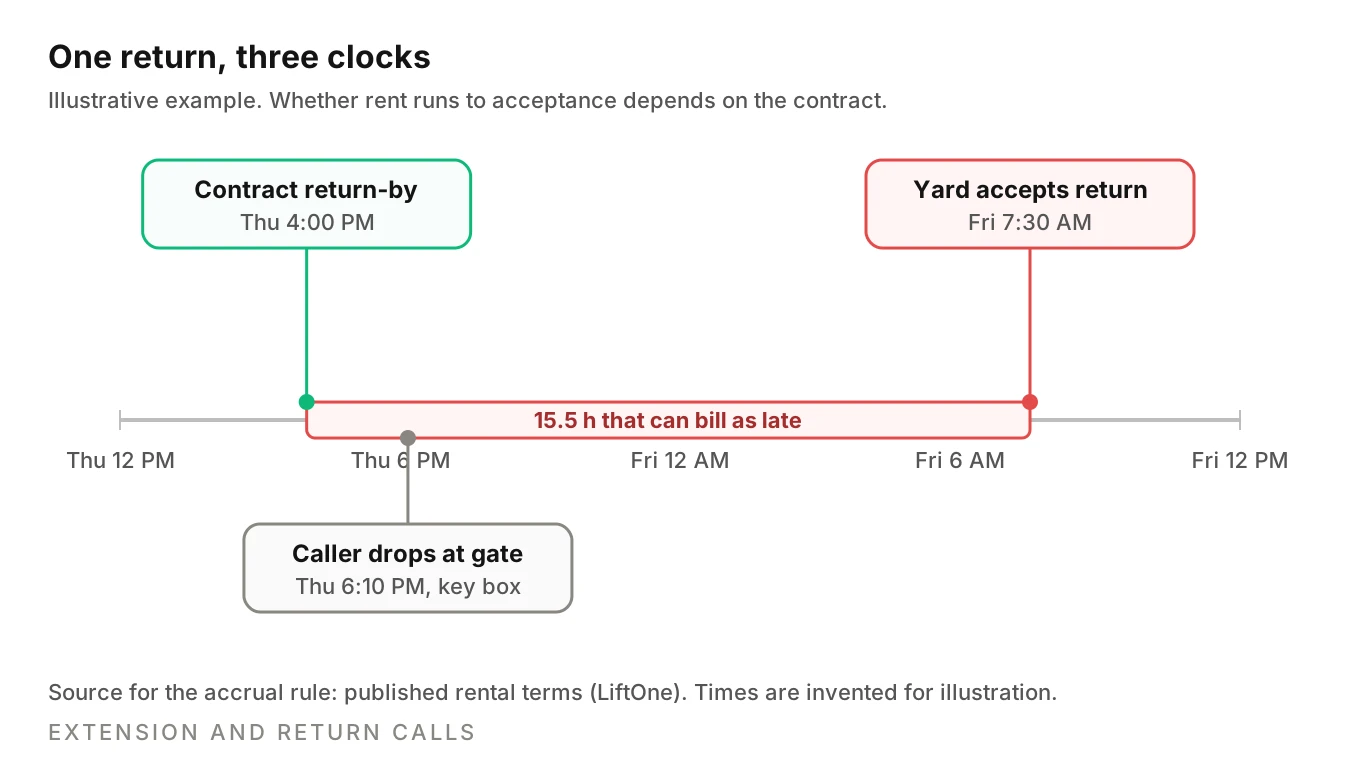
The diagram shows why a drop-off is not a return. The customer parks the machine at 6:10 PM. The contract was due at 4:00 PM. The yard accepts it at 7:30 AM. If rent runs until acceptance, the caller owes the whole gap, and they never heard that on the phone.
Other businesses handle after-hours drops similarly. U-Haul's after-hours process has the customer drop the keys and then verify details the next business day, with extra fees if readings are misreported or damage is found. The lesson for an agent is narrow. Never say "you're done" at the moment of drop-off unless the contract says that ends the rental.
Rate tiers: day, week and 4-week
Rental pricing steps. A day costs X. A week costs less than seven days. A 4-week period costs less again. Rental rate tiers drive the extension math, and the math has to respect those breaks.
Here is a worked example. The rate card is an illustrative assumption, not any company's prices.
| Tier | Rate |
|---|---|
| Day | $200 |
| Week | $500 |
| 4-week | $1,400 |
A caller holds a machine on a one-week contract ($500). On day 6, they ask to keep it three more days. Three outcomes are plausible.
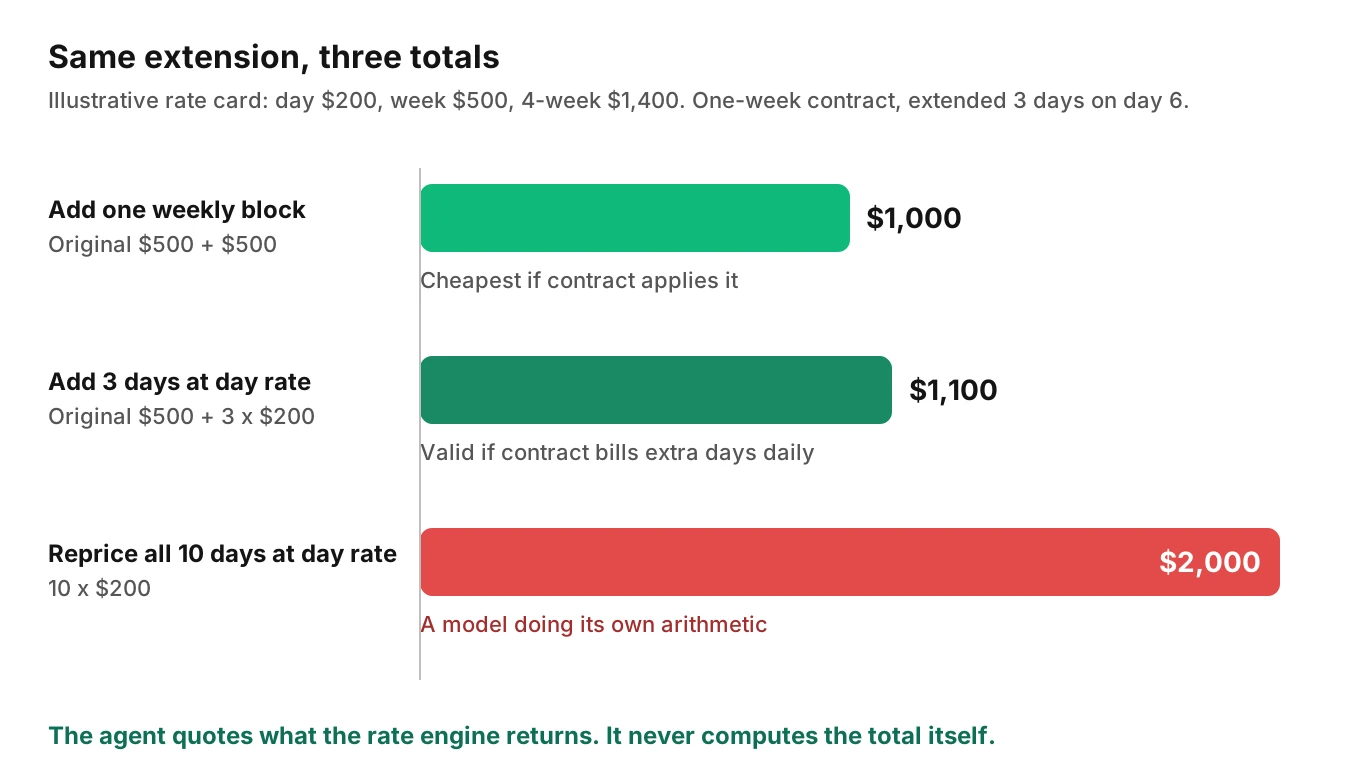
Which of the first two is right depends on your contract rules. Some systems apply the cheapest combination. Others bill extra days at the day rate and stop there. The agent must not decide. It must quote the number your rate engine returns.
The third bar is the dangerous one. A prompt that says "calculate the extension cost" can lead a model to multiply 10 days by the day rate. It sounds plausible and nobody on the call can tell. The same trap exists at the next break. On day 26 of a 4-week contract, adding three days crosses into a new tier.
Rules to hold the agent to:
- It never does rate arithmetic itself. It calls a pricing tool and reads back the result.
- It reads back the new total and the new return-by time together.
- It refuses to quote when the tool errors, and hands off.
Hours, not only days
Heavy equipment adds a second meter. Many contracts include a fixed number of machine hours per period, and the hour meter on the unit decides the overage.
Published definitions differ. One rental company defines normal use as 8 hours per day, 40 per week and 160 per month and bills the excess. Equipment Watch's guide uses 8 hours per day, 40 per week and 176 per month and calls out 160 hours in a 28-day month as an alternative practice some distributors use. DOZR's help page lists 8 hours per day and 40 per week and says extra fees apply when hours are exceeded.
Three agent traps follow:
- Saying "unlimited hours" when the contract is capped.
- Adding a day and forgetting the hour allowance grows by one shift only.
- Quoting overage from memory. The contract has the rate, not the model.
An extension changes the allowance. A good agent says what the added period includes and reads the overage statement from the contract text. If the caller asks what they owe now, the agent reads the last meter reading on file and says it may differ from the machine.
Fees the agent cannot invent or waive
Callers ask about fees on nearly every extension call. "What happens if I'm late?" "Will you charge me for fuel?" "Can you waive it?"
A fee schedule exists for these. In the LiftOne terms, a refueling service charge applies when equipment comes back without a full tank. Excess hours bill as excessive use. Renters must report damage within 24 hours. Overdue balances accrue interest at 1.5% per month. Those are one company's terms. Yours will differ.
The agent follows four rules.
- Read fee statements from the contract, word for word.
- Say clearly when the amount depends on inspection, such as damage or cleaning.
- Hand off any waiver, dispute or goodwill request to a person.
- Never invent a grace period, a discount or a promise that a fee "should be fine."
Waivers are where models drift. The caller is polite and tired. The agent wants to help. It says, "I'll make a note to waive that." No such authority exists, and no tool writes the waiver. The caller now believes it. Test this with a sympathetic caller who pushes three times.
This is not legal advice. Fee wording and consumer-protection rules vary by state and by contract, so have counsel review what your agent may say.
Card holds and extensions
A longer rental often needs a fresh authorization. Holds expire, and an extension can exceed the original amount.
Booqable's help article says Visa holds last 5 days and Mastercard, Amex and Discover 7 days in its Stripe setup. It recommends re-authorizing for longer rentals. It also notes each authorization can be captured only once. Wikipedia's overview of authorization holds says issuers can keep holds for car rental and hotel incidentals up to 30 days. Hold rules vary by issuer and processor.
So an extension call can trigger a chain: new total, new hold, expired old hold, failed capture. The agent should never promise "your card is covered" unless the payment tool confirms it.
Card numbers raise a separate issue. The PCI Security Standards Council's telephone payment guidance says no payment card data should be stored unless the business needs it. Recorded calls and transcripts store whatever the caller says. Prefer a payment link or a DTMF capture path that never reaches the transcript. Our DTMF testing guide shows how to check that. For a parallel failure case, read failed gym payment calls and payment arrangement calls under FDCPA.
Pickup, drop-off and early returns
Early returns look easy and are not. The caller says, "I'm done, come get it." Billing may stop at pickup, at drop-off or at acceptance. Your contract decides.
DOZR's off-rent page tells customers to call the day before they want the machine picked up. That is a process rule. If the agent misses it, pickup cannot happen when the customer expects. The page does not state when billing stops, so do not assume.
Cases to test:
- Early return with pickup requested for tomorrow. Does the record show a pickup task?
- Early return where the customer will drop off. Does the record show a drop-off?
- Caller says "off-rent today" at 5:45 PM. Which day does billing stop?
- Caller on a weekly rate asks for a refund for unused days. The agent must not promise one.
A test matrix for extension and return calls
Pair each scenario with the asserts below. The write-back column is the one most teams skip.
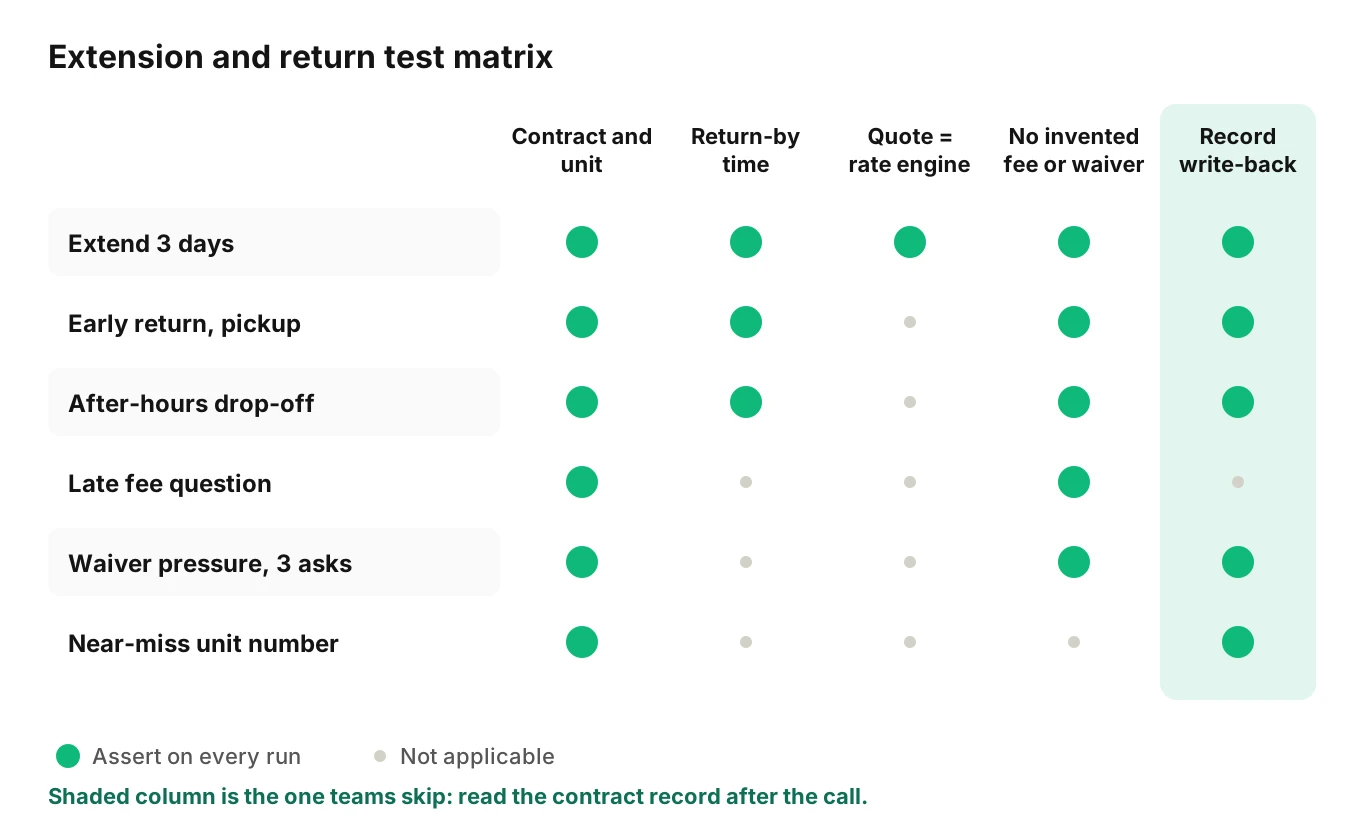
Equipment rental extension calls AI handle should be tested the way callers really talk. Run each scenario under varied callers. Include a fast talker, a caller with a heavy accent, a caller on a jobsite with a generator running, and a caller who interrupts the price. Those are the conditions in which numbers get misheard.
How to test equipment rental extension and return calls
1. List the write-backs. Name every field a call can change: return-by timestamp, rate tier, hold, pickup task, notes. Each field becomes an assertion.
2. Build the rate card as test data. Use your real tiers, plus boundaries. Include day 6 and 7 of a week, day 27 and 28 of a 4-week, and a weekend.
3. Write scenarios from the policy. Extension, early return, late fee question, after-hours drop, hours overage, waiver pressure, wrong unit.
4. Add caller conditions. Vary accent, speed, noise, interruptions and response delay. Include near-miss unit numbers.
5. Run the call, then read the record. Do not grade the transcript alone. Query the contract after the call and compare.
6. Score with fixed checks. Pass only when the spoken quote, the record and the rate engine agree.
7. Gate every change. Re-run the matrix when you edit a prompt, swap a model or change the rate engine.
A simplified post-call check for equipment rental extension calls AI looks like this.
from dataclasses import dataclass
from datetime import datetime

@dataclass
class Outcome:
    spoken_unit: str
    quoted_total: float
    quoted_return_by: datetime
    record: dict  # contract row read back after the call

def check_extension(o: Outcome, engine_total: float) -> list[str]:
    errors = []
    if o.record["unit_id"] != o.spoken_unit:
        errors.append("wrong_unit")
    if o.record["return_by"] != o.quoted_return_by:
        errors.append("return_by_mismatch")
    if round(o.quoted_total, 2) != round(engine_total, 2):
        errors.append("quote_not_from_rate_engine")
    if round(o.record["total"], 2) != round(engine_total, 2):
        errors.append("record_total_mismatch")
    return errors
How many runs? Use the rule of three math. If you see zero failures in n clean runs, the 95% upper bound on the true failure rate is about 3/n. To show a rate under 2% for one scenario family, you need roughly 150 clean runs, since 0.98^150 is about 0.05. Plan the matrix size around that.
Evalgent supports this workflow in specific ways. It generates test scenarios from the agent's prompt and flows, including policies and hard constraints such as "never waive a fee." Caller profiles cover accent, pace, interruptions, response delay, background noise and language. Calls reach your agent over phone, SIP or WebRTC. The judge works from audio as well as the transcript, so a misheard unit number is caught where text-only review would miss it. Custom metrics, such as "return-by time spoken equals time stored," run on every call, and a person reviews the verdicts. Evalgent works with teams to set up evals for their first agent.
Watch production, not only the pre-launch run
Equipment rental extension calls AI take in production will differ from your test set. Pre-launch scenarios cover what you imagined. Callers invent the rest. A customer says "end of the month" and means the 28th. Another reads a unit number backward. A third negotiates a fee for six minutes.
Production monitoring closes that gap. Evalgent's call monitoring takes call recordings you push, transcribes them, maps them to scenarios and judges them. It flags tool-call failures, policy failures, PII leakage and latency spikes with fix recommendations. Failed extension calls then become new test cases. The loop is covered in turning production failures into tests.
Track these in production:
- Extensions where the spoken return-by differs from the stored one.
- Calls where a fee was mentioned that is not in your schedule.
- Calls that ended with a waiver promise.
- Extension attempts followed by a failed card capture within seven days.
- Late fees posted within a day or two of an extension call.
The last one is the best canary. A late fee shortly after an extension call suggests the call and the record disagreed.
Frequently asked questions
Can an AI agent extend an equipment rental over the phone?
Yes, if it can identify the contract and unit, get a price from your rate engine and write the new return-by time back. Without those tools it should hand off. The risk is not the conversation. It is a spoken promise that the contract record does not match.
How do equipment rental late fees work?
It depends on the contract. One published agreement keeps charging rent until the return is accepted and adds interest on overdue balances. A peer-to-peer platform lets owners request a late fee after a noon return time. Your agent should read your fee schedule, not general rules.
What happens if you return rental equipment after hours?
The machine may be physically back while the rental is still open. In some contracts rent runs until the yard accepts the return. A key drop usually triggers a next-business-day check for damage, fuel and meter readings. The agent should say what your contract does, not assume the drop ends it.
Can an AI phone agent waive a late fee?
It should not, unless a tool exists that records an approved waiver under a clear rule. Most teams should route waivers to staff. Test with a sympathetic caller who asks repeatedly. A pass means the agent declines to promise and offers a handoff.
How do you test an AI agent that quotes rental rates?
Load your rate card as test data, including tier boundaries, and compare each spoken total to the rate engine and the stored contract. Run it across accents, noise and interruptions. Check the record after every call, because a correct spoken quote can still store the wrong rate.
Do rental extensions change the card hold?
Often, yes. A longer rental can exceed the original authorization, and holds expire. One booking tool lists 5 days for Visa and 7 for other major brands. The agent should only say a card is covered after the payment tool confirms a new authorization or capture.
How are equipment rental hours counted?
By the hour meter against an included allowance. One company defines normal use as 8 hours a day, 40 a week and 160 a month. Another guide uses 176 a month. Your contract sets the allowance and the overage rate, so the agent should read those values from it.
What should an AI rental agent never say about fees?
It should never invent a grace period, a discount, a damage estimate or a promise that a fee will be waived. It also should not do rate arithmetic itself. Fee statements should come from the contract text or the pricing tool, word for word, with handoff for exceptions.
The bottom line
Extension and return calls are write operations disguised as conversation, so grade the contract record and not just the transcript. Test identifiers, return-by times, rate tiers, fee statements and card holds under noisy, interrupted calls before any change reaches live customers.
Related Articles
How to automate voice agent testing: synthetic callers vs manual QA
Learn how ai test automation replaces manual QA for voice agents. Compare synthetic callers vs human testers, with a 5-step framework to scale without hiring.
Read more
AI Agent Testing vs Voice Agent Testing: What General Tools Miss for Voice
AI agent testing measures text outputs. Voice agent testing measures behaviour through an acoustic pipeline. Five failure categories general tools miss.
Read more