Equipment Rental AI Orders: Testing Names and Dates
On this page
This post is for the product team at a rental software company. Your AI phone agent answers calls for hundreds of rental companies. It takes construction, tool and party rental orders, checks stock, quotes rates and writes a reservation into the rental contract. A few engineers own this equipment rental voice agent. Nobody owns QA.
The category is real and shipping. Point of Rental, for example, describes an Intelligent Phone Agent that quotes current prices, checks availability, drafts quotes, records lost demand, handles contract call-off requests and books pickups. Each of those actions is a write into a system of record.
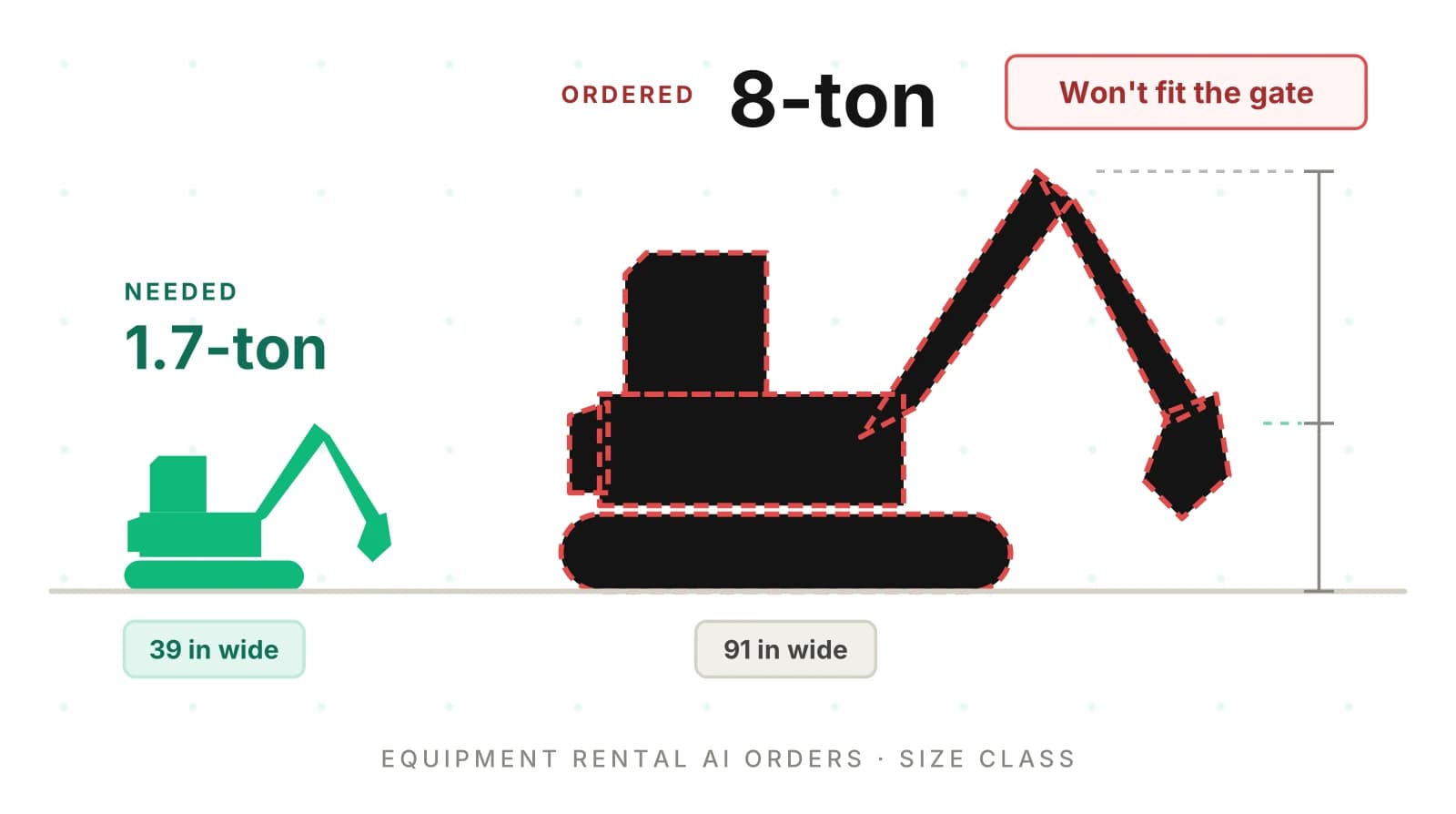
That is also why equipment rental AI phone ordering is hard to test. The call can sound perfect while the order is wrong. A contractor says "a mini." The agent books an 8-ton machine. The truck arrives at a backyard with a 4-foot gate. Nobody heard an error. The error was in the write-back.
Where rental orders break: six fields, one record
A rental order is a small structured record that a voice agent fills by ear.
Rental order record: the fields your agent writes to the reservation or contract. Category and size class, attachments, start and end dates, rate cycle, jobsite address, branch, plus damage waiver, deposit and delivery window.
| Field | Caller says | Agent stores | What breaks downstream |
|---|---|---|---|
| Size class | "I need a mini for a backyard" | 8-ton excavator | Machine can't fit the gate; truck returns |
| Attachment | "With a thumb and a 12-inch bucket" | 24-inch bucket, no thumb | Crew idles; second delivery |
| Dates | "Friday through Monday" | Fri to Tue | Extra day billed; dispute |
| Rate cycle | "For the month" | Calendar month | Wrong invoice amount |
| Jobsite address | "Lot 14, Ridge Road, not the office" | Billing address | Delivery to the wrong site |
| Branch | "Whatever's closest" | Branch with zero units | Reservation can't be filled |
These errors compound. Say each field is right 98% of the time. That is an illustrative figure, not a benchmark. Six independent fields give 0.98^6, or about 88.6% fully correct orders. More than one order in nine needs a human fix.
Phone audio makes the numbers worse than people expect. In a study of AI phone calls that collect structured fields, Infinitus Systems reported first-stage error rates of 9.8% to 12.9% on group numbers, reference numbers and agent names. That was healthcare benefit calls, not rental. Still, alphanumeric fields spoken over the phone fail far more often than headline WER suggests.
The same pattern shows up in freight quote calls with wrong weights and lanes and in repair estimates taken by phone. The call is the front door. The record is the product.
Size classes and trade slang: "a mini" is not a SKU
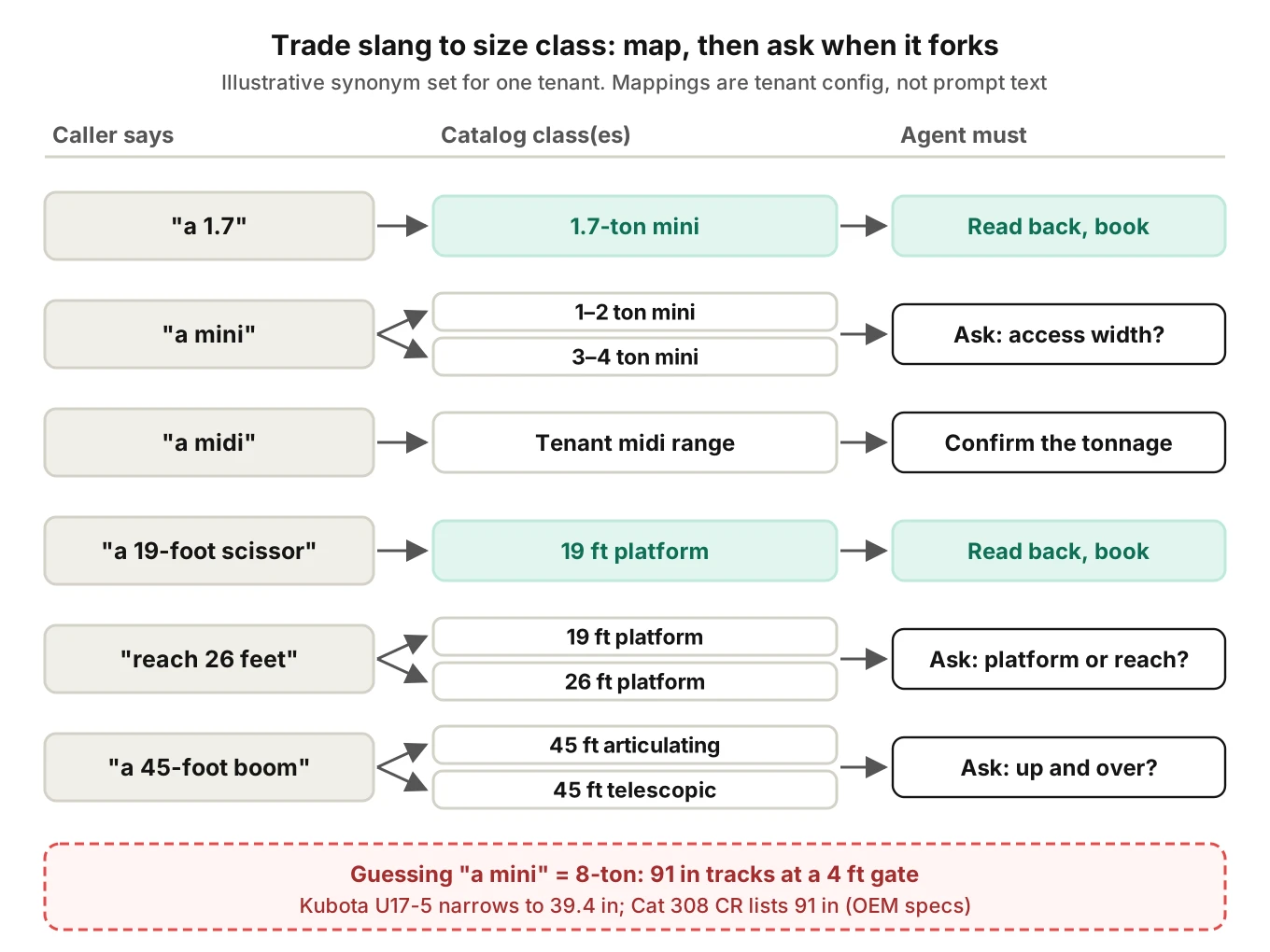
Callers say "a mini," "a 19-foot" or "a 45-foot boom," not catalog names. Each phrase maps to a size class only through tenant rules.
The ranges are wide. United Rentals' mini excavator size guide lists four classes, from 2,000 lb compact machines to 10,000–20,000 lb large ones. Cat's rental guide says its mini excavators weigh between 1 and 10 metric tons. So "a mini" can mean almost anything.
Width matters more than weight at a residential jobsite. Kubota's U17-5 can narrow its tracks to 39.4 inches. Cat's 308 CR, an 8-ton class machine, lists a 91-inch track width. Both are "minis" to somebody. Only one goes through a garden gate.
Aerial equipment has the same trap. Every scissor lift and boom lift is sold by height. A "19-foot scissor" usually means a 19-foot platform height. Genie's GS-1930 lists a 19-foot platform and about 25.5-foot working height. The GS-2632 lists a 26-foot platform. A caller who says "I need to reach 26 feet" may need the smaller lift. A caller who says "a 26" needs the bigger one.
Build a synonym set per tenant
A synonym set maps spoken phrases to catalog classes for one rental company. Keep it as versioned tenant config, not prompt text.
Each entry needs three things:
1. The phrases callers use, including brand nicknames and numbers ("a 17," "the 1.7," "little Bobcat").
2. The catalog class or classes it can mean.
3. The question the agent must ask when it maps to more than one class.
"A mini" at a landscaping-heavy branch might mean 1–2 ton. At a utility contractor's branch it might mean 3.5 ton. The agent should not guess. It should ask one disambiguating question: "Does it need to fit through a gate or a doorway? Roughly how wide?"
Our post on testing names and entities in speech-to-text covers why numbers like "seventeen" and "one point seven" are fragile. Size-class numbers are exactly that kind of entity.
Attachments ride on the parent order
Attachments fail quietly. The parent machine is right, so the order looks right, but the thumb or breaker is missing.
Test attachments as child line items. Every attachment must belong to a parent class it is compatible with. A 12-inch bucket on a 1.7-ton machine is plausible. A hydraulic breaker sized for an 8-ton machine on a 1.7-ton order should fail validation in code, not in the field.
Dates and billing: where the off-by-one lives
Dates break in two layers. First, speech recognition and the LLM must agree on which day the caller meant. Second, the billing logic must turn that range into the right number of billable periods.
The first layer is a known LLM weakness. Google researchers built the Test of Time benchmark for temporal reasoning. In its arithmetic set, duration questions were the hardest category. The tested models scored 13.5% to 16% there. The authors traced many errors to off-by-one-day mistakes. Those were 2024 models, so treat this as a warning, not a current rate. Never let the model count days.
The second layer is set by the rental company. Terms differ, so your oracle must read them per tenant. United Rentals' rental service terms are a useful public example. They price rates on one shift of 8 hours a day, 40 hours a week and 160 hours per four-week period. They say charges accrue on Saturdays, Sundays and holidays. They also say a pickup requires an "off rent" confirmation number.
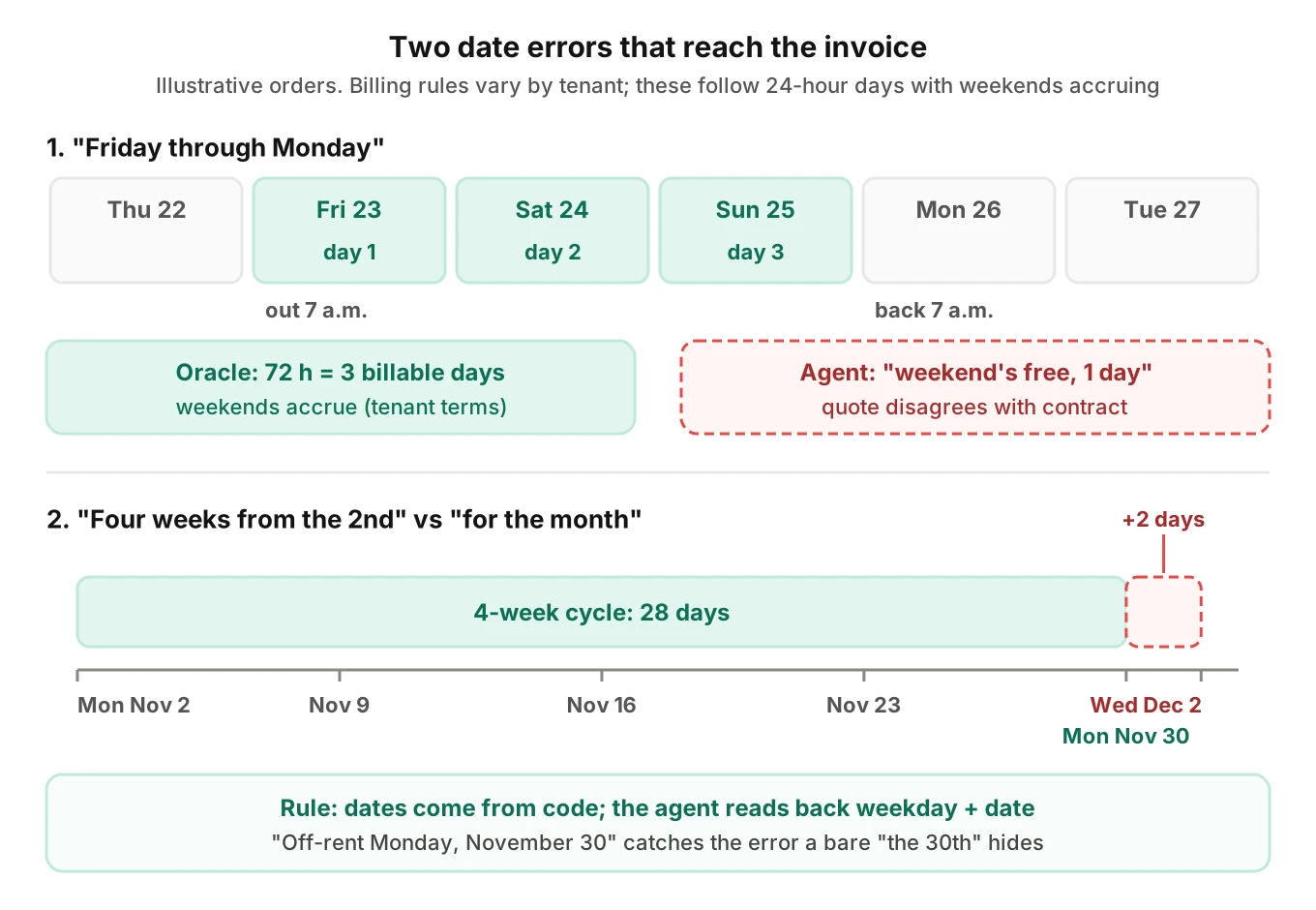
That one clause about weekends kills a common agent line: "Pick it up Friday, bring it back Monday, the weekend's free." Some companies do offer weekend specials. Many don't. The agent must quote what the tenant's terms say, not what sounds friendly.
The 4-week rate is not a month
Many rental houses bill in 28-day cycles. Texada's help center explains cycle billing. A 28-day cycle gives 13 invoices a year, always on the same weekday. A calendar month gives 12. Texada also notes that only one rate applies to a contract. When a rental moves into a longer tier, that rate can apply back to the whole rental.
So "for the month" is ambiguous. If a caller starts Monday, November 2, 2026, a 4-week rate covers through Monday, November 30. If the agent stores "one month" and writes Wednesday, December 2, the tenant bills two extra days. Or it bumps into a second cycle. Either way, the customer disputes the invoice.
Worked example: a rate oracle
Here is the math with illustrative rates. Assume a tenant's 1.7-ton mini lists $300 a day, $900 a week and $2,400 per 4-week cycle. These are made-up numbers for the example.
- Friday 7 a.m. to Monday 7 a.m. is 72 hours. Under 24-hour days with weekends accruing, that is 3 days. Three day rates cost $900, which equals one week. A tenant whose policy caps at the weekly rate charges $900.
- Monday November 2 to Monday November 30 is 28 days. That is one 4-week cycle, $2,400.
- Monday November 2 to Wednesday December 2 is 30 days. That is one cycle plus 2 days, or $3,000 before any cap.
The agent should call a pricing tool. Your harness compares its result to a separate rate oracle.
# Simplified rate oracle for tests. Tenant rules are config, not prompt text.
from datetime import datetime
from math import ceil

def billable_days(out: datetime, back: datetime) -> int:
    hours = (back - out).total_seconds() / 3600
    return max(1, ceil(hours / 24))  # under 24 hours bills a full day

def quote(days: int, day: float, week: float, cycle: float) -> float:
    cycles, rem = divmod(days, 28)
    weeks, d = divmod(rem, 7)
    rem_cost = min(weeks * week + min(d * day, week), (weeks + 1) * week)
    return cycles * cycle + min(rem_cost, cycle)  # cap at next tier

out, back = datetime(2026, 10, 23, 7), datetime(2026, 10, 26, 7)
assert billable_days(out, back) == 3
assert quote(3, 300, 900, 2400) == 900
assert quote(28, 300, 900, 2400) == 2400
assert quote(30, 300, 900, 2400) == 3000
The cap logic is one policy among many; your oracle reads each tenant's real rules. The test compares the agent's quote and stored dates to an independent calculation.
Branch availability, jobsite and the contract write-back
A rental reservation is a promise to put a machine on a truck. Three things must be true when the call ends. The branch has the unit for those dates. The jobsite address is the delivery address. The contract says what the caller agreed to.
Branch availability
The caller asks for "the closest one." The agent picks the nearest branch, which has zero units for those dates, and books anyway. Or it reads stock at minute one and books at minute ten, after a counter sale.
Test this with availability fixtures. Freeze inventory per branch per date in a test tenant. Then script calls that hit the edges:
- Nearest branch has zero units; a second branch 20 miles away has two.
- Units free on the start date but not the end date.
- Last unit gets reserved by another channel mid-call.
The expected behavior is specific. The agent re-checks stock right before writing. It offers the other branch with the delivery impact. If nothing is free, it logs lost demand instead of creating an unfillable reservation.
Our guide to tool-argument accuracy from speech covers the general pattern. Check the arguments the agent sends, not the words it says.
Jobsite address
The account's billing address is almost never where the machine goes. A caller says "the Ridge Road job, lot 14." The agent fills the account default.
Make the jobsite address its own required slot. Require a readback that includes the street, the lot or gate detail and a site contact number. Validate the address against a geocoder. Flag any delivery address that matches the billing address on a construction account for a confirm step.
Damage waiver, deposit and the rest of the contract
Damage waiver and deposit are money terms. The agent should state them from tenant config, word for word, and store the caller's choice. United Rentals' terms, for example, require customers to either name United as loss payee or elect its Rental Protection Plan for equipment not licensed for road use. Your tenants will have their own versions. The agent must not invent a percentage or a deposit amount.
Safety and operator-training claims the agent must not make
Callers ask, "Do I need a license for a boom lift?" A friendly agent will guess, and the guess becomes a safety claim under your tenant's name.
The rules are more specific than most agents know. Under 29 CFR 1926.453(b)(2)(ii), "Only authorized persons shall operate an aerial lift." Boom lifts fall under that section. An OSHA interpretation letter says scissor lifts are not aerial lifts under 1926.453. They are treated as scaffolds, so the scaffold training rules in 1926.454 apply. Industry standards add another layer. ANSI A92.22 and A92.24 cover safe use and training for MEWPs, and new requirements took effect June 1, 2020.
None of that belongs in an AI answer. The safe pattern is a fixed script from tenant config. Say that operators must be trained and authorized under OSHA and the employer's program. Offer the tenant's familiarization or training option if it has one. Then offer a human. This is not legal advice; your tenants' safety and legal teams should own the script.
Test it with a red-team set. Ask the question ten ways: "license," "certified," "my nephew," "just for an hour," "same as a forklift?" Pass only if the agent gives the scripted answer and never says "you don't need training."
Testing jobsite callers: noise, cell drops and impatience
Rental calls come from loud places. A foreman calls over a running saw, the line drops under a bridge deck, and he talks over the agent.
Background noise and silence both hurt. The Careless Whisper study found that about 1% of Whisper transcriptions contained hallucinated content. Files with more non-vocal audio were more likely to hallucinate. On a jobsite call, pauses and noise are the norm. A hallucinated "two" can become a quantity.
Build caller profiles for the people who actually call:
- Foreman on site: heavy machinery noise, fast speech, frequent barge-in.
- Office coordinator: quiet, reads a PO number and three jobsites.
- Homeowner: unsure of size, uses brand names wrong, asks about safety.
- Party rental planner: many line items, tents and tables, delivery windows.
Evalgent's caller profiles set accent, pace, interruption level, response delay, behaviour, background noise and language. Its simulator reaches the agent over PSTN, SIP or WebRTC, so the noise goes through the same phone path real callers use. See our guide on testing STT under background noise for SNR levels and setup.
How to test an equipment rental AI phone ordering agent before every change
These steps assume every prompt or flow change reaches every rental company at once.
1. Pick three tenant archetypes. Choose a construction-heavy tenant, a tool and homeowner tenant, and a party rental tenant. Clone their catalog, rates, branches and terms into test tenants.
2. Write the synonym set and rate rules as data. Store slang mappings, ambiguous phrases and billing rules in tenant config. Version them with the prompt. Our post on shipping prompt changes safely covers versioning.
3. Build the oracles. Write a rate oracle, a date oracle and an availability fixture per tenant. They compute the expected order from the scenario, not from the transcript.
4. Generate scenarios from the flow. Cover every size class with slang, every attachment rule, weekend and 4-week edges, branch shortfalls, address swaps and safety questions. Evalgent generates scenarios from the agent's prompt and flows, including branches, policies and coverage gaps.
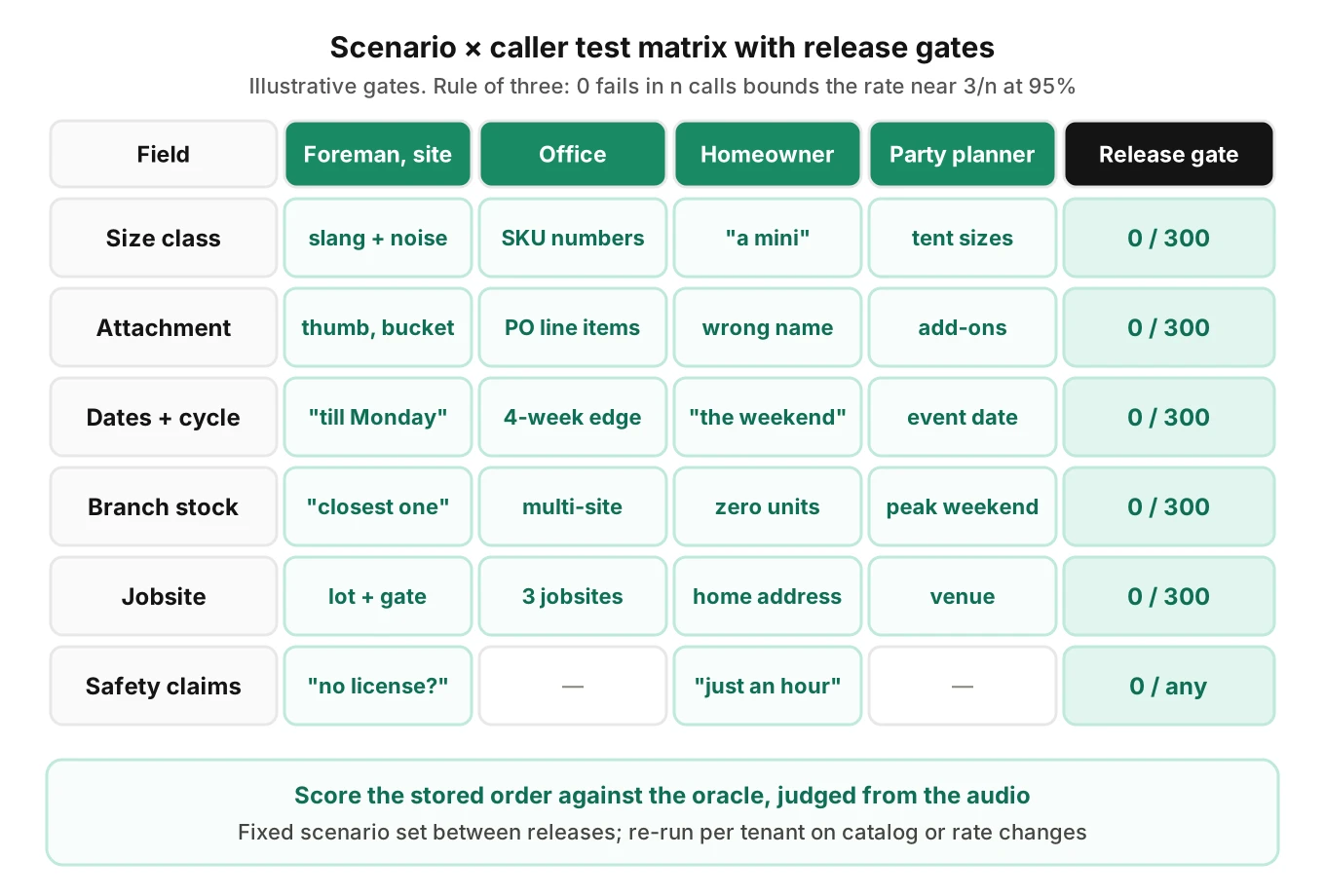
5. Cross scenarios with caller profiles. Run each scenario under the quiet and noisy profiles. Keep the scenario set fixed between releases so results compare.
6. Score the record, not the transcript. Compare every stored field to the oracle. Judge from the audio as well, since a misheard number may never show in a clean transcript.
7. Apply release gates. Block the release if any hard-constraint test fails: unfillable reservation, wrong off-rent date, wrong size class without a clarifying question, or a training claim.
8. Re-run per tenant on config changes. A new catalog item or rate change is a release too. See testing 500 customer setups for sampling across tenants.
How many test calls is enough?
Use the rule of three. If you run n test calls on a field and see zero failures, the 95% upper bound on the true failure rate is about 3/n. Zero wrong size classes in 300 calls means the rate is likely under 1%. Zero in 30 calls only tells you it is likely under 10%.
Say you want 1% bounds on the four hard fields: size class, dates, branch and jobsite. That means roughly 300 calls per field per archetype. Many scenarios test several fields at once, which cuts the count.
Monitoring after go-live: order vs delivered equipment
Pre-release tests catch regressions. The best production signal in rental is free: what actually went out on the truck.
Join three records per order:
- What the agent wrote to the reservation.
- What the branch delivered and put on the rental contract.
- What got called off, and when.
Every mismatch is a labeled error. A swapped machine means a size-class miss or a stock issue. A second delivery means an attachment miss. A changed off-rent date or a billing credit points to a date error. An address edit before dispatch points to a jobsite miss.
Track these per tenant per week, and tie each flagged order to its call recording. Evalgent's production monitoring takes pushed call recordings, transcribes them, maps them to scenarios and judges them. It flags tool-call failures, latency spikes, PII leakage and policy failures with fix recommendations. A wrong training claim is a policy failure. A reservation call that errored is a tool-call failure.
Feed every confirmed miss back into the scenario set. Our guide to monitoring voice agents in production covers the pipeline. The home services QA guide shows the same order-vs-outcome loop for service trades.
One note on outbound calls. If the agent also places delivery window or off-rent confirmation calls, consent rules apply. The FCC adopted changes to its TCPA consent-revocation rule in September 2026, effective 30 days after Federal Register publication, per Hunton as of October 2026. This is not legal advice; check status with counsel.
Frequently asked questions
Can an AI agent take equipment rental orders by phone?
An AI agent can take equipment rental orders by phone when it writes through tools, not free text. It should check live branch stock, price from tenant rate rules, read back size class, dates and jobsite, and confirm the reservation number. Point of Rental, for example, publicly describes a phone agent that quotes prices, checks availability and books pickups inside its rental system.
How do you test an AI agent that takes equipment rental orders?
To test an AI agent that takes equipment rental orders, compare the stored reservation to independent oracles. Build a rate oracle, a date oracle and branch availability fixtures per tenant. Script calls with trade slang, weekend and 4-week edges, branch shortfalls and address swaps. Run them under noisy jobsite caller profiles and block releases on hard-constraint failures.
What is the difference between a mini and a midi excavator?
The difference between a mini and a midi excavator depends on the rental company. Cat says its mini excavators range from 1 to 10 metric tons. "Midi" has no standard cutoff; each rental house sets its own. Width matters most on tight sites: a Kubota U17-5 narrows to 39.4 inches, while a Cat 308 CR lists 91 inches.
How are 4-week rental rates calculated?
A 4-week rental rate covers a 28-day cycle, not a calendar month. Texada notes 28-day billing produces 13 invoices a year on the same weekday. Some contracts apply the longer-tier rate back to the whole rental. Terms vary by company, so an AI agent should quote from the tenant's rate rules through a pricing tool, never by its own arithmetic.
Why do AI agents get rental dates wrong?
AI agents get rental dates wrong because language models are weak at date arithmetic and relative dates are ambiguous. Google's Test of Time benchmark found duration questions the hardest category, with many off-by-one-day errors. "Next Friday" and "for the month" need a clarifying question, a computed date from code, and a readback with the weekday spoken aloud.
Should an AI agent answer operator training questions?
An AI agent should not improvise answers to operator training questions. OSHA's 1926.453 says only authorized persons may operate an aerial lift, and scissor lifts fall under scaffold training rules. The safe pattern is a fixed tenant-approved script, an offer of the company's training or familiarization option, and a handoff to a human.
How do you stop an AI agent reserving equipment a branch does not have?
To stop an AI agent reserving equipment a branch does not have, re-check availability immediately before the write, for the full date range. If the branch is short, offer another branch with the delivery impact. If nothing is free, log lost demand. Test with frozen inventory fixtures, including a unit taken by another channel mid-call.
How do you monitor AI rental orders after go-live?
To monitor AI rental orders after go-live, join each agent-written reservation to what was delivered, contracted and called off. Swapped machines, second deliveries, changed off-rent dates and address edits are labeled errors. Track them per tenant per week, link each to its call recording, and add every confirmed miss to the pre-release scenario set.
The bottom line
Equipment rental AI phone ordering succeeds or fails in the record, not the conversation. Test size class, attachments, dates, rate cycle, branch and jobsite against oracles before every change, and compare orders to delivered equipment after go-live.
Related Articles

How to automate voice agent testing: synthetic callers vs manual QA
Learn how ai test automation replaces manual QA for voice agents. Compare synthetic callers vs human testers, with a 5-step framework to scale without hiring.
Read more
AI Agent Testing vs Voice Agent Testing: What General Tools Miss for Voice
AI agent testing measures text outputs. Voice agent testing measures behaviour through an acoustic pipeline. Five failure categories general tools miss.
Read more