Test your voice agent
Build vs Buy: 3-Year Voice Agent Cost
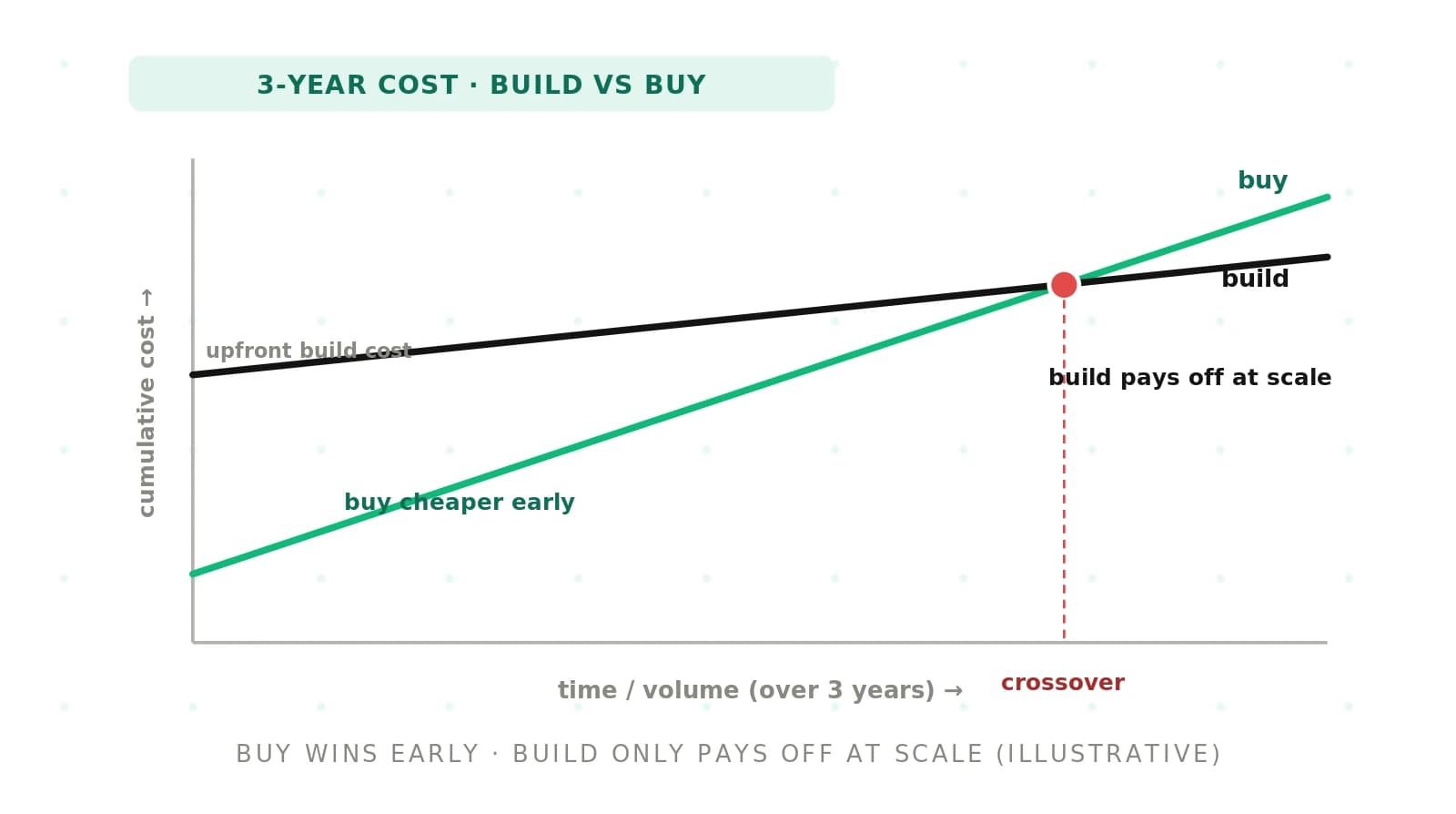
# Build vs buy voice agent cost over three years
Quick answer
> Quick answer: Build vs buy voice agent cost compares three years of building in-house against buying a platform. Building front-loads engineering, integration, and ongoing maintenance; buying spreads cost across subscription and usage fees. Buying usually wins at low volume and small teams. Building can win at high volume, if you count every hidden cost.
Most teams underestimate the build path. They price the launch and forget the three years after it. A voice agent is not a project you finish. It is a system you keep running, keep testing, and keep repairing as models and callers change.
This post models the real cost of both paths over three years. It counts the line items teams miss, shows where the crossover sits, and explains how that point moves with scale and team maturity. Every dollar figure here is illustrative. Use it as a template, then run the numbers on your own volume.
What build vs buy really means for voice agents
"Buy" means adopting a platform that hands you a working system. Speech recognition, a language model, voice synthesis, telephony, and orchestration arrive assembled. You configure it, connect your data, and launch. The plumbing is someone else's job.
"Build" means assembling and running those parts yourself. You wire the components, own the latency budget, and staff the on-call rotation. You control everything. You also maintain everything, forever.
This is the classic make-or-buy decision applied to voice AI. Firms have weighed it for a century. Economist Ronald Coase framed why firms make some things and buy others in The Nature of the Firm. The logic is old. The stack is new.
The mistake is treating it as a one-time comparison. Build and buy both carry costs that recur every month for years. A fair comparison spans the full horizon, not the launch.
The build path: every cost line, not just salaries
Building looks cheap when you price only the raw components. The per-minute cost of parts is low. The cost of the people who wire them, and keep them wired, is not.
Engineering and integration
The first cost is the build itself. Engineers pick each component and connect them. They tune the latency budget so the agent responds fast enough to feel human. They handle failovers, retries, and the edge cases that only appear on real calls.
Illustrative range: two to four engineers for four to eight months. At loaded US salaries, that is a large upfront number before a single production call. This is capital you spend once, but it is real.
Ongoing maintenance and on-call
The build never stops. Models change. Providers deprecate endpoints. Callers find new ways to break the flow. Someone has to watch it and fix it.
Plan for at least one engineer's time indefinitely, plus on-call coverage. This recurring cost is the line most build estimates omit. Over three years it often dwarfs the launch. It also accrues technical debt that slows every future change.
Testing and evaluation
A voice agent needs constant testing. You cannot ship a change and hope. You run test calls, score transcripts and audio, and catch regressions before callers do.
If you build the pipeline, you build the test harness too. That is more engineering time and more tooling. Skipping it is not saving money. It is deferring the cost to a production failure. Our guide on testing versus evaluation for voice agents draws the line between the two disciplines.
Opportunity cost
Every engineer on the voice stack is an engineer not on your product. That is opportunity cost, and it is often the largest hidden number of all.
If your differentiator is the product, not the plumbing, building the plumbing may cost you the lead. The spreadsheet rarely captures this. Your roadmap does.
Time to market
Building is slow. Getting latency, failovers, and edge cases right takes months. Every month of delay is revenue or savings you do not collect. Time to market is a cost even when it never hits an invoice.
The buy path: subscription, speed, and the limits you inherit
Buying trades a higher per-unit price for near-zero build cost. You pay to skip the hard integration. For most teams, early on, that is a good trade.
Subscription and usage fees
You pay a platform fee, a usage rate, or both. The rate looks expensive next to raw component pricing. It is not, once you add back the salaries that raw components hide. Our voice agent pricing models breakdown covers how these meters differ.
Faster launch
You can go live in weeks, not months. The integration is done. Your team configures and connects, rather than building from scratch. That speed is worth real money in most markets.
Less control
You inherit the platform's choices. Its component mix, its update schedule, its roadmap. If you need a custom behavior it does not support, you wait or work around it. For many teams that is a fine trade. For some, it is a wall.
Lock-in
Buying can create vendor lock-in. Your prompts, data, and integrations live in the platform's shape. Moving later takes work. The switching cost is a real, if delayed, part of the buy price. The comparison of open source versus managed voice agents walks through how much freedom you keep on each path.
Build vs buy voice agent cost over three years (illustrative)
The table below models both paths across the dimensions that move the number. Figures are illustrative and rounded. They assume a mid-volume US deployment. Replace every cell with your own inputs before you decide.
| Cost dimension (3-year) | Build in-house | Buy a platform |
|---|---|---|
| Upfront engineering and integration | High: ~$400k–$900k in salaried build time | Low: mostly configuration time |
| Ongoing maintenance and on-call | High: ~$150k–$300k per year, recurring | Included in platform fee |
| Testing and evaluation | Medium–high: build and run your own harness | Medium: still yours to verify independently |
| Infrastructure and per-minute usage | Low marginal: component rates only | Higher marginal: bundled into usage price |
| Subscription and platform fees | None | Medium–high: scales with volume |
| Opportunity cost | High: engineers off the core product | Low: team stays on the product |
| Time to first production call | Slow: ~4–8 months | Fast: ~2–8 weeks |
| 3-year total (illustrative) | Higher at low volume, lower at very high volume | Lower at low volume, higher at very high volume |
Read the table as a shape, not a verdict. The build column front-loads and then bleeds maintenance. The buy column starts small and grows with usage. Where the two lines cross is the whole decision.
Where the crossover sits, and how it moves
At low volume, buying almost always wins. The build effort dwarfs any runtime savings. Paying a premium per minute is cheap when you run few minutes. Your engineers are worth more on the product.
At high, sustained volume, the math can flip. When you run millions of minutes, a few cents of margin per minute compounds fast. That margin can fund a platform team and still leave savings. Scale is what justifies the build.
The crossover is not a fixed number. It moves with three things.
First, call volume. More minutes push the build case forward, because build cost is mostly fixed and buy cost mostly scales.
Second, team maturity. A team that already runs low-latency infrastructure builds cheaper and faster. A team new to voice pays a steep learning tax.
Third, your margins and the platform's price. Both set how much a cent per minute is worth to you. Model them with real inputs, not a vendor slide or a blog rule of thumb, including this one.
Because build cost lands upfront and buy cost spreads out, compare them in present-value terms. Net present value discounts future spending so a three-year build and a three-year subscription are compared fairly. A dollar spent in year three costs less than a dollar spent today.
How to run a build-vs-buy analysis
Run this analysis before you commit. It takes a day and prevents a very expensive year.
1. Set the horizon and volume. Pick three years. Estimate call minutes per month for each year, low and high. Build cost is fixed; buy cost scales, so volume drives everything.
2. Price the buy path fully. Get platform and usage quotes at your projected volume. Add integration, testing time, and expected switching cost. This is your total cost of ownership for buying.
3. Price the build path fully. Count upfront engineering, then recurring maintenance, on-call, testing tooling, and infrastructure. Add opportunity cost for engineers pulled off the product.
4. Add the soft costs. Put a number on time to market and on risk. A slower launch and a longer failure recovery both cost money, even off the invoice.
5. Discount to present value. Apply a discount rate so upfront build spend and spread-out subscription spend compare fairly across three years.
6. Find the crossover. Chart both totals against volume. See at what monthly minute count building becomes cheaper. Check whether you actually expect to reach it.
7. Stress-test the assumptions. Rerun with maintenance 50 percent higher and volume 30 percent lower. If the answer flips easily, buy and revisit later.
For the buy side line items most teams forget, pair this with our voice agent total cost of ownership guide and the AI voice agent cost breakdown.
The costs teams miss on the build path
The build path fails in the spreadsheet for a predictable reason. People price the launch and forget the years after it. Four costs get missed most often.
Maintenance is first. The agent needs an owner forever, not just at launch. That salary recurs every year and rarely appears in the pitch to buy in.
Testing is second. A voice agent drifts as models and callers change. Without a standing evaluation loop, quality erodes quietly until callers complain.
Opportunity cost is third. Engineers on the stack are not on the product. For a product-led company, that is the most expensive line, and the one no vendor invoice will ever show you.
Switching and integration friction is fourth. Even a build has churn. Providers deprecate, models change, and the wiring needs rework. The build is never truly done.
Verifying quality whichever path you pick
The cost model tells you what to spend. It does not tell you whether the agent is good. That is a separate question, and it does not care which path you chose.
Whether you build or buy, you still need to know the agent works on your calls. A build can be broken. A bought platform can quietly regress after an update. Neither the vendor's dashboard nor your own logs are a neutral judge of quality.
Evalgent is an independent, third-party evaluator for voice agents. We test your agent on your scenarios and score it on task completion, accuracy, latency, and safety. The audit is the same regardless of path, so you can compare a build and a platform on identical evidence. To choose a vendor well in the first place, our guides on how to evaluate voice agent vendors and independent voice AI evaluation show what to measure.
Frequently asked questions
How much does it cost to build a voice agent in-house?
Building in-house is dominated by people, not parts. Illustratively, expect two to four engineers for four to eight months upfront, then at least one engineer's time each year for maintenance and on-call. Loaded US salaries make that the largest line. Component and infrastructure rates are small next to the staffing cost over three years.
Is it cheaper to build or buy a voice agent?
Buying is usually cheaper at low and moderate volume, because build cost is mostly fixed while buy cost scales with usage. Building can be cheaper at very high, sustained volume, where per-minute savings compound. The honest answer depends on your call minutes, team maturity, and margins. Model both paths over three years before deciding.
What are the hidden costs of building a voice agent?
The four most-missed build costs are ongoing maintenance, testing and evaluation tooling, opportunity cost, and switching friction. Maintenance recurs every year. Opportunity cost means engineers are off your core product. Testing must run continuously as models drift. None of these appear at launch, which is why build estimates so often understate the true three-year total.
When does building a voice agent become cheaper than buying?
Building becomes cheaper when sustained volume is high enough that per-minute savings outweigh fixed build and recurring maintenance cost. The crossover moves with volume, team maturity, and platform pricing. It is not a fixed number. Chart both totals against your projected minutes, discount to present value, and check whether you truly expect to reach that volume.
How long does it take to build a voice agent versus buying one?
Buying a platform typically reaches a first production call in two to eight weeks, because integration is already done. Building in-house typically takes four to eight months, since latency budgets, failovers, and edge cases take time to get right. Time to market is a real cost even when it never appears on an invoice.
What is the total cost of ownership for a voice agent?
Total cost of ownership counts every cost across the horizon, not the sticker price. For build, that is upfront engineering plus recurring maintenance, on-call, testing, infrastructure, and opportunity cost. For buy, it is subscription and usage fees plus integration, testing, and switching cost. Comparing only launch cost, or only per-minute rates, produces the wrong decision.
Does buying a voice agent platform create vendor lock-in?
Buying can create lock-in, because your prompts, data, and integrations take the platform's shape. Moving later takes rework, and that switching cost is a real, if delayed, part of the buy price. You reduce it by keeping data portable, documenting configurations, and evaluating agents independently, so you can compare an alternative on identical evidence.
Should a small team build or buy a voice agent?
A small team should almost always buy first. Building demands engineers you likely need on the product, plus a maintenance commitment that never ends. Buy to launch fast, learn from real calls, and revisit the decision as volume grows. Building only pays off later, at high volume, with a team that can absorb the upkeep.
The bottom line
Buying wins for most teams at launch, because it turns a long build into a fast subscription; building only pays off at high, sustained volume with a team that can absorb the maintenance. Whichever path you pick, verify the agent on your own calls before you trust it, and book a demo to see how Evalgent audits a voice agent independently, build or buy.
Related Articles
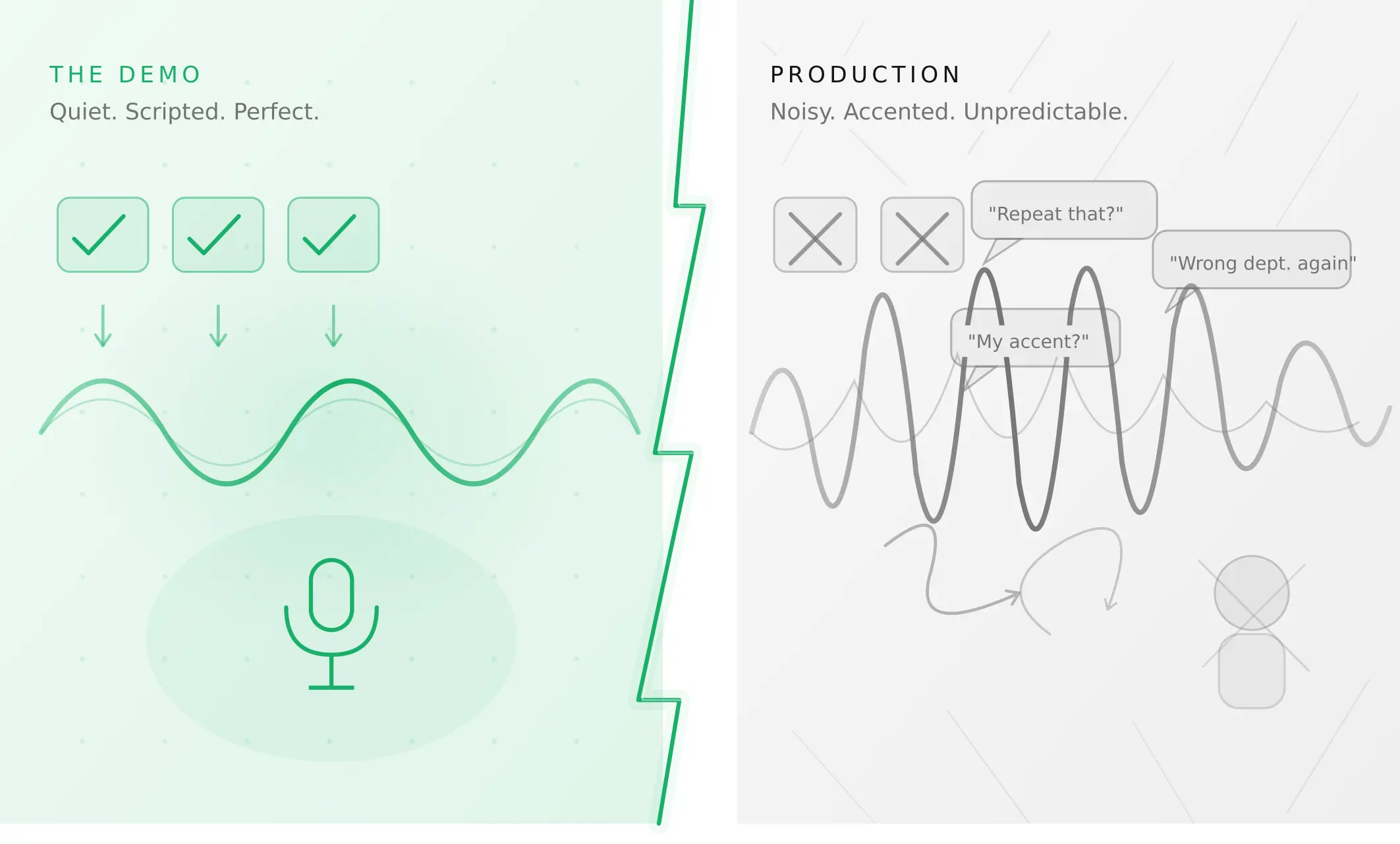
Why AI voice agents fail in production (and how to prevent it)
AI voice agents that ace demos still break in production. Learn the 5 root causes, how to test for each, and what production readiness actually means.
Read more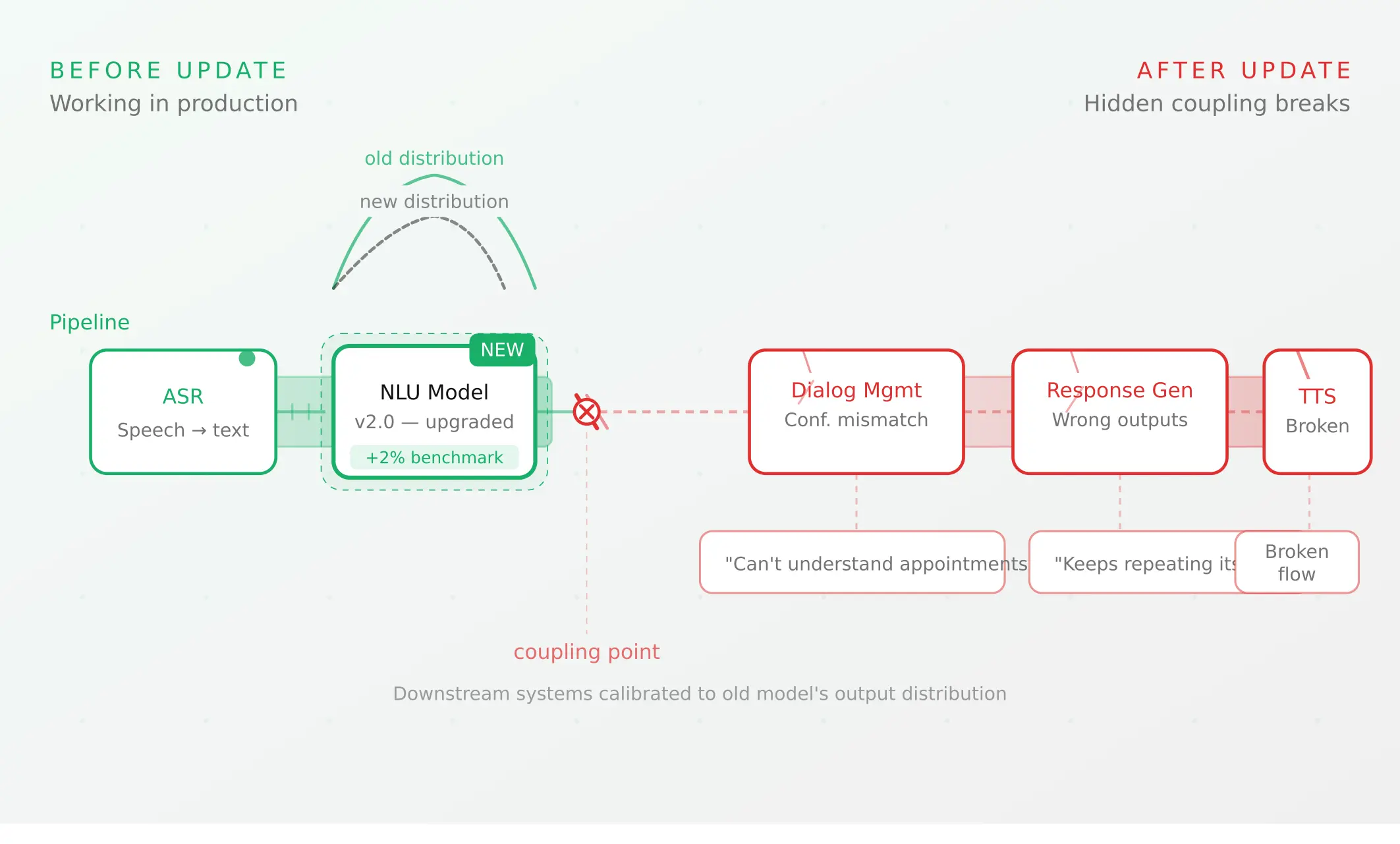
Voice agent regression testing: why LLM updates break production
LLM updates improve benchmarks but break voice agents in 5 predictable ways. How to detect and prevent regressions after every model or prompt change.
Read more