Test your voice agent
Voice AI Procurement Checklist for Enterprises
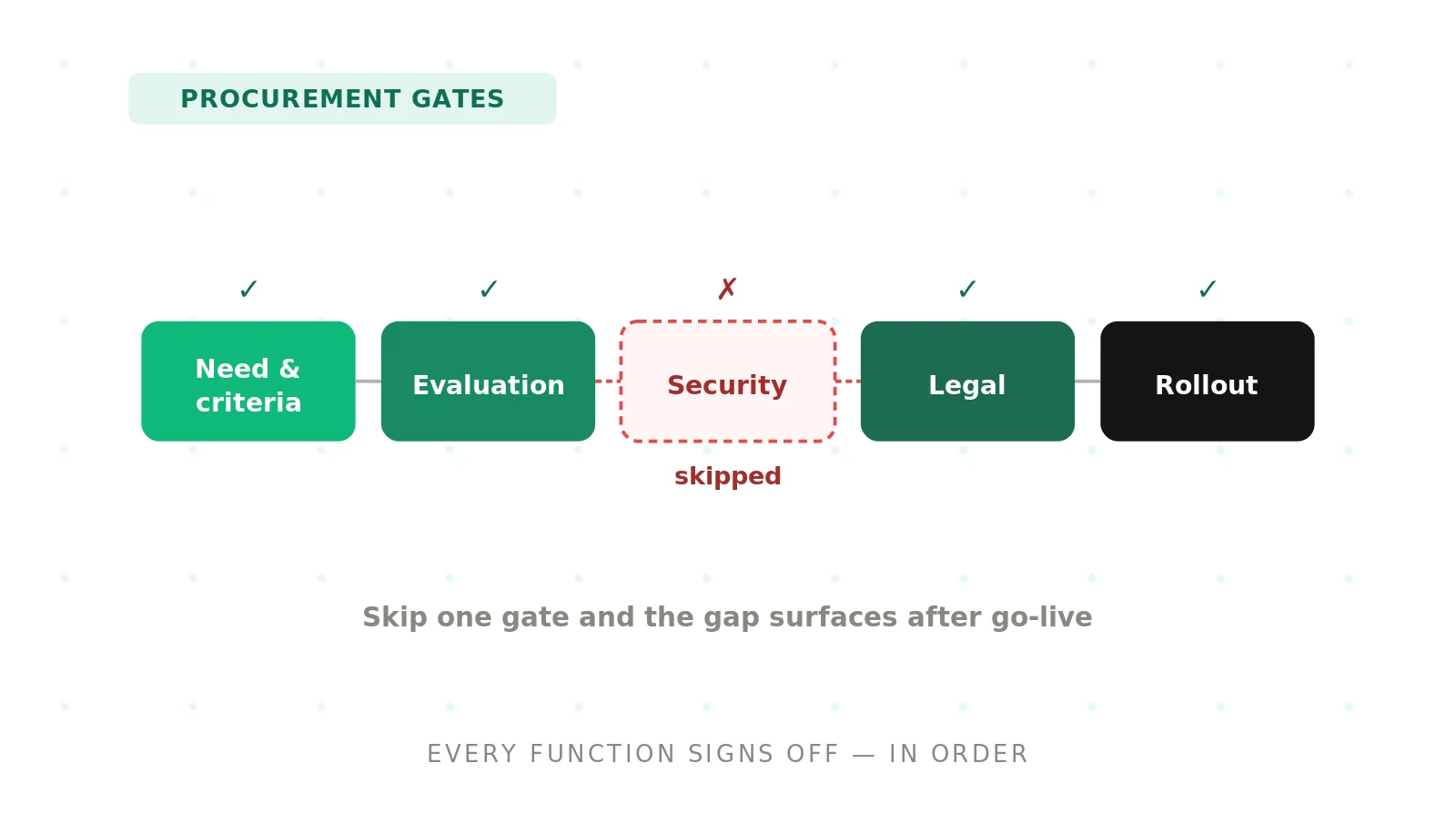
Buying a voice AI vendor is not a purchase; it is a project that crosses half the org chart. The business owner wants it live yesterday, security wants a SOC report, legal wants liability terms, finance wants a defensible cost, and someone has to actually prove the agent works. When those functions engage in the wrong order — or not at all — the deal either stalls for months or ships with a gap that surfaces after go-live. A procurement checklist keeps the process moving and complete. This is that checklist.
We will cover who is involved, the sequence of gates each function owns, and the specific checks at each stage. It sits downstream of the RFP checklist and the bake-off playbook, tying them into the full enterprise buy.
The stakeholders
Voice AI procurement fails most often because the right people join too late. Five functions have a stake, and each owns a gate.
The business owner defines the need and the success criteria and ultimately owns the outcome. The evaluation or engineering team proves the agent works, on your data. Security reviews the vendor's posture and data handling. Legal and privacy own the contract, liability, and data-processing terms. Finance and procurement own pricing, total cost, and the commercial relationship. Get all five aligned early on what each will require, and the process runs; surprise any of them at the end, and it restarts.
The procurement journey
A clean voice AI buy runs through seven gates in order. Skipping or reordering them is where deals go wrong — a security review discovered after the contract draft, or a bake-off run before anyone wrote down what success meant.
1. Define the need and success criteria — The business owner and evaluation team write down the use case and the pass/fail thresholds before any vendor is contacted, so the whole process has a fixed target.
2. Shortlist and issue the RFP — Procurement and the evaluation team send a specific, evidence-demanding RFP and filter responses against mandatory gates.
3. Run an independent evaluation — Prove the shortlisted vendors on your own calls, through a bake-off, so the choice rests on measured results rather than claims — the case for independent evaluation.
4. Complete the security review — Security assesses the vendor's attestations, data handling, and residency, treating gaps as blockers.
5. Negotiate legal and privacy terms — Legal secures the SLA, liability, IP, exit rights, and a data-processing agreement that fits your regulatory obligations.
6. Validate the commercials — Finance confirms pricing and total cost against the budget and the expected return.
7. Plan the rollout — The business and engineering teams stage the launch, monitoring, and re-evaluation before scaling.
Security and compliance gate
Security is the gate most likely to stop a deal late, so engage it early. Require the vendor's security attestations — a SOC report or ISO/IEC 27001, or equivalent — and review data handling, retention, and residency. Confirm how caller audio and transcripts are stored and whether they are used to train models. For sensitive workflows, map the assessment to a framework like the NIST AI Risk Management Framework, and verify prompt-injection and data-leak protections directly rather than trusting a checkbox. Treat a missing attestation as a blocker, not a deduction — a vendor that clears every other gate but fails security is still a no.
Legal, privacy, and commercial gates
Legal turns the RFP's promises into enforceable terms. Secure an uptime SLA with penalties, clear liability and indemnification, IP ownership of your data and configurations, and exit rights that limit lock-in so you can leave without losing your data. The data-processing agreement must match your regulatory obligations, including where data is processed.
Finance owns the money question, and the right metric is not the per-minute rate. Evaluate total cost of ownership — integration, pass-through fees, and cost per resolved call, not just the headline number our voice agent cost guide breaks down. A cheaper-per-minute agent that resolves fewer calls can cost more per outcome, so finance and evaluation should read the numbers together.
Rollout and change management
The buy is not done at signature. Stage the launch: start on a limited slice of traffic, confirm the agent holds up under real conditions before scaling, and gate the expansion on the pre-launch validation checklist. Stand up monitoring before the first real call, so production failures surface fast. And schedule re-evaluation, because a vendor's model updates can regress a deployment that passed at selection — the ongoing audit that keeps the vendor honest across the contract.
Where gates can run in parallel
The seven gates run in sequence, but not strictly one at a time — treating them as a rigid waterfall is how a voice AI buy takes six months. Some gates overlap safely. Security can begin its due diligence while the evaluation is still running, since it assesses the vendor's posture rather than the bake-off result. Legal can draft terms against the RFP responses before the finalist is chosen, so the contract is ready when the evaluation concludes. Finance can model total cost in parallel with the technical proof.
What cannot be compressed is the order of the decisions: you still need the measured evaluation before you award, and security's blockers cleared before you sign. The art of enterprise voice AI procurement is running the independent work in parallel while keeping the decision gates in order — fast where you can be, sequential where it counts.
A single owner should hold the plan across functions, tracking which gate each vendor is at and what each function still needs. Without one, parallel work drifts, functions duplicate effort or block each other, and the buy that could have taken weeks quietly stretches into a quarter.
Skipping a gate: what it costs
Each skipped gate has a predictable failure mode.
| Gate skipped | What goes wrong |
|---|---|
| Success criteria | The decision defaults to whoever demos best |
| Independent evaluation | You buy on vendor claims, not measured results |
| Security review | A data or compliance gap surfaces after go-live |
| Legal terms | No SLA teeth or exit rights; lock-in |
| TCO check | The "cheap" agent costs more per resolved call |
| Rollout plan | A big-bang launch fails loudly with real callers |
Common procurement mistakes
The errors follow from process, not technology. Engaging security and legal only after picking a vendor, forcing a restart. Buying on the demo because no success criteria were set. Accepting vendor-reported metrics instead of proving the agent on your data. Comparing per-minute rates instead of total cost per resolved call. Signing without exit rights and discovering lock-in later. And launching to all traffic at once instead of a staged rollout. Each turns a defensible enterprise buy into a decision someone has to explain after it goes wrong.
Voice AI procurement with Evalgent
Evalgent supplies the evidence the procurement gates depend on. At the evaluation gate, Scenarios run your real calls identically against every shortlisted vendor, and Metrics score accuracy, latency percentiles, task success, escalation, and safety on your own data, so the choice is measured rather than claimed. Profiles vary caller conditions so no vendor passes on clean audio, and Evaluations run at concurrency to test the reliability the SLA will promise. Reviews let security and business stakeholders replay any call behind a score. Because Evalgent has no stake in the winner, its results are exactly the kind of neutral evidence procurement, security, and legal can build an award on.
The result is a procurement decision every function can sign: measured on your calls, documented, and defensible. To generate the evaluation evidence your procurement process needs, book a demo.
The bottom line
Voice AI procurement is a cross-functional project, not a purchase, and it succeeds when every function's gate is engaged early and in order: business need and success criteria, RFP, independent evaluation, security, legal, finance, and rollout. Skip or reorder a gate and the deal stalls or ships with a hole.
Run the gates in sequence, prove the vendor on your own data before the paperwork, and stage the launch. A defensible voice AI buy is one where the business owner, security, legal, and finance can all point to the evidence behind the decision.
Frequently asked questions
What is the voice AI procurement process?
Voice AI procurement is the enterprise process of selecting and contracting a voice agent vendor across every function that must sign off: business, evaluation, security, legal, and finance. It runs through gates in order — define needs, issue an RFP, run an independent evaluation, complete security and legal review, validate cost, and plan rollout — so the decision is defensible, not demo-driven.
Who should be involved in buying a voice AI vendor?
Five functions each own a gate: the business owner defines the need and success criteria, the evaluation or engineering team proves the agent on your data, security reviews the vendor's posture and data handling, legal and privacy own the contract and data-processing terms, and finance owns pricing and total cost. Engaging all five early prevents the late surprises that force a restart.
What should a voice AI security review cover?
It should cover the vendor's security attestations such as a SOC report or ISO/IEC 27001, how caller audio and transcripts are stored, retained, and whether they train models, data residency, and prompt-injection and data-leak protections. Map the assessment to a recognized risk framework. Treat a missing attestation as a blocker rather than a scoring deduction, and verify protections directly, not by checkbox.
What contract terms matter for voice AI?
Secure an uptime SLA with penalties, clear liability and indemnification, IP ownership of your data and configurations, exit rights that limit lock-in so you can leave with your data, and a data-processing agreement that fits your regulatory obligations. Turn the RFP's performance promises — accuracy, latency, and model-update notifications — into binding terms, so a later shortfall is an enforceable breach rather than a disappointment.
How do you evaluate the cost of a voice AI vendor?
Evaluate total cost of ownership, not the per-minute rate: integration, pass-through fees, and cost per resolved call. A cheaper-per-minute agent that resolves fewer calls or escalates more can cost more per outcome. Finance and the evaluation team should read the numbers together, since the true economic comparison depends on how many calls each vendor actually resolves, not just the headline rate.
Why do voice AI procurement deals stall?
Usually because functions engage in the wrong order. Security or legal is brought in after a vendor is chosen and raises a blocker, forcing a restart; or no success criteria were set, so the decision has nothing to close on. Deals also stall when vendor claims can't be verified. Sequencing the gates and aligning every function early on its requirements keeps the process moving.
Should you run a proof of concept before buying voice AI?
Yes. Prove the shortlisted vendors on your own calls before committing, ideally as a bake-off scored against pre-set criteria, then validate the finalist on a limited slice of real traffic. Buying on a demo or vendor-reported metrics skips the one step that predicts production. The evaluation gate is where measured evidence replaces claims, and it is the hardest gate to add back in after signing.
How do you make a voice AI purchase defensible to stakeholders?
Document the evidence at every gate: the success criteria, the RFP responses, the measured evaluation results on your own data, the security attestations, the contract terms, and the total-cost analysis. Use a neutral evaluation so the performance numbers aren't the vendor's own. When business, security, legal, and finance can each point to the evidence behind the decision, the purchase withstands scrutiny after it is made.
Related Articles
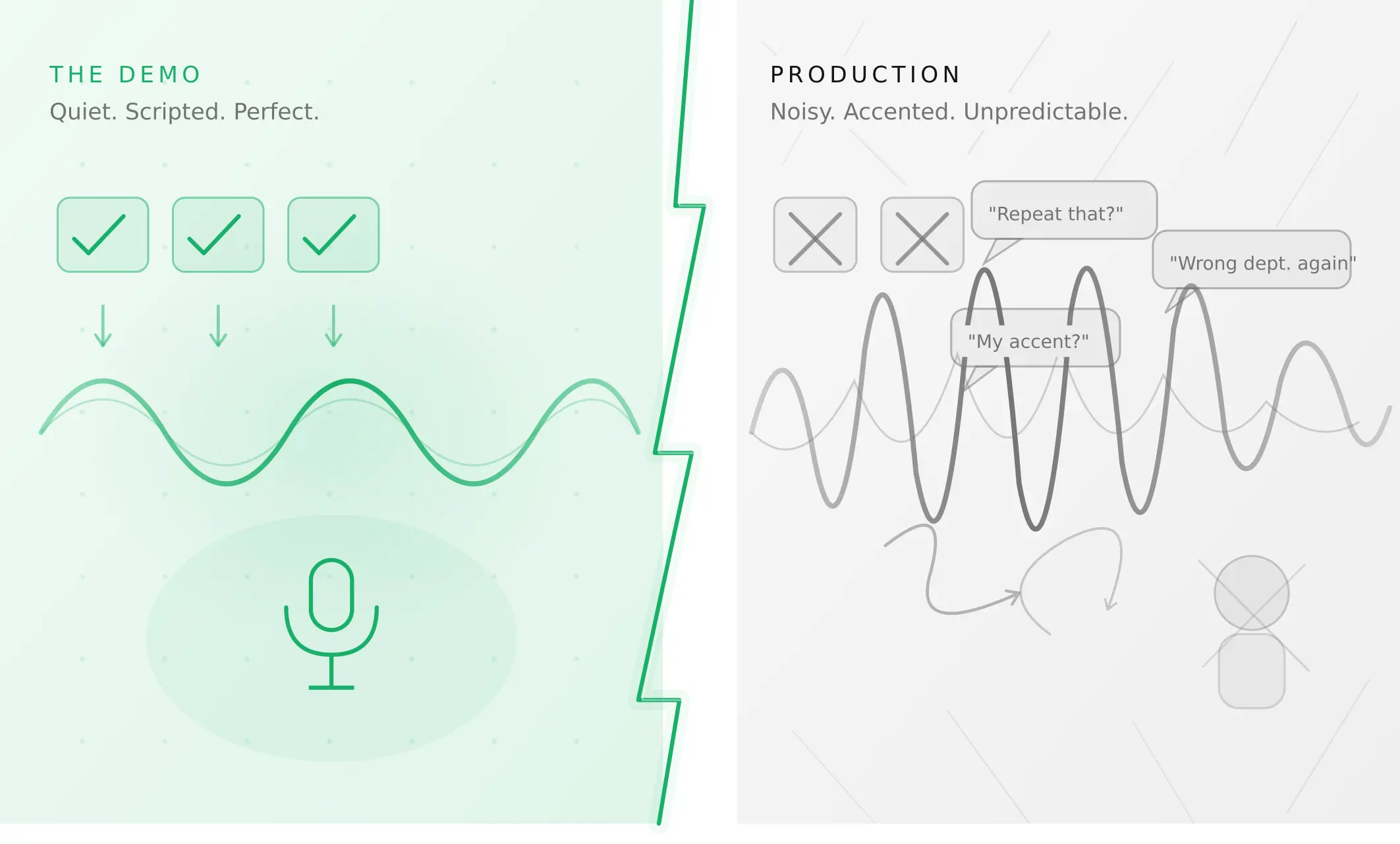
Why AI voice agents fail in production (and how to prevent it)
AI voice agents that ace demos still break in production. Learn the 5 root causes, how to test for each, and what production readiness actually means.
Read more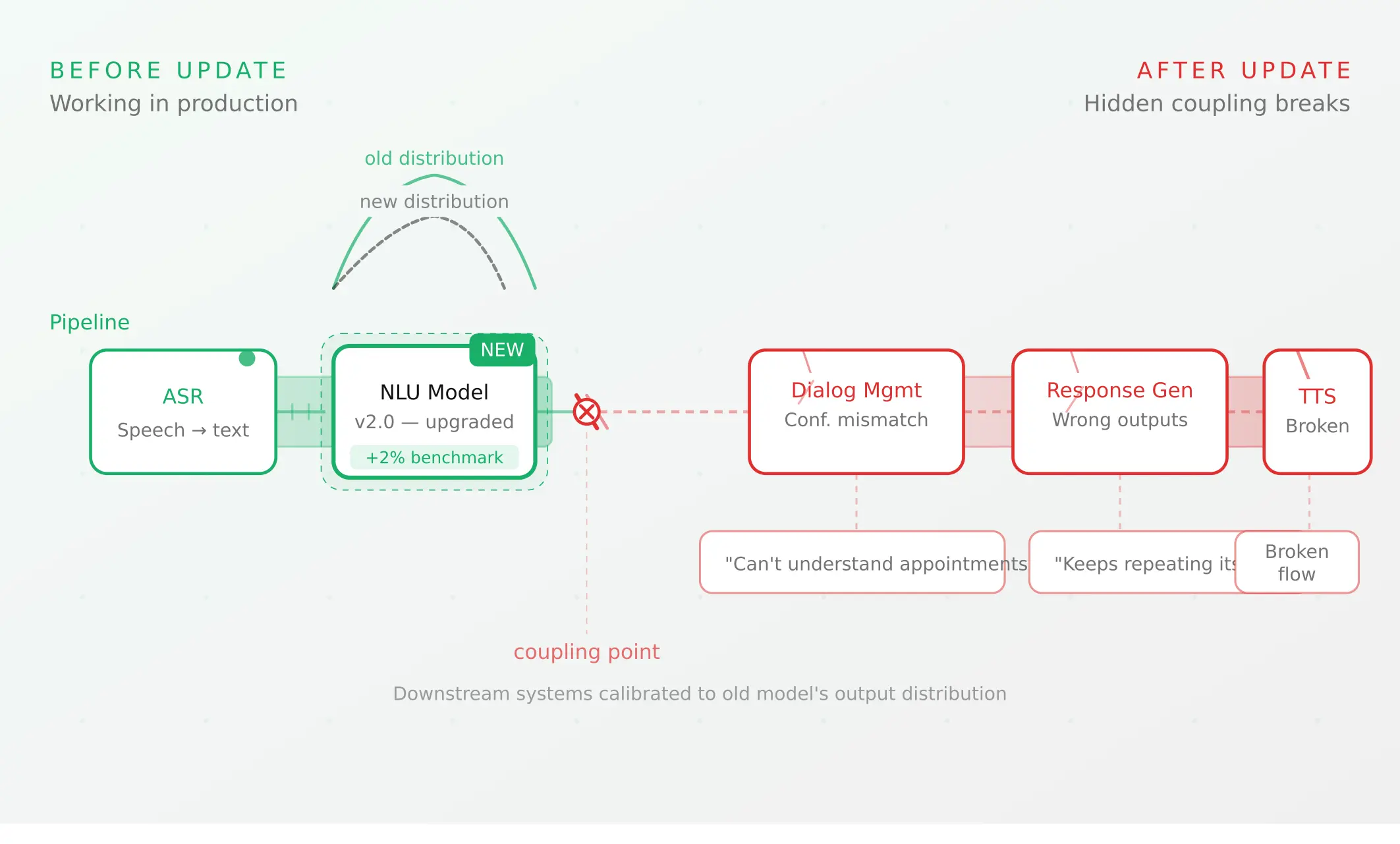
Voice agent regression testing: why LLM updates break production
LLM updates improve benchmarks but break voice agents in 5 predictable ways. How to detect and prevent regressions after every model or prompt change.
Read more