Test your voice agent
Voice Agent Vendor Benchmarking: A 2026 Guide
Everyone benchmarks voice agent vendors; almost no one benchmarks them well. A team runs a handful of test calls through two or three vendors, eyeballs the transcripts, and declares a winner — then the "winner" underperforms in production because the benchmark measured the wrong thing on too little data. Benchmarking is not hard because the concept is subtle. It is hard because a fair comparison has strict requirements, and skipping any of them quietly produces a confident, wrong answer. This guide covers those requirements and how to meet them.
We will define what makes a benchmark trustworthy, how to design and run one, the statistics that keep you from over-reading a small gap, and the mistakes that produce false winners. It builds directly on the vendor scorecard and the case for independent evaluation.
What makes a voice agent benchmark trustworthy
A benchmark) is only as good as its controls. Four properties separate a benchmark you can act on from a number that misleads.
Representative data. The test calls must reflect your real traffic — your callers' accents, your background noise, your tasks — not a clean sample that flatters everyone. A benchmark on studio audio predicts studio performance.
Fixed definitions. Every metric needs one precise definition applied to all vendors. "Accuracy" scored as transcription for one vendor and task success for another is not a comparison.
Controlled conditions. Everything except the vendor should be held constant — same calls, same profiles, same scoring — so differences are attributable to the agent and not to a confounding variable in the setup.
Reproducibility. You should be able to rerun the benchmark and get the same ranking. If the result changes when someone else runs it, it was noise, not signal — the standard of reproducibility that separates a measurement from an anecdote.
Miss any one, and the benchmark still produces a number — it just isn't a trustworthy one.
Designing the benchmark
Design happens before any vendor is touched. Start by choosing the metrics that matter for your use case: task success, accuracy weighted for critical entities rather than a clean-audio word error rate, latency at the tail judged against a real threshold like the ITU-T G.114 150ms comfort limit, escalation, and safety mapped to a framework such as the NIST AI Risk Management Framework. Write one fixed definition for each.
Then build the test set. Assemble scenarios and caller profiles that mirror your production traffic, deliberately including the hard cases — accents, noise, interruptions, and adversarial callers — because a benchmark that omits them measures the easy path only. Decide the conditions you will hold constant, and decide how many calls each scenario needs, which is a statistical question, not a guess.
How to benchmark voice agent vendors
Run the process identically for every vendor.
1. Fix the metrics and definitions — Lock the metrics and their exact definitions before testing, so no vendor is scored on a different yardstick.
2. Build one representative test set — Assemble scenarios and profiles from your real traffic, including the failures and edge cases.
3. Set an adequate sample size — Run enough calls per scenario that the result is stable, not a fluke of a few calls.
4. Run the identical calls on every vendor — Hold everything constant except the vendor, so the difference is the agent.
5. Score on your own data — Measure each metric yourself from the recordings, never accepting vendor-reported figures.
6. Test under production load — Re-run the critical metrics at expected peak concurrency, since rankings can invert under load.
7. Report with ranges, and re-run over time — Present results with their uncertainty, and repeat after model updates, because a benchmark is a snapshot.
The statistics that keep you honest
The most common benchmarking error is over-reading a small gap. If Vendor A scores 92% and Vendor B scores 90% on forty calls, that two-point difference may be pure noise — the sample size is too small to distinguish them. Treating it as a real gap picks a winner at random.
Two habits fix this. First, run enough calls per scenario that small differences become meaningful, and more where the metric varies a lot. Second, report results as ranges rather than single points, so a genuine gap is visible and a coin-flip gap is not mistaken for one. The same discipline applies under load, where variance grows: a ranking that holds on ten calls can dissolve on a thousand, which is why benchmarking at concurrency, as our stress testing guide covers, is part of a serious benchmark rather than an afterthought.
A worked benchmarking example
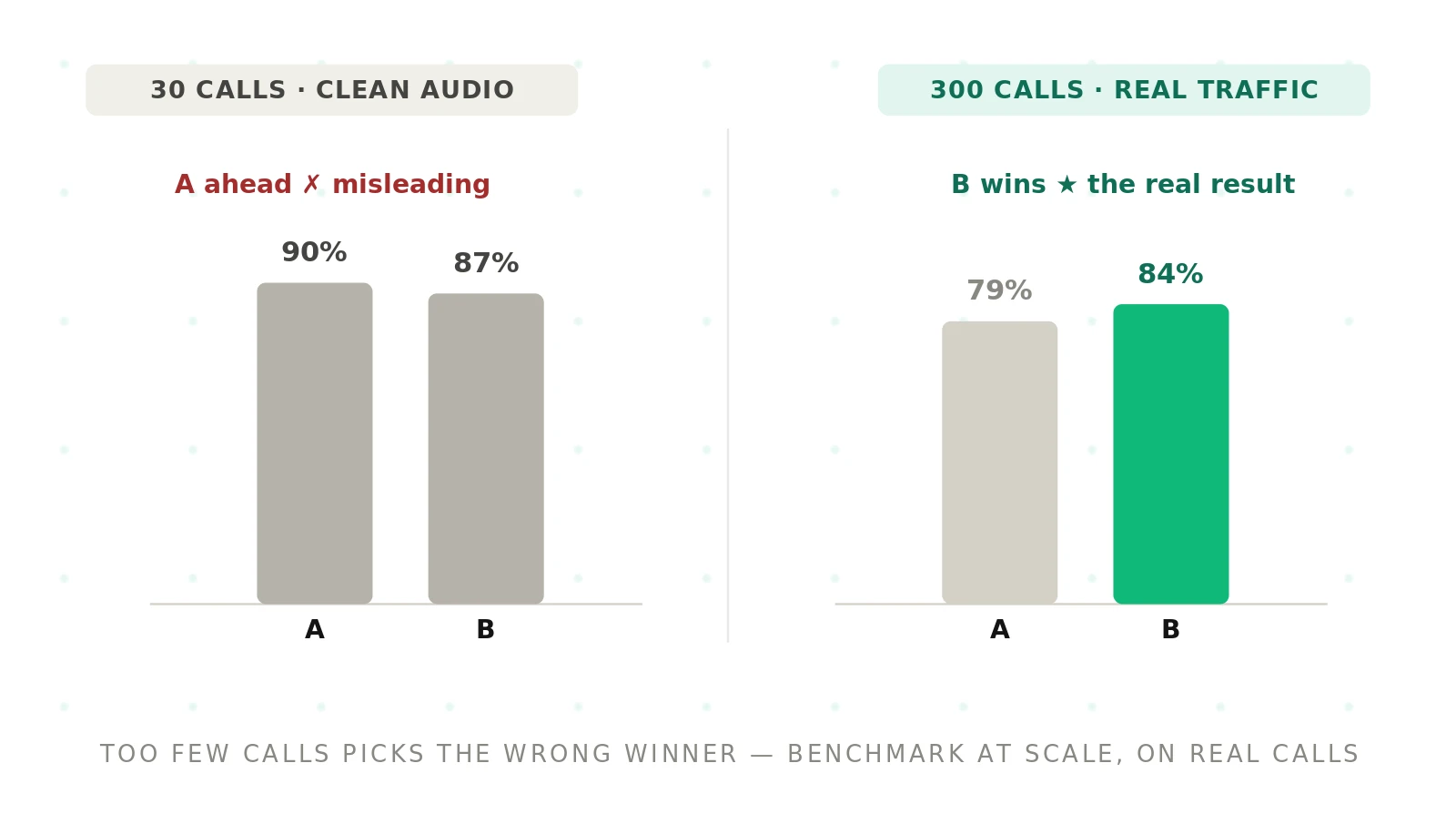
Two vendors are compared for a customer support line. On a quick run of thirty calls, Vendor A resolves 90% and Vendor B resolves 87%, and the team is ready to sign Vendor A. But thirty calls is far too few to separate a three-point gap, and the test used clean audio.
Rerun on three hundred representative calls — accents, background noise, and a share of angry callers — and the picture changes. Vendor B holds near 84% while Vendor A drops to 79%, because A's transcription degrades on noisy lines and it escalates poorly when callers push back. Under peak concurrency, A's latency also climbs past the point where callers hang up.
The quick benchmark picked the vendor that looked best on easy calls; the real benchmark picked the one that held up on hard ones. Same two vendors, opposite decision — determined entirely by sample size, representative data, and testing under load. Had the team signed on the thirty-call result, the wrong vendor would have gone live, and the failure would have surfaced only once real callers found it.
Trustworthy vs untrustworthy benchmarks
The contrast is the checklist.
| Property | Untrustworthy benchmark | Trustworthy benchmark |
|---|---|---|
| Data | Vendor sample or clean audio | Your representative calls |
| Definitions | Vary by vendor | Fixed, identical |
| Conditions | Uncontrolled | Held constant except vendor |
| Sample size | A handful of calls | Large enough to be stable |
| Reporting | Single numbers | Ranges with uncertainty |
| Reproducible | No | Yes |
Common benchmarking mistakes
The failures repeat. Benchmarking on too few calls and treating noise as a result. Using different definitions for each vendor without noticing. Testing on clean audio and being surprised by production. Letting a variable other than the vendor differ between runs, so the comparison is confounded. Reporting a single number with no uncertainty, so a coin-flip gap looks decisive. Benchmarking once and trusting it forever, when a model update can change the ranking. And optimizing to a public leaderboard, which measures the leaderboard, not your calls — the reason vendor benchmarks so often fail to predict how an agent handles your traffic, the theme of why vendor metrics mislead.
Benchmarking voice agent vendors with Evalgent
Evalgent runs benchmarks that meet these requirements by construction. Scenarios reproduce your real calls — accents, noise, interruptions, and adversarial callers — and run identically against every vendor, so conditions are held constant. Profiles vary caller characteristics deliberately, so the benchmark covers the distribution your traffic creates rather than a flattering slice. Metrics apply one fixed definition to every vendor and are measured on your own data, and Evaluations run enough calls at concurrency to make small differences meaningful rather than noise. Reviews let your team replay any call behind a score, so a ranking comes with the evidence for it. Because the same suite runs against everyone and can be rerun, the benchmark is reproducible.
The result is a ranking you can trust and defend: measured on your calls, controlled, and stable enough to act on. To benchmark the vendors you are weighing on identical calls, book a demo. For how the results feed a decision, see the vendor scorecard.
The bottom line
Voice agent vendor benchmarking is only useful when it is fair: your representative data, fixed definitions, controlled conditions, and a sample large enough to be reproducible. Anything less produces a confident number that does not predict production.
Run the identical benchmark against every vendor, report results with their uncertainty, and re-run after model updates. A quick eyeball of a few calls picks a winner at random; a real benchmark, run on enough representative calls and repeated over time, tells you which vendor holds up on the calls you actually get.
Frequently asked questions
What is voice agent vendor benchmarking?
Voice agent vendor benchmarking is the process of measuring several vendors against the same metrics, on the same representative calls, to rank them fairly. A trustworthy benchmark uses your own data, one fixed definition per metric, controlled conditions, and a sample large enough to be reproducible. It is how you turn competing vendor claims into a single comparison you can actually act on.
How do you benchmark voice agents fairly?
Lock the metrics and their exact definitions first, build a test set from your real traffic including edge cases, and run the identical calls against every vendor while holding everything else constant. Use enough calls per scenario that small differences are meaningful, score on your own data, test under load, and report results with their uncertainty rather than as single numbers.
How many test calls do you need to benchmark a voice agent?
Enough that the result is stable rather than a fluke — a handful of calls cannot distinguish vendors reliably. The exact number depends on how much the metric varies and how small a gap you need to detect; noisier metrics and closer vendors require more calls. Run more per scenario until rerunning the benchmark produces the same ranking, which is the practical test of adequacy.
Why do vendor benchmarks fail to predict production?
Usually because they measured the wrong thing on the wrong data. Clean-audio benchmarks miss the accents, noise, and interruptions of real calls; small samples turn noise into a false winner; and public leaderboards get optimized rather than reflecting your traffic. A benchmark predicts production only when it runs your representative calls, controlled and at scale, with metrics defined the same way for everyone.
What's the difference between a scorecard and a benchmark?
A benchmark is the measurement — running identical calls against every vendor and producing the numbers. A scorecard is the decision layer on top: the criteria, the weights for your use case, and the weighted total that names a winner. You benchmark to generate trustworthy, comparable numbers, then apply the scorecard's weights to turn those numbers into a defensible choice.
How do you avoid bias when benchmarking vendors?
Hold everything constant except the vendor, so no confounding variable enters the comparison. Use one fixed definition per metric, the same test set and profiles for everyone, and your own data rather than vendor samples. Report results with uncertainty so you don't over-read a small gap, and have a party with no stake in the outcome run or verify the benchmark to remove selection bias.
Should you use public voice AI benchmarks to choose a vendor?
Use them only as background. Public benchmarks rarely match your traffic, are often not fully reproducible, and get optimized once vendors compete on them, so a leaderboard winner can still fail your calls. Treat public results as context, then run your own benchmark on representative calls to make the actual decision, because only your data predicts your production performance.
How often should you re-benchmark voice agent vendors?
Re-benchmark after any vendor model update and on a regular cadence, because a vendor that led at selection can regress when its underlying models change. A benchmark is a snapshot, not a permanent verdict. Between full benchmarks, sample and score live calls continuously so regressions surface early, and refresh the full comparison before renewing a contract or expanding a deployment.
Related Articles
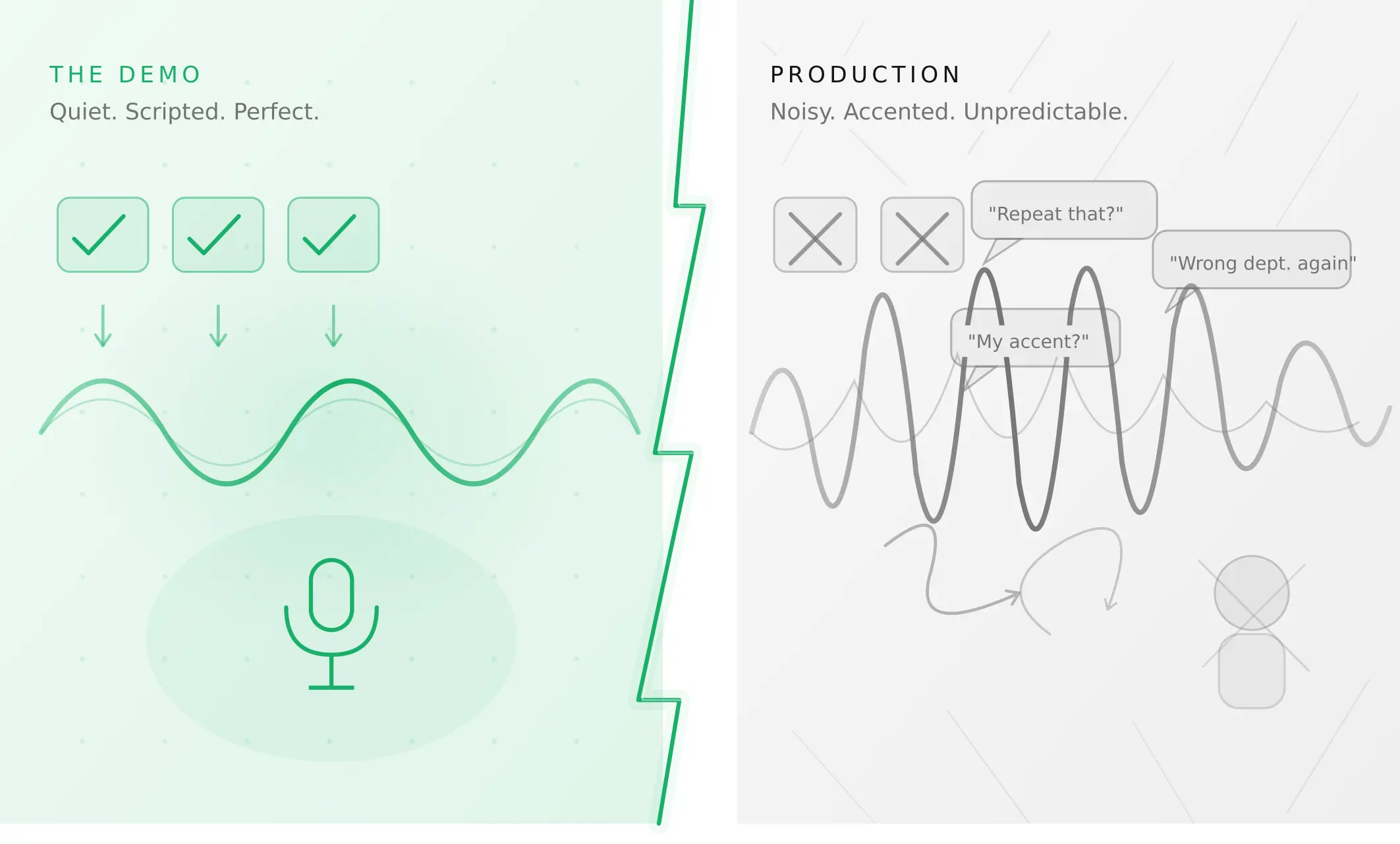
Why AI voice agents fail in production (and how to prevent it)
AI voice agents that ace demos still break in production. Learn the 5 root causes, how to test for each, and what production readiness actually means.
Read more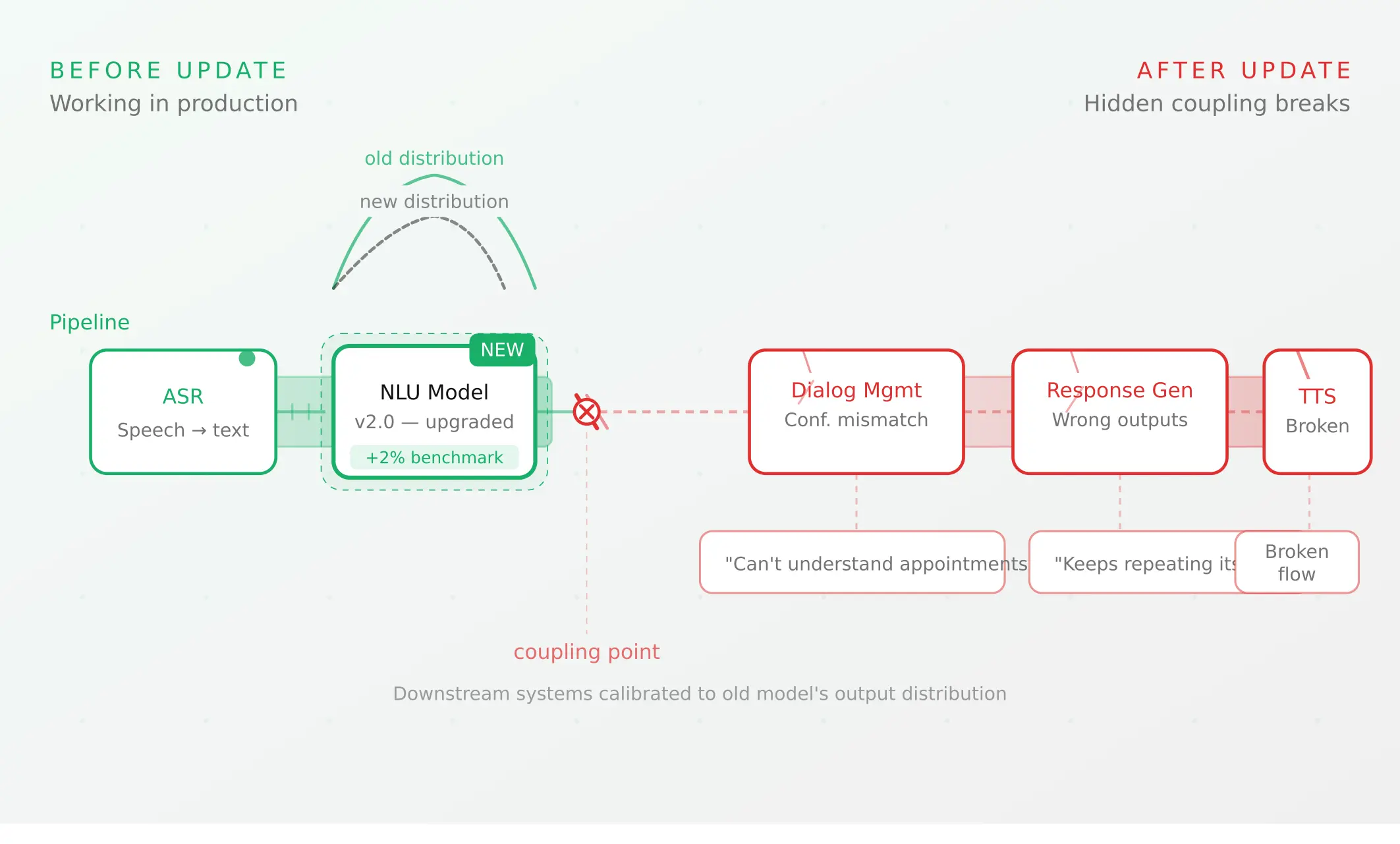
Voice agent regression testing: why LLM updates break production
LLM updates improve benchmarks but break voice agents in 5 predictable ways. How to detect and prevent regressions after every model or prompt change.
Read more