Voice agent testing for customer support: containment, accuracy, and escalation
On this page
Customer support is where most voice agents earn their keep, and where the temptation to chase one metric does the most damage. Push containment too hard and you trap callers or ship wrong answers; escalate too eagerly and the agent is just an expensive router. Good testing holds both in balance. Evalgent tests support agents for resolution, accuracy, and escalation together, and this guide explains how.
Customer support voice agent testing: verifying that a support voice agent resolves the calls it should, grounds its answers in a trusted source, and hands off cleanly on the ones it should not, measured by containment and accuracy together.
Why support voice agents are deceptively hard to test
A support agent looks simple — answer questions, resolve issues — but the difficulty is in the spread of what callers actually ask. Real support calls are ambiguous, multi-intent, and full of edge cases the demo never covers. The agent has to understand the real question, pull the right answer, and know when it is out of its depth.
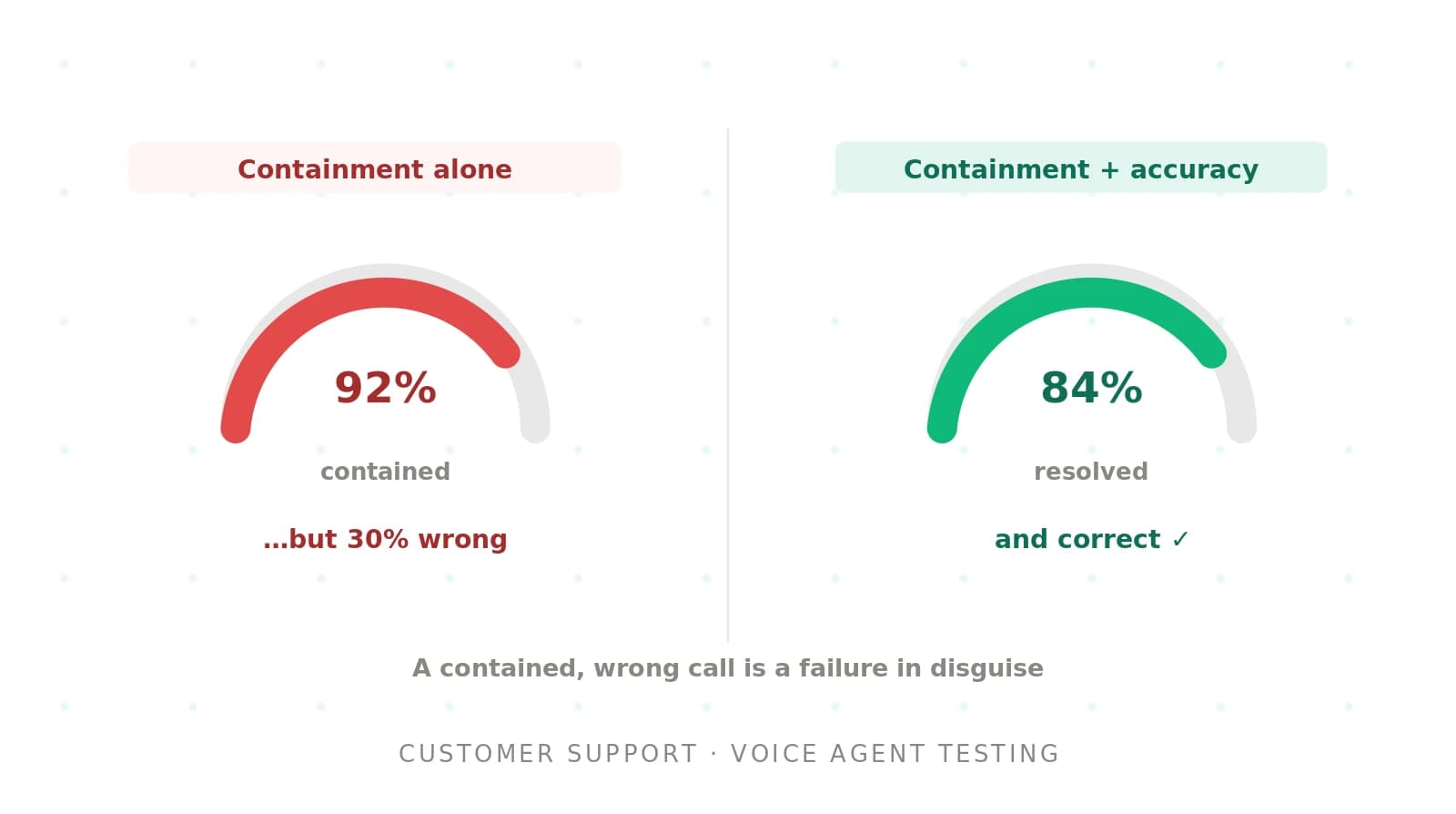
The trap is optimizing containment in isolation. Containment is the share of calls resolved without a human, and it is easy to inflate by never escalating. But a "contained" call where the caller got a wrong answer or gave up is worse than an honest handoff. Testing has to measure whether contained calls were actually resolved correctly, not just that no human was involved. Our piece on testing versus monitoring covers why a single production number can mislead here.
Containment and accuracy: the balance testing must hold
The central tension in support testing is between containment and accuracy, and a good test suite measures them against each other, not separately.
Containment tells you how much work the agent took off human queues. Accuracy tells you whether that work was done right. A high containment rate with low accuracy means the agent is confidently resolving calls wrong, which shows up later as callbacks, churn, and complaints. The right target is high containment on the calls the agent can genuinely handle, and clean escalation on the rest. Testing establishes that line by running the full range of calls and checking both dimensions on each.
First contact resolution is the business version of this. As the first call resolution concept captures, a call resolved right the first time is worth far more than one that technically ended. Test for genuine resolution, not just call termination.
Grounding: stopping the confident wrong answer
The fastest way a support agent destroys trust is answering confidently from nothing. If the agent invents a policy, a price, or a step, the caller acts on it and the problem compounds. Grounding is the fix, and testing has to verify it.
A grounded agent answers from a current knowledge base, not from the model's memory, and refuses or escalates when the answer is not there. Testing drives out-of-scope and edge questions designed to tempt a guess, then asserts the answer matches the source or the agent defers. This is the same discipline as our hallucinations guide, applied to the support knowledge base. When the knowledge base changes, re-testing catches answers that drifted.
Multi-turn and context: resolving real issues
Support calls rarely resolve in one exchange. A caller explains a problem, gives an account detail, answers a clarifying question, and expects the agent to hold all of it. When the agent forgets what was said earlier, the call collapses into repetition.
Testing has to cover multi-turn resolution: information given early that must be used later, references to earlier turns, and context that has to survive a tool call or lookup. Our context retention guide covers this failure mode directly, and in support it is one of the most common reasons a contained call still fails.
The support scenarios you must test
A strong support scenario set spans the easy resolutions, the ambiguous cases, and the ones that should escalate.
| Scenario | What it tests |
|---|---|
| Common FAQ resolution | Correct, grounded answer |
| Account-specific request | Authentication, then correct action |
| Ambiguous or vague issue | Clarification, not a wrong guess |
| Multi-intent call | Handling more than one need in a call |
| Out-of-scope question | Deferral or escalation, not a guess |
| Explicit request for a human | Clean, in-context handoff |
| Frustrated or repeat caller | Sentiment handling and recovery |
Metrics that matter in customer support
Support metrics only make sense as a set. Containment without accuracy is misleading; accuracy without containment means the agent is not doing enough.
Track containment rate and task completion together, so you see resolution, not just call end. Track answer accuracy against the knowledge base to catch confident wrong answers. Track escalation accuracy: correct handoffs on the calls that need them, and no over-escalation on the ones the agent should handle. Track first contact resolution as the business outcome, and sentiment as an early warning of frustration. Read them as a scorecard — the point is to stop one good number from hiding a bad one.
Regression: keeping containment honest over time
A support knowledge base and prompt change constantly, and each change can quietly break a resolution that worked last week. Testing a support agent is not a one-time launch gate but a suite you re-run on every update, so a prompt tweak that fixes one intent does not regress another.
The strongest support teams treat their scenario set as a living asset. Every new failure found in production becomes a test, and the suite grows into a precise map of how the agent should behave across the full range of calls. That is what turns a rising containment rate into a trend you can trust rather than a number that drifts as the agent changes. Without regression coverage, containment and accuracy can quietly diverge between releases, and the first sign is a wave of callbacks — long after the change that caused it shipped.
Common failure modes in support agents
| Failure | Why it hurts | Test for it |
|---|---|---|
| High containment, low accuracy | Confident wrong resolutions | Assert accuracy on contained calls |
| Confident wrong answer | Erodes trust, causes callbacks | Assert grounding against the source |
| Lost context across turns | Caller repeats, call fails | Test multi-turn retention |
| Missed escalation | Caller trapped, no resolution | Assert handoff on unresolved calls |
| Over-escalation | Wastes human queues | Assert the agent resolves what it can |
Authentication and account-specific actions
Many support calls are not general questions but account-specific requests — checking an order, changing a plan, resetting access. These require the agent to authenticate the caller before it acts, and that gate is easy to test and easy to get wrong.
Testing has to cover the verification step and the action it protects. Assert the agent confirms identity before revealing account details or making changes, refuses gracefully when verification fails, and does not leak whether a specific detail was the one that did not match. Then assert the action itself is correct: the right plan changed, the right order looked up.
These calls also raise escalation in a specific form. When a caller cannot verify but has a legitimate need, the agent should route them to a human path rather than dead-ending. Testing both the authenticated success and the graceful failure keeps account actions from becoming either a security gap or a source of stuck callers.
Testing customer support voice agents with Evalgent
Evalgent tests support agents for resolution and accuracy at once, on realistic calls. Scenarios span common questions, ambiguous and multi-intent calls, out-of-scope prompts, and explicit escalation requests, so containment and accuracy are measured together. Profiles vary caller phrasing, sentiment, accent, and noise, so the agent faces the real spread of support calls. Metrics encode containment, task completion, answer accuracy, and escalation accuracy with thresholds you set, so a high containment rate cannot hide wrong answers. Evaluations run the suite as automated batches before every release. Reviews let your team replay a failed resolution and hear exactly where it went wrong.
The result is a support agent that resolves more without resolving wrong: high containment on the calls it can handle, clean handoffs on the rest. For the broader discipline, see the AI voice agent testing pillar.
Conclusion
Customer support voice agent testing is about holding containment and accuracy in balance rather than chasing either alone. A contained call that got a wrong answer or trapped the caller is a failure dressed up as a success.
Test resolution and accuracy together, ground every answer in a trusted source, and verify clean escalation on the calls the agent cannot handle. That is how you raise containment safely instead of hiding failures behind it.
Frequently asked questions
How do you test a customer support voice agent?
Build scenarios across easy resolutions, ambiguous and multi-intent calls, out-of-scope questions, and explicit escalation requests. Drive them with varied caller phrasing and sentiment, and measure both containment and accuracy on each call. Assert answers are grounded in the knowledge base, context survives across turns, and unresolved calls escalate cleanly. Gate releases on the combined scorecard.
What is a good containment rate for a voice agent?
There is no universal number; it depends on the complexity of your calls and your knowledge base coverage. The important point is that containment only counts if those calls were resolved correctly. A high containment rate with low accuracy is worse than a lower rate with clean escalation, so always read containment alongside task completion and answer accuracy.
How do you test containment for a voice agent?
Run the full range of calls the agent will receive and measure how many it resolves without a human — but verify each contained call was actually resolved correctly, not just ended. Pair the containment number with accuracy and escalation checks, so you can tell genuine self-service from calls where the agent guessed wrong or the caller gave up.
How do you test escalation in a support agent?
Drive calls that should hand off — out-of-scope questions, unresolved issues, and explicit requests for a person — and assert the agent escalates within a sensible limit and passes context to the human. Separately, test that it does not over-escalate on calls it can resolve. Escalation accuracy in both directions is what keeps containment honest.
How do you stop a support agent giving wrong answers?
Ground it in a current knowledge base so it answers from source rather than memory, and give it a refusal path for questions it cannot answer. Then test with out-of-scope and edge questions that tempt a guess, asserting the answer matches the source or the agent defers. Re-test whenever the knowledge base changes, since answers can drift.
What metrics matter for support voice agents?
Read them as a set: containment rate and task completion together to measure real resolution, answer accuracy to catch confident wrong answers, escalation accuracy in both directions, first contact resolution as the business outcome, and sentiment as an early warning. The goal is a scorecard where no single number can hide a failure in another.
How do you test first contact resolution?
Test whether calls are genuinely resolved on the first interaction, not just ended, by asserting the caller's actual issue was handled correctly and did not require a follow-up. Include ambiguous and multi-intent calls, since those are where first contact resolution breaks. Treat a call that ends without resolving the underlying issue as a failure, even if it was contained.
How do you test a voice agent against a knowledge base?
Build a fact set from the knowledge base, then run questions — including edge and out-of-scope ones — and assert each answer matches the source or the agent defers. Test that updates to the knowledge base are reflected and that stale answers are caught. This grounding check is what separates a reliable support agent from one that guesses convincingly.
Related Articles
How to automate voice agent testing: synthetic callers vs manual QA
Learn how ai test automation replaces manual QA for voice agents. Compare synthetic callers vs human testers, with a 5-step framework to scale without hiring.
Read more
AI Agent Testing vs Voice Agent Testing: What General Tools Miss for Voice
AI agent testing measures text outputs. Voice agent testing measures behaviour through an acoustic pipeline. Five failure categories general tools miss.
Read more