How to test context retention in AI voice agents
On this page
Nothing makes a caller feel unheard faster than being asked their name twice. Context retention is what keeps a call feeling like one conversation, not a series of resets. Evalgent tests this across turns. Here is how retention breaks and how to test it.
Context retention: the agent's ability to carry information from earlier in a call — names, account details, stated goals, prior answers — and use it correctly in later turns.
What lost context looks like
These are the symptoms on a real call:
- The agent asks for a detail the caller already gave.
- It forgets the caller's stated goal halfway through.
- It loses the thread after a tool call or a transfer.
- It cannot resolve a reference like "the first option."
- It contradicts something it said earlier in the call.
The signal is repetition. When the agent re-asks what it was told, retention has failed.
Why voice agents lose context
Retention is a state problem. The agent has to hold prior turns and feed the relevant ones back to the model, and that breaks in several ways. The table maps each cause to what you hear and how to fix it.
| Cause | How it shows on a call | Fix |
|---|---|---|
| No conversation state | Re-asks details every turn | Maintain call state; feed prior turns to the model |
| Context window overflow | Forgets the start of a long call | Summarize earlier turns; keep key facts pinned |
| State lost on tool calls | Loses the thread after a lookup | Preserve context across tool calls and returns |
| Poor reference resolution | Cannot handle "the first one" | Track entities so references map to real values |
| No slot memory | Collects the same field twice | Store filled slots; do not re-request them |
| Reset on handoff | Human or sub-flow starts blind | Pass the full context on every transition |
How to test context retention in AI voice agents
1. Write multi-turn scenarios — Give a detail early, then require it several turns later, and assert the agent uses it.
2. Interrupt the flow — Insert a tool call or topic change, then check the earlier context survived.
3. Test references — Use phrases like "the first one" and assert the agent resolves them correctly.
4. Run long calls — Push past the easy length to see when the start of the call drops out.
5. Check slot memory — Confirm the agent never re-asks a field the caller already provided.
6. Assert consistency — Verify the agent never contradicts something it said earlier in the call.
A worked example
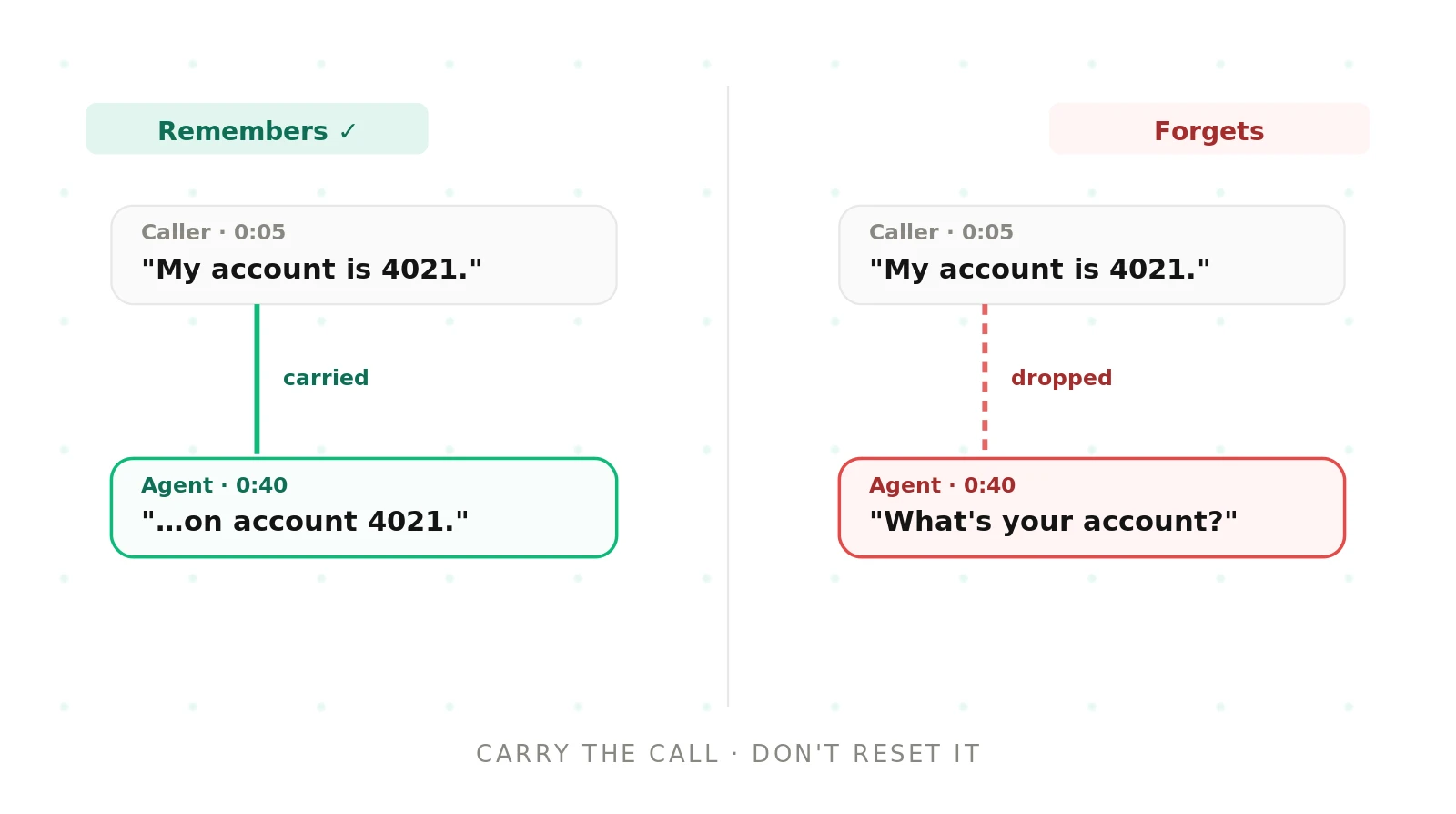
A caller gave their account number in the first ten seconds. Four turns later, after a balance lookup, the agent asked for the account number again. The tool call had reset the working context, so the earlier detail was gone. The transcript looked polite, but the caller was clearly annoyed. Only a multi-turn scenario — give a detail early, require it after a tool call — exposed the drop.
Testing context retention with Evalgent
Evalgent tests retention the way real calls unfold, across many turns. Scenarios give information early and require it later, including after tool calls, topic changes, and long stretches of conversation. Profiles vary how callers phrase and reference things, so the agent faces real ambiguity. Metrics assert the agent used prior context and never re-asked a known detail, with thresholds you set. Evaluations run the multi-turn suite as batches of synthetic callers before release. Reviews let you replay a call and see the exact turn where context dropped. On the model side, see best LLM for voice agents. For failure modes, see why voice agents fail in production.
The bottom line
Context retention is what makes a call feel like one conversation, and it breaks most often on long calls and after tool calls. Test with multi-turn scenarios that require early information later, and assert the agent never re-asks what it was already told.
Frequently asked questions
What is context retention in a voice agent?
Context retention is the agent's ability to remember what the caller said earlier in the same call and use it correctly later. That includes names, account details, the stated goal, and prior answers. Good retention makes the call feel like one conversation; poor retention makes the agent re-ask things and feel like it is not listening.
Why does my voice agent forget what I said?
Usually because it is not holding conversation state, or the call has grown past the model's context window. Tool calls and transfers are common culprits, since they can reset the working context. Without a deliberate way to store and feed back prior turns, the agent only sees a narrow slice of the conversation.
How do you test context retention in a voice agent?
Write multi-turn scenarios where a detail is given early and required several turns later, then assert the agent uses it. Interrupt the flow with a tool call or topic change and check the context survived. Test reference resolution, run long calls, and confirm the agent never re-asks a field the caller already provided.
Why does my voice agent re-ask for information it already has?
Because it lacks slot memory, so it treats each field as unfilled every time it needs it. It may also be losing state across turns or tool calls. The fix is to store filled slots and prior turns, and feed them back, so the agent knows a detail was already collected and does not request it again.
How does context window size affect a voice agent?
The context window limits how much of the conversation the model can see at once. On a short call it rarely matters, but a long call can push early turns out of the window, and the agent forgets how it started. Summarizing earlier turns and pinning key facts keeps important context available without overflowing.
Do tool calls cause context loss?
They often do. A tool call can reset or crowd out the working context, so the agent returns from a lookup having lost the thread. Preserve the conversation state across the call and its return, and test the path directly by inserting a tool call mid-scenario and asserting the earlier context is still used.
How do you test multi-turn conversations?
Script conversations that span many turns, where success depends on information from earlier turns, not just the latest one. Include interruptions, references like "the first one," and long stretches. Assert the agent carries context forward, resolves references, and completes the multi-turn task, rather than only handling each turn in isolation.
What metrics measure context retention?
Useful measures include a context-retention rate, a repeat-question rate that counts how often the agent re-asks known details, and multi-turn task success. Track them per scenario, since retention breaks unevenly — long calls and post-tool-call turns fail most. Use the numbers as a release gate so a regression in memory is caught before production.
Related guides
How to test tool calling in AI voice agents
Tool calling fails when a voice agent picks the wrong function, fills bad arguments, or acts silently. Learn how to test tool calling and catch it.
How to reduce latency in AI voice agents
Voice agent latency is the pause before the agent replies. Learn what drives it, what a good target is, and how to reduce latency without losing quality.