Test your voice agent
Containment vs Resolution: Which to Track
# Containment vs resolution: which to track
Quick answer
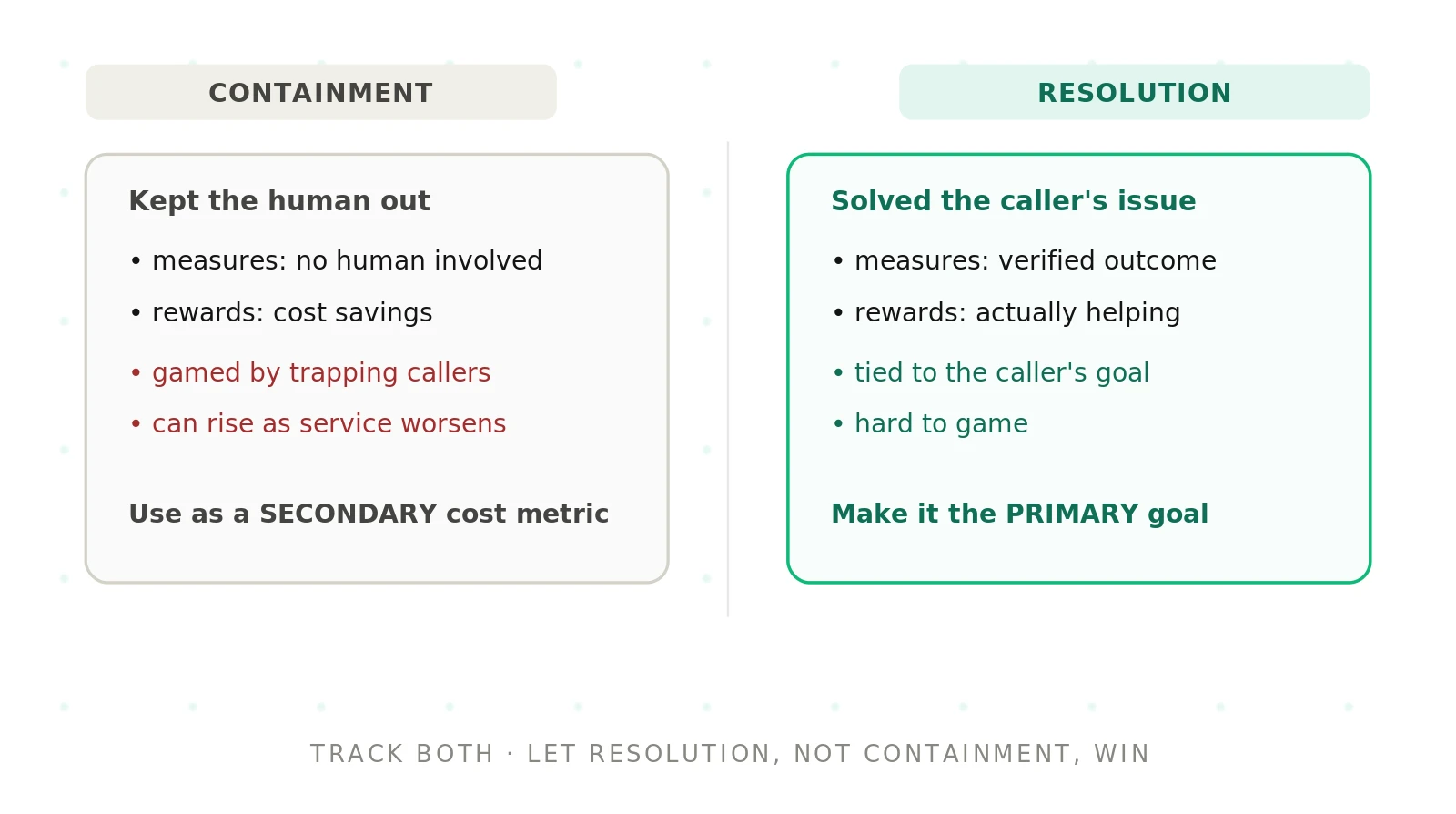
> Quick answer: In voice agent containment vs resolution, containment counts calls handled without a human, while resolution counts calls where the issue was actually solved. Track resolution as your primary goal. Containment is a fine secondary cost metric, but on its own it rewards trapping callers.
Most voice agent dashboards lead with containment. It is the first number teams cite and the one they optimize hardest. That is the mistake this post is about.
Containment tells you the agent avoided a human. It does not tell you the caller got what they needed. Those are different questions with different answers. When you chase the first, you can lose the second without noticing.
This post compares containment and resolution and argues which belongs at the top of your scorecard. For the mechanics of each rate, see how to measure containment rate and resolution rate. For a related but separate distinction, our containment versus deflection guide draws that line. Evalgent is an independent evaluator, so our stake here is a metric you can defend.
What each metric actually measures
The two metrics answer two different questions. Say them out loud and the gap is obvious.
Containment asks a cost question. Did the agent finish this call without a human? Resolution asks an outcome question. Did the caller leave with the thing they came for? One is about work avoided. The other is about work done.
> Containment rate: the share of qualifying calls a voice agent handles to the end without a human, shown as a percentage. It counts calls the agent finished, not the caller's outcome.
> Resolution rate: the share of calls where the caller's issue was actually solved, verified by evidence outside the agent's own claim. It counts outcomes, not just completed flows.
Containment lives in the self-service family. The caller served themselves through the agent, with no live person. Resolution lives in the customer service family. It asks whether the service actually happened. A call can be contained and unresolved at the same time. That single fact is the heart of this comparison.
Resolution is close to first call resolution in a traditional contact center. It asks whether one contact settled the issue. The difference is who does the resolving, and how honestly you check it.
Why teams over-optimize containment
Containment wins attention for three reasons. All three are understandable. None of them make it the right primary metric.
First, containment is easy to measure. You can compute it from call routing logs alone. A call either reached a human or it did not. No transcript reading, no outcome checking, no judgment. Resolution needs evidence, and evidence takes work.
Second, containment maps directly to cost. Each contained call is a human minute saved. Finance understands that number instantly. It fits a spreadsheet and a payback model. Resolution maps to satisfaction and retention, which are slower to see and harder to price.
Third, containment usually looks good. Vendors report it because it flatters the product. A high number feels like proof the agent works. So it becomes the headline, and the headline becomes the target.
That last step is the danger. When a proxy becomes the target, it stops being a good proxy. This is Goodhart's law in one line. Containment is a proxy) for a working agent. Optimize the proxy and you can wreck the thing it stood for.
How optimizing containment goes wrong
Push containment hard and you teach the agent one lesson. Keep the caller off the human queue at any cost. That lesson has ugly ways to succeed.
The agent can stall. It can loop through clarifying questions. It can refuse to offer a transfer. It can talk until the caller gives up and hangs up. Every one of those raises containment. Not one of them solves the problem.
A trapped caller looks identical to a served caller in a routing log. Both stayed with the agent. Both never reached a person. Containment cannot tell them apart. Only an outcome check can.
Containment vs resolution compared
The table below sets the two metrics side by side. Read the gaming risk row twice. That is where most teams get hurt.
| Dimension | Containment | Resolution |
|---|---|---|
| What it measures | Calls handled without a human | Calls where the issue was actually solved |
| Question it answers | Did we avoid a human? | Did the caller get what they needed? |
| Primary lens | Cost and deflection | Outcome and satisfaction |
| Data needed | Routing logs only | Verified evidence: transcript, system record, or review |
| Ease of measurement | High, automatic from logs | Lower, needs outcome verification |
| What it rewards | Keeping callers on the line | Getting the caller's task done |
| Gaming risk | High: stalling and trapping both inflate it | Low: hard to fake a verified outcome |
| Blind spot | Trapped and abandoned callers count as wins | Almost none when outcomes are verified |
| Best used as | Secondary cost metric | Primary goal, the north-star |
The pattern is clear. Containment is cheap to measure and easy to game. Resolution is costlier to measure and hard to fake. The metric that resists gaming is the one that belongs at the top.
When containment is still a useful metric
Containment is not a bad number. It is a bad primary number. As a secondary metric it earns its place.
Use containment to size cost. Once resolution is stable, containment tells you how much human time the agent saved. That is a real and useful figure for a budget. Pair it with a cost-per-resolution view and finance has what it needs.
Use containment to spot capacity limits. A sudden drop can flag an outage, a broken tool, or a routing bug. As an operational signal it is fast and cheap. Watch it move, then check whether resolution moved with it.
The rule is simple. Report containment beside resolution, never alone. A containment number without a resolution number next to it is missing its context. On its own it is closer to a vanity stat than a key performance indicator.
Why resolution should be the primary goal
Resolution should sit at the top of the scorecard for one reason. It is the metric tied to the outcome that matters. The caller called to solve a problem. Resolution measures whether that happened.
Everything the business cares about flows from resolution. Satisfaction, retention, and repeat contact all track the resolved outcome, not the contained one. A resolved call rarely comes back. An unresolved call almost always does. That return trip costs more than the human you avoided the first time.
Resolution also resists gaming. You cannot stall your way to a resolved call. You cannot trap your way there either. A verified outcome needs a real result: an order placed, a balance corrected, an appointment booked. The metric is honest because the evidence sits outside the agent's own claim.
For teams that want one headline number, resolution or verified task success is the right choice. We make that case in full in our north-star metric post. Containment sits under it as support, not above it as the goal.
Resolution, verified task success, and their limits
Resolution and verified task success are close cousins. Both ask whether the caller's intent was met. Both need evidence, not the agent's word. Where they differ is scope. Task success can be judged per task inside a call. Resolution judges the whole contact.
Neither is free. Verification costs effort, whether through downstream records, transcript review, or human judgment. That cost is exactly why teams retreat to containment. The answer is not to retreat. It is to sample. You do not need to verify every call to trust the rate. You need a defensible sample and a written definition.
What tracking only containment hides
A containment-only dashboard hides a specific and dangerous pattern. The headline rises while the service degrades. Here is how the trap closes.
Containment climbs because the agent stops offering transfers. Resolution falls because more callers leave unserved. But you are not watching resolution, so you do not see the fall. The dashboard is green. The customers are not.
The hidden cost surfaces as repeat contact. An unresolved caller calls back. That second call may reach a human, or it may fail again. Either way, your true cost per solved issue went up, not down. Containment counted the first call as a win and ignored the return.
Dissatisfaction hides the same way. A trapped caller is an angry caller. They churn, complain, or escalate through another channel. None of that shows in a containment number. It shows in retention and reviews, weeks later, when the cause is hard to trace.
> Repeat-contact leakage: the share of contained calls that generate a follow-up contact within a set window. It exposes calls that looked contained but were never resolved.
This is why containment alone can hide a worsening agent. The metric that is easiest to report is the one least able to see the problem. To catch it, you have to measure the outcome you skipped.
How to track both without letting containment win
You can keep containment on the board without letting it drive behavior. The trick is order and pairing. Track both, but let resolution set the target. Here is the method.
1. Write the resolution definition first. Decide what "resolved" means and what evidence proves it. Use a transcript, a downstream system record, or a human review. Put it in writing so it cannot drift month to month.
2. Make resolution the primary target. Set the team's goal on resolution or verified task success. Containment becomes a reported number, not a target. This alone removes most of the gaming pressure.
3. Never show containment without resolution. Put the two numbers on the same line of the same dashboard. A rise in containment must be read against resolution before anyone celebrates.
4. Add a repeat-contact check. Measure how many contained calls come back within a set window. Rising repeat contact next to rising containment is the signature of trapped callers.
5. Verify a sample, not the log. You cannot trust self-reported success. Pull a representative sample of contained calls and confirm the outcome with evidence outside the agent's claim.
6. Segment by intent. Split both metrics by call type. A high overall containment can hide one intent where the agent traps everyone. Segments expose the pocket the average conceals.
7. Have an independent party check the definition. A vendor grading its own containment has an incentive to be generous. An independent evaluator applies the same rules to every call. That is where we come in.
Follow these steps and containment can no longer win by itself. It stays a cost signal. Resolution stays the goal. For the full metric stack, see our voice agent metrics scorecard.
Choosing based on your situation
The right emphasis shifts a little by context. The principle does not. Resolution leads; containment supports.
For a support line handling billing and account issues, resolution leads clearly. An unresolved billing call is a guaranteed callback and a guaranteed cost. Containment here is almost pure vanity if it stands alone.
For a high-volume, low-stakes deflection use case, such as store hours or order status, containment matters more as a cost lever. Even then, verify that contained calls actually answered the question. A wrong answer delivered confidently is worse than a transfer.
For a regulated workflow, resolution and verified outcome are non-negotiable. A contained call that gave incorrect guidance is a compliance risk, not a saving. The evidence trail is the point. Independent evaluation, covered in our independent voice AI evaluation explainer, gives you that trail.
Across all three, the shape is the same. Pick resolution as the goal, size cost with containment, and verify the calls you call contained.
Frequently asked questions
Should you track containment or resolution for a voice agent?
Track both, but make resolution the primary goal. Resolution measures whether the caller's issue was actually solved, which is the outcome the business cares about. Containment is a useful secondary cost metric that shows how much human time was saved. Reported alone, containment rewards trapping callers rather than serving them.
Why do teams over-optimize containment rate?
Containment is easy to measure from routing logs, maps directly to cost savings, and usually looks good on a dashboard. Vendors report it because it flatters the product. Those incentives push it to the top of the scorecard. Once a proxy becomes the target, teams start optimizing the number instead of the outcome behind it.
How does containment differ from resolution?
Containment counts calls the agent handled without a human. Resolution counts calls where the caller's issue was actually solved and verified. A call can be contained but unresolved, for example when a caller gives up and hangs up. Containment reads that as a win. Resolution reads it as the failure it is.
Can a high containment rate hide a bad voice agent?
Yes. An agent can raise containment by stalling, looping, or refusing to transfer until callers give up. Those trapped calls look identical to served calls in a routing log. Without a resolution metric beside it, a rising containment number can mask falling service and growing repeat contact for weeks.
Is containment a good primary metric for voice agents?
No. Containment is a good secondary metric and a poor primary one. As the top target it rewards keeping callers on the line, not solving their problems. Use it to size cost and spot outages, always beside resolution. Let resolution or verified task success set the goal your team optimizes toward.
What does tracking only containment hide?
It hides unresolved callers and their cost. Containment counts trapped and confused callers as successes. Those callers call back, churn, or escalate elsewhere, which raises your true cost per solved issue. Because you are not measuring resolution, the dashboard stays green while satisfaction and retention quietly fall.
What is repeat-contact leakage?
Repeat-contact leakage is the share of contained calls that generate a follow-up contact within a set window. It exposes calls that looked contained but were never resolved. Watching it beside containment catches trapped callers early. Rising leakage next to rising containment is a clear sign the agent is deflecting, not solving.
Is resolution rate the same as task success rate?
They are close but not identical. Task success is judged per task inside a call. Resolution judges the whole contact and asks whether the caller's overall intent was met. Both require evidence outside the agent's own claim. Either works as a primary goal, as long as the definition is written down and verified on a real sample.
The bottom line
Track resolution as the primary goal and keep containment as a secondary cost metric. Containment reported alone rewards trapping callers and hides the repeat contacts that prove the issue was never solved.
Ready to see which of your calls are truly resolved, not just contained? Book a demo and we will audit your voice agent on your own call data, as an independent third party.
Related Articles
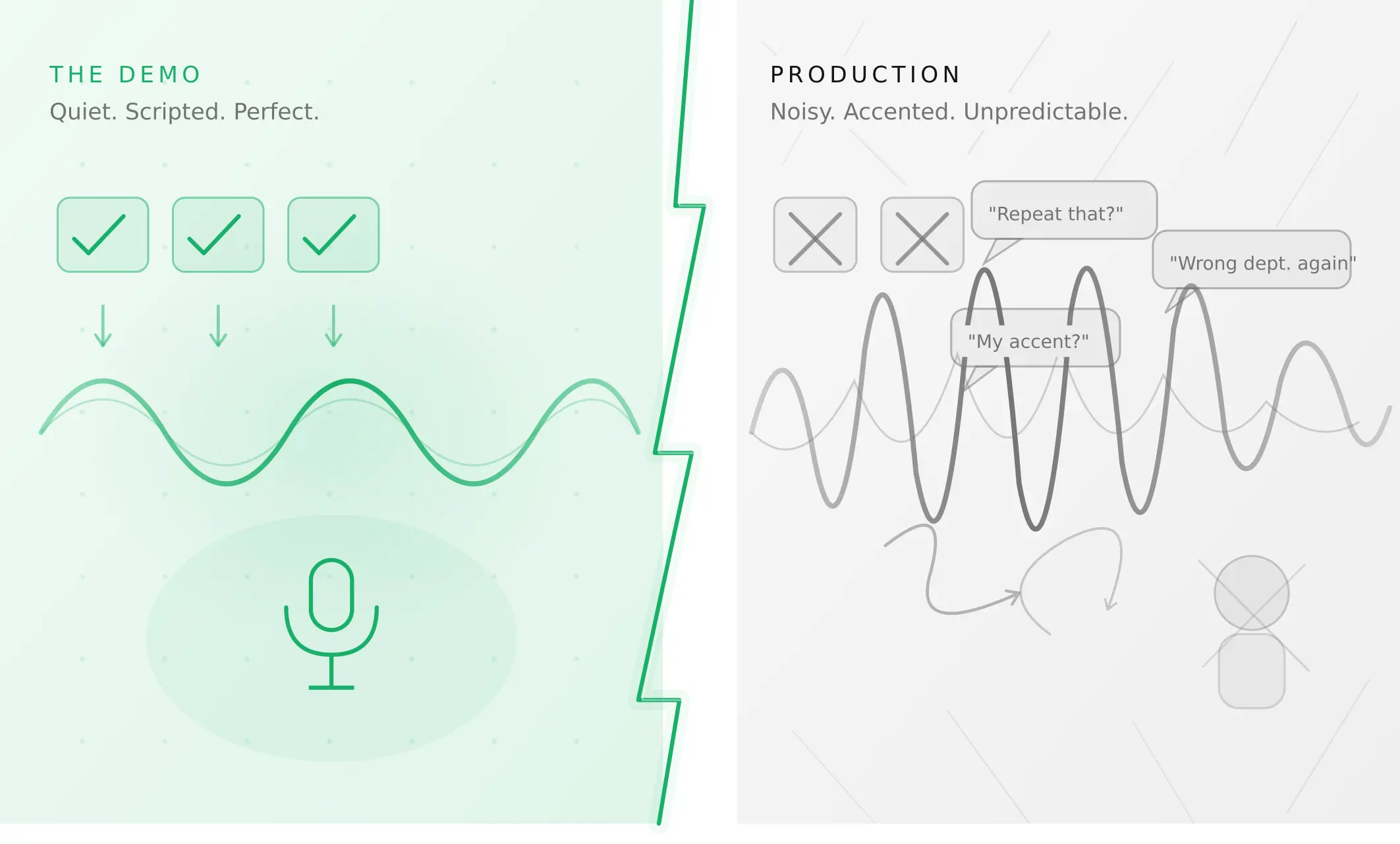
Why AI voice agents fail in production (and how to prevent it)
AI voice agents that ace demos still break in production. Learn the 5 root causes, how to test for each, and what production readiness actually means.
Read more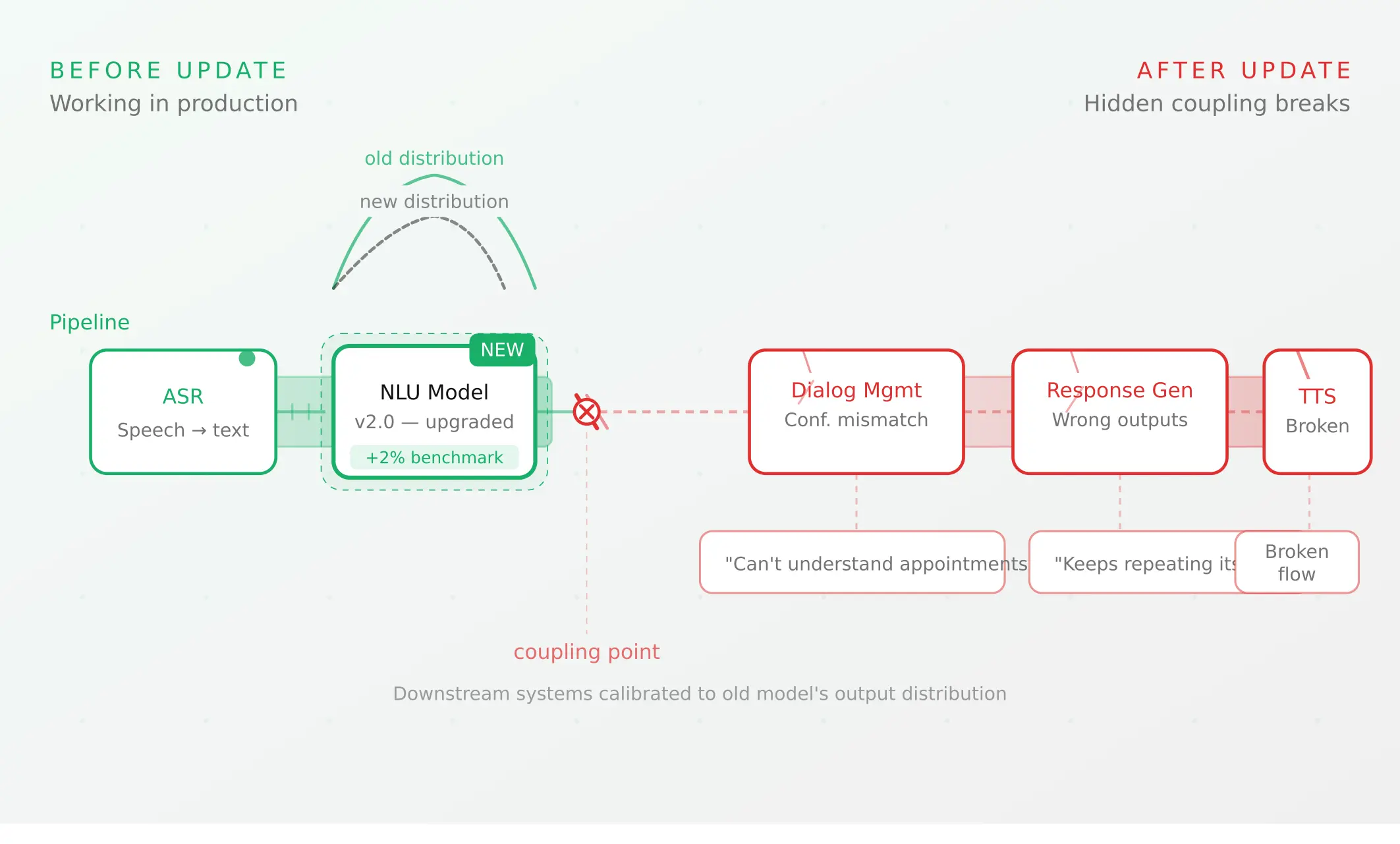
Voice agent regression testing: why LLM updates break production
LLM updates improve benchmarks but break voice agents in 5 predictable ways. How to detect and prevent regressions after every model or prompt change.
Read more