Test your voice agent
Testing SOP-based voice agents: how to verify procedure adherence
A SOP-based voice agent is only as good as its adherence to the procedure. Encoding the SOP makes the agent more reliable, but it does not guarantee the agent follows it once real callers arrive. Testing SOP-based voice agents is how you prove adherence before production. This guide covers step coverage, assertions, escalation testing, metrics, and the method that ties them together.
This is the closest fit to what Evalgent does, so we will be concrete. If you have not yet read the companion piece, start with SOP-based voice agents, then come back.
What is SOP adherence testing?
SOP adherence testing: verifying that a voice agent executes the required steps, transitions, and escalations of its standard operating procedure, in the right order, across realistic calls.
Adherence is the core question for an SOP-based agent. Did it verify identity before sharing account details? Did it offer escalation within the required number of turns? Did it skip a mandatory disclosure? SOP adherence testing answers these by driving the agent through its procedure and checking that each required step fires.
This is different from grading a transcript for tone. It is structural. The procedure defines what must happen, and the test confirms it happened. That structure is exactly what makes SOP-based agents more testable than prompt-only ones.
Why SOP-based agents need a different testing approach
Prompt-only agents give you one diffuse thing to test: did the model behave? SOP-based agents give you a map of explicit steps and branches. The testing approach should use that map rather than ignore it.
The shift is from outcome-only checks to path-aware checks. You still care about the final outcome, but you also care about the route taken to get there. A call can reach the right answer while skipping a compliance step, and only path-aware testing catches that. Our ai voice agent testing pillar covers the broader discipline; SOP testing is the path-aware specialisation of it.
Step coverage: testing every node and branch
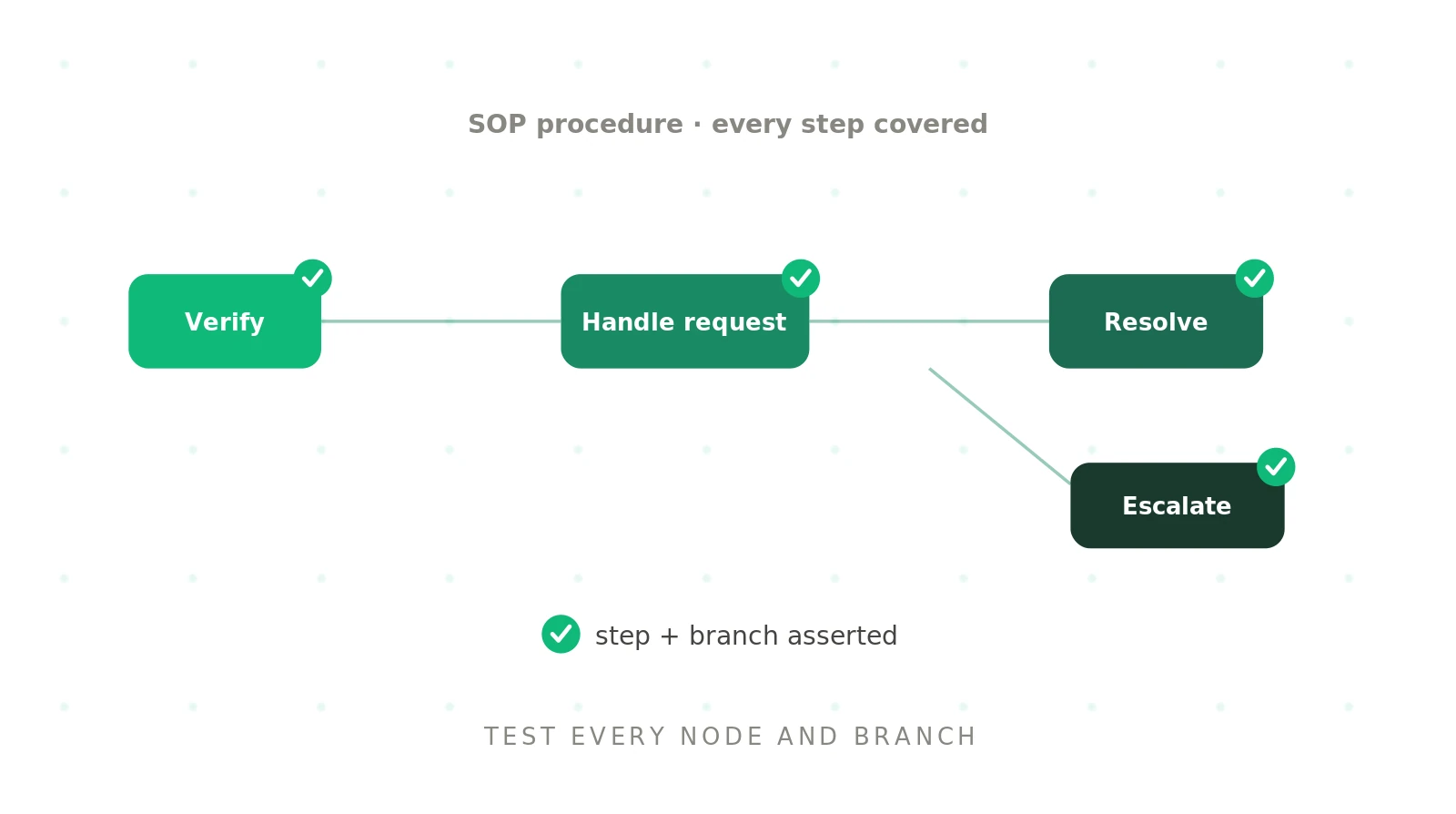
In software, code coverage measures how much of the code your tests exercise. SOP step coverage applies the same idea to the procedure. Every node should be reached by at least one test, and every branch should be taken in at least one direction.
SOP step coverage: the share of the procedure's steps and transitions exercised by your test suite, by analogy with code coverage in software.
Untested branches are where production surprises live. The escalation path that never fired in testing is the one that breaks on a live angry caller. Node-level testing means writing scenarios that deliberately drive the agent down each path, including the rare ones. Aim for full branch coverage on anything tied to compliance or safety.
Test cases vs assertions for SOP agents
These two work together, and the distinction matters for SOP agents.
Test case: a scenario that drives the agent down a specific SOP path, such as a caller who fails identity verification twice.
Assertion: a checkable rule about what must happen on that path, such as the agent escalating after the second failure.
One test case carries several assertions. The scenario sets up the path; the assertions verify the required steps, transitions, and guardrails on it. Good SOP testing writes assertions about behaviour and procedure, not just about the words in the transcript. Instruction-following becomes something you measure, not assume.
How to test escalation paths and edge cases
Escalation is where SOP agents earn their keep, and where they most often fail quietly. A procedure usually defines when to hand off to a human, and that rule must hold under pressure. Test it directly.
- Drive calls that should trigger escalation and assert it happens within the defined limit.
- Test the edges: repeated failures, hostile callers, ambiguous requests, and silence.
- Confirm the agent does not escalate when it should resolve, which wastes human time.
- Check that compliance steps fire even when the caller pushes the conversation off-script.
Edge cases are not optional extras here. They are the paths most likely to break, so they belong in the core suite. Guardrail testing means proving the rules hold exactly when a caller is trying to bypass them.
Metrics for evaluating SOP-based voice agents
SOP-based voice agent evaluation needs metrics that capture procedure, not just outcome. Track these alongside the usual quality measures.
| Metric | What it measures |
|---|---|
| SOP adherence rate | Share of calls that followed the required steps |
| Step coverage | Share of nodes and branches your tests exercise |
| Escalation accuracy | Correct hand-offs versus missed or false ones |
| Compliance pass rate | Required disclosures and checks that fired |
| Task completion | Whether the caller's goal was met |
| Regression delta | Metric change since the last known-good run |
Set pass/fail thresholds per metric and per scenario. A compliance step is usually pass-or-fail, not a percentage. Tie each threshold to your risk, and use the results as a release gate rather than a report nobody reads. Be cautious using an LLM as a judge alone, since it grades language, not whether a procedure step actually executed.
SOP testing checklist
Use this checklist to build a test suite for an SOP-based voice agent.
1. Map the procedure — List every node, transition, and escalation rule in the SOP.
2. Write path scenarios — Create a test case for each branch, including rare and failure paths.
3. Add assertions — Specify the required steps and guardrails that must fire on each path.
4. Measure step coverage — Confirm every node and branch is exercised by at least one test.
5. Run synthetic callers — Execute the suite as realistic calls with varied accents and behaviour.
6. Gate and re-run — Block release on failures, and re-run the suite whenever the SOP changes.
Regression testing when the SOP changes
The procedure will change. Steps get added, escalation rules get tightened, and tools get swapped. Every change can break a path that worked before. Deterministic voice agent testing makes this manageable, because the same input should produce the same path, so a difference is a real signal.
Re-run the full suite on every SOP edit, model change, or prompt update, and compare against the last known-good run. Flag any adherence or coverage drop. This is the same discipline as regression testing after model updates, applied to the procedure itself. Keep an audit trail of which version passed which tests.
Testing SOP-based vs prompt-based voice agents
The procedures differ because the architectures differ.
| Aspect | Prompt-based | SOP-based |
|---|---|---|
| What you test | Outcomes and tone | Outcomes plus each step |
| Coverage model | Hard to define | Node and branch coverage |
| Assertions | Mostly transcript-level | Step, transition, guardrail |
| Failure diagnosis | Diffuse | Pinned to a node |
| Adherence metric | Not really possible | Measurable directly |
SOP-based agents do not need less testing, but they reward a more precise kind. For the architectural background, see graph-based voice agents, since a graph is how many SOPs are implemented.
A repeatable evaluation loop
Evaluating SOP agents is not a one-time task. It is a loop. You define the paths. You run them. You read the results. You fix, then re-run. Deterministic testing makes the loop trustworthy. The same call yields the same path. So a change in results is a real change, not noise.
Make sop compliance testing the non-negotiable core of that loop. Compliance steps are binary. They either fired or they did not. Track them as evaluation metrics with hard thresholds. A dip is a release blocker, not a discussion. Over time, the loop builds a record of what passed. That record becomes your audit trail. Run the loop before every release. Treat skipping it as shipping untested.
How to test a SOP-based voice agent with Evalgent
Evalgent is built for exactly this. It runs realistic conversations against your agent and verifies the procedure at every step. Scenarios drive the agent down specific SOP paths, including escalation and edge cases. Profiles vary caller personas, accents, and behaviour so paths are tested under real conditions. Metrics encode SOP adherence, step coverage, and compliance with custom pass/fail thresholds. Evaluations run the whole suite as automated batches of synthetic callers. Reviews let your team inspect any failed path with audio, transcript, and metrics together.
The result is procedure adherence you can prove, with a release gate that blocks regressions before they ship. For the wider method, see the synthetic callers guide. Anthropic's note on building effective agents makes the same case: structure is what you can verify.
Frequently asked questions
How do you test a SOP-based voice agent?
Test a SOP-based voice agent by driving it down each path of its procedure and asserting that required steps, transitions, and escalations fire. Write a test case per branch, including failure paths, add assertions for guardrails, and measure step coverage. Run the suite as synthetic callers under varied conditions, and gate releases on the results.
What is SOP adherence testing?
SOP adherence testing verifies that a voice agent executes the required steps, transitions, and escalations of its standard operating procedure, in the right order, across realistic calls. It is structural rather than tone-based: the procedure defines what must happen, and the test confirms it happened. Adherence can be tracked as a metric and used as a release gate.
How do you evaluate SOP compliance in voice agents?
Evaluate SOP compliance by asserting that mandatory steps, such as identity verification and disclosures, fire on every relevant call. Treat each compliance step as pass-or-fail rather than a percentage. Run scenarios that try to push the agent off-script, and confirm the rules still hold. Track a compliance pass rate and block release when it drops.
What is SOP step coverage in testing?
SOP step coverage is the share of a procedure's steps and transitions that your test suite exercises, by analogy with code coverage in software. Every node should be reached by at least one test, and every branch taken in at least one direction. Untested branches, especially escalation paths, are where production failures usually appear.
How do you test escalation paths in SOP agents?
Test escalation paths by driving calls that should trigger a hand-off and asserting it happens within the defined limit. Use edge cases like repeated failures, hostile callers, and ambiguous requests. Also confirm the agent does not escalate when it should resolve. Escalation is a high-risk path, so it belongs in the core suite, not as an afterthought.
Do SOP-based agents need less testing?
No. SOP-based agents do not need less testing, but they reward a more precise kind. Their explicit steps make node and branch coverage possible and let you measure adherence directly. A prompt-only agent gives you one diffuse target; a SOP-based agent gives you a map. You still must verify the agent actually follows that map under real callers.
What metrics evaluate a SOP-based voice agent?
Key metrics for evaluating SOP-based voice agents are SOP adherence rate, step coverage, escalation accuracy, compliance pass rate, task completion, and regression delta against the last known-good run. Set pass/fail thresholds per metric and per scenario, treating compliance steps as binary. Use the metrics as a release gate rather than a report that no one acts on.
Testing SOP-based vs prompt-based voice agents: what changes?
Testing prompt-based agents focuses on outcomes and tone, with coverage hard to define. Testing SOP-based agents adds path-aware checks: node and branch coverage, assertions on steps and guardrails, and a measurable adherence rate. Failure diagnosis is sharper too, because a failure pins to a specific node rather than a vague impression of the whole call.
Conclusion
Testing SOP-based voice agents is path-aware testing. Because the procedure is explicit, you can cover every node and branch, assert that required steps fire, and measure adherence as a real number.
Encoding the SOP is half the work. Proving the agent follows it, on every path, under real callers, is what turns a procedure on paper into reliability in production.
Related Articles
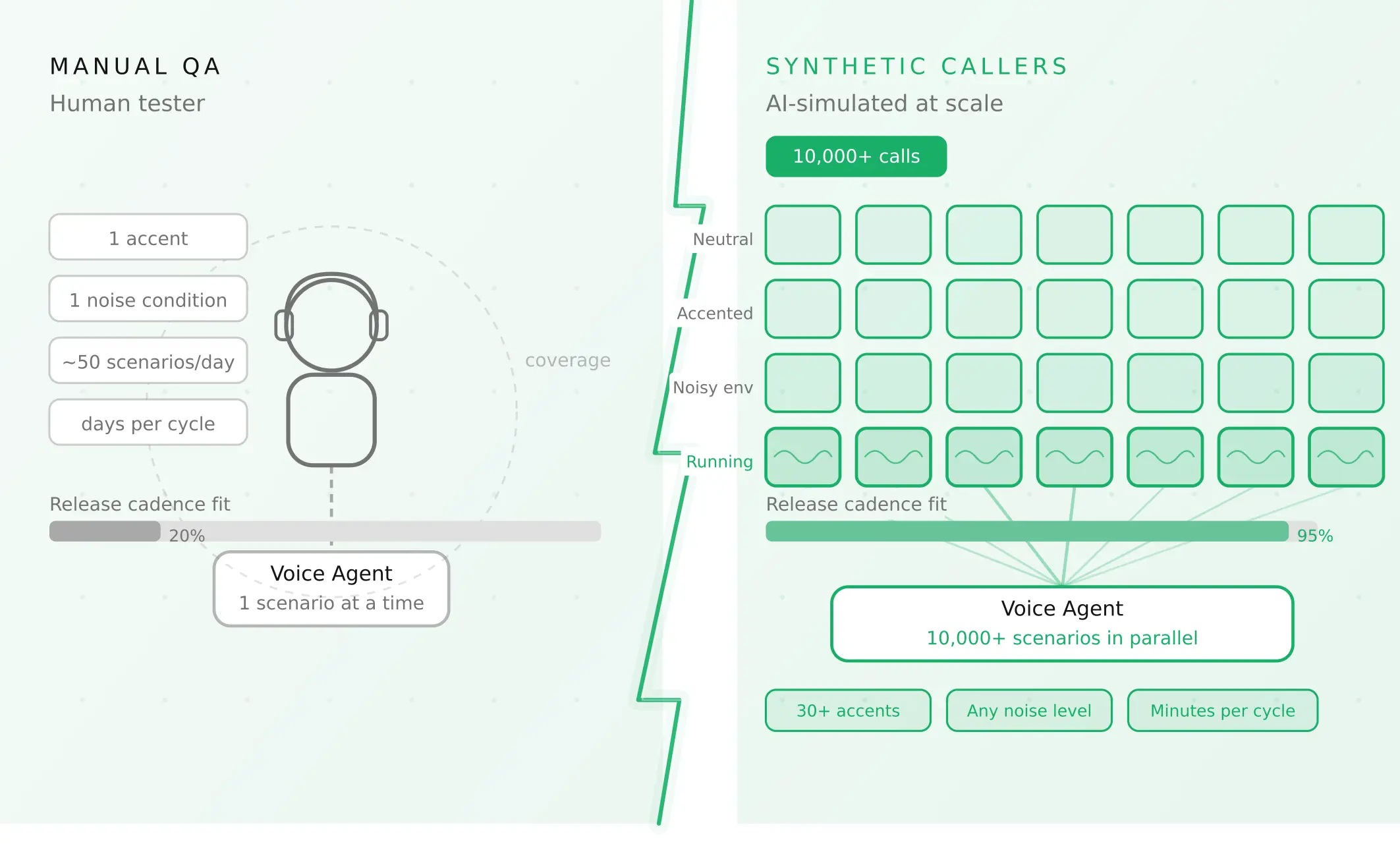
How to automate voice agent testing: synthetic callers vs manual QA
Learn how ai test automation replaces manual QA for voice agents. Compare synthetic callers vs human testers, with a 5-step framework to scale without hiring.
Read more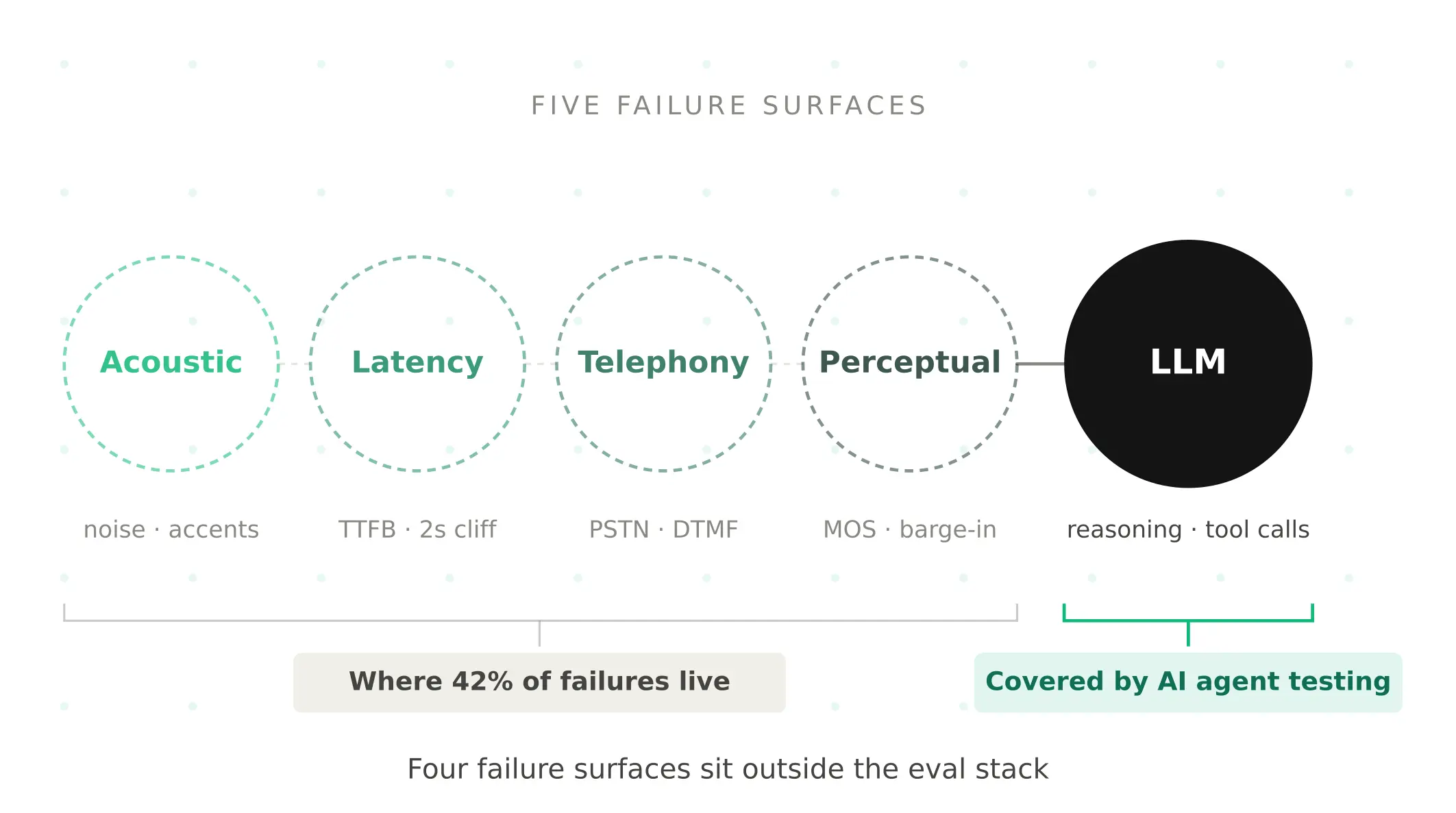
AI Agent Testing vs Voice Agent Testing: What General Tools Miss for Voice
AI agent testing measures text outputs. Voice agent testing measures behaviour through an acoustic pipeline. Five failure categories general tools miss.
Read more