Test your voice agent
SOP-based voice agents: how standard operating procedures make agents reliable
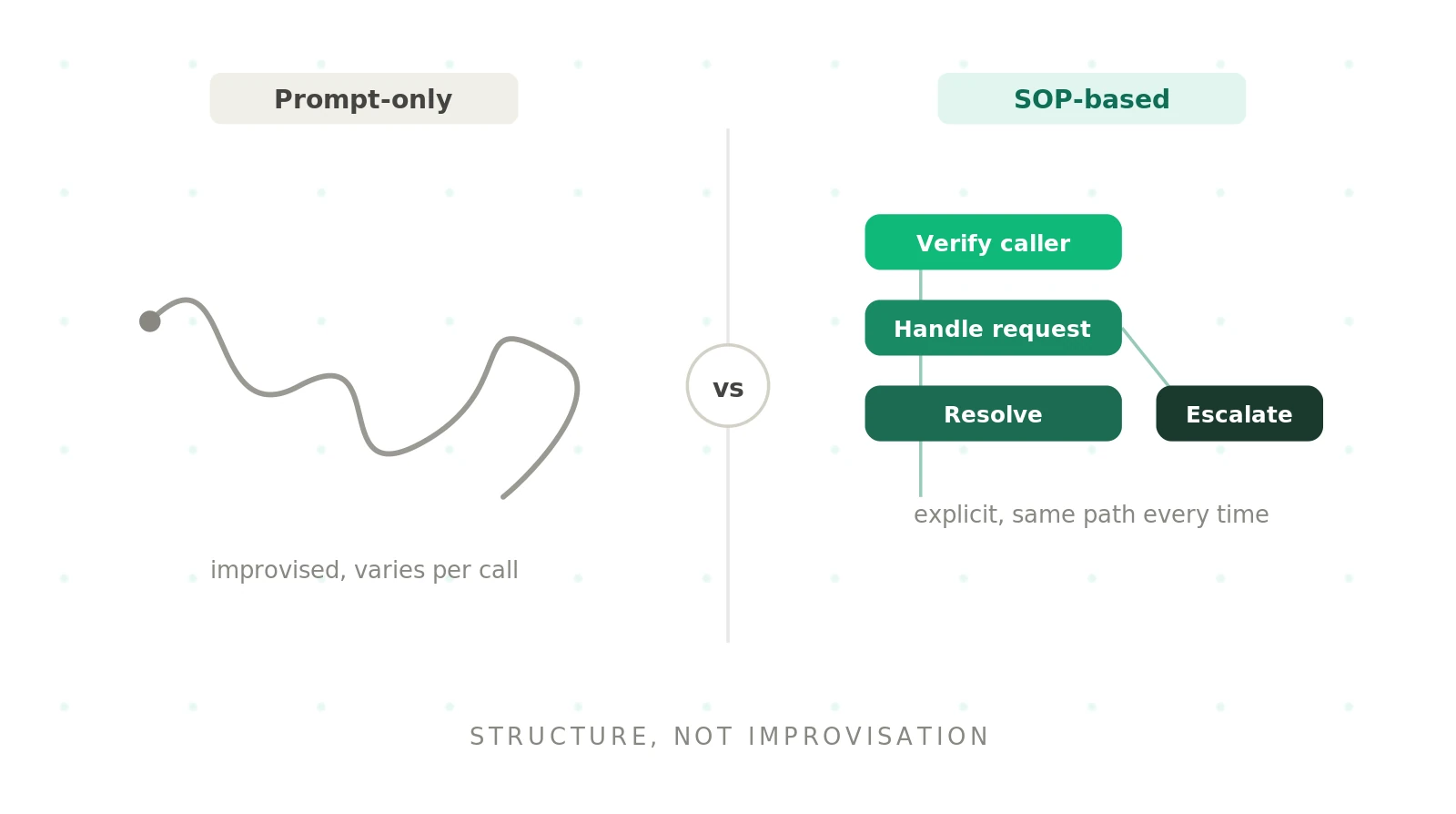
Prompt-only voice agents are fast to build and hard to trust. They work in demos, then improvise in production, skip steps, and handle the same call differently each time. SOP-based voice agents take the opposite approach: they encode the process explicitly. This guide explains what they are, why they improve reliability, and how they relate to graph-based design.
Evalgent cares about this because structure is what makes an agent testable. We return to that at the end. First, the concept.
What is a SOP-based voice agent?
SOP-based voice agent: a voice agent whose behaviour is governed by an explicit standard operating procedure, encoded as a structured workflow, rather than left entirely to a language model's prompt.
A standard operating procedure is a defined step-by-step process for completing a task the same way every time. Humans have used them for decades in support, healthcare, and finance. A SOP-based voice agent applies the same idea: the agent follows a known procedure, with the language model handling language, not deciding the whole process from scratch.
This is the difference between giving an agent instructions and giving it a workflow. Instructions hope the model follows them. A workflow encodes them, so the path is explicit, repeatable, and inspectable. The Wikipedia entry on standard operating procedures captures the underlying idea.
What are agent operating procedures?
Agent operating procedures: natural-language procedures that compile into validated, structured workflows an AI agent executes, turning a written SOP into agent behaviour.
The term agent operating procedures describes how teams turn a human SOP into agent logic. Instead of a chatbot that only answers questions, the agent takes real actions: verifying identity, processing a refund, updating a record, or escalating. A single procedure can drive the same behaviour across chat, email, and voice.
Research has formalised this. Work such as Agent-S models SOPs as agentic workflows so an LLM agent can automate operational procedures, and approaches like SOPRAG retrieve the right procedure for industrial settings. The common thread is structure: the procedure is explicit, not implied.
Why prompt-only voice agents drift
A prompt-only agent puts the entire process inside the model's context and trusts it to comply on every turn. That works until the call gets messy. The model forgets a required step, asks for information it already has, or invents a path that was never approved.
The result is low reproducibility. The same scenario can produce different behaviour on different calls, which is unacceptable in regulated or high-stakes flows. Our piece on why voice agents fail in production covers how this drift shows up once real callers arrive. Prompt-only design trades control for speed, and the bill comes due in production.
How SOPs improve reliability
Encoding the SOP shifts the hard decisions out of the prompt and into a structure the agent must follow. That brings several gains.
- Controllability: the agent follows a known path, so behaviour is predictable.
- Reliability: required steps cannot be skipped, even on a long or chaotic call.
- Reproducibility: the same input yields the same process every time.
- Guardrails: escalation and compliance rules are enforced, not suggested.
- Fewer hallucinations: the model handles language within each step, not the whole plan.
This does not remove the language model. It scopes it. The LLM still understands the caller and generates natural responses, but it does so inside a step whose purpose and exits are defined. Instruction-following becomes a property of the system, not a hope about the prompt.
SOP-based vs prompt-based voice agents
The trade-off is structure versus flexibility. Prompt-based agents are quick to build and flexible. SOP-based agents are more work to design but far more dependable.
| Factor | Prompt-based | SOP-based |
|---|---|---|
| Control | Model decides the flow | Workflow defines the flow |
| Reproducibility | Varies per call | Same path every time |
| Reliability on long calls | Degrades | Holds |
| Compliance | Hard to guarantee | Enforced by design |
| Build effort | Low | Higher upfront |
| Testability | Diffuse | Step-by-step, explicit |
For a deeper architectural treatment, see our guide on graph-based vs prompt-based voice agents. SOP-driven voice agents sit firmly on the structured side of that divide.
How SOPs relate to graph-based agents
SOP-based and graph-based design are closely linked. A graph is one natural way to encode an SOP: nodes are steps, edges are the allowed transitions, and the whole thing behaves like a state machine. Some research models SOPs as tree structures and traverses them with a decision tree or depth-first logic.
The point is that an SOP needs a representation, and a graph-based workflow is a strong one. Standard operating procedure AI agents and graph-based voice agents are often the same system described from two angles: the SOP is the procedure, the graph is the implementation. Our deep dive on graph-based voice agents explains the architecture in detail.
Determinism and structured workflows
Structure buys determinism. Deterministic voice agents take the same path for the same input. That predictability is the whole point of an SOP. Prompt-only agents are non-deterministic by nature. They can pick a different route on every call.
Structured voice agent workflows make the route explicit. Each step has one job. Each transition has a clear condition. A sop ai agent runs that workflow rather than improvising. The language model still speaks naturally. It just does so inside a fixed frame.
This is what people mean by an agentic workflow with guardrails. The agent acts, but within bounds. Determinism does not make the agent rigid. It makes the agent dependable. You can still branch for edge cases. You just branch on purpose, not by accident.
Determinism also helps audits. A reproducible path is one you can review. Regulators value that. So do your own engineers. When a call goes wrong, you can trace which step failed. With a prompt-only agent, the answer is often a shrug. Structure turns debugging from guesswork into a lookup.
How to build a SOP-based voice agent
Building one is a design exercise before it is a coding one. The procedure has to exist clearly before you encode it.
1. Write the SOP — Document the real step-by-step process, including decision points and escalation rules.
2. Map the steps — Turn each step into a node with a clear purpose and defined exits.
3. Define transitions — Specify the conditions that move the call from one step to the next.
4. Scope the LLM — Let the model handle language inside a step, not the overall plan.
5. Add guardrails — Encode compliance, verification, and escalation as enforced rules.
6. Wire tool calling — Connect each step's actions to the APIs and systems it needs.
The output is a structured workflow, not a longer prompt. For where this sits in the wider system, see the voice agent stack guide.
Where SOP-based agents fit
SOP-based design pays off most where consistency and compliance matter. Customer service is the clearest case: refunds, identity verification, and cancellations follow defined procedures that must run the same way every time. Healthcare and financial services add regulatory weight, where a skipped step is a real risk.
For open-ended, exploratory conversations, a lighter prompt-based approach can be enough. But for transactional, regulated, or high-volume flows, the reliability of an SOP-based agent is worth the extra design. Anthropic's guidance on building effective agents makes a similar point: structure beats cleverness for production reliability.
Testing SOP-based voice agents
Structure brings a major benefit beyond reliability: testability. Because an SOP-based agent has explicit steps and transitions, each one is a surface you can check. A prompt-only agent gives you one diffuse thing to test. An SOP-based agent gives you a map.
This is where Evalgent fits. Evalgent runs realistic conversations against your agent and verifies behaviour at each step of the procedure. Scenarios drive the agent down specific SOP paths, Profiles vary caller personas and accents, Metrics check that required steps and escalations happen with custom thresholds, Evaluations run these as automated batches of synthetic callers, and Reviews let your team inspect any failed path with audio and transcript together.
The result is SOP adherence you can measure, not assume. For the full discipline, see the ai voice agent testing pillar. Encoding the SOP is half the work; proving the agent follows it under real callers is the other half.
Frequently asked questions
What is a SOP-based voice agent?
A SOP-based voice agent is a voice agent whose behaviour follows an explicit standard operating procedure encoded as a structured workflow, rather than left to a single prompt. The language model handles conversation within each defined step, while the procedure controls the overall flow. This makes the agent more controllable, reproducible, and easier to test than a prompt-only design.
What are agent operating procedures?
Agent operating procedures are natural-language procedures that compile into validated workflows an AI agent executes. They turn a written SOP into agent behaviour, letting the agent take real actions such as verifying identity or processing a refund. One procedure can drive the same behaviour across chat, email, and voice, rather than answering questions alone.
How do SOPs improve voice agent reliability?
SOPs improve reliability by encoding required steps so the agent cannot skip them, even on long or chaotic calls. They make behaviour reproducible, enforce compliance and escalation as guardrails rather than suggestions, and scope the language model to handling language within a step. The result is predictable behaviour instead of per-call improvisation.
SOP-based vs prompt-based voice agents: which is better?
SOP-based voice agents are more reliable and reproducible, while prompt-based agents are faster to build and more flexible. Prompt-based design lets the model decide the flow, which varies per call. SOP-based design defines the flow as a workflow. For transactional, regulated, or high-volume flows, SOP-based wins; for open-ended chat, prompt-based can be enough.
How do you build a SOP-based voice agent?
Build a SOP-based voice agent by first writing the real step-by-step procedure, including decision points and escalation rules. Map each step to a node with defined exits, specify the transitions between steps, scope the LLM to language within a step, add guardrails for compliance, and wire tool calling for each action. The output is a structured workflow, not a longer prompt.
Do SOP-based agents reduce hallucinations?
SOP-based agents reduce hallucinations by scoping the language model to handle language within a defined step instead of planning the whole interaction. With the process encoded as a workflow, the model has fewer open-ended decisions to get wrong. It cannot invent an unapproved path, because transitions are explicit. This narrows where errors can occur and makes them easier to catch.
Are SOP-based voice agents good for customer service?
Yes. Customer service is the clearest fit for SOP-based voice agents, because flows like refunds, identity verification, and cancellations follow defined procedures that must run consistently. Encoding these as a workflow enforces required steps and escalation rules. Healthcare and financial services benefit even more, since a skipped step there carries regulatory and safety risk.
How do you test a SOP-based voice agent?
Test a SOP-based voice agent by checking each step and transition of the procedure. Use scenarios to drive the agent down specific SOP paths, vary caller profiles, and assert that required steps and escalations occur. Because the procedure is explicit, SOP adherence becomes measurable. Platform-agnostic testing with synthetic callers, such as Evalgent, verifies this before real callers do.
Conclusion
SOP-based voice agents replace hope with structure. By encoding the procedure as an explicit workflow, they make behaviour controllable, reproducible, and testable in ways a prompt alone never achieves.
The structure is only worth it if the agent actually follows it. Encode the SOP, then test every step under real callers, because a procedure on paper is not the same as a procedure in production.
Related Articles
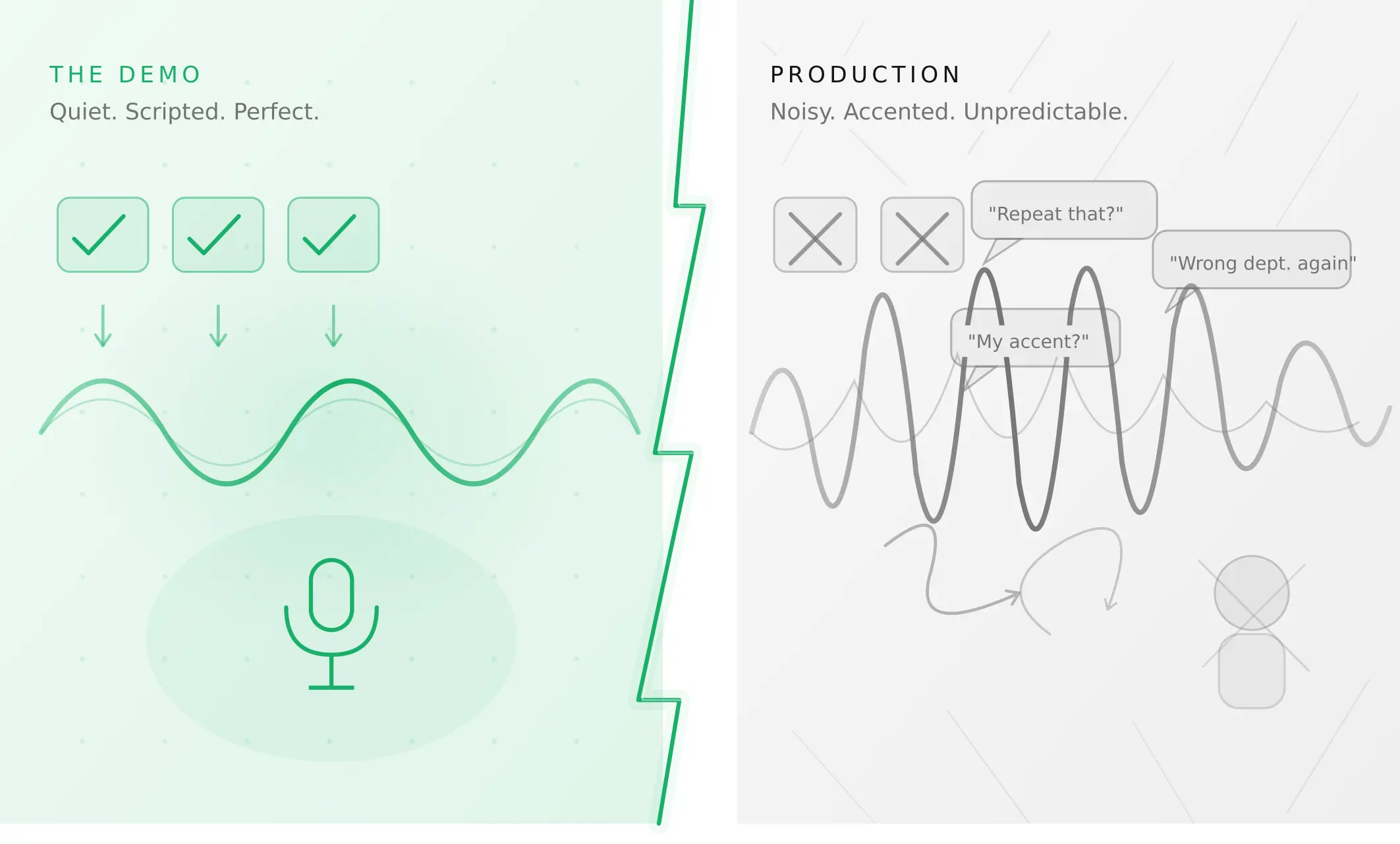
Why AI voice agents fail in production (and how to prevent it)
AI voice agents that ace demos still break in production. Learn the 5 root causes, how to test for each, and what production readiness actually means.
Read more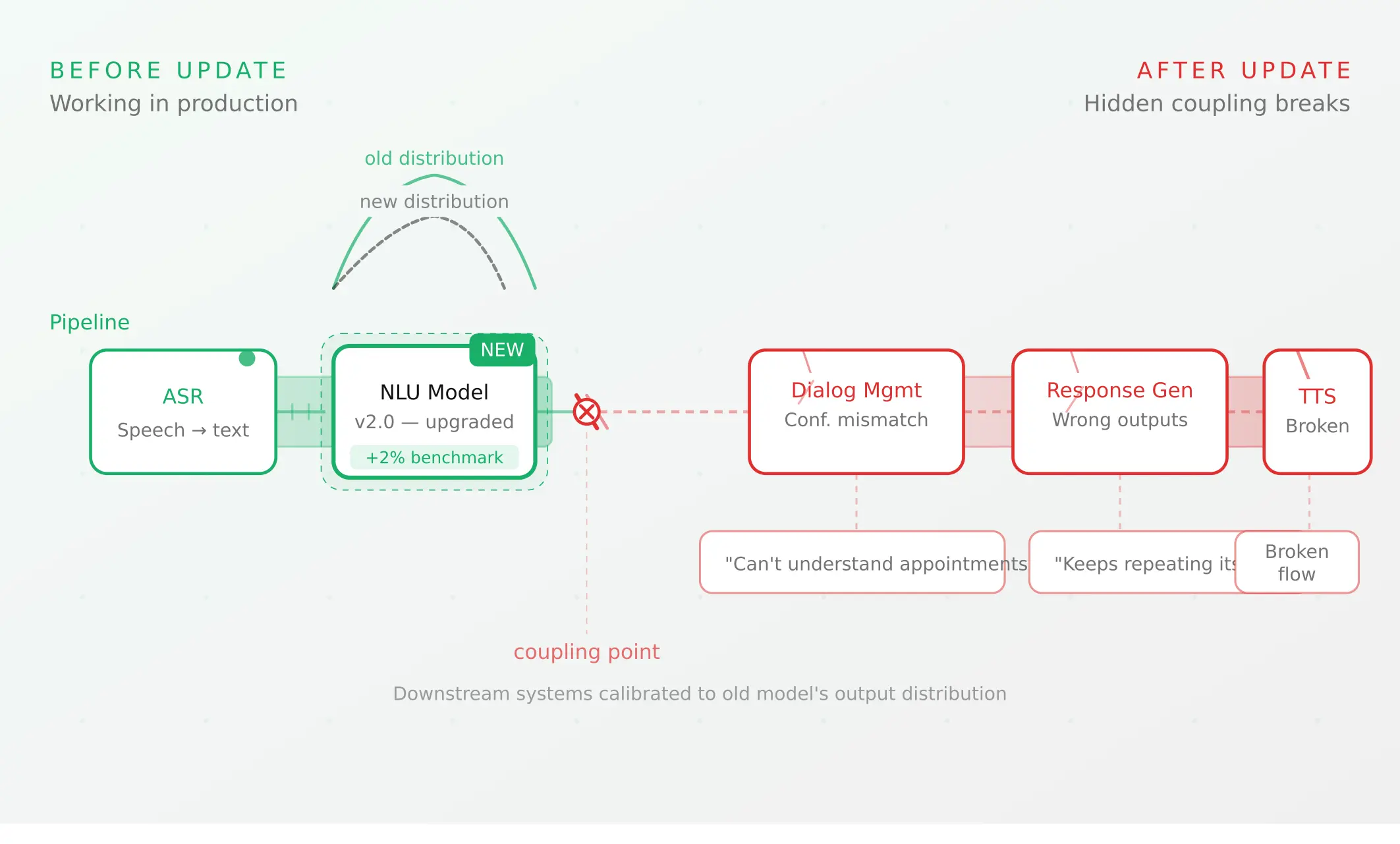
Voice agent regression testing: why LLM updates break production
LLM updates improve benchmarks but break voice agents in 5 predictable ways. How to detect and prevent regressions after every model or prompt change.
Read more