Staffing Assignment AI Calls: Timesheet Errors to Test
On this page
Your team built a staffing agency voice agent that phones temp workers. It confirms tomorrow's assignment. It reads back the site and start time. It answers "did you get my hours?" Staffing assignment AI calls look simple, but they write to a dispatch record and sometimes a timesheet. One speech error becomes a wrong gate, a missed shift or a pay dispute. This post is for the Head of AI or product lead who owns that agent and ships prompt changes straight to live workers. It covers what to test, which questions the agent must never answer, and how to prove it before the next release.
What an assignment call actually writes
A voice agent call is the front door to a workflow. The worker speaks. The agent captures a decision. A system action follows. A confirmation goes out. A record is written back. Every stage can drift from what the worker meant.
A temp worker assignment confirmation usually touches these fields:
- Worker identity: which person answered, matched to which candidate record.
- Assignment: client, work site, job title and start date.
- Start time and shift length: often spoken as "six thirty" or "seven to three".
- Pay rate shown: the hourly rate on the assignment record.
- Reporting details: supervisor name, gate or dock, dress code, safety gear.
- Confirmation status: confirmed, declined, unsure or no answer.
The agent then does a write-back of a status, maybe a note, and often triggers a text. If the status is "confirmed" but the worker heard the wrong site, nothing errors. The dispatcher sees green. The branch finds out at 6:45 the next morning.
Our post on shift confirmation AI calls covers measuring no-show misses from confirm rates. This one goes a level down, to the assignment details the agent reads and the timesheet and pay questions workers ask on the same line. For rate and skill questions during screening, see staffing agency AI screens.
Where assignment calls go wrong
Here are the failures worth a named test. Each one writes a clean-looking record.
| Failure | What the worker says | What gets stored or spoken | What breaks downstream |
|---|---|---|---|
| Sound-alike time | "Is that fifteen to three?" | Start 3:15 PM read back as 3:50 | Worker arrives early or late; client counts a no-show |
| Wrong site, same client | "The north plant?" | Confirmed against the south plant record | Worker at the wrong gate; supervisor marks absent |
| Stale assignment | "Okay, see you tomorrow." | Confirmed, but the client cancelled at 4 PM | Worker travels for a cancelled job |
| Hedge taken as yes | "I think so, maybe." | Status: confirmed | Fill gap discovered at start time |
| Wrong person | A spouse says "yes, he'll be there" | Worker confirmed | No-show with a confirmed flag |
| Rate misread | "Is it still seventeen?" | Agent says "seventeen" from the old rate | Pay dispute on the first check |
| Read-back skipped | "Uh-huh" | Details never confirmed | Wrong time never caught |
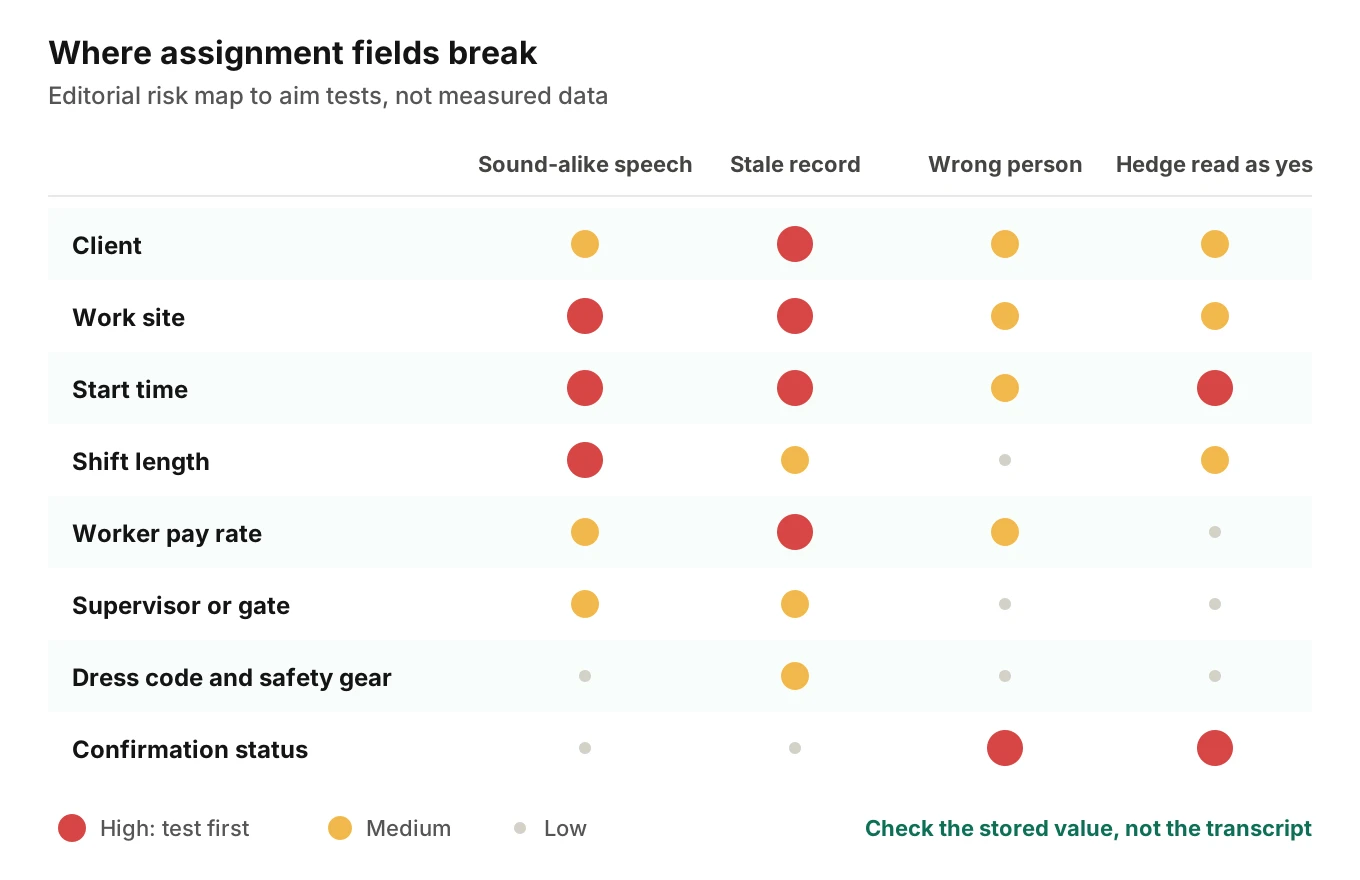
Three deserve more depth: times, rates and identity. Together they drive no-show prevention.
Start times are the hardest spoken number
Times are spoken in many forms. "Six thirty", "half past six", "six-three-zero" and "oh-six-thirty" all mean the same thing. Meanwhile "fifteen" and "fifty" sound close on a compressed phone line. A start time must survive speech recognition, number formatting and your own prompt.
A 2024 paper by Christian Huber and Alexander Waibel studied how speech recognition formats numbers. Their results show that timestamps were the hardest category. One model turned "10 o'clock" into 17:00. The authors also note that standard word error rate normalizes number formats. So a formatting error can hide inside a metric that looks healthy.
Do not trust a word error rate for this agent. Measure the field. Compare the stored time with the time the worker was told and the time on the dispatch record.
Worked example (illustrative assumption, not a measurement): an agency places 400 workers a day, and the agent confirms each by phone. Say 2% of confirmations carry a wrong time or site. That is 8 workers a day and 40 a week. Each one is a late arrival or a no-show that a human never saw coming.
Same client, several sites
A warehouse client may have a north and south facility. Workers say "the plant" or "the usual place." A fuzzy match on the spoken name can attach the confirmation to the wrong site record. Read the full site back ("Eastgate warehouse, Dock 4") and require an explicit yes. Test with look-alike site names.
Wrong person on the line
Temp workers share phones. A partner or parent may answer and say "yes." The agent must confirm identity before reading details, and log a third-party answer as its own outcome. Add one rule: never read the pay rate or client name to an unverified person.
Pay rate: read from the record, never improvise
The temp worker pay rate sits beside a second figure on the assignment record. One is what the worker is paid. The other is what the client is billed. A voice agent that pulls from the wrong field can disclose the bill rate. That is a business problem, not a speech problem. It happens because a prompt says "tell the worker the rate" and the tool returns both.
Some states require a written notice of the assignment terms. Illinois is one example. The Day and Temporary Labor Services Act requires the agency to give a day or temporary laborer a statement before dispatch. Public Act 103-1030 lists its contents. They include the work to be performed, the wages offered, and the destination's name and address. The agency must also give itemized pay statements. Public Act 96-1185 describes statement contents such as the client, hours worked and rate of pay.
This is not legal advice, and statutes change. Check the current text and your state's rules with counsel. The engineering point is simple. The spoken assignment is not the legal notice. If your agent says a rate or a site that differs from the written notice, you now have two versions of the terms.
Three design rules follow:
1. Read only the worker pay rate field. Never read a field named bill rate, markup or margin.
2. Say where it came from. "The rate on your assignment record is eighteen dollars an hour."
3. Route any dispute. "Is that the right rate?" goes to staff with the assignment ID attached.
Our post on AI screens and pay rates covers what the agent should say about pay before hire. After hire, the rule is stricter: the agent reads a stored value or routes.
Timesheet questions: what to answer and what to route
Workers ask the same agent AI timesheet questions. They sound harmless. They are where wage law meets a language model.
Federal wage rules set what the agency must keep. Under 29 CFR 516.2, employers keep records of hours worked each workday and total hours each workweek, along with total wages paid each pay period. The Department of Labor's Fact Sheet 21 says payroll records should be kept at least three years. Records used to compute wages, such as time cards, should be kept two years.
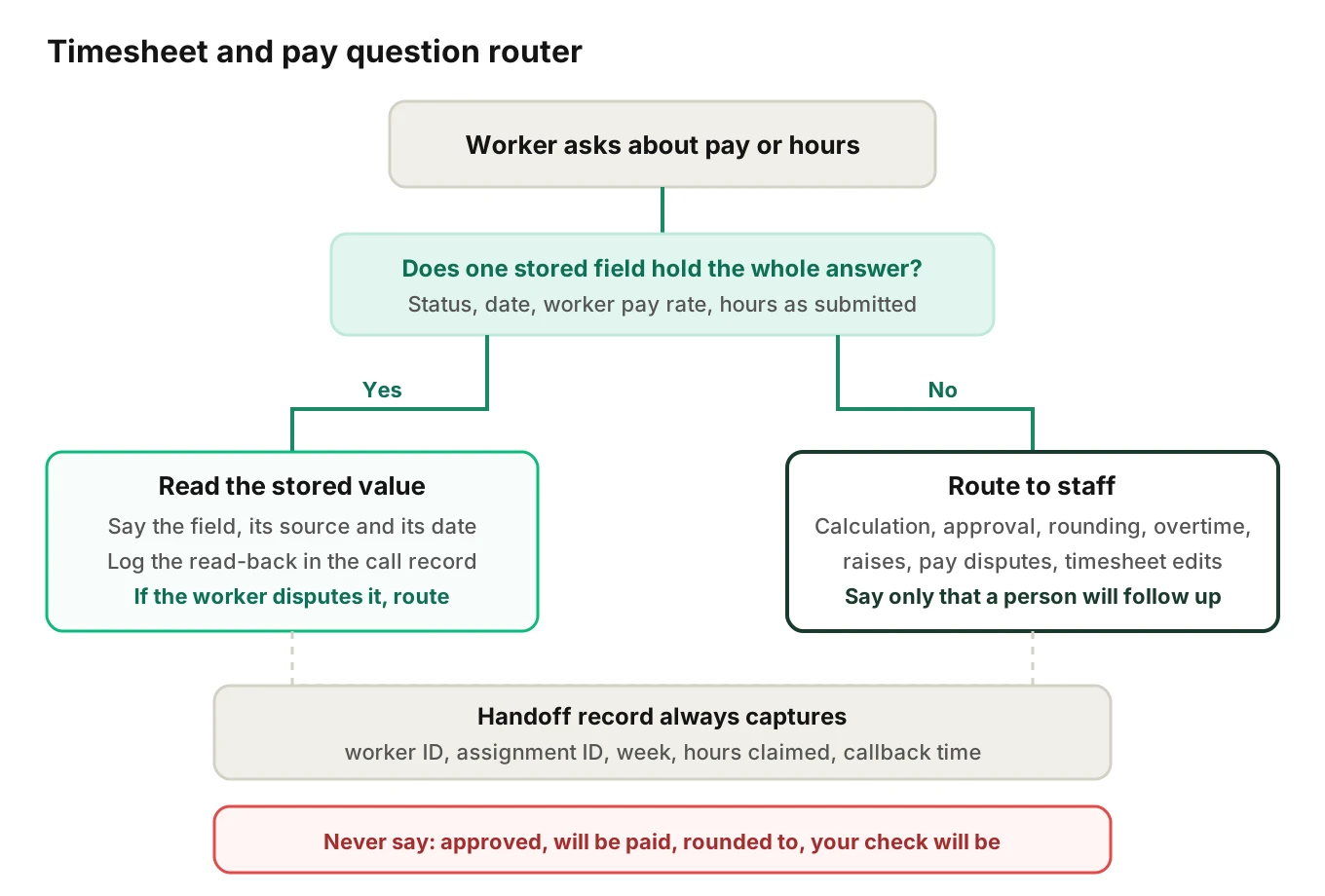
Those records are what a pay dispute turns on. So an agent must not say anything that could contradict them. Here is a policy table you can copy.
| Worker asks | Agent may | Agent must route to staff |
|---|---|---|
| "Did you get my timesheet?" | Read the submission status field and its date | Any claim that hours are approved or will be paid |
| "How many hours am I getting paid?" | Read hours as submitted, labelled as submitted | Any total, overtime or rounding statement |
| "My supervisor didn't sign" | Say the issue is logged and name the process | Deciding whether hours count |
| "Why is my check short?" | Capture week, client, hours claimed, callback number | The explanation and any promise of a fix |
| "What's my rate?" | Read the worker pay rate from the assignment record | Rate disputes, raises and overtime rate |
| "Can you change my hours?" | Log a correction request | Editing the timesheet itself |
Rounding and overtime are interpretation
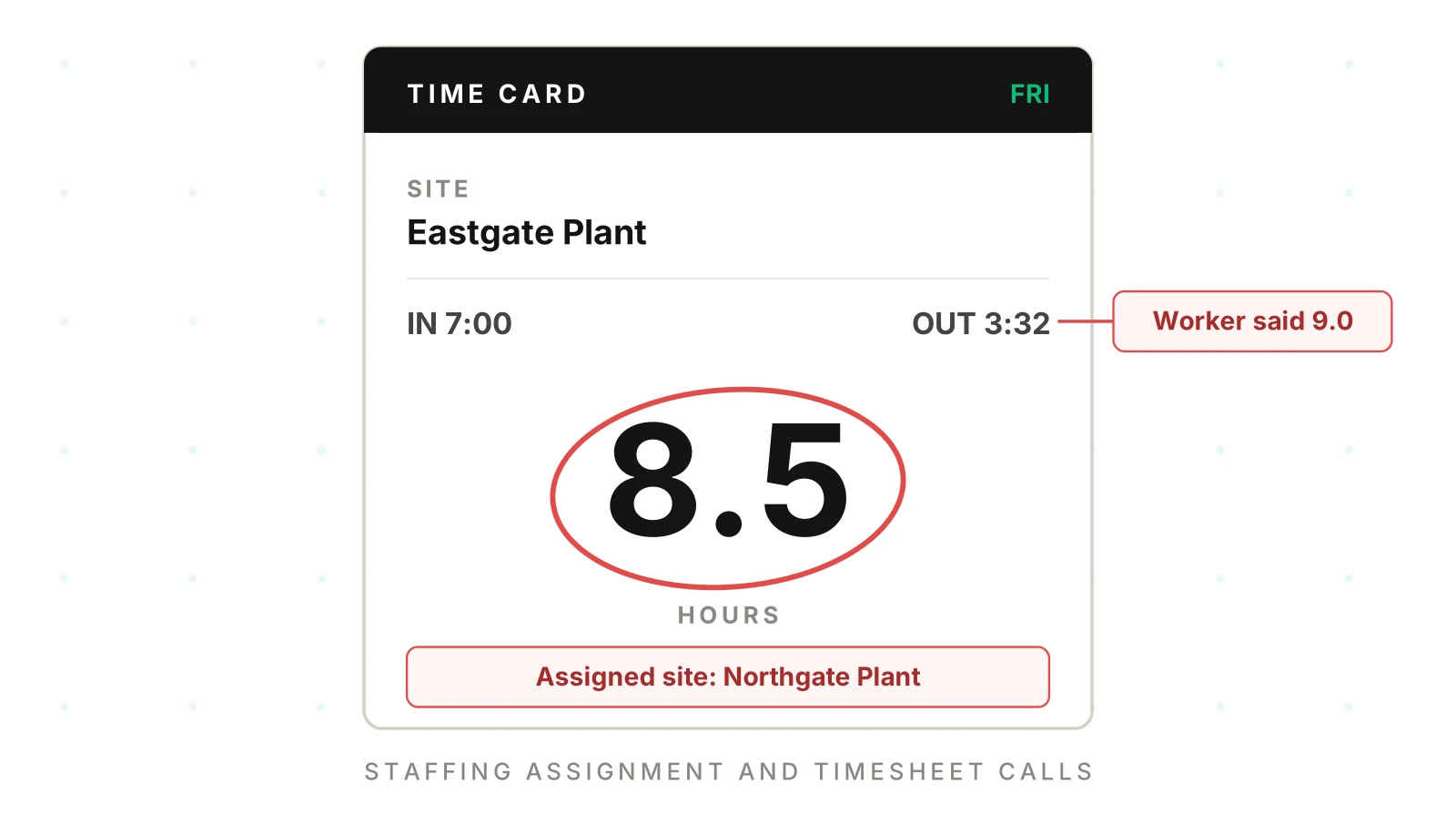
Timeclock rounding is a good example. Under 29 CFR 785.48, some employers round start and stop times to the nearest five minutes, tenth or quarter hour. The rule is accepted only if it does not lead to underpayment over time. Say a worker is on site from 7:00 to 3:32. That is 8 hours 32 minutes, or about 8.53 hours. Rounded to the quarter hour it is 8.5. If the agent says "you will be paid for eight and a half hours," it has made a payroll statement. It may be right. It is still not the agent's call.
Overtime is the same. The Department of Labor reported in March 2024 that two Massachusetts staffing agencies had underpaid overtime and kept inadequate records, covering 238 workers. That case was not about voice agents. It shows the weight hour records carry here. Do not let a speech agent become a second, unreviewed source of truth about hours.
The captured handoff is the product
When the agent routes a timesheet question, the handoff should be complete. Capture the worker ID, assignment ID, week, hours the worker says they worked, and a callback time. Staff should not need to call back to ask what the issue was. Test the handoff the same way you test any escalation: did the right fields arrive, and did the agent tell the worker only what is true?
Accents, languages and noise on the worker line
Temp workers call from loading docks, cars and bus stops. Many speak English as a second language. Speech systems are not equally accurate across speakers. The PNAS study by Koenecke and colleagues tested five commercial systems on 42 white and 73 black speakers. Average word error rate was 0.35 for black speakers and 0.19 for white speakers. The authors tie the gap to the acoustic models and to training data. It is not a staffing study. It does show why a single clean-audio test is not evidence.
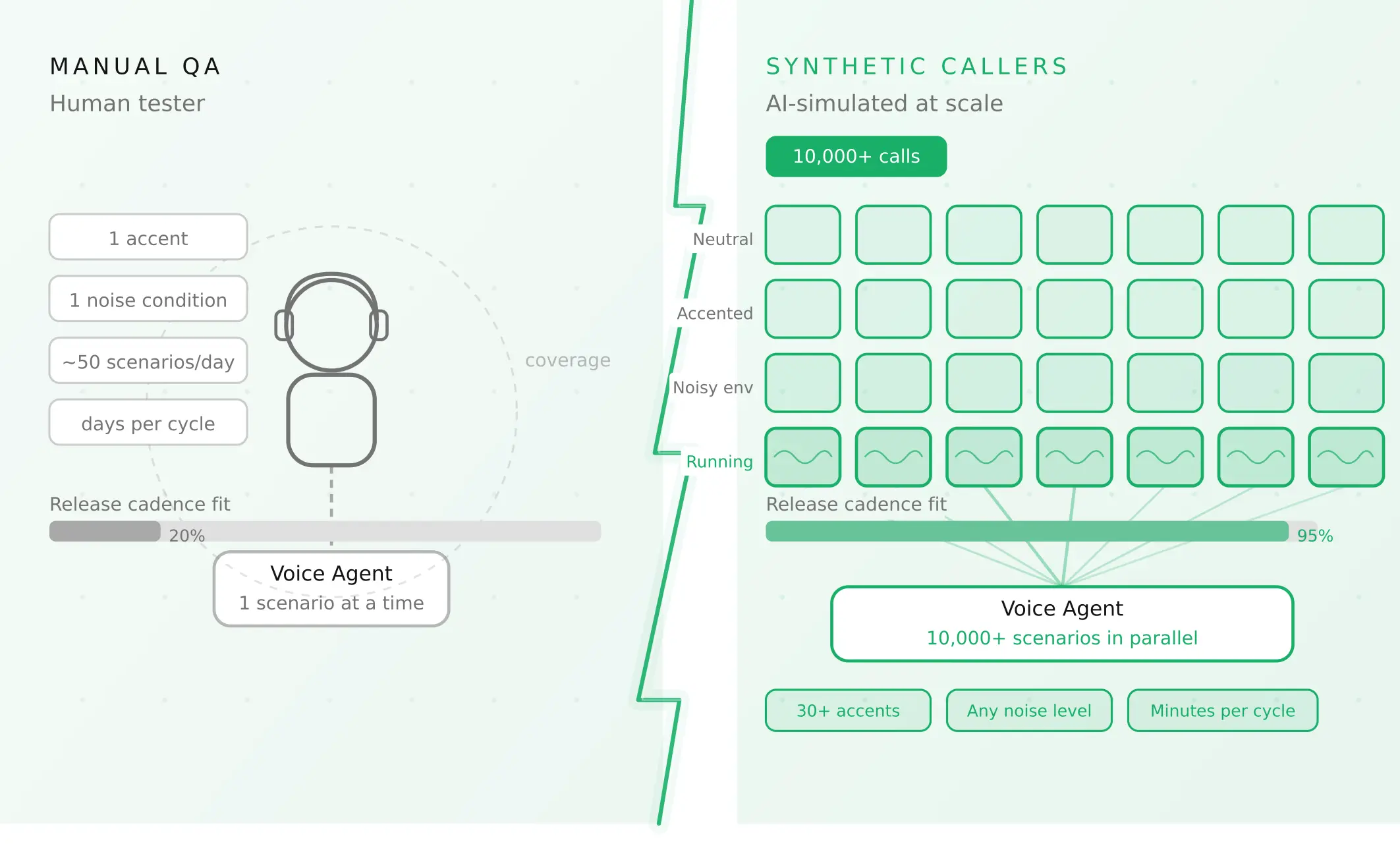
Apply that to your own agent. An error on "nineteen" versus "ninety" costs more than an error on "hello." Build caller profiles for accent, pace and background noise. Run the same assignment script across all of them. Compare stored fields, not transcripts. Our guides on accent robustness, multilingual accuracy and testing STT in background noise go deeper on each condition.
If your workforce speaks Spanish, test the whole call in Spanish, including numbers and addresses. Do not assume the English prompt carries over.
A test matrix for assignment and timesheet calls
Build a matrix of scenarios by condition. Scenarios come from your prompt and flows. Conditions come from your callers.
| Scenario | Conditions to vary | Pass means |
|---|---|---|
| Confirm start time | Accent, pace, road noise, "fifteen/fifty" phrasing | Stored time equals dispatch time; read-back done |
| Confirm site | Two similar site names at one client | Correct site ID; full address read back |
| Client cancels after confirm | Record changes mid-day | Agent does not confirm a dead assignment |
| Hedged answer | "Maybe", "I think", silence | Status is unsure; follow-up queued |
| Third party answers | Spouse, child, voicemail | No details disclosed; no confirmation written |
| Rate question | Old rate vs current rate | Current worker rate only; dispute routed |
| Timesheet status | Not found, pending, approved | Field read as stored; no promise of pay |
| Pay complaint | Angry, interrupting, Spanish | Handoff with week, client, hours captured |
| Correction request | Worker gives different hours | Request logged; timesheet unchanged |
How many runs you need
Run each cell several times, because speech systems vary from call to call. If you see zero failures in n independent trials, a simple rule of thumb gives a 95% upper bound of about 3 divided by n. This is the "rule of three." With 300 clean runs on a critical scenario, you can say the true failure rate is probably below 1%. With 30 runs, you can only say below 10%. That is a weak claim for a field that sets where people show up.
What to score
Score three things separately. Did the stored record match the truth? Did the agent say anything it should have routed? Did the worker hear what the record says? The first needs your database. The other two need the call itself. A transcript can look right while the audio carried a clipped number or a talk-over. This is why Evalgent judges calls from the audio and not only the transcript. It generates scenarios from your agent's prompt and flows, runs caller profiles with different accents, speech pace, interruptions and background noise, and reports against metrics such as instruction adherence, hallucination and context retention.
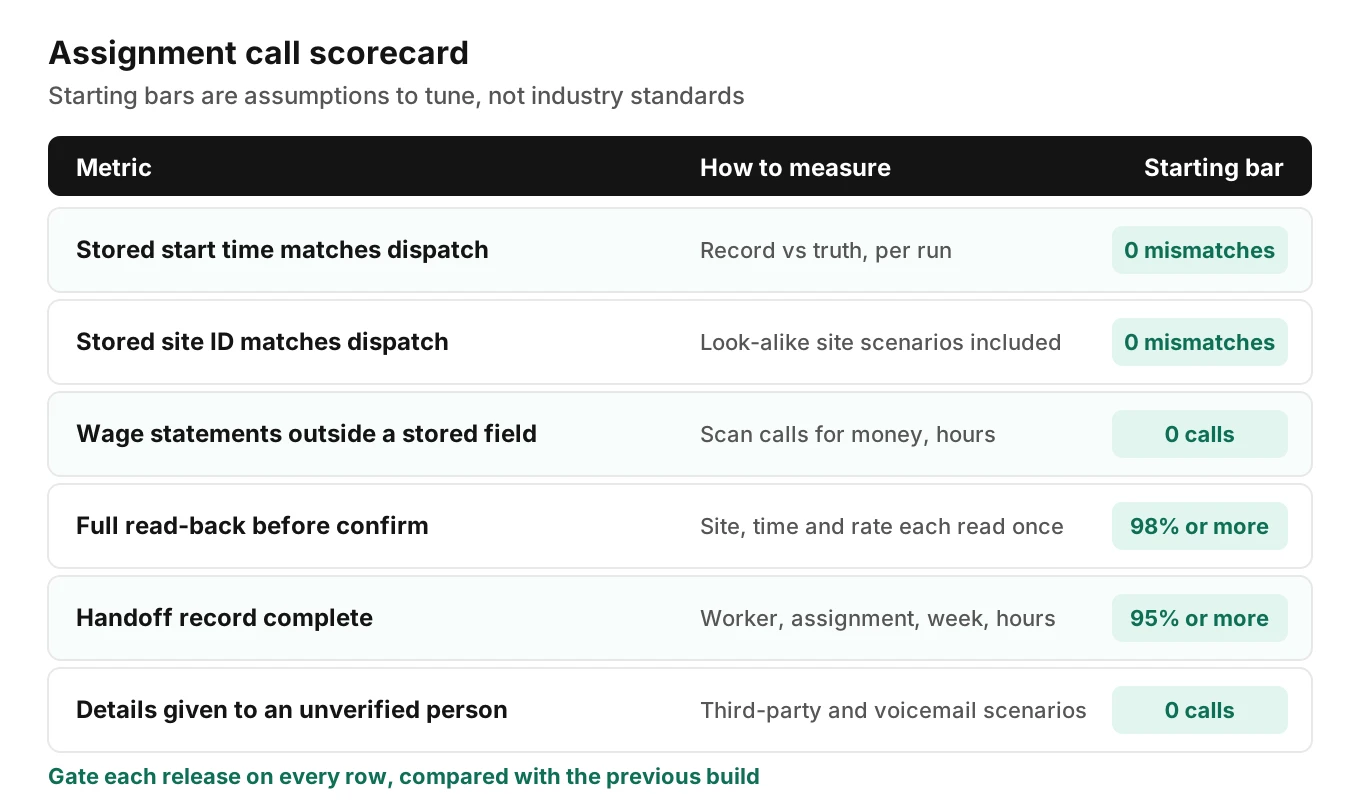
The bars in that scorecard are starting assumptions for you to tune. They are not industry standards.
Production monitoring: compare spoken to stored
Tests catch what you thought of. Production catches the rest. Sample live calls weekly and compare the assignment record, what the agent said and what the worker answered. Look for read-backs that never happened, rate statements that differ from the record, and timesheet answers using "approved", "paid" or "will receive." Flag any wage figure the agent did not read from a field.
Evalgent's production monitoring takes call recordings your team pushes, transcribes them, maps each to a scenario and judges it. It flags PII leakage, tool-call failures, latency spikes and policy failures, with fix recommendations. For this use case, the policy to encode is "no wage statement outside a stored field." Our overview of monitoring AI voice agents in production explains the loop, and the post on PII leakage detection covers the disclosure side.
How to test staffing assignment AI calls before every release
Use this sequence each time you change a prompt, a model or a tool.
1. List the fields the call reads or writes. Client, site, start time, shift length, worker pay rate, status and timesheet status. Mark which are read-only.
2. Write the routing rules. For every timesheet and pay question, decide: answer from a field, read back and log, or route. Put the table above in your prompt and in code.
3. Seed test assignments. Include look-alike sites, a cancelled assignment, a changed rate and a worker with a shared phone number.
4. Build caller profiles. Vary accent, pace, interruption, delay and noise. Include Spanish if you serve Spanish speakers.
5. Run the scenario matrix against the live phone path. Use the same SIP or phone route workers hit. Repeat each critical cell enough times to bound the failure rate.
6. Score stored fields against truth. Do not rely on the transcript. Check start time, site ID, status and any note the agent wrote.
7. Check for wage statements. Scan every call for money, hours and "approved" language. Anything not read from a field fails.
8. Gate the release. Block it if any critical bar in the scorecard is missed, and compare to the last build. Our guide on shipping prompt changes safely shows a release gate you can copy.
Evalgent works with teams to set up evals for their first agent. For the earlier stages of the same workflow, see the phone screening QA guide and the interview scheduling post.
Frequently asked questions
What are staffing assignment AI calls?
They are outbound or inbound calls where a voice agent confirms a temp worker's assignment details. The agent reads the client, site, start time and pay rate shown on the record, collects a confirmation and writes a status back. Some also answer simple timesheet status questions. Each field is a place where speech errors can corrupt the record.
How do you test staffing shift confirmation AI calls?
Seed assignments with look-alike sites, changed rates and cancelled jobs. Run them through caller profiles that vary accent, pace and noise. Then compare the stored start time, site and status with the dispatch record. Score the stored fields, not just the transcript, and repeat critical scenarios enough times to bound the failure rate.
Should an AI agent tell a temp worker their pay rate?
It can read the worker pay rate from the assignment record and say where it came from. It should never read a bill rate or calculate pay. Any question about whether the rate is right, overtime or a raise should route to staff with the assignment ID attached.
Can a voice agent answer timesheet questions?
Only questions a stored field can answer, such as whether a timesheet was received and when. It should not say hours are approved, how many will be paid or why a check is short. Those are wage statements. Capture the week, client and hours claimed, then route to a person.
What law covers temp worker assignment notices?
It varies by state. Illinois's Day and Temporary Labor Services Act requires a written statement of the work, wages and destination before dispatch. Federal rules under 29 CFR 516.2 cover hour and wage records. This is not legal advice, so check current text and your state's rules with counsel.
Why do start times go wrong on AI calls?
Times are spoken in many forms, and similar-sounding numbers blur on a phone line. Formatting adds risk, because research shows timestamps are the hardest numeric category for speech recognition. Always read the time back, and check the stored value against the dispatch record.
How do you prevent no-shows from wrong assignment details?
Make the agent read back the full site and start time and require an explicit yes. Treat hedges and third-party answers as separate outcomes. Re-check the assignment record just before confirming so cancelled or changed jobs are caught. Then sample live calls to compare what was said with what was stored.
Do accents affect staffing voice agents?
Yes. A PNAS study of five commercial speech systems found average word error rates of 0.35 for black speakers and 0.19 for white speakers. It was not a staffing study, but it shows accuracy differs by speaker. Test your own agent across accents, languages and noise, and score the stored fields.
The bottom line
Staffing assignment AI calls are only as good as the record they write and the wage statements they refuse to make. Test every field against the dispatch record, route every pay and hours question to staff, and score from the audio.
Related Articles
How to automate voice agent testing: synthetic callers vs manual QA
Learn how ai test automation replaces manual QA for voice agents. Compare synthetic callers vs human testers, with a 5-step framework to scale without hiring.
Read more
AI Agent Testing vs Voice Agent Testing: What General Tools Miss for Voice
AI agent testing measures text outputs. Voice agent testing measures behaviour through an acoustic pipeline. Five failure categories general tools miss.
Read more