Should You Build a Graph-Based or Prompt-Based Voice Agent?
On this page
The architectural debate around voice agents has resolved into a clear pattern in 2026. Graph-based architectures dominate production voice deployments. Prompt-based architectures remain everywhere for prototypes, demos, and certain kinds of conversation. The case for graph-based is documented at length in graph-based voice agents — S8 in this series. This post does something different. It does not relitigate the argument. It helps you decide which architecture fits the specific ai voice agents you are building right now. Whether that is a customer-service ai voice bot, an outbound ai voice call automation, or an internal ai voice tool agents of ai teams use to streamline workflows.
The question most teams ask is "which is better." The right question is "which fits this." This post is a voice agent architecture decision framework. Below: five questions that determine the answer for your case. A decision matrix you can screenshot. The cases where prompt-based actually wins. The underappreciated role of hybrid architecture in real deployments. And the migration question for teams already running prompt-based agents in production. Together these constitute a graph based vs prompt based voice agent comparison grounded in production reality rather than architectural ideology.
The five questions that determine which architecture fits
Five questions decide the architectural fit for most voice agents. Run through them honestly and the answer is usually clear.
1. What does the agent need to do? Transactional flows have well-defined states and predictable transitions — booking, cancelling, updating accounts, escalating, processing payments. They map cleanly to a state machine. Graph-based is the right answer for a transactional agent. Open-ended advisory dialogue is different. Counselling, exploratory diagnostics, financial planning, complex troubleshooting — none of these fits a finite graph. Prompt-based or hybrid is the right answer for an advisory agent. The transactional/advisory split is the single biggest determinant. Conversation complexity scales differently for each.
2. What is your iteration stage? When to use prompt based voice agent design becomes a stage question. A pre-product MVP exists to validate whether the use case works. That is not the place to invest in graph-based agent design. Ship a prompt-based prototype, learn whether anyone uses it, then commit. A production voice agent at scale is different. Prompt-based architectures start failing there. Graph-based architectures pay back the upfront investment. MVP iteration favours prompt. Production scale favours graph. This is also the answer to when to use graph based voice agent architecture: at the point where reliability matters more than iteration velocity.
3. What is your team capability? Product managers and designers can iterate on prompts. They cannot iterate on LangGraph node definitions. If your iteration loop runs through non-engineers — content updates, tone adjustments, new flows added by non-developers — prompt-based has real advantages. If the agent is owned end-to-end by engineering, graph-based unlocks reliability the prompt-based version cannot reach.
4. What is your tolerance for production regression? Prompt-based agents regress invisibly when prompts change. The team often does not notice until customer complaints accumulate. If your deployment is internal-only and silent regressions are tolerable, prompt-based works. If you ship to enterprise customers, regulated industries (healthcare, BFSI, insurance), or anywhere a missed regression has compliance or customer-trust consequences, graph-based is non-negotiable. This is also where teams typically adopt evaluation infrastructure — platforms like Evalgent that run the full scenario × profile matrix against every release and gate the deploy on scenario success rate, rather than trusting prompt changes to ship safely.
5. How long does the conversation need to be? Two-to-five-turn conversations work fine in either architecture. Eight-to-fifteen turn conversations under acoustic noise, accent diversity, and unexpected user behaviour are where prompt drift compounds. Graph-based agents hold state externally and do not degrade as conversations lengthen. Their explicit fallback handling — defined as graph edges, not as prompt instructions — keeps long calls predictable. Long conversations under production conditions favour graph-based heavily.
How to choose voice agent architecture, ultimately, comes down to how you weight these five questions. Most production transactional agents need to handle calls in the longer multi-turn range, which is why the architectural shift has been so decisive for that category.
The decision matrix
The five questions above resolve into a use-case matrix. This is the post's central reference. Screenshot it, share it, hand it to your tech lead. Three columns: graph-based, prompt-based, hybrid. Eight rows for the use-case characteristics that matter most.
| Use case characteristic | Graph-based | Prompt-based | Hybrid |
|---|---|---|---|
| Transactional flow, well-defined states | ★★★ | ★ | ★★ |
| Open-ended advisory conversation | ★ | ★★ | ★★★ |
| MVP / proof-of-concept | ★ | ★★★ | ★ |
| Production at scale | ★★★ | ★ | ★★ |
| Regulated industry / compliance critical | ★★★ | — | ★★ |
| Long multi-turn conversations | ★★★ | ★ | ★★ |
| Frequent prompt iteration by non-engineers | ★ | ★★★ | ★★ |
| Multiple model providers / model swap | ★★★ | ★ | ★★ |
The matrix is not a scoring system. It is a fit indicator. Read each row by asking "is this characteristic true of my agent?" If three or more rows point to graph-based, you have your answer. If three or more point to prompt-based, you have a different answer. If the rows are mixed — some point one way, some the other — you are probably looking at a hybrid agent. That is what most production deployments actually are.
Where prompt-based voice agents actually win
Most content about graph-based architecture makes prompt-based sound like the obviously inferior choice. That framing is wrong. The prompt based voice agent advantages are three, they survive 2026, and ignoring them produces over-engineered systems where simpler ones would ship faster and serve users better.
Speed to first working prototype. A prompt based voice agent MVP takes a weekend. Write a focused system prompt, hook it up to a voice ai platform or a voice ai tool, ship a demo. A graph-based MVP takes a sprint. For idea validation — where the question is "does anyone use this?" rather than "does it scale?" — the weekend wins. Iteration velocity matters more than architectural purity at this stage. Teams that build their prototype graph-based often spend more time on architecture than on learning whether the agent has product-market fit.
Non-engineer iteration. Prompt-based architecture lets product managers, content designers, and ops teams iterate the agent's behaviour without engineering involvement. Change the tone. Add a new fallback line. Adjust the greeting. All editable in a prompt. A graph-based equivalent requires opening a code editor, modifying a node, redeploying. The cognitive load of prompt based agent design for non-engineers is low. The cognitive load of graph based agent design is meaningfully higher.
Genuinely flexible conversations. When the conversation cannot be enumerated as a finite set of states — exploratory product discovery, open advisory dialogue, anything where the user might take the conversation in any direction — the LLM's flexibility is the feature, not a bug. Over-constraining these conversations with a graph hurts more than it helps. The advisory agent that needs to handle "ask me anything about your retirement planning" is better served by a long careful system prompt. An attempt to map every possible question into a graph does worse.
These three prompt based voice agent advantages are real and worth naming clearly. The architectural choice is not graph-always. It is graph-when-appropriate. The caveat: prompt-based prototypes that stay in production past validation eventually run into the regression and reliability problems S8 documents. The moment a prompt-based agent moves from prototype to scale is usually the moment evaluation infrastructure — Evalgent or equivalent — becomes load-bearing, regardless of whether the team migrates the architecture itself.
Where hybrid architectures win — the underappreciated answer
Most production voice agents are not pure graph-based or pure prompt-based. They are hybrid. The architectural literature underdiscusses this because "we built it both ways" lacks the punch of "we built it the right way" — but hybrid architecture is the answer most teams actually ship. The graph based voice agent advantages — testability, debuggability, model-swap optionality — combine with prompt-based flexibility into a single design.
A hybrid voice agent architecture has a graph backbone for the parts of the conversation where structure matters and prompt-heavy nodes for the parts where flexibility matters. The graph handles intent routing, tool calls, compliance checks, and transactional flows. The prompts handle advisory dialogue, exploratory clarification, and unanticipated user input. Framework choice matters here — some frameworks (LangGraph, Pipecat Flows) make hybrid trivial; others force you to commit to one model. Three concrete hybrid patterns recur in production deployments.
Graph backbone with prompt advisory nodes. The top-level agent is a graph. Intents routed deterministically, tools called by code, state held externally. But certain nodes — typically the ones handling "tell me more about my options" or "I'm not sure what I need" — are implemented as long-prompt LLM calls with significant flexibility. This is the most common hybrid pattern for enterprise agents that need to handle both transactional and advisory queries in the same conversation.
Graph router with prompt subgraphs. The very top of the agent — intent classification, escalation routing, compliance checks — runs as a graph. Once intent is identified, the conversation hands off to a subgraph that is essentially a focused prompt-based agent for that specific topic. Useful when different intent categories have very different conversation shapes. Forcing them all into a unified graph would be over-engineering.
Prompt orchestrator with graph tool calls. The conversation flow itself is mostly prompt-driven — the LLM decides what to do next based on conversation context. But every action that touches an external system goes through a graph-style deterministic node. Booking, payment, escalation, account modification — all executed as code with strict input validation. The conversation is flexible. The actions are bounded. This pattern is increasingly common in agents that need to support open advisory conversations but still hit deterministic tool reliability for the actions those conversations produce.
Hybrid is not a compromise. It is a first-class architectural choice that matches how real voice agents need to behave. Naming it explicitly — rather than calling everything "graph-based" or "prompt-based" — clarifies the actual design space teams are working in. The testing complication hybrid adds is that you cannot evaluate the agent purely at the node level (the prompt-driven sections won't test that way) or purely at the conversation level (the graph sections deserve deterministic verification). End-to-end voice evaluation against the full scenario × profile matrix is the only level at which hybrid agents test honestly. This is exactly where Evalgent sits — the architecture varies, the voice-level evaluation discipline does not.
The migration question
Many readers landing on this post already have a prompt based voice agent in production and are weighing migration. The decision deserves direct treatment, not just an architectural argument. Migration is worth it under specific conditions. Each condition is concrete.
Migrate when the agent is hitting reliability ceilings that prompt iteration will not fix. When adding instructions to the prompt stops improving behaviour or starts making it worse. Migrate when enterprise customers are asking procurement questions about regression testing, model swap procedures, or compliance auditability that the prompt-based architecture cannot answer. Migrate when model upgrades are becoming necessary (new STT, faster LLM, better TTS) but the team is paralysed by the risk of swapping models on a prompt-based agent. Migrate when tool calls are failing at rates the business notices — appointments booked at the wrong time, accounts updated incorrectly, payments processed for the wrong amounts.
Do not migrate when the agent works well enough at current scale. When the team is too small to support the engineering investment in graph based agent design. When the use case itself is still being validated. Migration is not free. The cost is several weeks of engineering work plus a transition period where both architectures coexist. If the prompt-based agent serves current users adequately and the failure modes that drive migration are not present, the migration cost is poorly spent.
The mid-cycle decision — "we are still iterating on the use case but suspect we will need to migrate eventually" — usually resolves toward staying prompt-based until product-market fit is clearer. Graph based agent design rewards commitment. It does not reward optionality.
One operational note for teams actually migrating: the migration only succeeds if you can prove the new graph-based agent matches or beats the old prompt-based one on the scenarios that matter. Without a baseline scenario library running against both versions, the migration becomes a leap of faith — exactly the failure mode graph-based architecture was supposed to solve. Evalgent is built for this case. The same scenario × profile matrix that gated the prompt-based agent gates the graph-based replacement, and the comparison is empirical rather than hopeful.
What this means for testing
The architecture choice shapes how the agent gets tested. Prompt-based voice agents and graph based agents have different unit-test surfaces, different regression strategies, and different debugging tools. A prompt-based agent is tested at the conversation level. Scenarios end-to-end, with regression caught only by re-running the full suite. A graph-based agent can be tested at three levels. The node level — each LLM call individually. The subgraph level — a flow end-to-end with synthetic callers. And the end-to-end voice level — full scenario × profile matrix under production conditions. Migration also changes what testing looks like.
Both architectures still need voice agent testing. The kind that covers acoustic conditions, accent diversity, latency cliffs, and interruption handling. Architecture choice does not eliminate this requirement. It only changes what tests are practical at each level. This is the layer Evalgent operates in — scenario × profile matrices, behavioural conditions, end-to-end voice evaluation that works the same way whether the agent under test is prompt-based, graph-based, or hybrid. The architecture is the implementation detail. The evaluation discipline is the constant. The full methodology for testing graph-based voice agents is covered in S10 of this series. The broader testing philosophy lives in eval-driven development and ai agent testing vs voice agent testing.
Summary
The graph based vs prompt based voice agent question is not architectural. It is situational. Match the architecture to the agent, not the agent to the architecture.
Frequently asked questions
What is the main difference between graph-based and prompt-based voice agents?
A prompt based voice agent encodes its behaviour in one long system prompt and trusts the LLM to follow it across multi-turn conversations. A graph based voice agent encodes behaviour as a directed graph of nodes — intent classification, tool calls, transitions, fallbacks — with the LLM used inside specific nodes and deterministic routing handling control flow.
When should I use a graph based voice agent?
Use a graph based voice agent when the use case is transactional with well-defined states, when shipping to production at scale, when regression risk is unacceptable, when conversations regularly run eight or more turns under noise, or when frequent model swaps require bounded testing. Graph based agents handle these conditions reliably where prompt based agents drift.
When should I use a prompt based voice agent?
Use a prompt based voice agent when shipping an MVP or proof-of-concept where speed matters more than scale. When non-engineers need to iterate the agent's behaviour directly. When the conversation is genuinely open-ended and cannot be mapped to a finite state graph. When the cost of architectural investment exceeds the value of validation at the current stage.
What is a hybrid voice agent architecture?
A hybrid voice agent architecture combines a graph backbone for transactional structure (intent routing, tool calls, compliance checks) with prompt-heavy nodes for advisory flexibility (open dialogue, exploratory clarification). Three common patterns: graph with prompt advisory nodes, graph router with prompt subgraphs, and prompt orchestrator with graph tool calls. Most production enterprise voice agents are hybrid.
How do I decide between graph-based and prompt-based for my agent?
Run through five questions. What does the agent do (transactional or advisory)? What stage is the team in (MVP or scale)? Who iterates the agent (engineers or non-engineers)? What is the tolerance for regression (low or high)? How long are conversations (short or long)? Most agents resolve cleanly. Mixed answers usually indicate a hybrid voice agent architecture is appropriate.
Can I migrate from prompt based to graph based?
Migration is worth the investment when the agent is hitting reliability ceilings prompts cannot fix, when enterprise customers need regression auditability, when model swaps are blocked by upgrade risk, or when tool call failures are hurting the business. Migration is not worth it if the prompt based agent works well at current scale or if the use case is still being validated.
Are graph based agents always better?
No. Graph based agents trade upfront engineering investment and design complexity for production reliability and testability. For prototypes, MVPs, and open-ended advisory conversations, prompt based agents remain the better choice. The decision is situational, not universal. Most production transactional voice agents benefit from graph based design; most prototypes do not.
What is the cost difference between graph-based and prompt-based voice agents?
Prompt based voice agent design costs less upfront — a weekend of engineering versus a sprint. Graph based agent design costs more upfront but less over time. Maintenance, regression testing, model swaps, and team scaling are all cheaper with graph based architectures. For agents expected to live in production beyond six months, graph based agents are typically cheaper in total cost of ownership.
Related Articles
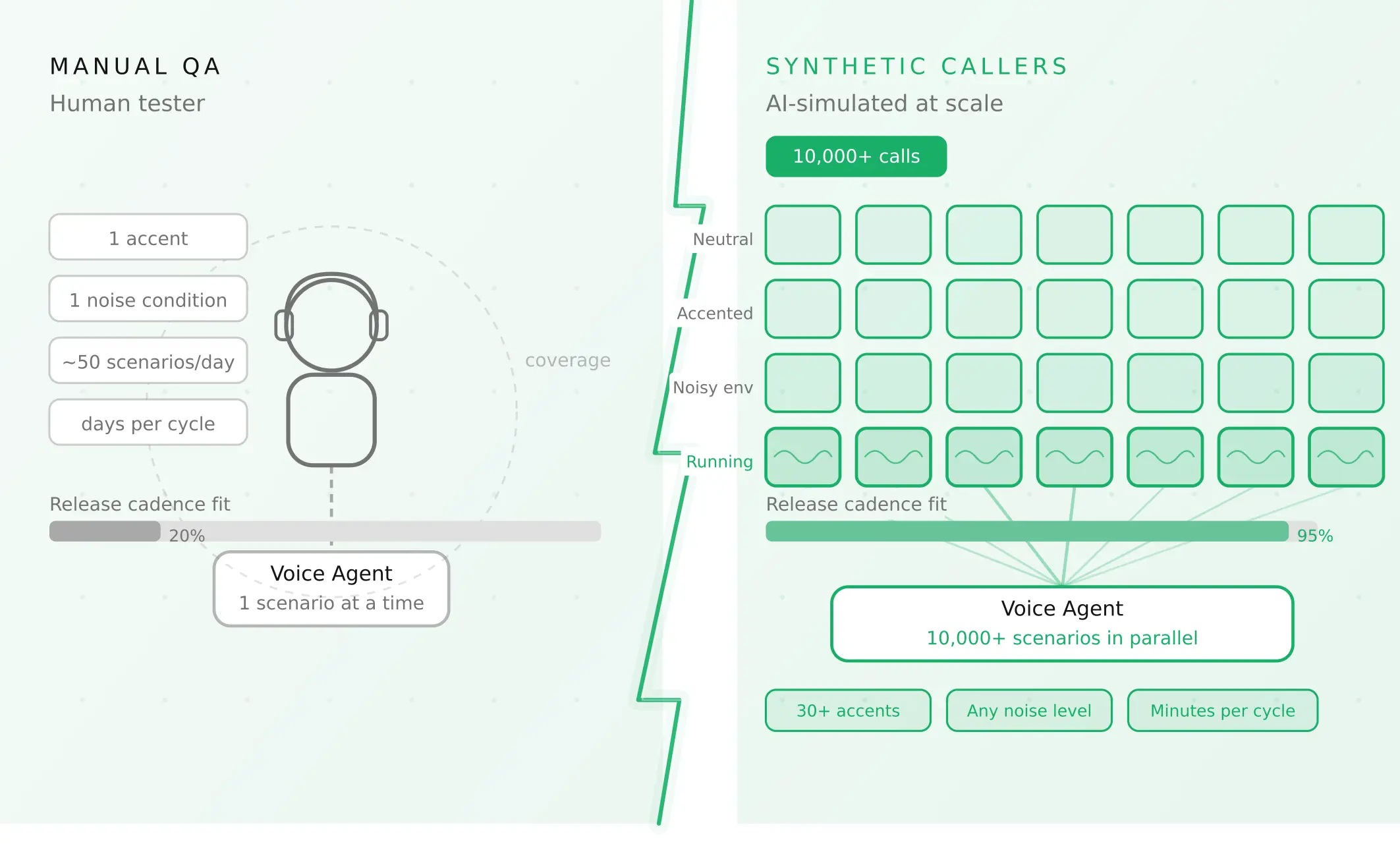
How to automate voice agent testing: synthetic callers vs manual QA
Learn how ai test automation replaces manual QA for voice agents. Compare synthetic callers vs human testers, with a 5-step framework to scale without hiring.
Read more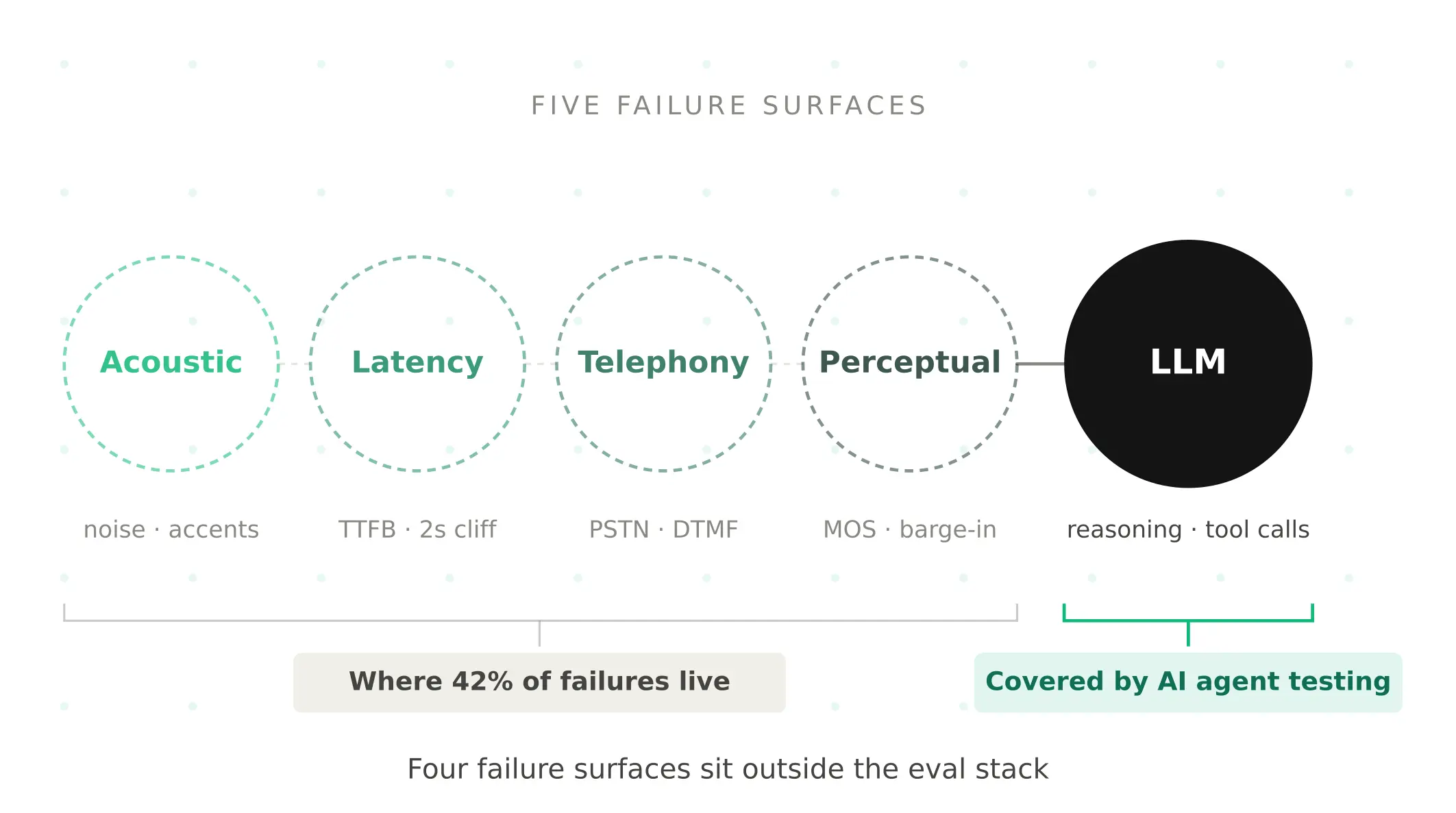
AI Agent Testing vs Voice Agent Testing: What General Tools Miss for Voice
AI agent testing measures text outputs. Voice agent testing measures behaviour through an acoustic pipeline. Five failure categories general tools miss.
Read more