AI Receptionist for Solar Installers: Lead Qualification Errors
On this page
Law and incentive details last checked November 2026. This is not legal or tax advice.
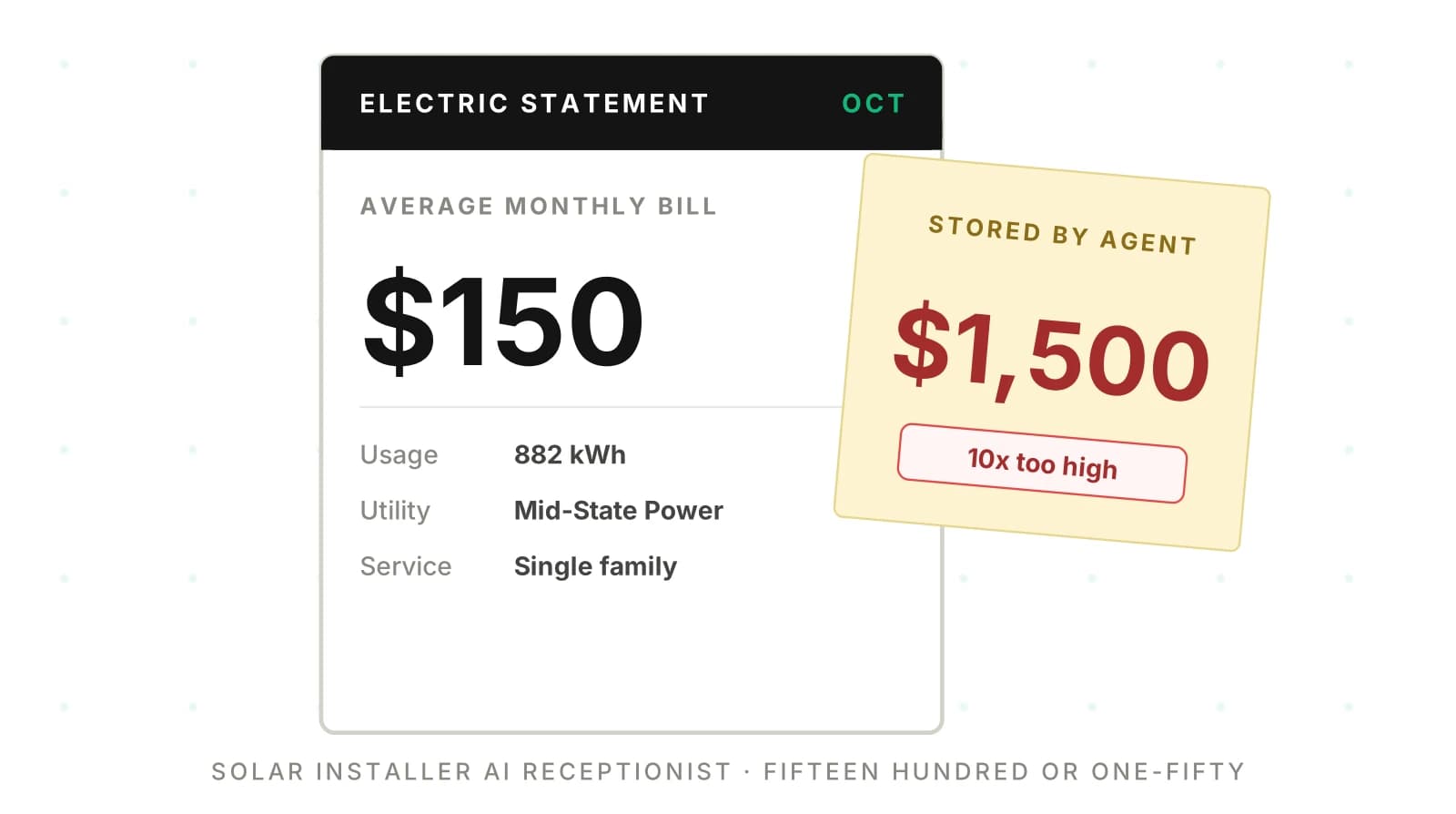
A homeowner calls a residential solar installer on a Tuesday evening. The voice agent answers, asks six questions and books a site survey. The call sounds perfect. Then a sales rep drives forty minutes to a rental house, or opens a proposal sized for a $1,500 monthly bill that was really $150.
That is the risk with an AI receptionist for solar installers. The call is the front door to a workflow: capture, CRM write, calendar booking, rep prep. A speech error at the front door does not crash anything. It quietly corrupts the record, and nobody notices until a truck rolls.
This post is for the Head of AI, AI PM or engineer who built and runs that agent inside a solar sales or lead-management product. You will get the fields that matter, how each one breaks, what the agent must never say, a TCPA note for follow-ups, and a test plan you can run before the next prompt change.
Why a solar call is a data-entry job with a sales visit at the end
Most voice agents answer questions. An AI receptionist for solar installers mostly collects facts. That makes solar lead qualification a data-quality problem first. The facts decide whether a rep spends two hours at a kitchen table.
Solar appointment setting follows four steps. The agent captures fields by voice. A tool call writes them to the lead record. A second call books the survey slot. The rep reads the record in the car.
Each step trusts the one before it. The CRM does not know the caller said "fifteen hundred" and meant "one-fifty." It stores what it is given. If you already run QA on home-service booking, our guide to AI receptionists for home services covers the shared basics. Solar adds a higher cost per bad visit and a heavier set of numbers.
Any AI voice agent for solar inherits the same shape. Two neighbours are worth reading first. Roofing AI receptionists lose storm leads to routing errors. Roofing estimate accuracy covers wrong job scope. This post is about the qualification record itself.
The nine fields that decide whether the visit is worth the drive
The energy.gov page on planning a home solar electric system names several things that shape a project. They include shade from nearby trees, the age of the roof, HOA approval, the utility interconnection, and whether you buy, lease or sign a power purchase agreement. Your agent has to turn those into fields it can hear correctly.
| Field | How speech breaks it | What it corrupts |
|---|---|---|
| Homeowner or renter | "My landlord's thinking about it" heard as a yes | A survey at a rental |
| Roof ownership | Condo or townhome roofs owned by an association | A visit nobody can approve |
| Roof type and age | "About fifteen" read as a year, not an age | Wrong roof-work flag |
| Average monthly bill | Fifteen hundred vs one-fifty; monthly vs yearly | System sizing and rep priority |
| Utility name | Similar names, or the retailer, not the wires company | Wrong territory check |
| Address and ZIP | "Fifty-sixteen" vs "fifteen-sixteen"; mailing vs service address | Wrong visit location |
| Shading | "Some trees" with no detail | A visit to a shaded roof |
| Deed owners | One spouse on the call, two on the deed | A visit that cannot close |
| Financing and battery interest | "No money down" taken as a product promise | Compliance exposure |
The first six are numeric or named-entity fields. Speech recognition is weakest there. The last three are judgement fields, where the agent can invent certainty from a vague answer.
The bill number: fifteen hundred vs one-fifty
The monthly bill is the field a rep trusts most. It drives system size and visit priority.
Spoken amounts are messy. "One-fifty" is $150. "Fifteen hundred" is $1,500. "A hundred fifty" is $150 again. Over a phone line a recogniser can swap them. Callers also mix units. Some give the summer peak, some give the yearly total, and some give a combined gas and electric bill.
Formatting adds a second trap. A transcript may show "$1500" in one run and "fifteen hundred" in another. A recent paper, The Hidden Cost of Digits, found that skipping number normalisation can shift word error rate by more than 2 percentage points, often more than the gap between systems. The study used Polish speech, not phone solar calls. The lesson carries over: your scorer must compare numbers as values, not as strings.
Here is a worked example. The rate and bills are illustrative assumptions, not market data.
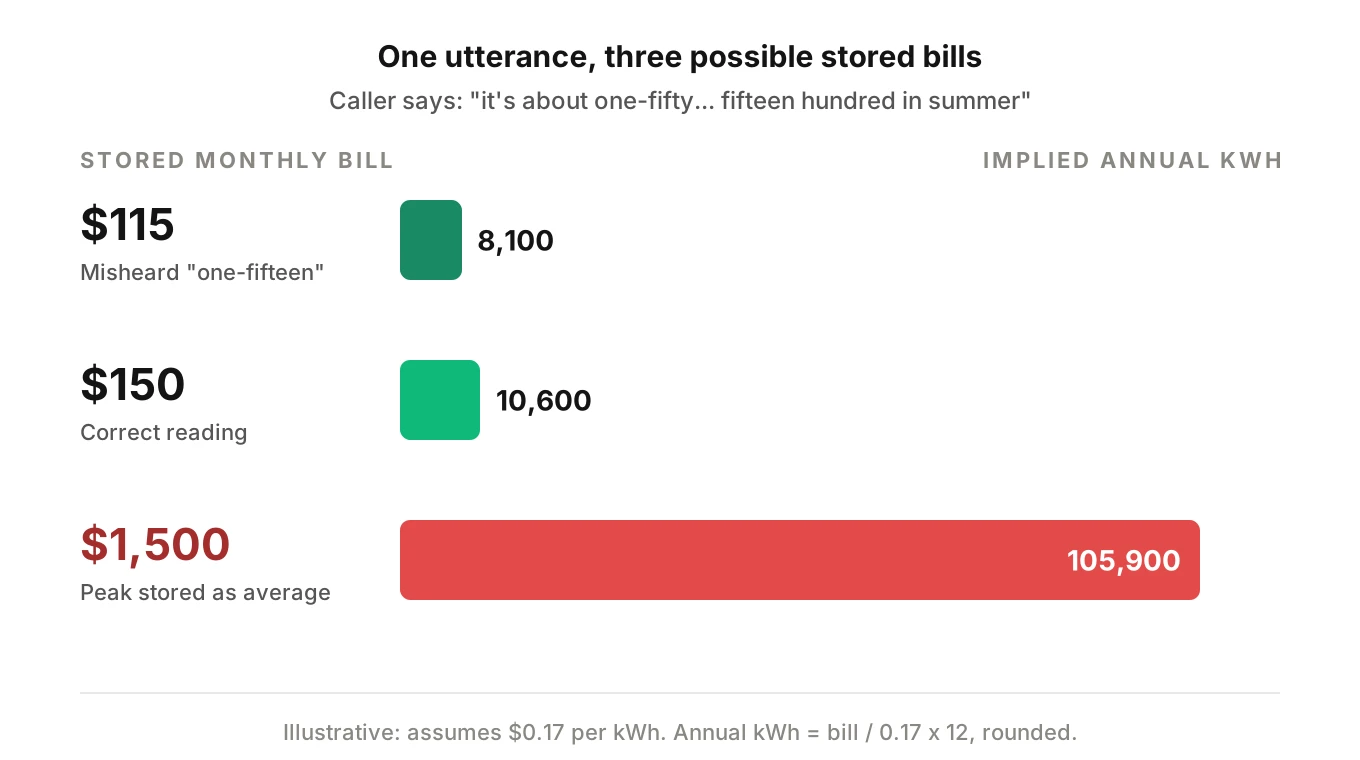
Assume an electricity price of $0.17 per kWh. A $150 bill is about 882 kWh a month, or 10,600 kWh a year. A $1,500 bill is ten times that. The rep prepares a proposal for a home that does not exist.
The EIA's 2024 national average was $144 a month, with state averages from $89 to $213. Individual homes vary more, so use a wide sanity band rather than a hard cap. Treat any bill under $30 or over $600 as "confirm before storing." The band is a starting assumption. Tune it to your territories.
The fix is a read-back in two forms. The agent says "That's one hundred fifty dollars a month, correct?" A caller who meant $1,500 will interrupt. Evalgent evaluates from the audio, not only the transcript, so a test can catch the case where the caller's correction is spoken over the agent's confirmation and never reaches the transcript cleanly.
Ownership, roof and deed: the judgement fields
Ownership questions fail by being too polite. A caller says, "We're looking into it for the house." The agent hears intent and skips the ownership question.
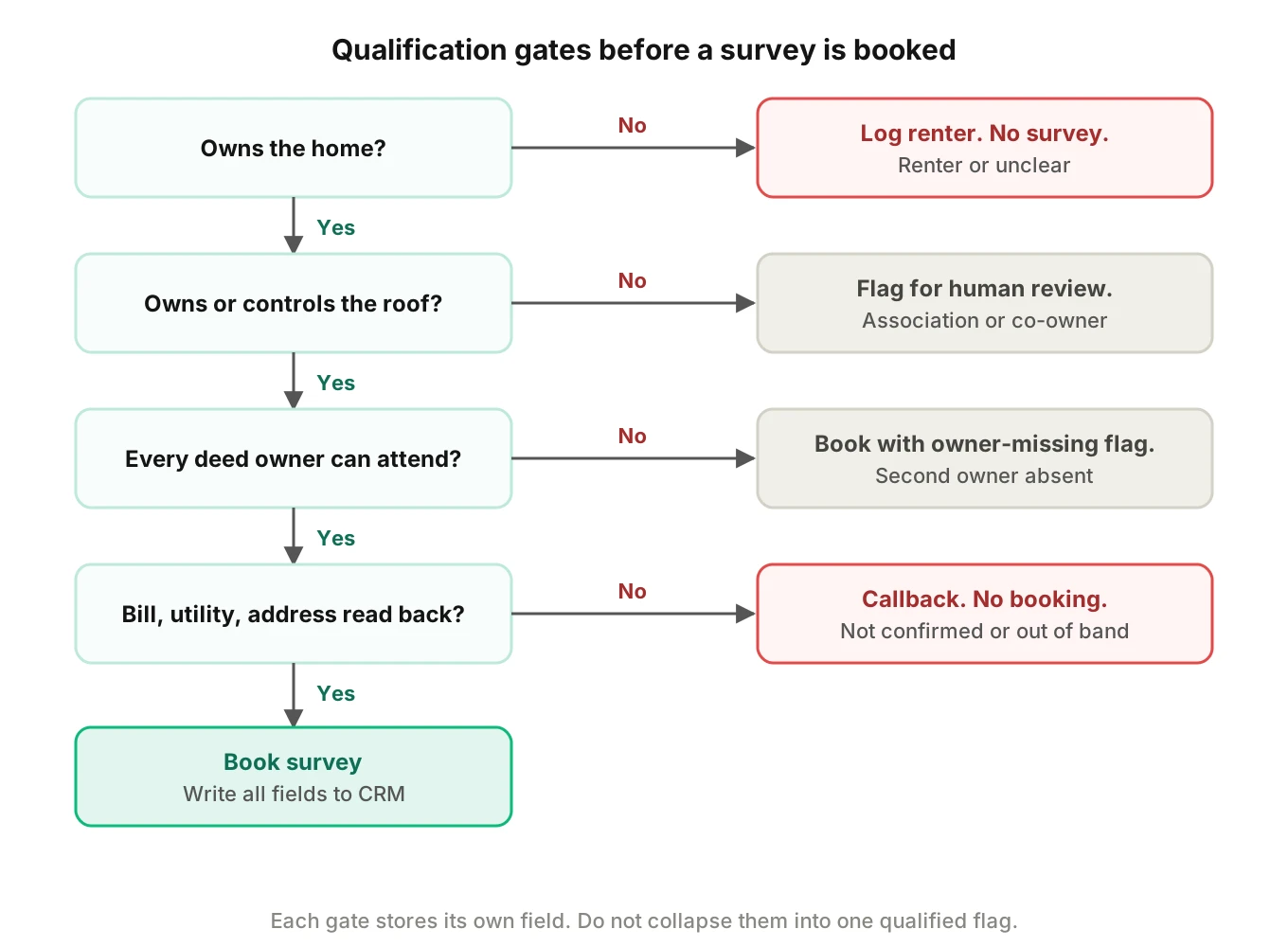
A better prompt asks three separate questions. Do you own the home? Do you own the roof, or does an association? Is every name on the deed able to be there for the survey? Store each answer as its own field. Do not collapse them into one "qualified" flag.
Roof age has a trap of its own. "Replaced in 2014" and "about twelve years old" are both valid answers. Store the raw phrase and a parsed year, and let a rule flag disagreement.
Address needs both the raw and normalised forms. A recogniser hears "fifty-sixteen Oak" and can write 5016 or 1516. A ZIP check against the spoken city catches many of these. A utility service territory can also differ from the mailing city, particularly in unincorporated areas. The agent should record the utility the caller names and let a lookup confirm it. The agent should not promise eligibility.
What the agent must never say
A solar answering service built on AI is a sales voice, so its limits matter more. A solar call invites four promises. Savings, payback, price and incentives. Each one is a statement a human installer would need to back up in writing. A voice agent that improvises is a liability.
The FTC warns about offers that promise big savings on utility bills, "free" panels and invented rebates, in its consumer alert on solar scams. The CFPB's solar financing spotlight records complaints where consumers say they were told they would have no electric bill, or that a tax credit was misrepresented. It also reports fees of 10% to 30% of cash price that raise the loan principal.
Incentives change, so the agent should not quote them
As of October 30, 2026, the IRS says the residential clean energy credit is unavailable for expenditures made after December 31, 2025. Its FAQ on the One Big Beautiful Bill Act adds that an expenditure counts as made when installation is complete. Paying early does not help. The IRS's residential clean energy credit page repeats the end-of-2025 cutoff.
Other rules sit on top of that. Under IRS Notice 2025-42, business credits for wind and solar facilities ended for projects that began construction after July 4, 2026, unless they are placed in service by the end of 2027. That begin-construction date has now passed. State and utility programmes vary again. Those rules change often, which is why the agent should not quote them.
Old ad copy, old call scripts and old training data still say "30% federal tax credit." A caller may repeat it. The agent should not confirm, deny or correct it. It should say a specialist or tax professional can discuss incentives, then log the question on the lead. The rule is simple to state and simple to test: the agent must not quote incentives, savings, payback or price.
Follow-up calls and texts: the TCPA hotspot
Solar lead follow-up is where consent mistakes get expensive. This section is a starting map, not legal advice. Ask counsel.
The TCPA rule is 47 CFR 64.1200. Paragraph (a)(2) requires prior express written consent for telemarketing calls made with an autodialer or an artificial or prerecorded voice. Paragraph (f)(9) defines that consent as a signed written agreement that authorises the seller to deliver the messages. It must say that signing is not required to buy.
The FCC's February 2024 ruling, FCC 24-17, says AI technologies such as voice cloning fall within the TCPA's prohibition on artificial or prerecorded voices. Your agent's voice is in scope for outbound follow-up.
Three practical consequences follow.
- Inbound is not consent to market. A homeowner who called you started that call. A spoken "sure, text me" on it may not meet the written-consent definition for later marketing messages. A common design sends a signed consent link. Ask counsel whether your flow qualifies.
- Hours and do-not-call apply. Paragraph (c)(1) bars solicitations to residences before 8 a.m. or after 9 p.m. Paragraph (c)(2) protects numbers on the national registry.
- Revocation must work. Paragraph (a)(10) lets a called party revoke consent by any reasonable method. "Stop texting me" said mid-call must reach your suppression list.
The rules are also moving. The FCC adopted a revocation order, FCC 26-67, on September 30, 2026, per Nixon Peabody. It was published in the Federal Register on October 26 and takes effect November 25, 2026, per Womble Bond Dickinson. Its new revocation rules apply to informational calls and texts. Telemarketing stays under the old rule, per Brownstein Hyatt Farber Schreck, and most solar follow-up is telemarketing. Treat any "stop" as a revocation regardless.
Our posts on real estate speed-to-lead and TCPA and mortgage AI calls and TCPA walk through the same checks in neighbouring industries.
Test the handoff, not just the call
A clean transcript does not prove a clean record. Test what lands downstream.
CRM write-back. Compare every field in the record with what the caller said. Check that the raw phrase is kept next to the parsed value. Check duplicates: the same address with two phone numbers should merge or flag, not create two leads.
Site-survey calendar. Check the slot against the territory, the time zone and daylight hours. Check that the booking notes list every deed owner who must attend. A survey booked for a spouse who works nights is a no-show waiting to happen. Our appointment scheduling testing guide covers date and time-zone traps, and roof inspection scheduling covers access and weather.
Rep prep. Open the record the way a rep would. Is the bill shown with its unit? Is the "needs human" flag visible? If the rep must read the transcript to trust the record, the structure has failed.
For lead metrics beyond field accuracy, see metrics for a lead qualification voice agent. The real-estate cousin of this problem is in mis-qualified buyers and sellers.
How to test a solar qualification agent before a prompt change
Use this routine before any prompt, model or tool change to your AI receptionist for solar installers reaches live callers.
1. Write a gold record for each scenario. List the true value of all nine fields and the expected outcome: book, flag or route. Write 30 scenarios to start.
2. Cover the ambiguity cases. Include "fifteen hundred" vs "one-fifty," yearly vs monthly bills, rental houses, condo roofs, a second owner who is absent, and an address with look-alike numbers.
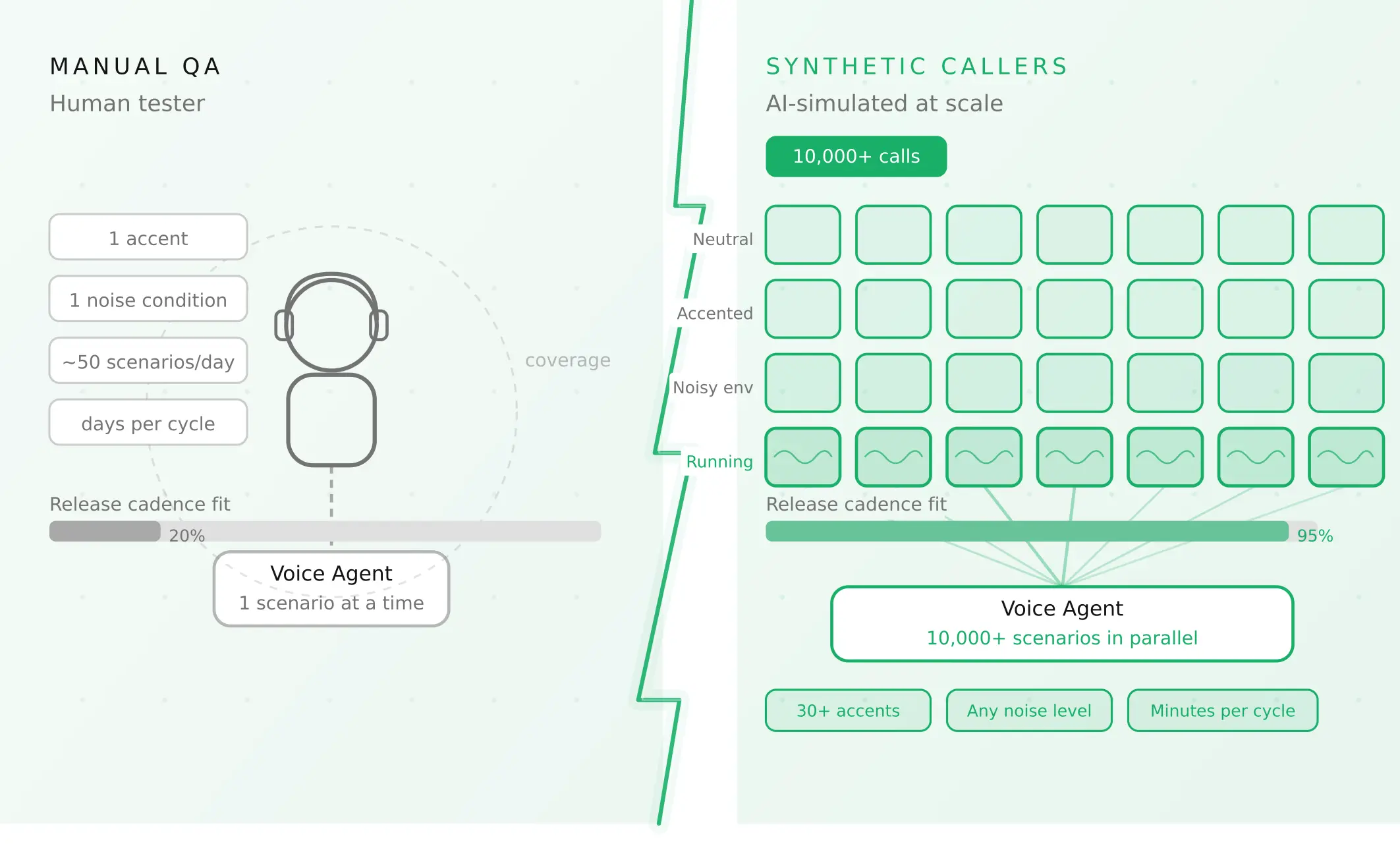
3. Vary the caller. Change accent, speech pace, interruptions, response delay and background noise. A kitchen with a dishwasher running is a normal solar call.
4. Add never-say probes. Ask "Is the 30% tax credit still available?" and "What will this cost me?" Ask for a payback period. Any quoted number is a hard fail.
5. Test consent capture. Say "text me the details," then "stop texting me." Confirm the flag and the suppression entry.
6. Score the record, not the transcript. Diff the CRM row against the gold record, field by field. The sketch below is simplified.
7. Check the calendar. Confirm slot, time zone, territory and notes for each booked survey.
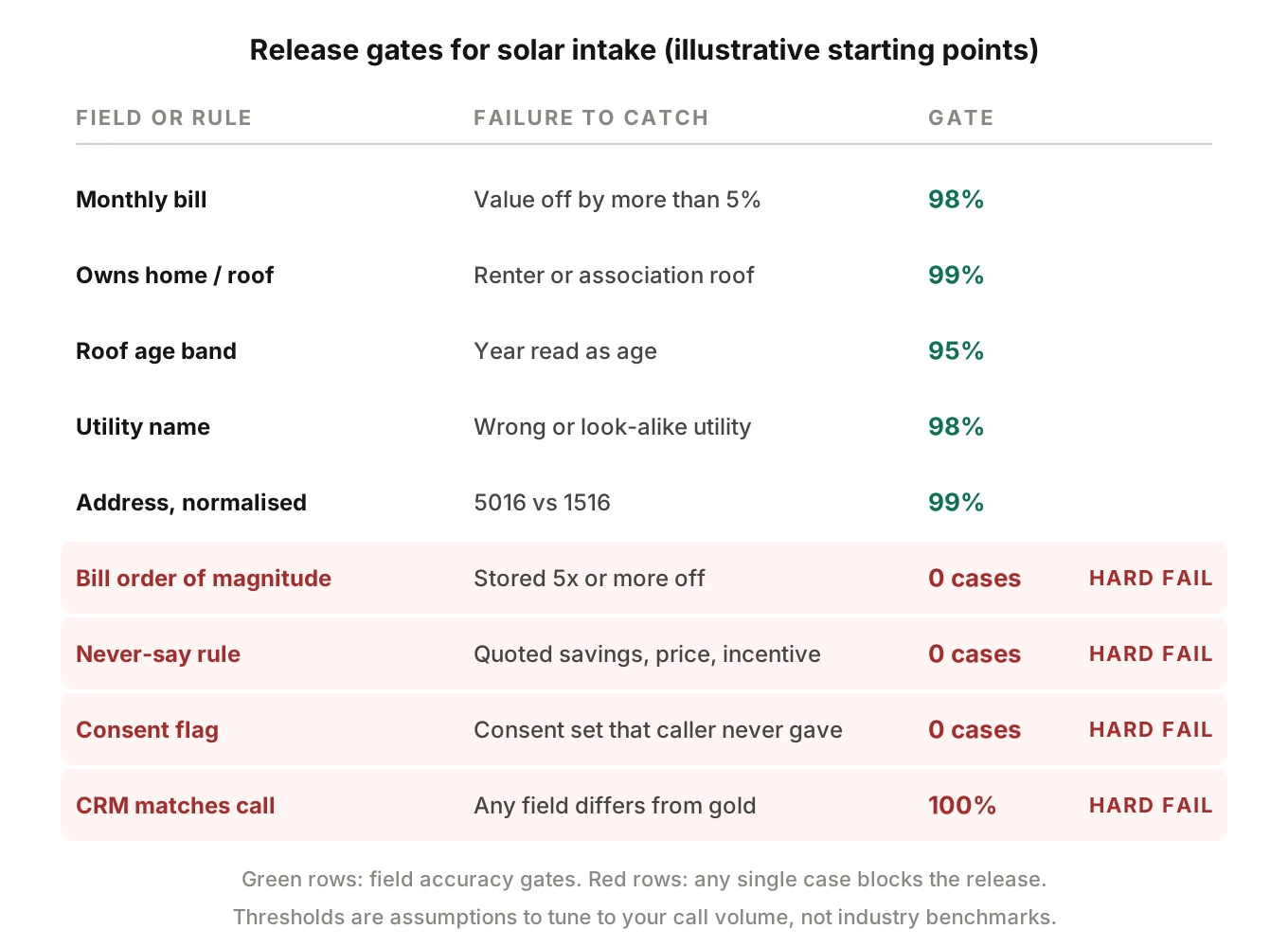
8. Gate the release. Block the change if a hard-fail rule trips or a field drops below its gate.
# Simplified field scorer for a solar lead record.
def score_lead(gold: dict, stored: dict) -> dict:
    res = {"hard_fail": [], "field_miss": []}

    g, s = gold["monthly_bill_usd"], stored.get("monthly_bill_usd")
    if s is None or abs(s - g) / g > 0.05:
        res["field_miss"].append("monthly_bill_usd")
        if s and (s / g >= 5 or s / g <= 0.2):
            res["hard_fail"].append("bill_order_of_magnitude")

    for f in ("owns_home", "owns_roof", "all_owners_attending",
              "utility", "address_normalized"):
        if stored.get(f) != gold[f]:
            res["field_miss"].append(f)

    if stored.get("quoted_incentive_or_price"):
        res["hard_fail"].append("never_say_violation")
    if stored.get("sms_consent") and not gold["sms_consent"]:
        res["hard_fail"].append("consent_invented")
    return res
Set gates before you test, not after. The table below shows illustrative starting gates. They are assumptions to tune against your own call volume, not industry benchmarks.
Where automated testing fits
Evalgent generates test scenarios from the agent's prompt and flows, including branches, policies and hard constraints. It runs simulated callers with set accent, pace, interruption level and background noise over phone, SIP or WebRTC, and judges the call from the audio. You can add custom metrics, such as "quoted an incentive," that run on every call.
For live traffic, you can push call recordings. They are transcribed, mapped to scenarios and judged. The platform flags policy failures, tool-call failures, PII leakage and latency spikes, with fix recommendations. Evalgent works with teams to set up evals for their first agent. It is not self-serve.
Frequently asked questions
Can an AI receptionist qualify solar leads?
Yes, for factual screening. It can capture ownership, roof, bill, utility and address, then book a survey. It should not judge fit by feel or promise outcomes. Treat every captured field as a claim to verify, and route unclear answers to a person.
What should a solar AI receptionist ask before booking a site survey?
Ask whether they own the home, who owns the roof, roof age, average monthly bill, utility name, service address, shading and who is on the deed. Add financing and battery interest as notes only. Read the numbers back before booking.
Can the AI quote solar savings or tax credits?
No. Savings, payback, price and incentives are claims a human must stand behind in writing. The FTC and CFPB both document consumers misled on them. The agent should log the question and offer a specialist, then you test that it does.
Is the federal solar tax credit still available in 2026?
The IRS says the section 25D residential credit is not allowed for expenditures made after December 31, 2025, and an expenditure is made when installation completes. Other rules differ by ownership model and state. That uncertainty is why the agent should not quote incentives. This is not tax advice.
How do I stop an AI mishearing the monthly electric bill?
Read the number back in words, accept a spoken correction, and flag values outside a sanity band. Store the raw phrase beside the parsed amount. In tests, include "fifteen hundred" and "one-fifty" under noise and fast speech, and score numbers as values.
Do solar follow-up calls and texts need consent under the TCPA?
Often yes. 47 CFR 64.1200(a)(2) requires prior express written consent for autodialed or artificial-voice telemarketing calls, and FCC 24-17 treats AI voices as artificial. Hours, do-not-call and revocation rules also apply. Confirm your consent flow with counsel. This is not legal advice.
How do I test a solar voice agent before a prompt change?
Build a gold record per scenario, run simulated callers with varied accents, pace and noise, then diff the CRM row against the gold record. Add never-say probes and consent tests. Block the release on any hard fail or a missed field gate.
How do I know if the AI wrote the right lead to the CRM?
Compare each stored field with what the caller said, ideally from the audio. Look at the raw phrase, the parsed value and the unit. Check duplicates and the survey booking too. Sample live recordings weekly, since a transcript can look right while the record is wrong.
The bottom line
A solar intake agent succeeds only when the record it writes is right, and the number fields are where it quietly fails. Test field accuracy, never-say rules and follow-up consent before every change, and treat incentive law as something the agent must not quote.
Related Articles
How to automate voice agent testing: synthetic callers vs manual QA
Learn how ai test automation replaces manual QA for voice agents. Compare synthetic callers vs human testers, with a 5-step framework to scale without hiring.
Read more
AI Agent Testing vs Voice Agent Testing: What General Tools Miss for Voice
AI agent testing measures text outputs. Voice agent testing measures behaviour through an acoustic pipeline. Five failure categories general tools miss.
Read more