Open door for builders.
Retail Voice Agent Vendor Scorecard
# Retail voice agent vendor scorecard
Quick answer
A retail voice agent vendor scorecard is a weighted rubric for picking one voice AI vendor across your whole retail operation. It scores catalog and policy grounding, order handling, peak-load performance, integration reliability, containment, CSAT, and cost on a 1 to 5 scale. You total the weighted scores and decide on measured results, not a demo.
Most retail teams pick a voice agent vendor the wrong way. They watch a polished demo, read a page of vendor-reported numbers, and sign. Then December arrives and the agent invents stock levels, misfires on refunds, and stalls under load.
A scorecard fixes this. It forces every vendor through the same weighted criteria, scored on your own catalog and traffic. This post gives you that framework for the whole retail vertical, not one narrow use case. It builds on our general voice agent vendor scorecard, tuned for the risks that make retail different.
Why retail needs its own vendor scorecard
Retail is not generic support. It combines a live catalog, money changing hands, and violent seasonal swings. A scorecard that ignores those facts will pick the wrong vendor.
Three things set the retail risk profile apart. Each one deserves weight in the framework.
Peak and seasonal load. Black Friday and Cyber Monday can multiply call volume overnight. Concurrency jumps from hundreds of calls to tens of thousands. A vendor that feels fast in October can collapse in November.
Catalog and policy grounding. Prices, stock, promotions, and return windows change daily. The agent must answer from your live data, not from training memory. A hallucinated price or stock count is a promise you cannot keep.
Money and abuse. Refunds are financial actions. A wrong promo code costs margin. Callers probe for stacked discounts and fake price matches. Any flow that touches payment card data raises a PCI question the vendor must answer.
Integration reality is the fourth pressure. A retail agent lives or dies on tool calls to your order management system, your catalog service, and carrier tracking APIs. When one of those calls times out, a weak agent invents an answer instead of failing gracefully. The scorecard must test those integrations directly, not assume they work.
These pressures cut across every retail use case, which is why the scorecard spans the whole vertical rather than a single channel. A single-channel review, however deep, cannot tell you whether one vendor can carry order status, returns, product Q&A, and loyalty at the same time. That is the question a vendor decision actually turns on.
The retail use cases your scorecard must span
A retail voice agent does far more than answer support tickets. Scoring only support would miss most of the work. Your scorecard should cover the full set of jobs the agent will actually do.
- Customer support. General questions, complaints, and account help. This is the deepest use case, and we cover it separately in our retail support vendor guide.
- Order status and WISMO. "Where is my order" is the single most common retail call. It hides a chain of tool calls to your order and carrier systems.
- Returns and exchanges. Start a return, check eligibility, and issue a label. Edge cases like out-of-window returns break weak agents.
- Refunds. A financial action that must be correct, logged, and reversible on error.
- Product and inventory Q&A. Price, availability, specs, and comparisons. This is where catalog grounding is tested hardest.
- Order placement. Taking an order by voice, applying promos, and confirming totals.
- Loyalty. Points balances, tier status, and reward redemption.
Weighting depends on your traffic mix. A grocer with heavy reorder volume weights order placement higher. A fashion brand weights returns and exchanges. Map your call volume to these jobs before you set weights.
The retail voice agent vendor scorecard
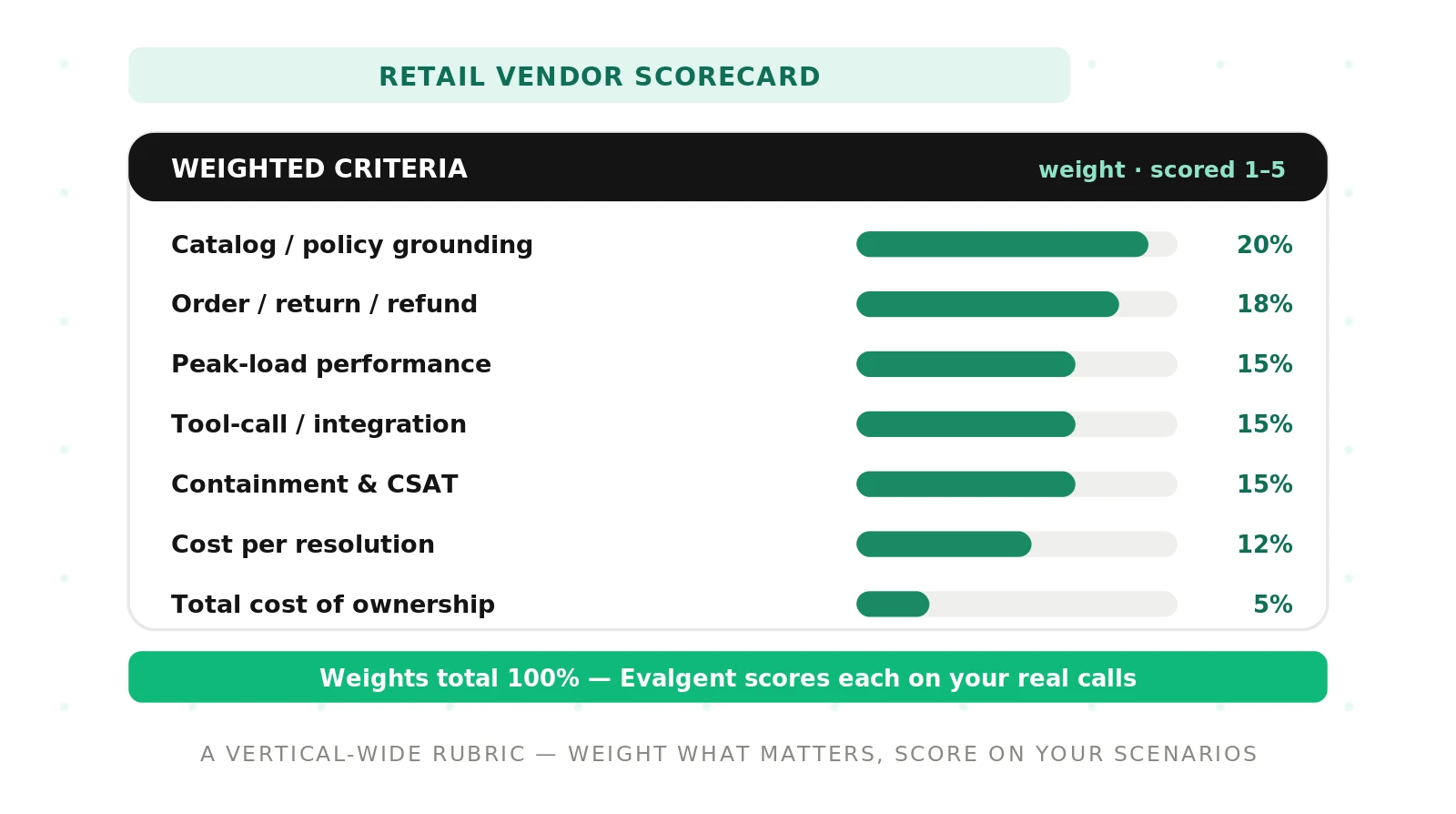
Score every vendor on the seven categories below. Each carries a weight that reflects its business impact. Rate each on a 1 to 5 scale, where 1 is a clear fail and 5 is production-ready under your load. Multiply each score by its weight, then total to a single number out of 5. The categories draw on established software quality and risk-management thinking, adapted to a retail phone call.
The weights below are a starting point. Adjust them to your risk tolerance and traffic mix, but keep them constant across every vendor so the comparison stays fair.
| Criteria category | Weight | What to score (1–5) | Pass bar to clear |
|---|---|---|---|
| Catalog & policy grounding | 20% | Answers on price, stock, promos, and return windows trace to your live data | Zero invented prices or stock; 4+ |
| Order, return & refund handling | 18% | Correct actions on order lookup, returns, exchanges, and refunds, including edge cases | 95%+ correct actions; 4+ |
| Peak-load performance | 15% | Accuracy and latency held as concurrency ramps to your seasonal peak | Within 15% of baseline at peak; 4+ |
| Tool-call & integration reliability | 15% | Correct calls to OMS, catalog, and carrier APIs, with clean failure handling | 98%+ correct tool calls; 4+ |
| Containment & CSAT | 15% | Genuine resolution and satisfaction, not trapped callers | CSAT at or above human baseline; 4+ |
| Cost per resolution | 12% | Fully loaded cost divided by contacts actually solved | At or below current cost; 3+ |
| Total cost of ownership | 5% | Integration, maintenance, and switching costs over the contract | No hidden lock-in; 3+ |
A vendor that scores 5 on grounding but 2 on peak load is not ready. The weighted total keeps one strong category from hiding a fatal weak one. Two categories reward care: containment paired with customer satisfaction, and total cost of ownership so a cheap rate card cannot hide expensive integration and switching costs. For the metric definitions behind these categories, see our voice agent metrics scorecard.
How to score retail voice agent vendors with this scorecard
Follow these steps to turn the framework into a defensible decision. Run the same process for every vendor so the numbers compare.
1. Set your weights. Start from the table, then adjust to your traffic mix and risk. A brand with heavy returns weights that category up. Lock the weights before you test anyone.
2. Build your scenario set. Pull real calls across every use case: WISMO, returns, refunds, product Q&A, order placement, and loyalty. Include angry callers and edge cases like out-of-window returns.
3. Ground on your own data. Connect each vendor to a copy of your live catalog, order management system, and carrier feeds. Grounding on sample data proves nothing.
4. Run identical tests per vendor. Play the same scenario set through each agent. Change nothing between vendors except the agent itself.
5. Ramp to peak load. Drive synthetic callers from normal volume to your Black Friday peak. Hold the peak for at least an hour and record accuracy and latency at each step.
6. Probe grounding and abuse. Ask questions answerable only from your catalog. Attempt stacked promos and fake price matches. Any invented answer or accepted abuse fails the category.
7. Score each category 1 to 5. Use the pass bars as your anchor. Record evidence for every score so the number is defensible.
8. Weight, total, and compare. Multiply, sum, and rank. The highest weighted total that clears every pass bar wins.
Using the scorecard in an ecommerce voice agent RFP
The scorecard doubles as the scoring section of a request for proposal. Put the seven categories and their weights directly into the RFP. Vendors then know exactly how you will judge them.
Ask each vendor to commit to pass bars in writing. Turn the peak-load bar into a service-level agreement clause tied to concurrency, not average traffic. Require answers on PCI scope for any payment flow and on how catalog data is synced.
Treat vendor-reported numbers as claims, not evidence. The RFP scores what you measure on your own scenarios. This mirrors an A/B test discipline: same inputs, controlled conditions, one variable changing at a time. Cost belongs in the RFP too, scored on cost per resolution rather than headline rate cards. Our cost per resolution guide shows how to build that denominator.
How Evalgent runs the scorecard on your catalog
Evalgent is an independent, third-party evaluator for voice agents. We do not sell a voice agent, so we have no reason to favor one vendor over another. We run this exact scorecard on your catalog, your order flows, and your scenarios.
We connect each vendor to your live data and play your real use cases through every agent. We ramp concurrency to your seasonal peak and hold it. We check every tool call against your order and carrier systems, and flag each hallucinated price, trapped caller, and failed refund. Tool-call and escalation behavior are scored with the depth described in our tool-calling and escalation guides.
The output is a weighted scorecard across all seven categories, with evidence behind each score. For the case behind neutral evaluation, see our independent voice AI evaluation explainer. For the metric benchmarks, see our customer support voice agent metrics guide.
Book a demo to see the retail scorecard run on your own catalog and peak traffic.
Frequently asked questions
What is a retail voice agent vendor scorecard?
A retail voice agent vendor scorecard is a weighted rubric for choosing one voice AI vendor across the retail vertical. It scores catalog grounding, order and refund handling, peak-load performance, integration reliability, containment, CSAT, and cost on a 1 to 5 scale. You weight each category, total the scores, and rank vendors on measured results.
How do you weight a retail voice ai vendor evaluation?
Start from the standard weights, then adjust to your traffic mix and risk. Catalog grounding and order handling usually carry the most weight because they touch money and trust. A brand with heavy returns raises that category. Lock the weights before testing any vendor so every comparison uses the same rubric.
What should an ecommerce voice agent RFP include?
An ecommerce voice agent RFP should include the seven scorecard categories, their weights, and written pass bars. Add a peak-load SLA tied to concurrency, PCI scope for payment flows, and catalog sync details. Require vendors to be scored on your scenarios, not their own numbers. Score cost on cost per resolution, not headline rates.
How do you test a retail voice agent for peak season?
Ramp synthetic callers from normal volume to your Black Friday peak, then hold that peak for at least an hour. Measure latency, dropped calls, and accuracy at each concurrency step. A vendor that stays within 15% of its low-load numbers is ready. One whose latency doubles under load is not.
What pass bar should a retail voice agent meet?
Reasonable starting bars: zero catalog hallucinations, 95%+ correct actions on order scenarios, 98%+ correct tool calls, latency within 15% of baseline at peak, and CSAT at or above your human baseline. Cost per resolution should be at or below current cost. Set your own thresholds where your margin and risk differ.
How is a vertical scorecard different from evaluating retail support?
A vertical scorecard spans every retail use case: support, order status, returns, refunds, product Q&A, order placement, and loyalty. Evaluating a retail support vendor goes deep on one channel. Use this framework to select a vendor for the whole operation. Then use our retail support guide for support-specific depth.
Should payment handling be in a retail voice agent scorecard?
Payment handling belongs in the scorecard whenever the agent takes orders or issues refunds by voice. Score whether the vendor keeps card data in a PCI-compliant scope and never reads it back. Test refund flows for correctness and reversibility. A vendor that logs raw card numbers or mishandles refunds should fail the order-handling category.
How do you compare retail voice agent vendors on cost?
Compare vendors on cost per resolution, not headline rate cards. Add fully loaded costs: platform fees, telephony, tool usage, and human escalations. Divide by contacts actually solved, using the same denominator for every vendor. Then add total cost of ownership, including integration and switching costs. Cheap containment that hides low resolution looks expensive here.
The bottom line
A retail voice agent vendor is only as good as it performs on your catalog, at your peak, across every use case you run. Set your weights, score all seven categories on identical inputs, and pick the vendor with the highest weighted total that clears every pass bar.
Related Articles
Why AI voice agents fail in production (and how to prevent it)
AI voice agents that ace demos still break in production. Learn the 5 root causes, how to test for each, and what production readiness actually means.
Read more
Voice agent regression testing: why LLM updates break production
LLM updates improve benchmarks but break voice agents in 5 predictable ways. How to detect and prevent regressions after every model or prompt change.
Read more