Open door for builders.
When and How to Re-Audit Your Voice Agent Vendor
# When and how to re-audit your voice agent vendor
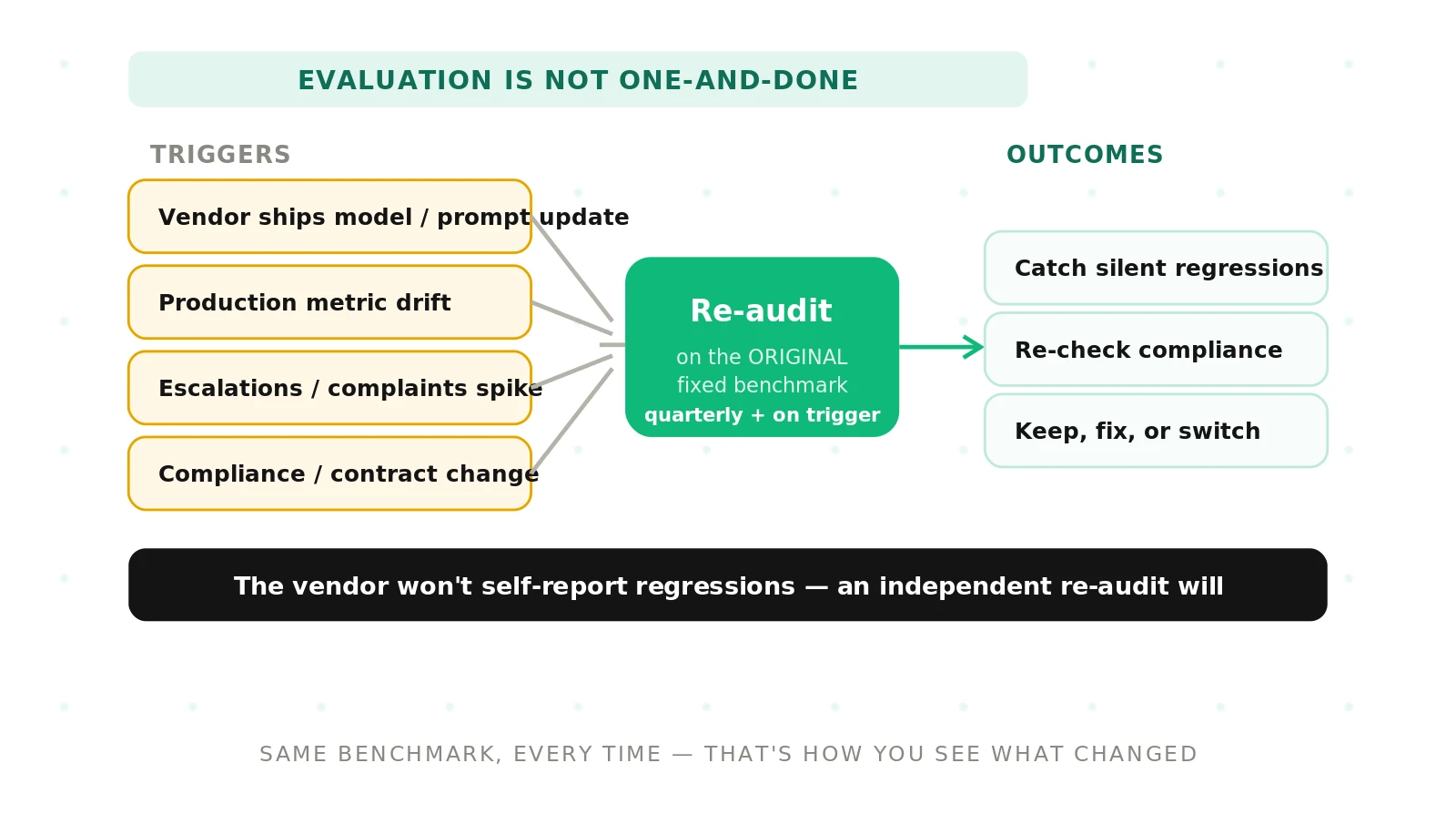
> Quick answer: To re-audit a voice agent vendor, re-run your original benchmark against the live agent on a fixed test set, then compare results to the baseline you signed off on. Re-audit on a schedule (quarterly) and on triggers — a model update, drift, a complaint spike, or contract renewal — to catch silent regressions the vendor won't report.
The evaluation that picked your voice agent vendor is already out of date. The agent you approved at go-live is not the agent answering calls today. Vendors ship model updates, prompt tweaks, and voice changes on their own schedule. Your call mix shifts as your product and customers change. None of that is announced. The quality you measured once quietly moves. The only report you get is the vendor's own dashboard, which was never built to flag a regression against your benchmark.
That is why a re-audit is not the same task as the initial selection. Selection asks "which vendor is best?" A re-audit asks "is the vendor we chose still the one we measured, and is it still the best available?" This guide covers when to re-audit, what a re-audit covers, how often to run one, and the step-by-step process. It builds on our voice agent vendor evaluation scorecard, applied to the life after the contract is signed.
Why evaluation is not one-and-done
A one-time evaluation is a photograph. Production is a film. The moment you sign, three things start moving underneath your baseline. None of them wait for your review cycle.
First, the vendor changes the product. A new model, a re-tuned prompt, or a swapped voice can shift accuracy without any note to you. Second, your traffic changes. A new product line or a policy update alters the call mix the agent faces. Third, quality drifts on its own. That is the slow decline our voice agent metric drift guide unpacks. Any one of these can move a number you already signed off on.
The core risk is the silent regression. The vendor's dashboard reports its own metrics, measured its own way. It has no reason to surface a decline against the specific benchmark you care about.
> Silent regression: A drop in a voice agent's real quality that no alert catches because it happens inside a vendor update, a caller-mix shift, or gradual drift. It stays invisible until a re-audit compares the live agent against a fixed baseline.
A re-audit exists to make silent regressions loud. It re-runs the exact calls you used to select the vendor. Then it compares the results to the number you approved. That is a form of regression testing applied to a vendor you do not control. It is the only way to prove the agent you bought is the agent you still have.
What triggers a voice agent re-audit
Some re-audits are scheduled. Others are triggered by an event that could have moved quality. Treat the triggers below as tripwires. When one fires, run a re-audit even if the calendar says you are not due.
- The vendor ships an update. A model, prompt, or voice change is the highest-risk trigger. It can regress silently between one call and the next.
- Your call mix or product changes. New use cases, new caller demographics, or a new script arrive. The agent now faces calls your original test set never covered.
- Metric drift shows up in production. A slow slide in task success, containment, or latency signals the baseline no longer holds.
- A compliance or regulatory change lands. New disclosure rules or data-handling requirements demand a fresh compliance re-check.
- Escalations or complaints spike. A jump in transfers to a human, repeat calls, or complaints is a symptom that something regressed upstream.
- Contract renewal approaches. Renewal is the moment to re-price the relationship against measured performance, not the demo you saw a year ago.
- You are about to expand scope. Before you route more volume or a new use case to the vendor, confirm it still performs on the calls it handles today.
The mapping below turns each trigger into a concrete plan: what to re-check, how urgently, and what you risk by skipping it.
| Re-audit trigger | What to re-check | Cadence / urgency | Risk if skipped |
|---|---|---|---|
| Vendor ships model, prompt, or voice update | Full regression vs baseline, new failure modes | Within days of the change | Silent regression ships to every caller |
| Call mix or product changes | Task success on new scenarios, refresh test set | Before the new volume goes live | Agent fails calls it was never tested on |
| Metric drift in production | Drift confirmation vs control limits, root cause | Within the current review cycle | Slow quality decline compounds unnoticed |
| Compliance or regulatory change | Compliance re-check, disclosures, data handling | Before the rule's effective date | Regulatory exposure and audit findings |
| Escalation or complaint spike | Escalation accuracy, recovery, failing scenarios | Immediately, treat as incident | Rising cost, churn, and reputational harm |
| Contract renewal | Full re-audit plus comparison vs alternatives | 60–90 days before renewal | Renewing a vendor that is no longer best |
| Expanding scope or volume | Performance under load, new use-case coverage | Before scaling up | Scaling a weakness across more calls |
What a re-audit covers
A re-audit is not a lighter version of the original evaluation. It is the same rigor, aimed at a different question. Five areas belong in every re-audit, and the weighting shifts with the trigger that prompted it.
Regression against the original benchmark
This is the spine of the re-audit. Re-run the exact test set you used at selection. Score it the same way, and lay the results next to the baseline you approved. The comparison is only valid if the benchmark is fixed — same calls, same scoring rubric, same definitions of task success. A moving benchmark cannot detect a regression. You can no longer tell whether the agent changed or the test did.
Drift detection
Regression testing catches a step change from a known event. Drift detection catches the slow slide that no single event explains. Track your core metrics — task success rate, containment, escalation accuracy, and latency — against control limits over a rolling window. Flag when the live agent breaks the expected range. This is where a re-audit and continuous monitoring meet.
New failure modes
Every re-audit should add scenarios, not just repeat old ones. Production surfaces failures your original test set never imagined: a new intent, an accent the model mishandles, a tool call that started timing out. Mine your production calls, especially escalations and complaints. Fold the new failure patterns into the benchmark, so the next re-audit covers them.
Compliance re-check
Regulated deployments carry a standing obligation, not a one-time clearance. Re-verify disclosures, consent capture, data handling, and refusal behavior against current rules. Map them to a recognized framework such as the NIST AI Risk Management Framework. A vendor update can regress a compliant behavior as easily as a functional one. That is why our voice agent compliance audit treats re-checks as routine. Adversarial coverage belongs here too — a periodic red-team audit confirms guardrails still hold.
Comparison against alternatives
The final question a re-audit answers is the one selection asked: is this still the best vendor? The market moves fast. A competitor may now beat your incumbent on the calls you care about. Run a subset of your benchmark against one or two alternatives. When the incumbent no longer wins, the re-audit becomes the evidence for a move. Our voice agent vendor migration guide takes it from there.
How to run a voice agent vendor re-audit
The process mirrors the initial evaluation, with the baseline as the fixed point of comparison. Run it identically each time so results stay comparable across audits.
1. Retrieve the original benchmark and baseline — Pull the exact test set, scoring rubric, and the results you signed off on at selection. This is your fixed point of comparison.
2. Refresh the test set with production reality — Add scenarios drawn from recent production calls, escalations, and complaints, while keeping the original core intact so old results still compare.
3. Re-run the identical calls against the live agent — Put the current production agent through the same scenarios, so any difference comes from the vendor, not the test.
4. Score on your own data — Measure each metric yourself from the recorded calls, rather than accepting the vendor's dashboard figures.
5. Compare to baseline and control limits — Flag any metric that regressed against the signed-off number or broke its expected range over the rolling window.
6. Investigate and attribute each regression — Trace whether a drop came from a vendor update, a call-mix shift, or gradual drift, so the fix targets the real cause.
7. Benchmark against one or two alternatives — Run a subset of the test set against competing vendors to confirm the incumbent is still the best available.
8. Report, decide, and set the next date — Document findings, decide to keep, remediate, or migrate, and schedule the next scheduled re-audit.
How often to re-audit
Cadence is a floor, not a ceiling. Run a scheduled re-audit on a fixed rhythm, and run an unscheduled one whenever a trigger fires. The two together are what catch both the slow drift and the sudden regression.
For most production deployments, a quarterly re-audit is a sensible baseline. High-stakes or regulated agents — healthcare intake, financial services, collections — justify a monthly rhythm, because a single mishandled call carries more risk. Low-volume or low-stakes agents can stretch to twice a year, provided the event triggers still apply. The point is not the exact interval. The point is simple: "we evaluated them last year" is not evidence about the agent running today.
This scheduled-plus-triggered pattern is a continual improvement process applied to a vendor relationship. Each re-audit tightens the benchmark, feeds new failure modes back into the test set, and keeps the service-level agreement tied to measured performance rather than a promise.
When to re-audit versus when to monitor
Monitoring and re-auditing are complementary, not interchangeable. Monitoring watches production metrics continuously and raises an early flag. A re-audit is a deeper, point-in-time audit that re-runs a fixed benchmark and produces a decision. Use monitoring to detect a possible problem, and use a re-audit to confirm it, attribute it, and decide what to do. Our testing versus evaluation guide draws the same line between fast checks and deep measurement.
Where an independent evaluator fits
A re-audit only works if the benchmark is fixed and the scoring is neutral. That is hard to guarantee when the party running the audit also owns the agent being audited. Vendors have every incentive to measure themselves generously. They have no incentive to flag a regression against your specific calls. Even your own team can drift the benchmark unintentionally. A softened scenario here, a re-scored edge case there, and the comparison stops meaning anything.
Evalgent is an independent, third-party evaluator that re-audits your voice agent vendor on a fixed benchmark you own. The test set does not move, and the scoring is neutral. So a re-audit catches the silent regressions and drift the vendor will not self-report. It also compares your incumbent against alternatives on the same calls, so a renewal or migration decision rests on evidence. Our approach to independent voice AI evaluation explains why the evaluator's independence is the load-bearing part.
This is also the natural home for a renewal decision. A defensible renewal or re-price rests on a fresh re-audit, not the demo that won the original deal, and a recognized process like a request for proposal benefits from measured comparison data. When a re-audit shows the incumbent has fallen behind, escalation planning matters too — our escalation design guide covers the handoff paths a struggling agent needs while you plan the move.
The bottom line
A voice agent vendor you evaluated once is not the vendor you have now, because models, prompts, and call mixes all move after go-live. Re-audit on a fixed benchmark — quarterly and on every trigger — so you catch the silent regressions and drift the vendor's own dashboard will never show you.
The discipline is simple to state and easy to skip: keep the benchmark fixed, re-run it on a schedule and on triggers, and score on your own data. Do that, and a renewal, a scope expansion, or a migration becomes a decision backed by evidence rather than a hope that last year's evaluation still holds. Book a demo to see how an independent re-audit works against your own calls.
Frequently asked questions
When should I re-audit a voice agent vendor?
Re-audit on a schedule and on triggers. A quarterly cadence suits most production agents. Run an unscheduled re-audit whenever the vendor ships a model, prompt, or voice update, your call mix changes, metrics drift, escalations spike, a compliance rule changes, or a contract renewal approaches. Triggers override the calendar.
How is a re-audit different from the initial vendor evaluation?
The initial evaluation asks which vendor is best. A re-audit asks whether the vendor you chose still matches the baseline you approved, and whether it is still the best available. It re-runs your original benchmark against the live agent, so it detects regressions and drift the first evaluation could not have seen.
How often should I re-audit a voice agent vendor?
Quarterly is a sensible baseline for most production deployments. High-stakes or regulated agents, such as healthcare or financial services, justify a monthly rhythm. Low-stakes agents can stretch to twice a year. Cadence is a floor — event triggers such as a vendor update should prompt a re-audit regardless of the schedule.
What triggers a voice agent re-audit?
The main triggers are a vendor model, prompt, or voice update; a change in your call mix or product; metric drift in production; a compliance or regulatory change; a spike in escalations or complaints; contract renewal; and any plan to expand the agent's scope or volume. Each one could have moved quality since the last check.
How do I catch silent regressions in a voice agent?
Re-run your original fixed benchmark against the live production agent and compare the results to the baseline you signed off on. Score on your own recorded calls, not the vendor's dashboard. A regression appears as a metric that dropped against the approved number, even when no alert or vendor note flagged it.
Does a voice agent need re-evaluation after go-live?
Yes. Vendors update models and prompts without notice, your call mix shifts, and quality drifts on its own. The agent answering calls today is not the one you approved at go-live. Periodic re-evaluation against a fixed benchmark is the only way to confirm the quality you measured still holds in production.
Can the vendor run the re-audit for us?
A vendor can share metrics, but it cannot be the neutral party in its own audit. Vendors measure themselves on their own data and have no incentive to flag a regression against your calls. A re-audit needs a fixed benchmark you own and neutral scoring, which is why an independent third-party evaluator is the more credible option.
What happens if a re-audit shows the vendor has regressed?
First attribute the regression to a vendor update, a call-mix shift, or drift, so the fix targets the real cause. Then decide: hold the vendor to remediation against your service-level agreement, or, if a benchmarked alternative now performs better, use the re-audit as the evidence to plan a staged migration to a new vendor.
Related Articles
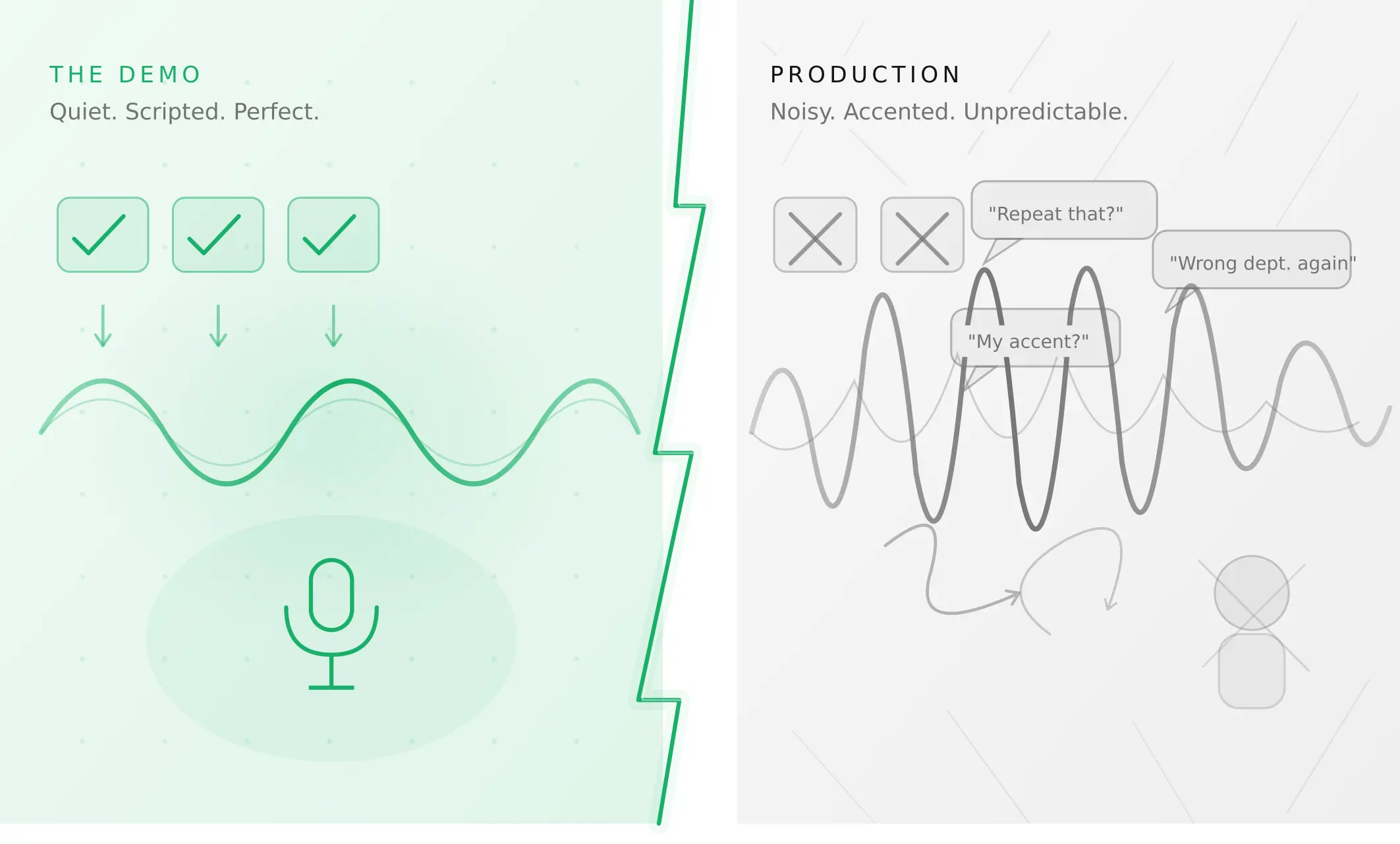
Why AI voice agents fail in production (and how to prevent it)
AI voice agents that ace demos still break in production. Learn the 5 root causes, how to test for each, and what production readiness actually means.
Read more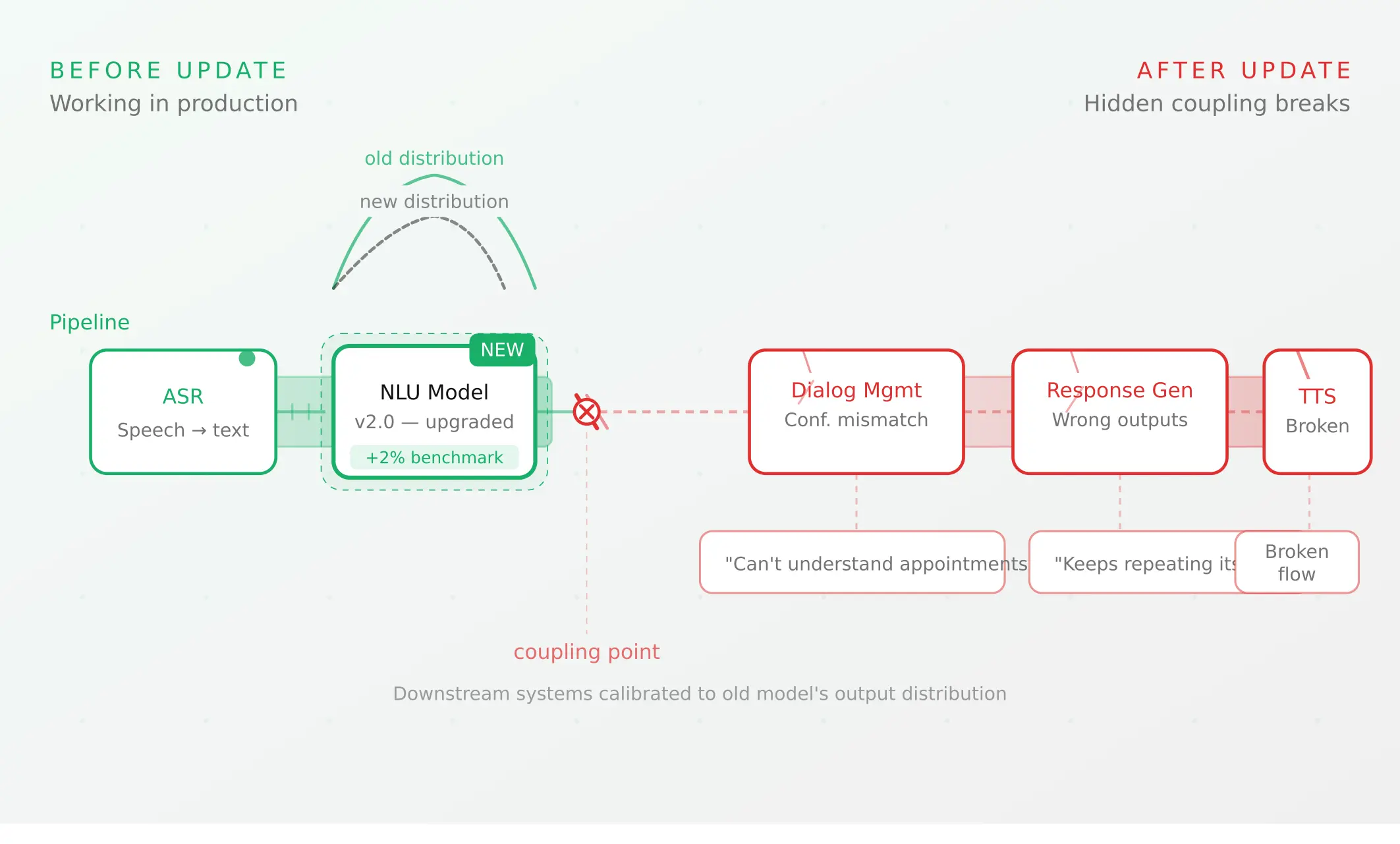
Voice agent regression testing: why LLM updates break production
LLM updates improve benchmarks but break voice agents in 5 predictable ways. How to detect and prevent regressions after every model or prompt change.
Read more