Test your voice agent
Pipecat vs LiveKit: which voice agent framework should you choose?
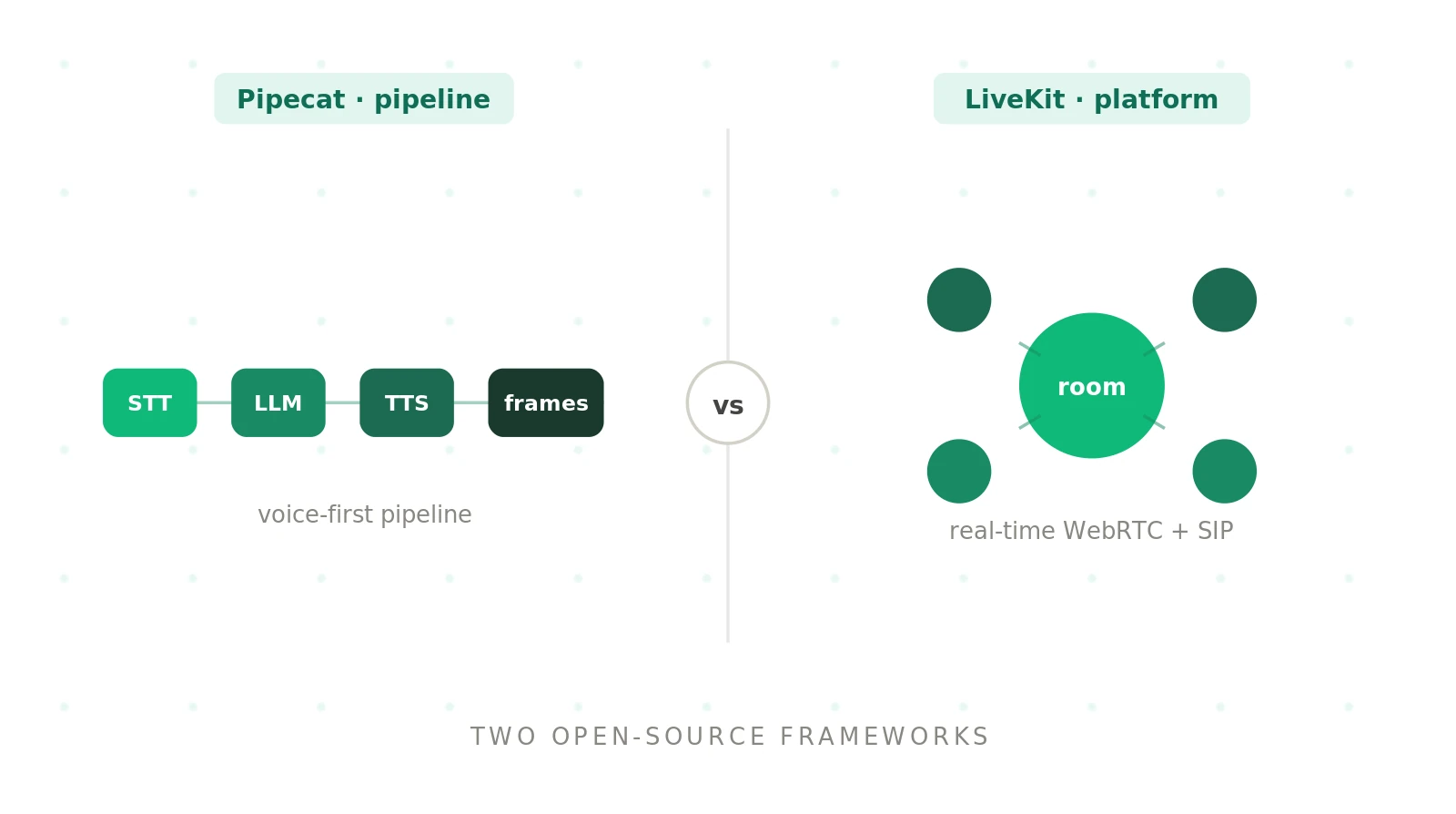
Pipecat and LiveKit are the two open-source frameworks most teams compare when they decide to build a voice agent rather than buy one. Both are free, both run very low latency, and both can self-host. They differ in design philosophy and in where they put the hard parts. This open source voice agent framework comparison covers architecture, turn detection, latency, telephony, and pricing.
One point holds for both: a framework helps you build the agent, but it does not prove the agent works with real callers. We close on that gap, where Evalgent fits. First, the comparison.
Pipecat vs LiveKit at a glance
Both are open-source and free to run. The difference is what each gives you out of the box. Pipecat hands you a voice-first pipeline. LiveKit hands you real-time infrastructure.
| Factor | Pipecat | LiveKit |
|---|---|---|
| Core | Python pipeline framework | WebRTC platform + agents |
| Focus | Voice-first conversations | Real-time media, voice and video |
| Turn detection | SmartTurnDetection (LLM-based) | Configurable VAD thresholds |
| Telephony | Twilio via Pipecat Cloud | Built-in SIP, own numbers |
| Managed option | Pipecat Cloud (Daily) | LiveKit Cloud |
| License / cost | Open-source, free | Open-source, free |
| Best for | Pipeline control | Full real-time infrastructure |
Both shift per-minute cost to your own STT, LLM, TTS, and compute. Confirm managed rates on the LiveKit pricing page and Pipecat Cloud, since they change.
What is Pipecat?
Pipecat: an open-source Python framework for building voice and multimodal conversational agents, organised as a pipeline of processors that handle audio, text, and video frames in real-time.
Pipecat is voice-first and framework-led. You assemble a pipeline of processors, and the framework coordinates STT, the LLM, TTS, transport, and audio handling. The Pipecat docs and the Pipecat GitHub cover its processors and integrations. Pipecat AI is maintained by Daily.
For hosting, Pipecat Cloud is now generally available. It is a managed, vendor-neutral platform with multi-region support, Twilio telephony, and Krisp noise reduction. You can also self-host the open-source framework anywhere.
What is LiveKit?
LiveKit: an open-source, WebRTC-based platform for real-time audio, video, and AI agents, with an agents framework layered on top of its media infrastructure.
LiveKit starts from the media layer. Its agents framework integrates tightly with live rooms, participants, and media streams, which suits real-time voice and video together. The LiveKit docs cover the agents framework, SIP, and deployment.
LiveKit also ships built-in SIP and its own phone-numbers product, so telephony is native. You can self-host the infrastructure or run LiveKit Cloud, where agent sessions start around $0.01 per minute.
Architecture: Python pipeline vs WebRTC platform
This is the core of the Pipecat vs LiveKit decision. Pipecat is a Python pipeline framework. You think in processors and frames, and you keep tight control of the conversation flow. It is lighter and transport-agnostic, often paired with Daily WebRTC.
LiveKit is a platform. It owns the WebRTC infrastructure and exposes agents on top of live rooms. That gives you media routing, session state, and multi-participant real-time out of the box. For a refresher on the underlying layers, see our voice agent stack guide.
Neither is better in the abstract. Pipecat rewards teams who want a focused voice pipeline in Python. LiveKit rewards teams who need full real-time infrastructure, including video. The right fit follows your team's strengths and the shape of the product you are building.
Turn detection and latency
Turn detection is where these two differ in a way callers feel. Pipecat uses SmartTurnDetection, an LLM-based classifier that predicts when a speaker has finished. LiveKit relies on configurable VAD silence thresholds. SmartTurnDetection reduces the agent talking over the user by roughly 30% compared with pure VAD, and it responds faster on short utterances.
On raw latency, both frameworks can run under 500ms, and both target the roughly 300ms that feels conversational. LiveKit is known for extremely low latency at the media layer. Pipecat's pipeline is built for ultra-low latency frame handling. In practice, the deciding factor is less the framework and more how you tune turn detection, VAD, and transport. Measure it on your own setup.
Telephony, transport, and SIP
Telephony shapes reliability and reach. LiveKit ships inbound and outbound SIP natively, plus its own phone numbers, so calls are a first-class path. Pipecat connects to telephony through providers like Twilio, typically via Pipecat Cloud, and uses Daily WebRTC as a common transport.
Transport is the deeper distinction. LiveKit owns the real-time transport layer, which is why video and multi-participant scenarios are strong. Pipecat stays transport-agnostic, which keeps the framework flexible but means you choose and wire the transport yourself. If native SIP matters most, LiveKit has the edge; if you want pipeline flexibility, Pipecat does.
Pricing and deployment
Both frameworks are open-source and free. Your real cost is the providers you use and the compute you run.
| Cost component | Pipecat | LiveKit |
|---|---|---|
| Framework license | Open-source, free | Open-source, free |
| Self-host cost | your compute only | your compute only |
| Managed option | Pipecat Cloud (Daily) | LiveKit Cloud, ~$0.01/min agent |
| Models | your STT, LLM, TTS vendors | your STT, LLM, TTS vendors |
| Telephony | Twilio pass-through | SIP ~$0.003–$0.004/min |
Self-hosting either framework can push well under $0.05 per minute at volume, but you take on infrastructure, on-call, and latency-tuning work. The managed clouds absorb that work for a per-minute or plan fee. Model both paths against your real volume before committing.
Deployment maturity is worth weighing too. Pipecat Cloud reached general availability in 2026 after a long beta with more than a thousand teams, so the managed path is proven. LiveKit Cloud is well established for real-time workloads at scale. For self-hosting, both have active open-source communities, but you own upgrades, monitoring, and capacity planning. The lighter your operations team, the more a managed cloud earns its fee. The larger your scale, the more self-hosting pays back the engineering you invest in it.
When to choose which
Match the framework to your use case and your team, not to a feature list.
- Choose Pipecat if you want a voice-first pipeline in Python, value LLM-based turn detection, and prefer a lighter, transport-agnostic framework. A pipecat alternative is rarely needed once teams want this level of conversation control.
- Choose LiveKit if you need full real-time infrastructure, native SIP telephony, multi-participant or video support, and tight media control. LiveKit agents shine when the media layer is central.
Searches for livekit vs pipecat and pipecat vs livekit describe the same trade-off from two directions. Pipecat AI leads on focused voice pipelines; LiveKit leads on real-time infrastructure breadth. The right call depends on whether your hard problem is conversation flow or media infrastructure.
Scalability and operating the stack
Both frameworks scale, but you own the scaling. Self-hosting gives the lowest per-minute cost and the most control, at the price of running real-time infrastructure yourself. The managed clouds, Pipecat Cloud and LiveKit Cloud, trade some of that saving for handled scalability, multi-region routing, and uptime.
Think about operating cost, not just framework features. Pipecat keeps you in a Python pipeline you fully control, which is easy to reason about for voice-first teams. LiveKit gives you more infrastructure surface, which is powerful but more to operate. Whichever you pick, scalability is an engineering commitment, and new traffic always surfaces new edge cases that smaller volumes hide. Plan for re-testing as you grow.
The step both skip: testing before production
Pipecat and LiveKit both help you build an agent. Neither proves it works under real conditions. This is the demo-to-production gap that breaks agents on every framework: accents, interruptions, background noise, and edge cases no framework surfaces for you.
This is where Evalgent comes in. Evalgent is platform-agnostic voice agent testing that runs realistic conversations against your agent, whether it is built on Pipecat, LiveKit, or your own stack. Its five primitives carry the work: Scenarios define real test conversations, Profiles configure caller personas and accents, Metrics measure what matters with custom thresholds, Evaluations run automated batches as synthetic callers, and Reviews let your team inspect failures with audio and transcript together.
The result is a release gate that sits above your framework choice. See our Pipecat testing guide and LiveKit testing guide for framework-specific walkthroughs, our guide to synthetic callers for the method, and the ai voice agent testing pillar for the full discipline.
Frequently asked questions
Is Pipecat or LiveKit better for voice agents?
Neither Pipecat nor LiveKit is universally better. Pipecat suits teams that want a voice-first Python pipeline with LLM-based turn detection. LiveKit suits teams that need full real-time infrastructure, native SIP, and video support. Both are open-source and free, so the better choice depends on whether your hard problem is conversation flow or media infrastructure.
Pipecat vs LiveKit which is lower latency?
Both Pipecat and LiveKit can run under 500ms and target the roughly 300ms that feels conversational. LiveKit is known for extremely low latency at the media layer, while Pipecat's pipeline handles frames with ultra-low latency. In practice, your turn detection, VAD, and transport tuning matter more than the framework, so measure latency on your own setup.
What is the difference between Pipecat and LiveKit?
The main difference between Pipecat and LiveKit is design focus. Pipecat is a Python pipeline framework built for voice-first agents, using SmartTurnDetection. LiveKit is a WebRTC platform with an agents framework, built-in SIP, and strong real-time media including video. Pipecat gives pipeline control; LiveKit gives full real-time infrastructure.
Is Pipecat open source and free?
Yes. Pipecat is an open-source Python framework and free to use. You can self-host it anywhere and pay only for your own compute and the STT, LLM, and TTS vendors you use. For managed hosting, Pipecat Cloud from Daily offers a vendor-neutral platform with multi-region support and telephony, billed separately from the open-source framework.
Does Pipecat or LiveKit have better turn detection?
Pipecat and LiveKit take different approaches to turn detection. Pipecat uses SmartTurnDetection, an LLM-based classifier that cuts the agent talking over users by roughly 30% versus pure VAD. LiveKit uses configurable VAD silence thresholds, which are simpler and tunable. Pipecat's approach tends to feel more natural on short utterances; LiveKit's is more predictable to configure.
When should you use Pipecat instead of LiveKit?
Use Pipecat instead of LiveKit when your priority is a focused, voice-first conversation pipeline in Python, with LLM-based turn detection and a lighter, transport-agnostic design. Choose LiveKit when you need native SIP telephony, multi-participant or video support, and tight control of the real-time media layer. Both are open-source, so the use case decides.
Does Pipecat support telephony and SIP?
Pipecat supports telephony through providers like Twilio, typically via Pipecat Cloud, and uses Daily WebRTC as a common transport. It is transport-agnostic, so you wire the path you need. LiveKit, by contrast, ships native inbound and outbound SIP plus its own phone numbers, making telephony a first-class, built-in path rather than an integration.
Do you still need to test voice agents built on Pipecat or LiveKit?
Yes. Pipecat and LiveKit help you build an agent, but neither proves it works with real callers. Accents, interruptions, noise, and edge cases break agents on every framework. Platform-agnostic testing with synthetic callers, such as Evalgent, is what confirms production readiness before real users find the failures first.
Conclusion
Pipecat and LiveKit are both strong open-source frameworks that differ on focus: voice-first pipeline versus real-time infrastructure. Choose Pipecat for pipeline control and LLM-based turn detection, and LiveKit for native SIP, video, and full media control.
The framework decision matters less than what follows it. Whichever you pick, the agent still has to survive real callers, and that only gets proven through testing. Pick your framework, then build your test suite. Both Pipecat and LiveKit reward teams that treat testing as part of the build, not an afterthought once calls start failing.
Related Articles
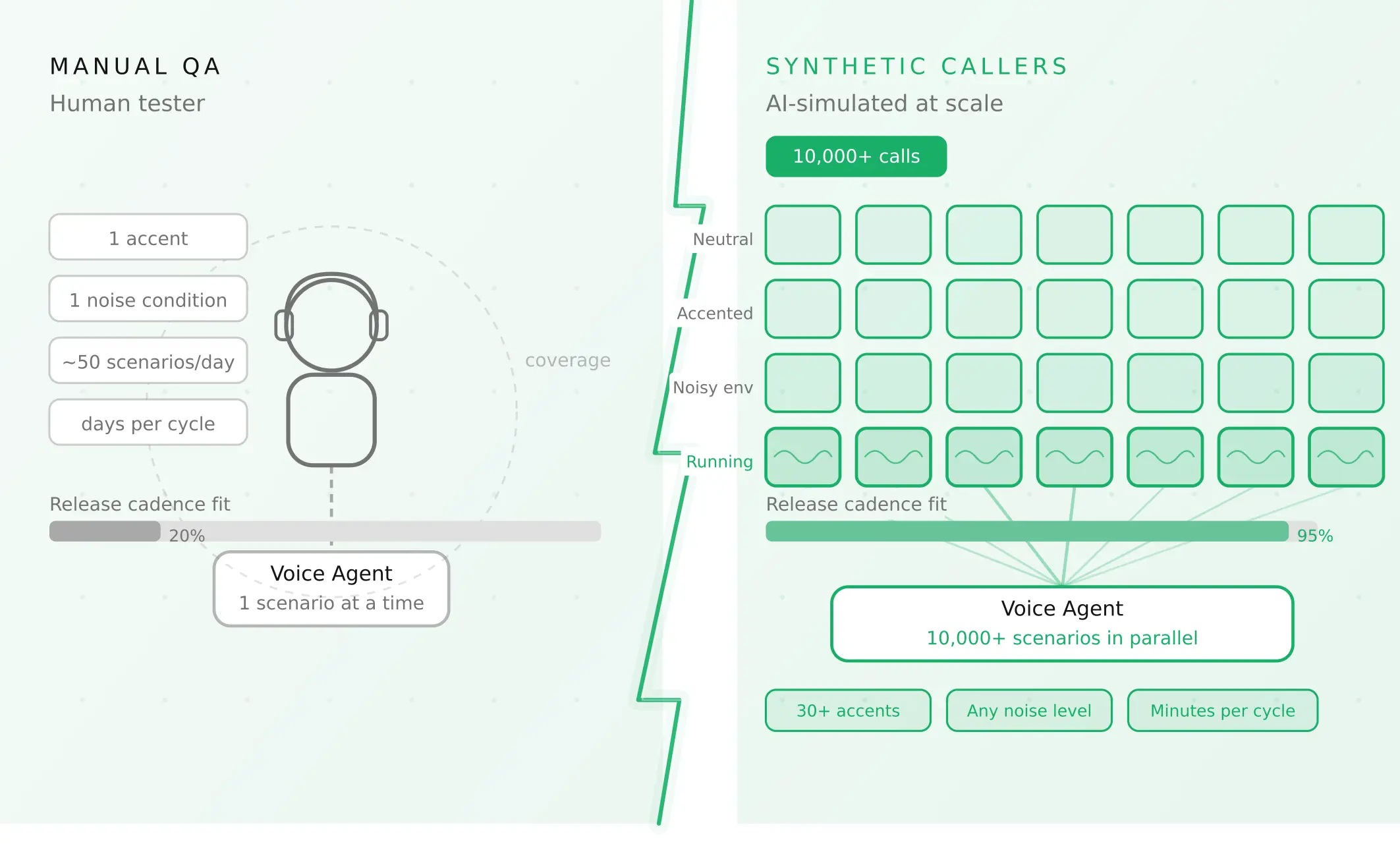
How to automate voice agent testing: synthetic callers vs manual QA
Learn how ai test automation replaces manual QA for voice agents. Compare synthetic callers vs human testers, with a 5-step framework to scale without hiring.
Read more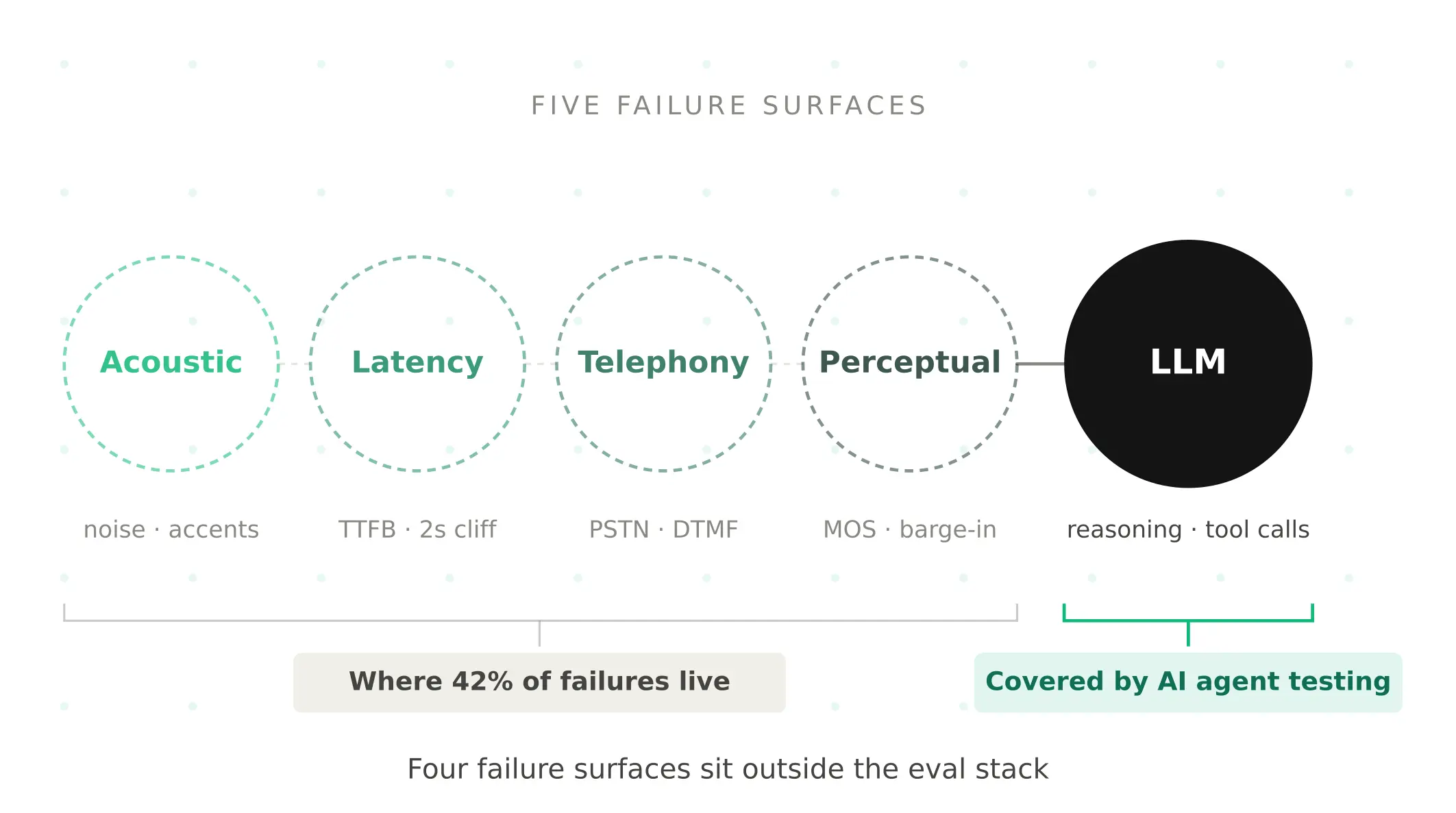
AI Agent Testing vs Voice Agent Testing: What General Tools Miss for Voice
AI agent testing measures text outputs. Voice agent testing measures behaviour through an acoustic pipeline. Five failure categories general tools miss.
Read more