Test your voice agent
LiveKit vs Vapi: which voice agent platform should you choose?
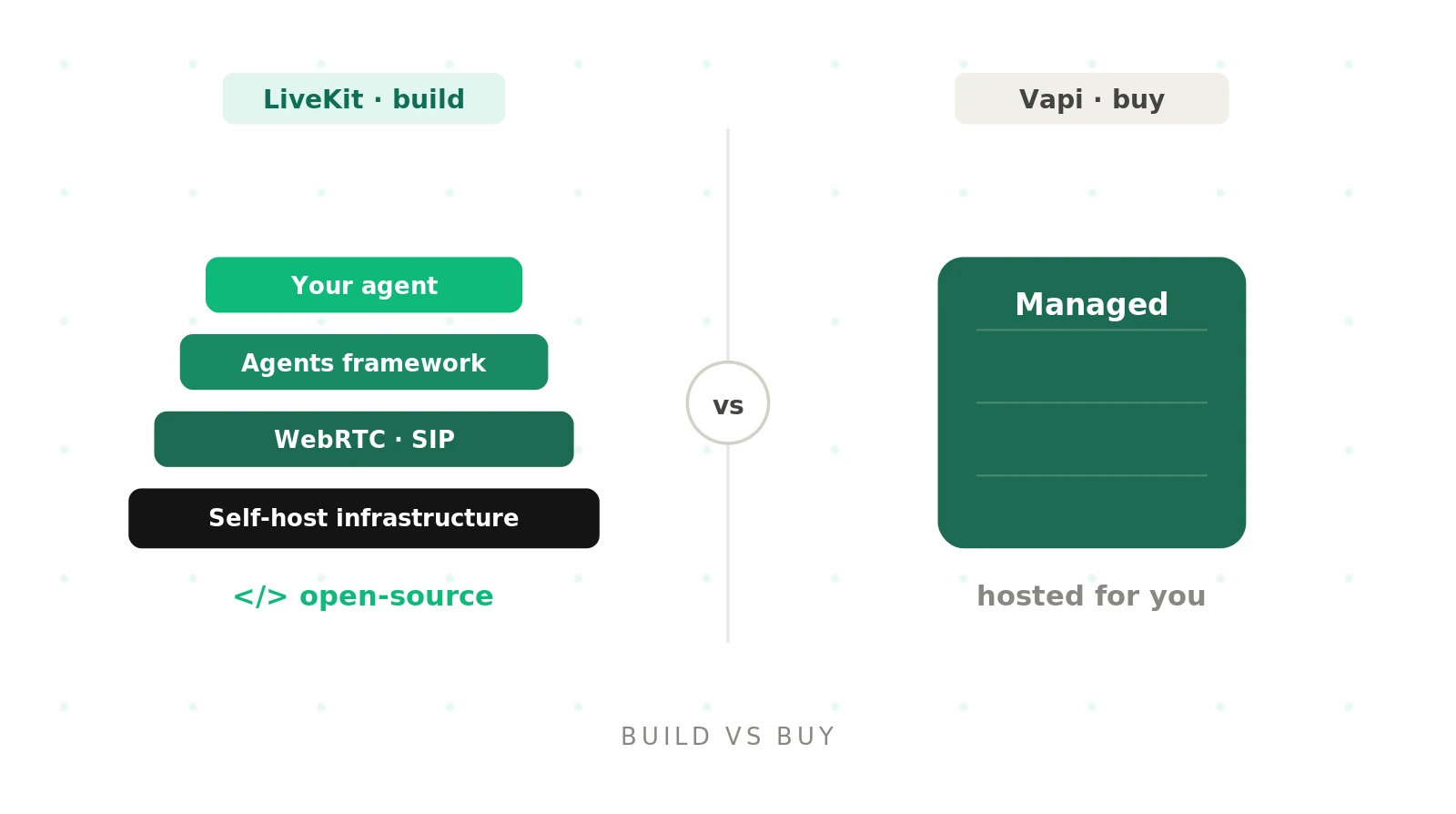
LiveKit and Vapi both help you ship a voice agent, but they sit at different layers of the stack. LiveKit gives you the real-time infrastructure to build on. Vapi gives you a managed platform to assemble on. This voice agent platform comparison looks at architecture, pricing, latency, telephony, and scale, then offers a clear way to decide.
One thing applies to both: a platform gets your agent running, but it does not prove the agent works with real callers. We close on that gap, where Evalgent fits. First, the comparison.
LiveKit vs Vapi at a glance
The split is build-versus-buy. LiveKit is infrastructure and code. Vapi is a hosted orchestration layer. The table shows where they diverge most.
| Factor | LiveKit | Vapi |
|---|---|---|
| Model | Open-source, self-host or Cloud | Managed orchestration |
| Control | Full, low-level | High-level, opinionated |
| Base cost | ~$0.01/min agent (Cloud); free self-hosted | ~$0.05/min platform |
| Latency | Very low, you tune it | ~700–1,500ms default |
| Telephony | Built-in SIP, own numbers | Bring your own (BYOK) |
| Engineering effort | High | Low |
| Best for | Scale and control | Speed to launch |
Figures are approximate 2026 ranges and depend on configuration. Check the official LiveKit pricing and Vapi pricing pages before budgeting.
What is LiveKit?
LiveKit: an open-source, real-time platform for audio, video, and AI agents, built on WebRTC, that you can self-host or run on LiveKit Cloud.
LiveKit started as real-time infrastructure and added LiveKit Agents, a framework for building voice agents on top of it. Because it is open-source, you can self-host the whole stack and pay only for your own infrastructure. The LiveKit docs cover the agents framework, turn detection, and deployment.
This is the maximum-control option. You own the pipeline, the latency tuning, and the uptime. LiveKit also supports multi-agent setups and real-time video, which matters for use cases beyond simple phone calls.
What is Vapi?
Vapi: a managed voice agent platform that orchestrates speech-to-text, an LLM, and text-to-speech so teams can ship phone agents quickly.
Vapi is orchestration middleware. It connects third-party providers and handles the plumbing, so you configure rather than build. The Vapi docs cover its SDKs, tool calling, and webhooks. Vapi supports BYOK, so you can supply your own providers when you need to.
The appeal is speed. You can stand up a working agent without managing infrastructure. The trade-off is that your latency and cost depend on Vapi's orchestration and the providers in the chain.
Architecture: infrastructure vs orchestration
This is the core of the LiveKit vs Vapi decision. LiveKit gives you real-time infrastructure and a code framework. You build the agent and run it where you choose. That suits teams who want control over every layer and plan to operate at scale.
Vapi sits higher up. It is managed orchestration that connects providers for you, which removes infrastructure work but adds a dependency. For a refresher on the underlying layers, see our voice agent stack guide.
Neither is better in the abstract. LiveKit rewards engineering investment with control and cost efficiency. Vapi rewards teams who value speed and a small operational footprint.
Pricing compared
The pricing models reflect the architecture. LiveKit charges little for orchestration and passes model costs through. Vapi charges a platform fee on top of the providers you use.
| Cost component | LiveKit | Vapi |
|---|---|---|
| Platform / agent | ~$0.01/min (Cloud); $0 self-hosted | ~$0.05/min |
| Models | pass-through at vendor cost | pass-through (~$0.02–$0.20/min) |
| Telephony | SIP ~$0.003–$0.004/min | bring your own (~$0.01/min) |
| Cloud plans | Build $0, Ship $50/mo, Scale $500/mo | plan-dependent |
| Typical all-in | low, drops further self-hosted | ~$0.13–$0.31/min |
LiveKit pricing is far lower per minute, especially self-hosted, but you pay in engineering time. Vapi pricing is higher per minute but includes the platform work. LiveKit Cloud plans scale by concurrency and connection minutes. Confirm current numbers on the LiveKit and Vapi pricing pages, since rates change.
Latency and real-time performance
Latency is where callers feel the platform. LiveKit is built for real-time, so with good tuning it reaches very low latency, well under the half-second mark that separates natural from awkward. Vapi's default endpointing is higher, often around 1,450ms, though you can improve it with configuration.
The difference is who does the tuning. LiveKit gives you the controls, including turn detection and VAD, and expects you to use them. Vapi abstracts these, which is simpler but gives you less room to optimise. If sub-500ms latency is a hard requirement, LiveKit gives you more headroom.
Telephony, SIP, and scale
Telephony shapes both reliability and cost. LiveKit ships inbound and outbound SIP plus its own phone-numbers product, and a 2026 Telnyx partnership brought sub-200ms PSTN latency. Vapi expects bring-your-own telephony, which adds a vendor but keeps routing in your hands.
Scale is where the models separate most. LiveKit Cloud handles concurrency through its plans, and self-hosting removes per-minute fees entirely once your volume is high enough. A common rule of thumb: below roughly 10,000 minutes a month, a managed platform like Vapi is simpler; above 50,000 minutes, building on LiveKit can cut per-minute cost by a large margin. The trade is that you then own latency, telephony, and uptime.
When to choose which
Match the platform to your stage and your constraint, not to a feature list.
- Choose LiveKit if you want full control, expect high volume, need real-time or multi-agent capability, or want to self-host for cost and compliance. It rewards engineering teams operating at scale.
- Choose Vapi if you want to launch fast with a small team, your volume is moderate, and you would rather configure than build infrastructure. It rewards speed to production.
Searches for vapi vs livekit and livekit vs vapi describe the same trade-off from both directions. If you want a Vapi alternative with more control, LiveKit is the usual answer; if you want a simpler path than LiveKit, Vapi is. The right call depends on whether you are optimising for control or for time.
Migration and the crossover point
Many teams start on Vapi and move to LiveKit as volume grows. That path is common because the economics flip. Early on, the engineering cost of self-hosting infrastructure outweighs the per-minute savings. Past a certain scale, the savings dominate.
Plan the move deliberately. Switching means rebuilding orchestration, telephony, and tooling on a new foundation, and re-validating behaviour. The crossover is less about a magic number and more about when engineering capacity and call volume both justify owning the stack.
Scalability and total cost of ownership
Scalability is where the two models diverge most over time. On LiveKit Cloud, the primary usage charge is agent session minutes, billed at roughly $0.01 per minute for the time an agent is active on a call. As volume climbs, that per-minute economy compounds, and self-hosting can remove the platform fee entirely. Vapi keeps operations simple, but its higher per-minute cost holds as you grow, so high-volume teams pay more for the convenience.
Compare scalability on total cost of ownership, not the headline rate. LiveKit shifts cost from per-minute fees to your own engineering and uptime burden. Vapi keeps cost predictable and hands-off, but higher per minute. For a small team at moderate volume, Vapi often wins once engineering time is counted. For a larger team running millions of minutes, LiveKit's scalability advantage becomes hard to ignore. Model both paths with your actual volume before committing, because the cheaper option flips as you scale. Re-run that model every quarter, since pricing and your call volume both shift over time. The platform that is cheapest today may not be the cheapest at ten times the volume.
The step both skip: testing before production
LiveKit and Vapi both get an agent built. Neither proves it works under real conditions. This is the demo-to-production gap that breaks agents on every platform: accents, interruptions, background noise, and edge cases no builder surfaces for you.
This is where Evalgent comes in. Evalgent is platform-agnostic voice agent testing that runs realistic conversations against your agent, whether it runs on LiveKit, Vapi, or your own infrastructure. Its five primitives carry the work: Scenarios define real test conversations, Profiles configure caller personas and accents, Metrics measure what matters with custom thresholds, Evaluations run automated batches as synthetic callers, and Reviews let your team inspect failures with audio and transcript together.
The result is a release gate that sits above your build choice. See our LiveKit testing guide and Vapi testing guide for platform-specific walkthroughs, our guide to synthetic callers for the method, and the ai voice agent testing pillar for the full discipline.
Frequently asked questions
Is LiveKit or Vapi better for voice agents?
Neither LiveKit nor Vapi is universally better. LiveKit suits teams that want full control, low cost at scale, and real-time or multi-agent capability, and can invest engineering time. Vapi suits teams that want to launch quickly with a small footprint. The better choice depends on whether your constraint is control and scale or speed.
LiveKit vs Vapi which is cheaper?
LiveKit is cheaper per minute, charging around $0.01 per minute on Cloud and nothing for orchestration when self-hosted. Vapi starts near $0.05 per minute plus provider costs. LiveKit's savings grow at scale but come with engineering and operational work. Vapi costs more per minute but includes the platform effort.
What is the difference between LiveKit and Vapi?
The main difference between LiveKit and Vapi is the layer they occupy. LiveKit is open-source real-time infrastructure you build on and self-host or run on Cloud. Vapi is managed orchestration that connects providers for you. LiveKit gives more control and lower cost at scale; Vapi gives faster setup and less operational work.
Does LiveKit or Vapi have lower latency?
LiveKit generally achieves lower latency because it is built for real-time and gives you direct control over turn detection and VAD. With tuning it can run well under 500ms. Vapi's default endpointing is higher, often around 1,450ms, though configuration helps. Measure latency on your own setup before deciding.
Is LiveKit open source and can you self-host it?
Yes. LiveKit is open-source, and you can self-host the entire stack on your own infrastructure. Self-hosting removes per-minute platform fees, so you pay only for the compute and telephony you run. LiveKit also offers LiveKit Cloud if you prefer a managed option without operating the infrastructure yourself.
When should you switch from Vapi to LiveKit?
Switch from Vapi to LiveKit when call volume and engineering capacity both justify owning the stack. As a rough guide, below 10,000 minutes a month a managed platform is simpler, while above 50,000 minutes building on LiveKit can cut per-minute cost sharply. The move means rebuilding orchestration and re-testing behaviour, so plan it.
Does LiveKit support SIP and telephony for voice agents?
Yes. LiveKit ships inbound and outbound SIP and its own phone-numbers product, so it handles telephony directly. A 2026 Telnyx partnership added sub-200ms PSTN latency and carrier-grade SIP. Vapi, by contrast, expects bring-your-own telephony, which adds a vendor but keeps call routing under your control.
Do you still need to test voice agents built on LiveKit or Vapi?
Yes. LiveKit and Vapi get an agent built, but neither proves it works with real callers. Accents, interruptions, noise, and edge cases break agents on every platform. Platform-agnostic testing with synthetic callers, such as Evalgent, is what confirms production readiness before real users find the failures first.
Conclusion
LiveKit and Vapi differ on one axis: build versus buy. Choose LiveKit for control, scale, and low per-minute cost, and Vapi for speed and a small operational footprint.
The platform decision matters less than what follows it. Whichever you choose, the agent still has to survive real callers, and that only gets proven through testing. Pick your platform, then build your test suite. The second step is the one that protects production.
Related Articles
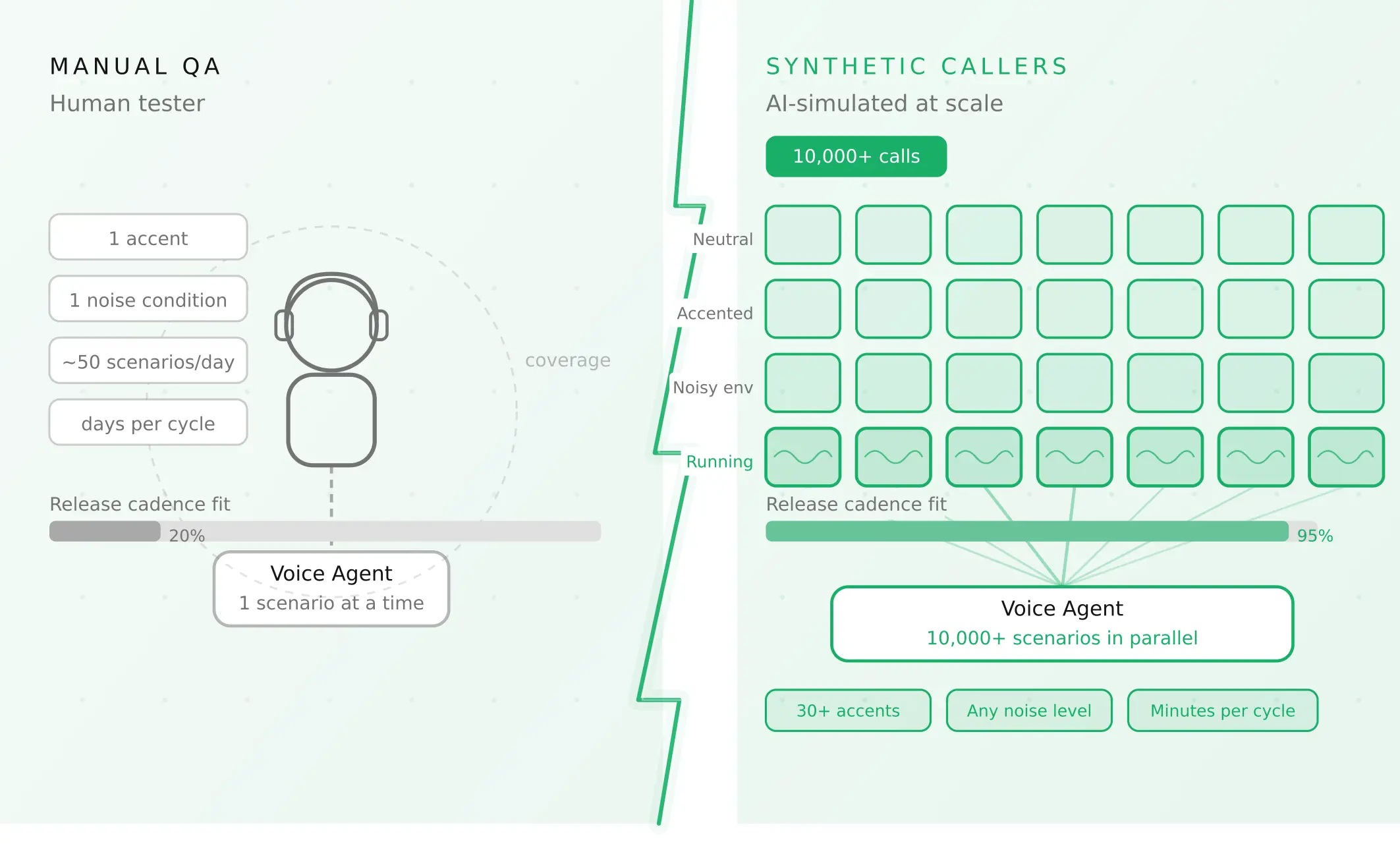
How to automate voice agent testing: synthetic callers vs manual QA
Learn how ai test automation replaces manual QA for voice agents. Compare synthetic callers vs human testers, with a 5-step framework to scale without hiring.
Read more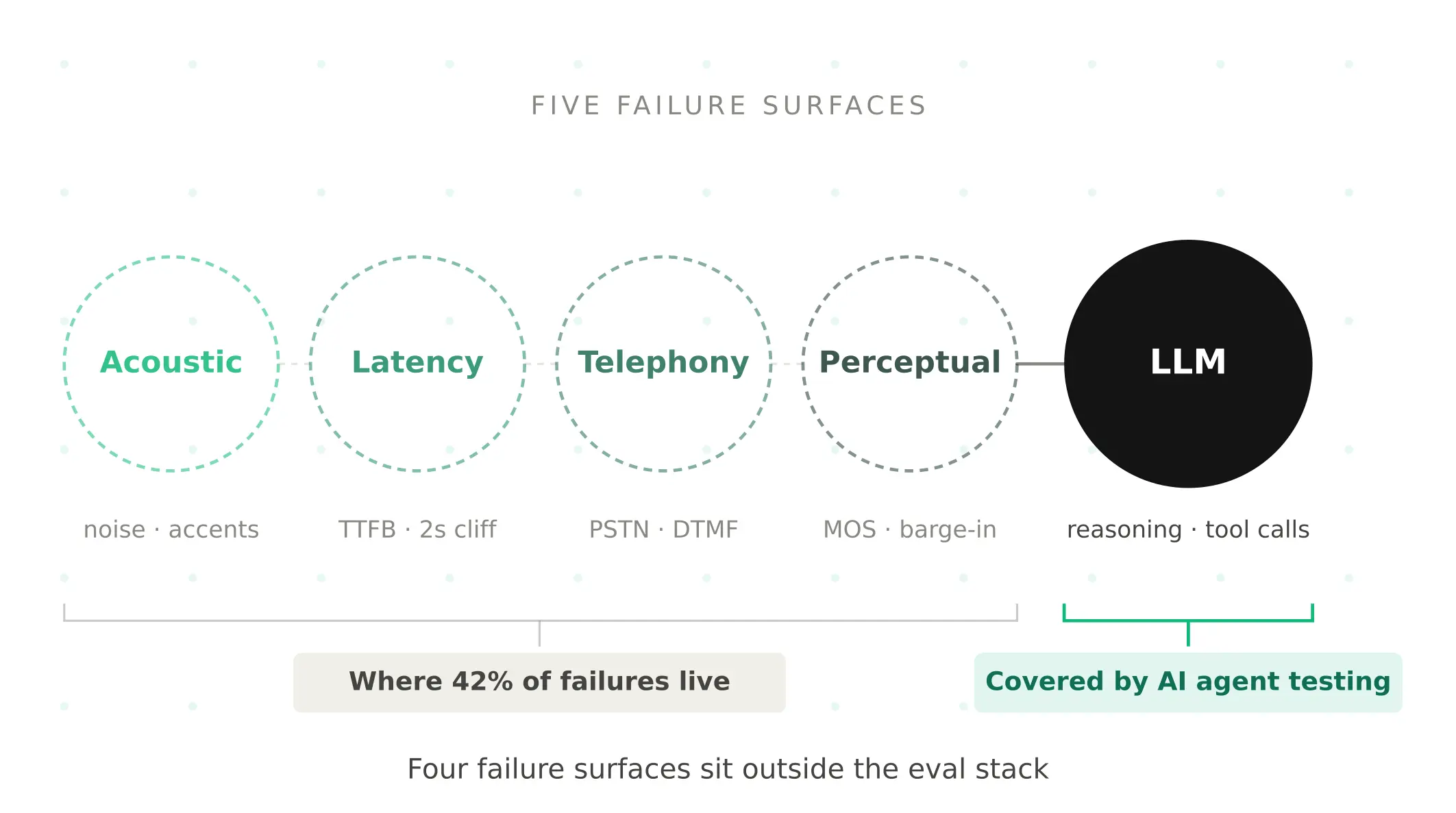
AI Agent Testing vs Voice Agent Testing: What General Tools Miss for Voice
AI agent testing measures text outputs. Voice agent testing measures behaviour through an acoustic pipeline. Five failure categories general tools miss.
Read more