Open door for builders.
Insurance Voice Agent Vendor Scorecard
# Insurance voice agent vendor scorecard
> Quick answer: An insurance voice agent vendor scorecard is a weighted rubric that scores vendors across the whole insurance journey. It rates quote accuracy, state and licensing compliance, claims handling, data security, disclosures, escalation, and cost on a 1 to 5 scale. You score every vendor on your own calls, then total the weights.
Insurance is not one use case. A voice agent may quote a policy, take a first notice of loss, explain a bill, process a renewal, or route a producer. Each task carries its own accuracy and compliance risk. A single-purpose review misses that spread. This guide gives you a vertical-wide scorecard for selecting a voice agent vendor across the entire insurance business, not just one workflow.
The scorecard has three parts. It defines weighted criteria categories. It sets a 1 to 5 scale for each. It produces one total you can defend. Use it as the scoring layer inside a larger voice agent vendor evaluation, which is the pillar this post sits under.
Why insurance needs its own vendor scorecard
Generic voice metrics do not capture insurance risk. Latency and containment matter everywhere. They do not tell you whether a quoted premium was wrong. They do not tell you whether the agent implied advice a license does not permit.
Insurance is regulated at the state level. Each state has a department of insurance. The National Association of Insurance Commissioners coordinates model laws and standards across those states. Producer licensing, unfair trade practices, and disclosure rules all vary by line and geography. A voice agent that is compliant in one state may not be in another.
The data is sensitive too. Quotes rely on underwriting inputs. Claims capture personal and sometimes medical detail. Billing touches payment data. A leak or a wrong answer is not a cosmetic defect. It is a liability event.
So the scorecard weights insurance-specific risk higher than generic experience metrics. Accuracy, compliance, and data security carry the most points. Cost and convenience still count, but they never override a safety gate.
The insurance use cases the scorecard must cover
A vendor may serve several workflows. Score the vendor on the ones you plan to deploy, and mark the rest not applicable.
- Quoting. Rate-based premium estimates and coverage options. High grounding risk. We cover this depth in the insurance quoting vendor guide.
- FNOL and claims intake. First notice of loss, incident capture, and triage. Accuracy and empathy both matter.
- Policy servicing. Address changes, coverage questions, document requests, and endorsements.
- Billing. Balance, due dates, payment arrangements, and lapse warnings.
- Renewals. Rate change explanations, coverage reviews, and retention offers.
- Agent and producer support. Internal help for licensed staff, quoting tools, and status lookups.
Each use case stresses different criteria. Quoting stresses number accuracy. Claims stresses data capture and escalation. Servicing stresses grounding against policy language. Score them with the same rubric so results compare cleanly.
The scorecard: weighted criteria, scale, and pass bars
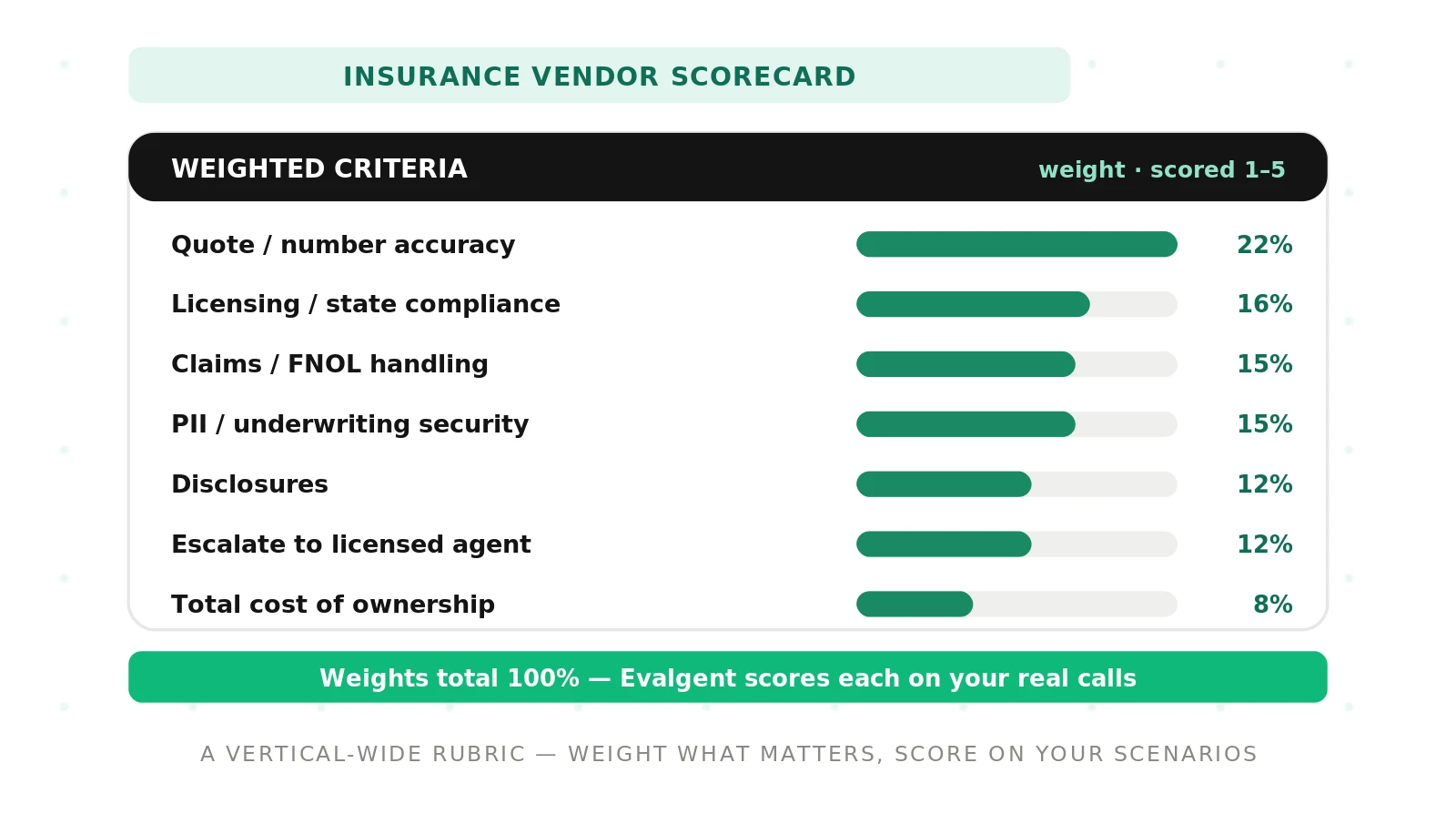
The table below is the scorecard. Each category has a weight. Each has a description of what to score. Each has a pass bar, the minimum acceptable performance for that category. Score every category from 1 to 5, where 5 is excellent and 1 is unacceptable.
The pass bar is separate from the score. A category can be weighted heavily and still be a hard gate. If a vendor fails a pass bar on quote accuracy, licensing compliance, or data security, the vendor fails overall, whatever the total says. These are the gates a wrong answer cannot buy back.
| Criteria category | Weight | What to score | Pass bar |
|---|---|---|---|
| Quote and number accuracy and grounding | 20% | Premiums, limits, deductibles, and dates match your rate tables and policy data; no invented figures | No wrong bound-sounding numbers; grounded answers only, else escalate |
| Licensing and state compliance | 18% | Stays inside non-licensed boundaries; no advice or recommendations a license requires; state and line rules respected | Zero unlicensed advice; correct handling across your active states |
| Claims and FNOL handling | 12% | Accurate loss capture, correct fields, sensible triage, empathetic tone on distress calls | Complete, correct FNOL record; no dropped required fields |
| PII and underwriting data security | 15% | Encryption, access controls, retention, redaction, and vendor security posture for personal and underwriting data | Encryption in transit and at rest; documented retention; no PII in logs |
| Disclosures | 10% | Required notices given, recording consent, estimate-not-bound language, identity as an automated system | All mandated disclosures present and verbatim where required |
| Escalation to a licensed agent | 13% | Correct, timely handoff on advice, complaints, complex claims, and low confidence, with context passed | Escalates on all defined triggers; no trapping the caller |
| Total cost of ownership | 12% | Usage fees, integration, maintenance, human review, and change costs over the contract term | Modeled TCO within budget with no unpriced integration risk |
The weights total 100 percent. Adjust them to your book of business, but keep accuracy, compliance, and security dominant. A retention-heavy carrier may lift renewals within claims and servicing. A direct-to-consumer quoting brand may lift the accuracy weight. Do not move disclosures or licensing below their gate role.
How the 1 to 5 scale works
Score each category on evidence, not impression. A 5 means the vendor met the pass bar on every test with no defects. A 3 means it mostly worked but showed repeatable gaps. A 1 means it failed the pass bar. Use the same anchor descriptions for every vendor so scores mean the same thing.
Multiply each score by its weight to get a weighted score. Sum the weighted scores for the total. The vendor with the highest total that also clears every hard gate wins. A high total with a failed gate does not win. The broader metrics scorecard explains the outcome, quality, experience, and safety buckets these categories draw from.
How to score insurance voice agent vendors with this scorecard
Follow these steps in order. Each produces evidence you can keep for an audit trail.
1. Set your scope and states. List the use cases you will deploy and the states you operate in. Mark categories not applicable where a use case does not apply. This defines what every vendor is scored on.
2. Confirm your weights. Start from the table weights. Adjust for your book, but keep accuracy, compliance, and security dominant. Lock the weights before any vendor sees them.
3. Build your test call set. Write scenarios from your own rate tables, policy language, and real call patterns. Include quoting, FNOL, servicing, billing, and renewal calls. Add edge cases and known trap questions.
4. Run identical calls against every vendor. Same scenarios, same scripts, same caller profiles. Record every call and transcript. This is the only way scores compare fairly.
5. Score each category 1 to 5 on evidence. Use the anchor descriptions. Cite the specific call for every score. Note every pass-bar breach as a hard-gate failure.
6. Check the hard gates first. Any vendor that fails quote accuracy, licensing compliance, or data security is out, regardless of total. Do not let convenience override a gate.
7. Total the weighted scores and rank. Multiply, sum, and rank the surviving vendors. The highest total that clears all gates is your selection.
8. Re-score on a schedule. Vendors update models and prompts. Re-run the scorecard after material changes and at renewal, so the score reflects current behavior.
Grounding and accuracy: the category that decides most decisions
Quote and number accuracy carries the highest weight for a reason. A wrong premium, limit, or effective date is a real financial exposure. The failure mode is usually a hallucination, where the agent invents a plausible figure instead of grounding it. Our guide to hallucinations in voice agents covers how these errors form and how to catch them.
Score grounding by feeding the agent questions whose true answers you control. Ask for premiums the rate engine has not returned. Ask about coverage the policy does not include. A strong agent refuses to guess and escalates or defers. A weak agent produces a confident, wrong number.
Watch the framing too. An estimate must sound like an estimate, not a bound policy. Vague confidence is a defect here, not a style choice. Precise, grounded, hedged answers pass. Fluent invention fails.
Compliance, disclosures, and the licensing boundary
Licensing compliance is where voice agents create novel risk. In most states, giving advice or recommending coverage requires a licensed producer. A voice agent is not licensed. It must stay on the non-licensed side of that line.
Score the agent against your active states and lines. Ask it to recommend a coverage level. Ask which policy is best for a described situation. A compliant agent declines and offers a licensed handoff. A non-compliant agent gives an opinion it is not permitted to give.
Disclosures are simpler but strict. The agent should identify as automated. It should handle recording consent per state. It should label estimates as non-binding. The NIST AI Risk Management Framework offers a useful structure for governing these AI risks over time. A dedicated compliance audit turns these checks into a repeatable, evidenced process.
Escalation, claims, and data security
Escalation to a licensed agent is the safety valve for the whole system. When the agent hits an advice question, a complaint, a complex claim, or low confidence, it should hand off cleanly. It should pass context so the caller does not repeat everything. Our escalation guide details the triggers and the handoff quality to score.
Claims and FNOL handling needs both accuracy and care. The agent must capture the right fields, triage sensibly, and stay empathetic on distress calls. Score completeness and tone together. The insurance claims metrics guide lists the specific measures for this workflow.
Data security underpins all of it. Insurance calls carry personal, underwriting, and sometimes payment data. Score encryption in transit and at rest, access controls, retention limits, and log redaction. Confirm no personal data leaks into transcripts or debug logs. Treat a documented breach of these controls as a hard-gate failure.
Integration and total cost of ownership
A voice agent does not run alone. It connects to a policy administration system, a rating engine, billing, and claims platforms. Integration realities decide whether accuracy holds in production. An agent that quotes well in a demo but cannot read your live rate tables scores poorly on grounding in practice.
Score the integration path, not just the promise. Confirm the agent reads current data, writes clean records, and handles system timeouts. Weak integration shows up as stale quotes and dropped claim fields.
Total cost of ownership is the last category. Model usage fees, integration build, ongoing maintenance, human review, and change costs across the term. Use the total cost of ownership lens, not just the per-minute rate. Fold in the service level agreement terms and the customer satisfaction impact of failures. A cheap agent that erodes trust is not cheap.
Building this into an RFP
The scorecard doubles as the backbone of an insurance voice agent RFP. A request for proposal that asks vendors to self-report metrics invites cherry-picked numbers. Instead, publish the criteria and the pass bars, and tell vendors you will score their agent on your own calls. That shifts the burden from marketing claims to measured behavior.
Ask each vendor to commit to the hard gates in writing. Ask how they support your states, integrate with your systems, and handle your data. Then verify every answer with the test call set. The RFP describes the standard; the scorecard proves who meets it.
Where an independent evaluator fits
Running this scorecard well takes effort and neutrality. Internal teams are busy and, understandably, invested in a chosen vendor. That is where an independent party helps. Evalgent is a third-party evaluation platform that runs your scorecard on your scenarios, across every candidate vendor, and reports the scores without a stake in the outcome.
Independence matters most on the hard gates. A vendor grades its own accuracy generously. An independent voice AI evaluation applies the same tests to everyone and reports what actually happened. For regulated lines, that evidence trail is also part of your defense. The financial services metrics guide shows how the same discipline extends across adjacent regulated products.
Frequently asked questions
What is an insurance voice agent vendor scorecard?
An insurance voice agent vendor scorecard is a weighted rubric for selecting a voice agent vendor across insurance workflows. It scores vendors on quote accuracy, state and licensing compliance, claims handling, data security, disclosures, escalation, and cost. Each category has a weight and a pass bar. You total the weighted scores to rank vendors on measured evidence.
How do you score insurance voice agent vendors?
Score each vendor on the same test calls built from your own rate tables and policies. Rate every category from 1 to 5 using fixed anchor descriptions, and cite the call behind each score. Multiply scores by weights, sum the totals, and check hard gates first. Any gate failure removes the vendor regardless of total.
What criteria belong in an insurance voice ai vendor evaluation?
An insurance voice AI vendor evaluation should weight quote and number accuracy, licensing and state compliance, claims and FNOL handling, PII and underwriting data security, disclosures, escalation to a licensed agent, and total cost of ownership. Accuracy, compliance, and security should dominate the weights. Convenience and cost matter but never override a safety gate.
What should an insurance voice agent RFP include?
An insurance voice agent RFP should publish the scoring criteria, weights, and pass bars up front. Ask vendors to commit to the hard gates in writing and describe state support, system integration, and data handling. State that scoring happens on your own test calls, not vendor-reported metrics. This shifts evaluation from marketing claims to measured behavior.
How much weight should quote accuracy get on the scorecard?
Quote and number accuracy usually carries the highest single weight, around twenty percent, because a wrong premium or limit is a financial liability. It also works as a hard gate. A vendor that produces confident, wrong figures fails regardless of total. Direct-to-consumer quoting brands may raise this weight further for their book.
Can an insurance voice agent handle FNOL and claims intake?
Yes, a voice agent can take first notice of loss and claims intake, but score it carefully. Check that it captures every required field, triages correctly, and stays empathetic on distress calls. It should escalate complex or disputed claims to a human. Grade completeness and tone together, and treat dropped required fields as a defect.
What state and NAIC rules apply to insurance voice agents?
Insurance is regulated by state departments of insurance, with model laws coordinated by the NAIC. Producer licensing, unfair trade practices, and disclosure rules vary by state and line. A voice agent must stay inside non-licensed boundaries, give required disclosures, and behave correctly across every state you operate in. Score compliance against your active states.
Who should run the insurance voice agent vendor scorecard?
Your team can run the scorecard, but an independent evaluator improves neutrality and evidence quality. Internal reviewers are busy and often invested in a chosen vendor. A third party like Evalgent runs the same scorecard on your scenarios across every candidate and reports scores without a stake in the result. That evidence trail also supports regulatory defense.
The bottom line
An insurance voice agent vendor scorecard turns a high-stakes decision into weighted, evidenced scoring across quoting, claims, servicing, billing, and renewals. Weight accuracy, compliance, and data security highest, treat them as hard gates, and score every vendor on your own calls rather than their demos.
Book a demo to see how Evalgent runs this scorecard on your scenarios, independently and on a schedule.
Related Articles
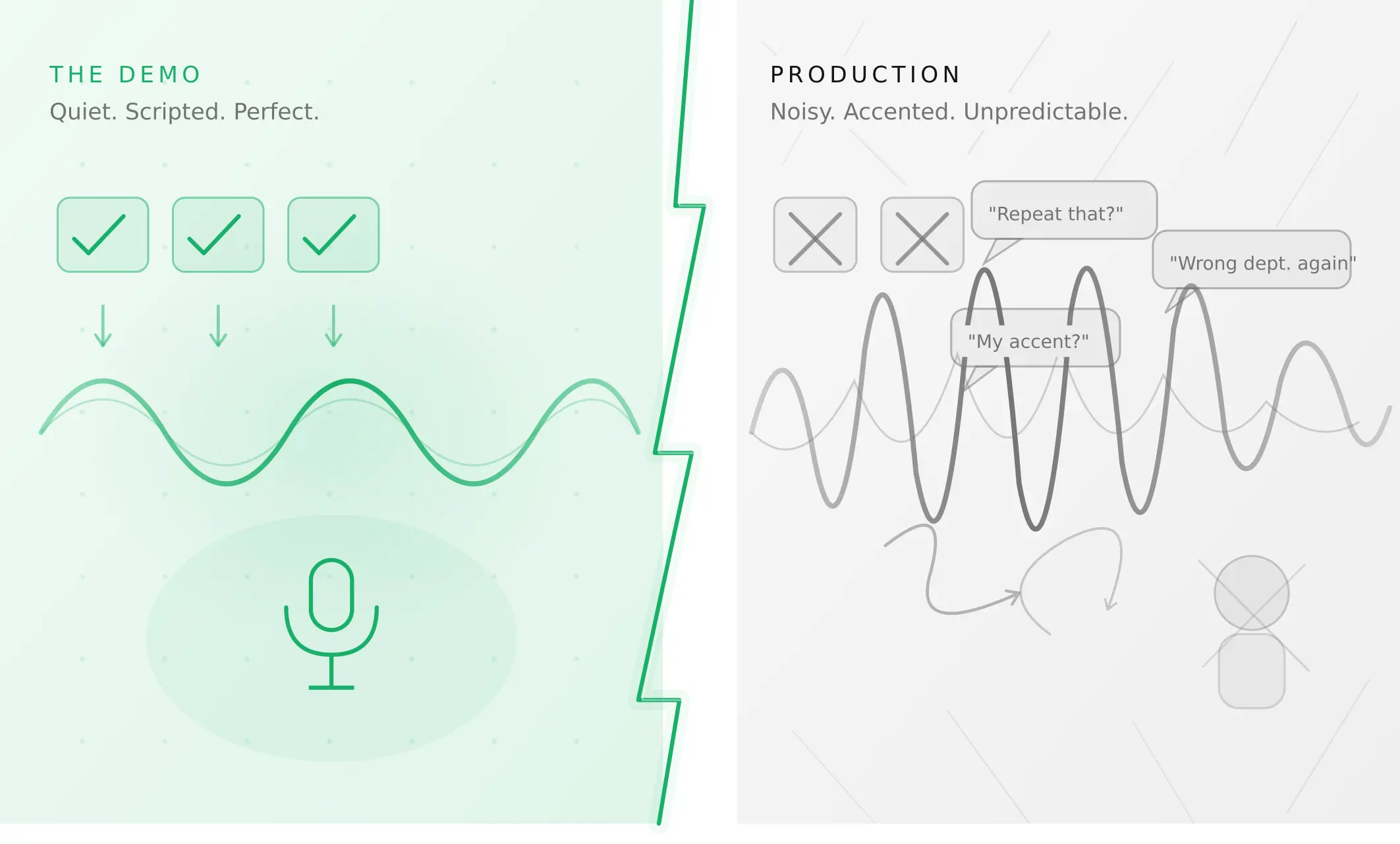
Why AI voice agents fail in production (and how to prevent it)
AI voice agents that ace demos still break in production. Learn the 5 root causes, how to test for each, and what production readiness actually means.
Read more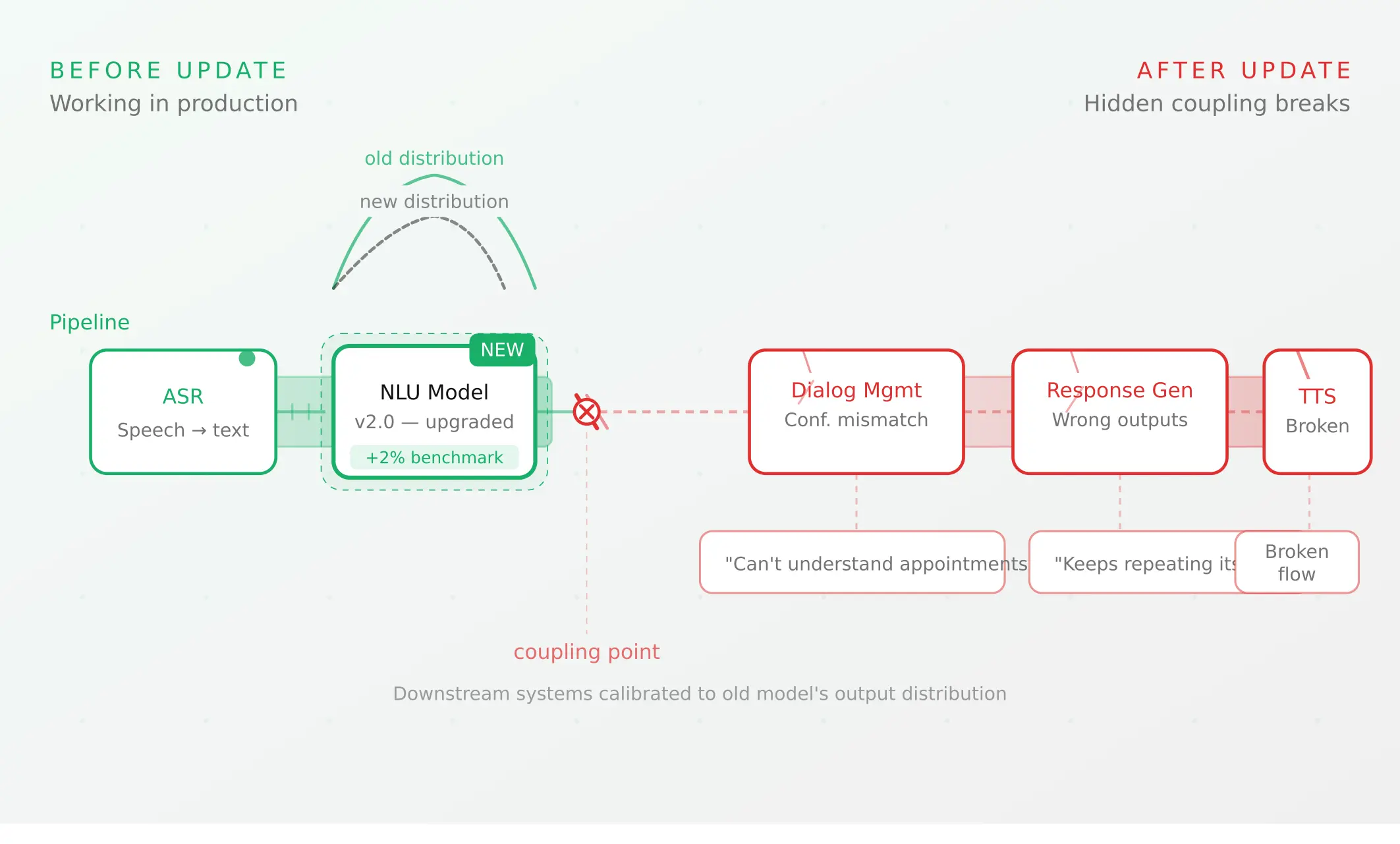
Voice agent regression testing: why LLM updates break production
LLM updates improve benchmarks but break voice agents in 5 predictable ways. How to detect and prevent regressions after every model or prompt change.
Read more