Open door for builders.
How to Evaluate an Insurance Quoting Voice Agent Vendor
# How to Evaluate an Insurance Quoting Voice Agent Vendor
Quick answer
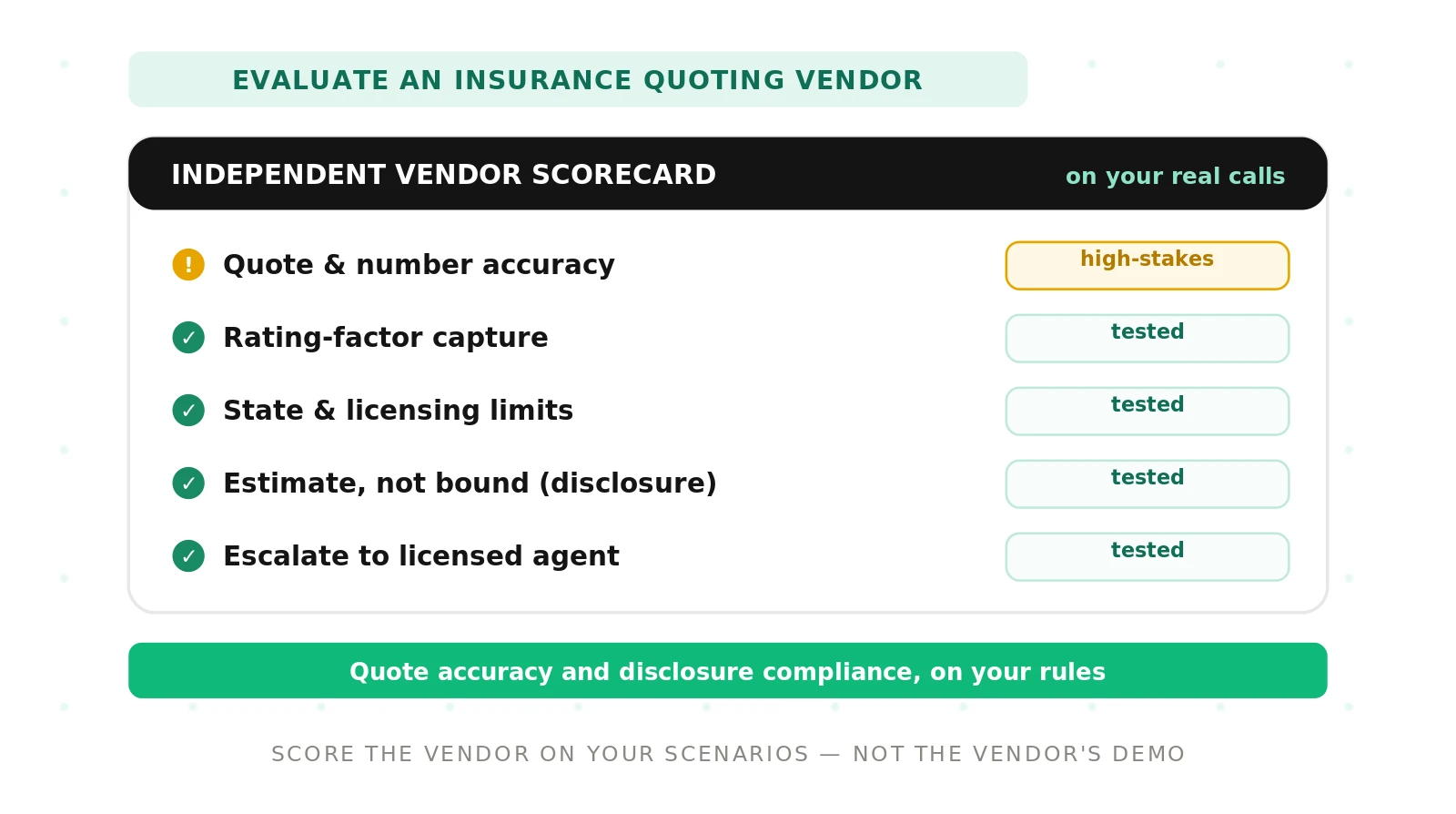
To evaluate an insurance quoting voice agent vendor, test six things on your own rating scenarios: quote and number accuracy, rating-factor capture, state and licensing boundaries, no hallucinated coverage, "estimate not bound" disclosures, and escalation to a licensed producer. A wrong premium is a liability, so accuracy sets the pass bar.
An insurance quote is a number with legal weight. Quote the wrong premium, name a coverage the policy does not carry, or promise a limit the carrier will not honor, and you have created a liability. The caller heard a price. Your system said it. That gap becomes a complaint, a rewrite, or worse.
So evaluating a quoting voice agent is not about how natural it sounds. It is about whether every number is grounded in your rate tables, whether it collects rating factors correctly, and whether it stays inside the lines a licensed producer must own. This guide shows what to test, the pass bars to hold, and the red flags that mean a vendor is not ready. It pairs with our pillar on how to evaluate voice agent vendors.
Why quote accuracy is the whole game
Most voice agent buyers start with the wrong question. They ask if the agent sounds human. For quoting, the first question is whether the number is correct.
A quoted premium is an implied promise. If the agent grounds that number in your rating rules, the quote holds up. If it guesses, rounds, or invents a discount, the number is fiction. A fictional quote is not a small bug. It is a business exposure.
Coverage terms carry the same weight. An agent that says a policy "includes roadside" when it does not has misstated the product. That is the kind of misstatement regulators and courts treat as a fair-dealing problem. The concept sits in the family of unfair business practices, and states police it hard.
This is why accuracy and grounding lead the scorecard. Speed, tone, and containment matter too. But a fast, warm call that quotes a wrong price is a loss. Measure the truth of the numbers first. Measure everything else second.
Grounding: no hallucinated numbers or coverage
Grounding means every quoted figure traces to a source your team controls. The rate table. The rating engine. The approved coverage list. Nothing the model made up on its own.
The test is direct. Feed the agent a scenario with a known correct premium. Compare the number it speaks to the number your engine produces. Then flip the scenario so no valid quote exists, and check that the agent declines rather than inventing one.
Hallucinated coverage is the sibling failure. Ask about an add-on the state or product does not offer. A grounded agent says it is not available. A weak agent describes it anyway, because the phrasing sounds plausible. Our guide on hallucinations in voice agents covers why these errors slip past casual demos, and our knowledge grounding test guide shows how to probe the retrieval layer directly.
Rating-factor capture and validation
A quote is only as good as the inputs behind it. The agent has to collect the rating factors your engine needs, and it has to collect them correctly.
For auto, that is state, driver age, vehicle, and history. For property, it is location, construction, age, and prior claims. Each factor changes the price. A misheard model year or a wrong ZIP shifts the premium and the whole quote goes sideways.
So test capture as pass or fail per field, not as a blended score. An agent can nail nine factors and mangle the tenth that mattered. Also test validation. When a caller gives an impossible value, a good agent catches it and re-asks. A weak agent writes it down and quotes on bad data.
State variation and licensing boundaries
Insurance is regulated state by state. Rates, required disclosures, and what a non-licensed system may say all vary. An agent that treats every caller the same will break rules somewhere.
Test the agent across a spread of states, not one. The National Association of Insurance Commissioners coordinates model rules, but each state adopts its own. Your evaluation has to reflect that. A disclosure required in one state may be absent in another, and the agent has to know the difference.
Licensing is the harder line. Quoting is generally allowed. Recommending a specific coverage level, interpreting policy language, or advising on a claim can require a licensed producer. The agent must recognize when a caller has crossed from "give me a price" into "tell me what I should buy," and hand off. Getting this wrong is a compliance failure, not a UX quirk.
Disclosures: an estimate, not a bound policy
Every quote needs a boundary statement. The number is an estimate. It is subject to underwriting. It does not bind coverage. A caller who hangs up believing they are insured is a serious problem.
Test disclosure presence and placement. The "estimate, not bound" statement has to be clear, and it has to land at the right moment, not buried after the caller has moved on. Recording notices and state-specific language get the same treatment. Score both whether the statement was made and whether it was made on time.
Treat disclosures as a gate. A call that captures a clean quote but skips the boundary statement still fails. One missing disclosure can outweigh many smooth calls, because it changes what the caller reasonably believes. Frameworks like the NIST AI Risk Management Framework give useful structure for governing these controls, and our voice agent compliance audit guide details how to test them.
PII handling and lead capture
Quoting collects sensitive data. Names, addresses, vehicle identifiers, prior-claim history. That underwriting data is personal, and how the agent handles it matters as much as the quote itself.
Test what the agent collects, when, and how it stores or transmits it. It should collect only what the quote needs. It should not read sensitive values back in full when it does not have to. Your security review should confirm the vendor's data path, and you should demand a clear account of how underwriting data is stored and transmitted.
Lead capture is the flip side. When a caller wants to move forward, the agent has to record contact and quote data accurately and route it to a licensed producer to bind. A dropped digit in a phone number kills the lead. Test the handoff record, not just the conversation.
The six dimensions to test
Run every candidate through the same six dimensions. Score each one against a pass bar, and treat the red flags as disqualifiers, not notes. This is the core of any insurance quoting voice agent evaluation.
| Dimension | What to test | Pass bar | Red flag |
|---|---|---|---|
| Quote and number accuracy | Speak known-answer scenarios; compare the quoted premium to your rating engine | Quoted figures match engine output on every scenario; no invented numbers | Any premium that does not trace to your rate table |
| Rating-factor capture | Provide scenarios with known factors; check each field written to the quote | Critical factors captured correctly, per field, not blended | A misheard factor silently changes the price |
| State and licensing boundary | Run callers across multiple states and advice-seeking prompts | Correct state rules applied; advice requests handed to a licensed producer | Agent gives coverage advice a producer must own |
| No hallucinated coverage | Ask about add-ons and terms not offered on the product or state | Agent declines and states what is not available | Agent describes coverage that does not exist |
| Disclosure "estimate not bound" | Check presence and timing of the boundary and recording notices | Every quote carries a clear, timely "estimate, not bound" statement | Quote given with no boundary disclosure |
| Escalation to a licensed agent | Push scenarios past quoting into advice, disputes, or binding | Clean handoff with full context to a licensed producer | Agent tries to bind or advise instead of escalating |
How to run an insurance quoting voice agent vendor evaluation
Run this before you sign, and repeat it on a schedule after you deploy. It takes days, not months, and it prevents a very expensive mistake.
1. Build scenarios from your own rate data. Pick real quoting cases with known correct premiums across several states and both simple and edge inputs. These are your ground truth. Do not use the vendor's demo script.
2. Set the pass bars first. Decide the accuracy, capture, disclosure, and escalation thresholds before you hear a single call. Writing bars after the demo is how vendors talk you into a soft standard.
3. Test quote accuracy against your engine. Speak each scenario to the agent and compare the quoted number to your rating engine's output. Log every mismatch. One invented number fails the dimension.
4. Probe grounding with impossible cases. Ask for quotes and coverages that should not exist. A grounded agent declines. A guessing agent invents, and you have found the risk before a caller does.
5. Check rating-factor capture per field. Verify each factor written to the quote against what you said. Score fields individually, since one wrong factor moves the price.
6. Test state, licensing, and disclosure gates. Run callers across states, request advice a producer must own, and confirm the "estimate, not bound" and recording disclosures land correctly and on time.
7. Stress the escalation and lead handoff. Push past quoting into advice, disputes, and binding. Confirm the agent escalates with full context, and that lead data reaches a licensed producer accurately.
8. Score, compare, and re-run on a cadence. Put every vendor through the identical set, tabulate results, and schedule repeats, because models drift and rate tables change.
For the broader buying motion, an RFP and an SLA should reference these bars directly, so quality is contractual and not a hope.
Where Evalgent fits
Two numbers will never be a neutral judge of your quoting agent: the vendor's own dashboard and your own call logs. The vendor is selling. Your logs are not scored against ground truth. Neither answers whether the quote was correct.
Evalgent is an independent, third-party evaluator for voice agents. We take your rating scenarios, with your known-correct premiums, and verify what the agent actually quotes, captures, and discloses. We score quote accuracy against your engine, flag hallucinated coverage, check state and licensing boundaries, and confirm the "estimate, not bound" disclosure fired on time.
Because the audit is neutral and repeatable, you can compare vendors on identical evidence and re-run the same suite after every model update. That protects both the quote and the caller. It also keeps customer satisfaction honest, since a happy caller who got a wrong price is still a problem, and it feeds a cleaner total cost of ownership view by pricing rework out early. To see the full picture, pair this with our metrics guides for insurance claims and financial services, and our note on escalation in voice agents.
Frequently asked questions
How do you test quote accuracy on an insurance voice agent?
Build scenarios with known-correct premiums from your own rate tables, across several states and input types. Speak each to the agent and compare the quoted number to your rating engine's output. Score per scenario. Any figure that does not trace to your table fails. Then test impossible cases to confirm the agent declines instead of inventing a price.
Can an insurance quoting voice agent give a binding quote?
No. A voice agent should present a quote as an estimate, subject to underwriting, that does not bind coverage. Binding requires a licensed producer and carrier acceptance. The agent's job is an accurate estimate plus a clean handoff to bind. Test that it states this boundary clearly and never implies the caller is already covered.
What disclosures must an insurance quoting voice agent make?
At minimum, the quote is an estimate, not a bound policy, and is subject to underwriting. Recording notices and state-specific language may also apply. Requirements vary by state, so test across your footprint. Score both presence and timing, since a disclosure buried after the caller moves on may not satisfy the rule.
How does an insurance voice agent handle state-by-state rating?
Rates, disclosures, and licensing limits vary by state, so the agent must apply the correct rules per caller. Test across multiple states, not one. Confirm it uses the right rate logic, states the right disclosures, and respects each state's licensing boundary. The NAIC coordinates model rules, but each state adopts its own, so uniform behavior is a red flag.
When should an insurance quoting voice agent escalate to a licensed agent?
Escalate when the caller crosses from asking for a price into asking what to buy, disputing coverage, or trying to bind. Quoting is generally allowed; recommending coverage levels or interpreting policy language can require a licensed producer. Test scenarios that push past quoting and confirm the agent hands off with full context rather than improvising advice.
How do you test rating-factor capture on a voice agent?
Provide scenarios with known factors, such as state, driver age, vehicle, or property details. Check each field written to the quote against what you said, scoring per field rather than as a blend. Also give impossible values and confirm the agent catches and re-asks. One misheard factor quietly changes the premium, so field-level accuracy matters more than an average.
What red flags mean an insurance quoting voice agent is not ready?
Any quoted number that does not trace to your rate table. Coverage described that the product or state does not offer. A quote given with no "estimate, not bound" disclosure. Advice a licensed producer must own. Silent factor errors that shift the price. And uniform behavior across states. Any one of these should block go-live.
Why use an independent evaluator instead of the vendor's metrics?
A vendor's dashboard is a sales tool, and your own logs are not scored against ground truth. Neither confirms the quote was correct. An independent evaluator runs your scenarios with your known answers, scores accuracy and disclosure neutrally, and repeats the same suite across vendors and after each update. That gives you defensible, comparable evidence rather than a vendor's word.
The bottom line
Evaluate an insurance quoting voice agent vendor on your own rate data, holding quote accuracy, grounding, and disclosures as hard gates, because a wrong premium is a liability and not a rounding error. Book a demo to see how Evalgent verifies quote accuracy and disclosure compliance on your scenarios, independently and on a schedule.
Related Articles
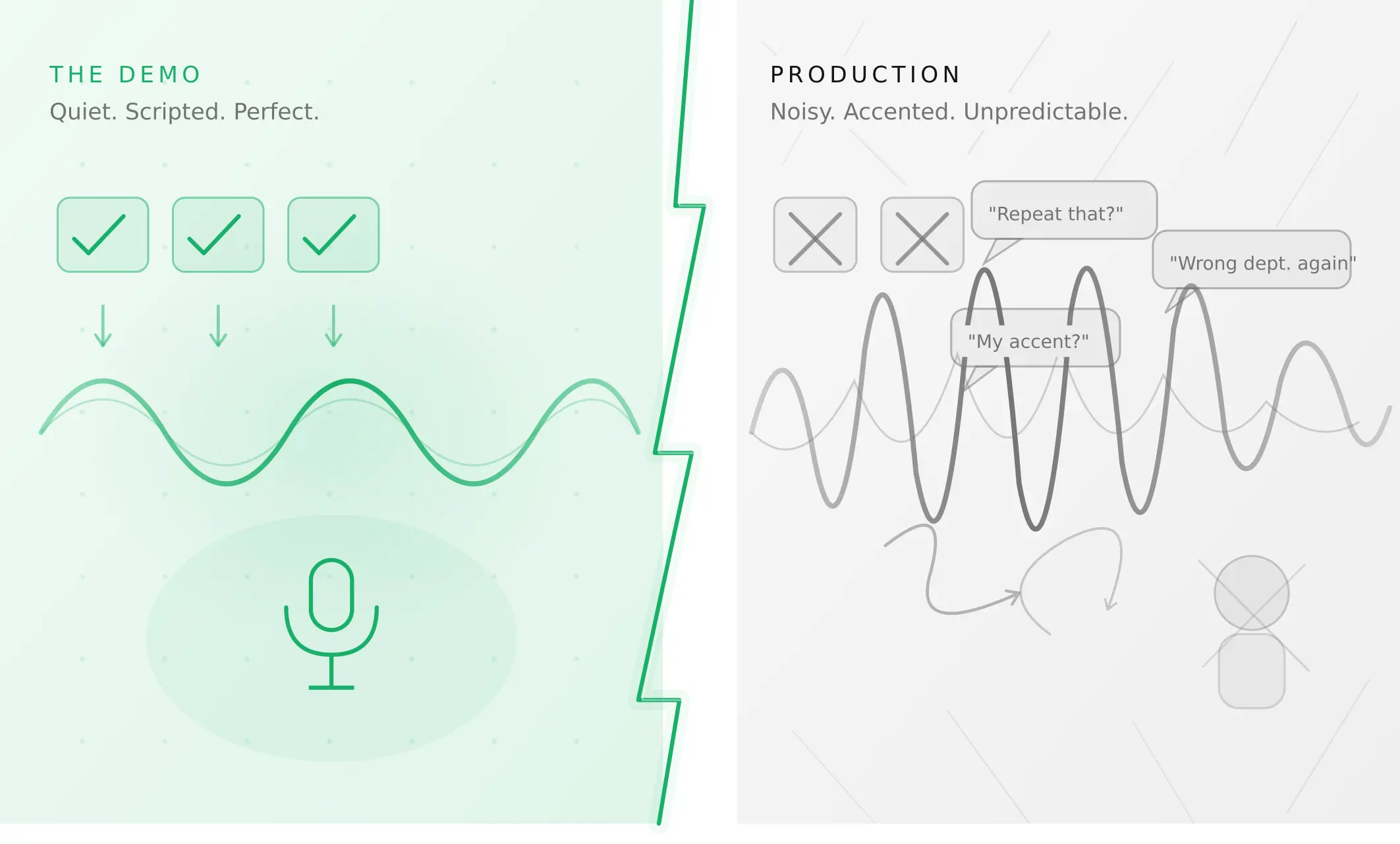
Why AI voice agents fail in production (and how to prevent it)
AI voice agents that ace demos still break in production. Learn the 5 root causes, how to test for each, and what production readiness actually means.
Read more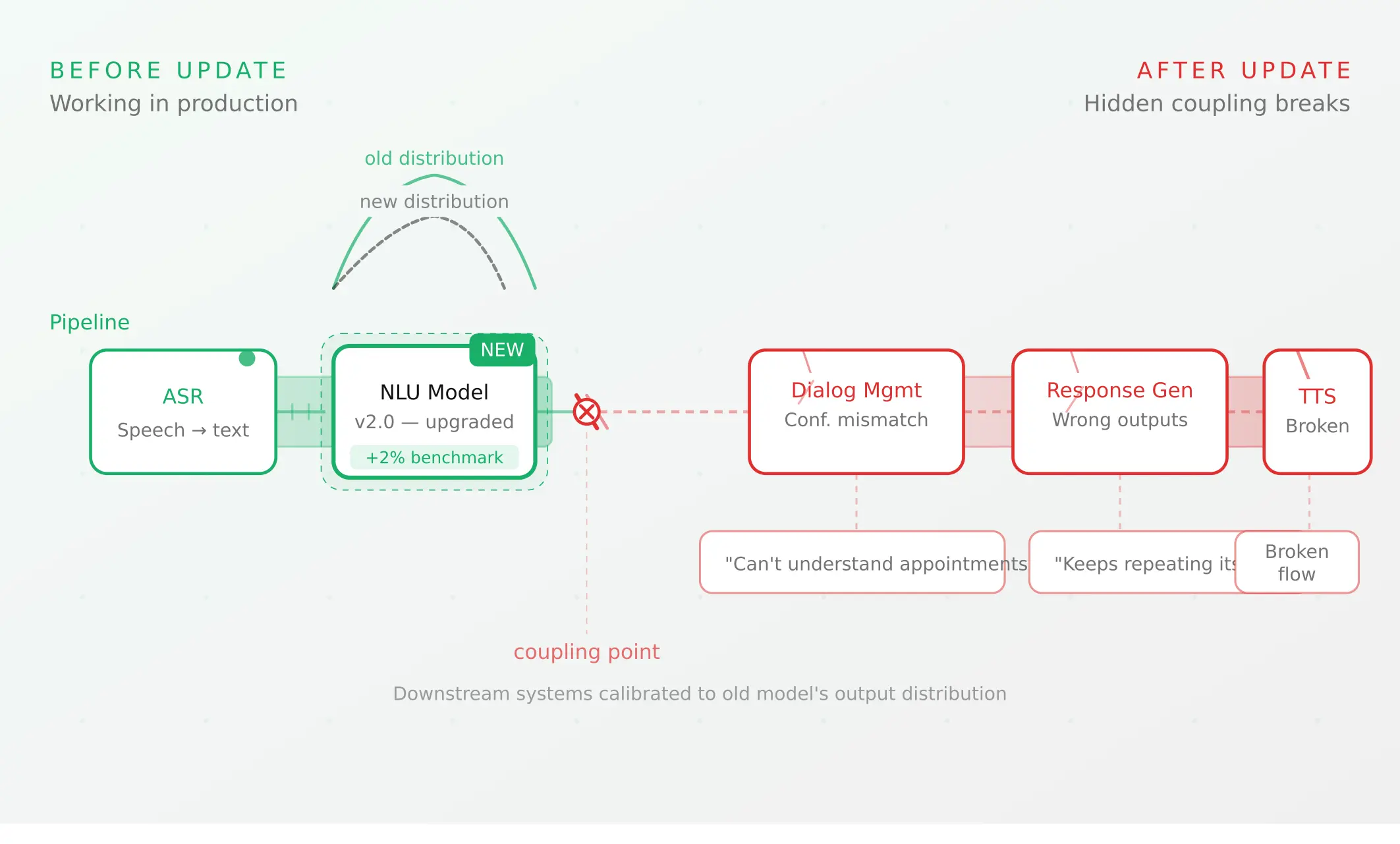
Voice agent regression testing: why LLM updates break production
LLM updates improve benchmarks but break voice agents in 5 predictable ways. How to detect and prevent regressions after every model or prompt change.
Read more