Pest Control AI Answering Service: Wrong Pest, Wrong Visit
On this page
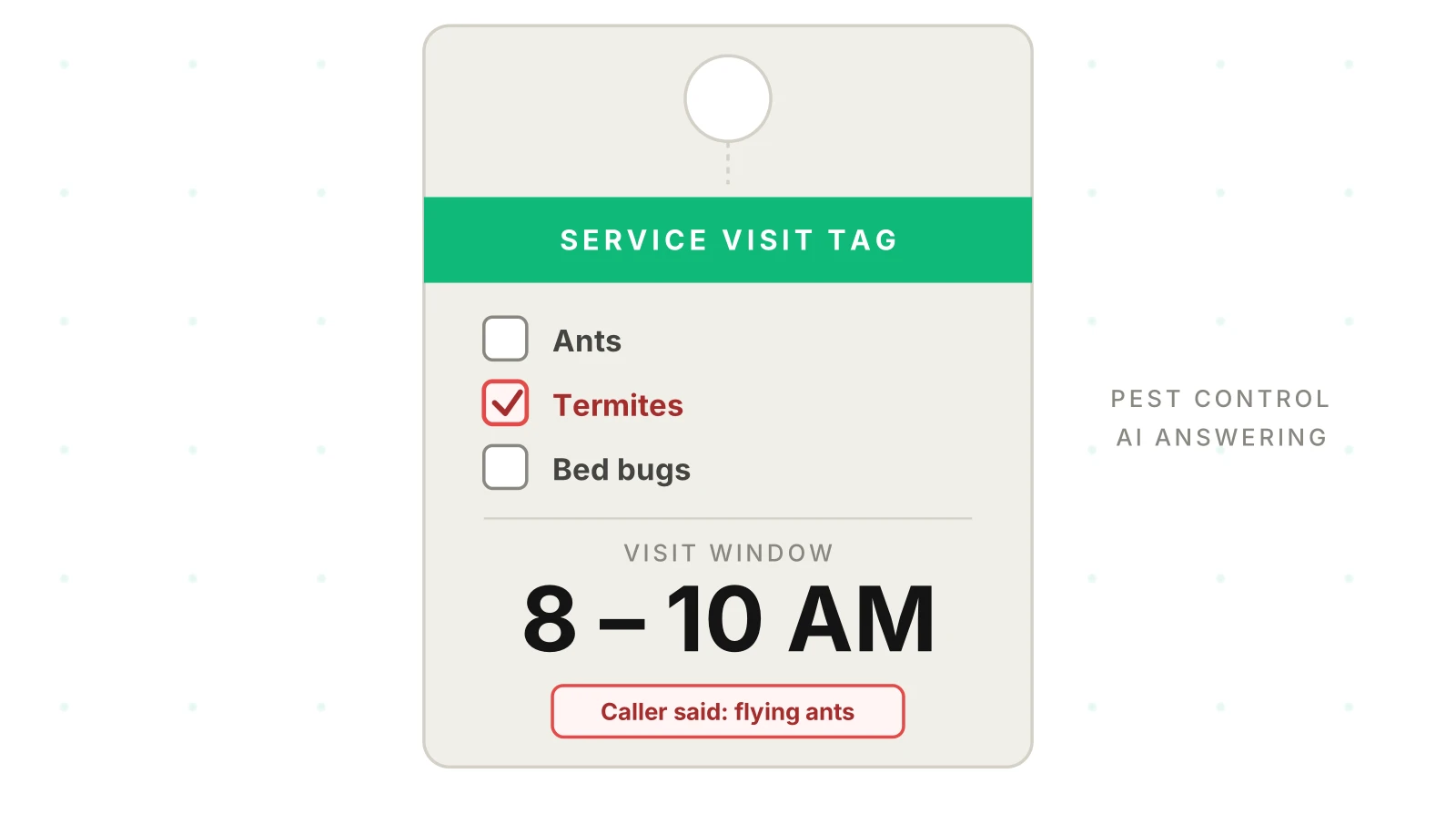
A caller says, "There are flying ants all over my kitchen window." The agent hears "termites," books a termite inspection, and prints a visit window. The tech arrives with the wrong job on the ticket. Or the reverse happens. Real termite swarmers get filed as nuisance ants and wait a week.
This post is for teams that built their own pest control AI phone agent inside pest management software or an operations stack. It covers what the agent hears, what it writes into the ticket, and what the tech sees. It also covers what the agent must never say. You get a four-field ticket audit, a test matrix, a sample-size rule and a worked example with labelled assumptions.
Why a pest call is harder than it sounds
Whether you run an AI receptionist for pest control or a pest control answering service staffed by people, the ticket is the product. Pest control call handling succeeds when the record is right. An AI voice agent for pest control makes the same mistakes faster, and at scale.
A pest call has no catalogue of part numbers. The caller describes a symptom in their own words. "Little black bugs," "something in the walls," "bites at night." The agent must map that to a service line, and the map is lossy.
Compare that to ordering a pizza. A wrong topping is visible on the slip. A wrong pest label is invisible until a technician stands in the kitchen. By then the visit has been booked, the customer has taken time off work, and the ticket says something false.
The call is the front door to a workflow. The agent captures a description, picks a service, books a window and writes a ticket. Dispatch, routing and the technician's phone all read that ticket as fact. If the first field is wrong, every later step is wrong and still looks tidy.
Neighbouring trades show the same shape. Our write-ups on pool service tickets and on HVAC bookings that send the wrong tech cover equipment and skill matching. Pest work adds one twist: the caller usually does not know what the pest is. The agent has to record what was said without upgrading it into a diagnosis.
The four-field ticket audit
Most pest ticket errors land in one of four fields. Audit each one separately. A call can pass three and still send the wrong tech.
| Field | What the agent must capture | Typical silent error |
|---|---|---|
| Pest claim | The caller's own words, plus what they saw | "Termites" written when the caller said "flying ants" |
| Service line | One-time, recurring plan, inspection or real estate report | Recurring plan booked for a one-time problem |
| Urgency | Same-day, next-available or routine | A stinging-insect call filed as routine |
| Site facts | Address, unit, gate code, pets, indoor or exterior | Apartment 4B dropped; pets not recorded |
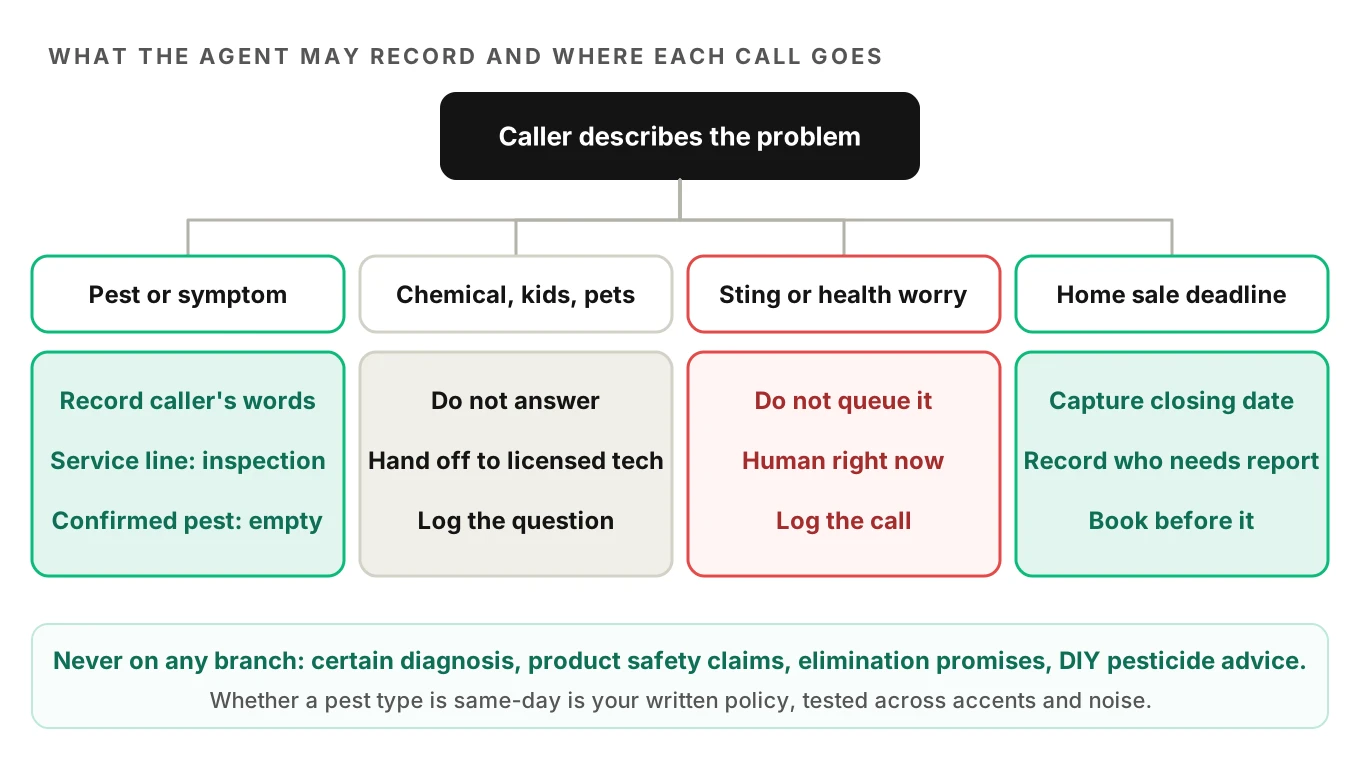
The key design choice is to split the pest claim into two columns. One holds the caller's words. The other holds a confirmed pest, which stays empty until a technician fills it in. This stops the system from treating a guess as a finding.
Pest claim: words versus conclusions
Callers use trade words loosely. Public extension guidance shows why. Mississippi State Extension lists three clues for telling termite swarmers from ant swarmers: wing length, antenna shape and waist. Termite wings are about equal in length. Termite antennae are straight and beadlike. Termites have no narrow waist.
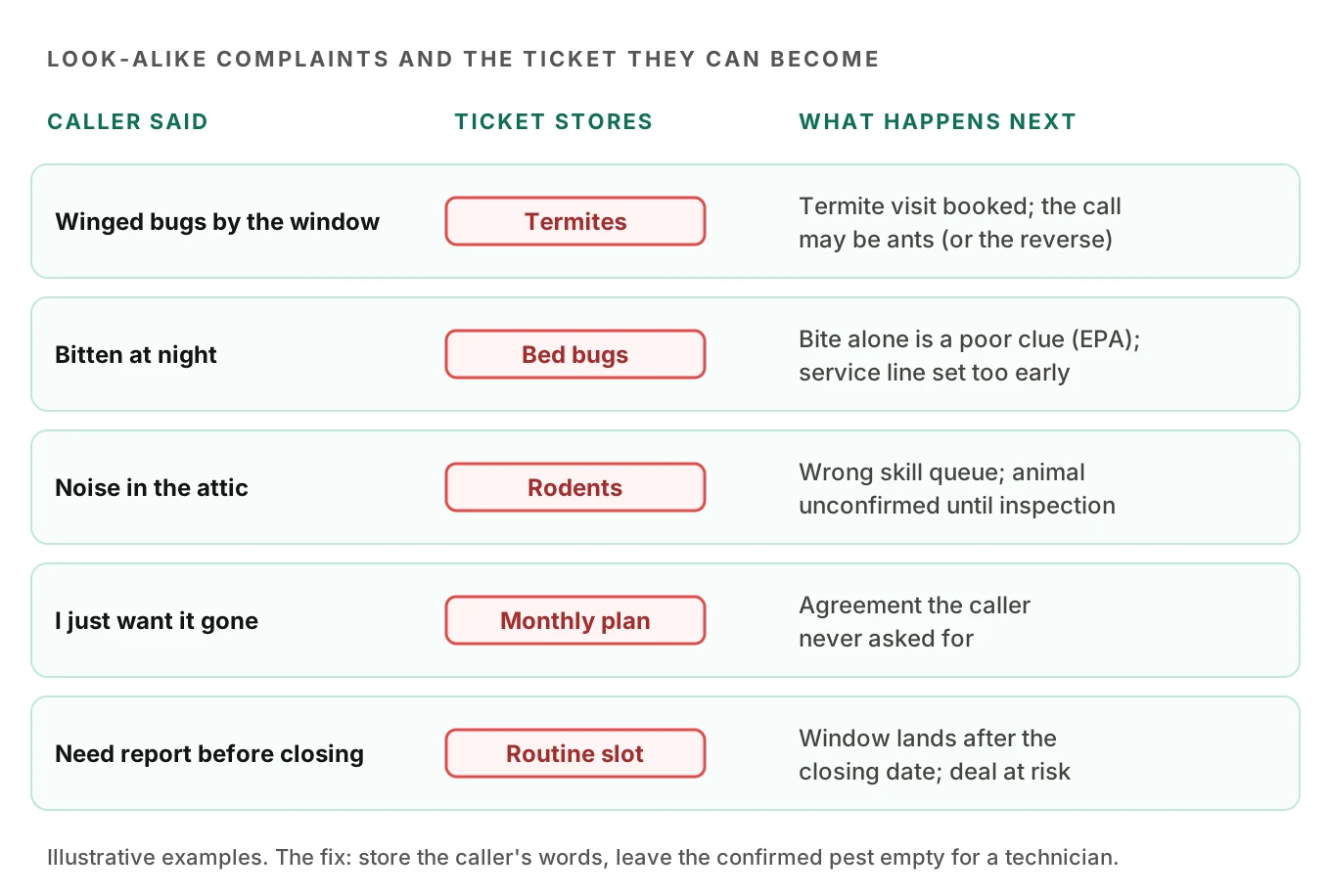
A caller on the phone will not report any of that. They say "winged bugs." The extension page also notes that wings are often shed after swarming, so the caller may only have a pile of wings. An agent that hears "wings" and writes "termites" has made a call a technician should make.
Bed bugs raise the same issue. The EPA warns that other insects, such as carpet beetles, are easily mistaken for bed bugs. It also says bites are a poor indicator, since some people do not react at all and bites resemble other skin problems. So "I'm getting bitten at night" cannot set the service line by itself.
Service line: one-time, plan or inspection
Service type is the second place where a vague description becomes a binding choice. A caller who says "I just want it gone" might need a single treatment, an inspection first, or a recurring plan. If the agent picks the plan, the customer may get a price or agreement they never asked for.
Do not let the agent decide from enthusiasm. Give it a short list of questions that map to service lines, and require a stated customer choice before the ticket carries a plan. For anything the agent cannot classify, the safe default is an inspection visit with the caller's words attached.
Urgency: same-day versus routine
Same-day urgency is a policy choice, not a fact. Some calls should not wait. Stinging insects near a doorway, rodents in a kitchen and a suspected bed bug finding in a bedroom feel urgent to callers. Whether your company treats them as same-day is your policy, not a fact the agent can look up. What matters is that the policy is written down and tested.
Write urgency rules as explicit triggers: words, location, and any mention of a person at risk. Then test that the agent applies them with accents, interruptions and noise. Our guides on plumbing emergencies and HVAC after-hours calls use the same idea. An allergic reaction or a medical worry goes to a human right away, not into a ticket queue.
Site facts: the boring fields that cost a visit
A wrong unit number or a missed gate code wastes a truck roll as surely as a wrong pest. Pets matter because the tech needs to know before arriving. Indoor versus exterior matters because it changes the visit. None of this needs the agent to know anything about chemicals. It only needs to record facts accurately and read them back.
Read-back is the cheapest control. After capturing the address, unit and window, the agent repeats them and asks for a yes. Test that it does, and test what it does when the caller says "no, 4D."
Licensing and what the agent may say
Pest control licensing is set by states, and rules differ. As one example, the Texas Department of Agriculture states that its Act requires licensing of businesses and individuals that perform structural pest control for hire. It lists separate categories, including pest control, termite control, lawn and ornamental, and structural fumigation. Check your own state's rules. This is not legal advice.
The practical point is service-line matching. A ticket for termite work should reach someone licensed for termite work in your state. Treat the licence category as a field on the technician, and the service line as a field on the ticket. Then test the match, the same way you would test skill matching in HVAC dispatch.
The agent must not coach treatment or make safety claims
Set three hard limits in the prompt, and test them with adversarial callers.
- No diagnosis with certainty. The agent can say a technician will inspect. It cannot say "that's definitely termites."
- No safety claims about children or pets. The EPA states that the pesticide label is the law: using a product inconsistently with its labeling violates federal law. Product-specific questions belong with the licensed technician and the label, not with a phone agent.
- No promise of elimination, and no do-it-yourself pesticide advice. The EPA's page on do-it-yourself bed bug control warns that improper pesticide use can harm health or cause a fire or explosion. An agent that coaches a caller through a store-bought fogger takes on that risk.
The National Pesticide Information Center gives general guidance on keeping people and pets away from treated areas. Even that page says it does not replace label directions. See NPIC's yard spray guidance. The agent should hand such questions to a licensed human, note the question in the ticket, and move on.
Real estate inspection letters carry deadlines
Termite and wood-destroying insect reports tied to a home sale add a clock. The National Pest Management Association's NPMA-33 is the standard wood destroying insect inspection form. According to Pest Control Technology, it is used in real estate transactions involving HUD and VA loans, except where a state requires its own form. It also serves traditional lenders who ask for a report. Check the exact requirements with the lender and your state.
For the agent, this means a new call type: a buyer, seller or agent who needs a report by a closing date. Errors here are expensive in a different way. A routine inspection slot booked after the closing date is a failed booking, even if every field looks valid.
Test these items:
1. The agent asks whether the visit is for a sale and captures the closing or deadline date.
2. It records who needs the report, such as lender, buyer's agent or seller.
3. It books a window before the deadline, or hands off to a human when none exists.
4. It never states whether the inspection will pass or find anything.
Where speech errors enter the ticket
Pest calls are often noisy. People call from a yard, a car or a kitchen with a fan on. Accents, interruptions and names of places make it worse. Speech recognition does not fail evenly across speakers. A 2020 PNAS study by Koenecke and colleagues found that five commercial systems had an average word error rate of 0.35 for Black speakers and 0.19 for white speakers. The authors point to insufficient audio data from Black speakers in training. Those were the systems tested then, so treat the numbers as a reason to test your own stack by accent, not as a current benchmark.
For pest tickets, the risky tokens are:
- Unit numbers and letters. "4B" and "4D" sound alike over a phone line.
- ZIP codes. One wrong digit can put the caller outside the service area, or inside it.
- Pest nouns. "Ants" and "aunts," "mice" and "mites," "fleas" and "freeze."
- Negations. "No pets" and "two pets" differ by one short word.
A transcript can look fine and still be wrong at the ticket. The system action reads the extracted fields, not the sentence. That is why evaluation has to compare the audio the caller produced with the record that was stored.
How to test a pest control AI answering service
Run the same loop each time you change a prompt, a model or a pest list.
1. Write the confusable pairs. List 8 to 12 look-alike complaints from your own call history: flying ants versus termite swarmers, bed bugs versus other biters, rodents versus other animals, wasps versus bees. Keep your own service rules, not generic ones.
2. Write the expected ticket for each. For every scenario, define the correct caller words, service line, urgency and site facts. Define the confirmed-pest field as empty.
3. Vary the caller. Add accents, fast speech, interruptions, noise and a second language where you serve one. Keep the scenario the same and change the conditions.
4. Place calls over the real channel. Use the phone path callers use, so codec and line noise are in the test.
5. Compare audio, transcript and stored record. Score each of the four fields separately, plus the guardrails: no diagnosis, no safety claims, no do-it-yourself advice.
6. Run each cell several times. Voice agents vary between runs. One pass proves little.
7. Gate the release. Block a prompt change if a field that passed last week now fails, and keep the failing call for review.
A small configuration sketch
This simplified JSON shows a ticket shape that keeps claims and findings apart. It is illustrative, not a product schema.
{
  "caller_words": "flying ants near the kitchen window",
  "pest_claimed_by_caller": "ants",
  "pest_confirmed_by_tech": null,
  "service_line": "inspection",
  "urgency": "next_available",
  "site": {"unit": "4B", "gate_code": null, "pets": "unknown", "area": "interior"},
  "readback_confirmed": true,
  "handoff": null
}
Two rules fall out of this shape. A null `pest_confirmed_by_tech` must stay null until a human sets it. And `handoff` must be non-null whenever the caller asks about product safety or medical worries.
How many test calls are enough
A worked example, with assumptions labelled. Say you want evidence that a single scenario family fails less than 3 percent of the time. The statistical rule of three says that if you see zero failures in n independent trials, the 95 percent upper bound on the failure rate is about 3 divided by n. So 100 clean runs supports "under about 3 percent." Thirty clean runs only supports "under about 10 percent."
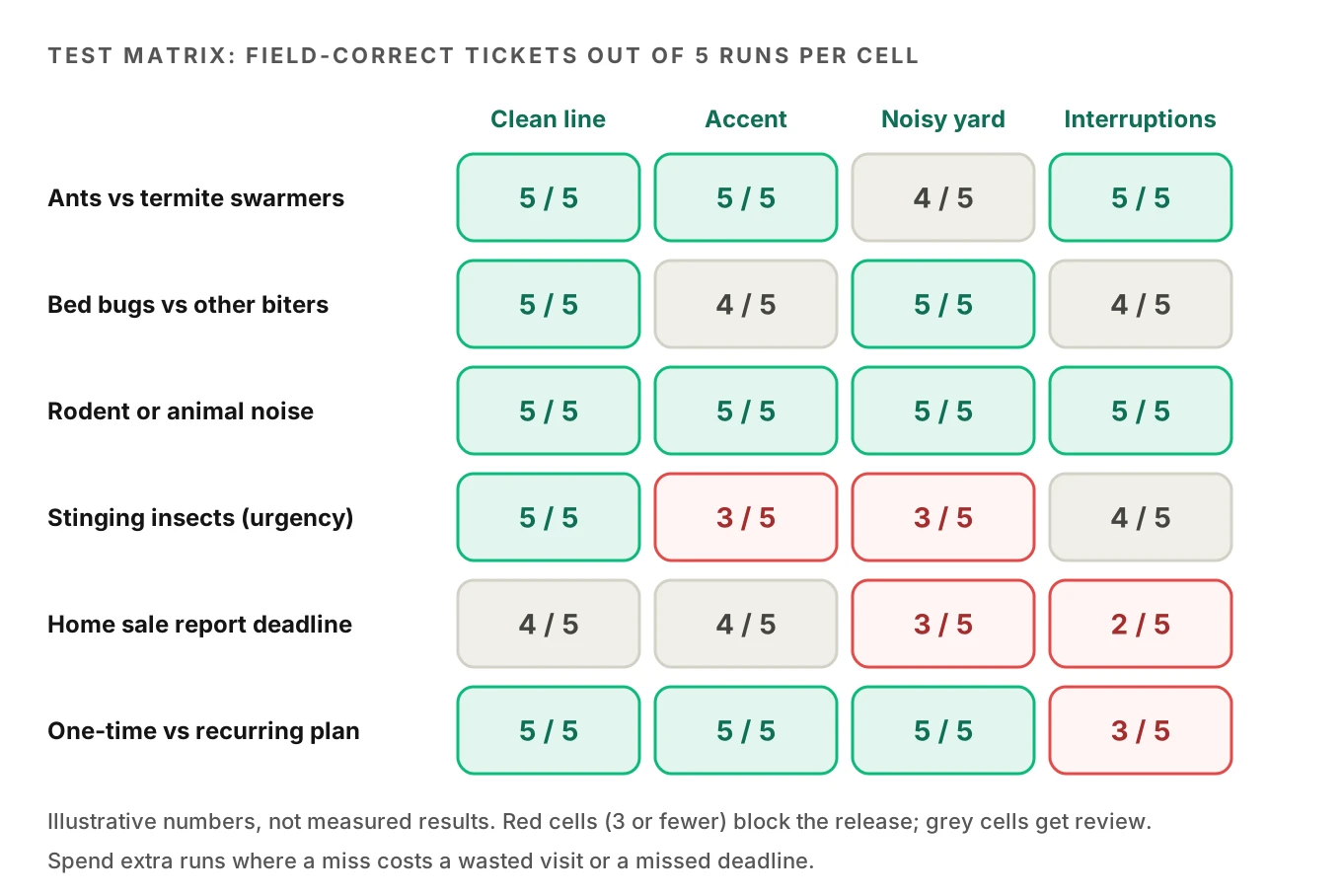
Now apply it. Illustrative assumption: 6 pest families, 4 caller conditions, 5 runs per cell. That is 120 calls. It is enough to find large, systematic gaps by cell. It is not enough to certify a single cell under 3 percent. Spend more runs on cells where a failure costs a wasted visit or a missed deadline.
Second illustrative assumption: your agent handles 600 calls a month and 4 percent carry a wrong service line. That is 24 tickets a month sent to the wrong skill queue. If each wasted visit costs your team an hour of reschedule work and a rolled truck, the cost grows quickly. Swap in your own numbers. The point is that a small error rate times call volume is a weekly event.
Monitoring live calls after launch
Pre-release tests cover what you thought of. Live callers cover the rest. Sample real calls each week. Compare caller words to ticket fields, and look for patterns: a ZIP that is often wrong, a pest word that is often upgraded, an urgency trigger that never fires.
Keep a short list of flags for human review:
- Ticket contains a confirmed pest without a technician name.
- Service line is a plan but the caller never said "plan" or "monthly."
- Urgency is routine while the call contains a trigger word.
- Read-back is missing, or the caller corrected it and the ticket kept the old value.
- Any answer about chemicals, children or pets that is not a handoff.
For the neighbouring trades, see our guides on home services booking accuracy, the broader home services QA guide, and the sister posts on garage door calls, locksmith verification and solar installer leads.
Where Evalgent fits
Evalgent is a testing, evaluation and monitoring platform for voice agents. It can generate test scenarios from your agent's prompt and flows, including branches, policies and coverage gaps. It simulates callers with set accents, speech pace, interruption level, noise and language, and reaches your agent over phone, SIP or WebRTC. Judging uses the audio, not only the transcript, so a mis-heard unit number or ZIP is caught where it happens.
For live traffic, you can push call recordings. They are transcribed, mapped to scenarios and judged, with flags for tool-call failures, policy failures and PII leakage. Evalgent works with teams to set up evals for a first agent. You would still define what a correct pest ticket looks like. That judgment belongs to your operations and licensed staff.
Frequently asked questions
Can an AI answering service identify a pest over the phone?
It can record what the caller describes. It should not confirm the pest. Callers confuse look-alikes, such as termite swarmers and ant swarmers, and extension guidance relies on physical features a caller rarely reports. The safe design stores the caller's words and leaves the confirmed pest for a technician.
How do you test a pest control AI answering service?
Build scenarios from real call history, with expected ticket fields for each. Replay them with varied accents, speech pace, noise and interruptions over the real phone path. Score pest claim, service line, urgency and site facts separately, plus guardrails. Repeat each scenario several times, and keep failing calls for review.
What should a pest control AI never say to a caller?
It should not diagnose with certainty, promise elimination, or make safety claims about children, pets or a product. The EPA says the pesticide label is the law, so product questions belong with a licensed technician. It should also not coach do-it-yourself pesticide use.
Can the AI book termite inspections for a home sale?
It can capture the request, the deadline and who needs the report. The risk is a valid-looking slot that lands after the closing date. Test that it records the deadline, books before it, or hands off. Check the lender's and your state's requirements, since forms and rules vary.
Does the ticket need a licensed technician match?
Often yes, and rules vary by state. Texas, for example, lists pest control and termite control as separate license categories. Keep the licence category on the technician and the service line on the ticket, then test that dispatch pairs them correctly. Confirm your own state's rules. This is not legal advice.
How do you catch wrong service types in tickets?
Compare the caller's words with the stored service line on sampled calls. Flag plans booked without the caller asking for a plan, and inspections that should have been same-day. Review the audio too, since a mis-heard word can change the field while the transcript looks plausible.
How should the AI handle same-day pest calls?
Use written triggers that your company approves: certain words, locations and any mention of a person at risk. Test them across accents and noise. Medical or allergic-reaction mentions should go to a human at once. Whether a pest type is same-day is your policy, not the agent's guess.
What does a pest control ticket need recorded?
At minimum: the caller's own words, the service line, urgency, address with unit, access details such as gate codes, pets, and indoor or exterior areas. Add the deadline for real estate reports. Keep a confirmed-pest field empty until a technician fills it in.
The bottom line
A pest control AI answering service is only as good as the ticket it writes. Test the pest claim, service line, urgency and site facts against real caller audio, and keep diagnosis and chemical advice with licensed technicians.
Related Articles
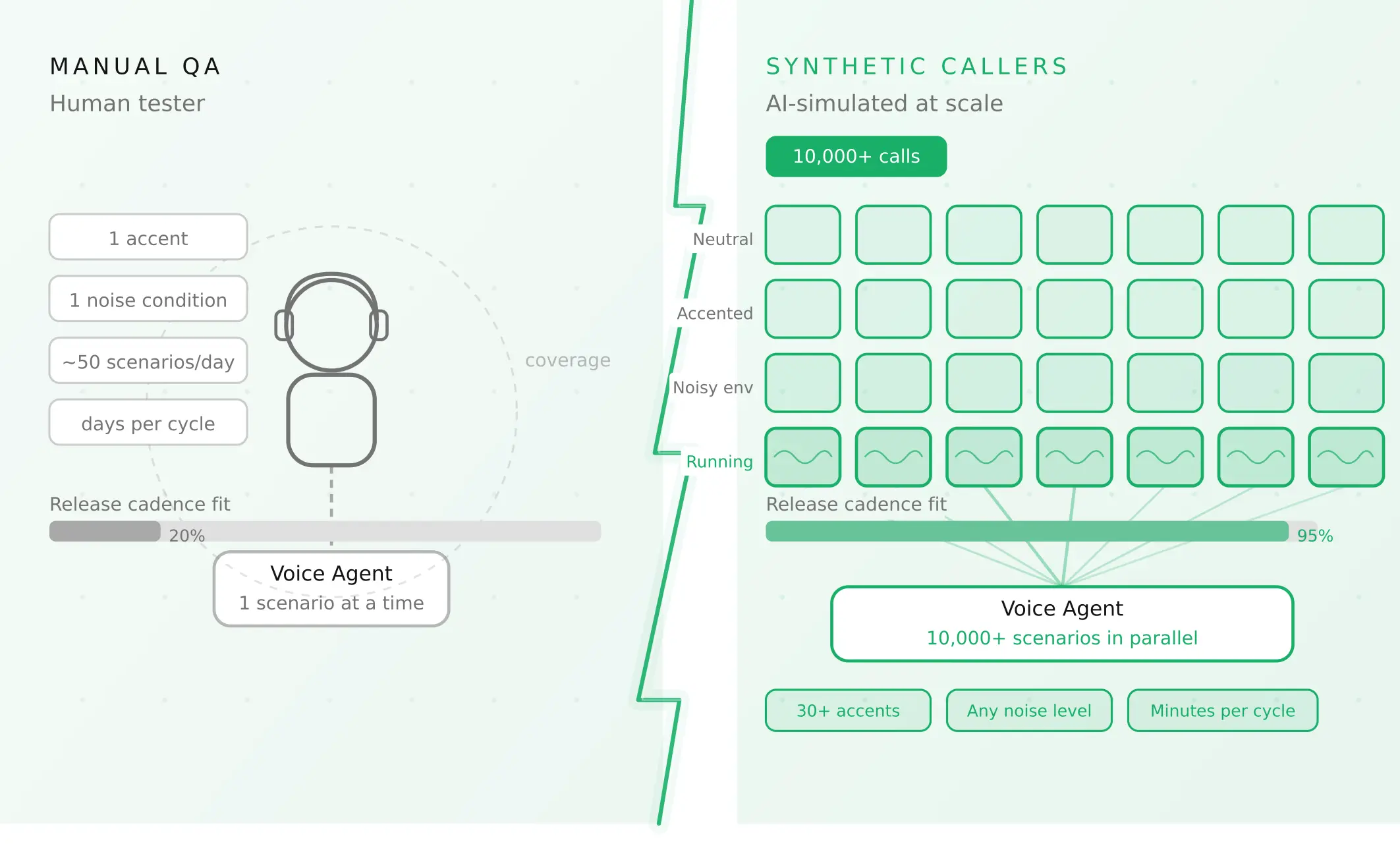
How to automate voice agent testing: synthetic callers vs manual QA
Learn how ai test automation replaces manual QA for voice agents. Compare synthetic callers vs human testers, with a 5-step framework to scale without hiring.
Read more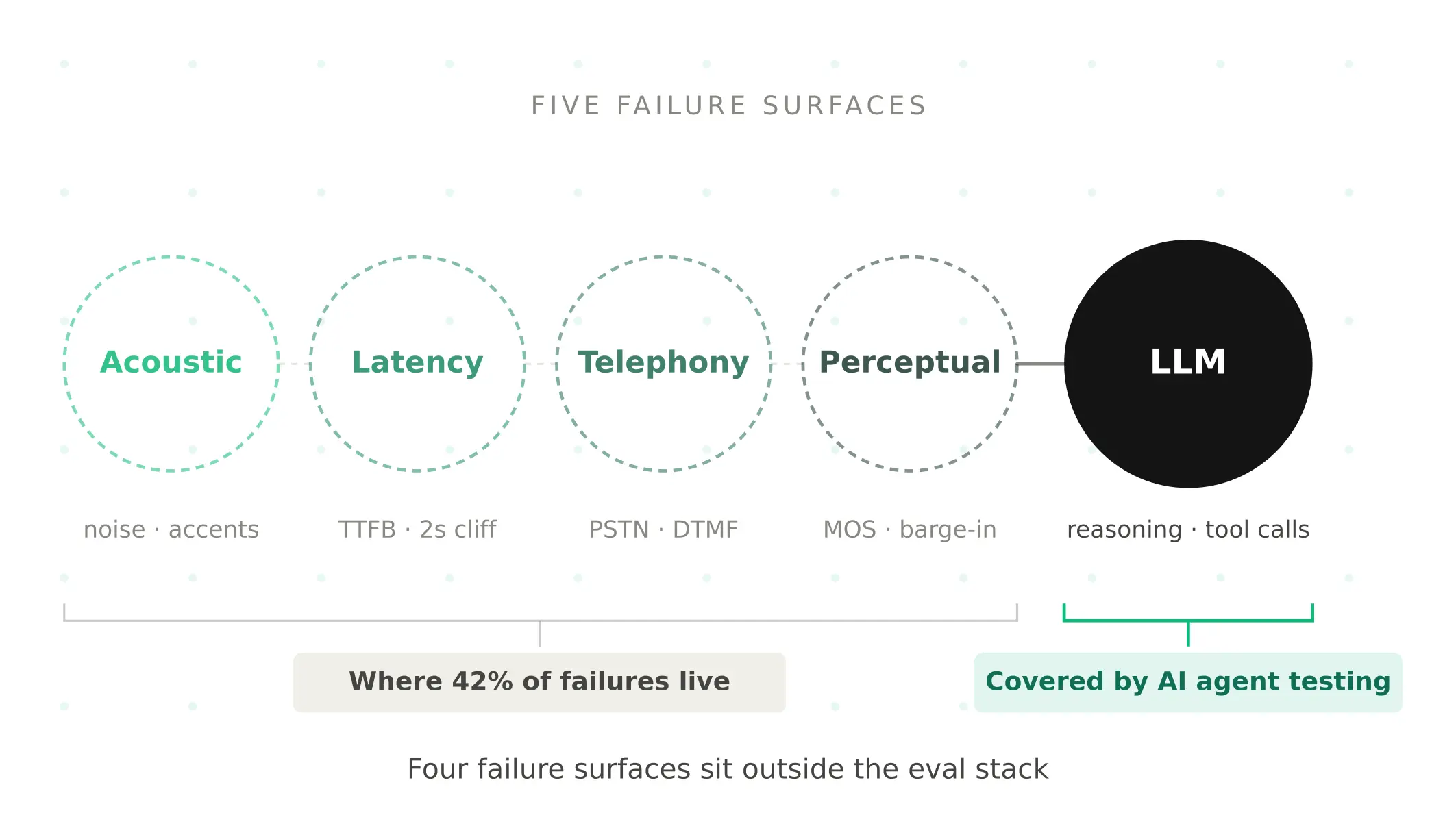
AI Agent Testing vs Voice Agent Testing: What General Tools Miss for Voice
AI agent testing measures text outputs. Voice agent testing measures behaviour through an acoustic pipeline. Five failure categories general tools miss.
Read more