Open door for builders.
How to Evaluate a Collections Voice Agent Vendor
# How to evaluate a collections voice agent vendor
Quick answer
> Quick answer: To evaluate a collections voice agent vendor, red-team it for compliance on your own scenarios. Test FDCPA, CFPB Reg F, and TCPA behavior, not just call quality. A wrong-party leak or missed disclosure is a legal liability. So compliance is the pass or fail axis, judged by an independent auditor.
You cannot evaluate collections voice agent vendors on a demo. Debt collection is one of the most regulated things a phone call can do. The agent is not just answering questions. It makes legally sensitive statements about a debt. Each of those statements can create liability.
That changes what evaluation means. For a support bot, a bad call is a bad experience. For a collections agent, a bad call can be a rule violation. It can trigger a consumer complaint or a regulatory action. This guide treats compliance as the dominant axis. It applies the discipline in our voice agent vendor scorecard to the specific risks of collections.
Why compliance is the dominant axis for collections
In most voice AI use cases, task success leads the scorecard. In collections, compliance leads it. The agent can transcribe well, sound warm, and still break the law on the same call.
The rules are specific and enforced. The Fair Debt Collection Practices Act governs how third-party collectors may contact consumers. The FDCPA statute text sets it out. The CFPB's Regulation F adds detail on call frequency, disclosures, and conduct. See the Regulation F rule for that detail. Outbound and automated calling also touch the TCPA and robocall rules.
The goal here is not legal advice. It is to frame the risk. A wrong disclosure is not a low satisfaction score. A debt revealed to the wrong person is not a bad call. Both are exposure. So the evaluation must be built around that exposure. And it must be run by someone independent of the vendor.
The stakes scale with your program. A first-party creditor calling its own customers faces a different rule set than a third-party agency. A high-volume medical or auto-loan portfolio carries more disclosure surface than a single product line. A regulated bank has stricter audit needs than a small buy-now-pay-later lender. Whatever the shape, the pattern holds. Compliance is the axis that fails a vendor, and it must be tested on your own calls.
What to test in a collections voice agent
A collections evaluation is a compliance audit in a call-quality jacket. The test surface differs from a generic agent. Each area below is something you can red-team on real scenarios.
> Third-party disclosure: revealing that a debt exists, or its details, to anyone other than the consumer or an authorized party. The FDCPA restricts this tightly. So the agent must verify identity before it discusses a debt.
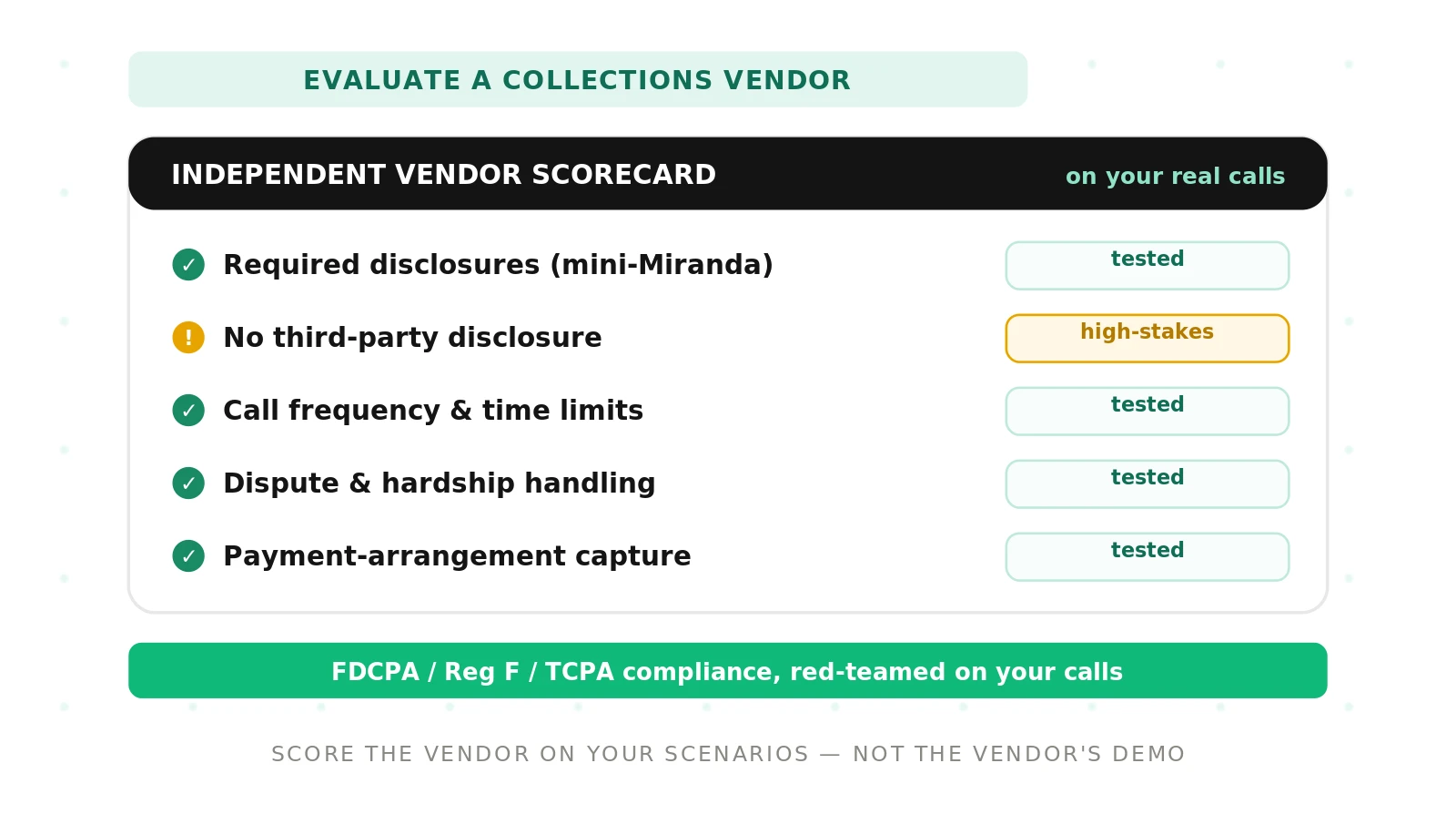
Required disclosures. The agent must deliver the disclosures the rules require. The "mini-Miranda" states that the call is from a debt collector. It adds that information will be used for that purpose. First contact usually requires validation information about the debt. Test whether the agent says these, in the right place, every time.
Identity verification. The agent must confirm the right consumer before revealing any detail. Test what happens when a family member or coworker answers. It should not confirm a debt exists to the wrong party.
Call frequency, time, and place. Reg F sets expectations on how often and when a collector may call. A compliant agent respects prohibited times and places. It also respects frequency caps. Test whether the system enforces these, or leaves them to a caller's schedule.
TCPA consent for outbound. Outbound and automated calling depend on the right consent for the number. Test whether the agent and the dialer honor consent status. Test whether they honor stop requests too.
Disputes, cease-and-desist, and hardship. The agent must handle "I dispute this debt" correctly. It must handle "stop calling me" and "I can't pay" correctly too. These are not edge cases. They are the moments of highest risk. So they deserve the heaviest testing.
Tone and harassment. The rules prohibit harassing, abusive, or deceptive conduct. Test whether the agent stays civil under pressure. Check whether it ever threatens or pressures a distressed caller.
Payment-arrangement capture. When a consumer agrees to pay, the agent must capture the terms. That means the amount, the date, and the conditions. A misremembered arrangement becomes a dispute later. Test the agent's accuracy on numbers and dates.
Escalation to a human. On a dispute or clear distress, the agent should route to a person. It should not push forward with the script. Our escalation guide covers how to test handoff triggers.
The collections voice agent evaluation table
Use one table to keep the audit disciplined. Each dimension gets a test, a pass bar, and a red flag. Score every vendor on the identical set, so the comparison stays fair.
| Evaluation dimension | What to test | Pass bar | Red flag |
|---|---|---|---|
| Required disclosures | Mini-Miranda and validation info | Present on every applicable call | Skipped under interruption |
| Third-party disclosure | Spouse, coworker, or stranger answers | Never confirms debt to wrong party | Reveals balance before verifying |
| Call frequency and time | Prohibited times, places, caps | System enforces limits | Left to human scheduling |
| Dispute and cease-and-desist | "I dispute this," "stop calling me" | Logs, stops, and routes correctly | Keeps collecting after a stop |
| Payment capture | Amount, date, and terms readback | Captures and confirms accurately | Misrecords the arrangement |
| Tone and harassment | Angry or hostile callers | Stays civil, never threatens | Threatens or badgers |
How to run a collections voice agent vendor evaluation
Run the same process for every vendor. Treat it as an audit, not a sales call.
1. Map the regulatory surface first — List the disclosures, consent rules, and conduct limits for your program. Turn each into a testable requirement.
2. Build collections-specific scenarios — Write scenarios for the risky moments. Cover wrong-party answers, disputes, cease-and-desist, hardship, and hostile callers.
3. Red-team third-party disclosure — Have testers answer as a spouse, coworker, or stranger. Check that the agent never reveals the debt without verifying identity.
4. Test every required disclosure — Confirm the mini-Miranda and validation information appear on cue. Include calls where the consumer interrupts the agent.
5. Probe stop and dispute handling — Say "stop calling me" and "I dispute this debt." Verify the agent logs it, stops, and routes to a human.
6. Score compliance as pass or fail — A vendor that fails a compliance dimension is out. Rank the survivors on accuracy, latency, and cost.
7. Re-audit on a schedule — Re-run the suite after any model or prompt change. A compliant agent can regress silently after an update.
Common mistakes when evaluating collections vendors
The mistakes here cost more than in other use cases. Teams accept the vendor's demo. The demo never includes a hostile caller or a wrong-party answer. They test the happy path and skip disputes. So the riskiest response never gets checked. They score tone and latency, but verify no disclosures.
The deepest mistake is letting the vendor grade its own compliance. A vendor has every incentive to report that it follows the rules. Independent evaluation exists because that self-report is not evidence. We develop that theme in our independent red-team audit guide. Another common error is treating personal data loosely. Our PII handling guide shows how to test for leakage on real calls.
Evaluating collections voice agents with Evalgent
Evalgent is an independent, third-party auditor for voice agents. It red-teams compliance on your scenarios. It does not sell the agent, so it has no stake in the result. Scenarios reproduce the moments that carry legal risk. That means wrong-party answers, disputes, cease-and-desist requests, hardship, and hostile callers. Profiles vary accent, pace, and line quality. So a vendor cannot pass on clean audio alone.
Metrics score each compliance dimension directly on your calls. They map to a recognized structure like the NIST AI Risk Management Framework. So the result reads as evidence, not assurance. Reviews let your compliance and legal teams replay any call. They hear exactly what the agent said. That is what a defensible RFP and a real service-level agreement need behind them. For metric definitions, see our collections voice agent metrics guide. For the wider method, see our voice agent compliance audit approach, and our collections testing walkthrough. To audit the vendors you are weighing, book a demo.
The bottom line
Evaluate a collections voice agent vendor on compliance first and quality second, using your own red-team scenarios rather than the vendor's demo. A mishandled disclosure or a wrong-party leak is a legal liability, so an independent auditor should test it directly on your calls and fail any vendor that misses.
Frequently asked questions
How do you evaluate a collections voice agent vendor?
Evaluate a collections voice agent vendor by red-teaming it for compliance on your own scenarios. Test required disclosures, third-party disclosure, identity verification, call frequency, consent, dispute and cease-and-desist handling, tone, payment capture, and escalation. Score compliance as pass or fail, then rank survivors on accuracy and cost. Use an independent auditor, since the vendor cannot grade its own compliance.
What compliance does a debt collection voice agent need?
A debt collection voice agent must respect the same rules a human collector does. That includes FDCPA and CFPB Regulation F requirements on disclosures, call frequency, prohibited times and places, and conduct. It also includes TCPA consent rules for outbound and automated calling. The specifics depend on your program, so map the applicable rules to testable requirements and verify each one on real scenarios.
Does a collections voice agent have to follow the FDCPA?
A third-party collections voice agent is generally subject to the same FDCPA restrictions as the collector operating it, per the FDCPA statute text. That covers how and when it may communicate, what it must disclose, and what conduct is prohibited. Treat FDCPA and Regulation F requirements as pass-or-fail criteria, and confirm your specific obligations with your own legal or compliance team.
How do you test a voice agent for third-party disclosure?
Test third-party disclosure by having testers answer the call as someone other than the consumer. Use a spouse, a child, a coworker, and a stranger. Check that the agent verifies identity first, and never confirms that a debt exists to the wrong party. A single wrong-party leak should fail the vendor, since it is exactly the disclosure the rules restrict.
What is the mini-Miranda disclosure for a voice agent?
The mini-Miranda is the debt collector's disclosure that the call is from a debt collector, and that any information obtained will be used for that purpose. A collections voice agent must deliver it at the right point on the call. Test whether the agent says it every time, including when the caller interrupts, talks over it, or changes the subject.
How do you audit a debt collection voice agent for TCPA consent?
Audit TCPA consent by checking that the agent and the dialer honor consent status for each number, and respect stop requests. Test outbound scenarios where consent is absent, revoked, or tied to a different number. The agent should not place or continue automated calls without valid consent. It should also stop cleanly when a consumer asks it to stop.
How should a collections voice agent handle a cease-and-desist?
When a consumer says "stop calling me," the agent should treat it as a cease-and-desist signal. It should log it, stop collecting on that call, and route to a human. Test this with varied phrasings, since consumers rarely use legal wording. An agent that keeps collecting after a stop request should fail the evaluation on compliance grounds.
Who should audit a collections voice ai vendor?
An independent, third-party auditor should evaluate a collections voice AI vendor, not the vendor itself. The vendor has an incentive to report that its agent is compliant, so its self-report is not evidence. An independent auditor red-teams the agent on your scenarios and scores each compliance dimension on your own calls. That produces results you can defend to legal, compliance, and procurement.
Related Articles
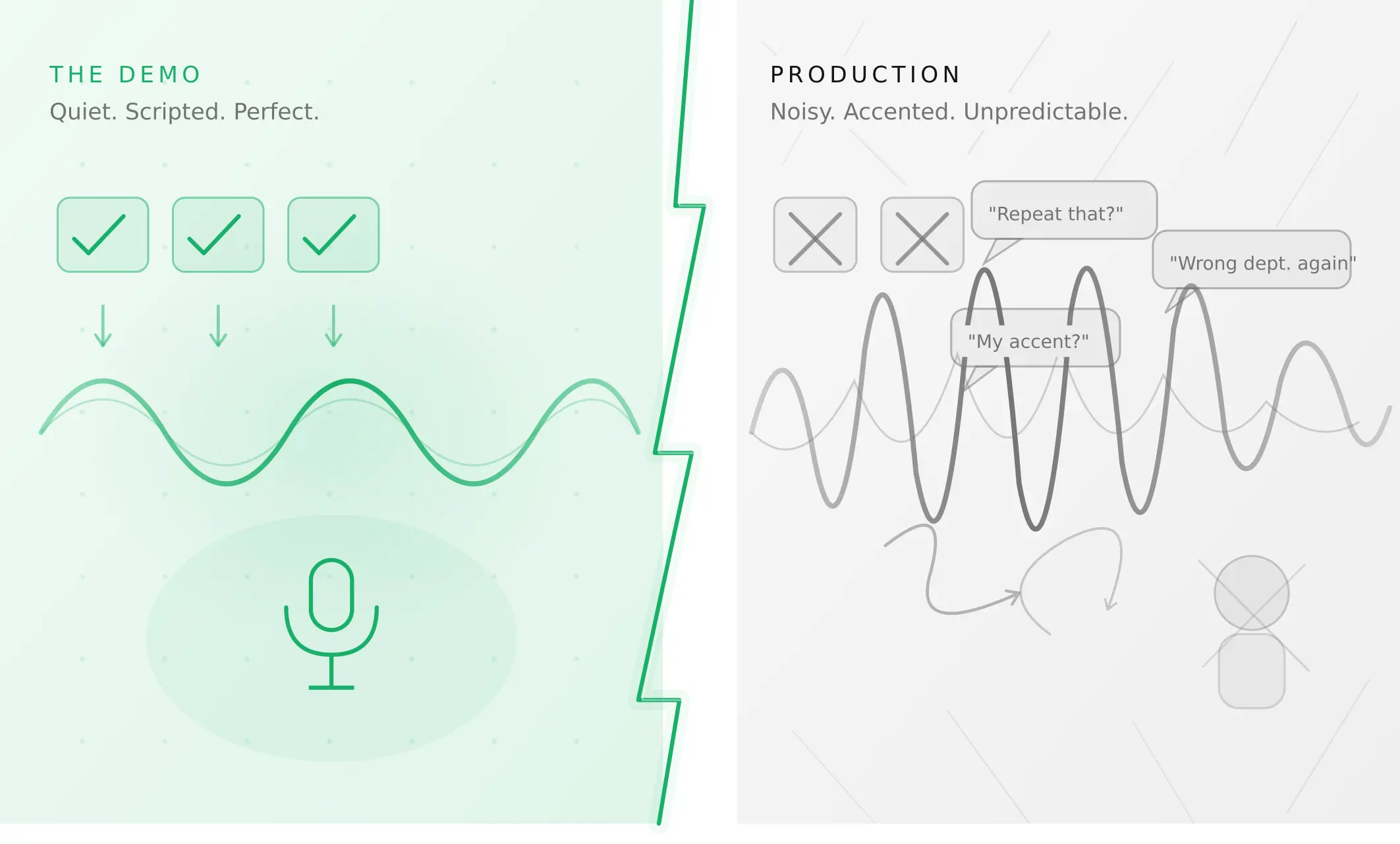
Why AI voice agents fail in production (and how to prevent it)
AI voice agents that ace demos still break in production. Learn the 5 root causes, how to test for each, and what production readiness actually means.
Read more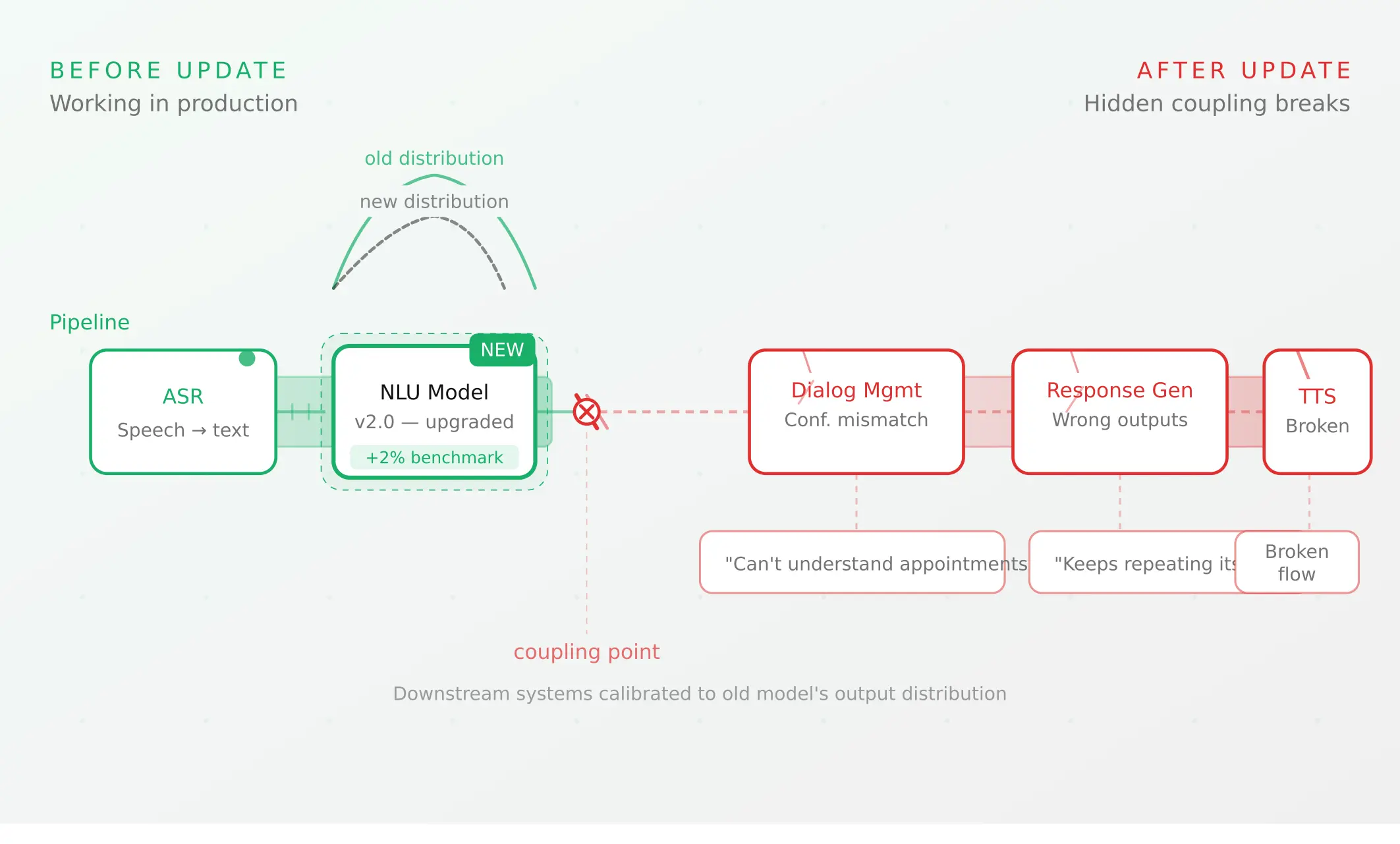
Voice agent regression testing: why LLM updates break production
LLM updates improve benchmarks but break voice agents in 5 predictable ways. How to detect and prevent regressions after every model or prompt change.
Read more