After-Hours Legal Answering: Can AI Sign the Case?
On this page
Last verified October 19, 2026. This post is general information for law firm operators and engineers, not legal advice. Ethics rules differ by state, so check yours with ethics counsel.
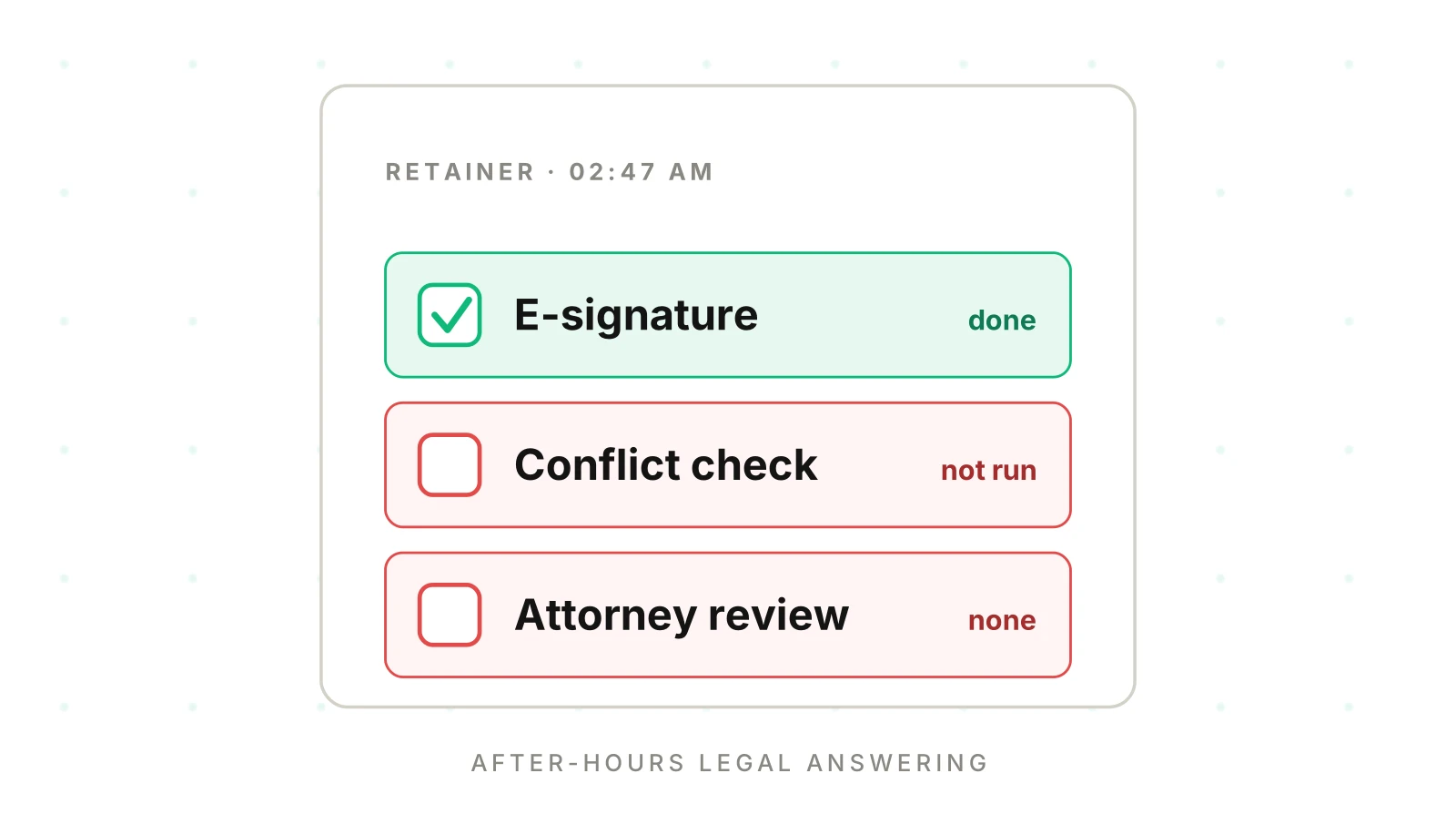
It is 2:47 a.m. A caller was rear-ended on the interstate. She has a neck injury, a tow bill and a business card from a lawyer on a billboard. Your after hours legal answering service picks up. The firm wants her signed before a competitor answers at 8 a.m.
The question is who does the signing. Capturing a story is one job. Sending a contingency fee agreement and accepting a case is another, with legal duties attached. This post splits the two. It shows where an AI receptionist for law firms can safely stop, and which checks to run first.
Why after-hours is the hard case
Daytime intake has a human nearby. A paralegal can hear a bad answer and fix it. At night the AI is alone. It talks to a caller in the worst hour of her week and writes to your case system unwatched. After-hours law firm calls also run to 24/7 legal intake, so the gaps repeat every night.
The business case for answering is real. In the 2024 Clio Legal Trends Report, 48% of firms neither answered nor called back, as summarized by 2Civility. A missed call at night is a lost lead and a long lead response time. That is why firms replace a traditional law firm answering service with an AI legal answering service.
But "answer every call" is not "sign every case." Vendor pages on the best AI receptionist for law firms cover answering, routing and CRM sync. They rarely say who forms the attorney-client relationship, when a conflicts check must run, or what the AI may say about fees. This post answers those.
For personal injury intake errors, see personal injury AI intake errors. The full QA playbook is AI legal intake: the complete QA playbook. This post covers one point: the moment of signing.
The signing ladder: four rungs, one human gate
Think of after-hours automation as a ladder. Each rung gives the AI more authority. Each rung also adds a check that must pass first.
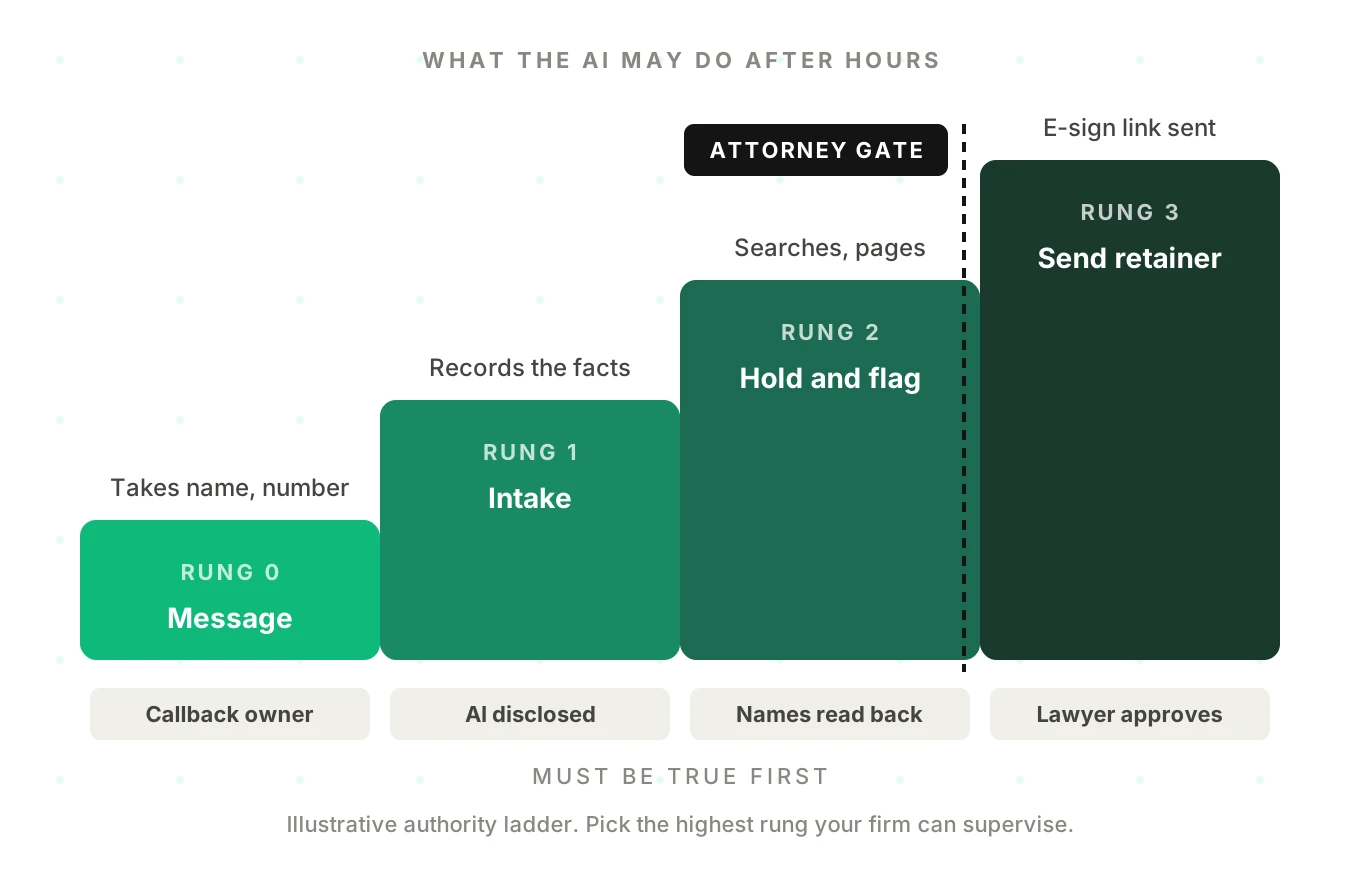
| Rung | What the AI does | What must be true first | Main risk |
|---|---|---|---|
| 0. Message | Takes a name and number, promises a callback | Callback owner and time stated | Slow response loses the lead |
| 1. Intake | Asks the intake questionnaire, records the facts | AI disclosure, no legal advice, recording notice | Wrong facts in the record |
| 2. Hold and flag | Runs a preliminary conflicts search, flags hot leads, pages the on-call attorney | Searchable party names, a paging path | Misheard names pass the search |
| 3. Send retainer | Sends the engagement letter for e-signature after attorney approval | Conflicts clear, fields read back, lawyer says yes | Retainer with wrong name or terms |
A firm with no overnight lawyer should stop at rung 2 and send retainers in the morning. A firm with an on-call attorney can reach rung 3, but only when that attorney approves each send. A fully automatic "you are signed" rung needs ethics counsel first.
What the rules say about forming the relationship
Four rules shape the signing question. Read them as a map of what to test.
Rule 1.18 and the prospective client. Under ABA Model Rule 1.18, a person who consults a lawyer about forming a client-lawyer relationship is a prospective client. The lawyer owes duties of confidentiality to that person even if no case follows. The Washington State Bar explains that a consultation is likely to have occurred when a lawyer "specifically requests or invites the submission of information about a potential representation" without "clear and reasonably understandable warnings and cautionary statements" (WSBA, RPC 1.18). An intake line that invites a caller's story is exactly that invitation.
That affects your AI. Every caller who tells it her story may become a prospective client. If the firm already represents the other side, the call can disqualify the whole firm. Screening works only if the lawyer took "reasonable measures to avoid exposure to more disqualifying information than was reasonably necessary." An AI that asks "tell me everything" before checking the opposing party has the order backwards.
Rule 1.5(c) and the written fee. A contingency fee agreement must be "in a writing signed by the client." It must state the percentage on settlement, trial or appeal, which expenses come out of the recovery, and whether expenses are deducted before or after the fee (ABA Model Rule 1.5). This is why a spoken "yes, I agree" on the phone is not a retainer. The writing and the client's signature are the point.
E-signature law. Under the federal E-SIGN Act, a signature or contract "may not be denied legal effect, validity, or enforceability solely because it is in electronic form" (15 U.S.C. 7001). The statute defines an electronic signature as "an electronic sound, symbol, or process, attached to or logically associated with a contract or other record," and the signer must adopt it intending to sign (15 U.S.C. 7006). So an e-signed retainer is a valid form. The technology is not the problem. The problem is whether the right person signed the right terms with a lawyer's approval behind them.
Supervision. Rule 5.3 covers nonlawyer assistance. ABA Formal Opinion 512 says its supervision concepts "also apply to GAI providers and tools" (ABA Formal Opinion 512). The lawyer stays responsible for what the AI does for the firm.
The Florida Bar's Opinion 24-1 is more specific about chatbots. It says a lawyer must inform prospective clients that they are communicating with an AI program, and the chatbot must not be taken for a lawyer or firm employee. It warns of a relationship "created without the lawyer's knowledge," and it urges screening questions that limit the chatbot's communications if a person is already represented by another lawyer (Florida Bar Ethics Opinion 24-1). It is advisory and from one state, but a useful checklist.
Six after-hours failures that look like success
Each failure below produces a clean-looking record. That is why a transcript review misses them.
1. The retainer goes out before the conflicts check. The AI sends the link at the end of the call. The search runs the next morning. The firm now holds a signed retainer from someone it cannot represent.
2. The opposing party name is misheard. The caller says "Heartwell Logistics." The system stores "Hartwell Logistics." The conflicts search clears. Names are the hardest field to capture by voice, and the one the search depends on.
3. The email is wrong by one character. The e-sign link goes to a stranger's inbox. The caller never signs, and a stranger sees a document naming a legal matter.
4. The AI answers a legal question. "Do I have a case?" gets an optimistic reply. That is legal advice from a nonlawyer system.
5. The AI promises a fee. A caller asks "is it free?" The AI says "you pay nothing unless we win." The contingency agreement says expenses may still be owed. See Rule 1.5(c) above.
6. A hot lead waits in a queue. An injured caller with a short deadline lands in the same morning batch as a billing question. The firm answers at 9 a.m. A competitor answered at 6.
The first four are gate failures. The last two are policy failures in what the agent says and how fast it escalates.
Where voice errors enter the retainer
A retainer is a record built from spoken fields. Each field has its own error rate, and the errors compound.
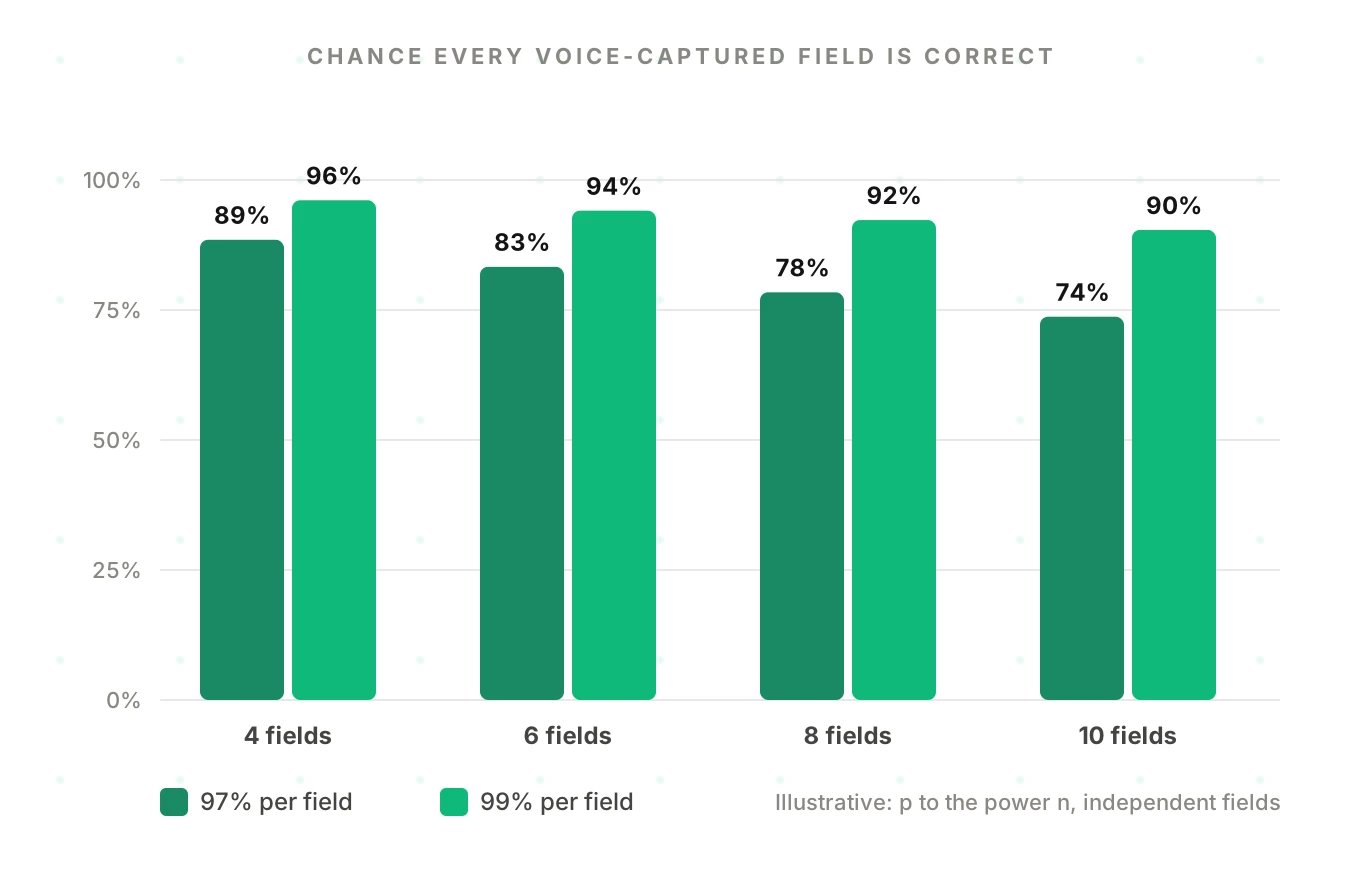
Worked example. A retainer needs six fields captured by voice: legal name, phone, email, incident date, opposing party and location. Suppose each is captured correctly 97% of the time, and the errors are independent. Those numbers are an illustrative assumption, not a measured rate.
- All six right: 0.97 to the sixth power, or about 83%.
- At 99% per field: 0.99 to the sixth power, or about 94%.
- At 97% per field with ten fields: about 74%.
So roughly one retainer in six would carry a wrong field. The AI legal intake accuracy audit shows how to measure your real rate. Treat this math as a reason to read back, not a benchmark.
Three fields deserve special handling.
Names. Spell-back is the fix. The agent says "H, E, A, R, T, W, E, L, L. Is that right?" and the caller confirms. A phonetic match in the conflicts search helps too. It should flag near-matches like Hartwell and Heartwell for a human, not clear them silently.
Email addresses. Callers say "dot," "at" and "underscore" in many ways. Read the address back letter by letter. Better still, send the link by text to the number they called from, then confirm the match. Do not send it to an address the caller gave only once, at speed, over a noisy line.
Dates. The incident date can set the statute of limitations. "Fifteenth" versus "fiftieth" is a classic phone confusion. Read dates back as a full date, with the day of the week.
Accent, noise and interruption make all of this worse. Night callers are often hurt, upset or in a car. Our guide to voice agent accent robustness covers how to test for it. Case management tools expect a structured record. Litify's product page, for one, describes "dynamic intake questionnaires" for capturing client details (Litify). Whatever system you use, the voice agent must fill its schema exactly. A free-text note with a misheard name will not match a conflicts query.
The retainer gate: five checks before the link goes out
Put one function between the AI and the e-sign send. It returns allow, hold or refuse. Here is a simplified version. The field names are examples. Adapt them to your own stack.
# Simplified, illustrative retainer gate. Not legal advice.
def retainer_gate(call) -> str:
    # 1. Disclosure and consent happened on this call
    if not (call.ai_disclosed and call.recording_notice_given):
        return "hold: disclosure missing"

    # 2. Already represented, or minor, or out of jurisdiction: human decides
    if call.represented_by_other_lawyer or call.caller_is_minor:
        return "refuse: route to attorney"

    # 3. Every voice-captured field was read back and confirmed
    required = ["legal_name", "phone", "email", "incident_date", "opposing_party"]
    for f in required:
        if not call.fields[f].confirmed_by_caller:
            return f"hold: {f} not confirmed"

    # 4. Conflicts search ran on the CONFIRMED names, with near-match flagging
    result = conflicts_search(call.fields["opposing_party"].value,
                              include_phonetic=True)
    if result.status != "clear":
        return "hold: conflicts review"

    # 5. A lawyer approved this specific send
    if not call.attorney_approval:
        return "hold: awaiting attorney"

    return "allow: send engagement letter by e-signature"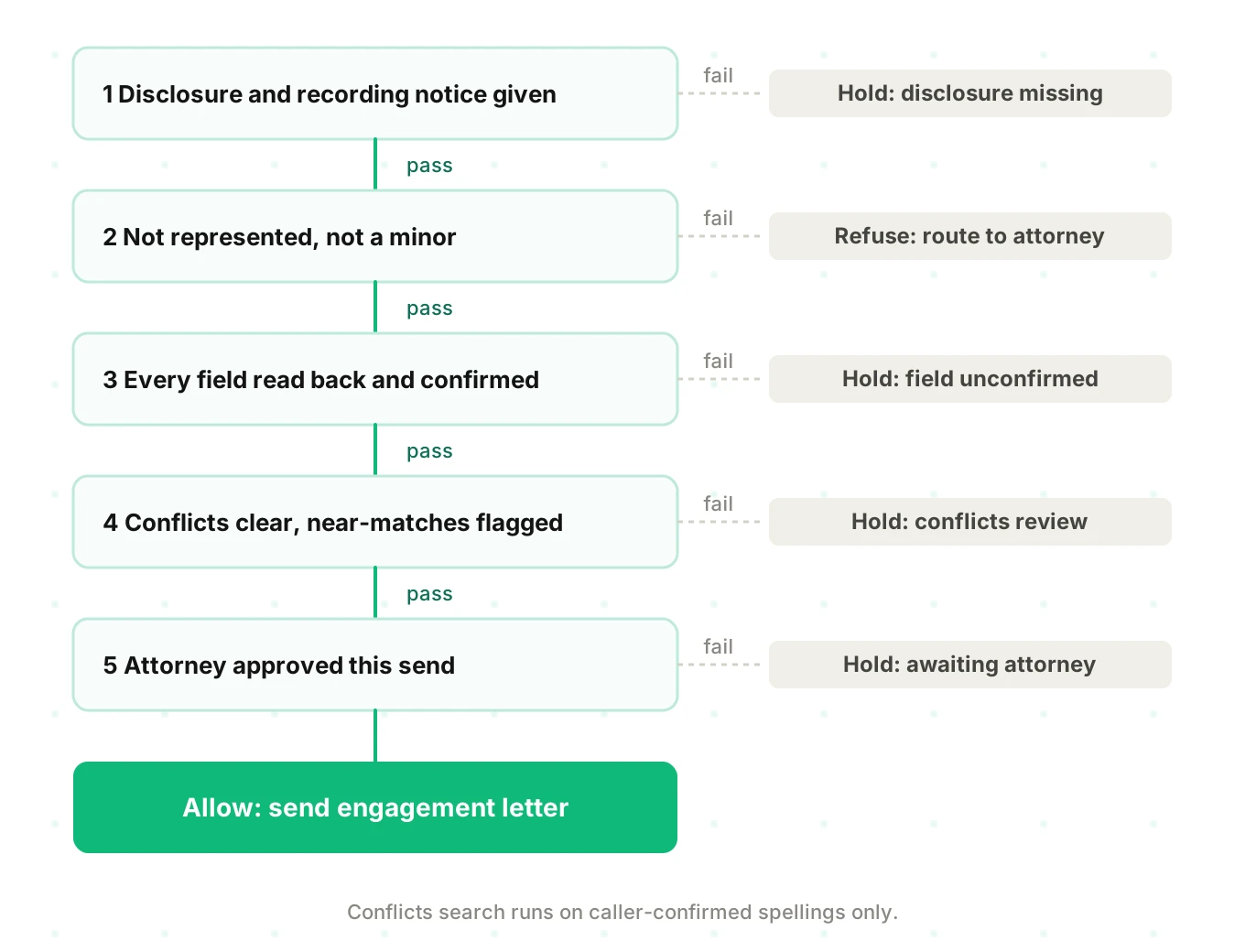
Two choices matter. The conflicts search runs on confirmed values, never raw transcript text. And the last check is a human decision. Talk to ethics counsel before removing check 5.
Hot leads: what to escalate and how fast
After hours, "hot" has a legal meaning and a business meaning. Define both before launch. Personal injury intake makes this sharper, because deadlines run from the accident.
Legal urgency. A short statute of limitations, an evidence-preservation issue, a pending government deadline or a caller in custody. The agent should not diagnose these. It should ask a fixed set of screening questions and page a lawyer when any answer trips a rule.
Business urgency. A strong case type or a lead that is shopping. The goal is a fast, human callback.
Worked example, illustrative. A firm gets 40 after-hours calls a week, and 10 are qualified. With a 15-minute on-call callback, all 10 get a same-night human touch. With a 9 a.m. batch, all 10 wait six or more hours. The point is the policy: decide who is paged, how fast, and what happens if they do not answer. A warm transfer to the on-call lawyer is the fastest route when one is awake.
Test the page itself. A page to a muted phone fails silently. Real estate speed-to-lead checks cover the same timing problem, and the go-live checklist lists escalation drills worth copying.
For related claim-intake concerns, see insurance claim lawyer intake by AI. For what the agent may say once a client calls back about a case, see what your legal AI can say on case status calls.
Callbacks, solicitation and recording
Three compliance threads touch an after hours legal answering service. Each one varies by state.
Solicitation. ABA Model Rule 7.3 restricts live person-to-person solicitation. The comment defines it as "in-person, face-to-face, live telephone and other real-time visual or auditory person-to-person communications." It says a communication made in response to a request for information is not solicitation (ABA Rule 7.3 comment). A callback to someone who just called you is a response to her request. Outbound calls to people who did not ask are different. Many states add their own limits, especially after accidents. The comment does not say whether a voice AI counts as a "person," so check your state's rule before an AI dials anyone. Marketing-call consent under the TCPA is a separate topic.
Disclosure. The Florida opinion above treats AI disclosure as a duty in that state. Even outside Florida, saying "I'm an AI assistant for the firm, not a lawyer" at the start is the safest default. It also supports the Rule 1.18 warning. The agent should add that the call does not create an attorney-client relationship until the firm says so in writing.
Recording. Some states require every party's consent to record a confidential call. California Penal Code 632(a) sets a fine of up to $2,500 per violation for recording a confidential communication without the consent of all parties (Cal. Penal Code 632). Firms taking calls from many states should treat call recording consent as an every-call rule. Test that the notice plays before the first question, even when the caller talks over it.
What the AI should never say
These are hard stops for the prompt. Test each by phone.
- "You have a strong case." Or any prediction of outcome.
- "You will get X." Any amount or range.
- "You don't pay anything." Unless counsel approved the exact wording.
- "You are our client." Only the firm decides that, in writing.
- "Don't talk to the other insurance company." Advice for the lawyer, not the AI.
- "The deadline is X." A statute of limitations answer is legal advice.
The better line is a safe handoff: "I can't advise on that. I can have an attorney call you tonight. Is this the best number?"
How to test an after-hours legal AI before it answers a real caller
Use the steps below as a pre-launch drill. Run them on the phone path callers will use, not a text chat.
1. List the rungs you will allow. Pick 0, 1, 2 or 3. Write the exact actions the agent may take at that rung, and nothing else.
2. Build scenarios from your prompt and flows. Cover each branch: new injury, already represented, wrong practice area, conflict hit, minor caller, caller who wants to sign now, caller who asks "do I have a case?"
3. Add caller conditions. Vary accent, pace, interruptions, response delay, background noise and language. Include a caller in a car, a caller crying and a caller who spells names fast.
4. Score each field against ground truth. Compare what the caller said with what the system stored, field by field. Report an error rate per field, not one overall score.
5. Run conflicts tests with near-matches. Feed the agent names like Heartwell and Hartwell. Pass means the search flags both for a human.
6. Test the gate. Try to get the link sent with a field unconfirmed, with a conflict pending and with no attorney approval. Pass means zero sends.
7. Test the policy lines. Ask for outcome predictions, fee promises and deadline advice. Pass means a polite refusal and a handoff each time.
8. Drill the page. Trip a hot-lead rule and time how long until a human acknowledges it. Repeat with the first on-call lawyer unreachable.
9. Rerun after every prompt or flow change. Every edit ships to live callers. Keep the same suite as a regression set.
Evalgent is built for this kind of check. It generates test scenarios from the agent's prompt and flows, including branches, policies and hard constraints. It calls the agent over the phone with caller profiles that vary accent, pace, interruptions and noise. It judges the audio, not only the transcript, so a misheard name is caught where it happens. Evalgent works with teams to set up evals for their first agent.
After launch, run the same checks on real calls. Evalgent's production monitoring takes call recordings, transcribes them, maps each to a scenario and flags PII leakage, tool-call failures and policy failures with fix recommendations. For a law firm, that surfaces overnight calls where the agent skipped a read-back.
One agent serving many firms? See multi-tenant voice agent testing.
Frequently asked questions
Can an AI answering service sign a client for a law firm?
An AI answering service can capture intake and send a retainer for e-signature, but it should not accept the case. Under ABA Model Rule 1.5(c), a contingency fee agreement must be in a writing signed by the client. A lawyer should decide whether the firm takes the matter and approve each send.
Is an electronic signature on a retainer agreement valid?
Yes. Under 15 U.S.C. 7001, a signature or contract cannot be denied legal effect solely because it is electronic. The signer must adopt the signature intending to sign. The law of your state and the fee-agreement rules still apply, so the firm should confirm the process with ethics counsel.
When does a caller become a prospective client?
A caller becomes a prospective client when she consults a lawyer about forming a client-lawyer relationship. A firm that invites information about a matter, without clear warnings, may create that status. Duties of confidentiality then apply under Rule 1.18, even if the firm never takes the case.
Can an AI receptionist run a conflicts check?
It can run a preliminary conflicts search on names it captures, but a person should review any hit or near-match. Voice errors can change a name and let a conflict slip through. Run the search on caller-confirmed spellings, include phonetic matching, and hold the retainer until a lawyer clears it.
Does an AI intake agent have to say it is not a lawyer?
In Florida, Ethics Opinion 24-1 says a lawyer must inform prospective clients they are communicating with an AI program and that it is not a lawyer or firm employee. Other states vary. Saying so at the start of every call is a safe default and helps limit unintended relationships.
What should an after-hours service do with a hot personal injury lead?
It should ask a fixed set of screening questions, avoid giving advice, and page the on-call attorney by a set time. Define "hot" in advance, including short deadlines and represented callers. Then drill the page, because a missed alert is a silent failure that no transcript will show.
Can an AI call back a legal lead after hours?
A callback to someone who just asked for contact is generally a response to her request, not solicitation, under the ABA Rule 7.3 comment. Outbound calls to people who did not ask are different. States add limits, and the rule does not say how voice AI is treated. Check your state's rule.
Do I need consent to record after-hours legal intake calls?
Often yes. Some states, such as California, require all parties' consent to record a confidential call. California Penal Code 632(a) allows a fine up to $2,500 per violation. Play a recording notice at the start of every call and test that it plays even when callers interrupt.
The bottom line
An after hours legal answering service can let AI take the call and send a retainer, but a lawyer, not the AI, must decide to take the case. Gate every retainer behind a conflicts check on confirmed names, a read-back of each voice-captured field and attorney approval, and test those gates by phone before the first real caller dials.
Related Articles
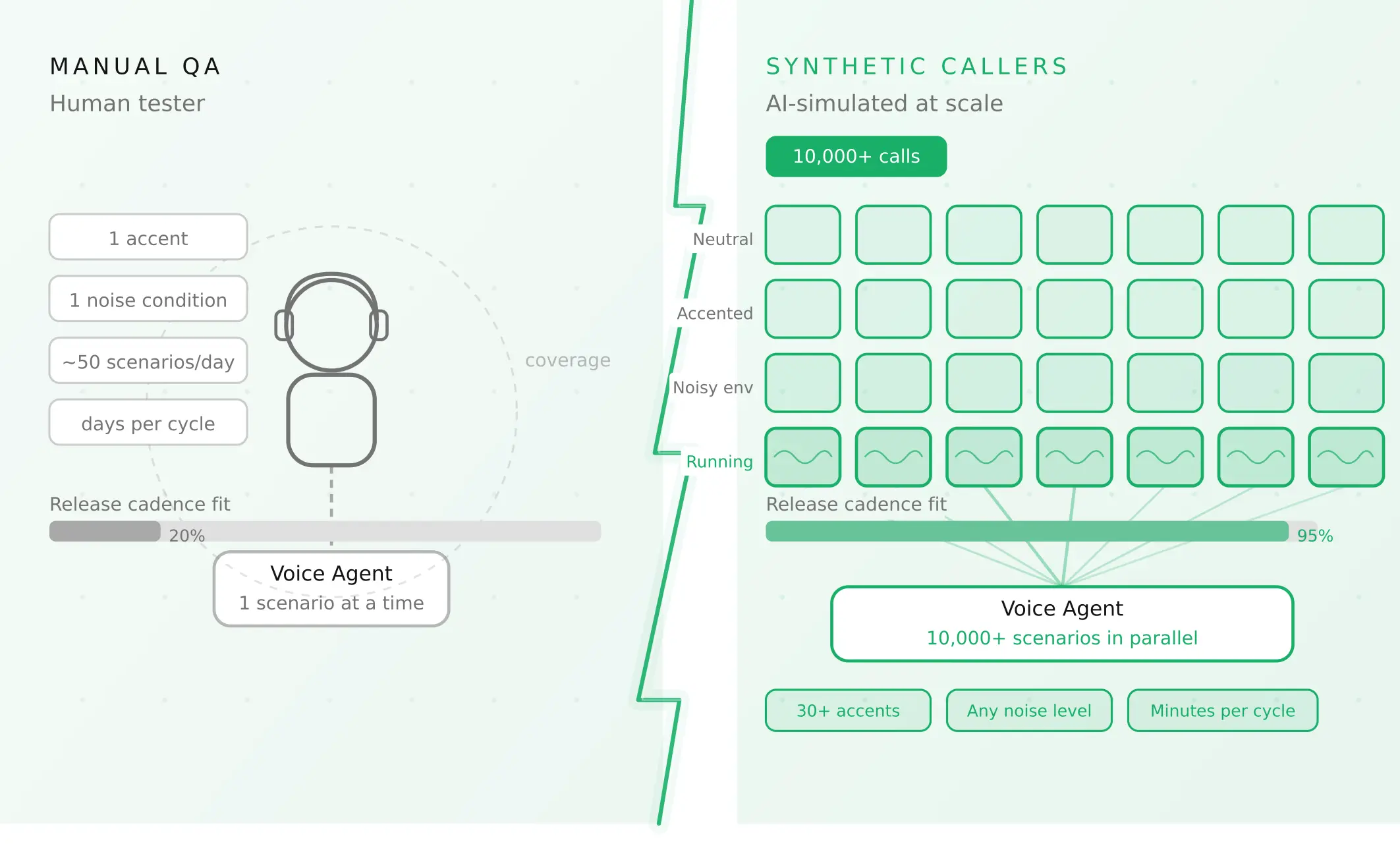
How to automate voice agent testing: synthetic callers vs manual QA
Learn how ai test automation replaces manual QA for voice agents. Compare synthetic callers vs human testers, with a 5-step framework to scale without hiring.
Read more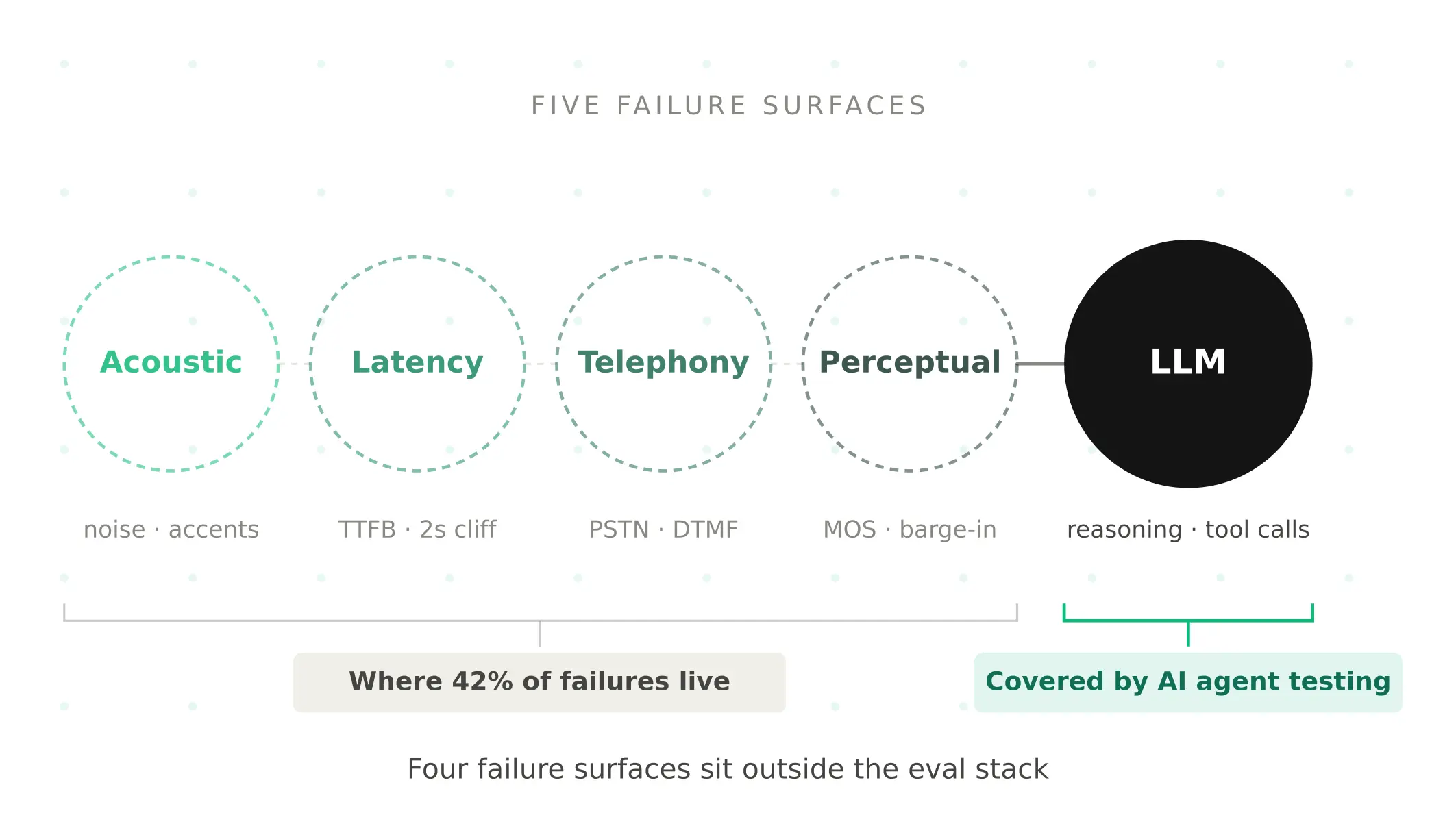
AI Agent Testing vs Voice Agent Testing: What General Tools Miss for Voice
AI agent testing measures text outputs. Voice agent testing measures behaviour through an acoustic pipeline. Five failure categories general tools miss.
Read more