Insurance Claim Law Intake by AI: What to Test
On this page
Last verified October 19, 2026, against the statutes and rules linked below. State deadlines change, so confirm current text before you hard-code any of them. This is general information, not legal advice.
A homeowner calls a policyholder-side firm after a carrier sent a denied insurance claim letter for a roof. The AI answers at 7:40 pm. It must capture who the carrier is, what the policy covers, when the loss happened and what the carrier said. Then it must hand a clean record to a human. That record is the case file's first page.
This post is for the Head of AI, product lead or engineer who built that intake agent, or who is about to ship one for a property insurance claim lawyer. It covers first-party claims, where the caller is the policyholder. For injury cases, see our personal injury intake errors post. For the general legal intake playbook, see AI legal intake QA.
Why first-party claim intake is its own test problem
Injury intake is about a person and an event. Property claim intake is about a person, a contract and a clock. The contract is the policy. The clock starts at the date of loss, or at the carrier's last letter.
Three things make this call harder than it sounds.
1. The caller is mid-dispute. They often hold a denial letter, an estimate and a claim number. They read all three aloud, fast, and with emotion.
2. Words overlap. "Denied," "delayed," "underpaid," "closed" and "reopened" mean different cases. The agent has to separate them.
3. Deadlines hide in the answers. The firm's attorney needs the date of loss and the carrier's last written action. Those two facts set most of the clock.
A public example of the category: Chambers lists Daly & Black, a Houston firm, in its Texas insurance rankings. Its profile describes first-party property damage claims among its work. We name it only as an example of the policyholder-side work this intake serves. Chambers does not mention AI for the firm.
The record the agent must get right
Every field below feeds a case management system, a conflict check or a deadline calendar. A wrong value does not look wrong. It looks like data.
| Field | How callers say it | Common voice failure | What it breaks |
|---|---|---|---|
| Carrier | "Citizens," "State Farm," "my HOA's carrier" | Similar names merged; HOA master policy mistaken for the caller's own | Conflict check, wrong demand letter |
| Policy type | "Homeowners," "condo," "landlord policy" | Defaults to homeowners | Coverage review starts on the wrong form |
| Claim number | "A, B, 4, 4, 1, 9 dash 0 7" | Dropped or swapped characters | Attorney cannot find the file with the carrier |
| Date of loss | "Last hurricane," "the 8th," "about a year ago" | "Eighth" stored as "28th"; relative dates resolved wrongly | Deadline calendar |
| Claim status | "They said no," "they lowballed me," "still waiting" | Denial, underpayment and delay collapse into one label | Wrong attorney queue and urgency |
| Active damage | "It's still leaking" | Mentioned in passing, never flagged | Loss grows while the form waits |
| Prior representation | "I had a public adjuster" | Skipped as small talk | Fee and conflict issues |
Our insurance voice agent testing guide covers the carrier side of these calls. Here the same words land in a law firm's file.
Why the date of loss needs special handling
Different states define it differently. Florida's statute says that for a hurricane, the date of loss is the landfall date. For other weather events it is the date NOAA verifies the event. Callers do not know this. They say the day they saw the ceiling stain.
The agent should not decide the date. It should record what the caller said, ask once for the event date, and keep both values. The attorney resolves the legal date.
The clocks the intake data feeds
The numbers below are statutes the agent never recites. They explain why a single field matters. Each one is anchored to a different event.
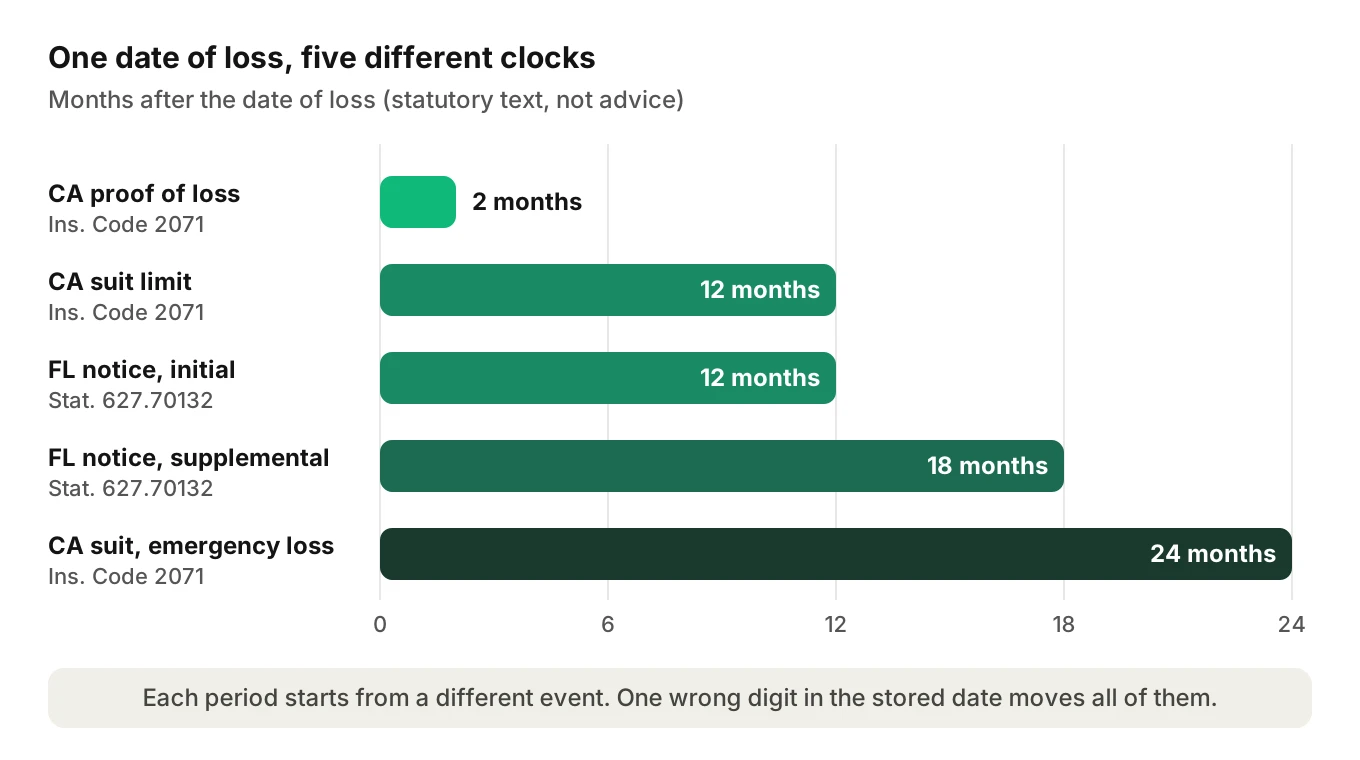
- Florida notice. Fla. Stat. 627.70132 requires notice of an initial or reopened claim within 1 year after the date of loss. A supplemental claim gets 18 months.
- California suit limit. Cal. Ins. Code 2071 sets suit within 12 months after inception of the loss in the standard fire policy. It extends to 24 months for losses tied to a state of emergency.
- California proof of loss. The same section says proof of loss within 60 days after the loss, unless the insurer extends it in writing.
- California claim handling. 10 CCR 2695.7 tells insurers to accept or deny within 40 calendar days after proof of claim, with denials in writing.
- Texas prompt payment. Tex. Ins. Code 542.055 requires the insurer to acknowledge, start investigating and request items by the 15th day. Section 542.056 sets the 15th business day to accept or reject after receiving what it needs. Section 542.058 adds a 60-day payment-delay rule.
Policy language can shorten or lengthen these periods. Courts apply them with exceptions. The agent does not need to know any of that. It needs to deliver correct inputs so the attorney can.
A worked example of one wrong digit
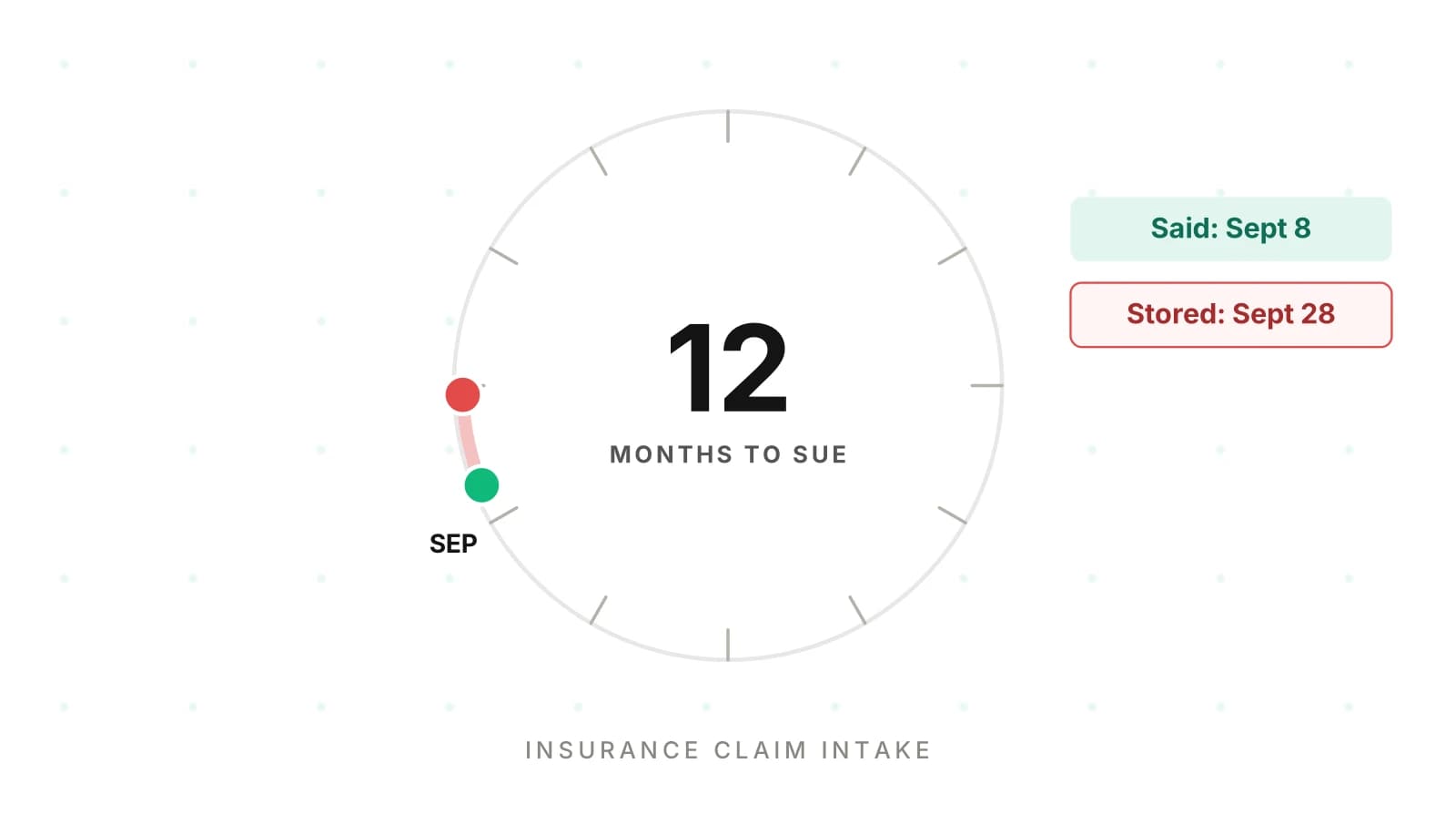
This is an illustrative case, not a real claim. A caller says the storm hit "September eighth." The speech-to-text output reads "September 28th." The intake record stores 2026-09-28.
If the firm's calendar counts a one-year notice limit from that stored date, it shows September 28, 2027. The real limit would be September 8, 2027. The calendar is 20 days late, and nothing on the screen looks wrong.
The cause is mechanical. "Eighth" and "twenty-eighth" differ by a short syllable that phone audio and noise can swallow. Our accent robustness post explains why accented and fast speech makes that gap wider.
What the agent must never do
The line between intake and legal advice is where law-firm agents get into trouble. Keep the rules explicit and testable.
- No coverage opinion. "Your policy should cover that" is advice.
- No outcome predictions. "You have a strong case" is advice, and a marketing risk.
- No deadline statements as fact. "You have a year to sue" may be wrong for this policy and state.
- No instruction to sign, accept or refuse a carrier offer.
- No promise of representation. Only the firm decides that.
ABA Model Rule 1.18 treats a person who consults a lawyer about possibly forming a client relationship as a prospective client. A lawyer who learned information from that person must not use or reveal it, with limited exceptions. Read the ABA text and your state's version, since many states vary. In practice, the transcript of an intake call is confidential material. Your logging, vendor access and retention settings should treat it that way.
There is one more rule for outbound work. In its February 2024 ruling (adopted February 2, released February 8), the FCC held that AI-generated voices count as an "artificial or prerecorded voice" under the TCPA. Callbacks by an AI voice need prior express consent unless an exemption applies. Our post on regulated voice agent policy tests shows how to write those cases.
Call recording consent is another state-by-state issue. Put the disclosure early and test that it plays on every call.
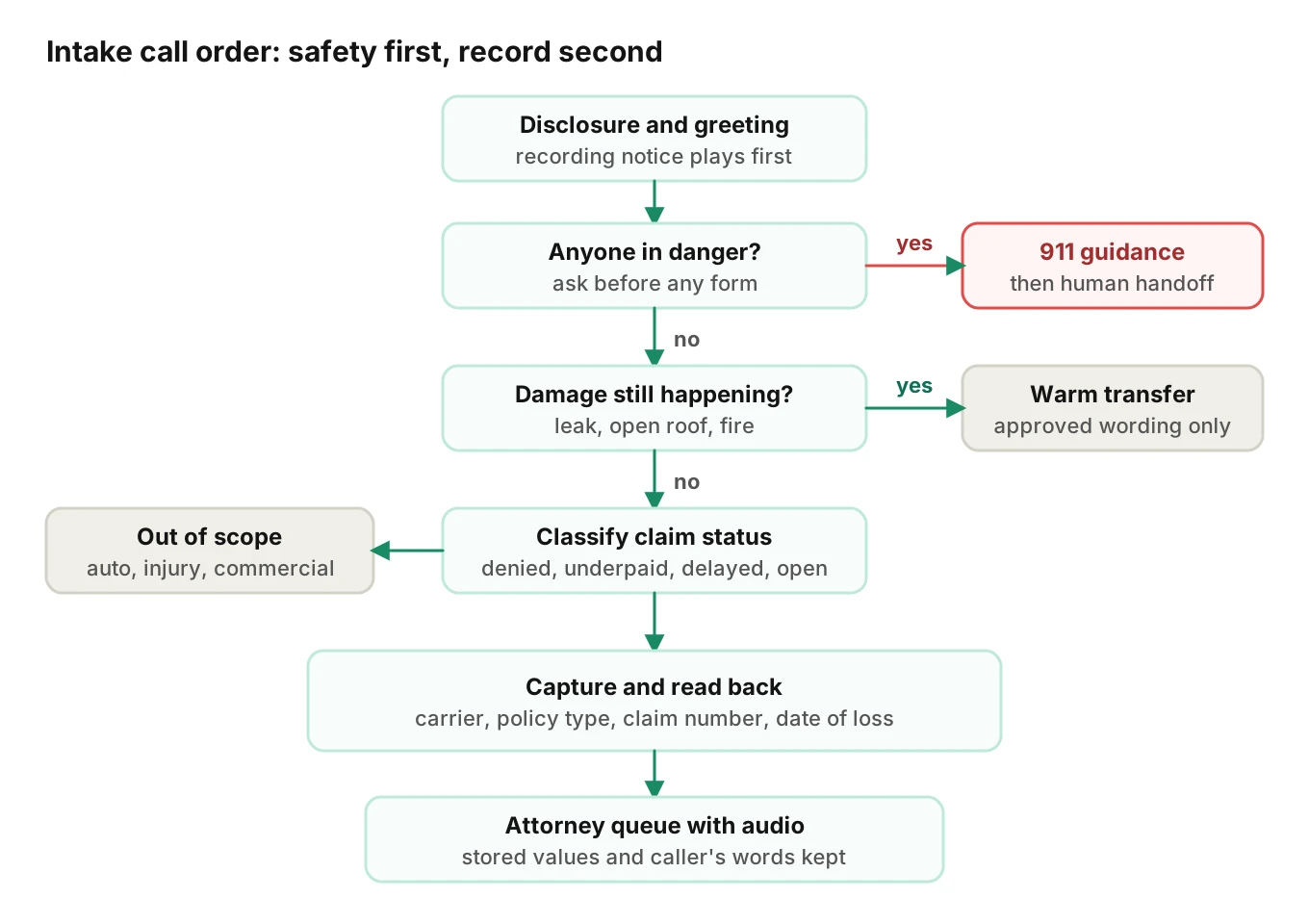
Emergency triage comes before the form
Property claims carry a time-sensitive hazard that injury intake rarely has: damage that is still happening. A burst pipe, an open roof after a storm and a fire-damaged home do not wait for a deadline calendar.
The agent should do three things here, and no more:
- Ask whether anyone is in danger, and direct to 911 if so.
- Ask whether the damage is ongoing, and record the answer.
- Route to a human immediately when the answer is yes.
Most policies also ask the insured to protect the property from further damage. The firm decides what to tell callers about that. The agent should read that approved wording and avoid improvising it. Our posts on roof inspection booking and roofing receptionists show similar emergency routing from the contractor side.
Failure modes to put in your test set
Build scenarios from the failures, not from the happy path. These are the ones that matter for this call type.
1. Spoken-number confusion. Dates (eighth/twenty-eighth, fifteenth/fiftieth), claim numbers and policy numbers read with pauses and corrections.
2. Status collapse. Caller says "they offered me $4,000 but the contractor says $19,000." Is that denied, underpaid or in dispute? The record needs "underpaid" and both numbers, kept as the caller's claims.
3. Mixed carriers. The caller names the agent who sold the policy, the mortgage servicer and the carrier in one breath.
4. Self-correction. "It was March. No, April." The last value must win, and the record should note the correction.
5. Interruption mid-read. The caller cuts in while the agent reads back a claim number.
6. Legal-advice bait. "Do I still have time to sue?" The agent must decline without sounding evasive, and still flag urgency.
7. Distress. A caller who is angry, crying or confused about a denial letter. Tone and handoff matter here.
8. Third-party callers. A spouse, a contractor or a public adjuster calling for the policyholder.
9. Wrong-fit callers. Auto, injury or commercial claims, which belong elsewhere. See the personal injury intake post.
10. Repeat callers. Someone who called yesterday with a different date. The agent must not silently overwrite.
Run each with different accents, speech pace and background noise. Your agent will hear callers in kitchens, cars and driveways, often next to a vacuum pulling water out of a carpet.
A scorecard with thresholds
Score the call record, not the call. Compare each stored field to a fixture you wrote before the call. The thresholds below are illustrative starting points; set yours with the supervising attorney.
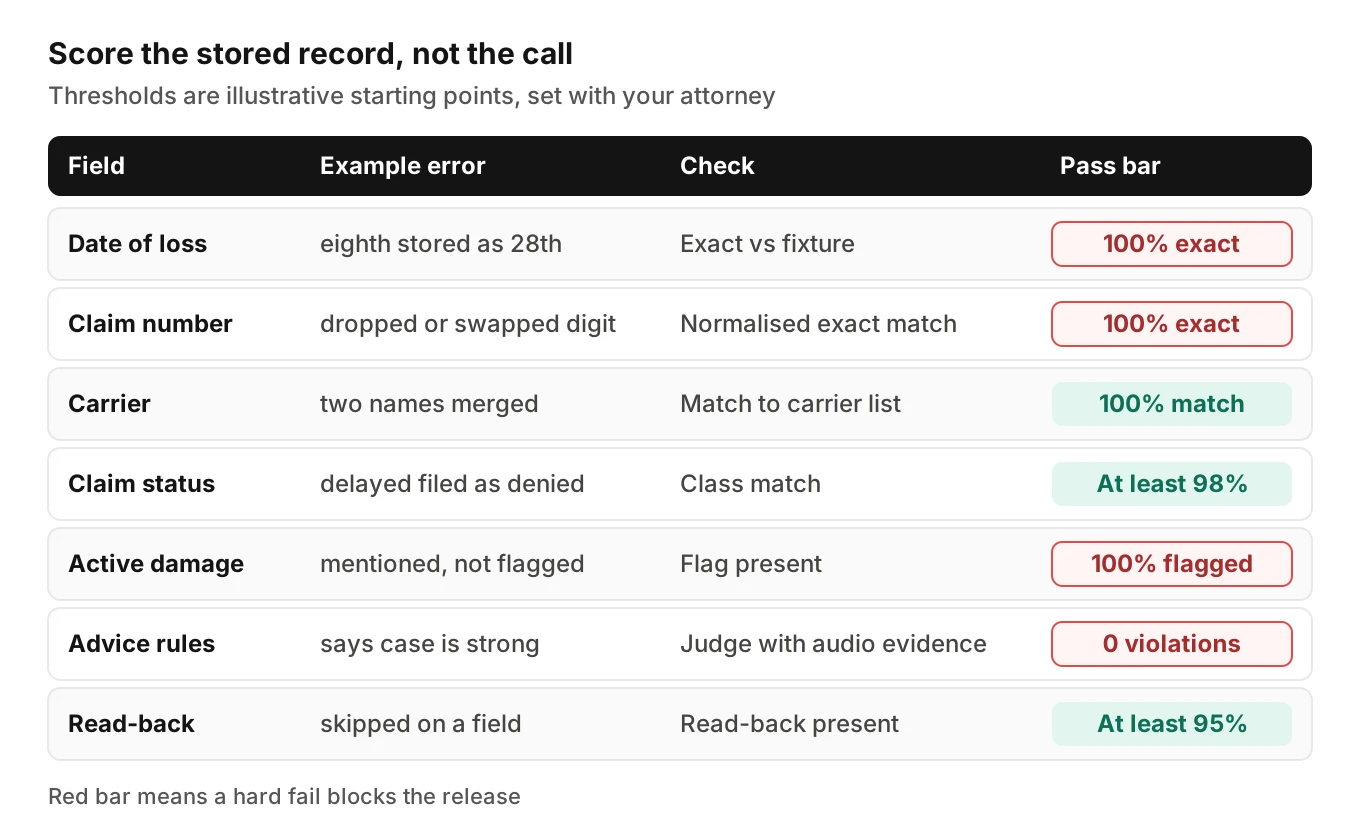
Here is a simplified check. It uses a fixture and flags a deadline-relevant date error.
from dataclasses import dataclass
from datetime import date

@dataclass
class Intake:
    carrier: str
    policy_type: str
    claim_number: str
    date_of_loss: date
    status: str          # denied | underpaid | delayed | open
    active_damage: bool

def check(stored: Intake, truth: Intake) -> list[str]:
    errs = []
    for f in ("carrier", "policy_type", "status", "active_damage"):
        if getattr(stored, f) != getattr(truth, f):
            errs.append(f"{f}: {getattr(stored, f)!r} != {getattr(truth, f)!r}")
    norm = lambda s: s.replace("-", "").replace(" ", "").upper()
    if norm(stored.claim_number) != norm(truth.claim_number):
        errs.append("claim_number mismatch")
    gap = (stored.date_of_loss - truth.date_of_loss).days
    if gap:
        errs.append(f"date_of_loss off by {gap} days")
    return errs

truth = Intake("Acme Mutual", "HO-3", "AB4419-07",
               date(2026, 9, 8), "denied", True)
stored = Intake("Acme Mutual", "HO-3", "AB4419-07",
                date(2026, 9, 28), "denied", True)
print(check(stored, truth))   # ['date_of_loss off by 20 days']
Treat any date or claim number mismatch as a hard fail. A near miss on a tone score is a different kind of problem.
How many calls is enough
Use the rule of three. If you see zero failures in n independent test calls, the 95% upper bound on the true failure rate is about 3 divided by n. With 59 calls it is about 5%. With 299 calls it is about 1%.
That only holds for scenarios you actually ran. A clean result on quiet, native-speaker calls says nothing about noisy kitchens. Count each condition separately.
How to test insurance claim lawyer intake AI
1. List the intake fields. Use your own case management form. Mark which fields are deadline-relevant or conflict-relevant.
2. Write fixtures. For each scenario, write the true record first: carrier, policy type, claim number, date of loss, status, damage state.
3. Script caller personas. Combine accent, pace, interruptions, response delay and noise. Add Spanish where the firm serves Spanish speakers.
4. Add the failure modes above. Include self-corrections, third-party callers and legal-advice bait.
5. Run the calls over the real path. Use the phone number, SIP trunk or WebRTC endpoint callers use. Do not call the model directly.
6. Score stored fields against fixtures. Exact match for dates and claim numbers. Class match for status. Pass or fail for the advice rules.
7. Review the audio on failures. A transcript can look right while the audio shows a swallowed syllable.
8. Gate every change. Re-run the full set after each prompt, model or voice change. Block the release on any hard-fail field.
9. Monitor live calls. Sample real calls weekly and compare stored values with the recording.
Evalgent generates test scenarios from the agent's prompt and flows, and runs simulated callers with chosen accents, pace, interruptions and noise. It can reach the agent over PSTN, SIP or WebRTC. It judges from the audio rather than only the transcript, and you can define custom metrics, such as exact date match, to run on every call. Our go-live checklist covers the broader release gate.
Monitoring after launch
Pre-launch tests miss what real callers do. Customers can push call recordings to Evalgent, which transcribes them, maps them to scenarios and judges them. It flags PII leakage, tool-call failures, latency spikes and policy failures, with fix recommendations. For a law firm agent, add a custom check that compares the stored date of loss with the date spoken in the audio.
Review the flagged calls with an attorney or intake lead. Verdicts need human review before they change your prompt. For carrier-side metrics on similar calls, see insurance claims voice agent metrics.
Frequently asked questions
Can AI answer calls for a property insurance claim law firm?
Yes, for intake. The agent can greet callers, check for emergencies, and capture carrier, policy type, claim number, date of loss and status. It should not give coverage opinions, predict outcomes or state deadlines. A human attorney decides whether to take the case and what the deadlines are.
What questions should an insurance claim lawyer intake AI ask?
It should ask who the carrier is, what type of policy it is, the claim number, the date and cause of loss, and what the carrier did. It should also ask whether damage is ongoing, whether a public adjuster or lawyer is involved, and the best callback number. Each answer needs read-back.
How does an AI intake agent catch claim deadlines?
It does not calculate legal deadlines. It captures the date of loss, the date of the carrier's last letter and the claim status, then flags urgency to a human. The attorney applies the statute and policy terms. The test target is accurate inputs, not legal conclusions.
Should AI tell a caller whether their denied claim is worth a lawyer?
No. A claim assessment is legal advice and depends on the policy, facts and state law. The agent can say the firm will review the information and follow up. Test that it declines politely when asked "do I have a case?" and does not hint at the answer.
What should AI do when a caller has an active water leak or storm damage?
It should ask about safety first, direct to 911 if anyone is in danger, and record that damage is ongoing. Then it should route the call to a human right away, using wording the firm approved. It should not improvise repair or policy-duty advice.
How do you test an AI intake agent for claim numbers and policy details?
Write the true record first, then place simulated calls where the caller reads values aloud with accents, noise and interruptions. Compare each stored field with the fixture. Require exact matches on claim numbers and dates. Review the audio on every miss to find where the error began.
Is a call to a law firm intake AI confidential?
Treat it as confidential. Under ABA Model Rule 1.18, information from a prospective client is generally protected, though state rules vary. Check where recordings and transcripts are stored, who can access them and how long they are kept. Ask your own ethics counsel about the specifics.
How do I tell if an insurance claim lawyer intake AI is making mistakes?
Compare stored records with the recordings, not just the transcripts. Sample live calls each week and check dates, claim numbers and status labels by ear. Track hard-fail fields separately from tone. A rising rate of corrected fields at human review is an early warning.
The bottom line
Insurance claim lawyer intake AI succeeds when the stored record matches what the caller said, down to one digit in a date or claim number. Test the audio, score fields against fixtures, and keep every legal conclusion with the attorney.
Related Articles
How to automate voice agent testing: synthetic callers vs manual QA
Learn how ai test automation replaces manual QA for voice agents. Compare synthetic callers vs human testers, with a 5-step framework to scale without hiring.
Read more
AI Agent Testing vs Voice Agent Testing: What General Tools Miss for Voice
AI agent testing measures text outputs. Voice agent testing measures behaviour through an acoustic pipeline. Five failure categories general tools miss.
Read more