The voice AI deployment gap: why demos win and production breaks
On this page
The demo went flawlessly. The pilot metrics looked great, and the launch was approved. Then real callers arrived and the numbers fell off a cliff. This pattern is so consistent it has a name: the deployment gap. It is not bad luck, and it is not a model problem. It is a measurement problem. The pilot measured a world that production does not deliver. This guide explains what causes the gap and how to close it before it costs you.
Evalgent exists to close this gap, so we will be specific about where it comes from. First, the anatomy.
What the deployment gap is
Voice AI deployment gap: the drop in performance between a voice agent's controlled pilot or demo and its behaviour with real callers in production.
A demo is designed to show capability. Production is designed by no one; it is whatever real callers bring. The demo to production gap is the space between those two worlds. An agent tuned to pass a demo has been optimised for exactly the conditions production removes.
This is not unique to voice, but voice makes it worse. A text agent's demo and production inputs look similar. A voice agent's do not: the demo has a clean mic and a patient tester, while production has a moving car, an accent, and a caller who interrupts. The gap is built into the medium.
Why do voice agents work in demos but fail in production?
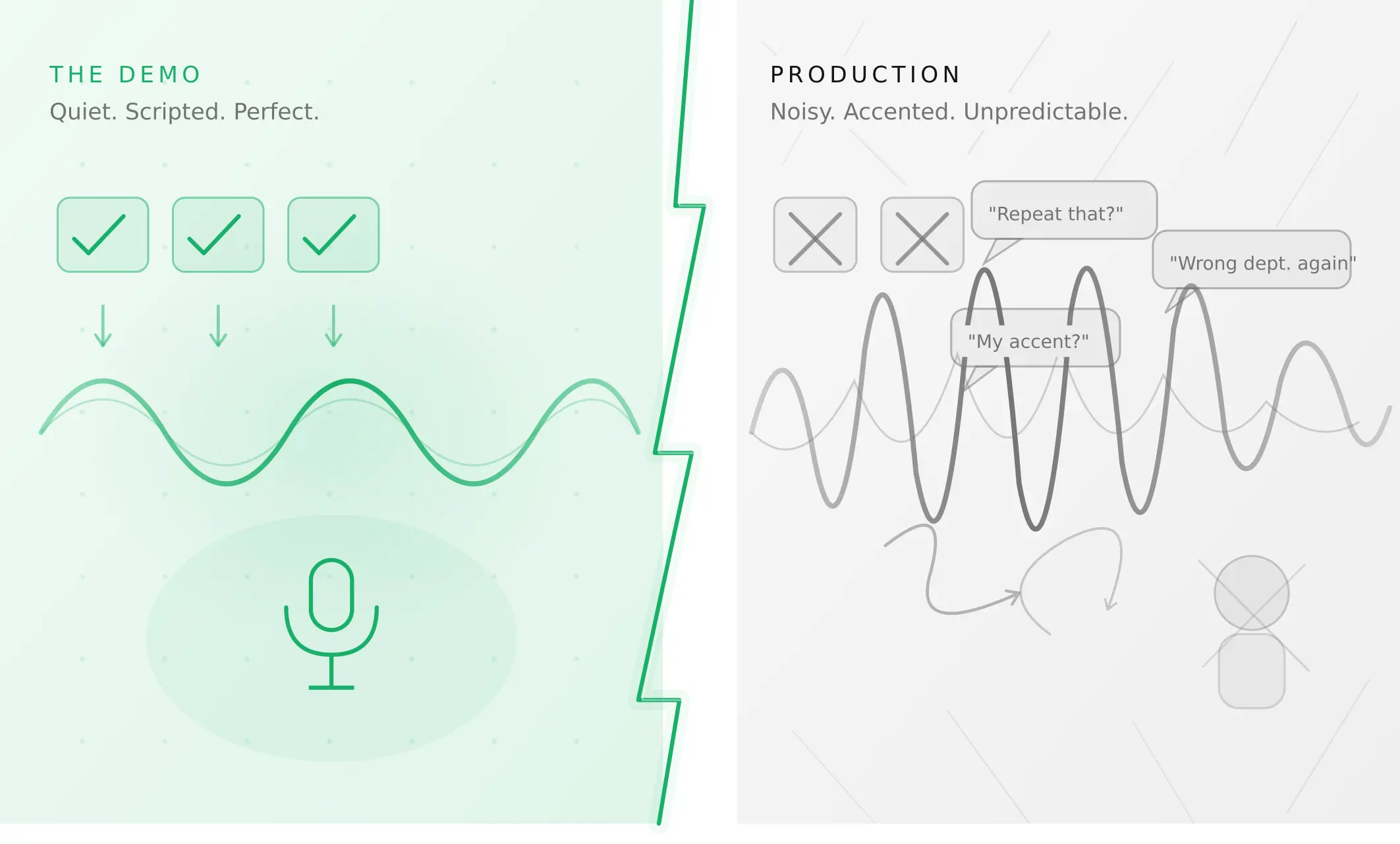
Demos control every variable that production releases. That control is exactly what hides the failures.
- Clean audio: demos use good mics and quiet rooms; production has noise and bad lines.
- Familiar speech: demos use native, standard accents; callers span many accents and dialects.
- Scripted flow: demos follow a happy path; callers interrupt, backtrack, and go off-script.
- Low volume: a demo is one call; production is thousands, so rare failures become daily ones.
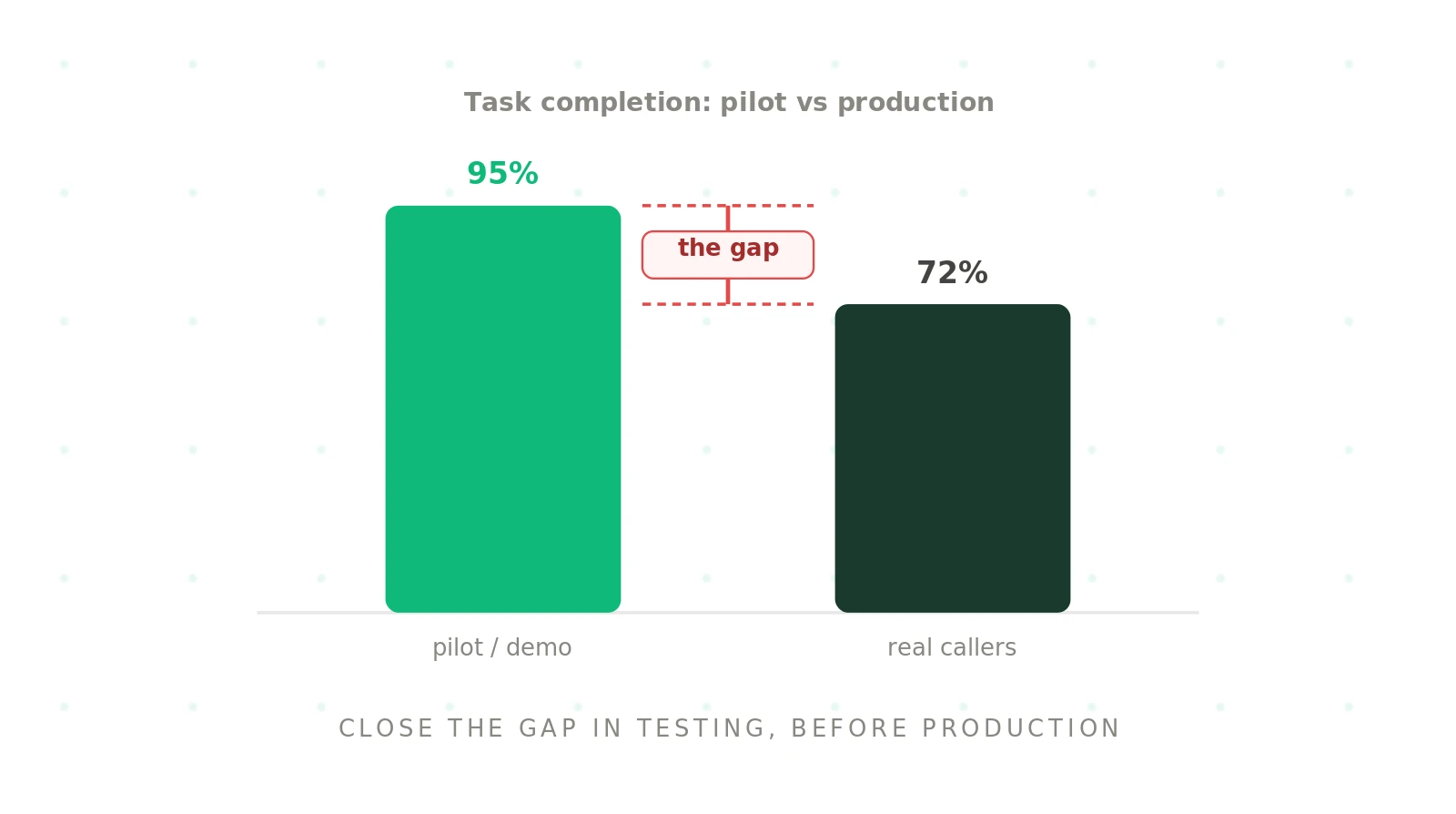
Each factor alone lowers performance. Together they compound. An agent at 95% in a pilot can drop to 70% or lower once these conditions stack, as our guide to why voice agents fail in production details. The pilot did not lie. It just measured the wrong conditions entirely.
Why do voice AI deployments fail after the pilot?
A pilot is a proof of concept. It answers "can this work," not "will this work at scale." Teams treat a passing pilot as a green light and deploy, then hit the gap.
The failure is usually one of three things. First, the pilot used a narrow, friendly slice of traffic, so it never saw the hard calls. Second, it ran at low volume, so edge cases never appeared. Third, it measured aggregate success and missed the cohorts that were already failing. Voice AI pilot to production transitions break when the pilot's conditions do not match the production conditions that follow.
How big is the demo to production drop?
The exact number varies, but the direction is consistent and the size is large. Agents commonly fall from the mid-to-high 90s in controlled testing to the 70s or lower under real conditions. A 20-point drop in task completion is not unusual when accents, noise, and interruptions all arrive at once.
What matters is not the headline number but where the drop concentrates. It is rarely uniform. One accent group, one noisy channel, or one edge case carries most of the failures, while the average looks tolerable. This is why aggregate pilot metrics are dangerous. They hide the cohorts that will generate your support tickets. A 90% average can hold a group failing at 40%. That group is small in the pilot and large in production. Report per cohort, or the drop stays invisible until callers find it.
What is production readiness for voice agents?
Production readiness: the state where a voice agent has been tested under the conditions it will actually face, with measured pass thresholds, before it serves real callers.
Readiness is not a feeling of confidence from a good demo. It is evidence. A production-ready agent has been run against realistic accents, noise, interruptions, and edge cases, with metrics per cohort and defined pass thresholds. The discipline mirrors operational readiness in software, described in Google's SRE guidance: you do not ship because it worked once, you ship because it passed a gate.
Anthropic's note on building effective agents makes a related point: reliability comes from disciplined process, not from an impressive demo.
How to close the gap
Closing that gap means bringing production conditions into testing, before production. If the pilot had faced what production faces, there would be no gap.
- Test on real conditions: accents, noise, interruptions, and your actual telephony.
- Test at the edges: hostile callers, silence, off-script requests, rare inputs.
- Measure per cohort: never ship on an average that hides a failing group.
- Gate the release: define pass thresholds and block launch until they are met.
- Watch after launch: pair pre-release testing with production monitoring.
The lever is testing that reproduces production. Our stress-testing guide covers how to push an agent to its breaking points before callers do. Close the gap in testing, and the production drop shrinks to something you predicted rather than something that surprised you. The goal is not zero surprises. The goal is no surprises you could have measured in advance. Everything on that list is measurable before a single real caller connects.
The deployment gap by another name
Call it what you like. The voice agent deployment gap is the same failure by another name. An agent tuned for a demo meets real callers. It drops.
The reasons compound. A prompt regression that never showed at low volume appears at scale. An escalation path that was never tested fails on a hostile caller. Containment looks fine in the pilot. Then noisy calls flood in and it collapses. None of these is exotic. Each is a condition the pilot skipped.
So why voice agents fail after the pilot is really a question about coverage. The pilot covered the easy calls. Production brought the rest. The gap is just the untested part of your traffic, revealed all at once.
Strong teams change how they decide. They do not deploy voice agents on a good demo. They deploy on evidence. That bar has a name: production readiness voice agents earn by passing a gate against real conditions, measured per cohort. Regression, escalation, and containment are all checked before launch, not discovered after it.
The mindset shift is small but decisive. A demo asks can it work. Production asks does it work for everyone, at volume, on a bad day. Those are different questions. Only the second predicts your support queue.
None of this slows you down for long. The first honest test is uncomfortable, because it surfaces failures the demo hid. But finding them in a test is cheap. Finding them in production is expensive, paid in churned callers and lost trust. Teams that close the gap early ship carefully once and confidently after.
Testing across the gap with Evalgent
Evalgent is built to close the deployment gap before launch. It runs the conditions production will bring, against your agent, while you can still fix what breaks. Scenarios reproduce noisy, accented, interrupted, and off-script calls. Profiles vary caller personas so results split per cohort, exposing the group that would have failed in production. Metrics score task completion, latency, and adherence with pass thresholds. Evaluations run this as automated batches of synthetic callers, and Reviews let your team hear the calls that would have generated tickets.
The result is a pilot that actually predicts production, because it tested production's conditions. You measure the gap in advance and close it, instead of discovering it from churn. For the full discipline, see the ai voice agent testing pillar, and for the production side, voice agent observability.
Frequently asked questions
What is the voice AI deployment gap?
The deployment gap is the drop in performance between a voice agent's controlled demo or pilot and its behaviour with real callers in production. Demos use clean audio, familiar accents, and scripted flows, while production brings noise, diverse accents, interruptions, and edge cases at scale. The gap is a measurement problem: the pilot tested the wrong conditions.
Why do voice AI deployments fail after the pilot?
Voice AI deployments fail after the pilot because a pilot proves the agent can work, not that it will work at scale. Pilots often use a friendly slice of traffic, run at low volume so edge cases never appear, and report aggregate metrics that hide failing cohorts. When production brings the full range of callers and volume, the untested conditions surface as failures.
Why do voice agents work in demos but fail in production?
Voice agents work in demos because demos control every variable that production releases: clean audio, standard accents, scripted flows, and a single call. Production removes all of that. Real callers bring noise, many accents, interruptions, and thousands of calls, so rare failures become daily ones. The agent was optimised for the exact conditions production takes away.
How do you close the voice AI deployment gap?
Close the gap by bringing production conditions into testing before launch. Test on real accents, noise, interruptions, and your actual telephony, push the edges with hostile and off-script calls, measure per cohort, and gate the release on pass thresholds. Then pair pre-release testing with production monitoring, so the drop is something you predicted rather than discovered.
What is production readiness for voice agents?
Production readiness for voice agents is the state where the agent has been tested under the conditions it will actually face, with metrics per cohort and defined pass thresholds, before serving real callers. It is evidence, not confidence from a good demo. A ready agent has passed a gate against realistic accents, noise, interruptions, and edge cases, not just a scripted happy path.
How do you test a voice agent before deployment?
Test a voice agent before deployment by running realistic scenarios that reproduce production conditions: varied accents, background noise, interruptions, and off-script requests, through your real telephony. Measure task completion and latency per cohort, and gate the release on thresholds. Synthetic callers make this repeatable at volume, so edge cases appear in testing rather than in your first week of production.
How big is the demo to production drop?
The demo to production drop varies but is consistently large. Agents commonly fall from the mid-to-high 90s in controlled testing to the 70s or lower under real conditions, a 20-point swing in task completion when accents, noise, and interruptions arrive together. The drop is rarely uniform; it concentrates in specific cohorts that aggregate pilot metrics tend to hide.
What causes voice agent pilots to fail?
Voice agent pilots fail to predict production when they test a narrow, friendly slice of traffic, run at low volume so edge cases never surface, and report aggregate success that masks failing cohorts. A pilot answers whether the agent can work, not whether it will at scale. Matching the pilot's conditions to real production traffic is what makes it a reliable signal.
Conclusion
The voice AI deployment gap is not inevitable; it is unmeasured. Agents fail in production because the pilot tested clean conditions and production brings messy ones, and the difference was never measured before launch.
Close the gap by testing what production will actually deliver: real accents, noise, interruptions, and edge cases, per cohort, behind a release gate. The pilot that predicts production is the one that tested production's conditions.
Related Articles
Why AI voice agents fail in production: 9 failure layers, how to detect each, and how to prevent them
Voice agents fail in production across 9 layers, from 8 kHz audio to silent tool errors. Symptoms, root causes, alerts, and fixes in one master table.
Read more
Voice agent regression testing: how to detect regressions from model updates you don't control
Voice agent regression testing for changes you don't control: pin each layer, run a nightly pinned-vs-latest canary, and use paired stats to detect drops.
Read more