Open door for builders.
How to Evaluate an Order Status Voice Agent Vendor
# How to Evaluate an Order Status Voice Agent Vendor
Quick answer
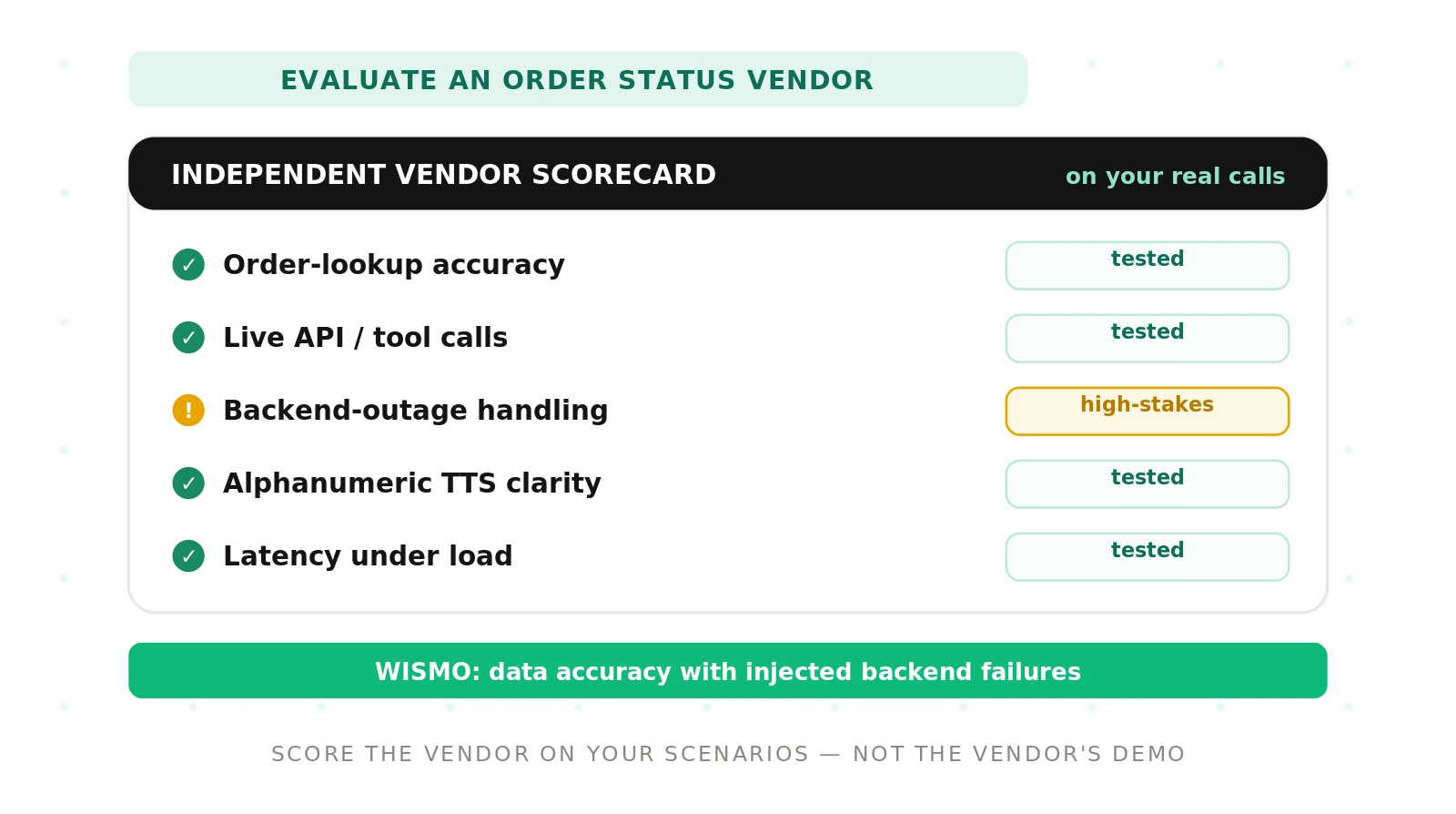
> Quick answer: To evaluate an order status voice agent vendor, test data accuracy and integration reliability on your own systems, not the demo. Score order lookup, live API correctness, outage behavior, alphanumeric TTS clarity, edge handling, and latency under load. The vendor that admits an outage beats the one that hallucinates a tracking number.
Order status is the most common reason people call support. The industry calls it WISMO: "where is my order." It looks simple, so teams evaluate it on a smooth demo and move on.
That is the mistake. WISMO is a narrow, high-volume, tool-call-heavy use case. The words the agent says barely matter. What matters is whether the number it reads is real, current, and pulled from the right order.
This guide shows how to evaluate an order status voice agent vendor on the things that actually break: bad lookups, stale data, silent tool failures, and backend outages. It builds on our voice agent vendor scorecard and applies it to one high-traffic call type.
Why order status is a data problem, not a conversation problem
Most voice agent evaluations grade conversation. They score tone, turn-taking, and how natural the agent sounds. For WISMO, that is the wrong lens.
An order status call is a database read wrapped in speech. The caller gives an identifier. The agent looks up an order. It reads back a status. The whole exchange lives or dies on data.
The agent has to hit an order management system and often a carrier's API too. Each call is a live integration. A demo runs against clean, cached data. Your production traffic does not.
So a fluent agent that reads the wrong ship date fails the call. A stiff agent that reads the right date passes it. Fluency is table stakes. Accuracy is the job.
WISMO ("where is my order"): the support call where a customer asks about the status of a placed order — its location, ship date, tracking number, or delivery estimate. It is high-volume, repetitive, and dependent on real-time backend data.
What order status / WISMO calls actually demand
Before you score any vendor, list the behaviors a real WISMO call requires. These are your test targets. Each one is a place the agent can fail silently.
- Lookup by multiple keys. Callers rarely have the order number handy. The agent must find the order by phone, email, or order number, and confirm it is the right one.
- Accurate real-time status. The status must come from the live OMS or carrier feed. No stale cache. No guessed delivery date.
- Edge cases. Not-found orders, multiple orders on one account, and partial shipments are common. Each needs a distinct, correct path.
- Clear alphanumeric readout. Tracking numbers and dates are strings of letters and digits. The agent must speak them so a human can write them down.
- Honest failure. When the backend is slow or down, the agent should admit it, not invent a status.
- Correct escalation. Lost packages, disputes, and damaged goods are exceptions. They need a clean handoff, not a scripted dead end.
If a vendor cannot show these on your data, the demo told you nothing. This maps to the same discipline in our customer support metrics guide, narrowed to one intent.
The six dimensions that decide an order status vendor
Score every vendor on the same six dimensions, on your integrations, with your edge cases injected. The table below is the core of an order status voice agent evaluation. Set the pass bar before you test, so no vendor gets graded on a curve.
| Dimension | What to test | Pass bar | Red flag |
|---|---|---|---|
| Order-lookup accuracy | Find the right order by phone, email, and order number, including near-duplicate accounts | Correct order retrieved and confirmed on every valid key | Returns the wrong order, or cannot look up by phone or email |
| Live API / tool-call correctness | Real OMS and carrier calls with correct arguments, not cached or mocked data | Status matches the source system on every call | Reads a stale or guessed status; wrong tool arguments |
| Backend-outage graceful degradation | Force the OMS or carrier API to time out, error, or return partial data | Admits the outage and offers a fallback or callback | Hallucinates a status or tracking number during the outage |
| Alphanumeric TTS clarity | Read tracking numbers, order IDs, and dates aloud | A listener transcribes them correctly on first hearing | Slurs digits, drops characters, or reads dates ambiguously |
| Not-found and edge handling | Missing order, multiple orders, partial or split shipments | Each case gets a distinct, correct, non-confusing path | Treats a missing order as found; merges two orders |
| Latency under load | Response time at peak concurrency, with the backend under strain | Time to first audio holds at your p95 target under load | Latency spikes or calls drop as concurrency rises |
Weight these to your business. A retailer with a flaky carrier feed weights outage behavior highest. A high-volume seller weights latency and lookup accuracy. The dimensions stay fixed so comparison stays fair, an idea we expand in the metrics scorecard.
How to run an order status voice agent vendor evaluation
Run this process identically for every vendor. The goal is one dataset, one rubric, and results that come from the agent rather than the test.
1. Map your real WISMO traffic. Pull a month of order status calls. Note the mix of lookup keys, edge cases, and exception types. This mix becomes your test set.
2. Wire the vendor to your real integrations. Connect the agent to your OMS and carrier APIs in a sandbox. Evaluate against live data, not the vendor's demo backend.
3. Build a fixed scenario set. Include valid orders, not-found orders, multi-order accounts, and partial shipments. Add accents, noise, and callers who lack their order number.
4. Inject backend failures. Force API timeouts, error codes, and partial responses on purpose. Watch whether the agent admits the outage or fabricates a status.
5. Check every tool call, not the transcript alone. Compare each lookup's arguments and result against the source system. This catches silent tool failures the words hide.
6. Grade alphanumeric readback. Have a listener transcribe spoken tracking numbers and dates. Count characters wrong, not vibes.
7. Load-test at peak. Run concurrent calls at your busiest expected volume. Measure latency and drop rate while the backend is under strain.
8. Score and record. Fill the six-dimension table for each vendor. Keep the raw calls so procurement can audit the decision later.
Reading tracking numbers and dates out loud
Alphanumeric readout is where order status agents quietly fail. A tracking number is a long, meaningless string. If the caller cannot capture it, the call did not resolve.
Test the text-to-speech on real strings. Listen for grouped digits, clear letter names, and a pace a person can follow. "1Z" should not blur into "one zee" at speed.
Dates are their own trap. "10/11" is ambiguous when spoken fast. A good agent says "October eleventh," then offers to text the details. Check that the fallback channel actually fires.
Score this with a simple transcription test. Play the readout once. Ask a listener to write it down. Count the errors. That number is honest in a way a satisfaction survey is not.
When the backend goes down: hallucination or honesty
The hardest test is the outage. OMS and carrier APIs fail, time out, and return partial data. Your evaluation must force these conditions, because production will.
There are two ways an agent can respond. It can admit the problem: "I can't reach our tracking system right now." Or it can invent an answer: a confident, wrong, fully hallucinated tracking number.
The second failure is dangerous because it sounds perfect. The caller writes down a fake number and leaves happy. They call back angry a day later, and your resolution rate was a lie the whole time.
A silent tool failure is worse than a loud one. The agent's tool call errored, but the agent kept talking as if it succeeded. You only catch this by inspecting the tool call itself, not the transcript.
So inject failures and watch two things. Does the agent detect that the tool failed? And does it degrade gracefully, with an honest message and a real fallback, rather than filling the gap with fiction? A vendor that passes this is rare and worth a premium.
Latency, load, and the peak-hour reality
WISMO volume is spiky. A shipping delay, a sale, or a weather event floods the line. The agent that felt snappy in a one-call demo can crawl under real concurrency.
Test latency while the backend is under strain, not idle. Every WISMO call adds an API round trip. When the OMS slows down, the agent's whole turn slows with it, and callers hear dead air.
Measure time to first audio and turn latency at your p95, under peak concurrency. Human tolerance for delay on a phone line is low and well studied. Set the bar against your traffic, then hold every vendor to it.
How Evalgent evaluates order status vendors
Evalgent is an independent, third-party evaluator. We do not sell a voice agent. We grade the ones you are considering, on your systems, so the score is neutral.
For WISMO, that means we connect to your OMS and carrier integrations and run your real scenario mix. Then we inject the failures vendors never show in a demo: API timeouts, error codes, partial shipments, and not-found orders.
We check every tool call against the source system, so a hallucinated status or a silent failure cannot hide behind a smooth transcript. We grade alphanumeric readback by transcription, and we load-test at your peak. This is the independent evaluation layer that a vendor cannot run on itself.
The output is a defensible scorecard. It ties to a recognized risk frame like the NIST AI Risk Management Framework, and it gives procurement the evidence a real request for proposal needs. The scorecard also feeds your service-level agreement targets and your total cost of ownership math, and it ties agent behavior to real customer satisfaction. Book a demo to see the WISMO evaluation on your own integrations.
Frequently asked questions
How do you evaluate an order status voice agent vendor?
Test the vendor on your own OMS and carrier integrations, not its demo. Score six dimensions: order-lookup accuracy, live API correctness, outage behavior, alphanumeric TTS clarity, edge handling, and latency under load. Inject real failures like timeouts and not-found orders. Grade every tool call against the source system, not the transcript.
What is a WISMO voice AI vendor?
WISMO means "where is my order." A WISMO voice AI vendor sells a voice agent built to answer order status calls: looking up orders, reading tracking numbers, and giving delivery estimates. It is a narrow, high-volume, tool-call-heavy use case, so evaluation should center on data accuracy and integration reliability rather than conversational polish.
How do you test order lookup accuracy in a voice agent?
Give the agent valid orders and confirm it retrieves the correct one by phone, email, and order number. Include near-duplicate accounts and multiple orders per customer. The pass bar is the right order retrieved and confirmed on every valid key. A wrong order returned, or a key it cannot search, is a red flag.
Does the voice agent hallucinate when the order API is down?
Force the order management or carrier API to time out or error during your test. A good agent admits it cannot reach the system and offers a fallback or callback. A dangerous agent invents a confident but fake status or tracking number. Only forced-outage testing reveals which one you are buying.
How should a voice agent read a tracking number out loud?
The agent should group digits, name letters clearly, and pace the readout so a human can write it down. Run a transcription test: play the readout once and have a listener transcribe it. Count character errors. A strong agent also offers to text the tracking number as a fallback channel.
How do you handle a not-found order in a voice agent?
A not-found order needs its own path: the agent confirms the identifier, explains no match was found, and offers to try another key or escalate. The failure to catch is an agent that treats a missing order as found and reads a stale or invented status. Test missing orders explicitly in every evaluation.
What happens when the order status API times out?
The agent's tool call fails, and the risk is a silent tool failure where it keeps talking as if the call succeeded. Detect this by inspecting the tool call, not the transcript. A graceful agent notices the timeout, tells the caller honestly, and routes to a fallback. See our tool calling guide for the mechanics.
How do you test a voice agent under call load?
Run concurrent calls at your busiest expected volume while the backend is under strain. Measure time to first audio and turn latency at your p95, plus the call drop rate. A vendor that feels fast in a single-call demo can slow sharply under real concurrency, because every WISMO call adds a live API round trip.
The bottom line
Order status is a data-accuracy problem, so evaluate the vendor on lookups, live API calls, outages, and alphanumeric readback, not on how natural it sounds. The agent that admits an outage beats the one that hallucinates a tracking number, and only forced-failure testing on your own systems tells you which you are buying.
Related Articles
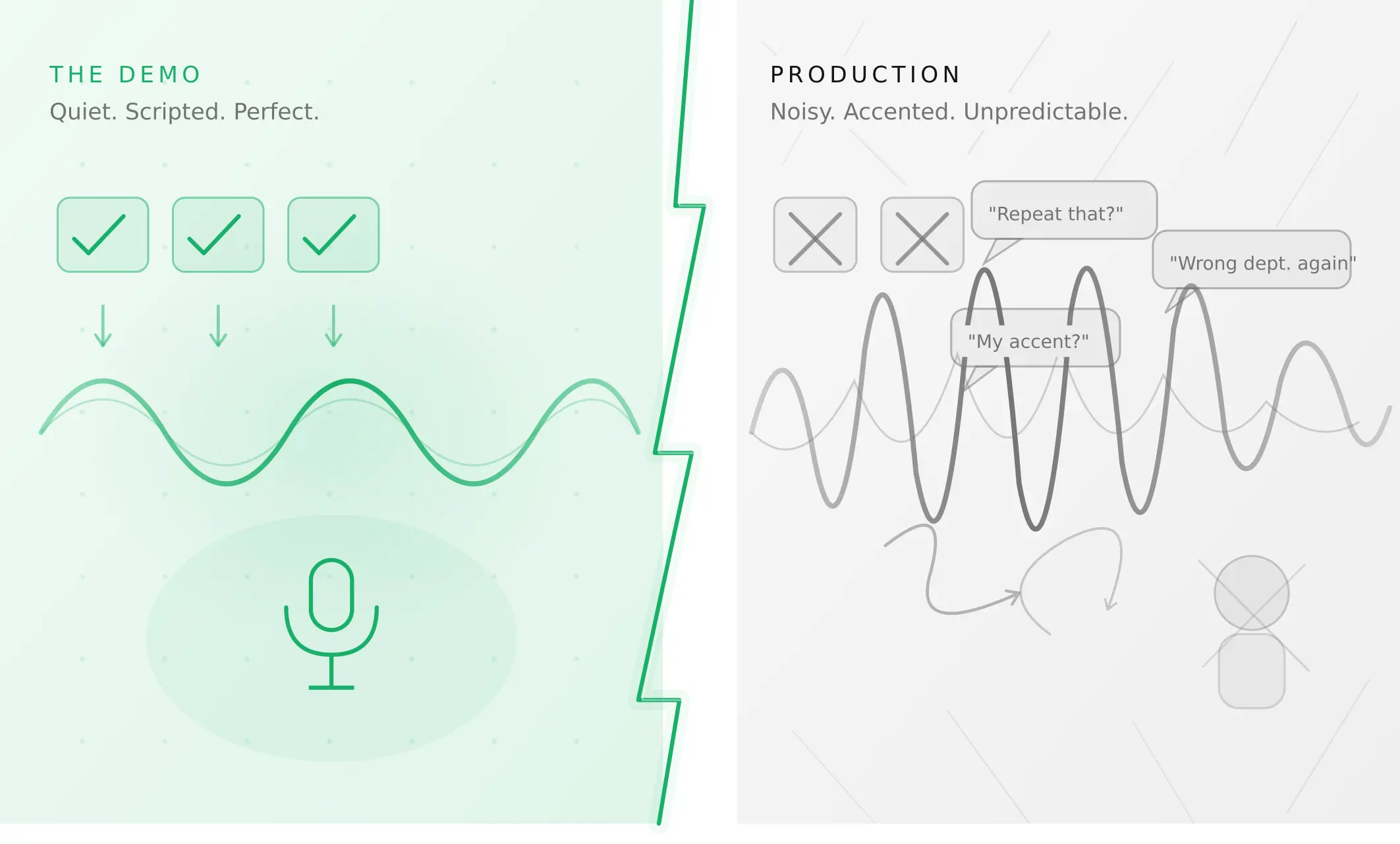
Why AI voice agents fail in production (and how to prevent it)
AI voice agents that ace demos still break in production. Learn the 5 root causes, how to test for each, and what production readiness actually means.
Read more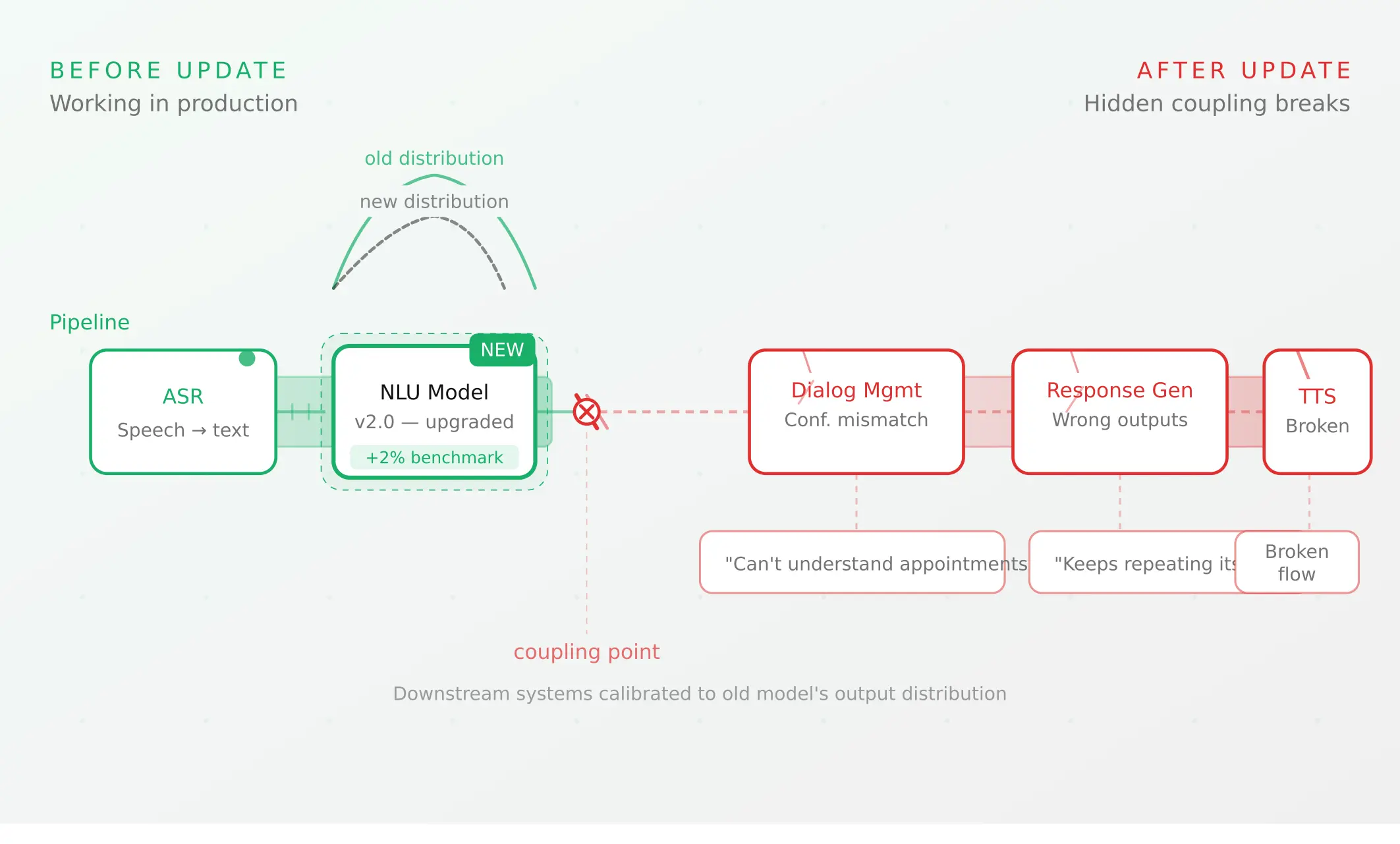
Voice agent regression testing: why LLM updates break production
LLM updates improve benchmarks but break voice agents in 5 predictable ways. How to detect and prevent regressions after every model or prompt change.
Read more